

Schneider Electric’s latest Hannover Messe 2026 message is bigger than a product demo, and that is exactly why it matters. The company is not simply adding AI to industrial software; it is trying to redefine how factories are designed, validated, commissioned, and changed by pairing EcoStruxure Automation Expert with Microsoft Azure AI. The pitch is that agentic manufacturing can compress engineering cycles, reduce documentation overhead, and make production changes far faster without sacrificing control or compliance. That is an ambitious claim, but it lands in a moment when manufacturers are under pressure to modernize without disrupting uptime, labor stability, or quality.
Schneider Electric and Microsoft are using Hannover Messe 2026 to show that industrial AI has moved beyond dashboards and pilots into something closer to an operating model. Schneider says its industrial copilot, powered by Azure AI, can cut engineering time by up to 50%, while changes that once took weeks can now be completed in hours nover Messe framing reinforces that this is part of a broader industrial intelligence push, not an isolated showcase.
The significance is not just the promised productivity gain. It is the architectural shift behind it. Schneider Electric positions EcoStruxure Automation Expert as an open, software-defined automation backbone that can run across on-premisenvironments, while Microsoft supplies the cloud and AI orchestration layer that helps reason over industrial context. In other words, the companies are trying to make industrial change feel more like software deployment and less like a series of custom integration projects.
This matters because manufacturing has long been trapped between the need for stability and the need for change. Plants do not want to retool every time a product mix changes, but they also cannot keep running rigid control stacks forever. The collaboration aims to reduce that teg reusable logic, validating automation earlier, and preserving traceability through the lifecycle. That is where the real value lies: not in flashy AI output, but in fewer handoffs and less rework.
There is also a competitive dimension. Microsoft is clearly trying to establish itself as the intelligence layer for industry, while Schneider Electric wants to be the execution layer that makes that intelligence operational. The partnership gives each company something it needs. Microsoft gains a credible industrial runtime story, and Schneider gains the scale and AI depth of Azure. Together, they are building a case for trusted industrial AI that can survive the realities of regulated production environments.
Microsoft’s industrial ambitions have evolved in parallel. Over several Hannover Messe cycles, the company has steadily moved from generic cloud messaging toward industrial copilots, digital twins, and workflow orchestration. The company is now framing the market around a unified intelligence layer that can understand people, production data, and institutional knowledge. That is a big shift from “AI as a helper” to “AI as part of the industrial stack.”
The timing also reflects a broader set of pressures facing manufacturers. Product variability is rising, supply chains remain unstable, and many plants are dealing with aging infrastructure that was not designed for rapid change. At the same time, executives are being asked to modernize safely, maintain compliance, and improve sustainability. That combination creates a strong incentive for architectures that can reduce the cost of change without forcing a disruptive rip-and-replace strategy.
Historically, manufacturing software evolved in layers: hard-wired control, PLCs, SCADA, MES, ERP, and then a patchwork of point solutions. The problem is not lack of data. It is coordination. Engineering teams, operations teams, compliance teams, and systems integrators often work indifferent assumptions, which slows down change and increases the risk of mistakes. Schneider and Microsoft are now pitching a single traceable workflow that links design intent to execution and back again.
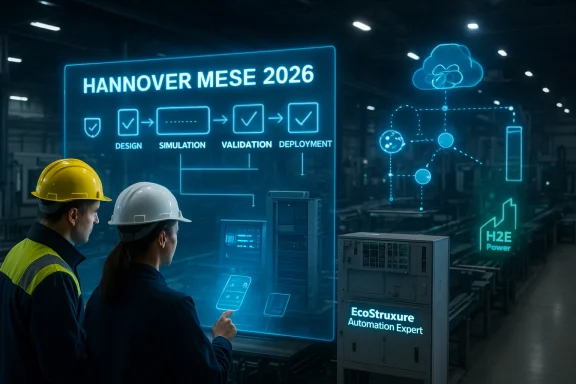
The deeper story is that Schneider is trying to turn automation engineering intoftware workflow. EcoStruxure Automation Expert allows logic to be authored once, simulated, validated, and deployed across environments without repeated retooling. If that works as advertised, then the company is not just accelerating one task. It is compressing an entire lifecycle of work that has traditionally been fragmented across teams and tools.
This is also why the company keeps emphasizing traceability. In regulated or safety-critical industries, speed alone is not enough. Every change has to be explainable, auditable, and testable. Schneider’s framing suggests tmulation, and lifecycle traceability are the real product, while AI is the accelerator that makes those qualities easier to deliver at scale.
Key operational promises include:
At the same time, the exact number should be treated carefully. Vendor productivity claims often depend on process maturity, asset standardization, and how much of the workflow is already digitized. The point is not that every plant will cut its engineering work in half. The point is that the architecture appears capable of creating material leverage where traditional automation has been too rigid to do so.
That is a strategically important role. In industrial settings, AI cannot just be smart; it has to be trustworthy, auditable, and connected to the realities of plant operations. Microsoft is trying to position Azure as more than a model endpoint. It wants to be the infrastructure that can connect maintenance records, production data, documentation, and operator workflows into a governed system. That is a more durable market position than one-off AI features.
Microsoft also benefits from having Schneider as a proof point. Hyperscalers are often accused of speaking in abstractions when they talk about manufacturing. By pairing with Schneider Electric, Microsoft can point to a concrete execution layer, not just a cloud narrative. That makes the company’s industrial story feel more grounded and more relevant to plant-floor decision makers.
This helps explain why the architecture is hybrid rather than cloud-only. Factories need local responsiveness, but they also need the scale and analytical power of the cloud. The hybrid model preserves deterministic behavior at the edge while still letting AI reason over broader patterns. That balance is one of the most important design choices in the entire collaboration.
The bigger implication is that competition in industrial software is no longer just about dashboards, storage, or analytics. It is about who controls the workflow between engineering, operations, and AI. Whoever owns that workflow can influence how factories adapt over time. That is where long-term platform value accumulates.
Manufacturing environments demand deterministic behavior, compliance, and auditability. No serious plant manager wants a system that improvises its way through production. The promise of agentic manufacturing is therefore not to replace engineers, but to automate the repetitive connective tissue that slows them down. That includes documentation, configuration, validation, and handoff work.
This distinction matters because industrial buyers have seen plenty of AI marketing that sounds impressive but has little operational value. Agentic manufacturing is more credible because it is framed around work that can be governed. The agents are meant to assist within a structured workflow, not break the workflow. That makes the concept useful in places where compliance and safety are non-negotiable.
The practical benefits are easy to see:
Still, agentic should not be mistaken for autonomous. In manufacturing, the strongest version of the concept is a governed system that helps people make better decisions faster. That is far more plausible — and far more valuable — than a plant that runs itself without oversight.
There is also a timing advantage. Manufacturers are under pressure from labor shortages, volatile demand, and the need to modernize aging infrastructure without interrupting production. A platform that can reduce engineering overhead and speed up change management is easier to justify than a speculative AI initiative. The combination of Schneider’s automation runtime and Microsoft’s AI stack gives buyers a more complete modernization path.
The announcement also reflects a broader industry shift away from hardware-centric thinking. If logic can be authored once and deployed across multiple environments, then plants can change faster without constantly rebuilding the stack. That is a powerful idea in a sector where the cost of change has historically been one of the biggest barriers to transformation.
That consumer effect is subtle, but it should not be dismissed. Industrial gains often show up downstream as more resilient supply chains and more stable product delivery. The average consumer may never hear the term agentic manufacturing, but they will benefit from the systems it helps create.
That makes the collaboration important not just as a product announcement, but as a sign of where industrial software is heading. The winner in this space will be the vendor that can make change safer, faster, and more repeatable at scale.
The importance of that example is that it moves the conversation from theory to performance. Industrial buyers care about uptime, yield, and cost per unit more than they care about buzzwords. If autonomous operations can survive in such a harsh environment, then the architecture deserves attention. The proof point does not validate every claim in the announcement, but it does give the collaboration a stronger foundation than many AI-related releases.
It also shows how industrial AI and sustainability are converging. Green hydrogen production is capital-intensive, operationally sensitive, and highly dependent on efficiency. A platform that can improve stability while reducing cost has value on both economic and environmental grounds. That is the kind of use case that makes enterprise adoption feel more credible.
The takeaway is not that the hydrogen plant proves every manufacturing use case. It does not. But it does show that the architecture can operate in a high-stakes environment where stability matters more than novelty. That raises confidence in the broader platform story.
Manufacturers increasingly want systems that can support efficiency and resiliency at the same time. In that sense, the hydrogen example is not just a side note. It is a preview of how industrial AI may be sold in the future: not as a novelty, but as a lever for both performance and sustainability.
For Schneider Electric, the opportunity is to deepen its role as the execution backbone for software-defined industrial operations. For Microsoft, the goal is to prove that Azure can do more than host factory data; it can help orchestrate industrial work. Together, they are offering a more complete story than many rivals can provide. That matters in a market where buyers increasingly want interoperability without surrendering control.
Competitors will now be under pressure to show similar depth. Automation vendors will need to demonstrate AI that fits real plant workflows. Cloud vendors will need to show they can work inside industrial guardrails. Industrial software companies will need to prove they can reduce friction, not just visualize it.
The risk for competitors is that they get stuck at the feature level while Schneider and Microsoft are selling a workflow. In industrial technology, workflows win because they reduce integration pain. That is where the real buying decision gets made.
This is also why the announcement matters for enterprise software more broadly. It suggests that the next battleground is not just model quality, but orchestration across the full industrial lifecycle. That is a tougher, slower, and more valuable market to win.
What to watch:
The real test will be whether the partnership can scale without losing the discipline that industrial customers demand. If it can preserve traceability, maintain safety, and still deliver faster engineering cycles, then the argument for agentic manufacturing will become much stronger. If it cannot, the concept risks becoming another attractive label for incremental automation. For now, though, the evidence suggests something more interesting: a serious attempt to make industrial AI operational, not ornamental.
The next 12 to 18 months will show whether this is the beginning of a new manufacturing operating model or simply the most polished version of a familiar promise. Either way, Schneider Electric and Microsoft have made one thing clear: the future of industrial AI will be judged not by how clever it sounds, but by how reliably it changes the way factories work.
Source: Process and Control Today Process and Control Today | Schneider Electric Unveils Next Generation Agentic Manufacturing Capabilities with Microsoft Azure AI at Hannover Messe 2026
 Overview
Schneider Electric and Microsoft are using Hannover Messe 2026 to show that industrial AI has moved beyond dashboards and pilots into something closer to an operating model. Schneider says its industrial copilot, powered by Azure AI, can cut engineering time by up to 50%, while changes that once took weeks can now be completed in hours nover Messe framing reinforces that this is part of a broader industrial intelligence push, not an isolated showcase.The significance is not just the promised productivity gain. It is the architectural shift behind it. Schneider Electric positions EcoStruxure Automation Expert as an open, software-defined automation backbone that can run across on-premisenvironments, while Microsoft supplies the cloud and AI orchestration layer that helps reason over industrial context. In other words, the companies are trying to make industrial change feel more like software deployment and less like a series of custom integration projects.
This matters because manufacturing has long been trapped between the need for stability and the need for change. Plants do not want to retool every time a product mix changes, but they also cannot keep running rigid control stacks forever. The collaboration aims to reduce that teg reusable logic, validating automation earlier, and preserving traceability through the lifecycle. That is where the real value lies: not in flashy AI output, but in fewer handoffs and less rework.
There is also a competitive dimension. Microsoft is clearly trying to establish itself as the intelligence layer for industry, while Schneider Electric wants to be the execution layer that makes that intelligence operational. The partnership gives each company something it needs. Microsoft gains a credible industrial runtime story, and Schneider gains the scale and AI depth of Azure. Together, they are building a case for trusted industrial AI that can survive the realities of regulated production environments.
Background
Schneider Electric has been pushing software-defined automation for years, and that history is essential to understanding this announcement. EcoStruxure Automation Expert was built around portability, reusable logic, and deployment flexibility, womation should be less dependent on fixed hardware and proprietary toolchains. That concept predates the current AI wave, which is why the 2026 messaging feels less like a sudden pivot and more like the natural extension of a long-running strategy.Microsoft’s industrial ambitions have evolved in parallel. Over several Hannover Messe cycles, the company has steadily moved from generic cloud messaging toward industrial copilots, digital twins, and workflow orchestration. The company is now framing the market around a unified intelligence layer that can understand people, production data, and institutional knowledge. That is a big shift from “AI as a helper” to “AI as part of the industrial stack.”
The timing also reflects a broader set of pressures facing manufacturers. Product variability is rising, supply chains remain unstable, and many plants are dealing with aging infrastructure that was not designed for rapid change. At the same time, executives are being asked to modernize safely, maintain compliance, and improve sustainability. That combination creates a strong incentive for architectures that can reduce the cost of change without forcing a disruptive rip-and-replace strategy.
Historically, manufacturing software evolved in layers: hard-wired control, PLCs, SCADA, MES, ERP, and then a patchwork of point solutions. The problem is not lack of data. It is coordination. Engineering teams, operations teams, compliance teams, and systems integrators often work indifferent assumptions, which slows down change and increases the risk of mistakes. Schneider and Microsoft are now pitching a single traceable workflow that links design intent to execution and back again.
Why Hannover Messe matters
Hannover Messe is where industrial technology vendors have to prove that their vision can survive contact with factory reality. It is not enough to claim innovation. Buyers at the show tend to care about reliability, safety, interoperability, and whether a system can be deployed incrementally without threatening uptime. That makes it a useful stage for a story like this, because it forces vendors to balance ambition with operational discipline.The move from copilots to orchestration
One of the more important shifts in the last two years has been the move from simple copilots to more procedural AI. A copilot helps a human work faster. An orchestrator coordinates multiple systems, agents, and checkpoints so the work itself moves with less friction. That distinction is crucial in manufacturing, where mistakes can create downtime, scrap, or safety risk. The Schneider-Microsoft pitch is that industrial AI has to become procedural, not just conversational.What Schneider Electric Is Actually Showing
The headline claim is straightforward: Schneider EleAI-powered industrial copilot is already producing up to 50% time savings on control configuration and documentation tasks, with some production changes moving from weeks to hours. That is the kind of claim that catches the attention of plant managers because it targets one of manufacturing’s least glamorous bottlenecks: repetitive engineering labor.The deeper story is that Schneider is trying to turn automation engineering intoftware workflow. EcoStruxure Automation Expert allows logic to be authored once, simulated, validated, and deployed across environments without repeated retooling. If that works as advertised, then the company is not just accelerating one task. It is compressing an entire lifecycle of work that has traditionally been fragmented across teams and tools.
This is also why the company keeps emphasizing traceability. In regulated or safety-critical industries, speed alone is not enough. Every change has to be explainable, auditable, and testable. Schneider’s framing suggests tmulation, and lifecycle traceability are the real product, while AI is the accelerator that makes those qualities easier to deliver at scale.
The industrial copilot as a workflow tool
The useful way to think about Schneider’s industrial copilot is not as a chat interface for engineers. It is more like a workflow layer that can prepare, validate, and package automation work so engineers spend less time on repetitive setup and more time on exceptions, architecture, and risk review. That is a much more credible industrial use case than a generic chatbot.Key operational promises include:
- Faster control configuration.
- Reduced documentation overhead.
- Earlier validation before deployment.
- Less rework during commissioning.
- Better continuity across sites and lines.
Why the numbers matter
The 50% claim is important even if it will vary by site. Manufacturing buyers do not need every deployment to produce the same result; they need a believable path to meaningful efficiency gains. In this case, the value is not just labor savings. It is faster response to product changes, less downtime during transitions, and a shorter path from engineering intent to production reality.At the same time, the exact number should be treated carefully. Vendor productivity claims often depend on process maturity, asset standardization, and how much of the workflow is already digitized. The point is not that every plant will cut its engineering work in half. The point is that the architecture appears capable of creating material leverage where traditional automation has been too rigid to do so.
What Microsoft Brings to the Table
Microsoft’s role is to provide the cloud and AI intelligence layer around Schneider’s industrial execution backbone. The company’s Hannover Messe 2026 theme, Industrial Intelligence Unlocked, is about making industrial AI feel governed, contextual, and operational rather than abstract ([microsofcrosoft.com/en-us/microsoft-cloud/blog/manufacturing/2026/04/16/industrial-intelligence-unlocked-microsoft-at-hannover-messe-2026/). In the Schneider story, Azure AI helps orchestrate, analyze, and optimize industrial processes across cloud and edge environments.That is a strategically important role. In industrial settings, AI cannot just be smart; it has to be trustworthy, auditable, and connected to the realities of plant operations. Microsoft is trying to position Azure as more than a model endpoint. It wants to be the infrastructure that can connect maintenance records, production data, documentation, and operator workflows into a governed system. That is a more durable market position than one-off AI features.
Microsoft also benefits from having Schneider as a proof point. Hyperscalers are often accused of speaking in abstractions when they talk about manufacturing. By pairing with Schneider Electric, Microsoft can point to a concrete execution layer, not just a cloud narrative. That makes the company’s industrial story feel more grounded and more relevant to plant-floor decision makers.
Azure AI as an orchestration layer
Azure AI’s value here is less about raw generative output and more about context. Industrial AI becomes much more useful when it understands constraints, dependencies, and historical plant behavior. That is why Microsoft’s ability to connect data sources and workflows matters so much. A factory-side AI system that understands its environment can reduce noise and improve confidence; one that does not can create risk and mistrust.This helps explain why the architecture is hybrid rather than cloud-only. Factories need local responsiveness, but they also need the scale and analytical power of the cloud. The hybrid model preserves deterministic behavior at the edge while still letting AI reason over broader patterns. That balance is one of the most important design choices in the entire collaboration.
A broader industrial platform strategy
Microsoft’s industrial strategy is increasingly about becoming the control plane for industrial intelligence. That is why its Hannover Messe messaging emphasizes orchestration, human-agent trust, and a unified intelligence layer. Schneider Electric fits neatly into that strategy because it gives Microsoft an industrial runtime story with real-world credibility.The bigger implication is that competition in industrial software is no longer just about dashboards, storage, or analytics. It is about who controls the workflow between engineering, operations, and AI. Whoever owns that workflow can influence how factories adapt over time. That is where long-term platform value accumulates.
Agentic Manufacturing Explained
The phrase agentic manufacturing is doing announcement, and it deserves a careful reading. In this context, it appears to mean a workflow where specialized AI agents handle routine design, validation, and orchestration tasks under human supervision, rather than a single chatbot responding to prompts. That is a much more realistic industrial model than full autonomy.Manufacturing environments demand deterministic behavior, compliance, and auditability. No serious plant manager wants a system that improvises its way through production. The promise of agentic manufacturing is therefore not to replace engineers, but to automate the repetitive connective tissue that slows them down. That includes documentation, configuration, validation, and handoff work.
This distinction matters because industrial buyers have seen plenty of AI marketing that sounds impressive but has little operational value. Agentic manufacturing is more credible because it is framed around work that can be governed. The agents are meant to assist within a structured workflow, not break the workflow. That makes the concept useful in places where compliance and safety are non-negotiable.
From assistance to coordination
A conventional copilot helps one person move faster. An orchestrated agentic system coordinates many steps across many functions. That is a big difference in manufacturing, where engineering, commissioning, operations, and compliance often happen in separate silos. The value of the system is not just that it is faster; it is that it reduces friction between functions.The practical benefits are easy to see:
- Less handoff loss between teams.
- Fewer translation errors between design and execution.
- More consistent validation before deployment.
- Better preservation of tribal knowledge.
- More repeatable change management across sites.
Why the term matters strategically
The term agentic also signals ambition. It suggests that the companies want to move beyond software that merely assists humans and toward software that actively participates in the workflow. That is important for Microsoft because it ties industrial AI into the broader agentic narrative the company has been pushing elsewhere. It is also important for Schneider because it shows that its automation platform can serve as the execution layer for a more intelligent industrial stack.Still, agentic should not be mistaken for autonomous. In manufacturing, the strongest version of the concept is a governed system that helps people make better decisions faster. That is far more plausible — and far more valuable — than a plant that runs itself without oversight.
Why the Partnership Matters Now
The Schneider Electric-Microsoft collaboration matters now because industrial buyers are growing less interested in AI novelty and more interested in operational leverage. The market has seen enough pilots. What it wants now is repeatability, traceability, and measurable engineering savings. That is why this announcement lands differently from the usual “AI transformation” rhetoric.There is also a timing advantage. Manufacturers are under pressure from labor shortages, volatile demand, and the need to modernize aging infrastructure without interrupting production. A platform that can reduce engineering overhead and speed up change management is easier to justify than a speculative AI initiative. The combination of Schneider’s automation runtime and Microsoft’s AI stack gives buyers a more complete modernization path.
The announcement also reflects a broader industry shift away from hardware-centric thinking. If logic can be authored once and deployed across multiple environments, then plants can change faster without constantly rebuilding the stack. That is a powerful idea in a sector where the cost of change has historically been one of the biggest barriers to transformation.
Enterprise vs. consumer implications
For enterprise buyers, the implications are direct. This is about faster commissioning, lower integration overhead, better lifecycle traceability, and less dependence on custom engineering for every change. For consumers, the impact is indirect but still real. More efficient manufacturing can improve availability, reduce waste, and, in some cases, lower costs over time.That consumer effect is subtle, but it should not be dismissed. Industrial gains often show up downstream as more resilient supply chains and more stable product delivery. The average consumer may never hear the term agentic manufacturing, but they will benefit from the systems it helps create.
Why this is more than a one-off demo
The strategic value of the partnership is that it connects a real automation runtime to a real AI ecosystem. Many industrial AI demos are impressive at the presentation layer and weak at the execution layer. Schneider and Microsoft are trying to bridge that gap by showing how software-defined automation, simulation, validation, and deployment can all live in the same workflow.That makes the collaboration important not just as a product announcement, but as a sign of where industrial software is heading. The winner in this space will be the vendor that can make change safer, faster, and more repeatable at scale.
The Hydrogen Proof Point
One of the strongest pieces of evidence in the announcement is Schneider Electric’s reference to a live autonomous green hydrogen deployment with H2E Power in India. The company says the system has logged more than 6,000 hours of stable autonomous operation in a demanding solid oxide electrolysis environment, while reducing the levelized cost of hydrogen by up to 10%, or around €500,000 per year for a typical 10 MW plant. That is a serious industrial result, not a showroom demo.The importance of that example is that it moves the conversation from theory to performance. Industrial buyers care about uptime, yield, and cost per unit more than they care about buzzwords. If autonomous operations can survive in such a harsh environment, then the architecture deserves attention. The proof point does not validate every claim in the announcement, but it does give the collaboration a stronger foundation than many AI-related releases.
It also shows how industrial AI and sustainability are converging. Green hydrogen production is capital-intensive, operationally sensitive, and highly dependent on efficiency. A platform that can improve stability while reducing cost has value on both economic and environmental grounds. That is the kind of use case that makes enterprise adoption feel more credible.
Why proof matters in industrial AI
Industrial AI has often struggled because the demos are easier to produce than the deployments. The H2E Power example helps Schneider and Microsoft argue that their model is not just a theoretical framework. It has already been applied in a live setting with real operational consequences. That is a powerful distinction in a market crowded with prototypes.The takeaway is not that the hydrogen plant proves every manufacturing use case. It does not. But it does show that the architecture can operate in a high-stakes environment where stability matters more than novelty. That raises confidence in the broader platform story.
Sustainability as an operational argument
The sustainability angle is also important because it makes the case for industrial AI more than a productivity story. If software-defined automation can improve energy efficiency, reduce waste, and support lower-carbon production methods, then it addresses both shareholder pressure and regulatory pressure. That dual value proposition is likely to matter more in Europe, but it has relevance globally.Manufacturers increasingly want systems that can support efficiency and resiliency at the same time. In that sense, the hydrogen example is not just a side note. It is a preview of how industrial AI may be sold in the future: not as a novelty, but as a lever for both performance and sustainability.
Competitive Implications
The Schneider-Microsoft partnership is also a competitive signal. Industrial technology vendors, cloud providers, and automation specialists are all trying to become the platform that owns the workflow between data and execution. That competition is getting sharper because AI is changing where value sits in the industrial stack. It is no longer enough to have the best dashboard or the best sensor story.For Schneider Electric, the opportunity is to deepen its role as the execution backbone for software-defined industrial operations. For Microsoft, the goal is to prove that Azure can do more than host factory data; it can help orchestrate industrial work. Together, they are offering a more complete story than many rivals can provide. That matters in a market where buyers increasingly want interoperability without surrendering control.
Competitors will now be under pressure to show similar depth. Automation vendors will need to demonstrate AI that fits real plant workflows. Cloud vendors will need to show they can work inside industrial guardrails. Industrial software companies will need to prove they can reduce friction, not just visualize it.
How rivals may respond
Expect rival vendors to emphasize three areas. First, they will likely talk more about hybrid deployment, because factories cannot be cloud-only. Second, they will lean harder into traceability and governance, because AI without auditability will not pass muster in regulated environments. Third, they will push their own stories about simulation, digital twins, and reusable logic.The risk for competitors is that they get stuck at the feature level while Schneider and Microsoft are selling a workflow. In industrial technology, workflows win because they reduce integration pain. That is where the real buying decision gets made.
What this means for the market
The broader market implication is that industrial AI is maturing. The conversation is shifting from whether AI can help to where it should sit in the architecture. That is a meaningful transition because it turns AI from a sidecar into infrastructure. Once that happens, buying decisions become more strategic and less experimental.This is also why the announcement matters for enterprise software more broadly. It suggests that the next battleground is not just model quality, but orchestration across the full industrial lifecycle. That is a tougher, slower, and more valuable market to win.
Strengths and Opportunities
The partnership has real strengths because it connects industrial credibility with cloud-scale AI. Schneider Electric brings the execution layer, Microsoft brings the intelligence layer, and the two together are targeting a workflow that manufacturers actually struggle with every day. That makes the story more practical than a generic AI announcement, and it gives both companies a clearer path to ROI.- Clear industrial pain point: engineering time, documentation, and change management are expensive.
- Strong platform fit: software-defined automation aligns well with AI-assisted workflows.
- Hybrid architecture: supports real factory constraints instead of forcing cloud-only assumptions.
- Traceability emphasis: crucial for safety, auditability, and compliance.
- Reusable logic: can reduce duplication across sites and product lines.
- Sustainability upside: efficiency gains can also support lower-carbon operations.
- Better customer story: enterprise buyers can modernize incrementally rather than all at once.
Risks and Concerns
For all its promise, the collaboration carries real risks. The most obvious is that productivity claims may not translate evenly across industries, plants, or maturity levels. A 50% time saving sounds dramatic, but manufacturing environments are highly variable, and one site’s success does not guarantee another’s. The risk is not that the technology is useless; it is that expectations may outrun deployment reality.- Variable results: gains may differ widely by plant and process maturity.
- Integration complexity: legacy environments can still slow adoption.
- Governance burden: more automation means stronger review processes are needed.
- Overhyped terminology: “agentic” can sound broader than the actual capability.
- Cybersecurity exposure: more connected systems can increase attack surface.
- Vendor dependence: hybrid does not eliminate lock-in concerns entirely.
- Change management: engineers and operators may resist workflow disruption.
What to Watch Next
The next phase will be about evidence, not rhetoric. Investors, industrial customers, and competitors will want to see whether the announced workflow can be repeated across different plants and sectors. If Schneider and Microsoft can show consistent results beyond showcase environments, the collaboration could become one of the more influential industrial AI stories of 2026.What to watch:
- Whether Schneider and Microsoft publish more deployment examples beyond hydrogen.
- Whether the 50% engineering-time claim holds up across multiple sites.
- Whether other manufacturers adopt the same workflow architecture.
- How Microsoft frames the partnership at future industrial events.
- Whether competitors respond with similar hybrid, agentic manufacturing offerings.
Looking Ahead
If the Schneider Electric-Microsoft collaboration works as intended, it could mark a shift in how manufacturers think about automation modernization. The goal would no longer be to digitize a few isolated functions, but to create a continuous, software-defined workflow that links design, simulation, commissioning, and operations. That is a much bigger ambition, and it is also a much more valuable one.The real test will be whether the partnership can scale without losing the discipline that industrial customers demand. If it can preserve traceability, maintain safety, and still deliver faster engineering cycles, then the argument for agentic manufacturing will become much stronger. If it cannot, the concept risks becoming another attractive label for incremental automation. For now, though, the evidence suggests something more interesting: a serious attempt to make industrial AI operational, not ornamental.
The next 12 to 18 months will show whether this is the beginning of a new manufacturing operating model or simply the most polished version of a familiar promise. Either way, Schneider Electric and Microsoft have made one thing clear: the future of industrial AI will be judged not by how clever it sounds, but by how reliably it changes the way factories work.
Source: Process and Control Today Process and Control Today | Schneider Electric Unveils Next Generation Agentic Manufacturing Capabilities with Microsoft Azure AI at Hannover Messe 2026
