

Agroz’s announcement that it has launched an AI-driven food-production platform — Agroz OS, built on Microsoft Azure and tied to a commercialized vertical-growing product called the Agroz Groz Wall — is a clear signal that one class of AgTech companies is trying to move vertical farming from an R&D novelty into a standardized, cloud‑first infrastructure offering.
Agroz Inc., a Malaysia‑based controlled‑environment agriculture (CEA) company, completed an initial public offering on the Nasdaq Capital Market in early October 2025 and concurrently disclosed a suite of product and go‑to‑market plans tied to a cloud platform it calls Agroz OS. The IPO raised approximately $5.0 million from the sale of 1,250,000 ordinary shares at $4.00 per share. Agroz says Agroz OS is “built on Microsoft Azure’s AI stack” and will be offered together with the Agroz Groz Wall — a productized integration of the Harvest Today Harvest Wall growing system. Agroz frames the offering as a larger thesis: food production as investable infrastructure. That thesis rests on three linked claims: (1) standardize physical farms via modular hardware; (2) operate them with cloud‑native orchestration, telemetry and AI; and (3) sell predictable outputs (yield, quality, ESG metrics) to institutional customers and property owners. The company is positioning Agroz OS as the software control plane for that stack.
Agroz’s announcement is a signal: hyperscalers, platform‑enabled AI and productized vertical‑farm hardware are converging. That convergence can produce durable improvements in local food resilience and shorter supply chains — but only if the operational and economic realities of CEA are solved and validated in the field. Agroz has the script in place: cloud backbone, a hardware partner, public capital and an infrastructure narrative. The coming 12–24 months will reveal whether that script can be executed at scale, with the transparency and independent validation that corporate and public buyers will demand.
Source: Investing.com Nigeria Agroz unveils AI-driven food production platform on Microsoft Azure By Investing.com
 Background / Overview
Agroz Inc., a Malaysia‑based controlled‑environment agriculture (CEA) company, completed an initial public offering on the Nasdaq Capital Market in early October 2025 and concurrently disclosed a suite of product and go‑to‑market plans tied to a cloud platform it calls Agroz OS. The IPO raised approximately $5.0 million from the sale of 1,250,000 ordinary shares at $4.00 per share. Agroz says Agroz OS is “built on Microsoft Azure’s AI stack” and will be offered together with the Agroz Groz Wall — a productized integration of the Harvest Today Harvest Wall growing system. Agroz frames the offering as a larger thesis: food production as investable infrastructure. That thesis rests on three linked claims: (1) standardize physical farms via modular hardware; (2) operate them with cloud‑native orchestration, telemetry and AI; and (3) sell predictable outputs (yield, quality, ESG metrics) to institutional customers and property owners. The company is positioning Agroz OS as the software control plane for that stack. What Agroz announced (the factual snapshot)
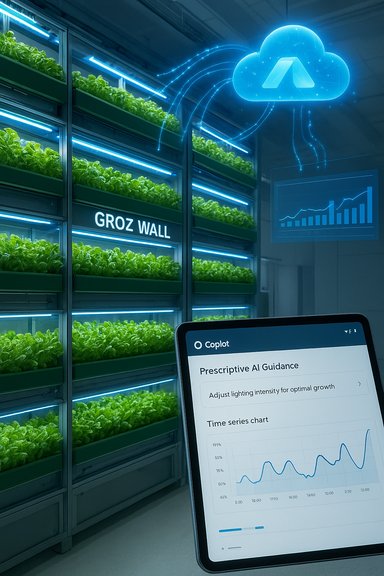
- Agroz OS: A cloud‑based vertical‑farm operating system the company says is built on Microsoft Azure and Azure AI capabilities. The public materials present the platform as combining IoT device integration, telemetry and time‑series storage, predictive analytics, optimization models and operator applications (for example, a “Copilot” function that delivers prescriptive guidance).
- Agroz Groz Wall: A commercial product developed in collaboration with Harvest Today, using the Harvest Wall patented grow‑wall system as the physical element. Agroz will integrate Harvest Wall hardware with Agroz OS features to target hotels, schools, restaurants and small commercial customers.
- Public markets and financing: Agroz completed its IPO and began trading under ticker AGRZ on the Nasdaq Capital Market; a Form F‑1 registration statement was declared effective by the SEC prior to the offering. Net proceeds are intended for capital expenditures, R&D, marketing and possible acquisitions.
- Geographic and policy angle: Agroz highlighted Malaysia as an early market and referenced a 10‑year tax incentive cited in company materials as a policy tailwind; that policy detail is a company claim that should be verified against official government texts.
The technology stack — what “built on Azure” likely means
Agroz’s announcement uses “built on Microsoft Azure’s AI stack” as a shorthand for the platform’s backbone. In practical and verifiable terms, that implies a set of Azure services commonly used in industrial and agricultural IoT/AI solutions:- Device connectivity and edge telemetry: Azure IoT Hub / Azure IoT Edge to ingest sensor data and manage devices at scale. Azure’s Industrial IoT pages and partner examples show this is the canonical pattern for connecting sensors and actuators in industrial contexts.
- Time‑series and data management: Azure Data Lake / Azure SQL / time‑series storage and pipelines; for agriculture specifically, Microsoft’s Azure Data Manager for Agriculture (previously FarmBeats) is the platform Microsoft promotes to aggregate satellite, drone and sensor data into structured datasets for models. Agroz’s claim to use Azure AI can reasonably include that service family.
- Modeling and inference: Azure Machine Learning and Azure OpenAI Service can run prediction models, optimization routines and natural‑language interfaces or copilots. Microsoft has published multiple agriculture pilots showing how generative AI transforms sensor output into simple, local instructions for farm operators.
- Digital twin / orchestration: Azure Digital Twins or similar graph models to map devices, racks and environment zones for facility‑level optimization and simulation. Azure’s industrial materials describe digital twins as the tool for modeling complex physical environments like farms or factories.
Independent corroboration and proof points
Key factual claims about Agroz’s market moves and technology are corroborated by multiple independent documents:- IPO and listing details: Nasdaq and multiple market outlets confirm the IPO pricing, share count, gross proceeds and ticker symbol AGRZ. The SEC filing history shows the registration statement (Form F‑1) was declared effective. These are verifiable, auditable facts.
- Platform and partnership: Agroz’s PR releases (distributed on PR Newswire and Nasdaq press channels) explicitly identify Microsoft Azure as the cloud backbone and Harvest Today’s Harvest Wall as the hardware partner; industry press coverage (e.g., Vertical Farm Daily) also reports the Groz Wall collaboration. These are consistent third‑party confirmations of the announcements.
- Technology context: Microsoft documentation and case studies describing Azure Data Manager for Agriculture (formerly FarmBeats), Azure OpenAI pilots in agriculture, Azure IoT and Digital Twins provide clear vendor precedent for how a company like Agroz can deliver the capabilities it describes. These Microsoft sources show the technical building blocks exist and have been used in agricultural pilots worldwide.
Why this matters: strengths and upside
- Cloud scale + enterprise compliance: Running the control plane on Azure gives Agroz instant access to global scale, enterprise security controls and compliance features — a meaningful advantage for customers that need audited telemetry, traceability, and data residency options. Azure’s platform maturity shortens time to market for data‑heavy features.
- Productizing hardware + software: The Agroz Groz Wall partnership with Harvest Today converts a generic vertical‑farm idea into a productized unit with defined form factors, warranties and install processes. Productized hardware lowers one of the biggest sources of variability in small CEA deployments: bespoke engineering.
- Public‑market discipline and access to capital: An IPO (and a declared SEC Form F‑1) imposes reporting obligations and increases transparency. It gives Agroz a clearer runway to fund pilot expansion and invest in software development if the market rewards execution.
- Policy tailwinds (if confirmed): Agroz highlights Malaysian tax incentives as a potential enabler for capital‑intensive deployments; if confirmed, such incentives can materially improve project economics for initial deployments and help seed broader rollouts. That’s a strategic lever for growth if the legal and eligibility details match the company’s claims.
The risks, caveats and where the hype can outpace reality
- Operational scale is harder than software
- Controlled‑environment agriculture is capital‑ and energy‑intensive. Scaling from pilot walls to hundreds of distributed city‑scale units requires mastery of horticulture (crop strains, disease control), engineering (lighting, HVAC), and operations (maintenance, local labor). Many CEA ventures have struggled with unit economics when those domains were not fully solved. Agroz’s platform can help coordinate those elements, but it cannot eliminate the underlying hardware, labor and energy costs.
- Vendor lock‑in and cloud dependency
- “Built on Azure” is a double‑edged sword. Azure provides robustness and compliance, but dependence on a single hyperscaler introduces risks: region availability for certain service SKUs, pricing increases, and limits on portability. Large institutional customers and governments will seek contractual assurances on data access, portability and cost ceilings. Agroz will need transparent contingency plans (multi‑cloud options or edge autonomy) for sensitive customers.
- Model fidelity and data quality
- AI copilots are only as good as their inputs. Bad sensor placement, inconsistent calibration, poor sampling, or missing environmental metadata can lead to erroneous recommendations. The company’s claims about prescriptive AI (Agroz Copilot) will require repeated field validation, independent audits, and customer‑shared telemetry to build trust.
- Energy and carbon footprint
- Indoor CEA often shifts emissions from transport to energy consumption (lighting, HVAC). The net sustainability case depends on grid carbon intensity, LED efficiency, and whether the operator sources low‑carbon power. Buyers who prioritize net‑zero will demand transparent energy and lifecycle accounting before deploying at scale. Agroz’s reliance on Azure (which itself has regional carbon profiles) further complicates the overall carbon calculation and will be an area for disclosure.
- Customer economics and contract risk
- The platform‑plus‑hardware model can succeed when customers sign multi‑year service contracts or when financing options (leasing, revenue‑share) make capex manageable. Absent disclosed anchor contracts or demonstrated payback metrics, the market will treat Agroz as an operator with technology, not a pure high‑margin SaaS business. Investors and procurement teams should insist on published unit economics.
- Regulatory and tax assumptions
- Agroz cites Malaysia’s Budget incentives as a growth catalyst. Policy claims should be corroborated directly against published budget laws and eligibility rules; tax incentives frequently include qualifying conditions (local content, hiring thresholds, periods) that materially affect their value. Treat such policy tailwinds as conditional until verified.
Practical guidance for customers, partners and investors
For procurement and facilities teams evaluating Agroz Groz Wall deployments:- Require an SLA that includes measurable yield guarantees, water and energy consumption baselines, food‑safety certifications, and an escalation/repair matrix.
- Insist on access to raw telemetry (time‑series and video) to permit third‑party audits of vendor claims.
- Pilot a single location for a full seasonal cycle before committing to network rollouts.
- Ask for detailed unit economics per square foot: capex, opex, expected yield, price per unit of produce and payback period.
- Require independent yield audits from agronomy labs or university partners.
- Negotiate data‑portability clauses and a migration plan if hyperscaler costs or availability change.
- Treat Agroz as an early industrial operator with a technology stack, not a pure SaaS play. Watch for: (a) disclosed long‑term contracts (ARR/volume guarantees), (b) published unit economics, (c) capital‑efficient deployment models (leases, partnerships), and (d) independent evidence of Agroz Copilot’s efficacy. The company’s SEC filings and subsequent quarterly filings are the primary diligence source.
Milestones to watch in the next 12–24 months
- Commercial anchor customers: disclosed contracts with hotels, hospitals, municipalities or retail partners which include volume or revenue guarantees.
- Third‑party validations: peer‑reviewed or independent audits of yield, water‑use, energy consumption and food‑safety metrics.
- Detailed unit‑economics publication: capex per port/sqft, payback period, contribution margins on Agroz OS services versus hardware sales.
- Evidence of model performance: case studies showing Agroz Copilot improving yields or reducing utility costs, ideally audited by an independent agricultural research body.
- Policy confirmation: official publication and legal interpretation of any Malaysia tax incentive claims and eligibility criteria. Treat company statements as preliminary until validated against official government texts.
How Agroz’s approach compares to broader Azure‑based AgTech trends
Microsoft has explicitly positioned Azure Data Manager for Agriculture (previously Project FarmBeats) and Azure OpenAI pilots as the vendor stack for modern, data‑driven agriculture: aggregating satellite, drone and ground sensor data; running analytics and models; and converting outputs into farmer‑facing actions via apps. Agroz’s architecture — IoT + time‑series + ML + a prescriptive copilot UI — mirrors those broader vendor patterns. That means the underlying building blocks are proven in pilots and a handful of production deployments; the distinctive question is whether Agroz can translate that into replicable commercial operations at scale.Security, privacy and governance considerations
- Data ownership and portability: Contracts should clearly define who owns sensor and model data, who may train downstream models on it, and how long telemetry is retained. Customers will want exportable data and the right to move it to alternative providers if necessary.
- Operational security for physical sites: Vertical farms are targets for sabotage, contamination and cyber‑physical threats. A secure stack requires device attestation, hardened edge controllers, encrypted telemetry channels and a documented incident response playbook.
- Compliance: Food safety standards, local plug‑and‑play installation codes, and employee training certifications must be part of any enterprise deployment checklist — not an afterthought.
Verdict — measured optimism with pragmatic caution
Agroz’s product announcements and Nasdaq listing are credible and verifiable events: the company successfully completed an IPO, publicly described its Azure‑based Agroz OS, and announced a hardware collaboration with Harvest Today to produce the Agroz Groz Wall. Multiple press outlets and the company’s SEC filings corroborate those facts. That gives Agroz the basic ingredients for a serious attempt at standardizing vertical farming into a purchasable, serviceable product. However, the announcement is the beginning of a long operational journey, not its endpoint. The crucial challenges remain executional: proving unit economics across geographies, validating AI prescriptive systems in real farm cycles, managing energy costs and demonstrating reliable, low‑variance yields at scale. For customers and institutional buyers, the sensible posture is “test, audit and contract” — require shared telemetry, pilot evidence and contractual guarantees before committing to rollouts. For investors, the company’s near‑term progress should be measured against concrete operational KPIs rather than brand or cloud affiliation alone.Practical checklist for stakeholders evaluating Agroz
- Obtain the final prospectus and all SEC‑filed disclosures (Form F‑1 / post‑effective amendments) to verify reported financials and risk factors.
- Ask for independent yield, water‑use and energy audits for at least one full growth cycle from an accredited agronomy laboratory.
- Review the Agroz OS SLA for data portability, model explainability, and outage remediation.
- Verify any government incentive claims against published budget law and regulatory guidance before baking them into financial models.
- Require cyber‑physical security evidence: device attestation, encrypted telemetry, and a documented incident response plan.
Agroz’s announcement is a signal: hyperscalers, platform‑enabled AI and productized vertical‑farm hardware are converging. That convergence can produce durable improvements in local food resilience and shorter supply chains — but only if the operational and economic realities of CEA are solved and validated in the field. Agroz has the script in place: cloud backbone, a hardware partner, public capital and an infrastructure narrative. The coming 12–24 months will reveal whether that script can be executed at scale, with the transparency and independent validation that corporate and public buyers will demand.
Source: Investing.com Nigeria Agroz unveils AI-driven food production platform on Microsoft Azure By Investing.com
