

Microsoft’s new Cyber Pulse report lands a clear, urgent message: AI agents are no longer an abstract future — they are active members of today’s enterprise workforce, scaling faster than many organizations can see, govern, or secure, and that visibility gap is now a measurable business risk.
AI agents — by which Microsoft and others mean purpose-built, often low-code/no-code autonomous or semi-autonomous assistants that plan, act, and access systems on behalf of people or teams — have moved from pilot projects to production at a velocity most security, compliance, and governance programs weren’t designed to manage. The Cyber Pulse report draws on Microsoft first‑party telemetry and a multinational survey of data security leaders to quantify that shift and to identify where the biggest gaps are.
This article synthesizes the report’s central findings, cross-checks the data against independent industry signals, and translates the implications into a practical roadmap for IT, security, and business leaders. It examines the technical controls (observability, runtime policy enforcement, identity-first access), organizational changes (shared governance, board-level accountability), and operational tradeoffs that come with treating agents as first‑class digital coworkers rather than experimental scripts.
This trend will accelerate the productization of agent governance: expect marketplaces, control planes, and enforcement SDKs that make the recommended controls easier to adopt across heterogeneous stacks.
The time to move is now: the tools and patterns for safe agent deployment exist, and the first movers will define not just the enterprise operating model of the next decade, but the trust framework that will determine which firms are perceived as safe custodians of customer data and enterprise reliability.
Source: Microsoft Source Microsoft Cyber Pulse: How AI Agents Power Business Growth
 Background
AI agents — by which Microsoft and others mean purpose-built, often low-code/no-code autonomous or semi-autonomous assistants that plan, act, and access systems on behalf of people or teams — have moved from pilot projects to production at a velocity most security, compliance, and governance programs weren’t designed to manage. The Cyber Pulse report draws on Microsoft first‑party telemetry and a multinational survey of data security leaders to quantify that shift and to identify where the biggest gaps are.This article synthesizes the report’s central findings, cross-checks the data against independent industry signals, and translates the implications into a practical roadmap for IT, security, and business leaders. It examines the technical controls (observability, runtime policy enforcement, identity-first access), organizational changes (shared governance, board-level accountability), and operational tradeoffs that come with treating agents as first‑class digital coworkers rather than experimental scripts.
Overview of what Microsoft found
Agents in the wild: adoption at scale
- More than 80% of Fortune 500 companies are running active AI agents built with Microsoft’s low‑code/no‑code tooling, according to Microsoft’s Cyber Pulse — a striking indicator that agentic automation has entered mainstream enterprise operations.
- Agent adoption is global and industry‑diverse: EMEA (Europe, Middle East, Africa) accounts for 42% of active agents, the United States 29%, Asia 19%, and the Americas (Latin America) 10%. By industry, the largest shares are in software & technology (16%), manufacturing (13%), financial services (11%), and retail (9%). These agents support tasks from drafting proposals and automating repetitive processes to triaging security alerts and surfacing financial insights at machine speed.
- Microsoft defines “active agents” conservatively: an agent is active if it’s deployed to production and has either engaged with a user or run autonomously at least once in the past 28 days. Telemetry for the report specifically measured agents built with Microsoft Copilot Studio and Microsoft Agent Builder.
Governance and visibility shortfalls
- The report flags a visibility gap: agent creation has diffused beyond central engineering teams into business units and even individual contributors using low‑code/no‑code tools. This diffusion is accelerating “shadow AI” — unsanctioned or unknown agents operating with privileges or access that IT doesn’t track. Microsoft reports 29% of employees have already used unsanctioned AI agents for work tasks.
- The Cyber Pulse links weak observability and poor governance to a concrete operational hazard: agents with broad access or unclear responsibilities can be repurposed or manipulated — becoming what the report terms unintentional “double agents.” Memory poisoning, malicious prompt injection, and credential misuse are highlighted as realistic attack vectors.
Why the data matters: context and corroboration
Microsoft’s telemetry and its multinational survey provide primary evidence that agent adoption is broad and that governance lags behind usage. Independent industry signals corroborate the risk trends Microsoft highlights.- Industry telemetry and security vendors have documented a rapid rise in data policy violations involving generative AI tools, with some vendors reporting more than doubled incidents year‑over‑year and frequent uploads of regulated data into unmanaged AI services. That operational reality aligns with Microsoft’s concern about oversharing and shadow AI.
- Vendor and analyst commentary — including coverage in European outlets and specialized security research — has picked up Microsoft’s “shadow AI” framing and echoes the call for observability and identity‑centric controls. Several security vendors are announcing runtime guardrails and DLP integrations for agent platforms, indicating a fast‑growing ecosystem response.
The opportunity — and the tradeoffs
AI agents unlock measurable benefits when applied to repeatable, data‑intensive work:- Faster decision cycles: Agents scale the cadence of insight delivery, triaging and summarizing data at machine speed.
- Efficiency gains: Routine tasks (report assembly, first‑pass triage, proposal drafting) are automated without 1:1 human labor.
- Democratized automation: Low‑code/no‑code builders let business teams create tailored automations that used to require full engineering projects.
- Expanded attack surface: Agents that can call APIs, access documents, and take action introduce new credential, data exfiltration, and integrity risks.
- Governance complexity: When hundreds or thousands of agents proliferate across business units, centralized policy, lifecycle management, and auditing become challenging.
- Skill and tooling mismatch: Security teams often lack the telemetry pipelines and runtime controls to monitor or interpose on agent behavior in real time.
Deep dive: the specific risks to watch
1) Shadow AI and unauthorized agents
When non‑technical staff can assemble agents with low‑code edifices, innovation accelerates — but so does the creation of agents outside official inventories. Shadow agents may be connected to sensitive data stores or service principals without review, creating undetected exfiltration paths. Microsoft’s 29% unsanctioned usage figure underscores the scale of the phenomenon.2) Excessive privileges and identity abuse
Agents often act under service identities or delegated user context. Without strict least‑privilege policies and identity lifecycle controls, an agent’s identity becomes a high-value target. Microsoft and other vendors now emphasize identity-first controls that treat agents like service accounts with their own identities, certificates, rotation schedule, and auditing.3) Memory poisoning and prompt manipulation
Agents that persist or retrieve conversational memory are vulnerable to poisoning attacks — where an adversary introduces misleading or malicious training artifacts that influence future agent behavior. Prompt injection and malicious inputs into retrieval-augmented workflows can cause agents to disclose secrets or execute harmful actions if not filtered and sandboxed.4) Data exposure and DLP bypasses
Security telemetry from multiple vendors shows growing incidents where reed to external generative AI tools by users, intentionally or accidentally, bypassing corporate DLP. Agents that aggregate datasets or index documents without proper redaction create systemic privacy and compliance exposure.5) Operational fragility and trust erosion
When agents provide incorrect analysis or overreach their remit, business users can lose trust. Worse, decisions made by agents (e.g., automated financial adjustments or proposal content) can generate operational errors at scale before humans detect faults — a risk amplified by weak observability and audit trails.What good looks like: Observability, governance, and security — integrated
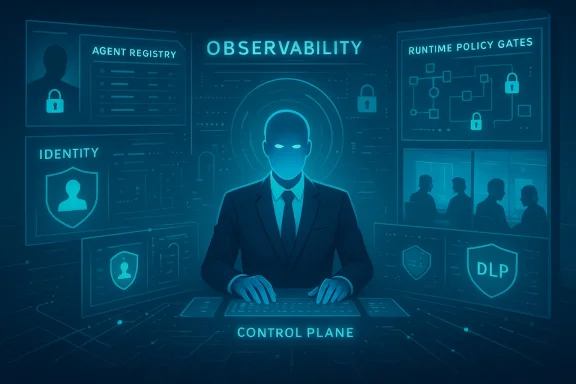
Microsoft’s prescription is practical and prescriptive: treat agents as production services with observability, Identity & Access Management, least privilege, runtime policy enforcement, and centralized governance. Below is a consolidated operational playbook that organizations can use to close the visibility gap and control risk while preserving speed.Foundational controls (must-have)
- Inventory and registration
- Maintain a central agent registry that records the agent owner, purpose, data access, runtime environment, identity, and approval history.
- Make registration a gating step for sensitive connectors or production deployment.
- Identity-first access
- Assign agents explicit identities in the enterprise directory; enforce conditional access, MFA for sensitive management operations, and credential rotation.
- Apply least privilege: only grant the minimal scopes required for the agent’s function.
- Observability and telemetry
- Capture rich telemetry for agent actions: API calls, tool invocations, data read/write patterns, and runtime decisions.
- Integrate agent telemetry into your SIEM/XDR and SRE observability tooling so policy violations surface in familiar monitoring streams.
- Runtime policy enforcement
- Route planned agent actions to a policy engine (approve/block) where necessary, or require stepwise approvals for high‑risk operations.
- Enforce Data Loss Prevention (DLP) and content classification inline, not just as post‑hoc logging.
- Model and prompt governance
- Catalog the models and model versions your agents rely on; record prompt templates and decision rules as change-tracked artefacts.
- Test agents against adversarial prompts and memory-poisoning scenarios as part of acceptance testing.
Operational practices (should-have)
- Role-based ownership: Define business, legal, compliance, and security owners for classes of agents. Make onboarding and offboarding an explicit cross-functional workflow.
- Periodic risk assessments: Reassess agent privileges, data flows, and assumptions on a regular cadence; treat agents as part of the enterprise attack surface.
- Integration with procurement and vendor risk: When agents call external APIs or third‑party models, include supply chain review and SLOs for data handling.
Technical guardrails (nice-to-have but increasingly available)
- Runtime action approval: Copilot Studio and comparable platforms are adding near‑real‑time intercepts where a policy engine can approve or block planned actions while an agent runs. This converts many agent risks from post‑mortem to preventable.
- Dedicated agent control planes: Products that centralize lifecycle management, identity, and telemetry for agents — treating them as auditable, governed services — remove much of the friction between innovation and security.
Practical step‑by‑step: a 90‑day sprint to close the visibility gap
- Week 1–2: Rapid discovery
- Use network and cloud telemetry, API gateway logs, and platform consoles to list active agents and service principals.
- Week 3–4: Risk triage
- Prioritize agents by data access, privileges, and external connectivity. Identify high‑risk agents for immediate controls.
- Month 2: Implement identity & least privilege
- Register agents with directory identities, apply conditional access, and constrain API scopes.
- Month 2–3: Deploy runtime policy and DLP
- Route high‑risk agent actions through a policy enforcement point and enable inline DLP on connectors.
- Month 3: Governance and operationalization
- Establish a cross‑functional AI agent governance board, define approval gates, and publish an agent lifecycle policy.
Organizational design: governance as leadership responsibility
The Cyber Pulse underscores that AI governance cannot live solely in IT or solely with security teams; it must be a cross‑functional enterprise responsibility with board-level visibility. The strongest programs:- Treat AI agent risk as a core enterprise risk (alongside operational and financial risks).
- Create joint KPIs: number of registered agents, mean time to detect unsanctioned agents, number of runtime policy blocks, and compliance posture for agent data access.
- Empower business owners to build with guardrails rather than forbidding low‑code innovation.
Vendor and ecosystem response — what to expect next
The market response is already visible: security vendors are integrating DLP and runtime guardrails into agent authoring surfaces and announcing integrations that let policy engines interpose on an agent’s planned actions. Observability vendors are embedding agent context into traces and incidents so an agent’s activity appears in the same dashboards used by SREs and SecOps. Analysts and security research firms are also elevating agent risk in their frameworks, moving from generic AI risk to agent‑specific operational controls.This trend will accelerate the productization of agent governance: expect marketplaces, control planes, and enforcement SDKs that make the recommended controls easier to adopt across heterogeneous stacks.
Legal, compliance, and privacy implications
Agents complicate compliance mapping because they blur the line between human action and automated processing. Legal teams must be engaged early to:- Map agents to data processing agreements and data protection impact assessments.
- Ensure contractual controls for third‑party models and APIs called by agents.
- Define retention and audit requirements for agent memory and conversational logs.
Critical analysis: strengths of Microsoft’s approach and remaining gaps
Strengths
- Practical framing: Microsoft links technical controls (observability, runtime enforcement, identity) directly to governance and business outcomes, which helps boards and C‑suites prioritize investment.
- Measured telemetry: The report uses first‑party telemetry and a large multinational survey to quantify adoption and behaviors, lending weight to its recommendations.
- Product alignment: Microsoft is rapidly building features (agent registries, Copilot Studio runtime policies, identity controls) that align with the required controls, reducing the gap between guidance and implementable tooling.
Remaining gaps and open questions
- Coverage beyond Microsoft tooling: Microsoft’s telemetry focuses on agents built with its platforms; many enterprises use heterogeneous stacks and third‑party agent systems. Cross‑platform discovery and enforcement remain a practical challenge. Independent vendor telemetry and enterprise assessments show data exfiltration incidents often involve personal accounts and external tools outside vendor control.
- Human factors and culture: Policy alone won’t stop employees from using unsanctioned tools when they see immediate productivity gains. Incentives, training, and clear, fast approval pathways are necessary to shift behavior.
- Model-level risk management: The report emphasizes operational controls, but model provenance, training data governance, and robustness testing need more standardized, industry‑level practices.
- Small and medium business constraints: The recommendations assume significant security and identity investment; smaller organizations may lack the resources to implement all controls immediately. Managed service models and vendor-led guardrails will be important for broad adoption.
Recommended checklist for leaders (concise)
- Convene a cross‑functional AI agent governance board within 30 days.
- Inventory active agents and register each with owner, purpose, and data access within 60 days.
- Enforce identity-first access for agents and apply least privilege.
- Route high‑risk actions through runtime policy enforcement and enable inline DLP for connectors.
- Integrate agent telemetry with SIEM/XDR and SRE dashboards.
- Conduct adversarial tests (prompt injection, memory poisoning) during agent acceptance testing.
- Make agent lifecycle and retirement part of release and change management.
Conclusion
Microsoft’s Cyber Pulse report is a timely wake‑up call: agentic AI is already embedded in enterprise workflows at scale, and the business upside is substantial — but so are the risks when observability and governance lag. Treating AI agents as first‑class, auditable members of the enterprise — with identities, telemetry, least privilege, and runtime policy enforcement — converts an existential-looking risk into a managed operational capability. Organizations that act fast to inventory, govern, and secure agents will not only reduce risk; they will unlock a new class of competitive advantage where secure, transparent, and auditable automation accelerates innovation at machine speed.The time to move is now: the tools and patterns for safe agent deployment exist, and the first movers will define not just the enterprise operating model of the next decade, but the trust framework that will determine which firms are perceived as safe custodians of customer data and enterprise reliability.
Source: Microsoft Source Microsoft Cyber Pulse: How AI Agents Power Business Growth
