AI Amplified Bot War: Shell vs Donovan Over Archival Critique

  • Thread Author
The long-running feud between John Donovan and Shell plc has re‑entered a modern, high‑stakes phase: an AI‑amplified “bot war” that has prompted renewed legal posturing from Shell, intensified public debate over corporate brand protection tactics, and raised new questions about how multinational companies should — or can — respond to adversarial archival activism in the age of generative AI. Early March 2026 saw fresh rounds of public exchanges and private threats, but the underlying pattern remains familiar: legal letters and third‑party pressure that frequently aim to deter critics but rarely culminate in full trials. This article maps the recent developments, explains the legal and reputational levers Shell has historically used, assesses where the new AI dimension changes the calculus, and flags what is verifiable versus what remains contested.

A man reviews a contract as a holographic Shell briefing reveals a 2005 WIPO decision.Background: a three‑decade fight that never fully went away​

John Donovan’s campaign against Shell is not a 21st‑century phenomenon repurposed by Twitter; it is the continuation of a dispute that dates back to commercial and intellectual‑property clashes in the late 1980s and 1990s. Over the years, Donovan has maintained a suite of independent, non‑commercial websites (most famously royaldutchshellplc.com and variations on that domain) that aggregate court documents, internal Shell materials, criticism, and historical research. Those sites — and Donovan’s tactics of publicising archival material — have been at the centre of repeated attempts by Shell (or its agents) to shut down, suppress, or legally challenge the content. That history is important because it frames both parties’ strategies today: a persistent critic who knows the legal and reputational terrain, and a global corporation familiar with using legal instruments and intermediaries to protect its brands and reputation.

Key early turning points​

  • WIPO domain dispute (2005): Shell sought to reclaim domain names later used by Donovan. The World Intellectual Property Organization panel rejected Shell’s complaint and upheld Donovan’s right to operate the domains under non‑commercial, critical use. That case remains a legal anchor that Donovan cites when arguing the domains are lawful criticism rather than cybersquatting.
  • Repeated infrastructure pressure: Across the 2000s and into the 2010s and 2020s Shell’s representatives — sometimes lawyers, sometimes brand‑protection or security units — have sent takedown requests or warnings to domain registrars, web hosts, and publishers. Hosts have on occasion temporarily deactivated Donovan’s sites, and Donovan’s published archives document several such incidents. These interventions typically sought removal via intermediaries rather than open court fights.
  • Intelligence and brand‑protection networks: Donovan and others have alleged that Shell engaged private intelligence firms for reputational monitoring and discrete countermeasures. Mainstream reporting confirms that corporate intelligence firms — including ones with ex‑national‑security staffing like Hakluyt & Company — have been used by energy companies to gather information on NGOs and critics, though linking specific covert acts to named operatives remains legally and evidentially fraught. When precise operational attributions are made by Donovan, some are corroborated by internal documents he has published while others remain plausible but unproven in public record.

What changed with AI: Donovan’s “bot war” and Shell’s dilemma​

Late 2025 and early 2026 saw Donovan shift tactics from archiving and conventional publications to deliberately feeding his archive into multiple public large language models (LLMs) — ChatGPT, Microsoft Copilot, xAI’s Grok, Google AI Mode and others — then publishing the range of outputs side‑by‑side. The goal is twofold: to expose inconsistencies and hallucinations across models, and to use the very outputs of those models as provocation that draws wider attention to the original documents.
  • Scale and method: Donovan is reported to have an archive of tens of thousands of Shell‑related documents; by prompting AIs with identical queries about the same archive and publishing divergent answers, he creates a public spectacle that both amplifies older materials and reframes the dispute as an experiment in AI grounding and model disagreement.
  • The asymmetric effect: Activists need only produce contradictions or dramatic AI outputs; the company faces a higher bar to rebut each claim, especially when the underlying materials are archival and voluminous. Observers note that this asymmetry helps Donovan control the narrative in short, attention‑driven cycles.
  • Platform neutrality to date: Multiple public reports indicate that AI platforms have not instituted targeted blocks against Donovan’s prompts or the content he publishes, meaning the “bot war” continues to be fuelled by neutral platform responses rather than editorial suppression. For now, the platforms generate content drawing on public sources — including Donovan’s own sites — when no countervailing official record is presented.
This new dynamic matters because it shifts the reputational battleground from press releases and one‑off op‑eds to ongoing, algorithmically generated narratives that can be repeatedly reshaped and recirculated.

Shell’s historical toolkit: legal letters, third‑party pressure, and strategic litigation​

Shell’s response repertoire to critics is extensive and multifaceted. Key tactics, revealed through public reporting, Donovan’s archives and mainstream coverage, include:
  • Cease‑and‑desist and takedown requests aimed at intermediaries: domain registrars, hosting providers, and content networks rather than direct public lawsuits. These letters sometimes use intellectual property or trademark framing to demand content removal. Internal documents and Donovan’s published exchanges show this pattern over decades.
  • Engagement of brand‑protection or cybersecurity contractors: Companies employ specialist firms to monitor the internet and issue enforcement notices. Donovan’s published correspondence points to an episode in July 2021 where a firm called Pointer Brand Protection & Research sent a five‑day take‑down ultimatum to his host, alleging trademark and copyright infringement and “unfair competition.” That specific 2021 episode is primarily documented in Donovan’s published record and reporting that relies on his archive. Independent corroboration beyond Donovan’s materials is limited in mainstream outlets. Where factual claims rest mainly on Donovan’s documents — for example the precise text and tone of the Pointer letter — they should be treated as primary material provided by the critic, not independently verified by third‑party reportage.
  • Surveillance and private intelligence: Corporate security units historically monitor activist campaigns and sometimes hire intelligence firms. Documentation and third‑party reporting confirm the use of private intelligence in corporate contexts; however, attributing discrete covert acts to a named firm like Hakluyt in Donovan’s personal case is supported in part by internal memos and contemporaneous correspondence Donovan has published, but public, independently verified “smoking‑gun” evidence tying specific surveillance actions to a named operative is uneven. Journalists and analysts therefore generally treat operational attributions as plausible and supported by contextual evidence, while noting evidentiary limits.
  • High‑stakes strategic litigation: Where Shell sees significant legal or safety claims (for example, the 2023 action involving Greenpeace activists on a Sea‑based platform), it has not shied from court. The Greenpeace case, which led to a high‑value claim and a late‑2024 settlement arrangement that included a charitable donation and a limited non‑protest commitment, was widely viewed by critics as a strategic litigation attempt that carried SLAPP (strategic lawsuit against public participation) attributes. That case demonstrates Shell’s willingness to litigate aggressively when the company judges it necessary, even as it prefers quieter pressure in other disputes.

The renewed threats (early 2026): posture, purpose, and probable limits​

Public reporting in February–March 2026 documents that Shell either issued or considered renewed legal threats in response to Donovan’s AI‑amplified publications. Key elements and immediate assessments:
  • Nature of the threats: Reports describe the company or its agents warning of litigation and asking intermediaries or platforms to remove or flag content. In other cases, the threats appear to be considered internal options rather than immediate court filings. At present there is no public record of fresh lawsuits filed against Donovan arising from the early‑2026 exchanges.
  • Strategic logic: Legal advisers facing a high‑profile archival critic have three realistic avenues:
  • File a defamation suit or an IP complaint in court — costly, public, and potentially validating Donovan if the suit is seen as silencing dissent.
  • Press intermediaries (hosts, registrars, platforms) to remove content — faster and lower‑profile but vulnerable to public backlash and to the legal protections available for non‑commercial criticism and fair use.
  • Engage platforms and vendors directly to request corrections or provenance improvements where AI outputs repeat demonstrable factual errors — a softer remedy that aims to shape the information ecosystem rather than suppress content. Donovan’s recent tactics have arguably made route (3) more attractive to defenders who want to avoid the spectacle of suing a prominent critic.
  • The probable ceiling: Historically, many of Shell’s sternly worded letters result in retreats or settlements rather than protracted trials — particularly where the target is a small, non‑commercial critic with a defensible fair‑use posture. Given the 2005 WIPO decision and the non‑commercial character of Donovan’s public archive, any new legal action would need to be narrowly targeted (for example, alleging demonstrable falsity in a named claim) to stand a reasonable chance of producing a favourable, final judgment for Shell. Broad, sweeping suits are risky and may produce more publicity than relief.

What is verifiable — and what remains disputed​

In high‑conflict public disputes, separating robustly documented facts from contested claims is essential.
  • Verifiable and well‑sourced:
  • WIPO decision in 2005: Panel denied Shell’s attempt to transfer Donovan’s criticized domains. That administrative ruling is a public document and remains a material precedent in the domain disputes between Donovan and Shell.
  • Greenpeace settlement: Shell’s high‑value claim against Greenpeace over a platform boarding was settled in late 2024/early 2025 with the charity donation and limited non‑protest commitments; mainstream outlets reported the resolution and contextualised it as a contest over protest tactics and reputational leverage.
  • Milieudefensie appeal: The Dutch Court of Appeal overturned the 2021 order that had obliged Shell to cut emissions by a quantified percentage; this appellate decision is widely reported and publicly accessible. That litigation track shows Shell will litigate where it sees broader corporate‑policy exposures.
  • Plausible but partially verified claims:
  • Use of private intelligence and surveillance methods: It is well documented that Shell and other major firms have engaged corporate intelligence contractors and monitoring units. Donovan’s archive contains contemporaneous material that suggests covert monitoring and aggressive private intelligence activity; however, direct attribution of individual covert acts to specific contractors (and proof of criminality) is not uniformly present in the open record. Independent reporting confirms the existence of private intelligence relationships but in many cases leaves operational detail unproven for legal reasons and source protection. Readers should therefore treat specific operational attributions as plausible and contextually supported while noting evidentiary limits.
  • Claims that rely principally on Donovan’s published archive:
  • The Pointer Brand Protection ultimatum of July 2021 and similar takedown letters are documented in Donovan’s public archive and have been picked up in secondary blogs and commentaries. Major mainstream media coverage confirming every aspect of those private letters is limited; when a claim depends primarily on materials published by one disputant (even if the material appears authentic), standard journalistic caution requires flagging that the account is effectively a primary source from the critic. Evidence is strong that such letters were issued; independent confirmation in a wide set of outlets is thinner.

Risks and implications: for Shell, for platforms, and for public debate​

The Donovan–Shell “bot war” crystallises multiple modern risks that matter beyond this single feud.

For Shell: reputational risk and the law’s bluntness​

  • Legal letters intended to deter may amplify. Every takedown demand or threat becomes content in Donovan’s hands; he publicises these exchanges and turns them into evidence of corporate overreach. That dynamic reduces the deterrent value of behind‑the‑scenes pressure.
  • Courts and regulators move at different speeds than viral AI narratives. Suing may resolve specific legal issues but risks validating the dispute’s central publicity and exposing internal documents in discovery.
  • Engaging platforms to remove or label AI outputs raises novel legal and procedural questions about when companies can compel model vendors to act against outputs generated from public archival sources.

For AI platforms: governance and provenance challenges​

  • LLMs trained on or prompted with archival material will inevitably synthesize claims, some of which may be inaccurate or defamatory. Platforms face growing pressure to improve provenance, provide better citations, and offer mechanisms to contest outputs derived from contested archives.
  • Neutrality is operationally simple but socially risky: when platforms refuse to intervene in disputes that involve clear factual errors or harms, they implicitly privilege the loudest content producers. Conversely, heavy‑handed moderation invites accusations of censorship and collusion with corporate powers.

For public debate and journalism​

  • Donovan’s adversarial RAG (retrieval‑augmented generation) experiments expose weaknesses in public fact‑checking: journalists and experts must now adjudicate not only documents but also the outputs generated when documents are combined with different LLMs.
  • There is a civic need for transparent protocols to handle disputes where archival material and AI outputs intersect. Standards could include:
  • Clear provenance metadata for documents used as prompts.
  • Fast‑track fact‑checking mechanisms for contested claims amplified by AI.
  • Platform obligations to provide traceable reasoning or source links when models make factual assertions about living persons or corporate conduct.

Practical next steps each actor might reasonably take​

  • Shell
  • Prioritise targeted, evidence‑based challenges where concrete falsity can be shown, rather than broad legal threats that risk amplifying the dispute.
  • Build a platform‑engagement playbook with major AI vendors for correcting demonstrably incorrect outputs and improving model provenance on corporate history.
  • Continue rigorous public communications and, where appropriate, offer transparent rebuttals referencing primary documents rather than legal threats.
  • John Donovan and similar archival activists
  • Continue publishing primary materials and context while anticipating legal counters; redoubled attention to accuracy and context will reduce exposure to sound defamation claims.
  • Work with independent fact‑checkers or academic partners to strengthen the evidentiary value of archival releases.
  • AI platforms
  • Invest in provenance signals and appeal processes for outputs that repeat contested historical claims.
  • Provide accessible tools for third parties to flag potentially defamatory or materially false outputs that cite their archive as a major source.
  • Journalists and regulators
  • Treat AI‑generated narratives as claims that require source verification; avoid accepting model outputs as evidence without independently checking primary documents.
  • Consider whether new guidance is needed around corporate requests to remove AI outputs, balancing platform accountability, free expression, and harm reduction.

Conclusion: a classic pattern, with a new amplifier​

The Donovan–Shell feud demonstrates how longstanding disputes between critics and corporations are reshaped by technology. Shell’s historical pattern of using legal correspondence, third‑party pressure, and selective litigation remains evident; so too does Donovan’s capacity to convert pressure into publicity. What is new is the scale and rapidity with which archival material — when fed into public AI assistants — can generate divergent narratives and be re‑packaged for public consumption almost instantly.
As of early March 2026, renewed legal threats reported in response to Donovan’s AI‑amplified campaign appear consistent with Shell’s historical posture: forceful in letter, cautious in court. No fresh, major lawsuits have publicly materialised from the February–March 2026 exchanges, and the key legal precedents (notably the 2005 WIPO decision) continue to shape the likely outcomes of any domain‑oriented claims. Yet the strategic implications are clear: in an era where AI can reframe archives on demand, both corporations and platforms must develop faster, law‑sensitive, and transparent responses — otherwise every legal threat risks being repurposed as the next wave of content that the critic uses to amplify the dispute.

Source: Royal Dutch Shell Plc .com Donovan Shell Feud: Renewed legal threats?
 

The sudden departure of Kip Meeks — the inquiry chair who steered the Competition and Markets Authority’s (CMA) long-running cloud services investigation — has punctured open a growing argument about the UK regulator’s appetite and capacity to tackle the market power of the cloud hyperscalers. Meeks reportedly walked away in late January, telling a trade newsletter that he was frustrated at the “glacial” pace at which the CMA has moved to implement the recommendations from its 2025 cloud services report. That exit arrives after the CMA’s provisional findings identified serious competition concerns in Britain’s cloud market and recommended exploring formal designation of Microsoft and Amazon Web Services (AWS) under the government’s new digital markets powers — yet, more than a year on, tangible regulatory action remains elusive.

People stand before the Competition and Markets Authority building as cloud icons with data and gears loom overhead.Background: how the CMA’s cloud inquiry reached a crossroads​

The CMA’s market investigation into cloud services began with a formal reference in October 2023 and culminated in provisional findings published in 2025 that painted a concentrated market dominated by two US hyperscalers. The independent inquiry group concluded that market features — including technical interoperability barriers, certain contract and billing practices, and software licensing terms — were creating switching frictions and a form of vendor lock-in that disadvantaged alternative suppliers and, by extension, UK customers. The group recommended the CMA consider designating AWS and Microsoft with “strategic market status” (SMS), which would allow the regulator to impose binding pro-competition obligations under the Digital Markets, Competition and Consumers Act framework.
Those provisional findings quantified the imbalance: the inquiry estimated the UK cloud services market at roughly £9 billion in 2023 and found each of the two leading providers held a substantial share of customer spend — often expressed as “up to around 30–40%” for AWS and Microsoft in Infrastructure-as-a-Service (IaaS) and Platform-as-a-Service (PaaS) segments, with Google Cloud trailing significantly. The market concentration and the persistence of certain conduct were the central bases for recommending further action.
The statutory timetable published by the CMA signposted a decision window: following the inquiry’s statutory deadlines, the agency noted it would keep the matter under review and anticipated the CMA Board would consider options in early 2026. That timetable, and the apparent mismatch between what the inquiry group recommended and what the CMA has actually enacted so far, is the practical friction that underlies Meeks’ reported frustration.

What was in the 2025 report — and why it mattered​

The inquiry group’s 2025 provisional findings targeted a handful of concrete competitive problems rather than vague market malaise. The chief issues were:
  • Vendor lock-in via technical interoperability gaps — migrations are difficult, costly, and sometimes technically prevented by bespoke proprietary integrations.
  • Commercial friction points such as egress charges that make cross-cloud movement expensive, dissuading switching.
  • Software licensing practices, notably around Microsoft products, that can make running identical workloads on non‑Azure infrastructure materially more costly, effectively steering customers toward Azure.
Those mechanics matter because they create durable competitive advantages that are not necessarily explained by superior product quality alone. The inquiry group argued that these features have allowed the dominant players to capture returns that exceed what would be expected in a genuinely contestable market; the CMA’s statutory powers were therefore flagged as an appropriate tool to intervene if those harms persisted.

The resignation: what was reported, and what we can verify​

The Register first reported Meeks’ departure on March 4, 2026, giving his reasons as frustration with the CMA’s sluggish follow-through on the inquiry group’s recommendations and concern about potential institutional shifts that could dilute independent decision-making. The story cites Meeks telling The Morning Intelligence that he “shared concerns” about the slow pace and that he was “still concerned that the pace is going slowly.” The Register also reported the CMA’s statement that Meeks had “concluded his current caseload” and left some months before the end of an eight-year term. At the time of that reporting, independent verification of Meeks’ remarks beyond The Register’s account and its cited Morning Intelligence quote was limited. Where reporting rests on a single outlet’s interview, it is fair and necessary to treat the claim as reported rather than as a fully established, multi-source fact.
In short: The Register’s coverage is credible and consistent with the enquiry’s timeline, but the precise motives and internal CMA conversations that drove Meeks’ early exit have not been corroborated in multiple mainstream outlets as of publication. That caveat matters because Meeks’ departure is being used by critics to argue both that the CMA is too slow and that its independence may be under strain — accusations that should be treated seriously but with careful sourcing.

Why the pace matters: legal powers versus practical timelines​

The Digital Markets, Competition and Consumers Act (the UK’s recent digital regime) gives the CMA new tools — including the ability to designate firms with SMS and impose ex ante obligations — but the exercise of those powers is procedural, resource-intensive, and politically charged. The inquiry group’s recommendation to explore SMS designation was a referral to the CMA’s broader decision-making machinery, not an immediate enforcement action. Designating a firm, developing appropriate remedies, and defending that choice (and any remedies) are processes that require board sign-off, legal scrutiny, and often industry consultation — all of which slow the clock.
Even with procedural reasons accounted for, the perception of delay is influential. Businesses and buyers who have been promised regulatory oversight expect tangible interventions when the regulator signals a problem. When a high-profile inquiry chair resigns because of “pace”, the message to market participants — and to Parliament — is emphatic: the CMA has power on paper but must demonstrate timely will and capability in practice. That reputational dimension matters as much as the legal mechanics.

Conflict of interest optics: the CMA’s AWS hosting contract and leadership choices​

Complicating the narrative are two salient facts that have fed a narrative of potential conflict or at least awkward optics. First, the CMA itself recently entered a renewed hosting agreement with AWS: the watchdog’s contract renewal went live on 1 May 2024 and was publicly reported as having more than doubled the contract value compared with its prior deal, benefiting from government procurement frameworks and preferential pricing mechanisms. Observers note the awkward optics of a regulator buying significant cloud hosting from a company it is simultaneously scrutinising.
Second, the CMA’s chairman role was recently made permanent with the appointment of Doug Gurr, a former Amazon UK executive with a long tenure at Amazon. Gurr’s placement at the CMA has been controversial; unions, MPs, and campaigners have publicly questioned whether a former senior Amazon executive is the right person to sit at the head of an economic watchdog with major tech investigations on its plate. Parliamentary hearings and press coverage have scrutinised Gurr’s prior connections and asked for robust safeguards against conflicts of interest. Those concerns — whether fair or overstated — intensify scrutiny of the CMA’s operational tempo and governance choices.
Taken together, the CMA’s own AWS hosting agreement and the appointment of an ex-Amazon executive to a top role create a set of perception problems for the regulator. The CMA has legal conflict policies and the capacity to manage recusal and internal separation, but perception can erode public trust faster than policy safeguards can be set up, especially when regulatory action is slow.

The industry response: between relief and alarm​

Industry reaction to the CMA’s provisional findings has been mixed and unsurprisingly partisan.
  • Cloud challengers and some EU hosters welcomed the CMA’s attention and the prospect of robust remedies, arguing that incumbent hyperscalers have exploited technical and licensing levers to fortify their market positions. Trade groups such as CISPE in Europe have pursued separate complaints over Microsoft’s cloud licensing and extracted commitments that were later monitored by the European Cloud Competition Observatory. Independent hosters say the cumulative effect of licensing penalty dynamics and proprietary features reduce real choice for customers.
  • The hyperscalers (Microsoft and AWS/Amazon) have pushed back strongly. They argued the cloud market is intensely dynamic, with heavy ongoing capital investment, rapid product innovation (particularly driven by AI), and smaller vendors able to compete in specialized niches. Microsoft has publicly framed licensing changes as reasonable, defensive commercial choices and has pointed to separate remedies and commitments it has given in other regulatory contexts. AWS and Amazon have warned against policy choices that could make the UK a regulatory outlier.
  • Neutral observers and legal commentators have urged proportionality: if the CMA’s core harms can be addressed by targeted remedies (for example, rules on interoperability, limits on discriminatory licensing or clearer rules on egress and bundled discounts), then broader SMS designation — and all the attendant obligations — may not be the only or best path. That argument emphasises avoiding overreach and calibrating interventions to demonstrated harms rather than hypothetical worst-case scenarios.
That mix of responses is unsurprising. Big structural remedies raise the regulatory stakes, and businesses on both sides of the debate have high incentives to frame the problem in terms favourable to their commercial interest.

Technical mechanics at the centre of the dispute​

To evaluate whether the CMA is right to proceed with forceful, SMS-style tools, it helps to look at the concrete technical and contract features the inquiry identified:
  • Egress fees and billing complexity. Cloud providers commonly levy charges for moving data out of their systems; these charges can accumulate quickly on data-intensive workloads and materially change the switching calculus for customers. Even where egress is not prohibitive, the billing complexity and visibility of costs are poor, increasing switching friction.
  • Proprietary features and APIs. Hyperscalers accelerate adoption by offering higher-level managed services (databases, serverless, AI accelerators) that are tightly coupled to their platforms. Migrating an application that relies on deeply integrated platform services is not just a matter of copying VM images; it is a software architecture problem that can require extensive refactoring. That lock-in is technical as much as commercial.
  • Software licensing and “self‑preferencing.” The CMA flagged particular concern about Microsoft’s licensing model where certain rights and price points are more favourable within Azure compared with running the same workloads on rival clouds. That differential can operate as a self-preferencing mechanism that has real economic consequences for customers considering migration. The issue echoes similar contestations in the EU where trade groups have challenged Microsoft’s licensing conduct and reached partial settlements and commitments.
These are not purely academic points. For pragmatic buyers — public sector agencies, regulated industries that are bound by compliance constraints, and enterprises building AI stacks — the combination of technical refactoring cost, licensing variance, and operational disruption can make switching economically irrational even when a competitive alternative exists in principle.

Risks of heavy-handed regulation — and the countervailing risks of inaction​

Regulators face a double-sided risk:
  • Over-regulation risk. If the CMA moves to designate firms and imposes heavy ex ante obligations without careful tailoring, it could:
  • Increase compliance costs and slow product development at the companies that are heavily invested in UK cloud capacity.
  • Create regulatory uncertainty that reduces the attractiveness of the UK for future cloud and AI investment.
  • Trigger legal challenges that are lengthy and expensive to litigate, delaying remedies even further.
Critics of SMS designation stress that targeted interventions — e.g., rules on porting data, transparent egress pricing, and anti-discriminatory licensing requirements — might achieve the same practical outcomes with fewer systemic costs.
  • Inaction risk. Conversely, delaying action when the evidence shows durable frictions risks entrenching the status quo. For many customers, theoretically available competition is not practically effective when switching costs are high or pricing signals are distorted. Delay can therefore lock in competitive harms and discourage the emergence of alternative providers, ultimately harming innovation and consumer welfare. This is the argument Meeks reportedly echoed: the regulator’s statutory tools are only meaningful if deployed with sufficient speed and clarity to change market incentives.
Finding the balance requires rigorous, transparent, and well-scoped measures tailored to the actual mechanisms of harm — not an ideological tilt toward maximal intervention or laissez-faire passivity.

Practical remedies the CMA could pursue — a menu for policymakers​

For policymakers and the CMA Board, a pragmatic pathway could combine immediate, targeted interventions with a longer-term monitoring and structural-remedy plan. Proposed elements include:
  • Short-term, targeted rules and guidance
  • Require clear, standardised egress pricing disclosure and billing simulation tools for customers contemplating migration.
  • Impose non-discrimination commitments on licensing terms where equivalently configured workloads attract materially different prices depending on the cloud provider.
  • Mandate technical exportability standards for certain core services (data formats, container images, common API layers) to reduce refactor costs.
  • Medium-term structural measures
  • If evidence shows persistent foreclosure, targeted SMS obligations could be drafted narrowly to address the specific conduct (e.g., tying/bundling of licenses to cloud consumption, discriminatory marketplace policies).
  • Establish regulatory sandboxes and migration funds to support public-sector and SME migrations and test migration playbooks at scale.
  • Governance and transparency fixes
  • Publish a clear decision timetable so stakeholders know whether the Board will decide on designation and when — reducing uncertainty that itself harms investment decisions.
  • Define strict conflict-of-interest safeguards, including recusal policies and external oversight on decisions involving firms with prior relationships to CMA leadership.
  • International alignment
  • Coordinate with EU competition authorities and other major regulators to reduce duplication and prevent forum shopping by firms seeking the most favourable regulatory environment.
These steps are not exhaustive, but they are designed to be proportionate, evidence‑based, and practical: they address the specific, identifiable mechanisms of harm highlighted in the CMA’s inquiry without immediately resorting to maximalist structural remedies that risk collateral damage.

Governance questions the CMA must answer publicly​

Meeks’ resignation has magnified governance questions the CMA owes to Parliament, businesses, and the public:
  • What is the CMA’s decision timeline? The Board anticipated considering options “in early 2026.” A publicly posted, firm schedule would help rebuild confidence that the regulator is moving from diagnosis to treatment.
  • How will the CMA manage perceived conflicts of interest? Recent procurement choices and leadership appointments require clear, published recusal rules and transparent records of who participated in which decisions and why.
  • Will the CMA prioritise targeted remedies first? The CMA must set out why it has chosen either targeted measures or SMS designation, grounded in clear evidence and legal analysis of proportionality and practicability.
Answering these questions promptly and with detail would reduce perception risk and restore trust that the CMA is both independent and effective.

Conclusion: accountability, speed, and measured remedies​

Kip Meeks’ reported exit is more than a personnel story; it’s a signal flare. It highlights the tension between the complexity of modern platform markets and the expectation that regulators must act decisively when market power is producing demonstrable harms. The CMA has the statutory tools to address cloud market frictions, but the path from inquiry to enforcement is procedural and politically sensitive.
For UK customers — public bodies and private enterprises building the nation’s digital backbone — the stakes are immediate. Whether the CMA pursues targeted corrective measures or pursues formal SMS designations, it needs to act with three qualities simultaneously: legal precision, operational speed, and public transparency. Those virtues would address the core complaint Meeks reportedly voiced: the harm of having a powerful diagnosis on paper and no visible cure in practice. The choice before the CMA now is not whether to act, but how quickly it can move from report to remedy without making the cure worse than the disease.

Source: theregister.com Cloud inquiry chair quits CMA over glacial pace of reform
 

Microsoft's long-running "white flash" problem in File Explorer has finally been addressed in the Windows Insider preview channel updates released on March 6, 2026, with Microsoft explicitly listing the removal of the white flash when launching new File Explorer windows or tabs (particularly when File Explorer is set to open to This PC) and when resizing elements of File Explorer. For users who live in Dark Mode, this is more than a polish item — it’s a relief. After months of intermittent regressions and partial fixes that only helped certain configurations, the company’s latest Dev and Beta channel flights claim to remove the jarring, blinding white screen that used to appear during Explorer operations. This article explains what happened, why it was so stubborn, how Microsoft tried to fix it, what the new builds change, and what practical steps users and administrators can take in the meantime.

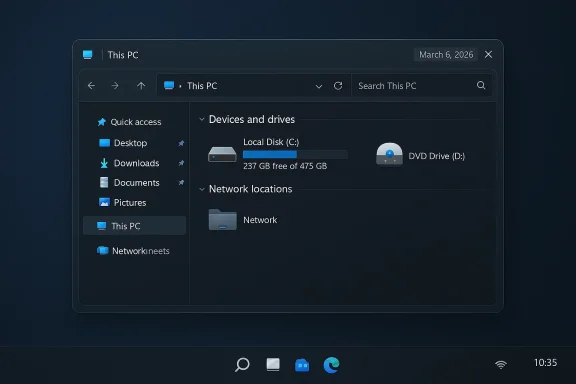
Dark Windows File Explorer shows This PC with Local Disk (C:) and a DVD Drive.Background / Overview​

The "white flash" is a visual glitch where File Explorer briefly shows a white background — often full-screen bright — when opening windows, creating tabs, switching between panes, or resizing UI elements while Dark Mode is active. Because the default window background in much of Windows' legacy UI code is white, the flash is most visible when Dark Mode is enabled: the window opens white for a fraction of a second, then the theme engine paints it dark. To the human eye that delay registers as a sudden white “flash,” which can be disorienting or painful for users who prefer dark themes.
This behavior became prominent for a wide number of users after a late-2025 update and, despite multiple attempts to patch it, continued to resurface in various forms until the March 6, 2026 Insider preview flights. Microsoft’s official Insider notes for the Dev and Beta channel updates released on March 6 explicitly list the removal of this white flash in the changelog for Build 26300.7965 (Dev) and Build 26220.7961 (Beta).

What changed on March 6, 2026​

The official correction, in short​

Microsoft’s Insider release notes for the March 6, 2026 preview builds list the following behavior change: the white flash that could occur when launching new File Explorer windows or tabs — particularly when File Explorer was configured to open to This PC — has been removed. The notes also call out the removal of white flashes when resizing File Explorer elements.
These fixes were packaged in the Dev Channel build 26300.7965 and Beta Channel build 26220.7961 and are distributed to Microsoft’s Windows Insider testers for validation before any broader rollout. The change is described as a targeted quality fix rather than a broad overhaul of theming mechanics.

Where this fits in the timeline​

  • November–December 2025: Users and Microsoft both began noticing a surge of white flash reports tied to an optional update; Microsoft acknowledged the issue and began investigating.
  • December 2025–January 2026: Microsoft shipped follow-up preview builds and fixes in Canary/Dev channels that attempted to address variants of the problem, with mixed results — some configurations improved while other use cases continued to flash.
  • March 6, 2026: Microsoft shipped targeted fixes in Dev and Beta preview builds that explicitly list the removal of the white flash for specific scenarios (e.g., launching Explorer to This PC and resizing elements).

Why the white flash was so stubborn​

A modern skin over an ancient skeleton​

Windows today is the product of decades of feature creep and compatibility work. The attempt to modernize the shell and add more consistent theming across UI surfaces sits on top of a sprawling legacy codebase that includes older windowing code, classical Win32 controls, newer XAML/WinUI elements, and the Desktop Window Manager (DWM) composition pipeline.
The fundamental challenge is timing: many legacy windows are created with a default white background as part of their creation sequence. The modern theming engine then runs afterward and repaints or re-styles the contents. If the theming step lags — due to a race condition, delayed paint, or ordering change in the window creation pipeline — the user sees the default white surface for a few frames. When that default color is the same as the target color (light mode), nothing looks wrong; when the target is dark, however, the white flash is obvious.

Multiple subsystems, multiple failure modes​

Several system components intersect in this rendering path, meaning there are many places where timing could go wrong:
  • Window creation code in legacy File Explorer components (Win32).
  • The theming pipeline that applies accent and background colors (which may require theme resource lookup, API calls, or composition updates).
  • DWM and GPU-accelerated composition, which may reorder frames or change paint timings depending on driver behavior.
  • Shell extensions and third‑party utilities that touch Explorer at startup or when switching views.
  • New code paths introduced by Microsoft to modernize certain dialogs and operations — these can inadvertently change the creation/paint order.
Because of that diversity, a fix that helps one scenario (for example, File Explorer opening to Home) might not address another (File Explorer opening to This PC), and a later change could reintroduce a regression.

Regression risk in a huge test matrix​

Windows runs on millions of hardware/driver combinations and countless software configurations. A change that forces the theming engine to apply color earlier could introduce other regressions (flashing different elements, flicker during animations, or rendering artifacts on specific GPU drivers). Microsoft’s engineering team must balance speed of theming against stability and compatibility, and that makes broad, risk-free fixes rare unless they are heavily validated.

The technical anatomy of a likely fix (what Microsoft probably changed)​

Microsoft’s release notes are intentionally terse and do not reveal implementation details. However, the types of changes that plausibly address this problem include:
  • Apply theme background color at window creation time for Explorer windows so there is no visible default white frame to repaint.
  • Defer the initial presentation until the themed background is ready — effectively hold the first frame until the theme paint completes.
  • Make the theming pipeline synchronous in the specific code paths where race conditions were observed (a surgical change rather than a blanket synchronous approach).
  • Adjust composition ordering in DWM so that Explorer’s initial layered window is composited after theme colors are applied.
Each of these remedies addresses the symptom (white flash) but varies in system impact and regression risk. For that reason, Microsoft rolled changes first to Insider channels to capture telemetry and early feedback.

What users are seeing in the new builds​

Early reports from testers show that the white flash when launching new Explorer windows or tabs while set to open to This PC is markedly reduced or eliminated on the builds that include the fix. Users on the Dev and Beta channels who install Build 26300.7965 or Build 26220.7961 report that the most visible cases of the flash are gone.
However, because previous fixes were partial and regressions happened, cautious users should verify behavior in their own configurations. Some testers still report flashes in corner cases — new tabs vs. new windows, third-party shell extensions, and toggling UI panes — which indicates there may still be edge cases to polish.

Practical guidance: what you can do today​

If you’re bothered by the white flash and want a fix now, here are several practical options — listed from least to most disruptive.
  • Temporarily switch File Explorer to Light Mode
  • Why: The white default background blends with the theme in light mode, eliminating the jarring contrast.
  • How: Open Settings > Personalization > Colors > Choose your mode and select Light.
  • Pros: Immediate, no reinstall required.
  • Cons: Changes your entire system appearance; may be unacceptable if you prefer dark themes.
  • Change File Explorer’s default start page from This PC to Home (if you haven’t already)
  • Why: Microsoft’s interim fixes historically helped Explorer when opening to Home more reliably than This PC. Some fixes were targeted to This PC in March 2026, but switching to Home can still be a useful workaround for users who can accept it.
  • How: In File Explorer’s Options (View > Options), set “Open File Explorer to:” to Home.
  • Pros: Minimal impact on workflow.
  • Cons: Not ideal for users who prefer starting at This PC.
  • Join Windows Insider Beta or Dev channels (advanced users)
  • Why: The March 6 fixes landed in Insider Dev/Beta first. Insiders can test the fix before public rollout.
  • How: Register for Windows Insider Program and choose the Beta or Dev channel. Be prepared for preview-quality builds and the potential for other regressions.
  • Pros: Early access to the fix.
  • Cons: Preview builds carry more risk and are not recommended for production machines.
  • Use an alternative file manager
  • Why: Third-party file managers such as Directory Opus, XYplorer, or Explorer++ render using their own UI code and are not subject to the same Explorer theming path.
  • Pros: Often feature-rich and stable; avoids Explorer-specific bugs.
  • Cons: Third-party software cost (some), learning curve, no complete integration with shell features.
  • Roll back the specific update (if you believe the flash started after a particular optional update)
  • Why: If the white flash began after an optional or preview update, uninstalling that update may return Explorer to the prior behavior.
  • How: Use Settings > Windows Update > Update history > Uninstall updates.
  • Pros: Restores previous behavior.
  • Cons: You may lose other fixes or security improvements; not recommended on enterprise-managed devices.
  • Submit a Feedback Hub report and collect logs if you’re impacted
  • Why: Microsoft uses telemetry and direct reports to prioritize bugs and reproduce them.
  • How: Run Feedback Hub, record a reproduction, attach screenshots or a short video, and include system info.
  • Pros: Increases likelihood of identification and fix for your configuration.
  • Cons: Time-consuming, and no immediate guarantee.

For administrators and IT pros: testing and deployment advice​

  • Evaluate risk before broad deployment
  • Treat preview fixes in Insider channels as signals, not guarantees. Do not push Dev channel builds in production.
  • Test representative hardware and workflows
  • Recreate your environment’s configurations (This PC vs Home, multiple monitors, graphics drivers, shell extensions).
  • Review third‑party shell extensions
  • Disable nonessential shell extensions while testing; many visual issues arise from extensions that hook Explorer.
  • Monitor driver updates
  • GPU drivers and DWM composition interplay can amplify flash issues. Ensure drivers are up to date for test devices.
  • Use controlled pilot rings
  • Deploy fixes to a small group of volunteers or pilot machines before organization‑wide rollout.

Why Microsoft’s development and validation process makes some fixes feel slow​

Microsoft ships Windows to an immense and heterogenous install base. The company uses multiple Insider channels (Canary, Dev, Beta) to iterate — Canary for earliest experimental work, Dev for active development, Beta for near-release quality. Fixes appear in Canary/Dev first so Microsoft can observe telemetry and user feedback. A fix that looks clean in the narrow test harnesss may still behave badly on specific OEM drivers or when interacting with legacy third‑party code.
Microsoft also must manage the risk of regressions — changes that fix one bug but break another. The white flash sits in a dramatic user-visible part of the UI, so the company is understandably careful. That caution explains why multiple partial fixes and follow-up patches occurred rather than one single dramatic patch.

Potential risks and downsides of Microsoft’s approach​

  • Fragmented user experience: When fixes land only in Insider channels, regular users continue to experience the issue, which erodes trust.
  • Regression churn: Repeated attempt/fix/revert cycles can create anxiety for users and admins — and increase support requests.
  • Perceived prioritization mismatch: Long‑standing UX nuisances like the white flash can give the impression that Microsoft is prioritizing new features over polish.
  • Enterprise risk: Inconsistent behavior across installs can complicate helpdesk triage and user training.
These are not theoretical: enterprises and support teams rely on predictable baseline behavior. A visual regression that came and went across updates forced many to either avoid updates or tolerate the glitch.

Why this matters beyond aesthetics​

On the surface, the white flash looks like a cosmetic quirk. But the problem touches on deeper UX, accessibility, and user-trust considerations:
  • Accessibility and health: Sudden white flashes can be triggering to users with photosensitivity or migraines. A visual regression that causes bright flashes is more than a minor annoyance for affected users.
  • Trust and reliability: Regressions in core interactions like File Explorer undermine user confidence in updates. If a new release regularly introduces visible regressions, users may delay or avoid installing updates — which has security implications.
  • Developer insight: This bug underscores the difficulty of modernizing a decades-old OS without stepping on legacy behaviors. It’s a cautionary tale for other large-platform maintainers.

What Microsoft could do next (and what we’d like to see)​

  • Publish more detailed technical notes for visual regressions so IT pros can identify whether their environment is impacted.
  • Provide a lightweight compatibility mode or registry control to force themed window background earlier for affected apps.
  • Expand automated test coverage to include common shell extension interactions and a broader matrix of GPU drivers.
  • Prioritize accessibility-related regressions with separate tracked timelines since flashes can pose real health risks.
A combination of clearer communication, better instrumentation, and targeted fixes would reduce user frustration and minimize enterprise churn.

Verdict and outlook​

The March 6, 2026 Insider preview fixes are a meaningful step toward resolving a persistent, user-visible problem. For many users, the white flash should now be gone in the scenarios Microsoft targeted — particularly launching new Explorer windows or tabs when set to open to This PC and when resizing File Explorer elements. That said, history shows that visual regressions can re-emerge as code is updated, and edge cases — third‑party shell extensions, unusual GPU drivers, and rarer Explorer flows — may still produce flashes until those paths are explicitly addressed.
If you prefer stability over early fixes, wait for Microsoft to push the change through Beta to Release Preview and then into the general cumulative updates. If you’re willing to help validate the fix and accept some preview risk, joining the Beta or Dev Insider channels will get you the update sooner.
Above all, this episode reaffirms a core lesson for platform maintainers: the appearance of a single bright flash is often a symptom of widely distributed complexity. Fixing it requires not just one commit, but careful orchestration across theming, composition, legacy compatibility, and testing. Microsoft’s March 6 updates are progress, and for many users they will finally restore the dark, consistent Explorer behavior they expect. For the rest, the path forward is clear: test, report with evidence, and keep systems patched as Microsoft continues to refine the fix.

Source: MakeUseOf Microsoft is finally fixing the "white flash" issue plaguing Windows users
 

Back
Top