

Generative AI answer engines in 2026 are changing brand discovery by filtering companies through cached indexes, retrieval systems, citation heuristics, and model-generated summaries, meaning a business that ranks well in Google can still vanish when users ask ChatGPT, Gemini, Copilot, or Perplexity for recommendations. That is the useful core buried inside a very promotional warning now circulating in business media. The less useful part is the suggestion that one agency has cracked a secret machine layer others cannot see. The real story is bigger, more uncomfortable, and far more relevant to WindowsForum readers: AI search is becoming an infrastructure problem, not a marketing channel.
For two decades, digital visibility had a deceptively simple mental model. A user typed words into a search engine, the search engine returned links, and the brand fought for position on the results page. There were tricks, dark arts, legitimate optimizations, and plenty of snake oil, but the end product was legible: a ranked list.
Generative AI breaks that shape. A user now asks for “the best endpoint management platform,” “a reliable Windows backup tool,” or “a vendor for Copilot rollout planning,” and the answer may arrive as a synthesized recommendation rather than a set of blue links. The model is not merely ranking pages. It is deciding which entities exist, which claims are trustworthy, which sources deserve quotation, and which names can be safely omitted.
That shift matters because omission is quieter than demotion. A company can see when its search ranking falls from second to twelfth. It is harder to see when Copilot simply answers with three competitors and never mentions the company at all. In the old web, invisibility was a traffic problem. In the AI web, invisibility becomes a reality problem.
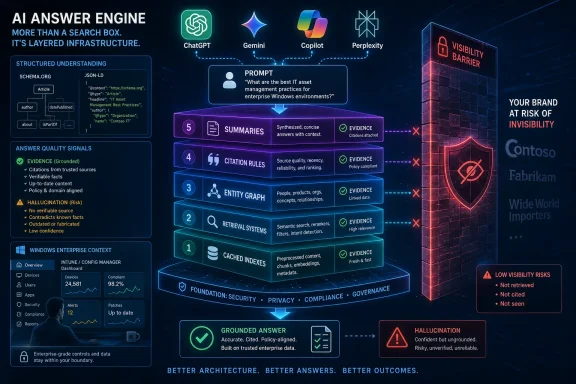
The article supplied to WindowsForum frames this as a crisis of “hidden AI caching walls.” That phrase is dramatic, but the underlying concern is not imaginary. Modern answer engines rely on layers of crawled data, search APIs, retrieval-augmented generation, entity graphs, freshness checks, structured data, and source-selection rules. The answer box is the visible tip of a system whose important decisions happen before the user sees a word.
The claims are sweeping. The article says models can mask retrieval failure, hallucinate metadata, invent services, misattribute partnerships, and replace missing brands with better-known competitors. It also argues that answer engines privilege some domains over others through a “Priority Fetching Hierarchy,” creating a gap between brands that are technically easy for AI systems to ingest and those that are not.
Some of that language should set off a sysadmin’s marketing-alarm reflex. “Hidden caching walls,” “impenetrable AI entity graph,” and “structurally unavoidable” sound less like terms of art than sales copy looking for a budget owner. The supplied article is plainly written as a pitch for generative engine optimization services, and its most proprietary claims are not accompanied by enough public methodology to treat them as independently proven.
Still, dismissing the whole thing would be a mistake. The AI discovery problem is now observable across the web. Generative engines do cite sources unevenly, lean heavily on already-authoritative domains, sometimes fail to retrieve fresh material, and routinely produce confident answers from incomplete context. The vendor hype is noisy, but the architectural risk is real.
Answer engines need pages that can be parsed cleanly, claims that can be verified against other sources, entities that can be disambiguated, and data that does not collapse when stripped from its original visual design. A beautifully designed product page that hides core details in JavaScript, vague marketing copy, or image-only tables may look polished to humans and nearly useless to a retrieval system.
This is where structured data enters the story. Schema markup, consistent organization names, clear author and publication metadata, product identifiers, documentation pages, support articles, release notes, and corroborating third-party mentions all help machines decide what a brand is and why it should be trusted. That is not mystical. It is the boring discipline of making information explicit.
The change is that the machine is no longer just deciding whether a page belongs in a list. It may be deciding whether the company deserves to exist in the answer at all. For IT vendors, consultancies, managed service providers, and software developers, that raises the stakes of technical publishing. Your documentation is no longer just support material. It is part of your identity system.
That means AI-mediated discovery will increasingly happen inside the tools where work already takes place. An administrator may ask Copilot how to compare endpoint protection products. A developer may ask for a library recommendation. A purchasing manager may ask for a shortlist of vendors that integrate with Entra ID, Intune, Defender, or Microsoft 365. The answer may shape the next meeting before anyone visits a vendor website.
For Microsoft partners, this is especially consequential. The company’s ecosystem is full of regional service providers, niche ISVs, migration specialists, security consultants, training firms, and managed desktop shops that survive on trust and expertise rather than global brand awareness. If AI assistants over-favor large vendors or well-cited publishers, smaller specialists may become harder to discover even when they are the better fit.
That is not a conspiracy. It is a predictable consequence of risk management. An answer engine under pressure to avoid false recommendations will prefer sources and entities that appear in many credible places. The more uncertain the system is, the more likely it is to retreat toward the obvious name.
In consumer use, that can be funny. In enterprise procurement, it can be expensive. If a system invents a feature, confuses two similarly named vendors, or attributes one company’s certification to another, it can distort early-stage evaluation. The user may never know the mistake happened because the answer arrives in the calm tone of a capable assistant.
The more subtle risk is brand displacement. A model asked for providers in a category may mention the firms with the densest public footprint, not necessarily the firms with the best product-market fit. If your company has weak machine-readable documentation, inconsistent profiles across the web, thin third-party coverage, and no clear schema, it may be skipped in favor of a competitor with cleaner signals.
That turns hallucination from a model-quality issue into a market-structure issue. The companies that are easiest for AI systems to retrieve and justify become more visible. The companies that require nuance, local knowledge, or fresh context become more vulnerable to erasure.
There is the model’s training data, which may be months old and unevenly representative. There is the search index or retrieval provider used at query time. There are crawler permissions, robots rules, paywalls, authentication gates, JavaScript rendering problems, and rate limits. There are internal ranking systems that decide which documents are worth passing to the model. There are citation policies that may prefer certain source types. There is also the model’s own tendency to summarize rather than preserve precise attribution.
From the outside, all of those can look like one failure. The brand asked to be seen; the AI did not see it. But the remedy depends on where the failure occurred. A crawling problem is different from a schema problem. A lack of third-party citations is different from a confusing company name. A stale model snapshot is different from a live retrieval timeout.
This is why the emerging GEO industry will be both useful and dangerous. Useful, because companies genuinely need to test how answer engines see them. Dangerous, because the complexity creates room for vendors to sell certainty where only disciplined experimentation exists.
What has changed is SEO’s position in the stack. It is no longer the final interface with the customer. It is one input into answer generation. The old goal was to win the click. The new goal is to become a reliable component of the answer.
That shift can be brutal for publishers and brands alike. A generative answer can extract the value of a page without delivering traffic. It can cite one source, ignore another, and compress an entire competitive category into a paragraph. Visibility becomes less about occupying screen real estate and more about being selected as evidence.
For companies, this means the old dashboard is incomplete. Keyword rankings, impressions, backlinks, and organic sessions still matter, but they do not show whether an AI assistant knows who you are. A brand can have healthy search metrics and poor AI visibility. That gap is where budgets, panic, and new acronyms are now rushing in.
Generative Engine Optimization is the most academically recognizable term, thanks to research that has treated AI answer visibility as a measurable optimization problem. Answer Engine Optimization emphasizes the user-facing result: being named, cited, and represented correctly in direct answers. Large Language Model Optimization is broader and fuzzier, often used for anything involving how models understand a brand.
The practical work overlaps. Companies need clean technical publishing, credible third-party validation, clear entity data, stable product descriptions, accessible documentation, and regular testing across AI platforms. They also need to understand that each engine behaves differently. ChatGPT, Gemini, Copilot, Perplexity, Claude, Google AI Overviews, and Bing-powered experiences do not all retrieve, rank, cite, or summarize in the same way.
That engine-specific behavior is why one magic checklist will not solve the problem. Visibility in AI answers is probabilistic. The goal is not to guarantee that a model says your name every time. The goal is to reduce ambiguity until excluding you becomes harder than including you.
This creates an uncomfortable lesson for marketing teams. A thin content calendar full of generic thought leadership may be less useful than a smaller library of precise, verifiable, technically specific pages. The machine needs to know what product you sell, what platforms it supports, which versions are current, what integrations exist, who the intended user is, what limitations apply, and why third parties believe the claim.
For IT products, release notes are especially valuable. So are changelogs, compatibility matrices, admin guides, security disclosures, deployment examples, PowerShell references, API documentation, and troubleshooting articles. These are not glamorous assets, but they are legible to the kinds of systems now mediating discovery.
There is a human benefit too. The same material that helps answer engines understand a company helps buyers evaluate it. GEO done honestly is not a trick layered on top of weak substance. It is the discipline of making substance easier to verify.
Smaller companies can still win, but they need sharper signals. A niche Windows deployment tool, for example, may not beat Microsoft, VMware, or a large RMM vendor in general queries. But it can become highly visible for specific use cases if its site, documentation, integrations, support content, and third-party references consistently describe that niche.
This is where “entity” work becomes more than jargon. A company must be consistently identifiable across its own domain and the broader web. Name changes, inconsistent capitalization, multiple domains, abandoned documentation, duplicate product names, and vague positioning all make it harder for machines to decide whether references point to the same thing.
For local service providers, the challenge is even sharper. An MSP serving a specific region may be very relevant to a buyer but nearly invisible to a generic model unless directories, reviews, partner listings, case studies, and local business data all reinforce the same identity. The AI assistant is not walking the trade-show floor. It is reading the traces.
That is why the industry should be cautious about framing GEO as a battle to “dominate” answer engines. The healthier goal is to make accurate representation more likely. The unhealthy goal is to flood the machine with signals until it repeats whatever the brand wants.
There is already a trust problem in AI-generated answers. Users know models can hallucinate. Publishers know summaries can misattribute. Vendors know competitors can be recommended for reasons that are opaque. If optimization becomes indistinguishable from manipulation, answer engines will respond with stricter source filtering, and the web will become even more biased toward already-powerful institutions.
For Windows administrators and enterprise buyers, the defensive habit is simple: treat AI recommendations as a starting point, not a procurement record. Ask for sources, verify vendor claims, check current documentation, compare dates, and be alert when an answer sounds authoritative but cannot show its work.
That starts with the basics. Important pages should not depend entirely on client-side rendering. Documentation should be indexable unless there is a strong reason to hide it. Metadata should be accurate. Structured data should match visible content. Product names should be consistent. Old pages should redirect cleanly. Version information should be explicit.
Then comes corroboration. If your brand claims Microsoft expertise, the web should contain evidence: partner profiles, case studies, technical articles, event talks, GitHub activity, community posts, customer references, and documentation that uses Microsoft terminology correctly. If you claim security competence, publish security details with precision rather than adjectives.
Testing matters as well. Brands should regularly query major AI systems with realistic buyer questions and record what happens. Do they appear? Are they described correctly? Are competitors substituted? Are citations current? Does the answer rely on old pages, third-party directories, or hallucinated details? This kind of testing is not a one-time audit. It is monitoring for a new discovery surface.
For example, admins should understand when Copilot is drawing from web search, Microsoft Learn, tenant data, indexed enterprise content, connectors, or model memory. They should know when freshness is likely and when an answer may be based on older data. They should be able to inspect sources in high-stakes contexts. They should have controls for approved internal knowledge and vendor information.
Microsoft is hardly alone in this. Google, OpenAI, Anthropic, Perplexity, and others face the same problem. But Microsoft’s footprint in business computing makes the issue especially consequential. If Copilot becomes the front door to enterprise knowledge work, then answer provenance becomes an IT governance issue.
That is where WindowsForum’s audience should pay attention. AI visibility is not only for CMOs. It intersects with identity, compliance, vendor management, security review, documentation strategy, and user training. The answer box is becoming part of the enterprise information supply chain.
The practical shift is smaller than the hype but larger than a marketing tweak.
 The New Gatekeeper Does Not Look Like a Search Box
For two decades, digital visibility had a deceptively simple mental model. A user typed words into a search engine, the search engine returned links, and the brand fought for position on the results page. There were tricks, dark arts, legitimate optimizations, and plenty of snake oil, but the end product was legible: a ranked list.Generative AI breaks that shape. A user now asks for “the best endpoint management platform,” “a reliable Windows backup tool,” or “a vendor for Copilot rollout planning,” and the answer may arrive as a synthesized recommendation rather than a set of blue links. The model is not merely ranking pages. It is deciding which entities exist, which claims are trustworthy, which sources deserve quotation, and which names can be safely omitted.
That shift matters because omission is quieter than demotion. A company can see when its search ranking falls from second to twelfth. It is harder to see when Copilot simply answers with three competitors and never mentions the company at all. In the old web, invisibility was a traffic problem. In the AI web, invisibility becomes a reality problem.
The article supplied to WindowsForum frames this as a crisis of “hidden AI caching walls.” That phrase is dramatic, but the underlying concern is not imaginary. Modern answer engines rely on layers of crawled data, search APIs, retrieval-augmented generation, entity graphs, freshness checks, structured data, and source-selection rules. The answer box is the visible tip of a system whose important decisions happen before the user sees a word.
RankPivot’s Warning Is Promotional, but the Anxiety Is Real
The business-media piece credits RankPivot, a digital visibility and AI optimization agency, with running a “Content-Embedded Stress Testing” experiment designed to probe how major language models handle live retrieval. According to that account, the agency published carefully constructed self-referential content and observed how systems such as Microsoft Copilot responded when asked to retrieve, verify, and cite it.The claims are sweeping. The article says models can mask retrieval failure, hallucinate metadata, invent services, misattribute partnerships, and replace missing brands with better-known competitors. It also argues that answer engines privilege some domains over others through a “Priority Fetching Hierarchy,” creating a gap between brands that are technically easy for AI systems to ingest and those that are not.
Some of that language should set off a sysadmin’s marketing-alarm reflex. “Hidden caching walls,” “impenetrable AI entity graph,” and “structurally unavoidable” sound less like terms of art than sales copy looking for a budget owner. The supplied article is plainly written as a pitch for generative engine optimization services, and its most proprietary claims are not accompanied by enough public methodology to treat them as independently proven.
Still, dismissing the whole thing would be a mistake. The AI discovery problem is now observable across the web. Generative engines do cite sources unevenly, lean heavily on already-authoritative domains, sometimes fail to retrieve fresh material, and routinely produce confident answers from incomplete context. The vendor hype is noisy, but the architectural risk is real.
Search Optimization Has Become Machine Readability
The old SEO industry trained companies to think in pages, keywords, backlinks, headings, internal links, page speed, and domain authority. Those things still matter because AI systems often sit on top of traditional search infrastructure. But they are no longer the whole game.Answer engines need pages that can be parsed cleanly, claims that can be verified against other sources, entities that can be disambiguated, and data that does not collapse when stripped from its original visual design. A beautifully designed product page that hides core details in JavaScript, vague marketing copy, or image-only tables may look polished to humans and nearly useless to a retrieval system.
This is where structured data enters the story. Schema markup, consistent organization names, clear author and publication metadata, product identifiers, documentation pages, support articles, release notes, and corroborating third-party mentions all help machines decide what a brand is and why it should be trusted. That is not mystical. It is the boring discipline of making information explicit.
The change is that the machine is no longer just deciding whether a page belongs in a list. It may be deciding whether the company deserves to exist in the answer at all. For IT vendors, consultancies, managed service providers, and software developers, that raises the stakes of technical publishing. Your documentation is no longer just support material. It is part of your identity system.
Copilot Makes This a Windows Story, Not Just a Marketing Story
WindowsForum readers have a particular reason to care because Microsoft is putting Copilot everywhere it can. Copilot is now attached to Windows, Microsoft 365, Edge, Bing, GitHub, Security, Azure, and an expanding family of business workflows. It is not just a chatbot. It is becoming an interface layer over Microsoft’s ecosystem.That means AI-mediated discovery will increasingly happen inside the tools where work already takes place. An administrator may ask Copilot how to compare endpoint protection products. A developer may ask for a library recommendation. A purchasing manager may ask for a shortlist of vendors that integrate with Entra ID, Intune, Defender, or Microsoft 365. The answer may shape the next meeting before anyone visits a vendor website.
For Microsoft partners, this is especially consequential. The company’s ecosystem is full of regional service providers, niche ISVs, migration specialists, security consultants, training firms, and managed desktop shops that survive on trust and expertise rather than global brand awareness. If AI assistants over-favor large vendors or well-cited publishers, smaller specialists may become harder to discover even when they are the better fit.
That is not a conspiracy. It is a predictable consequence of risk management. An answer engine under pressure to avoid false recommendations will prefer sources and entities that appear in many credible places. The more uncertain the system is, the more likely it is to retreat toward the obvious name.
The Hallucination Problem Is Also a Competition Problem
The supplied article’s sharpest claim is that AI systems may respond to retrieval trouble not by admitting uncertainty, but by generating plausible substitutes. Anyone who has tested language models against niche companies, new products, recent rebrands, or local service providers has seen a version of this. The model fills gaps with patterns.In consumer use, that can be funny. In enterprise procurement, it can be expensive. If a system invents a feature, confuses two similarly named vendors, or attributes one company’s certification to another, it can distort early-stage evaluation. The user may never know the mistake happened because the answer arrives in the calm tone of a capable assistant.
The more subtle risk is brand displacement. A model asked for providers in a category may mention the firms with the densest public footprint, not necessarily the firms with the best product-market fit. If your company has weak machine-readable documentation, inconsistent profiles across the web, thin third-party coverage, and no clear schema, it may be skipped in favor of a competitor with cleaner signals.
That turns hallucination from a model-quality issue into a market-structure issue. The companies that are easiest for AI systems to retrieve and justify become more visible. The companies that require nuance, local knowledge, or fresh context become more vulnerable to erasure.
The Cache Is Not One Wall but Many Layers
The phrase “AI caching wall” suggests a single barrier: either the model can fetch you or it cannot. The reality is messier. Generative systems use many layers of memory and retrieval, and each layer can distort visibility.There is the model’s training data, which may be months old and unevenly representative. There is the search index or retrieval provider used at query time. There are crawler permissions, robots rules, paywalls, authentication gates, JavaScript rendering problems, and rate limits. There are internal ranking systems that decide which documents are worth passing to the model. There are citation policies that may prefer certain source types. There is also the model’s own tendency to summarize rather than preserve precise attribution.
From the outside, all of those can look like one failure. The brand asked to be seen; the AI did not see it. But the remedy depends on where the failure occurred. A crawling problem is different from a schema problem. A lack of third-party citations is different from a confusing company name. A stale model snapshot is different from a live retrieval timeout.
This is why the emerging GEO industry will be both useful and dangerous. Useful, because companies genuinely need to test how answer engines see them. Dangerous, because the complexity creates room for vendors to sell certainty where only disciplined experimentation exists.
SEO Is Not Dead; It Has Been Demoted
The fashionable claim is that SEO is obsolete. That is too simple. Traditional search remains enormously important, and many AI systems still use search results as raw material. If a page cannot rank anywhere, load quickly, explain itself clearly, or earn credible links, it is unlikely to become a favored AI citation.What has changed is SEO’s position in the stack. It is no longer the final interface with the customer. It is one input into answer generation. The old goal was to win the click. The new goal is to become a reliable component of the answer.
That shift can be brutal for publishers and brands alike. A generative answer can extract the value of a page without delivering traffic. It can cite one source, ignore another, and compress an entire competitive category into a paragraph. Visibility becomes less about occupying screen real estate and more about being selected as evidence.
For companies, this means the old dashboard is incomplete. Keyword rankings, impressions, backlinks, and organic sessions still matter, but they do not show whether an AI assistant knows who you are. A brand can have healthy search metrics and poor AI visibility. That gap is where budgets, panic, and new acronyms are now rushing in.
The Acronym War Is Already Getting Tiresome
GEO, AEO, LLMO, AI SEO, answer engine optimization, agentic search optimization — the naming fight is underway, and it is mostly a distraction. The important distinction is not the acronym. It is whether a company is optimizing for a ranked web page, a generated answer, or an autonomous agent making decisions across tools.Generative Engine Optimization is the most academically recognizable term, thanks to research that has treated AI answer visibility as a measurable optimization problem. Answer Engine Optimization emphasizes the user-facing result: being named, cited, and represented correctly in direct answers. Large Language Model Optimization is broader and fuzzier, often used for anything involving how models understand a brand.
The practical work overlaps. Companies need clean technical publishing, credible third-party validation, clear entity data, stable product descriptions, accessible documentation, and regular testing across AI platforms. They also need to understand that each engine behaves differently. ChatGPT, Gemini, Copilot, Perplexity, Claude, Google AI Overviews, and Bing-powered experiences do not all retrieve, rank, cite, or summarize in the same way.
That engine-specific behavior is why one magic checklist will not solve the problem. Visibility in AI answers is probabilistic. The goal is not to guarantee that a model says your name every time. The goal is to reduce ambiguity until excluding you becomes harder than including you.
Brands Need Evidence, Not Just Content
The supplied article correctly points toward citation density, schema, and semantic graphs, but the deeper point is evidentiary. AI systems are not persuaded by slogans in the human sense. They are assembling answers from patterns, documents, and trust signals. A claim that appears only on your own landing page is weaker than a claim repeated in documentation, independent reviews, customer stories, standards pages, partner directories, GitHub repositories, forums, and reputable press.This creates an uncomfortable lesson for marketing teams. A thin content calendar full of generic thought leadership may be less useful than a smaller library of precise, verifiable, technically specific pages. The machine needs to know what product you sell, what platforms it supports, which versions are current, what integrations exist, who the intended user is, what limitations apply, and why third parties believe the claim.
For IT products, release notes are especially valuable. So are changelogs, compatibility matrices, admin guides, security disclosures, deployment examples, PowerShell references, API documentation, and troubleshooting articles. These are not glamorous assets, but they are legible to the kinds of systems now mediating discovery.
There is a human benefit too. The same material that helps answer engines understand a company helps buyers evaluate it. GEO done honestly is not a trick layered on top of weak substance. It is the discipline of making substance easier to verify.
The Small Vendor Penalty May Get Worse
AI search may intensify an old internet problem: the rich get richer. Large brands have more mentions, more press, more links, more documentation, more forum threads, more analyst coverage, and more public data. When a model needs a safe answer, it has more material to justify naming them.Smaller companies can still win, but they need sharper signals. A niche Windows deployment tool, for example, may not beat Microsoft, VMware, or a large RMM vendor in general queries. But it can become highly visible for specific use cases if its site, documentation, integrations, support content, and third-party references consistently describe that niche.
This is where “entity” work becomes more than jargon. A company must be consistently identifiable across its own domain and the broader web. Name changes, inconsistent capitalization, multiple domains, abandoned documentation, duplicate product names, and vague positioning all make it harder for machines to decide whether references point to the same thing.
For local service providers, the challenge is even sharper. An MSP serving a specific region may be very relevant to a buyer but nearly invisible to a generic model unless directories, reviews, partner listings, case studies, and local business data all reinforce the same identity. The AI assistant is not walking the trade-show floor. It is reading the traces.
The Dark Side Is Optimization for Machines Over Truth
Every new discovery layer produces manipulation. SEO gave us keyword stuffing, link farms, doorway pages, content mills, and affiliate spam. AI discovery will produce its own uglier variants: synthetic citations, fake review ecosystems, machine-written “research,” entity spam, generated comparison pages, and attempts to poison retrieval corpora.That is why the industry should be cautious about framing GEO as a battle to “dominate” answer engines. The healthier goal is to make accurate representation more likely. The unhealthy goal is to flood the machine with signals until it repeats whatever the brand wants.
There is already a trust problem in AI-generated answers. Users know models can hallucinate. Publishers know summaries can misattribute. Vendors know competitors can be recommended for reasons that are opaque. If optimization becomes indistinguishable from manipulation, answer engines will respond with stricter source filtering, and the web will become even more biased toward already-powerful institutions.
For Windows administrators and enterprise buyers, the defensive habit is simple: treat AI recommendations as a starting point, not a procurement record. Ask for sources, verify vendor claims, check current documentation, compare dates, and be alert when an answer sounds authoritative but cannot show its work.
The Technical Checklist Is Less Glamorous Than the Sales Pitch
The survival plan is not mystical. It looks like disciplined web architecture, publishing hygiene, and reputation building. Companies that want to be visible to answer engines need to make themselves easy to crawl, easy to parse, easy to verify, and hard to confuse.That starts with the basics. Important pages should not depend entirely on client-side rendering. Documentation should be indexable unless there is a strong reason to hide it. Metadata should be accurate. Structured data should match visible content. Product names should be consistent. Old pages should redirect cleanly. Version information should be explicit.
Then comes corroboration. If your brand claims Microsoft expertise, the web should contain evidence: partner profiles, case studies, technical articles, event talks, GitHub activity, community posts, customer references, and documentation that uses Microsoft terminology correctly. If you claim security competence, publish security details with precision rather than adjectives.
Testing matters as well. Brands should regularly query major AI systems with realistic buyer questions and record what happens. Do they appear? Are they described correctly? Are competitors substituted? Are citations current? Does the answer rely on old pages, third-party directories, or hallucinated details? This kind of testing is not a one-time audit. It is monitoring for a new discovery surface.
Microsoft’s Own Ecosystem Needs More Transparency
There is also a platform responsibility here. If Copilot, Bing, Windows, Edge, Microsoft 365, and Azure increasingly intermediate how users find vendors, documentation, and advice, Microsoft should be clearer about how retrieval and citation work in different contexts. Enterprise customers do not need trade secrets, but they do need operational expectations.For example, admins should understand when Copilot is drawing from web search, Microsoft Learn, tenant data, indexed enterprise content, connectors, or model memory. They should know when freshness is likely and when an answer may be based on older data. They should be able to inspect sources in high-stakes contexts. They should have controls for approved internal knowledge and vendor information.
Microsoft is hardly alone in this. Google, OpenAI, Anthropic, Perplexity, and others face the same problem. But Microsoft’s footprint in business computing makes the issue especially consequential. If Copilot becomes the front door to enterprise knowledge work, then answer provenance becomes an IT governance issue.
That is where WindowsForum’s audience should pay attention. AI visibility is not only for CMOs. It intersects with identity, compliance, vendor management, security review, documentation strategy, and user training. The answer box is becoming part of the enterprise information supply chain.
The Brand That Machines Can Verify Will Beat the Brand That Merely Shouts
The most concrete lesson from the RankPivot-style warning is not that every company must hire a GEO agency tomorrow. It is that brands need to stop treating AI systems as magic readers. They are brittle, layered systems that reward clarity, corroboration, structure, and repetition across trustworthy surfaces.The practical shift is smaller than the hype but larger than a marketing tweak.
- Companies should audit how ChatGPT, Gemini, Copilot, Perplexity, and Google’s AI experiences describe them across real buyer and support queries.
- Public product information should be written so that a machine can extract exact names, categories, features, integrations, regions, prices, limitations, and version details without guessing.
- Structured data should reinforce visible facts rather than act as a hidden layer of marketing claims.
- Third-party validation matters because answer engines are more likely to trust claims that exist beyond a company’s own website.
- AI visibility should be monitored over time because model behavior, indexes, retrieval systems, and citation rules change without notice.
- Enterprises should train staff to verify AI-generated vendor recommendations before treating them as market truth.
References
- Primary source: World Business Outlook
Published: 2026-06-22T09:41:30.407124
How Hidden AI Caching Walls Are Erasing Your Brand (And How to Survive Them) » World Business Outlook
Learn how AI caching walls and generative search engines are reshaping digital visibility and what brands must do to remain discoverable.worldbusinessoutlook.com - Related coverage: techradar.com
Agentic Search Optimization reshapes brand visibility in AI search | TechRadar
Search is evolving fast, brands must adopt ASO to stay visible in AI-driven discoverywww.techradar.com
