

Aldershot High School Grade 12 student Carter Young placed third in Best Buy Canada’s Teen Tech Network AI Art Video Challenge in June 2026 and asked that his $5,000 prize be donated to Aldershot’s multimedia program, where he developed the production skills behind his entry. That is the clean factual version of the story. The more interesting version is that a teenager used an AI contest to make the least automated point possible: the machine did not win the prize; the student’s judgment did. In a moment when schools are still deciding whether generative AI belongs in the classroom, Young’s project argues that the answer depends less on the software than on the curriculum around it.
Young’s third-place finish in a national AI video competition could have been filed as a familiar feel-good education story: talented student enters contest, earns prize, makes school proud. But the donation changes the center of gravity. By directing the $5,000 award back to Aldershot High School’s multimedia program, Young turned an individual win into an argument for the public classroom as a technology incubator.
That matters because generative AI is often sold as a shortcut around training. The pitch is seductive: type the prompt, receive the image, skip the messy middle. Young’s own account points in the opposite direction. He said the knowledge he gained in class — the manual, non-magical work of making media — was what allowed him to get useful results from the AI tools.
The contest asked students to move through a process that included concept development, storyboarding, planning, and production. That structure is important. It treats AI not as a vending machine for content but as one instrument in a longer creative workflow. In other words, the contest rewarded the same thing good media classes have always tried to teach: intention.
The donation also gives the story a practical ending. Aldershot multimedia teacher Warren Hutton hopes the money can help purchase a higher-end video camera for students. That is almost poetically apt. An AI video prize may wind up funding traditional production hardware, because the future of creative technology still depends on students understanding light, framing, motion, editing, and taste.
That is a more mature idea than much of the marketing around generative AI. The industry’s loudest demos tend to emphasize instantaneous output: a poster in seconds, a video from a sentence, a presentation from a meeting transcript. The implication is that the friction has been removed. Young’s project insists that the friction has merely moved.
The friction now lives in prompt craft, iteration, selection, editing, and knowing when the generated result is not good enough. Young described early tools as limited and said he moved to more advanced ones to get closer to the cinematic quality he imagined. That is not the workflow of someone passively accepting machine output. It is the workflow of a young creator learning where the software bends and where it resists.
The greenhouse image works because it preserves human agency without pretending the tool is irrelevant. A greenhouse is artificial. It manipulates light, temperature, and moisture. But it does not make the gardener obsolete. It gives the gardener a different environment in which skill becomes visible.
That distinction is where education becomes essential. A student without visual vocabulary may see a plausible clip and stop. A student with training in composition, pacing, editing, and genre can identify what is missing. The better the student’s taste, the more demanding the interaction with the machine becomes.
This is one of the reasons the “AI will let anyone create anything” line has always been too simplistic. Generative systems lower the barrier to producing something, but they do not automatically raise the user’s ability to judge it. In many creative fields, judgment is the scarce resource. Young’s success suggests he had enough of it to keep pushing.
Hutton’s comments reinforce that point. He described the contest as open-ended and difficult, not simply a matter of typing a few words and moving on. That framing is useful because it resists both panic and hype. The work changed, but it remained work.
That is the layer schools should be fighting to preserve. If AI tools are introduced into education as isolated gadgets, they will mostly reward students who already know how to experiment, troubleshoot, and self-direct. If they are introduced inside serious media, art, computer science, and design programs, they can become a way to teach process more explicitly.
Young’s project appears to have benefited from exactly that structure. The competition required modules. The classroom supplied prior knowledge. The teacher supplied expectations. The student supplied persistence. Remove any one of those pieces and the story becomes much less interesting.
This is also why the prize going back into equipment matters. Schools do not need to choose between AI literacy and conventional production literacy. In fact, the two now reinforce each other. A student who has shot video manually is better equipped to notice when generated video looks wrong. A student who has edited real footage is better equipped to shape generated clips into something coherent.
Teachers are being asked to prepare students for a labor market whose rules are changing while the students are still in school. In creative fields, the threat is especially visible. Tasks once reserved for junior designers, editors, animators, illustrators, and production assistants are increasingly the subject of AI demos and corporate pilots.
But refusing to teach the tools would not protect students. It would only make them less prepared for the workplaces they are likely to enter. The harder task is teaching AI as both capability and disruption: something students can use, critique, and compete with.
Young’s experience offers one model. He did not merely generate clips; he built a concept, worked through limitations, edited the result, and aligned the submission with a rubric. Those are portable skills. They apply whether the tool is a camera, a nonlinear editor, a text-to-video model, or whatever replaces today’s AI platforms.
The employment question remains unresolved. But the classroom response cannot be nostalgia. It has to be literacy plus craft, skepticism plus practice.
AI makes that lesson sharper. Because generative tools can produce endless variations, students can easily mistake abundance for progress. A rubric forces the opposite discipline. It asks whether the work meets the actual criteria, not whether the latest version looks cool.
That is a deeply practical lesson for anyone entering engineering, computer science, design, or media. In professional settings, “I made something interesting” is rarely enough. The work has to solve the assigned problem. It has to satisfy requirements. It has to survive evaluation by someone other than its creator.
Young’s reported attention to detail gave him an edge over other submissions. That detail is the antidote to generic AI output. When everyone can generate a clip, the differentiator becomes the specificity of the idea and the rigor of the assembly.
That experience will sound familiar to professionals testing AI video tools today. The outputs can be striking, but control is uneven. Continuity can break. Motion can feel uncanny. Style can drift. A prompt that seems clear to a human may produce something close in mood and wrong in execution.
For students, that limitation can be educational. The machine’s failure becomes a prompt for analysis: What is wrong with this shot? Why does the motion feel false? What visual cue would make the scene read properly? How should these fragments be edited so the audience understands the story?
In that sense, imperfect AI tools may be better for learning than perfect ones. They force students to diagnose, not merely consume. Young’s favorite part of the competition was reportedly the editing stage, where he assembled the AI-generated files into the final piece. That makes sense. Editing is where intention reasserts itself.
That does not make the contest cynical. It does make it strategic. Companies that sell computers, cameras, tablets, software, and services benefit when students see technology as a medium rather than a sealed appliance. A challenge like this creates a story around possibility: young people using new tools to make original work.
The risk is that corporate AI education can become marketing with a lesson plan attached. The best defense against that is the kind of classroom mediation visible here. Hutton’s skepticism matters because it prevents the contest from becoming a simple advertisement for AI optimism. The school’s role matters because it grounds the tools in a broader curriculum.
Young’s donation further complicates the corporate narrative in a good way. The money does not simply validate the platform or the sponsor. It returns to the public educational setting that made his participation meaningful. The loop closes around the classroom, not the brand.
Banning AI outright is increasingly unrealistic. Uncritically embracing it is irresponsible. The middle path requires teachers who understand both the promise and the threat, administrators willing to fund serious programs, and students who are encouraged to treat AI as a tool that demands judgment.
Young’s trajectory fits that middle path. He is graduating and hopes to study engineering and computer science at Wilfrid Laurier University, while continuing to keep multimedia in the picture. That combination is telling. The future workforce will not divide neatly into “technical” and “creative” camps. AI is making the boundary messier.
For WindowsForum readers, this should feel familiar. The PC has always been a hybrid machine: productivity tool, programming environment, editing bay, gaming rig, lab bench, and creative studio. AI does not erase that identity. It extends it, while raising the cost of not understanding what the machine is doing.
That distinction separates users from operators. A user accepts the output. An operator interrogates it. A user is impressed that the tool generated video at all. An operator asks whether the shot supports the concept, whether the sequence communicates, whether the tone matches the assignment, and whether the final edit holds together.
Schools should be trying to produce operators. So should companies, frankly, though many would prefer frictionless users. The more powerful AI systems become, the more dangerous it is to train students only to consume what they produce.
Young’s “guiding hand” metaphor captures this better than most institutional AI statements. The human does not need to perform every task manually to remain essential. But the human does need enough knowledge to direct, evaluate, and revise. Without that, the tool becomes less a collaborator than a slot machine.
A better camera will not only help students shoot cleaner footage. It will teach them why lenses matter, why lighting changes mood, why stabilization affects attention, and why resolution is not the same as quality. Those lessons carry directly into AI video generation because they give students the language to ask for better outputs and the standards to reject weaker ones.
This is the most grounded version of AI education: not a futuristic lab sealed off from existing arts and technology programs, but an upgrade to the whole creative stack. Students learn traditional tools. They experiment with new ones. They compare them. They discover where automation helps and where it fails.
That approach is also more equitable. Not every student has access to high-end gear, paid AI tools, or mentors outside school. A well-funded public program can make advanced creative work less dependent on family resources. Young’s donation strengthens the shared infrastructure, which means the next student’s starting line moves forward.
The winning formula was not “AI plus teenager equals magic.” It was AI plus instruction, AI plus iteration, AI plus editing, AI plus taste, AI plus a teacher willing to be both supportive and wary. That is a more complicated story, and therefore a more useful one.
For IT pros and administrators, the parallel is obvious. Organizations that deploy AI without process tend to get noise at scale. Organizations that embed AI into disciplined workflows are more likely to get leverage. The same appears true in classrooms.
The Aldershot story also pushes back against the notion that AI makes foundational skills obsolete. Young himself said the opposite: without the manual knowledge learned in class, he did not think he would have competed as well as he did. That sentence should be printed above every school board debate about AI tools.
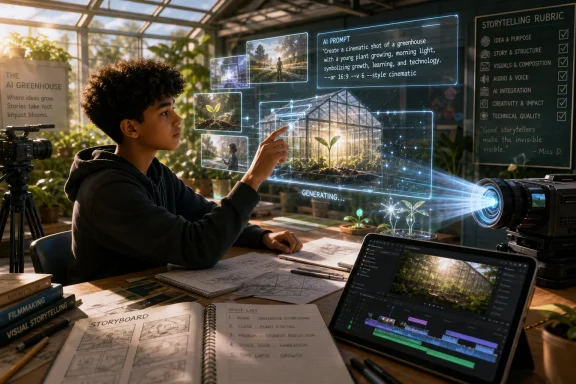 The Prize Went Back to the Place That Made the Work Possible
Young’s third-place finish in a national AI video competition could have been filed as a familiar feel-good education story: talented student enters contest, earns prize, makes school proud. But the donation changes the center of gravity. By directing the $5,000 award back to Aldershot High School’s multimedia program, Young turned an individual win into an argument for the public classroom as a technology incubator.That matters because generative AI is often sold as a shortcut around training. The pitch is seductive: type the prompt, receive the image, skip the messy middle. Young’s own account points in the opposite direction. He said the knowledge he gained in class — the manual, non-magical work of making media — was what allowed him to get useful results from the AI tools.
The contest asked students to move through a process that included concept development, storyboarding, planning, and production. That structure is important. It treats AI not as a vending machine for content but as one instrument in a longer creative workflow. In other words, the contest rewarded the same thing good media classes have always tried to teach: intention.
The donation also gives the story a practical ending. Aldershot multimedia teacher Warren Hutton hopes the money can help purchase a higher-end video camera for students. That is almost poetically apt. An AI video prize may wind up funding traditional production hardware, because the future of creative technology still depends on students understanding light, framing, motion, editing, and taste.
The Digital Greenhouse Is a Better AI Metaphor Than the Industry Deserves
Young’s entry, The Digital Greenhouse, reportedly depicts a person planting a seed and tending it as it grows, using AI-generated clips edited into a finished video. The metaphor is not subtle, but it is well chosen. AI does not replace cultivation; it changes the conditions under which cultivation happens.That is a more mature idea than much of the marketing around generative AI. The industry’s loudest demos tend to emphasize instantaneous output: a poster in seconds, a video from a sentence, a presentation from a meeting transcript. The implication is that the friction has been removed. Young’s project insists that the friction has merely moved.
The friction now lives in prompt craft, iteration, selection, editing, and knowing when the generated result is not good enough. Young described early tools as limited and said he moved to more advanced ones to get closer to the cinematic quality he imagined. That is not the workflow of someone passively accepting machine output. It is the workflow of a young creator learning where the software bends and where it resists.
The greenhouse image works because it preserves human agency without pretending the tool is irrelevant. A greenhouse is artificial. It manipulates light, temperature, and moisture. But it does not make the gardener obsolete. It gives the gardener a different environment in which skill becomes visible.
Prompting Is Not a Replacement for Craft
One of the more revealing details in Young’s account is that he had to word his instructions carefully when trying to generate a specific visual style. Anyone who has used modern image or video generators will recognize the pattern. The first result is often impressive in a broad, demo-friendly sense and wrong in several ways that only become obvious when the creator has a specific outcome in mind.That distinction is where education becomes essential. A student without visual vocabulary may see a plausible clip and stop. A student with training in composition, pacing, editing, and genre can identify what is missing. The better the student’s taste, the more demanding the interaction with the machine becomes.
This is one of the reasons the “AI will let anyone create anything” line has always been too simplistic. Generative systems lower the barrier to producing something, but they do not automatically raise the user’s ability to judge it. In many creative fields, judgment is the scarce resource. Young’s success suggests he had enough of it to keep pushing.
Hutton’s comments reinforce that point. He described the contest as open-ended and difficult, not simply a matter of typing a few words and moving on. That framing is useful because it resists both panic and hype. The work changed, but it remained work.
The Classroom Became the Missing Layer in the AI Stack
The most important technology in this story may not be the generative video software. It may be the classroom that taught Young how to use it critically. Aldershot’s multimedia Specialist High Skills Major program gave him a context in which AI output could be evaluated against established production habits rather than treated as a novelty.That is the layer schools should be fighting to preserve. If AI tools are introduced into education as isolated gadgets, they will mostly reward students who already know how to experiment, troubleshoot, and self-direct. If they are introduced inside serious media, art, computer science, and design programs, they can become a way to teach process more explicitly.
Young’s project appears to have benefited from exactly that structure. The competition required modules. The classroom supplied prior knowledge. The teacher supplied expectations. The student supplied persistence. Remove any one of those pieces and the story becomes much less interesting.
This is also why the prize going back into equipment matters. Schools do not need to choose between AI literacy and conventional production literacy. In fact, the two now reinforce each other. A student who has shot video manually is better equipped to notice when generated video looks wrong. A student who has edited real footage is better equipped to shape generated clips into something coherent.
The Teacher’s Skepticism Is Not a Contradiction
Hutton’s reaction contains the tension every serious educator now faces. He celebrated Young’s growth while also expressing skepticism about how AI might affect the employment prospects of students learning these tools. That is not hypocrisy. It is the honest position.Teachers are being asked to prepare students for a labor market whose rules are changing while the students are still in school. In creative fields, the threat is especially visible. Tasks once reserved for junior designers, editors, animators, illustrators, and production assistants are increasingly the subject of AI demos and corporate pilots.
But refusing to teach the tools would not protect students. It would only make them less prepared for the workplaces they are likely to enter. The harder task is teaching AI as both capability and disruption: something students can use, critique, and compete with.
Young’s experience offers one model. He did not merely generate clips; he built a concept, worked through limitations, edited the result, and aligned the submission with a rubric. Those are portable skills. They apply whether the tool is a camera, a nonlinear editor, a text-to-video model, or whatever replaces today’s AI platforms.
The employment question remains unresolved. But the classroom response cannot be nostalgia. It has to be literacy plus craft, skepticism plus practice.
The Rubric May Have Been the Hidden Lesson
Hutton’s observation that Young learned to work to the rubric rather than only to his own tastes deserves more attention. For young creatives, this is often a difficult transition. Personal style matters, but professional work usually happens inside constraints set by clients, judges, audiences, budgets, platforms, or institutions.AI makes that lesson sharper. Because generative tools can produce endless variations, students can easily mistake abundance for progress. A rubric forces the opposite discipline. It asks whether the work meets the actual criteria, not whether the latest version looks cool.
That is a deeply practical lesson for anyone entering engineering, computer science, design, or media. In professional settings, “I made something interesting” is rarely enough. The work has to solve the assigned problem. It has to satisfy requirements. It has to survive evaluation by someone other than its creator.
Young’s reported attention to detail gave him an edge over other submissions. That detail is the antidote to generic AI output. When everyone can generate a clip, the differentiator becomes the specificity of the idea and the rigor of the assembly.
AI Video Is Still a Fight With the Machine
Generative video has advanced rapidly, but Young’s comments show that it remains stubborn in the ways that matter to creators. He wanted cinematic results. The tools did not automatically produce them. He had to experiment, adjust, and move beyond the initial systems he used.That experience will sound familiar to professionals testing AI video tools today. The outputs can be striking, but control is uneven. Continuity can break. Motion can feel uncanny. Style can drift. A prompt that seems clear to a human may produce something close in mood and wrong in execution.
For students, that limitation can be educational. The machine’s failure becomes a prompt for analysis: What is wrong with this shot? Why does the motion feel false? What visual cue would make the scene read properly? How should these fragments be edited so the audience understands the story?
In that sense, imperfect AI tools may be better for learning than perfect ones. They force students to diagnose, not merely consume. Young’s favorite part of the competition was reportedly the editing stage, where he assembled the AI-generated files into the final piece. That makes sense. Editing is where intention reasserts itself.
Best Buy’s Contest Is Also a Retailer’s Bet on AI Literacy
Best Buy Canada’s role should not be treated as incidental. A national AI art video challenge is a community investment, but it is also part of a broader commercial moment in which consumer technology companies want AI to feel approachable, creative, and useful. Retailers have a stake in making AI tools legible to families, schools, and young buyers.That does not make the contest cynical. It does make it strategic. Companies that sell computers, cameras, tablets, software, and services benefit when students see technology as a medium rather than a sealed appliance. A challenge like this creates a story around possibility: young people using new tools to make original work.
The risk is that corporate AI education can become marketing with a lesson plan attached. The best defense against that is the kind of classroom mediation visible here. Hutton’s skepticism matters because it prevents the contest from becoming a simple advertisement for AI optimism. The school’s role matters because it grounds the tools in a broader curriculum.
Young’s donation further complicates the corporate narrative in a good way. The money does not simply validate the platform or the sponsor. It returns to the public educational setting that made his participation meaningful. The loop closes around the classroom, not the brand.
A Local Story Lands Inside a National Argument
It is tempting to keep this story small: one Burlington-area student, one school program, one contest placement. But local education stories often reveal national policy problems more clearly than official statements do. Here, the problem is how schools should handle AI when the technology is already arriving through contests, consumer software, workplace expectations, and student curiosity.Banning AI outright is increasingly unrealistic. Uncritically embracing it is irresponsible. The middle path requires teachers who understand both the promise and the threat, administrators willing to fund serious programs, and students who are encouraged to treat AI as a tool that demands judgment.
Young’s trajectory fits that middle path. He is graduating and hopes to study engineering and computer science at Wilfrid Laurier University, while continuing to keep multimedia in the picture. That combination is telling. The future workforce will not divide neatly into “technical” and “creative” camps. AI is making the boundary messier.
For WindowsForum readers, this should feel familiar. The PC has always been a hybrid machine: productivity tool, programming environment, editing bay, gaming rig, lab bench, and creative studio. AI does not erase that identity. It extends it, while raising the cost of not understanding what the machine is doing.
The Real Divide Is Between Users and Operators
The phrase “AI literacy” is already in danger of becoming a slogan. Young’s project gives it a more concrete meaning. Literacy is not merely knowing that AI exists or being able to type a prompt. It is knowing how to operate inside a workflow where the machine produces options and the human remains responsible for the result.That distinction separates users from operators. A user accepts the output. An operator interrogates it. A user is impressed that the tool generated video at all. An operator asks whether the shot supports the concept, whether the sequence communicates, whether the tone matches the assignment, and whether the final edit holds together.
Schools should be trying to produce operators. So should companies, frankly, though many would prefer frictionless users. The more powerful AI systems become, the more dangerous it is to train students only to consume what they produce.
Young’s “guiding hand” metaphor captures this better than most institutional AI statements. The human does not need to perform every task manually to remain essential. But the human does need enough knowledge to direct, evaluate, and revise. Without that, the tool becomes less a collaborator than a slot machine.
The Camera Fund Says More Than the Trophy
Near the close of the story, the prospective use of the prize money comes into focus: a higher-end video camera for the multimedia program. That detail should not be overlooked. The obvious AI-era purchase might be software subscriptions, faster GPUs, or cloud credits. A camera is a reminder that creative education still begins with seeing.A better camera will not only help students shoot cleaner footage. It will teach them why lenses matter, why lighting changes mood, why stabilization affects attention, and why resolution is not the same as quality. Those lessons carry directly into AI video generation because they give students the language to ask for better outputs and the standards to reject weaker ones.
This is the most grounded version of AI education: not a futuristic lab sealed off from existing arts and technology programs, but an upgrade to the whole creative stack. Students learn traditional tools. They experiment with new ones. They compare them. They discover where automation helps and where it fails.
That approach is also more equitable. Not every student has access to high-end gear, paid AI tools, or mentors outside school. A well-funded public program can make advanced creative work less dependent on family resources. Young’s donation strengthens the shared infrastructure, which means the next student’s starting line moves forward.
The Small Aldershot Lesson the AI Industry Keeps Missing
Young’s third-place finish is not a referendum on generative AI, and it should not be inflated into one. It is one student’s successful project in one national contest. But the details point toward a healthier way to talk about AI in schools.The winning formula was not “AI plus teenager equals magic.” It was AI plus instruction, AI plus iteration, AI plus editing, AI plus taste, AI plus a teacher willing to be both supportive and wary. That is a more complicated story, and therefore a more useful one.
For IT pros and administrators, the parallel is obvious. Organizations that deploy AI without process tend to get noise at scale. Organizations that embed AI into disciplined workflows are more likely to get leverage. The same appears true in classrooms.
The Aldershot story also pushes back against the notion that AI makes foundational skills obsolete. Young himself said the opposite: without the manual knowledge learned in class, he did not think he would have competed as well as he did. That sentence should be printed above every school board debate about AI tools.
What Aldershot’s Greenhouse Grows Next
The practical lesson from Young’s project is not that every school needs an AI video contest. It is that schools need creative and technical programs strong enough to absorb new tools without being swallowed by them. One student’s prize donation will not solve the funding problem, but it shows where the leverage is.- Carter Young’s third-place finish matters because the project rewarded process, not just AI-generated output.
- His decision to donate the $5,000 prize back to Aldershot’s multimedia program turns a personal award into shared classroom infrastructure.
- The project’s greenhouse metaphor makes a useful point: generative AI still needs human direction, taste, and revision.
- Warren Hutton’s skepticism about AI and employment is part of the story, not a footnote, because schools must prepare students for tools that may also disrupt their future jobs.
- The likely purchase of a higher-end video camera underlines that traditional media skills remain essential in an AI workflow.
- The broader lesson for educators and IT leaders is that AI works best when it is embedded in disciplined practice rather than treated as a shortcut around it.
References
- Primary source: burlingtontoday.com
Published: 2026-06-20T13:30:18.569475
MUST READ: Aldershot High School student Carter Young places third in national AI video contest - BurlingtonToday.com
After placing third in Best Buy Canada’s Tech Network AI Art Video Challenge, Aldershot High’s Carter Young has requested that his $5,000 prize be donated to the class that helped him build the skills to competewww.burlingtontoday.com - Related coverage: blog.bestbuy.ca
- Related coverage: fox10tv.com
50 Distinguished Young Women arrive in Mobile Tuesday for national finals
Mobile set to welcome nation’s brightest young women for a tradition nearly 70 years in the makingwww.fox10tv.com
- Related coverage: partners.bestbuy.com
