

Between 2024 and 2026, generative AI moved from a widely discussed classroom experiment to a near-universal study tool, with UK undergraduate use rising from 66 percent to 95 percent and Canadian student use climbing to 73 percent by 2025. The numbers make one thing plain: higher education is no longer deciding whether students will use AI. It is deciding whether that use will sharpen judgment or quietly outsource it. The uncomfortable lesson for universities, employers, and technology vendors is that AI literacy without critical thinking is just a faster route to confident error.
The most important fact in the latest student AI surveys is not that students are using ChatGPT, Gemini, Copilot, NotebookLM, and similar tools. It is that the behavior has become ordinary. In the space of three academic years, generative AI has gone from novelty to infrastructure, the digital equivalent of search, spellcheck, and cloud storage.
That shift matters because institutions often regulate new tools as if they are optional add-ons. A campus can ban a calculator in an exam room, block a website on a managed network, or require a citation style for a paper. But it cannot realistically pretend that a general-purpose language model is absent from the intellectual life of students who already use it for brainstorming, summarizing, outlining, coding, translation, revision, and emotional reassurance.
This is why the old framing — AI as primarily an academic misconduct problem — is losing explanatory power. Cheating still matters, and universities cannot simply shrug at fabricated essays or undisclosed machine-written submissions. But if 95 percent of UK students say they use AI in at least one way, then the policy challenge is no longer catching the outliers. It is teaching the majority.
The anxiety around critical thinking is therefore not a moral panic about students becoming lazy. It is a systems problem. Students have been handed a tool that can imitate synthesis, fluency, and confidence before they have always developed the habits needed to test those performances.
The danger begins when the on-ramp becomes the road. A model can produce a plausible overview of a topic without understanding the topic in the human sense. It can supply a citation-shaped answer, a literature-review-shaped paragraph, or a polished argument that feels complete precisely because it hides the uncertainty, gaps, and false starts that learning normally exposes.
That is why the Canadian finding that nearly half of surveyed students felt their critical thinking had deteriorated after adopting AI should be taken seriously. The problem is not that the machine gives answers. The problem is that it gives answers in a tone that discourages interrogation. It often sounds finished before the user has begun.
For WindowsForum readers, this should feel familiar from another domain: troubleshooting. Anyone who has ever copied a command from a forum post, run a registry tweak, or followed a driver-fix thread knows the difference between executing instructions and understanding the system. AI can generate the instructions. It cannot absolve the user from knowing whether they are sane.
But the plagiarism frame narrows the issue too much. It asks whether the student wrote the text. The deeper educational question asks whether the student can judge the text. In an AI-saturated environment, authorship is only one part of academic integrity; verification, disclosure, source evaluation, and intellectual accountability become just as important.
A student who submits an AI-generated essay without reading it has failed. A student who uses AI to generate possible counterarguments, checks them against course readings, rejects the weak ones, and explains the process may be doing something closer to real scholarship than a student who writes a mediocre paper in isolation. The distinction is not whether a chatbot was present. The distinction is whether the student remained intellectually responsible.
This is where many policies have lagged. Students report uncertainty not simply because they want permission to cheat, but because course rules can be inconsistent, vague, or punitive. One instructor treats AI as a banned ghostwriter. Another encourages it for ideation. A third says nothing until misconduct proceedings begin. That ambiguity teaches risk management, not literacy.
That does not make the tools magically safe. Institutional deployment can reduce some risks, especially around data handling, support, and consistent access, but it cannot eliminate hallucinations, bias, shallow reasoning, or overconfidence. A university-branded chatbot can still be wrong. A managed NotebookLM workspace can still encourage a student to accept a tidy summary instead of wrestling with the original source.
Still, supervised adoption changes the educational posture. Instead of treating AI as contraband, it treats AI as a lab instrument. Students can be taught when to use it, how to disclose it, what not to feed into it, and how to compare its output with primary material. That is a more mature response than hoping detection software can restore a pre-2022 world.
The use of custom prompts or “Gems” also hints at a practical middle ground. A student can configure a tool to act as a brainstorming partner, a simplifier, an editor, or a source-checking assistant. But the label matters less than the discipline behind it. A “fact checker” prompt is only useful if the student understands what counts as a fact, what counts as a reliable source, and when the model is merely laundering uncertainty through confident prose.
That is not a neutral development. Copilot, Gemini, ChatGPT, and NotebookLM are not just tools that sit outside the learning process. They influence the sequence of work: ask first, read second; summarize first, analyze second; generate first, revise second. In some contexts, that sequence is efficient. In others, it reverses the order in which expertise is built.
This is where the education debate overlaps with the enterprise IT debate. Organizations rolling out Microsoft 365 Copilot or Gemini for Workspace face the same basic issue as universities: a productivity gain can become a judgment loss if users treat the assistant as an authority rather than an accelerator. The student who accepts a fabricated citation has a close cousin in the employee who forwards an AI-generated compliance summary without checking the policy.
The vendor pitch emphasizes speed, personalization, and workflow integration. Those benefits are real. But the hidden curriculum of AI is that fluency becomes cheap. When fluency is cheap, the scarce skill is no longer producing a polished paragraph or a plausible answer. It is knowing what deserves trust.
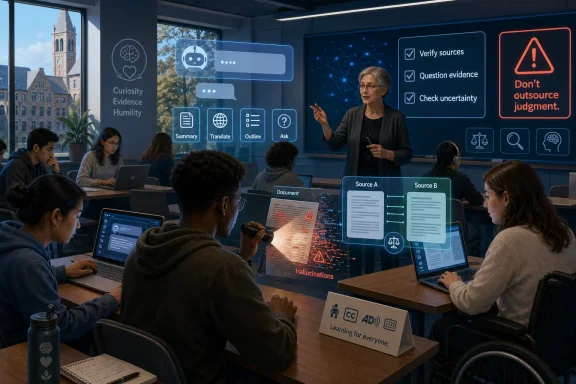
Critical thinking with AI means asking where an answer came from, what evidence would disprove it, what assumptions it smuggles in, and whether its confidence matches the available information. It means comparing a model’s output against primary sources, course material, data, and domain expertise. It means understanding that a summary can be useful and still incomplete.
This is especially important because generative AI often collapses the distinction between explanation and evidence. A model may explain why a claim is true without actually establishing that it is true. That is a classic failure mode for students, and AI can amplify it beautifully.
The best classroom uses of AI will therefore slow students down at key moments. They will ask students to critique outputs, identify missing sources, compare model answers, document prompt strategies, and explain why they accepted or rejected suggestions. The goal is not to make students prove they never touched AI. The goal is to make them prove they remained in charge.
That does not mean the essay is dead. It means the essay can no longer bear the whole weight of assessment. Draft histories, annotated bibliographies, reflective process notes, in-class writing, viva-style conversations, project logs, and source critique exercises all become more valuable in a world where polished prose is easy to obtain.
There is a temptation to answer AI with surveillance. Lockdown browsers, keystroke analysis, AI detectors, and plagiarism flags will all remain part of the ecosystem. But detectors are brittle, adversarial, and often unfair when treated as proof rather than signals. Worse, an enforcement-only approach can push honest students into confusion while doing little to stop determined misconduct.
A better assessment model assumes AI access and designs around it. If a student can use AI, the task should require judgment that AI alone cannot supply. If AI is banned for a task, the reason should be explicit and pedagogically defensible. “Because we said so” is not a policy; it is a postponement.
That is why blanket prohibition can be inequitable. Students with money will buy better tools, students with confidence will use them quietly, and students who most need guidance may avoid them out of fear. The result is not an AI-free campus. It is an unequal campus where the rules are clearest to those already best positioned to navigate them.
But the equity case also cuts the other way. If AI tools become unofficial tutors, students who rely on weak or hallucination-prone outputs may be harmed. If institutions outsource support to chatbots without teaching verification, they may widen gaps under the banner of innovation. Access to AI is not the same as access to education.
The supervised adoption model is attractive because it at least tries to resolve this tension. It gives students sanctioned access while creating room for common norms. The challenge is making sure those norms are not just legal disclaimers and acceptable-use pages, but actual teaching practices embedded in courses.
A university that enables Gemini, Copilot, or another AI assistant inside its productivity suite is making a curricular decision, even if it does not call it one. It is deciding which vendor’s interface mediates student work. It is deciding what data protections apply. It is deciding whether students learn inside a managed environment or drift toward consumer tools with weaker oversight.
For sysadmins, the familiar concerns still apply: data leakage, account governance, auditability, licensing, retention, accessibility, and support burden. But AI adds a layer that traditional software rollouts did not carry at the same scale. The tool is not merely storing or formatting student work. It is generating candidate knowledge.
That means IT cannot be the department of “yes, the service is available” while academics handle the rest. The rollout of AI tools needs policy, training, documentation, and feedback loops. If students are going to use institutionally sanctioned assistants, administrators need to know how those assistants fail.
Friction is not always bad. Confusion can be productive. Struggling with a paragraph, chasing a footnote, comparing two interpretations, and realizing that a source does not say what you thought it said are all part of intellectual development. AI can remove pointless friction, but it can also remove the useful kind.
The danger is that students may come to experience uncertainty as a defect to be eliminated rather than a signal to investigate. A model that instantly clarifies everything can make the world feel simpler than it is. That is comfortable. It is also dangerous.
Good AI pedagogy will preserve uncertainty. It will ask students to identify what the model cannot know, where evidence is thin, and why reasonable people might disagree. The aim is not to make AI less useful. It is to make usefulness compatible with skepticism.
Today’s undergraduate using AI to summarize a paper is tomorrow’s junior analyst using AI to summarize a contract, ticket queue, incident report, or PowerShell script. The habits formed now will travel into workplaces. If those habits are weak, IT departments will inherit them.
This is why universities are a preview of enterprise AI adoption. They show what happens when a powerful general-purpose tool arrives before norms have matured. They reveal the gap between access and competence. They also show that prohibition is rarely durable once a tool becomes genuinely useful.
For Windows enthusiasts and IT pros, the lesson is practical. The question is not whether AI assistants belong in the workflow. They are already there. The question is whether users are trained to treat them as fallible collaborators rather than invisible authorities.
This requires faculty development as much as student training. Many instructors are themselves learning how these tools behave. Some are enthusiastic, some are hostile, and many are exhausted. Institutions that simply issue policy memos without supporting instructors will produce uneven practice and student confusion.
The strongest courses will make AI use explicit. They will tell students when it is allowed, when it is prohibited, when it must be disclosed, and how it will be evaluated. They will also distinguish between using AI to support thinking and using AI to replace the work being assessed.
There is no universal rule that fits every discipline. A computer science course, a history seminar, a nursing program, and a creative writing workshop will have different boundaries. But every discipline can teach students to ask the same foundational question: what would I need to check before trusting this?
 The Classroom Has Already Crossed the Adoption Line
The most important fact in the latest student AI surveys is not that students are using ChatGPT, Gemini, Copilot, NotebookLM, and similar tools. It is that the behavior has become ordinary. In the space of three academic years, generative AI has gone from novelty to infrastructure, the digital equivalent of search, spellcheck, and cloud storage.That shift matters because institutions often regulate new tools as if they are optional add-ons. A campus can ban a calculator in an exam room, block a website on a managed network, or require a citation style for a paper. But it cannot realistically pretend that a general-purpose language model is absent from the intellectual life of students who already use it for brainstorming, summarizing, outlining, coding, translation, revision, and emotional reassurance.
This is why the old framing — AI as primarily an academic misconduct problem — is losing explanatory power. Cheating still matters, and universities cannot simply shrug at fabricated essays or undisclosed machine-written submissions. But if 95 percent of UK students say they use AI in at least one way, then the policy challenge is no longer catching the outliers. It is teaching the majority.
The anxiety around critical thinking is therefore not a moral panic about students becoming lazy. It is a systems problem. Students have been handed a tool that can imitate synthesis, fluency, and confidence before they have always developed the habits needed to test those performances.
The New Study Skill Is Knowing When the Machine Is Bluffing
Generative AI is seductive because it compresses the early mess of learning. A student facing a difficult article can ask for a summary. A student unsure how to start an essay can ask for a thesis. A student lost in terminology can ask for an explanation at three different reading levels. Used well, this is not anti-intellectual; it can be an on-ramp.The danger begins when the on-ramp becomes the road. A model can produce a plausible overview of a topic without understanding the topic in the human sense. It can supply a citation-shaped answer, a literature-review-shaped paragraph, or a polished argument that feels complete precisely because it hides the uncertainty, gaps, and false starts that learning normally exposes.
That is why the Canadian finding that nearly half of surveyed students felt their critical thinking had deteriorated after adopting AI should be taken seriously. The problem is not that the machine gives answers. The problem is that it gives answers in a tone that discourages interrogation. It often sounds finished before the user has begun.
For WindowsForum readers, this should feel familiar from another domain: troubleshooting. Anyone who has ever copied a command from a forum post, run a registry tweak, or followed a driver-fix thread knows the difference between executing instructions and understanding the system. AI can generate the instructions. It cannot absolve the user from knowing whether they are sane.
Universities Tried to Police Authorship When They Needed to Teach Verification
The first institutional response to generative AI was shaped by fear of plagiarism. That was understandable. ChatGPT arrived in late 2022 with the unnerving ability to produce fluent prose on demand, and universities had to defend the integrity of assessment almost overnight.But the plagiarism frame narrows the issue too much. It asks whether the student wrote the text. The deeper educational question asks whether the student can judge the text. In an AI-saturated environment, authorship is only one part of academic integrity; verification, disclosure, source evaluation, and intellectual accountability become just as important.
A student who submits an AI-generated essay without reading it has failed. A student who uses AI to generate possible counterarguments, checks them against course readings, rejects the weak ones, and explains the process may be doing something closer to real scholarship than a student who writes a mediocre paper in isolation. The distinction is not whether a chatbot was present. The distinction is whether the student remained intellectually responsible.
This is where many policies have lagged. Students report uncertainty not simply because they want permission to cheat, but because course rules can be inconsistent, vague, or punitive. One instructor treats AI as a banned ghostwriter. Another encourages it for ideation. A third says nothing until misconduct proceedings begin. That ambiguity teaches risk management, not literacy.
The University of Alberta Model Shows Where the Argument Is Heading
The University of Alberta’s supervised adoption approach is notable because it accepts the obvious: students will use AI, so the institution should shape the conditions of use. By introducing tools such as Gemini and NotebookLM into an institutional Google Workspace environment, the university is moving AI from the shadows of personal accounts into a governed setting.That does not make the tools magically safe. Institutional deployment can reduce some risks, especially around data handling, support, and consistent access, but it cannot eliminate hallucinations, bias, shallow reasoning, or overconfidence. A university-branded chatbot can still be wrong. A managed NotebookLM workspace can still encourage a student to accept a tidy summary instead of wrestling with the original source.
Still, supervised adoption changes the educational posture. Instead of treating AI as contraband, it treats AI as a lab instrument. Students can be taught when to use it, how to disclose it, what not to feed into it, and how to compare its output with primary material. That is a more mature response than hoping detection software can restore a pre-2022 world.
The use of custom prompts or “Gems” also hints at a practical middle ground. A student can configure a tool to act as a brainstorming partner, a simplifier, an editor, or a source-checking assistant. But the label matters less than the discipline behind it. A “fact checker” prompt is only useful if the student understands what counts as a fact, what counts as a reliable source, and when the model is merely laundering uncertainty through confident prose.
Microsoft, Google, and OpenAI Are Now Part of the Hidden Curriculum
For years, productivity software shaped student habits quietly. Word taught revision through red underlines and tracked changes. PowerPoint taught argument as slides. Search engines taught research as keyword iteration. Now AI assistants are teaching students what thinking feels like.That is not a neutral development. Copilot, Gemini, ChatGPT, and NotebookLM are not just tools that sit outside the learning process. They influence the sequence of work: ask first, read second; summarize first, analyze second; generate first, revise second. In some contexts, that sequence is efficient. In others, it reverses the order in which expertise is built.
This is where the education debate overlaps with the enterprise IT debate. Organizations rolling out Microsoft 365 Copilot or Gemini for Workspace face the same basic issue as universities: a productivity gain can become a judgment loss if users treat the assistant as an authority rather than an accelerator. The student who accepts a fabricated citation has a close cousin in the employee who forwards an AI-generated compliance summary without checking the policy.
The vendor pitch emphasizes speed, personalization, and workflow integration. Those benefits are real. But the hidden curriculum of AI is that fluency becomes cheap. When fluency is cheap, the scarce skill is no longer producing a polished paragraph or a plausible answer. It is knowing what deserves trust.
Critical Thinking Is Not a Vibe, It Is a Workflow
The phrase “critical thinking” is overused enough to become wallpaper. Universities invoke it, employers demand it, and students are told they need it without always being shown what it looks like in practice. In the AI era, the term needs to become more operational.Critical thinking with AI means asking where an answer came from, what evidence would disprove it, what assumptions it smuggles in, and whether its confidence matches the available information. It means comparing a model’s output against primary sources, course material, data, and domain expertise. It means understanding that a summary can be useful and still incomplete.
This is especially important because generative AI often collapses the distinction between explanation and evidence. A model may explain why a claim is true without actually establishing that it is true. That is a classic failure mode for students, and AI can amplify it beautifully.
The best classroom uses of AI will therefore slow students down at key moments. They will ask students to critique outputs, identify missing sources, compare model answers, document prompt strategies, and explain why they accepted or rejected suggestions. The goal is not to make students prove they never touched AI. The goal is to make them prove they remained in charge.
The Assessment Model Has to Move Past the Take-Home Essay Panic
If universities keep assessing students as if text production is the only visible evidence of learning, they will remain trapped. Generative AI is very good at text production. It is less good at defending choices in context, responding to oral challenge, applying concepts to local data, or showing a trail of reasoning over time.That does not mean the essay is dead. It means the essay can no longer bear the whole weight of assessment. Draft histories, annotated bibliographies, reflective process notes, in-class writing, viva-style conversations, project logs, and source critique exercises all become more valuable in a world where polished prose is easy to obtain.
There is a temptation to answer AI with surveillance. Lockdown browsers, keystroke analysis, AI detectors, and plagiarism flags will all remain part of the ecosystem. But detectors are brittle, adversarial, and often unfair when treated as proof rather than signals. Worse, an enforcement-only approach can push honest students into confusion while doing little to stop determined misconduct.
A better assessment model assumes AI access and designs around it. If a student can use AI, the task should require judgment that AI alone cannot supply. If AI is banned for a task, the reason should be explicit and pedagogically defensible. “Because we said so” is not a policy; it is a postponement.
The Equity Argument Cuts Both Ways
Generative AI can help students who have historically been underserved by traditional academic support. It can explain concepts repeatedly without impatience, help multilingual students revise phrasing, offer structure to neurodivergent learners, and provide immediate feedback when office hours are unavailable. For some students, AI is not a shortcut around learning but a bridge into it.That is why blanket prohibition can be inequitable. Students with money will buy better tools, students with confidence will use them quietly, and students who most need guidance may avoid them out of fear. The result is not an AI-free campus. It is an unequal campus where the rules are clearest to those already best positioned to navigate them.
But the equity case also cuts the other way. If AI tools become unofficial tutors, students who rely on weak or hallucination-prone outputs may be harmed. If institutions outsource support to chatbots without teaching verification, they may widen gaps under the banner of innovation. Access to AI is not the same as access to education.
The supervised adoption model is attractive because it at least tries to resolve this tension. It gives students sanctioned access while creating room for common norms. The challenge is making sure those norms are not just legal disclaimers and acceptable-use pages, but actual teaching practices embedded in courses.
The IT Department Is Now an Educational Actor
Campus AI policy is not only written in senate committees and academic integrity offices. It is also written in admin consoles, procurement contracts, data retention settings, identity systems, and the choice of which tools appear in a student’s account by default. That puts IT departments closer to the center of pedagogy than many institutions may realize.A university that enables Gemini, Copilot, or another AI assistant inside its productivity suite is making a curricular decision, even if it does not call it one. It is deciding which vendor’s interface mediates student work. It is deciding what data protections apply. It is deciding whether students learn inside a managed environment or drift toward consumer tools with weaker oversight.
For sysadmins, the familiar concerns still apply: data leakage, account governance, auditability, licensing, retention, accessibility, and support burden. But AI adds a layer that traditional software rollouts did not carry at the same scale. The tool is not merely storing or formatting student work. It is generating candidate knowledge.
That means IT cannot be the department of “yes, the service is available” while academics handle the rest. The rollout of AI tools needs policy, training, documentation, and feedback loops. If students are going to use institutionally sanctioned assistants, administrators need to know how those assistants fail.
The Real Risk Is Not That Students Stop Thinking, But That They Stop Noticing
The bleakest version of the AI education story imagines students becoming passive, incurious, and dependent. That can happen. But the subtler risk is more likely: students continue to think, but less visibly, less rigorously, and with fewer moments of friction.Friction is not always bad. Confusion can be productive. Struggling with a paragraph, chasing a footnote, comparing two interpretations, and realizing that a source does not say what you thought it said are all part of intellectual development. AI can remove pointless friction, but it can also remove the useful kind.
The danger is that students may come to experience uncertainty as a defect to be eliminated rather than a signal to investigate. A model that instantly clarifies everything can make the world feel simpler than it is. That is comfortable. It is also dangerous.
Good AI pedagogy will preserve uncertainty. It will ask students to identify what the model cannot know, where evidence is thin, and why reasonable people might disagree. The aim is not to make AI less useful. It is to make usefulness compatible with skepticism.
The Campus AI Fight Has Become a WindowsForum Story
At first glance, this may seem like a higher-education issue more than a Windows issue. But the same forces are arriving on every desktop. Microsoft has placed Copilot across Windows and Microsoft 365. Google is weaving Gemini into Workspace. OpenAI is pushing ChatGPT deeper into everyday work. The boundary between school software, office software, and consumer software is dissolving.Today’s undergraduate using AI to summarize a paper is tomorrow’s junior analyst using AI to summarize a contract, ticket queue, incident report, or PowerShell script. The habits formed now will travel into workplaces. If those habits are weak, IT departments will inherit them.
This is why universities are a preview of enterprise AI adoption. They show what happens when a powerful general-purpose tool arrives before norms have matured. They reveal the gap between access and competence. They also show that prohibition is rarely durable once a tool becomes genuinely useful.
For Windows enthusiasts and IT pros, the lesson is practical. The question is not whether AI assistants belong in the workflow. They are already there. The question is whether users are trained to treat them as fallible collaborators rather than invisible authorities.
The Universities That Win Will Teach the Machine as a Source of Error
The next mature phase of AI in education will not be defined by who adopts the flashiest tool. It will be defined by who teaches failure best. Students need to see hallucinations, biased outputs, shallow summaries, fake citations, and misleading certainty not as embarrassing exceptions but as normal risks to manage.This requires faculty development as much as student training. Many instructors are themselves learning how these tools behave. Some are enthusiastic, some are hostile, and many are exhausted. Institutions that simply issue policy memos without supporting instructors will produce uneven practice and student confusion.
The strongest courses will make AI use explicit. They will tell students when it is allowed, when it is prohibited, when it must be disclosed, and how it will be evaluated. They will also distinguish between using AI to support thinking and using AI to replace the work being assessed.
There is no universal rule that fits every discipline. A computer science course, a history seminar, a nursing program, and a creative writing workshop will have different boundaries. But every discipline can teach students to ask the same foundational question: what would I need to check before trusting this?
A Near-Universal Tool Demands Near-Universal Literacy
The latest adoption figures should end the fantasy that AI policy can be a niche concern. Once a technology reaches this level of use, every vague rule becomes a hidden curriculum and every unsupported instructor becomes a policy bottleneck. The institutions that respond best will be those that treat AI literacy as a core academic skill, not an optional workshop.- Students are already using generative AI for research, ideation, explanation, revision, and assessed work, so institutional silence now functions as informal permission mixed with fear.
- The central academic risk is not merely cheating, but the erosion of verification habits when fluent answers arrive before students have tested them.
- Supervised adoption models can reduce some risks, but only if they are paired with teaching that makes source-checking, disclosure, and human oversight routine.
- AI detectors and bans may have limited roles, but they cannot substitute for assessments that require process, judgment, and defense of reasoning.
- The same habits students build with AI tools in university will carry into workplaces that are rapidly adopting Copilot, Gemini, ChatGPT, and similar assistants.
- Critical thinking in the AI era must be taught as a repeatable workflow: question the output, inspect the evidence, compare sources, and remain accountable for the final claim.
References
- Primary source: Mirage News
Published: 2026-06-24T14:10:10.486790
AI Era Elevates Need for Critical Thinking | Mirage News
From 2024 to 2026, the proportion of post-secondary students in the United Kingdom using generative artificial intelligence "in some way in theirwww.miragenews.com
