

Microsoft Clarity’s December analysis reframes a simple traffic story: AI assistants still account for under 1% of measured visits, but those visits are growing rapidly and — where they’re tracked — convert at materially higher rates than traditional channels, forcing publishers, advertisers, and platform teams to rethink attribution, measurement, and optimization.
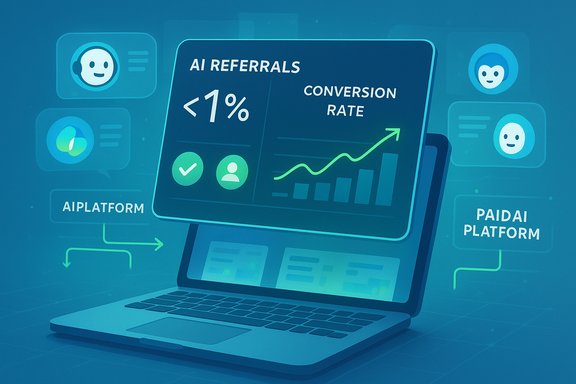
Microsoft Clarity’s anniversary post, authored by Ravi Yada, introduces the notion of the Agentic Web — a web where AI agents (ChatGPT, Microsoft Copilot, Google Gemini and others) act as intermediaries that read, synthesize, and sometimes route content to people rather than people navigating directly to pages. Clarity’s dataset, drawn from more than 1,200 publisher and news sites instrumented with Clarity, shows AI referrals up roughly 155% over an eight‑month window, while overall AI‑sourced visits still represent less than 1% of total sessions in that sample. Two headline implications emerge immediately:
Source: PPC Land Microsoft Clarity reveals how AI assistants are reshaping website traffic patterns
 Background / Overview
Microsoft Clarity’s anniversary post, authored by Ravi Yada, introduces the notion of the Agentic Web — a web where AI agents (ChatGPT, Microsoft Copilot, Google Gemini and others) act as intermediaries that read, synthesize, and sometimes route content to people rather than people navigating directly to pages. Clarity’s dataset, drawn from more than 1,200 publisher and news sites instrumented with Clarity, shows AI referrals up roughly 155% over an eight‑month window, while overall AI‑sourced visits still represent less than 1% of total sessions in that sample. Two headline implications emerge immediately:- The web’s discovery fabric is shifting from query→SERP→click to a mix of synthesis→zero‑click answers and selective clickthroughs.
- Measured conversion per AI-referred visit is higher in Clarity’s publisher sample — a pattern that complicates the simplistic “AI reduces traffic = publishers lose” narrative.
What Microsoft Clarity actually measured
The dataset and new channels
Clarity analyzed ~1,200+ publisher and news domains and added two explicit channel groups to its UI: AIPlatform (organic assistant referrals) and PaidAIPlatform (ads inside assistant experiences). The platform classifies sessions where the referrer or observed pattern matches known assistant sources and surfaces those sessions in the Referrer/Channels UI for recordings, heatmaps, and comparison. Clarity also warns that hidden or copy‑pasted AI interactions will still appear as Direct — the new channel helps but does not eliminate attribution friction.Key headline metrics reported by Clarity
- AI referrals grew roughly +155% over eight months.
- AI‑referred sessions represented <1% of total sessions in the sample during the measurement window.
- In a one‑month smart‑event snapshot, sign‑up conversion rates reported were approximately 1.66% for AI vs 0.15% for organic search; subscription conversions were ~1.34% AI vs 0.55% search. Clarity’s write‑up highlighted platform differences (Copilot, Perplexity, Gemini, etc. with Copilot showing especially strong relative uplifts in that sample.
Why AI referrals can appear to convert better
Clarity and independent analyses converge on several plausible mechanisms that explain higher per‑visit conversion rates for AI‑referred visitors in many publisher contexts:- Pre‑qualification by synthesis. Assistants summarize content and present the most relevant source(s), so a user who clicks has already received a distilled answer and is typically farther down the decision or research funnel.
- Editorial compression. Assistants suggest fewer sources than an open SERP, concentrating clicks toward a short list of recommended pages and increasing per‑click value.
- Task and intent skew. Conversational workflows often attract task‑oriented users (researchers, buyers, professionals) who are more likely to sign up or subscribe after a targeted landing.
- Contextual priming. AI answers can prime landing behavior by providing context before the click (e.g., “This guide contains the exact code snippet”), reducing friction on-site and improving conversion efficiency.
Measurement realities and the “invisible” AI problem
The most consequential insight is measurement blindness: when an assistant answers a user’s question without producing a click, the publisher’s analytics register nothing. Clarity calls this “zero‑click” consumption — content influences people but does not appear in page‑view counts. Publishers therefore face two measurement gaps:- Attribution gap: Not all AI influence produces referrer headers or navigations that analytics can record; a lot of AI influence is “dark” and ends up in Direct or in no signal at all.
- Bot/agent noise vs. human handoff: Assistants, crawlers and model training pipelines may access pages at volumes far exceeding human visits, complicating server‑log analysis and inflating bot noise if not filtered carefully. Clarity recommends refined bot detection and categorization to separate legitimate assistant retrievals from abusive scraping.
- Financial under‑crediting: content that drives decisions may not receive measurable credit for conversions that occur later via other channels.
- Reporting inaccuracies: conversion rates and channel mixes will look distorted if AI influence is misattributed as Direct or buried in other channels.
- Monetization friction: advertising and subscription models built on pageviews and ad impressions may underperform if AI consumption reduces click volumes for informational queries.
Corroborating evidence: where vendors and site‑owners agree (and disagree)
Multiple independent datasets provide complementary perspectives:- Ahrefs’ site‑level data showed AI search delivering a very small share of traffic (≈0.5%) but a disproportionate share of signups (~12.1% of signups in a 30‑day window for Ahrefs), implying a ~23x conversion lift versus organic search on that property. This is a concrete case study, not a universal claim.
- Microsoft Advertising’s August 6, 2025 analysis of Copilot ad experiences reported 73% higher CTRs and a 16% uplift in conversion rates for Copilot ad formats versus traditional search ad placements in their internal studies — an indicator that conversational ad formats can deliver strong engagement where ads are supported inside agent experiences. These are platform‑sourced metrics and should be judged as such.
- Industry tracking and practical guidance (SEO/analytics agencies and GA4 community posts) converged on one pragmatic approach: build explicit AI detection/segmentation into analytics (custom channel groups, regexes for known referrers, GTM detection) and treat AI referrals as a first‑class channel for reporting and experimentation.
Critical analysis: strengths, risks, and blind spots
Strengths of Clarity’s approach and the industry response
- Operational pragmatism. Clarity’s introduction of AIPlatform and PaidAIPlatform gives site owners a tangible, immediate way to surface and compare AI referrals within an analytics toolset. That operational capability is more valuable to practitioners than abstract discussion.
- Early warning on changing discovery. Clarity’s dataset and Ahrefs’ case study together provide concrete evidence that discovery dynamics are changing, and they give publishers early signals to experiment with AEO (AI Experience Optimization).
- Practical optimization hints. Structured data, clear FAQ blocks, concise summary sections and machine‑readable snippets are low‑cost, high‑leverage changes that make content more likely to be cited or handed off by assistants.
Risks and limitations to emphasize
- Small‑base volatility. A 155% increase off a 0.2% starting share is still tiny in absolute terms; multiplicative claims like “17×” can be fragile without confidence intervals. Decision‑makers should not over‑allocate resources based on percentage deltas alone.
- Vertical heterogeneity. News and subscription funnels benefit differently from AI referrals than product e‑commerce or local services; aggregate claims can mislead cross‑vertical planning.
- Attribution opacity and platform control. Assistants and platform owners control the UI and citation rules; a single product policy change (e.g., remove links from answers) could materially reconfigure referral volumes overnight. That creates strategic fragility for publishers relying on any single provider.
- Undocumented/opaque crawling. Some claims about assistants “crawling thousands of times more often than humans” are plausible but vary by provider and use case; treat such scale claims as directional and verify with server logs and bot filtering before acting. Where claims can’t be independently verified, label them as provisional.
Practical playbook for WindowsForum readers (product owners, IT, and admins)
The following steps prioritize measurement integrity, operational resilience, and low‑cost experimentation.1. Instrument AI traffic as a first‑class channel (analytics)
- In Microsoft Clarity: enable and monitor AIPlatform and PaidAIPlatform segments; review recordings and heatmaps for AI‑referred sessions.
- In GA4: create a custom channel group or session segment that matches known assistant referrers (chat.openai.com, chatgpt.com, copilot.microsoft.com, gemini.google.com, perplexity.ai, claude.ai, etc. using a maintained regex. Monitor this segment weekly to spot spikes or trends. Practical guides and regex patterns are widely available in the analytics community.
- ^(chat.openai.com|chatgpt.com|perplexity.ai|claude.ai|gemini.google.com|copilot.microsoft.com)$
2. Run a measurement experiment
- Identify 3–5 high‑value pages (guides, FAQ, long-form explainers).
- Add an explicit, concise summary + structured data (FAQ, HowTo, articleBody) and an obvious subscription/signup hook above the fold.
- Holdout: A/B test the summary + signup changes for users arriving from AIPlatform vs other channels. Measure sign‑up lift, engagement time, and bounce. Use Clarity recordings to qualitatively inspect differences.
3. Harden analytics and server logs
- Implement improved bot classification to separate assistant crawls from abusive scraping. Capture user agent and referrer patterns server‑side for offline correlation with Clarity/Ga4 segments. This reduces noise and clarifies human conversion rates.
4. Prepare product and legal teams
- Product: design landing pages and APIs that expose concise, machine-readable answers (schema.org JSON‑LD, OpenAPI endpoints) where appropriate.
- Legal/commercial: track whether platform reuse of content creates licensing or revenue claims; design guardrails and negotiation points for potential content compensation or attribution frameworks.
5. Rethink reporting and KPIs
- Add AI citation counts, AI‑to‑human handoff rates, and multi‑turn conversion metrics to executive dashboards as experimental KPIs while evaluating economic impact. Clarity and other vendors are already prototyping these metrics in dashboards.
Strategic takeaways and outlook
- Short term (0–12 months): AI referrals remain a small but rapidly growing channel for many publishers. Sites that instrument AI sources and run controlled experiments will gain operational learning and may capture disproportionate signups or subscriptions.
- Medium term (1–3 years): As assistants become embedded in apps, phones, cars and AR/VR interfaces, their absolute share of discovery can rise materially. Clarity projects scenarios where AI‑mediated discovery climbs into mid‑double digits for certain verticals, but such projections depend heavily on platform policies, UI changes, and monetization models. Treat such projections as plausible scenarios, not inevitabilities.
- Long term: The economics of informational content will change if more queries conclude inside assistant answers without clicks. That will push publisher strategies toward direct monetization (subscriptions, gated services, APIs) or negotiated revenue sharing/licensing with platforms that repurpose content at scale. Publishers that prepare early — instrumenting AI traffic, optimizing content for machine consumption, and testing monetization models — will be better positioned.
Conclusion
Microsoft Clarity’s Agentic Web analysis is an operationally useful wake‑up call: AI assistants are not yet a dominant referrer, but where they are measured they tend to deliver different visitors — more task oriented, often arriving mid‑funnel and in many publisher contexts converting at higher rates. Treat the headline multipliers with statistical caution, but treat the structural shift seriously: measurement, attribution, and content design must adapt. Instrument AI channels today, experiment deliberately, and build reporting that treats human and AI‑mediated consumption as complementary signals in product and marketing decisioning.Source: PPC Land Microsoft Clarity reveals how AI assistants are reshaping website traffic patterns
