

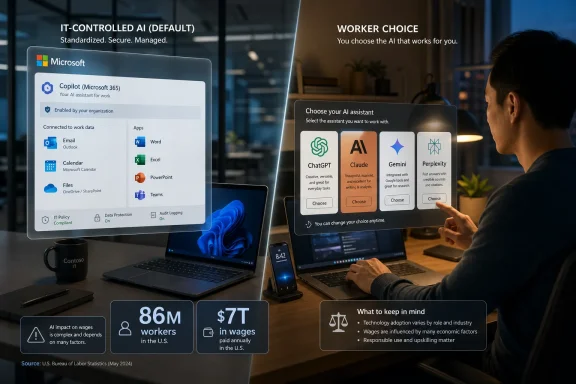
Eighty-six million employed Americans, representing 53 percent of U.S. workers, now use artificial intelligence on the job, according to PYMNTS Intelligence survey data published in June 2026, with those workers collectively earning roughly $7 trillion a year. That number is not proof that AI created $7 trillion in value, and treating it that way would be the fastest route to nonsense. What it does show is that AI has moved from software novelty to workplace infrastructure. The more interesting fight now is not whether workers use AI, but whether they prefer the AI handed to them by IT or the one they choose when nobody is watching.
For the last three years, the public argument over workplace AI has been trapped between two lazy poles. On one side sits the magical-productivity story, in which large language models quietly add an extra employee to every cubicle. On the other sits the automation panic, in which the same tools are already replacing entire departments before anyone has had time to update the org chart.
The PYMNTS number punctures both stories. If 86 million workers are using AI, then the technology is plainly no longer confined to prompt engineers, software developers, and executives with a taste for demos. But if the combined wages of those workers total $7 trillion, that does not mean AI generated $7 trillion, saved $7 trillion, or transformed $7 trillion of labor into something unrecognizable.
It means AI has reached the workflow. That is a different milestone, and in some ways a more consequential one. Technologies that enter the workflow do not need to be revolutionary on day one; they only need to be useful enough, often enough, that workers stop treating them as an experiment.
That is how a habit forms. A model summarizes the meeting, cleans up the memo, rewrites the email, drafts the spreadsheet formula, explains a policy, or turns a pile of rough notes into something presentable. None of those tasks announces the future of work with a trumpet blast. Together, they begin to change what workers expect from their computers.
That distinction matters because adoption is not the same as preference. Enterprise software has always benefited from forced familiarity. Outlook, Teams, SharePoint, Windows, and Office did not conquer every workplace because every worker performed a clean consumer comparison and picked the best tool. They won because the employer paid, the login worked, the files lived there, and the alternative required an argument with IT.
AI is now being pulled into the same machinery. The worker does not merely encounter a model; the worker encounters a model through procurement, identity management, security policy, compliance requirements, device management, and the politics of who gets to paste what into which box. The resulting usage numbers are real, but they are not spiritually neutral.
That is why the work-to-home crossover data is so revealing. PYMNTS says many employees who receive an AI platform at work also use it for personal tasks, including during work hours and after hours. At first glance, that looks like a straightforward win for whichever vendor lands the enterprise contract.
But the office is not just a place where habits are born. It is also a place where defaults are imposed. The key question is whether those defaults become preferences once the worker is free to choose.
That origin story still matters. When a worker uses ChatGPT at home and then uses it at work, the workplace is not necessarily the source of the habit. It may simply be the second location where an existing habit shows up. The same person who asks ChatGPT for dinner ideas may ask it to soften a tense email to a client, and from the outside both events look like adoption.
The PYMNTS framing usefully separates raw dual-purpose usage from what it calls crossover lift. Raw dual-purpose usage asks how many work users also use the tool personally. Crossover lift asks whether workplace exposure increases the likelihood of personal use compared with people who were already personal users.
That difference is the whole story. ChatGPT can dominate personal use and still show a relatively modest lift from workplace exposure because its consumer base was already enormous. In plain English: it does not need the office to introduce itself.
This is the first warning for Microsoft. Copilot may enjoy the more privileged position inside many workplaces, but ChatGPT owns a kind of cultural distribution that enterprise licensing cannot simply manufacture. It is the brand people ask for by name, and sometimes the category name they use even when they mean something else.
That makes Copilot’s distribution advantage formidable. Microsoft announced Microsoft 365 Copilot in March 2023, made it generally available to enterprise customers later that year, pushed Copilot across Windows and Edge, and even blessed new Windows keyboards with a dedicated Copilot key in 2024. This was not a subtle product launch. It was Microsoft using the full weight of the PC ecosystem to declare that AI would be part of the default Windows experience.
For IT departments, that pitch has obvious appeal. The Microsoft stack already has the contracts, the identity layer, the compliance story, the admin console, and the enterprise support channel. If a company is already paying for Microsoft 365, Copilot looks less like a risky outsider and more like the AI that can be explained in a budget meeting.
But that is also the trap. A product can be distributed widely without being loved deeply. Windows users of a certain age will remember Internet Explorer, Cortana, OneDrive nags, Edge prompts, and every other example of Microsoft mistaking surface area for affection.
Copilot’s workplace-to-personal lift, as described by PYMNTS, suggests that Microsoft’s distribution machine can move behavior. The question is whether it can move desire. If workers use Copilot at home because it is familiar from work, that is valuable. If they use it only because the icon was already there, that is fragile.
Copilot is the same playbook rewritten for the AI era. The tool is not trying to win every individual user one prompt at a time. It is trying to become the approved AI surface inside the operating system and productivity suite that already own the workday.
That is an enormous advantage in regulated environments. A bank employee, hospital administrator, government contractor, or corporate lawyer may have fewer choices than a freelance designer with three browser tabs open. If the only sanctioned assistant is Copilot, Copilot becomes the assistant.
Yet defaults have a ceiling when the category is still emotionally and practically unsettled. A worker may accept Teams for meetings because the calendar invite says Teams. But when that same worker needs help thinking through a hard problem, drafting a sensitive document, debugging code, or planning a personal trip, the choice becomes more intimate. The tool is not just a container; it is a collaborator.
That is where the old Microsoft distribution machine collides with the new AI preference market. In productivity software, the user often tolerates the tool because the organization standardizes on it. In AI, the user returns to the tool that produces the most useful answer, the right tone, the least friction, or the strongest feeling of being understood.
According to the survey material, Claude users are more likely than users of other major platforms to describe AI as essential or productivity-enhancing at work. That does not prove Claude caused those gains. It may be that people who choose Claude are already heavier AI users, more likely to work in writing-heavy, research-heavy, or coding-heavy roles, and more inclined to value a model’s reasoning and document handling.
Still, correlation can be commercially meaningful even when it is not causal. A tool that attracts the most demanding users, and then satisfies them enough that they say they would be meaningfully slower without it, is building a different sort of moat. It is not the moat of default placement. It is the moat of earned dependence.
Perplexity occupies a related but distinct lane. Its appeal is not that it is embedded into every corporate desktop, but that it has trained users to think of it as a research interface rather than a chatbot in the generic sense. For workers drowning in tabs, search results, source-checking, and synthesis, that distinction matters.
These products may never match Copilot’s enterprise distribution in raw volume. But the market should be careful about treating volume as destiny. The history of enterprise technology is full of tools that began as unofficial preferences before becoming impossible for management to ignore.
That makes Gemini’s crossover data more ambiguous. On Android, Gemini benefits from the same kind of default gravity that Copilot enjoys on Windows. For many users, especially outside the iPhone ecosystem, Google’s assistant is simply closer to the surface.
But Google also has a habit problem of its own. Search is one of the strongest habits in the history of computing, yet the migration from search box to AI assistant is not automatic. A person can use Google twenty times a day and still open ChatGPT when they want a composed answer, an edited paragraph, or a more conversational back-and-forth.
This is the paradox facing Google. It has perhaps the greatest consumer distribution surface in technology, but the generative AI moment taught millions of people to start somewhere else. Gemini’s task is not merely to be available. It must persuade users that the Google-shaped answer is the AI-shaped answer they want.
In the workplace, that persuasion runs through Workspace, Android device fleets, Chrome, and Google Cloud. In personal life, it runs through phones, search behavior, and the assistant layer. If Google can join those experiences without making users feel trapped in a rebranded search product, Gemini has room to grow.
AI makes the pattern more sensitive because the tool is not merely storing files or sending messages. It is ingesting prompts that may include confidential context, summarizing documents that may be privileged, and generating output that may later become official work product. The security implications are obvious, but so is the reason workers do it anyway.
They use the tool that works. If the approved assistant gives bland answers, lacks context, refuses common tasks, performs poorly with code, or sits behind licensing friction, workers will route around it. Some will do so recklessly; others will strip out sensitive data and use personal accounts for lower-risk tasks. Either way, policy alone will not settle the matter.
This is where the PYMNTS data should make administrators uncomfortable. If ChatGPT is heavily used both inside and outside work, then banning it may be less realistic than governing it. If Claude users report especially high dependence, then blocking Claude may create productivity resentment among exactly the workers most capable of explaining why the approved tool is worse.
The Windows enterprise lesson is straightforward. Control still matters, but control without usability creates shadow IT. In the AI era, shadow IT does not look like a rogue server under someone’s desk. It looks like a browser tab.
The Gallup-style picture of AI in the workplace has consistently suggested a more modest reality than either boosters or doomers prefer. Many employees report productivity gains, but fewer say AI has fundamentally transformed how work gets done. That squares with what many WindowsForum readers see in practice: AI is useful for the first draft, the explanation, the summary, the boilerplate, and the annoying syntax problem. It is less reliable as an autonomous owner of messy business judgment.
This distinction matters for budgets. A $30-per-user-per-month enterprise AI add-on must eventually justify itself against measurable outcomes, not vibes. Faster email is nice; fewer support tickets, shorter sales cycles, reduced rework, better code review, faster onboarding, and lower compliance risk are the sorts of claims finance departments can understand.
It also matters for labor politics. If executives tell workers AI is transformative while workers experience it as a sometimes-helpful assistant bolted onto already overloaded jobs, cynicism will follow. If workers are expected to use AI without training, guardrails, or time to redesign processes, the productivity story turns into one more management slogan.
The more sober interpretation is that AI has become a broad efficiency layer before it has become a broad transformation layer. That is still a big deal. It is just not the same thing as replacing the organization.
A chatbot in a browser is one thing. An AI assistant integrated into Windows, Office, Edge, Teams, and enterprise identity is something else. The deeper Copilot goes, the more useful it can become — and the more scrutiny it attracts from administrators, privacy advocates, regulators, and users who have spent years pushing back against unwanted prompts and cloud tie-ins.
The Copilot key is the perfect symbol. To Microsoft, it represented the arrival of the AI PC, a new invocation point for a new computing era. To skeptics, it looked like another attempt to reserve prime hardware real estate for a Microsoft service users might not have chosen.
That tension will define the next phase of Windows AI. If Copilot becomes the assistant that can reliably find settings, explain system behavior, triage errors, automate repetitive workflows, and respect enterprise boundaries, the key will look prescient. If it remains mostly a branded entry point into a general chatbot experience, it will look like a sticker on the keyboard.
Windows users have a long memory for this sort of thing. They forgive defaults that save time. They resent defaults that feel like advertising.
That is why the PYMNTS distinction between the AI you are given and the AI you choose is so important. Enterprise distribution can make a tool the first thing a worker encounters at 9 a.m. Consumer preference determines whether it is still the first thing that worker opens at 9 p.m.
ChatGPT’s strength is that it became the default starting point in the public imagination. Copilot’s strength is that Microsoft can make it the default starting point in the managed workplace. Gemini’s strength is that Google can place it near search, Android, and Workspace. Claude’s strength is that certain high-value users seem to treat it less like a novelty and more like a serious work instrument. Perplexity’s strength is that it has claimed the research-shaped corner of the market before the giants fully collapsed search and synthesis into one interface.
These starting points are not mutually exclusive. A single worker may use Copilot for meeting notes, ChatGPT for writing, Claude for document reasoning, Gemini on an Android phone, and Perplexity for research. The future may be less winner-take-all than browser history suggests.
Still, habits compound. The tool that becomes the first stop gains the prompt history, the user’s trust, the subscription, the integrations, and eventually the expectation that starting elsewhere requires a reason. That is the territory every AI platform wants.
That means AI procurement has to become more empirical. Which workers are using which tools, for which tasks, with what data, under what controls, and with what measurable outcomes? Which departments need document reasoning, which need code assistance, which need customer-service drafting, and which need search-grounded research? Which workflows are safe to automate, and which merely need augmentation?
The worst answer is a one-size-fits-all mandate justified by vendor consolidation. That may satisfy procurement, but it will not satisfy a paralegal who thinks Claude handles long documents better, a developer who prefers a coding assistant tuned to the repo, or an analyst who needs citations and source comparison more than a cheerful paragraph generator.
The second-worst answer is pretending unofficial use is not happening. If employees are already moving work into personal AI tools, the organization needs policy, logging, training, approved alternatives, and clear data boundaries. Shaming users for seeking productivity rarely works when the sanctioned workflow is slower.
The best answer is boring and difficult: treat AI like infrastructure, but evaluate it like a product. Security gets a vote. Legal gets a vote. Finance gets a vote. So do the people who have to use the thing ten times a day.
That split should sound familiar. The PC itself lived through versions of it, from corporate desktops to home machines, from BlackBerry to iPhone, from locked-down browsers to consumer cloud apps that later invaded the enterprise. The tool people love outside work has a way of becoming the tool they demand inside work.
Microsoft is not doomed by that pattern. It is one of the companies that best understands how to turn enterprise legitimacy into durable market power. But Copilot’s challenge is sharper than Office’s was because AI quality is more immediately felt. Nobody asks Excel to have judgment. People ask AI assistants to help them think.
That is why the distinction between sticky by default and sticky by merit matters. Defaults can build the bridge from work to home. Merit determines whether users cross it again when no one is paying them to.
 The AI Adoption Debate Has Outgrown Its Favorite Straw Man
For the last three years, the public argument over workplace AI has been trapped between two lazy poles. On one side sits the magical-productivity story, in which large language models quietly add an extra employee to every cubicle. On the other sits the automation panic, in which the same tools are already replacing entire departments before anyone has had time to update the org chart.The PYMNTS number punctures both stories. If 86 million workers are using AI, then the technology is plainly no longer confined to prompt engineers, software developers, and executives with a taste for demos. But if the combined wages of those workers total $7 trillion, that does not mean AI generated $7 trillion, saved $7 trillion, or transformed $7 trillion of labor into something unrecognizable.
It means AI has reached the workflow. That is a different milestone, and in some ways a more consequential one. Technologies that enter the workflow do not need to be revolutionary on day one; they only need to be useful enough, often enough, that workers stop treating them as an experiment.
That is how a habit forms. A model summarizes the meeting, cleans up the memo, rewrites the email, drafts the spreadsheet formula, explains a policy, or turns a pile of rough notes into something presentable. None of those tasks announces the future of work with a trumpet blast. Together, they begin to change what workers expect from their computers.
The Workplace Is Now AI’s Cheapest Distribution Channel
The most important thing about workplace AI may be that workers often do not shop for it. They inherit it. A company turns on Microsoft 365 Copilot, approves Gemini for Workspace, allows ChatGPT Enterprise, grants access to Claude for teams, or tolerates a browser-based chatbot until security finally writes a policy.That distinction matters because adoption is not the same as preference. Enterprise software has always benefited from forced familiarity. Outlook, Teams, SharePoint, Windows, and Office did not conquer every workplace because every worker performed a clean consumer comparison and picked the best tool. They won because the employer paid, the login worked, the files lived there, and the alternative required an argument with IT.
AI is now being pulled into the same machinery. The worker does not merely encounter a model; the worker encounters a model through procurement, identity management, security policy, compliance requirements, device management, and the politics of who gets to paste what into which box. The resulting usage numbers are real, but they are not spiritually neutral.
That is why the work-to-home crossover data is so revealing. PYMNTS says many employees who receive an AI platform at work also use it for personal tasks, including during work hours and after hours. At first glance, that looks like a straightforward win for whichever vendor lands the enterprise contract.
But the office is not just a place where habits are born. It is also a place where defaults are imposed. The key question is whether those defaults become preferences once the worker is free to choose.
ChatGPT Did Not Need the Office to Become a Verb
ChatGPT’s path into the workplace was upside down by enterprise software standards. It began as a consumer phenomenon in late 2022, before most companies had a coherent generative AI policy and before many CIOs had decided whether the tool was a productivity aid or a data-leakage machine. Workers arrived first; enterprise controls came later.That origin story still matters. When a worker uses ChatGPT at home and then uses it at work, the workplace is not necessarily the source of the habit. It may simply be the second location where an existing habit shows up. The same person who asks ChatGPT for dinner ideas may ask it to soften a tense email to a client, and from the outside both events look like adoption.
The PYMNTS framing usefully separates raw dual-purpose usage from what it calls crossover lift. Raw dual-purpose usage asks how many work users also use the tool personally. Crossover lift asks whether workplace exposure increases the likelihood of personal use compared with people who were already personal users.
That difference is the whole story. ChatGPT can dominate personal use and still show a relatively modest lift from workplace exposure because its consumer base was already enormous. In plain English: it does not need the office to introduce itself.
This is the first warning for Microsoft. Copilot may enjoy the more privileged position inside many workplaces, but ChatGPT owns a kind of cultural distribution that enterprise licensing cannot simply manufacture. It is the brand people ask for by name, and sometimes the category name they use even when they mean something else.
Copilot’s Advantage Is Real, but It Is Not the Same as Love
Microsoft deserves credit for understanding the terrain earlier than most incumbents. Copilot was not merely an app; it was a strategy for embedding generative AI into the productivity layer where millions of workers already live. Word, Excel, PowerPoint, Outlook, Teams, Edge, Windows, and Microsoft 365 administration are not glamorous territory, but they are where corporate time goes to die.That makes Copilot’s distribution advantage formidable. Microsoft announced Microsoft 365 Copilot in March 2023, made it generally available to enterprise customers later that year, pushed Copilot across Windows and Edge, and even blessed new Windows keyboards with a dedicated Copilot key in 2024. This was not a subtle product launch. It was Microsoft using the full weight of the PC ecosystem to declare that AI would be part of the default Windows experience.
For IT departments, that pitch has obvious appeal. The Microsoft stack already has the contracts, the identity layer, the compliance story, the admin console, and the enterprise support channel. If a company is already paying for Microsoft 365, Copilot looks less like a risky outsider and more like the AI that can be explained in a budget meeting.
But that is also the trap. A product can be distributed widely without being loved deeply. Windows users of a certain age will remember Internet Explorer, Cortana, OneDrive nags, Edge prompts, and every other example of Microsoft mistaking surface area for affection.
Copilot’s workplace-to-personal lift, as described by PYMNTS, suggests that Microsoft’s distribution machine can move behavior. The question is whether it can move desire. If workers use Copilot at home because it is familiar from work, that is valuable. If they use it only because the icon was already there, that is fragile.
Defaults Win Meetings Before They Win Markets
The WindowsForum audience understands this better than most because Windows itself is the canonical example of the default as empire. For decades, Microsoft’s genius was not simply building software people used. It was building software that became the path of least resistance for everyone else: OEMs, developers, IT departments, schools, governments, and ordinary users who just wanted the file to open.Copilot is the same playbook rewritten for the AI era. The tool is not trying to win every individual user one prompt at a time. It is trying to become the approved AI surface inside the operating system and productivity suite that already own the workday.
That is an enormous advantage in regulated environments. A bank employee, hospital administrator, government contractor, or corporate lawyer may have fewer choices than a freelance designer with three browser tabs open. If the only sanctioned assistant is Copilot, Copilot becomes the assistant.
Yet defaults have a ceiling when the category is still emotionally and practically unsettled. A worker may accept Teams for meetings because the calendar invite says Teams. But when that same worker needs help thinking through a hard problem, drafting a sensitive document, debugging code, or planning a personal trip, the choice becomes more intimate. The tool is not just a container; it is a collaborator.
That is where the old Microsoft distribution machine collides with the new AI preference market. In productivity software, the user often tolerates the tool because the organization standardizes on it. In AI, the user returns to the tool that produces the most useful answer, the right tone, the least friction, or the strongest feeling of being understood.
Claude and Perplexity Show the Other Kind of Moat
The PYMNTS findings about Claude are especially useful because they complicate the simplistic platform horse race. Claude does not have Microsoft’s operating-system leverage or ChatGPT’s consumer verb status. Its strength is narrower, but potentially more durable: a reputation among certain workers for being genuinely useful.According to the survey material, Claude users are more likely than users of other major platforms to describe AI as essential or productivity-enhancing at work. That does not prove Claude caused those gains. It may be that people who choose Claude are already heavier AI users, more likely to work in writing-heavy, research-heavy, or coding-heavy roles, and more inclined to value a model’s reasoning and document handling.
Still, correlation can be commercially meaningful even when it is not causal. A tool that attracts the most demanding users, and then satisfies them enough that they say they would be meaningfully slower without it, is building a different sort of moat. It is not the moat of default placement. It is the moat of earned dependence.
Perplexity occupies a related but distinct lane. Its appeal is not that it is embedded into every corporate desktop, but that it has trained users to think of it as a research interface rather than a chatbot in the generic sense. For workers drowning in tabs, search results, source-checking, and synthesis, that distinction matters.
These products may never match Copilot’s enterprise distribution in raw volume. But the market should be careful about treating volume as destiny. The history of enterprise technology is full of tools that began as unofficial preferences before becoming impossible for management to ignore.
Gemini’s Android Problem Is Also Its Opportunity
Google’s Gemini sits in an awkward but powerful position. Like Microsoft, Google has distribution. It has Android, Chrome, Search, Gmail, Docs, Workspace, and a consumer ecosystem that touches billions of devices. Unlike Microsoft, its workplace AI story competes with a long-standing perception that Google is stronger in consumer services and cloud-native collaboration than in the traditional enterprise desktop.That makes Gemini’s crossover data more ambiguous. On Android, Gemini benefits from the same kind of default gravity that Copilot enjoys on Windows. For many users, especially outside the iPhone ecosystem, Google’s assistant is simply closer to the surface.
But Google also has a habit problem of its own. Search is one of the strongest habits in the history of computing, yet the migration from search box to AI assistant is not automatic. A person can use Google twenty times a day and still open ChatGPT when they want a composed answer, an edited paragraph, or a more conversational back-and-forth.
This is the paradox facing Google. It has perhaps the greatest consumer distribution surface in technology, but the generative AI moment taught millions of people to start somewhere else. Gemini’s task is not merely to be available. It must persuade users that the Google-shaped answer is the AI-shaped answer they want.
In the workplace, that persuasion runs through Workspace, Android device fleets, Chrome, and Google Cloud. In personal life, it runs through phones, search behavior, and the assistant layer. If Google can join those experiences without making users feel trapped in a rebranded search product, Gemini has room to grow.
The BYOAI Era Is Already Here
The uncomfortable phrase for IT departments is bring your own AI. It is not new in spirit. Workers have always brought personal tools into professional contexts: Dropbox before enterprise file sync caught up, WhatsApp when corporate messaging was clunky, Gmail when Exchange felt ancient, and personal laptops when company hardware was miserable.AI makes the pattern more sensitive because the tool is not merely storing files or sending messages. It is ingesting prompts that may include confidential context, summarizing documents that may be privileged, and generating output that may later become official work product. The security implications are obvious, but so is the reason workers do it anyway.
They use the tool that works. If the approved assistant gives bland answers, lacks context, refuses common tasks, performs poorly with code, or sits behind licensing friction, workers will route around it. Some will do so recklessly; others will strip out sensitive data and use personal accounts for lower-risk tasks. Either way, policy alone will not settle the matter.
This is where the PYMNTS data should make administrators uncomfortable. If ChatGPT is heavily used both inside and outside work, then banning it may be less realistic than governing it. If Claude users report especially high dependence, then blocking Claude may create productivity resentment among exactly the workers most capable of explaining why the approved tool is worse.
The Windows enterprise lesson is straightforward. Control still matters, but control without usability creates shadow IT. In the AI era, shadow IT does not look like a rogue server under someone’s desk. It looks like a browser tab.
The Productivity Claims Still Need a Cold Shower
None of this means companies should accept every productivity claim at face value. AI survey data is tricky because users are poor instruments for measuring their own efficiency. A worker may feel faster because drafting is easier, while spending the saved time checking hallucinations, repairing tone, or reworking output that looked polished but missed the point.The Gallup-style picture of AI in the workplace has consistently suggested a more modest reality than either boosters or doomers prefer. Many employees report productivity gains, but fewer say AI has fundamentally transformed how work gets done. That squares with what many WindowsForum readers see in practice: AI is useful for the first draft, the explanation, the summary, the boilerplate, and the annoying syntax problem. It is less reliable as an autonomous owner of messy business judgment.
This distinction matters for budgets. A $30-per-user-per-month enterprise AI add-on must eventually justify itself against measurable outcomes, not vibes. Faster email is nice; fewer support tickets, shorter sales cycles, reduced rework, better code review, faster onboarding, and lower compliance risk are the sorts of claims finance departments can understand.
It also matters for labor politics. If executives tell workers AI is transformative while workers experience it as a sometimes-helpful assistant bolted onto already overloaded jobs, cynicism will follow. If workers are expected to use AI without training, guardrails, or time to redesign processes, the productivity story turns into one more management slogan.
The more sober interpretation is that AI has become a broad efficiency layer before it has become a broad transformation layer. That is still a big deal. It is just not the same thing as replacing the organization.
Windows Is Becoming the Battleground for AI Defaults
For Microsoft, the PC remains both asset and burden. Windows gives Copilot a home field advantage that no pure AI startup can match. It also forces Microsoft to answer a harder question: what should an AI assistant be allowed to do on a general-purpose computer?A chatbot in a browser is one thing. An AI assistant integrated into Windows, Office, Edge, Teams, and enterprise identity is something else. The deeper Copilot goes, the more useful it can become — and the more scrutiny it attracts from administrators, privacy advocates, regulators, and users who have spent years pushing back against unwanted prompts and cloud tie-ins.
The Copilot key is the perfect symbol. To Microsoft, it represented the arrival of the AI PC, a new invocation point for a new computing era. To skeptics, it looked like another attempt to reserve prime hardware real estate for a Microsoft service users might not have chosen.
That tension will define the next phase of Windows AI. If Copilot becomes the assistant that can reliably find settings, explain system behavior, triage errors, automate repetitive workflows, and respect enterprise boundaries, the key will look prescient. If it remains mostly a branded entry point into a general chatbot experience, it will look like a sticker on the keyboard.
Windows users have a long memory for this sort of thing. They forgive defaults that save time. They resent defaults that feel like advertising.
The Real Platform War Is Over Starting Points
The AI market is often described as a model race, but for most users the model is invisible. They experience the product as a starting point. Where do I go first when I need to write, search, summarize, plan, calculate, compare, troubleshoot, or decide?That is why the PYMNTS distinction between the AI you are given and the AI you choose is so important. Enterprise distribution can make a tool the first thing a worker encounters at 9 a.m. Consumer preference determines whether it is still the first thing that worker opens at 9 p.m.
ChatGPT’s strength is that it became the default starting point in the public imagination. Copilot’s strength is that Microsoft can make it the default starting point in the managed workplace. Gemini’s strength is that Google can place it near search, Android, and Workspace. Claude’s strength is that certain high-value users seem to treat it less like a novelty and more like a serious work instrument. Perplexity’s strength is that it has claimed the research-shaped corner of the market before the giants fully collapsed search and synthesis into one interface.
These starting points are not mutually exclusive. A single worker may use Copilot for meeting notes, ChatGPT for writing, Claude for document reasoning, Gemini on an Android phone, and Perplexity for research. The future may be less winner-take-all than browser history suggests.
Still, habits compound. The tool that becomes the first stop gains the prompt history, the user’s trust, the subscription, the integrations, and eventually the expectation that starting elsewhere requires a reason. That is the territory every AI platform wants.
IT Departments Cannot Confuse Compliance With Adoption
For sysadmins and CIOs, the lesson is not to surrender to the chaos of consumer AI. It is to stop pretending that approval alone creates adoption. An enterprise can standardize on a tool, but workers will judge that tool against the best AI experience they have elsewhere.That means AI procurement has to become more empirical. Which workers are using which tools, for which tasks, with what data, under what controls, and with what measurable outcomes? Which departments need document reasoning, which need code assistance, which need customer-service drafting, and which need search-grounded research? Which workflows are safe to automate, and which merely need augmentation?
The worst answer is a one-size-fits-all mandate justified by vendor consolidation. That may satisfy procurement, but it will not satisfy a paralegal who thinks Claude handles long documents better, a developer who prefers a coding assistant tuned to the repo, or an analyst who needs citations and source comparison more than a cheerful paragraph generator.
The second-worst answer is pretending unofficial use is not happening. If employees are already moving work into personal AI tools, the organization needs policy, logging, training, approved alternatives, and clear data boundaries. Shaming users for seeking productivity rarely works when the sanctioned workflow is slower.
The best answer is boring and difficult: treat AI like infrastructure, but evaluate it like a product. Security gets a vote. Legal gets a vote. Finance gets a vote. So do the people who have to use the thing ten times a day.
The Numbers Point to a Split AI Future
The cleanest reading of the PYMNTS data is that there are now two AI markets occupying the same user. One is assigned, managed, integrated, and paid for by the employer. The other is chosen, personal, emotionally sticky, and often paid for directly by the worker.That split should sound familiar. The PC itself lived through versions of it, from corporate desktops to home machines, from BlackBerry to iPhone, from locked-down browsers to consumer cloud apps that later invaded the enterprise. The tool people love outside work has a way of becoming the tool they demand inside work.
Microsoft is not doomed by that pattern. It is one of the companies that best understands how to turn enterprise legitimacy into durable market power. But Copilot’s challenge is sharper than Office’s was because AI quality is more immediately felt. Nobody asks Excel to have judgment. People ask AI assistants to help them think.
That is why the distinction between sticky by default and sticky by merit matters. Defaults can build the bridge from work to home. Merit determines whether users cross it again when no one is paying them to.
The Office AI Race Is Really a Loyalty Test
The practical lessons for Windows users and IT pros are less mystical than the market hype suggests. The survey numbers are large, but the decision points are concrete.- Employers should assume AI is already in the workflow, even where formal adoption programs are immature.
- Copilot’s enterprise advantage is meaningful, but its personal-use weakness shows that distribution is not the same as preference.
- ChatGPT remains the consumer benchmark that workplace tools are implicitly measured against.
- Claude and Perplexity demonstrate that specialized user trust can matter as much as broad default placement.
- IT departments should govern personal AI use instead of pretending policy can erase it.
- Productivity claims should be tied to specific workflows, not treated as a universal property of any AI license.
References
- Primary source: pymnts.com
Published: 2026-06-08T08:03:10.750478
PYMNTS | The AI You’re Given vs. the AI You Chose
Eighty-six million Americans now use AI at work, and most carry it home. Give workers a choice and the order of finish changes completely. www.pymnts.com
- Related coverage: latimes.com
Why some workers are embracing AI while others won't use it
A new Gallup poll finds that more American workers are experimenting with artificial intelligence in their jobs, but there is a cohort of employees who remain skeptical.www.latimes.com - Related coverage: allwork.space
Microsoft Brings Copilot To 743,000 Accenture Workers In Biggest Test Yet Of AI Productivity At Scale
Microsoft is rolling out its Copilot 365 AI assistant to roughly 743,000 Accenture employees, in the biggest enterprise deal forallwork.space - Related coverage: gallup.com
Global Indicator: Artificial Intelligence - Gallup
Explore U.S. employees’ reported use of, comfort with and the level of manager support received with AI integration in the workplace. www.gallup.com
- Related coverage: nbcwashington.com
- Official source: microsoft.com
Announcing Copilot for Microsoft 365 general availability and Microsoft 365 Chat | Microsoft 365 Blog
Discover the latest AI innovations across Microsoft 365 Copilot, Bing Chat Enterprise, and Windows.www.microsoft.com
- Related coverage: techspot.com
Microsoft is adding a dedicated Copilot key to Windows keyboards | TechSpot
The Copilot key will appear on new PCs and laptops from Microsoft partners. It will, of course, be used to open Microsoft's Windows Copilot generative AI assistant...www.techspot.com - Related coverage: windowscentral.com
Microsoft announces "most significant change to the Windows keyboard" in 30 years — adds dedicated AI Copilot key to all future PCs | Windows Central
New Windows PCs going forward will include a dedicated AI key on the keyboard deck.www.windowscentral.com - Related coverage: laptopmag.com
Microsoft to add Copilot AI key to Windows keyboards | Laptop Mag
Microsoft is bringing a new addition to the Windows keyboard for the first time in 30 years.www.laptopmag.com - Related coverage: tomshardware.com
Windows 11 PCs to come with a Copilot key as Microsoft pushes forward with AI | Tom's Hardware
It will be the first new standard Windows keyboard key since 1994.www.tomshardware.com - Official source: blogs.windows.com
Introducing a new Copilot key to kick off the year of AI-powered Windows PCs
Today, we are excited to take the next significant step forward and introduce a new Copilot key to Windows 11 PCs. In this new year, we will be ushering in a significant shift toward a more personal and intelligent computing future where AI will be sblogs.windows.com - Official source: techcommunity.microsoft.com
Evolving the Copilot key experience for commercial organizations - Windows IT Pro Blog
Learn more about the changes to the Copilot hardware key and how you can manage them for your organization. techcommunity.microsoft.com
- Related coverage: arstechnica.com
Microsoft is adding a new key to PC keyboards for the first time since 1994 - Ars Technica
Copilot key will eventually be required in new PC keyboards, though not yet.arstechnica.com - Related coverage: axios.com
Microsoft gives AI a place on the Windows keyboard
It's the first change to the PC keyboard since the addition of the Windows button 30 years ago.www.axios.com
