

Microsoft, Google, Uber, Amazon, New York lawmakers, and a growing number of workers and local communities have all collided in spring 2026 over the same problem: the AI boom is no longer just a product story, but a cost, infrastructure, labor, and trust story. The backlash is not a fringe revolt against technology. It is a correction against a sales pitch that asked everyone else to absorb the risks while Silicon Valley booked the upside. The “AI vibe shift” is real because the bill has finally become legible.
The first mistake in reading the current AI backlash is to treat it as a Luddite spasm. That is comforting for the industry, because it turns skeptics into caricatures: fearful students, angry artists, slow-moving regulators, and communities that supposedly do not understand progress. But the mood now spreading through workplaces, statehouses, and local zoning fights is more specific than that.
People are not rejecting machine learning because they dislike automation in the abstract. They are rejecting the idea that generative AI should be everywhere before anyone can show where it reliably pays for itself, who carries its costs, and what happens when its errors escape the demo stage. That distinction matters, because it means the backlash can coexist with heavy AI adoption. A company can use Copilot, Claude, Gemini, or ChatGPT and still conclude that the surrounding business narrative has become unmoored from reality.
For Windows users and IT departments, this is the point where the story stops being about novelty. AI is already being pushed into operating systems, office suites, browsers, developer tools, endpoint management, search, customer support, and security tooling. The question is no longer whether AI features will arrive. The question is whether they arrive as accountable software or as a permanent meter running in the background.
That is why the mood has changed. The AI boom promised abundance: intelligence too cheap to meter, copilots for every worker, agents that would dissolve drudgery, and productivity gains so obvious that only the stubborn would resist. The emerging reality is more prosaic. Tokens cost money, data centers consume power and water, hallucinations require human cleanup, and the people being told to use AI are asking whether the tools are making work better or merely making dashboards look modern.
That technical detail used to sit below the waterline. Consumers paid subscriptions, companies bought licenses, and executives talked about adoption. The industry’s public rhetoric stayed focused on capability: bigger models, longer context, better coding, more fluent assistants. But inside companies, the meter was always running.
“Tokenmaxxing” made the quiet part loud. The idea was simple: encourage workers, especially developers, to use as much AI as possible, then treat consumption itself as evidence of transformation. More prompts meant more adoption. More adoption meant more productivity, or so the theory went. In a venture-backed culture allergic to waiting for audited outcomes, token consumption became a proxy for progress.
The proxy is now collapsing. Uber’s experience became the symbolic break point because it condensed the entire problem into one corporate anecdote. A company with unusually aggressive AI adoption, reportedly with widespread engineering use of Claude Code and other tools, found its AI spending racing far ahead of expectations. Leadership then had to acknowledge the obvious: high token consumption is not the same thing as shipping better products.
That admission matters more than any one company’s bill. Uber was not an AI laggard caught off guard. It was precisely the sort of AI-forward enterprise vendors love to cite when selling the future to everyone else. If even that kind of company has to stop and ask whether AI usage maps to business results, the rest of the market has permission to ask the same question.
That is the uncomfortable economics behind the sudden nervousness around coding agents. The more autonomous the tool becomes, the more it can spend on behalf of the user. It may look like a single task in the interface, but underneath it can be a long chain of model calls, context assembly, tool invocations, and repeated attempts. The user sees “fix this bug.” Finance sees a meter.
For developers, this creates a strange inversion. The old software productivity pitch was that tools made expensive humans faster. The new agentic pitch sometimes risks making expensive compute supervise expensive humans, who then must review the expensive compute’s output. That can still be worth it in the right workflow. But it is not magic, and it is not automatically cheaper than conventional engineering.
This is where IT pros should pay attention. The migration from fixed subscription pricing toward usage-sensitive AI pricing changes procurement, budgeting, and governance. A Windows estate already has plenty of moving parts: Microsoft 365 licensing, Entra ID, Intune, Defender, Azure consumption, Teams telephony, endpoint refresh cycles, and compliance overhead. Add agentic AI on top without hard controls, and the next budget surprise may not come from cloud storage or egress fees. It may come from a developer tool, a help desk bot, or a Copilot workflow that quietly became popular.
The irony is that the AI industry trained customers to expect frictionless abundance. Now it must teach them cost discipline. That is a much harder sell.
That strategy is rational. Microsoft controls the enterprise desktop, the productivity suite, the identity stack, the developer platform, and a major cloud. If AI is going to be taxed through software distribution, Microsoft owns the roads. It can bundle, upsell, integrate, and make AI feel inevitable in a way few rivals can.
But inevitability is not the same thing as satisfaction. The more AI appears in default workflows, the more customers ask three operational questions: Can we disable it? Can we audit it? Can we predict the cost? Those are not philosophical objections. They are the normal questions of administrators responsible for security, compliance, training, and budgets.
GitHub Copilot is a particularly important test case because developers are both power users and early warning systems. They can see when an AI assistant genuinely saves time, and they can also see when a tool burns through context, produces plausible nonsense, or creates review burden. If pricing shifts make previously comfortable workflows feel metered or constrained, the goodwill can drain quickly.
Windows itself faces the same tension. Microsoft wants AI to become a native expectation in the PC experience, especially as “AI PC” hardware becomes part of the refresh cycle. But many users do not want another ambient service that records, indexes, summarizes, suggests, or nudges without a clear understanding of privacy and value. The Recall controversy already showed how quickly an AI-adjacent Windows feature can turn from marquee demo to trust problem when users feel surveillance is being smuggled in as convenience.
Microsoft’s challenge is not merely to make AI work. It is to make AI feel governed. That is a very different product discipline.
AI magnifies all of those problems. A bad CRM rollout is annoying. A bad AI rollout can create factual errors, expose sensitive data, degrade customer interactions, and make employees responsible for cleaning up machine-generated messes they never asked for. When workers avoid company AI tools and do tasks themselves, that may not be technophobia. It may be risk management.
The deeper workplace problem is that generative AI has been sold in two incompatible ways. Employees are told AI is a harmless assistant that will make their jobs easier. They are also told AI is powerful enough to replace whole categories of work. No amount of cheerful internal messaging can fully reconcile those claims. If a tool is good enough to threaten your livelihood, you will not treat its mandatory adoption as neutral.
White-collar workers are also learning that AI fluency can become a new form of unpaid labor. They must learn prompting, evaluate outputs, revise generated drafts, check hallucinations, and adapt to changing model behavior. In some jobs, that effort pays off. In others, it simply shifts cognitive work around while management celebrates “AI adoption.”
The smarter companies will stop treating usage as virtue. They will ask where AI reduces cycle time, improves quality, lowers support burden, or expands capacity without creating downstream risk. The less smart companies will keep building leaderboards and wondering why employees game them.
Large AI data centers are not just warehouses full of servers. They are enormous electrical and cooling demands landing in specific communities with specific grids, water systems, tax arrangements, roads, and land-use fights. Residents who might never argue about transformer models will absolutely argue about power bills, aquifers, diesel backup generators, transmission lines, and whether a promised jobs boom justifies the footprint.
That is why local data center opposition has become one of the most potent forms of AI backlash. It translates an abstract technology debate into tangible household concerns. People may disagree about whether AI will transform medicine or automate coding. They understand immediately when a hyperscale facility wants preferential access to scarce electricity.
New York’s move toward a one-year moratorium on large data center permits shows how quickly this politics can mature. A pause is not a ban, and supporters frame it as time to study energy use, environmental impact, transparency, and ratepayer protections. But the symbolism is unmistakable. The infrastructure layer of AI is no longer presumed to be a public good by default.
The industry’s response will likely emphasize investment, competitiveness, and the danger of slowing innovation. Those arguments are not frivolous. Data centers support real services, real jobs, and real economic activity. But they are no longer enough. Communities are asking why they should subsidize an AI race whose benefits are distributed globally while its burdens arrive locally.
For WindowsForum readers, the connection is direct. Every AI feature in a familiar app depends on someone’s backend infrastructure. The assistant in your editor, browser, shell, or ticketing system is not ethereal. It is a claim on compute, and compute is a claim on power.
That matters differently across use cases. A hallucinated dinner recommendation is low stakes. A hallucinated PowerShell command, security remediation, medical summary, financial analysis, or legal filing is not. The more deeply AI is embedded into professional workflows, the more error modes become governance problems.
The industry knows this, which is why so much current AI product design tries to surround models with retrieval systems, tool calls, validators, human review, and constrained workflows. That is the right direction. But it also undermines the fantasy of effortless replacement. If the model needs guardrails, grounding, audit logs, permission boundaries, and expert review, then the real product is not “intelligence.” It is a managed socio-technical system.
That is where many AI deployments quietly become more expensive than advertised. The model subscription is only one line item. Add policy design, data classification, user training, red-team testing, legal review, monitoring, incident response, and output validation. Suddenly the assistant looks less like a cheap intern and more like a new platform that needs administration.
This is familiar territory for IT. Every powerful tool becomes a management surface. AI is no exception. The difference is that AI vendors have often marketed the technology as though it floats above ordinary software constraints. The backlash is partly the sound of reality returning.
Generative AI is not useless. It is already useful for coding assistance, drafting, summarization, customer support triage, data extraction, search augmentation, translation, prototyping, and many forms of creative iteration. The strongest critique of the AI boom is not that the technology has no value. It is that the valuation story often assumes value capture on a scale that current economics do not yet support.
That gap is widening. Frontier model labs need enormous compute spending, expensive talent, vast infrastructure commitments, and continued investor confidence. Their consumer products have trained hundreds of millions of users to expect low-cost or free access. Their enterprise products must now prove measurable return in environments that are increasingly cost-conscious. Their agentic products may increase usage faster than revenue quality.
This does not guarantee a crash. It does make the system fragile. If investors begin to believe that AI demand has been inflated by subsidized usage, tokenmaxxing, bundled trials, and fear-of-missing-out procurement, the story changes. If customers impose usage caps, slow rollouts, or demand outcome-based pricing, the story changes. If communities delay infrastructure and regulators force disclosure, the story changes.
Nvidia complicates the bubble analogy because it has real profits, real demand, and a central position in the AI supply chain. During a gold rush, selling picks and shovels can be an excellent business. But even picks-and-shovels companies are exposed if miners discover that extracting the gold costs more than the gold is worth.
The question is not whether AI disappears. It will not. The question is whether the current capital structure around AI survives contact with ordinary economics.
The first wave of enterprise AI buying was defensive. Executives did not want to be seen as behind. Departments wanted pilots. Vendors bundled features into existing contracts. Employees experimented. Nobody wanted to miss the moment. That phase is ending.
The next phase will ask harder questions. Which users actually need premium AI seats? Which workflows justify agentic tools? What data can models access? Which prompts and outputs are logged? How are costs allocated by department? What happens when a user pastes regulated data into a model? Can the organization disable consumer AI services while allowing approved enterprise ones? How does AI output fit into records retention, e-discovery, and compliance?
These are not glamorous questions, but they are the questions that decide whether AI becomes durable infrastructure or another shelfware category. Microsoft is well positioned because it already speaks enterprise governance. But that also means Microsoft will be held to a higher standard. Customers will expect admin controls, auditability, tenant-level policy, predictable billing, and clear separation between consumer AI experiments and business data.
Developers will be an especially contested group. Coding assistants can produce real productivity gains, but they can also introduce subtle bugs, license concerns, insecure patterns, and review fatigue. The winning tools will not be the ones that generate the most code. They will be the ones that integrate cleanly into version control, testing, security scanning, documentation, and team review processes.
In other words, the AI buying center is moving from the keynote stage to the change advisory board.
That is why the mood has changed so quickly. Each constituency may care about a different part of the stack, but all are reacting to the same pattern: promises arrived before accountability.
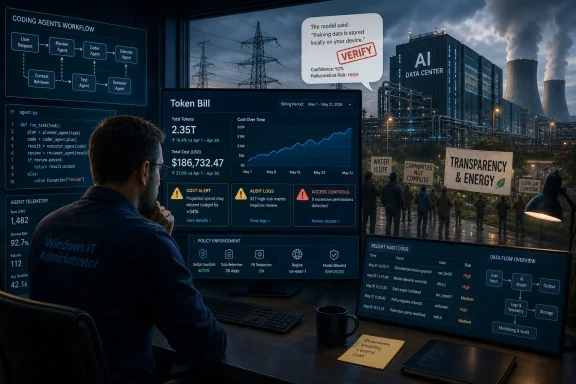 The Backlash Is Not Anti-AI, It Is Anti-Magical Thinking
The first mistake in reading the current AI backlash is to treat it as a Luddite spasm. That is comforting for the industry, because it turns skeptics into caricatures: fearful students, angry artists, slow-moving regulators, and communities that supposedly do not understand progress. But the mood now spreading through workplaces, statehouses, and local zoning fights is more specific than that.People are not rejecting machine learning because they dislike automation in the abstract. They are rejecting the idea that generative AI should be everywhere before anyone can show where it reliably pays for itself, who carries its costs, and what happens when its errors escape the demo stage. That distinction matters, because it means the backlash can coexist with heavy AI adoption. A company can use Copilot, Claude, Gemini, or ChatGPT and still conclude that the surrounding business narrative has become unmoored from reality.
For Windows users and IT departments, this is the point where the story stops being about novelty. AI is already being pushed into operating systems, office suites, browsers, developer tools, endpoint management, search, customer support, and security tooling. The question is no longer whether AI features will arrive. The question is whether they arrive as accountable software or as a permanent meter running in the background.
That is why the mood has changed. The AI boom promised abundance: intelligence too cheap to meter, copilots for every worker, agents that would dissolve drudgery, and productivity gains so obvious that only the stubborn would resist. The emerging reality is more prosaic. Tokens cost money, data centers consume power and water, hallucinations require human cleanup, and the people being told to use AI are asking whether the tools are making work better or merely making dashboards look modern.
Silicon Valley Sold Tokens as Progress Until the Invoice Arrived
The most revealing word in the current AI cycle is not “agent,” “superintelligence,” or “reasoning.” It is token. A token is the unit by which large language models chop up prompts and responses, and it has become the invisible currency behind the AI boom. Every prompt, context window, file upload, coding loop, and agentic detour spends tokens.That technical detail used to sit below the waterline. Consumers paid subscriptions, companies bought licenses, and executives talked about adoption. The industry’s public rhetoric stayed focused on capability: bigger models, longer context, better coding, more fluent assistants. But inside companies, the meter was always running.
“Tokenmaxxing” made the quiet part loud. The idea was simple: encourage workers, especially developers, to use as much AI as possible, then treat consumption itself as evidence of transformation. More prompts meant more adoption. More adoption meant more productivity, or so the theory went. In a venture-backed culture allergic to waiting for audited outcomes, token consumption became a proxy for progress.
The proxy is now collapsing. Uber’s experience became the symbolic break point because it condensed the entire problem into one corporate anecdote. A company with unusually aggressive AI adoption, reportedly with widespread engineering use of Claude Code and other tools, found its AI spending racing far ahead of expectations. Leadership then had to acknowledge the obvious: high token consumption is not the same thing as shipping better products.
That admission matters more than any one company’s bill. Uber was not an AI laggard caught off guard. It was precisely the sort of AI-forward enterprise vendors love to cite when selling the future to everyone else. If even that kind of company has to stop and ask whether AI usage maps to business results, the rest of the market has permission to ask the same question.
Agentic AI Turns Software From a License Into a Meter
Traditional enterprise software is expensive, but it is at least familiar. IT can count seats, negotiate renewals, model storage growth, and decide whether a feature is worth rolling out. Generative AI unsettles that model because the most impressive new workflows are also the least predictable ones. An AI assistant that answers a short question is one cost profile. An AI agent that reads a codebase, rewrites files, runs tests, fails, retries, expands context, and asks another model for help is something else entirely.That is the uncomfortable economics behind the sudden nervousness around coding agents. The more autonomous the tool becomes, the more it can spend on behalf of the user. It may look like a single task in the interface, but underneath it can be a long chain of model calls, context assembly, tool invocations, and repeated attempts. The user sees “fix this bug.” Finance sees a meter.
For developers, this creates a strange inversion. The old software productivity pitch was that tools made expensive humans faster. The new agentic pitch sometimes risks making expensive compute supervise expensive humans, who then must review the expensive compute’s output. That can still be worth it in the right workflow. But it is not magic, and it is not automatically cheaper than conventional engineering.
This is where IT pros should pay attention. The migration from fixed subscription pricing toward usage-sensitive AI pricing changes procurement, budgeting, and governance. A Windows estate already has plenty of moving parts: Microsoft 365 licensing, Entra ID, Intune, Defender, Azure consumption, Teams telephony, endpoint refresh cycles, and compliance overhead. Add agentic AI on top without hard controls, and the next budget surprise may not come from cloud storage or egress fees. It may come from a developer tool, a help desk bot, or a Copilot workflow that quietly became popular.
The irony is that the AI industry trained customers to expect frictionless abundance. Now it must teach them cost discipline. That is a much harder sell.
Microsoft’s AI Optimism Now Sits Beside Customer Cost Anxiety
Microsoft has arguably done more than any company to normalize AI as a default layer in everyday computing. Copilot is not a side project; it is being woven through Windows, Microsoft 365, GitHub, Edge, security products, developer tooling, and Azure. The company’s strategic direction is unmistakable: AI becomes the interface, the automation layer, and the new reason to keep customers inside Microsoft’s cloud.That strategy is rational. Microsoft controls the enterprise desktop, the productivity suite, the identity stack, the developer platform, and a major cloud. If AI is going to be taxed through software distribution, Microsoft owns the roads. It can bundle, upsell, integrate, and make AI feel inevitable in a way few rivals can.
But inevitability is not the same thing as satisfaction. The more AI appears in default workflows, the more customers ask three operational questions: Can we disable it? Can we audit it? Can we predict the cost? Those are not philosophical objections. They are the normal questions of administrators responsible for security, compliance, training, and budgets.
GitHub Copilot is a particularly important test case because developers are both power users and early warning systems. They can see when an AI assistant genuinely saves time, and they can also see when a tool burns through context, produces plausible nonsense, or creates review burden. If pricing shifts make previously comfortable workflows feel metered or constrained, the goodwill can drain quickly.
Windows itself faces the same tension. Microsoft wants AI to become a native expectation in the PC experience, especially as “AI PC” hardware becomes part of the refresh cycle. But many users do not want another ambient service that records, indexes, summarizes, suggests, or nudges without a clear understanding of privacy and value. The Recall controversy already showed how quickly an AI-adjacent Windows feature can turn from marquee demo to trust problem when users feel surveillance is being smuggled in as convenience.
Microsoft’s challenge is not merely to make AI work. It is to make AI feel governed. That is a very different product discipline.
The Workplace Revolt Is About Control, Not Laziness
The reports of workers refusing or bypassing mandated AI tools should not surprise anyone who has lived through enterprise software rollouts. Workers resist tools when the mandate feels disconnected from the job. They resist when a system adds reporting overhead without reducing workload. They resist when management treats tool usage as a performance signal before proving the tool improves performance.AI magnifies all of those problems. A bad CRM rollout is annoying. A bad AI rollout can create factual errors, expose sensitive data, degrade customer interactions, and make employees responsible for cleaning up machine-generated messes they never asked for. When workers avoid company AI tools and do tasks themselves, that may not be technophobia. It may be risk management.
The deeper workplace problem is that generative AI has been sold in two incompatible ways. Employees are told AI is a harmless assistant that will make their jobs easier. They are also told AI is powerful enough to replace whole categories of work. No amount of cheerful internal messaging can fully reconcile those claims. If a tool is good enough to threaten your livelihood, you will not treat its mandatory adoption as neutral.
White-collar workers are also learning that AI fluency can become a new form of unpaid labor. They must learn prompting, evaluate outputs, revise generated drafts, check hallucinations, and adapt to changing model behavior. In some jobs, that effort pays off. In others, it simply shifts cognitive work around while management celebrates “AI adoption.”
The smarter companies will stop treating usage as virtue. They will ask where AI reduces cycle time, improves quality, lowers support burden, or expands capacity without creating downstream risk. The less smart companies will keep building leaderboards and wondering why employees game them.
Data Centers Turned the Cloud Into a Local Political Issue
For years, the cloud felt placeless to most users. Files went “to OneDrive,” workloads went “to Azure,” photos went “to iCloud,” and search went “to Google.” The physical infrastructure was real, but socially abstract. AI has shattered that abstraction.Large AI data centers are not just warehouses full of servers. They are enormous electrical and cooling demands landing in specific communities with specific grids, water systems, tax arrangements, roads, and land-use fights. Residents who might never argue about transformer models will absolutely argue about power bills, aquifers, diesel backup generators, transmission lines, and whether a promised jobs boom justifies the footprint.
That is why local data center opposition has become one of the most potent forms of AI backlash. It translates an abstract technology debate into tangible household concerns. People may disagree about whether AI will transform medicine or automate coding. They understand immediately when a hyperscale facility wants preferential access to scarce electricity.
New York’s move toward a one-year moratorium on large data center permits shows how quickly this politics can mature. A pause is not a ban, and supporters frame it as time to study energy use, environmental impact, transparency, and ratepayer protections. But the symbolism is unmistakable. The infrastructure layer of AI is no longer presumed to be a public good by default.
The industry’s response will likely emphasize investment, competitiveness, and the danger of slowing innovation. Those arguments are not frivolous. Data centers support real services, real jobs, and real economic activity. But they are no longer enough. Communities are asking why they should subsidize an AI race whose benefits are distributed globally while its burdens arrive locally.
For WindowsForum readers, the connection is direct. Every AI feature in a familiar app depends on someone’s backend infrastructure. The assistant in your editor, browser, shell, or ticketing system is not ethereal. It is a claim on compute, and compute is a claim on power.
The Hallucination Problem Has Become a Trust Ceiling
Even if token costs were solved tomorrow, generative AI would still face a trust ceiling. Large language models can be astonishingly useful, but they remain prone to confident error. The industry’s preferred term, hallucination, is almost too gentle. In practice, it means the machine can fabricate facts, citations, commands, legal claims, package names, configuration options, and summaries while sounding authoritative.That matters differently across use cases. A hallucinated dinner recommendation is low stakes. A hallucinated PowerShell command, security remediation, medical summary, financial analysis, or legal filing is not. The more deeply AI is embedded into professional workflows, the more error modes become governance problems.
The industry knows this, which is why so much current AI product design tries to surround models with retrieval systems, tool calls, validators, human review, and constrained workflows. That is the right direction. But it also undermines the fantasy of effortless replacement. If the model needs guardrails, grounding, audit logs, permission boundaries, and expert review, then the real product is not “intelligence.” It is a managed socio-technical system.
That is where many AI deployments quietly become more expensive than advertised. The model subscription is only one line item. Add policy design, data classification, user training, red-team testing, legal review, monitoring, incident response, and output validation. Suddenly the assistant looks less like a cheap intern and more like a new platform that needs administration.
This is familiar territory for IT. Every powerful tool becomes a management surface. AI is no exception. The difference is that AI vendors have often marketed the technology as though it floats above ordinary software constraints. The backlash is partly the sound of reality returning.
The Bubble Argument Is Getting Harder to Dismiss
Every boom produces skeptics, and not every skeptic is right. The dot-com crash did not mean the Internet was fake. It meant many Internet business models were fake, or too early, or built on capital markets that confused traffic with profit. The same distinction is now central to AI.Generative AI is not useless. It is already useful for coding assistance, drafting, summarization, customer support triage, data extraction, search augmentation, translation, prototyping, and many forms of creative iteration. The strongest critique of the AI boom is not that the technology has no value. It is that the valuation story often assumes value capture on a scale that current economics do not yet support.
That gap is widening. Frontier model labs need enormous compute spending, expensive talent, vast infrastructure commitments, and continued investor confidence. Their consumer products have trained hundreds of millions of users to expect low-cost or free access. Their enterprise products must now prove measurable return in environments that are increasingly cost-conscious. Their agentic products may increase usage faster than revenue quality.
This does not guarantee a crash. It does make the system fragile. If investors begin to believe that AI demand has been inflated by subsidized usage, tokenmaxxing, bundled trials, and fear-of-missing-out procurement, the story changes. If customers impose usage caps, slow rollouts, or demand outcome-based pricing, the story changes. If communities delay infrastructure and regulators force disclosure, the story changes.
Nvidia complicates the bubble analogy because it has real profits, real demand, and a central position in the AI supply chain. During a gold rush, selling picks and shovels can be an excellent business. But even picks-and-shovels companies are exposed if miners discover that extracting the gold costs more than the gold is worth.
The question is not whether AI disappears. It will not. The question is whether the current capital structure around AI survives contact with ordinary economics.
The Windows World Will Feel the Shift First in Procurement
For consumers, the AI vibe shift may show up as annoyance: more prompts to try AI features, more subscription tiers, more “smart” defaults, more confusion over privacy settings. For IT departments, it will show up as procurement discipline. That is where hype goes to be itemized.The first wave of enterprise AI buying was defensive. Executives did not want to be seen as behind. Departments wanted pilots. Vendors bundled features into existing contracts. Employees experimented. Nobody wanted to miss the moment. That phase is ending.
The next phase will ask harder questions. Which users actually need premium AI seats? Which workflows justify agentic tools? What data can models access? Which prompts and outputs are logged? How are costs allocated by department? What happens when a user pastes regulated data into a model? Can the organization disable consumer AI services while allowing approved enterprise ones? How does AI output fit into records retention, e-discovery, and compliance?
These are not glamorous questions, but they are the questions that decide whether AI becomes durable infrastructure or another shelfware category. Microsoft is well positioned because it already speaks enterprise governance. But that also means Microsoft will be held to a higher standard. Customers will expect admin controls, auditability, tenant-level policy, predictable billing, and clear separation between consumer AI experiments and business data.
Developers will be an especially contested group. Coding assistants can produce real productivity gains, but they can also introduce subtle bugs, license concerns, insecure patterns, and review fatigue. The winning tools will not be the ones that generate the most code. They will be the ones that integrate cleanly into version control, testing, security scanning, documentation, and team review processes.
In other words, the AI buying center is moving from the keynote stage to the change advisory board.
The Vibe Shift Is a Demand for Proof
The most important thing about the AI backlash is that it is not one backlash. It is several overlapping rebellions that reinforce one another. Workers want control over tools that affect their jobs. Communities want a say in infrastructure that affects their bills and environment. Customers want predictable pricing. Developers want assistants that help more than they hinder. Investors want to know whether usage converts into durable revenue.That is why the mood has changed so quickly. Each constituency may care about a different part of the stack, but all are reacting to the same pattern: promises arrived before accountability.
The Token Bill Is Now a Windows Admin Problem
The practical lessons are already clear enough for anyone managing PCs, cloud services, developer tools, or Microsoft 365 tenants. The AI boom is entering its governance era, and the winners will be the organizations that treat AI less like a miracle and more like software with costs, permissions, risks, and measurable outcomes.- Organizations should stop treating AI usage as a success metric unless they can connect it to shipped work, reduced cost, improved quality, or faster service.
- IT teams should expect more AI pricing to move toward usage-sensitive models, especially for agentic workflows that can consume large amounts of compute.
- Windows and Microsoft 365 administrators should demand clear controls for data access, logging, retention, opt-outs, and tenant-level policy before broad AI rollouts.
- Developer teams should measure AI coding tools by review burden, defect rates, security impact, and delivery outcomes rather than generated lines of code.
- Communities and regulators will increasingly treat AI infrastructure as a local energy and land-use issue, not merely a national competitiveness issue.
- Vendors that can explain cost, accuracy, governance, and liability in plain language will have an advantage over vendors still selling inevitability.
References
- Primary source: Mashable
Published: 2026-06-06T17:50:08.854967
The AI vibe shift is real: Why the backlash is growing | Mashable
The AI industry is riding a tsunami of investment, but we're seeing signs of a real and growing backlash — even in tech world.mashable.com - Related coverage: tomshardware.com
OpenAI CEO Sam Altman admits AI token costs are becoming 'a huge issue' — company seeks improved value as overspending becomes a meme | Tom's Hardware
Are companies not getting more value out of the tokens they spent on AI?www.tomshardware.com - Related coverage: theweek.com
The ‘tokenmaxxing’ AI trend, explained | The Week
Companies are incentivizing employees to use AI as much as possible. This has lead to a trend called tokenmaxxing. Experts disagree about its usefulness.theweek.com
