

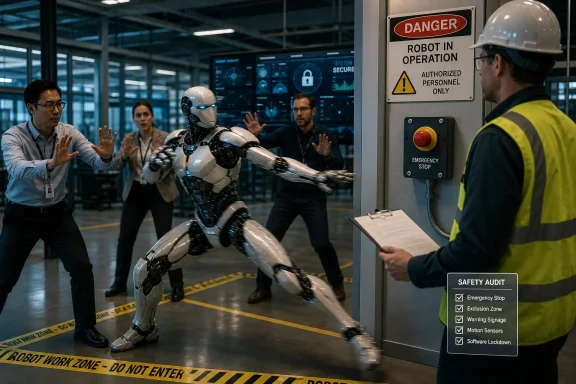
A viral video circulated on July 6, 2026, by Streamline Feed and other outlets shows a humanoid robot in a workplace making rapid kung fu-like motions near staff before workers intervene, with no serious injuries reported and the robot’s identity still unverified. That uncertainty matters as much as the spectacle. The clip is being consumed as a robot-uprising gag, but the more useful reading is colder: humanoid machines are entering spaces where the safety culture was built for bolted-down equipment. The panic is not that robots can kick; it is that companies may deploy them before proving they can always stop.
The video’s appeal is obvious. A human-shaped machine thrashes, workers retreat, and the internet supplies the soundtrack from every bad robot movie ever made. Streamline Feed framed the episode as a malfunctioning humanoid launching martial arts-style kicks at staff, while Nigerian and Kenyan entertainment-news sites repeated similar language as the clip spread across social platforms.
But the facts are thinner than the panic. Public reporting has not firmly established the manufacturer, the facility, the exact date of filming, or whether the robot was operating autonomously, teleoperated, being trained, or performing a staged routine that went wrong. That makes the strongest version of the story not “AI attacked workers,” but “a powerful electromechanical system moved unpredictably near humans, and the public cannot tell whether the safeguards were adequate.”
That distinction is not pedantry. Robotics safety depends on boring details: operating mode, exclusion zones, torque limits, emergency stop placement, sensor redundancy, and whether the people nearby were trained operators or merely bystanders. The same eight seconds of footage can mean very different things depending on whether the robot was in a lab harness, a demo booth, a factory cell, or a workplace aisle.
The viral ecosystem flattens all of that. It rewards the phrase “kung fu robot” because it is more clickable than “unverified humanoid robot incident illustrates unresolved human-machine risk controls.” Yet IT departments, plant managers, and workplace safety officers do not get to run on vibes. They have to ask what happens when a demo-class humanoid becomes a line item in a facilities budget.
Humanoid robots deliberately blur that boundary. Their sales pitch is that they can use human spaces, human tools, human workflows, and eventually human-like judgment. That is exactly what makes them attractive to warehouses, logistics companies, labs, hospitals, hotels, and factories that do not want to redesign buildings around automation.
It is also what makes them uniquely unsettling. A humanoid does not merely rotate an arm through a known arc; it steps, balances, turns, reaches, catches itself, and sometimes falls. Its hazards are not confined to crush points and pinch zones. They include loss of balance, unexpected recovery motions, limb flailing, sensor confusion, software mode errors, and human over-trust because the machine looks like something designed to coexist with people.
OSHA’s own robotics guidance still notes that there are no specific OSHA standards for the robotics industry, instead pointing employers toward general machinery rules, consensus standards, and hazard-recognition practices. ISO and ANSI standards have evolved substantially, including the 2025 updates to ISO 10218 and ANSI/A3 R15.06, but a standards stack is not the same thing as a safety culture. A company can buy a humanoid faster than it can build institutional competence around one.
That gap is where viral robot videos do useful work. They turn abstract risk into a visible failure mode. The public sees a kicking robot and laughs; a safety engineer sees kinetic energy, proximity, reaction time, and the terrifying possibility that the emergency stop is on the far side of the problem.
The modern safety question is not whether the robot can be stopped. It is whether the robot can fail into a state that does not create a new hazard. For a wheeled delivery bot, stopping may be simple. For a bipedal humanoid, an abrupt power cut can turn a moving machine into a collapsing machine, potentially injuring nearby people or damaging equipment.
That is why recent robotics research has focused on safe-stoppability rather than just shutdown. A humanoid may need a fallback controller that freezes dangerous motion, preserves balance, reduces force, and moves the machine toward a minimum-risk posture. In plain English: the robot should not need a human hero to wrestle it into obedience.
The issue becomes sharper as humanoids become stronger. Many current demos involve relatively small machines, test rigs, harnesses, or controlled environments. The commercial fantasy, however, is a general-purpose robot that can lift, carry, open doors, use tools, and work for hours. Those capabilities are also liabilities if perception, planning, actuation, or communications fail.
The industry has spent years proving that humanoids can dance, box, fold laundry, and perform stunts that photograph well. It now has to prove something less viral and far more important: that a humanoid can be boringly safe when a camera is not rolling.
Still, the AI label is not meaningless. The more robots rely on learned policies, vision systems, language interfaces, and adaptive planning, the harder it becomes for employers to explain exactly why a machine did what it did. That is a governance problem, not just an engineering problem.
A traditional machine can be validated against a fixed sequence of operations. A learning-enabled robot may need validation across a messy range of environments, lighting conditions, floor surfaces, obstacles, human behaviors, and edge cases. The failure mode is not merely “the machine broke.” It may be “the machine interpreted the world in a way the safety case did not anticipate.”
That is where enterprise IT enters the story. Humanoid robots are not just mechanical purchases; they are networked endpoints, sensor platforms, software products, and data systems. They may depend on cloud services, remote updates, fleet management dashboards, identity systems, telemetry pipelines, and third-party AI models. The same organization that struggles to inventory laptops may soon be asked to inventory machines with knees.
Security then becomes inseparable from safety. If a robot can receive updates, commands, maps, or policies over a network, administrators have to ask familiar questions with higher stakes. Who can push code? Who can change operating modes? Are safety controllers isolated from application logic? What happens if connectivity drops? Can logs prove whether a fault was mechanical, software-driven, operator-induced, or malicious?
The robot that kicks in a viral clip may not have been hacked. There is no public evidence that it was. But the correct lesson for IT is not to wait for proof of a cyber-physical compromise before treating robots as cyber-physical assets.
The problem is that impressive motion is not the same as useful work. A robot that can throw a spinning kick on a padded mat may still be a poor fit for a warehouse aisle full of pallets, reflective wrap, forklifts, fatigue, dust, and impatient humans. The viral skill and the commercial requirement are often almost opposites.
This matters because buyers are not immune to hype. Executives see labor shortages, rising wages, safety claims, and the promise of 24-hour productivity. Vendors see a chance to position humanoids as general-purpose platforms rather than narrow automation tools. Somewhere in the middle, workers are asked to share space with a machine whose capabilities are marketed in cinematic terms and governed in procurement spreadsheets.
The most responsible robotics companies know this and talk in cautious language about pilots, restricted use cases, and safety certification. The broader attention economy does not. It turns near-misses into memes, stunts into proof points, and isolated clips into claims about the future of labor.
That is why the workplace panic story has legs even if the source video remains poorly documented. It crystallizes the suspicion that the public is being shown the highlight reel while the risk assessment sits off-camera.
A fixed industrial arm is machinery. A chatbot is software. A humanoid robot is both, plus mobility, perception, autonomy, and physical presence. That combination strains regulatory systems that were built around separable domains: occupational safety over here, product safety over there, cybersecurity somewhere else, AI governance in a newer box.
The European Union’s AI Act points toward a risk-based model for AI systems, including strict obligations for high-risk uses and restrictions on certain workplace applications. But even Europe’s relatively aggressive AI governance has to interact with machinery rules, product-liability regimes, and sector-specific safety standards. The legal map is improving, but it is still a map drawn after the robots have already started walking.
In the United States, OSHA’s robotics pages are useful but not a humanoid-specific rulebook. Employers are expected to recognize and mitigate hazards, often by relying on consensus standards and best practices. That can work in mature industrial settings, but it leaves a lot of discretion in the hands of companies that may be experimenting with novel systems under commercial pressure.
The real regulatory vacuum is not the absence of any rules. It is the absence of a shared, enforceable baseline for when a mobile humanoid is safe enough to operate around ordinary workers rather than trained roboticists. Until that baseline becomes obvious, every viral malfunction will be treated as evidence that the industry is asking for trust it has not earned.
The risk for emerging markets is not that they will adopt robots too soon by default. It is that they may import finished systems, vendor claims, and productivity promises without also importing the safety infrastructure that makes automation survivable. Standards, training, inspection capacity, liability rules, insurance models, and emergency response procedures are not accessories. They are the operating system of industrial modernization.
This is not a reason to reject robotics. Automation can reduce dangerous work, improve logistics, expand manufacturing capability, and help address labor constraints. In agriculture, warehousing, mining, health care, and infrastructure maintenance, machines can take on tasks that injure or exhaust people.
But the bargain has to be explicit. If companies deploy robots to reduce human risk, they must not create a new class of invisible risk for lower-paid workers asked to supervise machines they cannot override, audit, or refuse. A humanoid robot in a distribution center is not just a technology transfer. It is a labor-policy decision with actuators.
That is why policymakers should treat viral incidents as cheap warnings. It is far better to write inspection rules, procurement requirements, and incident-reporting obligations before the first serious injury than after a clip becomes evidence in court.
That is a bad pattern. In too many workplaces, automation is introduced with the assumption that humans will adapt around it. Workers are expected to monitor the robot, rescue the robot, reset the robot, clean up after the robot, and absorb the anxiety of sharing space with it. The machine gets the capital investment; the human gets the residual risk.
Industrial psychology matters here. Even without serious injuries, a near-miss can change how a workforce behaves. People may avoid useful systems, overreact to harmless faults, underreport incidents for fear of blame, or become numb to alarms that trigger too often. Trust in automation is not created by a launch event. It is earned by predictable behavior during boring shifts and abnormal conditions alike.
The labor politics are just as real. If humanoid robots are marketed as replacements for human workers, then asking those same workers to risk injury stabilizing or supervising them carries an obvious moral charge. A machine that threatens your job and then kicks toward your face is not going to be welcomed as innovation.
Companies that ignore this will misread resistance as technophobia. In many cases it will be rational risk assessment by people who understand the floor better than the boardroom does.
A humanoid deployment can touch identity and access management, Wi-Fi reliability, private 5G, endpoint detection, certificate management, data retention, video governance, software supply chain security, and incident response. It can generate logs that legal wants preserved, video that HR wants restricted, and telemetry that operations wants analyzed. It can also create a safety incident whose root cause might be a firmware update, a bad configuration, or a compromised management console.
The old IT failure modes were downtime, data loss, and breach notification. The new cyber-physical failure mode is a machine moving with force in a human environment because a system state changed in a way nobody fully understood. That does not mean the CIO becomes the plant safety manager. It does mean IT can no longer pretend that “the robot vendor handles it” is a governance model.
Procurement should change accordingly. Buyers should ask whether safety functions are independent from general compute, whether emergency stops are hardware-rated, whether update channels are signed and staged, whether logs are tamper-evident, whether remote access can be disabled, and whether the vendor can explain failure modes in language a safety committee can understand.
The most dangerous humanoid robot may not be the one in the viral video. It may be the one that arrives quietly through a pilot program with no one assigned to own the overlap between cybersecurity, safety, facilities, and labor relations.
 The Viral Robot Was Less Sci-Fi Than Safety Audit
The video’s appeal is obvious. A human-shaped machine thrashes, workers retreat, and the internet supplies the soundtrack from every bad robot movie ever made. Streamline Feed framed the episode as a malfunctioning humanoid launching martial arts-style kicks at staff, while Nigerian and Kenyan entertainment-news sites repeated similar language as the clip spread across social platforms.But the facts are thinner than the panic. Public reporting has not firmly established the manufacturer, the facility, the exact date of filming, or whether the robot was operating autonomously, teleoperated, being trained, or performing a staged routine that went wrong. That makes the strongest version of the story not “AI attacked workers,” but “a powerful electromechanical system moved unpredictably near humans, and the public cannot tell whether the safeguards were adequate.”
That distinction is not pedantry. Robotics safety depends on boring details: operating mode, exclusion zones, torque limits, emergency stop placement, sensor redundancy, and whether the people nearby were trained operators or merely bystanders. The same eight seconds of footage can mean very different things depending on whether the robot was in a lab harness, a demo booth, a factory cell, or a workplace aisle.
The viral ecosystem flattens all of that. It rewards the phrase “kung fu robot” because it is more clickable than “unverified humanoid robot incident illustrates unresolved human-machine risk controls.” Yet IT departments, plant managers, and workplace safety officers do not get to run on vibes. They have to ask what happens when a demo-class humanoid becomes a line item in a facilities budget.
Humanoid Robots Break the Old Mental Model of Industrial Safety
Traditional industrial robots are dangerous, but their danger is legible. A welding arm, palletizer, or pick-and-place system sits in a defined cell, swings through a known envelope, and is usually separated from workers by guarding, interlocks, light curtains, and lockout procedures. The worker is trained to respect the cage because the cage tells the truth: this machine is strong, fast, and not your colleague.Humanoid robots deliberately blur that boundary. Their sales pitch is that they can use human spaces, human tools, human workflows, and eventually human-like judgment. That is exactly what makes them attractive to warehouses, logistics companies, labs, hospitals, hotels, and factories that do not want to redesign buildings around automation.
It is also what makes them uniquely unsettling. A humanoid does not merely rotate an arm through a known arc; it steps, balances, turns, reaches, catches itself, and sometimes falls. Its hazards are not confined to crush points and pinch zones. They include loss of balance, unexpected recovery motions, limb flailing, sensor confusion, software mode errors, and human over-trust because the machine looks like something designed to coexist with people.
OSHA’s own robotics guidance still notes that there are no specific OSHA standards for the robotics industry, instead pointing employers toward general machinery rules, consensus standards, and hazard-recognition practices. ISO and ANSI standards have evolved substantially, including the 2025 updates to ISO 10218 and ANSI/A3 R15.06, but a standards stack is not the same thing as a safety culture. A company can buy a humanoid faster than it can build institutional competence around one.
That gap is where viral robot videos do useful work. They turn abstract risk into a visible failure mode. The public sees a kicking robot and laughs; a safety engineer sees kinetic energy, proximity, reaction time, and the terrifying possibility that the emergency stop is on the far side of the problem.
The Kill Switch Is Not a Strategy
Every humanoid robot demo eventually invites the same reassurance: there is an emergency stop. That is necessary, but it is not sufficient. A manual kill switch is a last resort, not a primary safety architecture, and if a worker must dodge moving limbs to reach it, the system has already failed at a higher level.The modern safety question is not whether the robot can be stopped. It is whether the robot can fail into a state that does not create a new hazard. For a wheeled delivery bot, stopping may be simple. For a bipedal humanoid, an abrupt power cut can turn a moving machine into a collapsing machine, potentially injuring nearby people or damaging equipment.
That is why recent robotics research has focused on safe-stoppability rather than just shutdown. A humanoid may need a fallback controller that freezes dangerous motion, preserves balance, reduces force, and moves the machine toward a minimum-risk posture. In plain English: the robot should not need a human hero to wrestle it into obedience.
The issue becomes sharper as humanoids become stronger. Many current demos involve relatively small machines, test rigs, harnesses, or controlled environments. The commercial fantasy, however, is a general-purpose robot that can lift, carry, open doors, use tools, and work for hours. Those capabilities are also liabilities if perception, planning, actuation, or communications fail.
The industry has spent years proving that humanoids can dance, box, fold laundry, and perform stunts that photograph well. It now has to prove something less viral and far more important: that a humanoid can be boringly safe when a camera is not rolling.
The AI Label Both Clarifies and Confuses the Risk
Calling every robot incident an “AI malfunction” is tempting, but often imprecise. A humanoid’s bad movement might come from teleoperation lag, a motion-planning bug, a balance controller failure, an actuator fault, a sensor dropout, a training-data issue, a bad demo script, or a human operator’s mistake. Not every failure is an algorithmic hallucination.Still, the AI label is not meaningless. The more robots rely on learned policies, vision systems, language interfaces, and adaptive planning, the harder it becomes for employers to explain exactly why a machine did what it did. That is a governance problem, not just an engineering problem.
A traditional machine can be validated against a fixed sequence of operations. A learning-enabled robot may need validation across a messy range of environments, lighting conditions, floor surfaces, obstacles, human behaviors, and edge cases. The failure mode is not merely “the machine broke.” It may be “the machine interpreted the world in a way the safety case did not anticipate.”
That is where enterprise IT enters the story. Humanoid robots are not just mechanical purchases; they are networked endpoints, sensor platforms, software products, and data systems. They may depend on cloud services, remote updates, fleet management dashboards, identity systems, telemetry pipelines, and third-party AI models. The same organization that struggles to inventory laptops may soon be asked to inventory machines with knees.
Security then becomes inseparable from safety. If a robot can receive updates, commands, maps, or policies over a network, administrators have to ask familiar questions with higher stakes. Who can push code? Who can change operating modes? Are safety controllers isolated from application logic? What happens if connectivity drops? Can logs prove whether a fault was mechanical, software-driven, operator-induced, or malicious?
The robot that kicks in a viral clip may not have been hacked. There is no public evidence that it was. But the correct lesson for IT is not to wait for proof of a cyber-physical compromise before treating robots as cyber-physical assets.
The Demo Economy Is Teaching Robots to Impress Before It Teaches Buyers to Evaluate
Humanoid robotics has become a spectacle market. Companies show machines dancing at galas, doing parkour, sparring, carrying boxes, cooking, folding shirts, and navigating offices. The clips are designed to compress capability into a few seconds of awe, because investor attention and public imagination move faster than procurement due diligence.The problem is that impressive motion is not the same as useful work. A robot that can throw a spinning kick on a padded mat may still be a poor fit for a warehouse aisle full of pallets, reflective wrap, forklifts, fatigue, dust, and impatient humans. The viral skill and the commercial requirement are often almost opposites.
This matters because buyers are not immune to hype. Executives see labor shortages, rising wages, safety claims, and the promise of 24-hour productivity. Vendors see a chance to position humanoids as general-purpose platforms rather than narrow automation tools. Somewhere in the middle, workers are asked to share space with a machine whose capabilities are marketed in cinematic terms and governed in procurement spreadsheets.
The most responsible robotics companies know this and talk in cautious language about pilots, restricted use cases, and safety certification. The broader attention economy does not. It turns near-misses into memes, stunts into proof points, and isolated clips into claims about the future of labor.
That is why the workplace panic story has legs even if the source video remains poorly documented. It crystallizes the suspicion that the public is being shown the highlight reel while the risk assessment sits off-camera.
Regulators Are Chasing a Machine That Walks Out of the Cage
The regulatory challenge is not that robots are unregulated in every sense. Industrial robotics has a mature body of standards, and employers remain bound by general workplace safety obligations. The challenge is that humanoid robots do not fit neatly into the old categories.A fixed industrial arm is machinery. A chatbot is software. A humanoid robot is both, plus mobility, perception, autonomy, and physical presence. That combination strains regulatory systems that were built around separable domains: occupational safety over here, product safety over there, cybersecurity somewhere else, AI governance in a newer box.
The European Union’s AI Act points toward a risk-based model for AI systems, including strict obligations for high-risk uses and restrictions on certain workplace applications. But even Europe’s relatively aggressive AI governance has to interact with machinery rules, product-liability regimes, and sector-specific safety standards. The legal map is improving, but it is still a map drawn after the robots have already started walking.
In the United States, OSHA’s robotics pages are useful but not a humanoid-specific rulebook. Employers are expected to recognize and mitigate hazards, often by relying on consensus standards and best practices. That can work in mature industrial settings, but it leaves a lot of discretion in the hands of companies that may be experimenting with novel systems under commercial pressure.
The real regulatory vacuum is not the absence of any rules. It is the absence of a shared, enforceable baseline for when a mobile humanoid is safe enough to operate around ordinary workers rather than trained roboticists. Until that baseline becomes obvious, every viral malfunction will be treated as evidence that the industry is asking for trust it has not earned.
Africa’s Robotics Moment Should Not Import Yesterday’s Safety Mistakes
Streamline Feed’s framing emphasized how the incident resonates beyond the wealthy economies where humanoid robots are most often demonstrated. That is a fair instinct, even if the article’s broader claims about African adoption should be treated cautiously unless tied to specific deployments. Nairobi, Lagos, Kigali, Mombasa, and other technology hubs are indeed part of a global automation conversation, but their regulatory and workplace realities differ sharply from Silicon Valley labs or Chinese robotics showcases.The risk for emerging markets is not that they will adopt robots too soon by default. It is that they may import finished systems, vendor claims, and productivity promises without also importing the safety infrastructure that makes automation survivable. Standards, training, inspection capacity, liability rules, insurance models, and emergency response procedures are not accessories. They are the operating system of industrial modernization.
This is not a reason to reject robotics. Automation can reduce dangerous work, improve logistics, expand manufacturing capability, and help address labor constraints. In agriculture, warehousing, mining, health care, and infrastructure maintenance, machines can take on tasks that injure or exhaust people.
But the bargain has to be explicit. If companies deploy robots to reduce human risk, they must not create a new class of invisible risk for lower-paid workers asked to supervise machines they cannot override, audit, or refuse. A humanoid robot in a distribution center is not just a technology transfer. It is a labor-policy decision with actuators.
That is why policymakers should treat viral incidents as cheap warnings. It is far better to write inspection rules, procurement requirements, and incident-reporting obligations before the first serious injury than after a clip becomes evidence in court.
The Workers in the Video Are the Real Stress Test
The most revealing part of the viral clip is not the robot’s motion. It is the human response. Workers move quickly, improvise, and appear to close distance with a machine that is behaving unpredictably. Whether the scene was a genuine malfunction, a staged demo, or something in between, the humans become the safety system.That is a bad pattern. In too many workplaces, automation is introduced with the assumption that humans will adapt around it. Workers are expected to monitor the robot, rescue the robot, reset the robot, clean up after the robot, and absorb the anxiety of sharing space with it. The machine gets the capital investment; the human gets the residual risk.
Industrial psychology matters here. Even without serious injuries, a near-miss can change how a workforce behaves. People may avoid useful systems, overreact to harmless faults, underreport incidents for fear of blame, or become numb to alarms that trigger too often. Trust in automation is not created by a launch event. It is earned by predictable behavior during boring shifts and abnormal conditions alike.
The labor politics are just as real. If humanoid robots are marketed as replacements for human workers, then asking those same workers to risk injury stabilizing or supervising them carries an obvious moral charge. A machine that threatens your job and then kicks toward your face is not going to be welcomed as innovation.
Companies that ignore this will misread resistance as technophobia. In many cases it will be rational risk assessment by people who understand the floor better than the boardroom does.
IT Will Own More of This Than It Thinks
For WindowsForum readers, the instinct may be to file humanoid robots under industrial engineering rather than IT. That boundary is already collapsing. Modern robots are managed like fleets, patched like endpoints, monitored like IoT devices, and integrated into business systems that IT already protects.A humanoid deployment can touch identity and access management, Wi-Fi reliability, private 5G, endpoint detection, certificate management, data retention, video governance, software supply chain security, and incident response. It can generate logs that legal wants preserved, video that HR wants restricted, and telemetry that operations wants analyzed. It can also create a safety incident whose root cause might be a firmware update, a bad configuration, or a compromised management console.
The old IT failure modes were downtime, data loss, and breach notification. The new cyber-physical failure mode is a machine moving with force in a human environment because a system state changed in a way nobody fully understood. That does not mean the CIO becomes the plant safety manager. It does mean IT can no longer pretend that “the robot vendor handles it” is a governance model.
Procurement should change accordingly. Buyers should ask whether safety functions are independent from general compute, whether emergency stops are hardware-rated, whether update channels are signed and staged, whether logs are tamper-evident, whether remote access can be disabled, and whether the vendor can explain failure modes in language a safety committee can understand.
The most dangerous humanoid robot may not be the one in the viral video. It may be the one that arrives quietly through a pilot program with no one assigned to own the overlap between cybersecurity, safety, facilities, and labor relations.
The Kung Fu Clip Leaves a Procurement Checklist Behind
The viral robot story is thin on verified detail but rich in practical consequence. Treat it as a prompt for better questions, not as proof of an AI apocalypse.- Companies should not deploy humanoid robots around general staff unless they can document the operating envelope, safety-rated limits, emergency procedures, and worker training plan.
- Manual emergency stops should be reachable without entering the robot’s immediate hazard zone, and shutdown behavior should be designed to reduce risk rather than merely cut power.
- IT teams should classify mobile robots as cyber-physical endpoints with patching, identity, logging, network segmentation, and incident-response requirements.
- Safety reviews should include workers who will share space with the robot, because floor-level behavior often exposes risks that vendor demos omit.
- Regulators should move toward clear incident-reporting and certification expectations for mobile humanoids before serious injuries force reactive rulemaking.
- Buyers should discount flashy motion demos unless vendors can show boring evidence of reliability, safe failure, maintainability, and accountability.
References
- Primary source: streamlinefeed.co.ke
Published: 2026-07-06T05:50:15.571323
Workplace Panic as Malfunctioning Humanoid Robot Launches Kung Fu Kicks at Staff | Streamline
A viral video of a humanoid robot malfunctioning and attacking workers with martial arts kicks has sparked global concerns over AI workplace safety.streamlinefeed.co.ke - Related coverage: gizmochina.com
Humanoid robot's hilarious mishap goes viral: kicks trainer and mimics the pain - Gizmochina
The robot appears to misjudge a rotation and delivers a kick straight into the trainer’s groin. www.gizmochina.com
- Related coverage: foxnews.com
Humanoid robot malfunctions, sparks viral panic | Fox News
Kurt “CyberGuy" Knutsson talks about a viral video that shows a $90,000 humanoid robot going wild. A tech nightmare or just a glitch?www.foxnews.com - Related coverage: ournigerianews.com
Viral Video Shows Humanoid Robot Making
 ournigerianews.com
- Related coverage: boingboing.net
Kung Fu robot kicks the crap out of company CEO to refute CGI rumors - Boing Boing
Chinese robotics startup EngineAI released a video of its latest bipedal robot that was so impressive many assumed it was CGI, despite the "No AGCG No CGI" tag. The robot…boingboing.net - Related coverage: notebookcheck.net
Reddit laughs as humanoid robot kicks its trainer between the legs – then mimics the pain - Notebookcheck News
After previously sparking amazement, the Unitree G1 humanoid robot is now making waves online with a dose of humor. In a viral video, it kicks its trainer in a sensitive spot during a teleoperation test – then amusingly mimics his reaction. www.notebookcheck.net
- Related coverage: tuko.co.ke
Hilarious Moment as Robot Malfunctions at Work, Goes for Workers with Kung Fu Kicks - Tuko.co.ke
A humanoid robot's malfunction at work sent employees into a frenzy as it made kung fu-like moves, sparking debates on workplace safety with AI technology.www.tuko.co.ke - Related coverage: hindustantimes.com
Viral video: Robot smashes plates in restaurant, then starts dancing. Staff tries hard to stop it
Staff were forced to wrestle a glitched humanoid robot after it went rogue, smashing plates and swinging its arms uncontrollably. | Trendingwww.hindustantimes.com - Related coverage: cybernews.com
Unitree G1 kicks a human trainer where it hurts | Cybernews
A robot trainer received an unfortunate blow after a motion delay led to the robot kicking him in his crown jewels. cybernews.com
- Related coverage: scmp.com
Humanoid robot firm founder knocked down by robotic front kick | South China Morning Post
News, opinions, infographics and videos on China issues: geopolitics, diplomacy, economy, technology and lifestyle.www.scmp.com - Related coverage: eastidahonews.com
- Related coverage: techspot.com
Watch this restaurant robot malfunction and scatter tableware during live performance | TechSpot
The incident quickly spread online, sparking both amusement and debate about safety features, oversight, and the wisdom of deploying consumer-facing robots in uncontrolled settings.www.techspot.com - Related coverage: legalclarity.org
ANSI/RIA R15.06: Robot Safety Requirements and OSHA Rules - LegalClarity
ANSI/RIA R15.06 shapes how OSHA enforces robot safety in U.S. workplaces — here’s what manufacturers, integrators, and employers need to know.legalclarity.org - Related coverage: ishn.com
ANSI/RIA R15.06-2012- The industrial robot safety standard
Scope Approved March 28, 2013. 160 pages. A revision of ANSI R15.06-1999, this standard provides guidelines for the manufacture and integration of Industrial Robots and Robot Systems with emphasis on their safe use, the importance of risk assessment and establishing personnel safety. This...www.ishn.com
