Amazon, Alphabet, and Microsoft are accelerating custom AI chip programs in 2026 while still buying enormous volumes of Nvidia GPUs for cloud AI infrastructure, creating a near-term boom for Nvidia and a longer-term fight over who captures the economics of artificial intelligence compute. The story is not that hyperscalers have found a clean escape hatch from Nvidia. It is that they are spending enough money to justify building one, even if the door only opens partway.
That distinction matters for anyone watching the AI build-out from the Windows ecosystem. Microsoft’s Copilot ambitions, Azure capacity, developer tooling, enterprise AI services, and even the future economics of Windows-adjacent cloud workloads all sit on top of this silicon contest. Nvidia remains the indispensable supplier of the moment, but its best customers are also becoming its most serious negotiators.
The last decade trained the market to think of cloud computing as a software-and-scale business. Amazon Web Services, Google Cloud, and Microsoft Azure won by building global data centers, abstracting away infrastructure, and selling compute by the minute. The AI boom has changed the center of gravity: the most strategic part of the stack is now the accelerator, the networking fabric around it, and the software layer that makes thousands of chips behave like one machine.
That is Nvidia’s kingdom. Its GPUs became the default platform for training and serving large AI models not simply because the chips were fast, but because CUDA, networking, systems design, libraries, and developer familiarity made Nvidia the path of least resistance. In AI infrastructure, the fastest chip is not always the most valuable chip; the most valuable chip is the one that gets a model into production with the fewest surprises.
But Amazon, Alphabet, and Microsoft are not ordinary customers. They buy at a scale that gives them two uncomfortable options: keep paying Nvidia’s margins indefinitely, or spend billions trying to internalize some of that value. The second path is risky, slow, and technically unforgiving. It is also exactly what companies of this size tend to do when a supplier becomes too strategically important.
The result is a strange-looking market in which Nvidia can post explosive growth while its largest buyers openly work to reduce their dependence on it. That is not a contradiction. It is the normal shape of a platform transition before the economics settle.
The numbers now attached to that strategy are no longer experimental. Amazon has said its custom chip operation, including Graviton, Trainium, and Nitro, reached an annual revenue run rate above $20 billion in the first quarter of 2026. Andy Jassy’s more revealing claim was the hypothetical one: if the business sold chips externally the way a conventional semiconductor company does, Amazon believes it would be running at roughly $50 billion a year.
That framing is doing a lot of work. Amazon is not saying it has become Nvidia. It is saying that, inside AWS, its silicon is already large enough to be compared with stand-alone chip businesses. The real point is not branding; it is leverage.
Trainium is the piece most directly aimed at AI accelerators, but Graviton may be just as important to the economics of AI services. Modern AI workloads are not only giant GPU jobs. They include preprocessing, retrieval, orchestration, networking, storage, token routing, security, and mountains of CPU-heavy support work. If AWS can move more of that activity onto its own silicon, it reduces the total amount of outside hardware required to deliver an AI service.
Still, Amazon’s custom silicon story should not be mistaken for an Nvidia replacement story. AWS customers want Nvidia capacity because their models, frameworks, engineering teams, and procurement plans already revolve around it. When a customer is trying to ship an AI product this quarter, the promise of better price-performance on a custom accelerator next year is not always enough.
That is why Amazon can sound like a chip challenger and remain a huge Nvidia buyer at the same time. The company is not choosing between Nvidia and Trainium. It is trying to segment demand: Nvidia for the broadest, most urgent, most ecosystem-dependent workloads; Amazon silicon for the workloads AWS can steer, standardize, and optimize at scale.
For years, TPUs were best understood as Google’s internal advantage. They helped the company control costs and performance for its own workloads, while Google Cloud offered TPU access to customers willing to build inside that ecosystem. That was competitive, but still narrower than Nvidia’s role as the common currency of AI infrastructure across clouds, labs, start-ups, enterprises, and governments.
The newer shift is that Google appears more willing to turn TPU capacity into an external business in its own right. The Blackstone joint venture to offer Google TPU-backed compute as a service, with an initial $5 billion commitment and a plan to bring 500 megawatts of capacity online in 2027, is a sign that TPUs are moving from internal optimization to market weapon. So are large TPU commitments involving AI labs such as Anthropic.
That matters because Google has something most would-be Nvidia competitors do not: hardware, software, model expertise, and cloud distribution under one roof. It can tune chips for its own models, expose those chips through Google Cloud, and use partnerships to finance capacity beyond the pace of its own balance sheet. In a world where power and data center capacity are as scarce as chips, that full-stack position is meaningful.
Yet Google’s behavior also demonstrates Nvidia’s durability. Reports of major Google cloud arrangements involving large Nvidia GPU deployments show that even the most experienced TPU designer still needs Nvidia in volume. Some customers will want TPUs. Many will want Nvidia because their code, people, and expectations already assume Nvidia.
That is the central constraint on every custom accelerator. It is not enough to beat Nvidia on one benchmark, one model family, or one internal workload. A challenger must win enough real-world deployments to overcome the gravitational pull of Nvidia’s ecosystem. Google is closer than most, but even Google is not free of that gravity.
The Maia accelerator is Microsoft’s attempt to claim more control over the cost curve of AI inference. The second-generation Maia 200, announced in early 2026, is aimed at serving AI models across Azure, Microsoft Foundry, Microsoft 365 Copilot, and partner workloads. Microsoft has described it as part of a heterogeneous infrastructure strategy rather than as a universal GPU replacement.
That word, heterogeneous, is doing the same kind of work for Microsoft that “hybrid” once did in cloud computing. It means Microsoft wants different chips for different jobs. Nvidia GPUs can remain the workhorse for broad demand and cutting-edge model training, while Maia can serve workloads Microsoft understands deeply enough to optimize.
The WindowsForum audience should pay attention here because this is where cloud silicon meets everyday software. Microsoft 365 Copilot, Windows-connected AI services, developer agents, Azure AI Foundry, and enterprise automation all depend on the price and availability of inference. If Microsoft can lower the cost of serving AI features, it has more room to bundle them, expand them, or push them deeper into products customers already license.
But Microsoft is also the clearest example of how hard it is to catch up. Nvidia has years of production experience at AI scale, a mature software ecosystem, and a product cadence that keeps raising the bar. Maia may help Microsoft reduce cost in controlled scenarios, but Azure’s broad AI business still leans heavily on Nvidia because customers want the platform they already know.
The practical implication is that Microsoft’s custom chip effort is not a declaration of independence. It is an insurance policy against permanent dependence, a margin tool for internal workloads, and a bargaining chip in a supplier relationship that has become too important to leave untouched.
The bull case is also simple and backed by current results. Nvidia’s latest quarterly numbers showed revenue up sharply year over year, with data center revenue making up the overwhelming majority of the business. Hyperscalers remain central to that demand even as they promote their own accelerators. The customers trying hardest to escape Nvidia are still standing in line for more.
The reason is that Nvidia sells more than chips. It sells time. In an AI market where being six months late can mean losing developers, customers, or investor confidence, the lowest-risk infrastructure choice commands a premium. Nvidia’s platform lets companies deploy faster, hire from a larger talent pool, and use tooling that has already been battle-tested across the industry.
That premium is especially powerful for start-ups and enterprises that cannot afford to become chip experts. Jensen Huang has emphasized that a growing class of AI buyers does not design its own chips. Those customers are unlikely to build custom accelerators, and many will consume Nvidia indirectly through clouds, AI infrastructure providers, and managed services.
This is where Nvidia’s position looks less like a conventional component supplier and more like an operating platform. The risk for Nvidia is not that everyone stops buying GPUs. The risk is that the largest buyers become disciplined enough to reserve Nvidia for the workloads that truly need it, while shifting predictable inference and internal services onto cheaper custom silicon.
That would not kill Nvidia. It could, however, change the market’s assumptions about Nvidia’s pricing power, margins, and share of future AI infrastructure spending.
That is likely the near-term reality. Amazon, Alphabet, Microsoft, and Meta are planning extraordinary capital expenditures in 2026. Much of that spending flows into land, power, data centers, networking, servers, and accelerators. Nvidia’s slice can remain huge even if custom chips capture more of the incremental workload.
The distinction between training and inference also matters. Training frontier models remains one of the hardest computational jobs in the world, and Nvidia is deeply entrenched there. Inference, especially high-volume inference for known models, is where hyperscalers have the strongest incentive to optimize costs with their own silicon.
That creates a plausible division of labor. Nvidia remains dominant in the most flexible, demanding, and developer-facing parts of AI infrastructure. Custom chips gain ground in controlled environments where the cloud provider can tune hardware, models, compilers, and service architecture together.
For investors, that is a subtle but crucial difference. The question is not whether Nvidia’s revenue can keep rising. The question is whether the market is valuing Nvidia as if today’s dominance translates into permanent control over the profit pool. Those are not the same proposition.
For IT buyers, the issue is more practical. The chip inside the cloud may become less visible, but it will shape price, availability, latency, and vendor lock-in. A Microsoft 365 Copilot feature served on Maia, an AWS AI service optimized for Trainium, and a Google model running on TPUs may all look like “AI” to end users. Under the hood, they represent very different bets on cost and control.
That is why Microsoft’s Maia effort deserves more attention than a normal chip announcement. If Microsoft can serve Copilot workloads more cheaply, it can make AI features feel less like premium experiments and more like default software behavior. If it cannot, enterprises may keep seeing AI as a costly overlay with uneven return on investment.
Capacity is just as important as cost. Azure has repeatedly faced intense demand for AI infrastructure, and capacity constraints can shape product rollouts as much as software readiness. A cloud provider with more control over its accelerator supply has more options when Nvidia systems are scarce, expensive, or allocated to higher-priority customers.
There is also a lock-in dimension. Custom silicon tends to reward customers who stay close to the provider’s preferred models, frameworks, and managed services. Nvidia, for all its proprietary elements, often functions as a cross-cloud standard because so much of the AI ecosystem already supports it. A workload built around Nvidia GPUs may move between infrastructure providers more easily than one deeply optimized for a single cloud’s custom accelerator.
That does not make custom silicon bad for customers. It may lower prices, improve performance, and make AI services more widely available. But it does mean enterprises should read “optimized” carefully. Optimization is often another word for dependency with better benchmark numbers.
Microsoft’s challenge is particularly delicate because its customers already worry about licensing complexity, cloud commitments, and product bundling. If Maia helps Microsoft make AI cheaper and more reliable, customers benefit. If it becomes another layer that makes Copilot-era Microsoft harder to compare, audit, or exit, the benefit is less straightforward.
Amazon wants to turn chip design into AWS margin. Google wants to turn TPU expertise into both internal efficiency and external cloud revenue. Microsoft wants to reduce the cost of AI features that it hopes will reshape Office, Windows, Azure, and enterprise software. None of these companies needs to defeat Nvidia outright to improve its own economics.
That is why the phrase “Nvidia killer” is mostly a distraction. The more realistic outcome is erosion at the margins, not collapse. Nvidia keeps the premium workloads and the broad ecosystem. Custom silicon takes more of the predictable, internal, and vertically integrated work.
The open question is how much of AI compute eventually becomes predictable. Early generative AI favored flexibility because models, architectures, and demand patterns were changing quickly. Over time, successful services become standardized. Standardized workloads are exactly where custom silicon gets more attractive.
This is the old cloud playbook applied to AI. First, rent the best general-purpose tools to find product-market fit. Then, when the workload becomes large and stable, optimize mercilessly. Nvidia has thrived in the first phase and is still thriving as the second begins.
The company’s defense is to keep moving the frontier. If each new generation of Nvidia systems opens up workloads that custom chips cannot yet handle efficiently, the premium persists. Nvidia does not need to own every AI calculation. It needs to own the most valuable bottlenecks.
The hyperscalers do not need Nvidia’s margins to collapse for the stock narrative to change. They only need to show that custom silicon can absorb enough demand to make future growth less explosive, less profitable, or more cyclical than investors expect. A company can be essential and still become less surprising.
That is the tension in the current share-price reaction. A semiconductor sell-off can make Nvidia look vulnerable for a day, but the strategic issue is not one trading session. It is whether the market has confused a supply-constrained boom with an unassailable monopoly.
The answer is probably somewhere in between. Nvidia’s position is stronger than many skeptics admit because software ecosystems are hard to displace and AI demand remains enormous. But the hyperscalers’ motivation is stronger than many bulls admit because no cloud giant wants its AI margin structure permanently dictated by a single vendor.
For Microsoft, Amazon, and Google, designing chips is not a hobby. It is a way to shape the economics of their most important future products. For Nvidia, selling to those companies is both the engine of today’s growth and the seed of tomorrow’s bargaining problem.
That distinction matters for anyone watching the AI build-out from the Windows ecosystem. Microsoft’s Copilot ambitions, Azure capacity, developer tooling, enterprise AI services, and even the future economics of Windows-adjacent cloud workloads all sit on top of this silicon contest. Nvidia remains the indispensable supplier of the moment, but its best customers are also becoming its most serious negotiators.
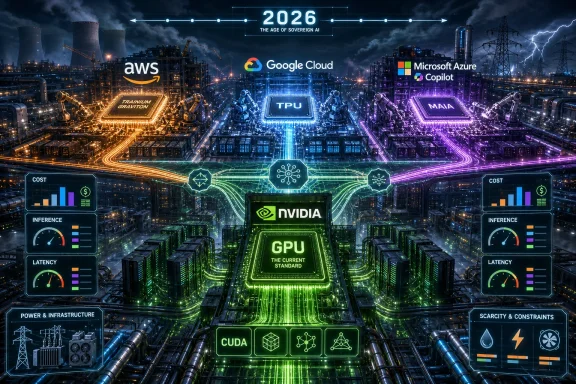 The AI Boom Has Turned Nvidia’s Customers Into Chip Companies
The last decade trained the market to think of cloud computing as a software-and-scale business. Amazon Web Services, Google Cloud, and Microsoft Azure won by building global data centers, abstracting away infrastructure, and selling compute by the minute. The AI boom has changed the center of gravity: the most strategic part of the stack is now the accelerator, the networking fabric around it, and the software layer that makes thousands of chips behave like one machine.That is Nvidia’s kingdom. Its GPUs became the default platform for training and serving large AI models not simply because the chips were fast, but because CUDA, networking, systems design, libraries, and developer familiarity made Nvidia the path of least resistance. In AI infrastructure, the fastest chip is not always the most valuable chip; the most valuable chip is the one that gets a model into production with the fewest surprises.
But Amazon, Alphabet, and Microsoft are not ordinary customers. They buy at a scale that gives them two uncomfortable options: keep paying Nvidia’s margins indefinitely, or spend billions trying to internalize some of that value. The second path is risky, slow, and technically unforgiving. It is also exactly what companies of this size tend to do when a supplier becomes too strategically important.
The result is a strange-looking market in which Nvidia can post explosive growth while its largest buyers openly work to reduce their dependence on it. That is not a contradiction. It is the normal shape of a platform transition before the economics settle.
Amazon Is Building a Chip Business Inside a Cloud Business
Amazon’s custom silicon effort is the most mature of the three because it did not begin as a panic response to generative AI. Graviton, Trainium, Inferentia, and Nitro all reflect a long-running AWS philosophy: if a workload is big enough and repetitive enough, Amazon eventually wants to optimize it below the level most customers ever see. That is how cloud providers turn infrastructure into margin.The numbers now attached to that strategy are no longer experimental. Amazon has said its custom chip operation, including Graviton, Trainium, and Nitro, reached an annual revenue run rate above $20 billion in the first quarter of 2026. Andy Jassy’s more revealing claim was the hypothetical one: if the business sold chips externally the way a conventional semiconductor company does, Amazon believes it would be running at roughly $50 billion a year.
That framing is doing a lot of work. Amazon is not saying it has become Nvidia. It is saying that, inside AWS, its silicon is already large enough to be compared with stand-alone chip businesses. The real point is not branding; it is leverage.
Trainium is the piece most directly aimed at AI accelerators, but Graviton may be just as important to the economics of AI services. Modern AI workloads are not only giant GPU jobs. They include preprocessing, retrieval, orchestration, networking, storage, token routing, security, and mountains of CPU-heavy support work. If AWS can move more of that activity onto its own silicon, it reduces the total amount of outside hardware required to deliver an AI service.
Still, Amazon’s custom silicon story should not be mistaken for an Nvidia replacement story. AWS customers want Nvidia capacity because their models, frameworks, engineering teams, and procurement plans already revolve around it. When a customer is trying to ship an AI product this quarter, the promise of better price-performance on a custom accelerator next year is not always enough.
That is why Amazon can sound like a chip challenger and remain a huge Nvidia buyer at the same time. The company is not choosing between Nvidia and Trainium. It is trying to segment demand: Nvidia for the broadest, most urgent, most ecosystem-dependent workloads; Amazon silicon for the workloads AWS can steer, standardize, and optimize at scale.
Google’s TPUs Are No Longer Just a Private Weapon
Alphabet has a different advantage: it has been living with custom AI accelerators longer than nearly anyone. Google’s tensor processing units were built for a company that had unusual internal needs before the rest of the market caught up. Search, ads, translation, YouTube, and later Gemini-scale AI gave Google a reason to design specialized silicon well before “AI factory” became the industry’s favorite phrase.For years, TPUs were best understood as Google’s internal advantage. They helped the company control costs and performance for its own workloads, while Google Cloud offered TPU access to customers willing to build inside that ecosystem. That was competitive, but still narrower than Nvidia’s role as the common currency of AI infrastructure across clouds, labs, start-ups, enterprises, and governments.
The newer shift is that Google appears more willing to turn TPU capacity into an external business in its own right. The Blackstone joint venture to offer Google TPU-backed compute as a service, with an initial $5 billion commitment and a plan to bring 500 megawatts of capacity online in 2027, is a sign that TPUs are moving from internal optimization to market weapon. So are large TPU commitments involving AI labs such as Anthropic.
That matters because Google has something most would-be Nvidia competitors do not: hardware, software, model expertise, and cloud distribution under one roof. It can tune chips for its own models, expose those chips through Google Cloud, and use partnerships to finance capacity beyond the pace of its own balance sheet. In a world where power and data center capacity are as scarce as chips, that full-stack position is meaningful.
Yet Google’s behavior also demonstrates Nvidia’s durability. Reports of major Google cloud arrangements involving large Nvidia GPU deployments show that even the most experienced TPU designer still needs Nvidia in volume. Some customers will want TPUs. Many will want Nvidia because their code, people, and expectations already assume Nvidia.
That is the central constraint on every custom accelerator. It is not enough to beat Nvidia on one benchmark, one model family, or one internal workload. A challenger must win enough real-world deployments to overcome the gravitational pull of Nvidia’s ecosystem. Google is closer than most, but even Google is not free of that gravity.
Microsoft’s Maia Is Less a Revolt Than an Insurance Policy
Microsoft sits in the most politically and commercially complicated position. It is one of Nvidia’s most important customers, the cloud partner behind much of OpenAI’s rise, the company trying to make Copilot a daily interface across work and Windows, and now a designer of its own AI silicon. That is not a clean strategy. It is a hedging strategy, and it probably has to be.The Maia accelerator is Microsoft’s attempt to claim more control over the cost curve of AI inference. The second-generation Maia 200, announced in early 2026, is aimed at serving AI models across Azure, Microsoft Foundry, Microsoft 365 Copilot, and partner workloads. Microsoft has described it as part of a heterogeneous infrastructure strategy rather than as a universal GPU replacement.
That word, heterogeneous, is doing the same kind of work for Microsoft that “hybrid” once did in cloud computing. It means Microsoft wants different chips for different jobs. Nvidia GPUs can remain the workhorse for broad demand and cutting-edge model training, while Maia can serve workloads Microsoft understands deeply enough to optimize.
The WindowsForum audience should pay attention here because this is where cloud silicon meets everyday software. Microsoft 365 Copilot, Windows-connected AI services, developer agents, Azure AI Foundry, and enterprise automation all depend on the price and availability of inference. If Microsoft can lower the cost of serving AI features, it has more room to bundle them, expand them, or push them deeper into products customers already license.
But Microsoft is also the clearest example of how hard it is to catch up. Nvidia has years of production experience at AI scale, a mature software ecosystem, and a product cadence that keeps raising the bar. Maia may help Microsoft reduce cost in controlled scenarios, but Azure’s broad AI business still leans heavily on Nvidia because customers want the platform they already know.
The practical implication is that Microsoft’s custom chip effort is not a declaration of independence. It is an insurance policy against permanent dependence, a margin tool for internal workloads, and a bargaining chip in a supplier relationship that has become too important to leave untouched.
Nvidia’s Moat Is Software, Scarcity, and Fear of Being Late
The bear case against Nvidia is simple and not foolish. Its biggest customers have every reason to design around it. If Amazon, Google, Microsoft, and Meta spend hundreds of billions on infrastructure, even a modest shift toward internal chips can redirect enormous sums away from Nvidia.The bull case is also simple and backed by current results. Nvidia’s latest quarterly numbers showed revenue up sharply year over year, with data center revenue making up the overwhelming majority of the business. Hyperscalers remain central to that demand even as they promote their own accelerators. The customers trying hardest to escape Nvidia are still standing in line for more.
The reason is that Nvidia sells more than chips. It sells time. In an AI market where being six months late can mean losing developers, customers, or investor confidence, the lowest-risk infrastructure choice commands a premium. Nvidia’s platform lets companies deploy faster, hire from a larger talent pool, and use tooling that has already been battle-tested across the industry.
That premium is especially powerful for start-ups and enterprises that cannot afford to become chip experts. Jensen Huang has emphasized that a growing class of AI buyers does not design its own chips. Those customers are unlikely to build custom accelerators, and many will consume Nvidia indirectly through clouds, AI infrastructure providers, and managed services.
This is where Nvidia’s position looks less like a conventional component supplier and more like an operating platform. The risk for Nvidia is not that everyone stops buying GPUs. The risk is that the largest buyers become disciplined enough to reserve Nvidia for the workloads that truly need it, while shifting predictable inference and internal services onto cheaper custom silicon.
That would not kill Nvidia. It could, however, change the market’s assumptions about Nvidia’s pricing power, margins, and share of future AI infrastructure spending.
The Capex Wave Can Hide a Share Shift for Years
The most dangerous mistake in reading this market is assuming that share loss and revenue growth cannot coexist. They can, and in an infrastructure boom they often do. If the total pool of AI spending is expanding fast enough, Nvidia can grow spectacularly while still losing percentage share at the edges.That is likely the near-term reality. Amazon, Alphabet, Microsoft, and Meta are planning extraordinary capital expenditures in 2026. Much of that spending flows into land, power, data centers, networking, servers, and accelerators. Nvidia’s slice can remain huge even if custom chips capture more of the incremental workload.
The distinction between training and inference also matters. Training frontier models remains one of the hardest computational jobs in the world, and Nvidia is deeply entrenched there. Inference, especially high-volume inference for known models, is where hyperscalers have the strongest incentive to optimize costs with their own silicon.
That creates a plausible division of labor. Nvidia remains dominant in the most flexible, demanding, and developer-facing parts of AI infrastructure. Custom chips gain ground in controlled environments where the cloud provider can tune hardware, models, compilers, and service architecture together.
For investors, that is a subtle but crucial difference. The question is not whether Nvidia’s revenue can keep rising. The question is whether the market is valuing Nvidia as if today’s dominance translates into permanent control over the profit pool. Those are not the same proposition.
For IT buyers, the issue is more practical. The chip inside the cloud may become less visible, but it will shape price, availability, latency, and vendor lock-in. A Microsoft 365 Copilot feature served on Maia, an AWS AI service optimized for Trainium, and a Google model running on TPUs may all look like “AI” to end users. Under the hood, they represent very different bets on cost and control.
The Windows Angle Is Cost, Capacity, and Lock-In
For Windows administrators and enterprise technology teams, the Nvidia-versus-custom-silicon race can feel remote. Most organizations are not buying racks of H100s, B200s, Trainium systems, or TPU pods. They are buying Microsoft 365 licenses, Azure services, developer tools, endpoint management, security products, and AI add-ons whose pricing depends on the infrastructure beneath them.That is why Microsoft’s Maia effort deserves more attention than a normal chip announcement. If Microsoft can serve Copilot workloads more cheaply, it can make AI features feel less like premium experiments and more like default software behavior. If it cannot, enterprises may keep seeing AI as a costly overlay with uneven return on investment.
Capacity is just as important as cost. Azure has repeatedly faced intense demand for AI infrastructure, and capacity constraints can shape product rollouts as much as software readiness. A cloud provider with more control over its accelerator supply has more options when Nvidia systems are scarce, expensive, or allocated to higher-priority customers.
There is also a lock-in dimension. Custom silicon tends to reward customers who stay close to the provider’s preferred models, frameworks, and managed services. Nvidia, for all its proprietary elements, often functions as a cross-cloud standard because so much of the AI ecosystem already supports it. A workload built around Nvidia GPUs may move between infrastructure providers more easily than one deeply optimized for a single cloud’s custom accelerator.
That does not make custom silicon bad for customers. It may lower prices, improve performance, and make AI services more widely available. But it does mean enterprises should read “optimized” carefully. Optimization is often another word for dependency with better benchmark numbers.
Microsoft’s challenge is particularly delicate because its customers already worry about licensing complexity, cloud commitments, and product bundling. If Maia helps Microsoft make AI cheaper and more reliable, customers benefit. If it becomes another layer that makes Copilot-era Microsoft harder to compare, audit, or exit, the benefit is less straightforward.
The Real Contest Is Over the Margin Stack
The AI chip race is often described as a hardware battle, but the deeper fight is over margins. Nvidia captures value because it controls a scarce, high-performance layer of the AI stack. Hyperscalers want that value because they operate the services that customers actually consume.Amazon wants to turn chip design into AWS margin. Google wants to turn TPU expertise into both internal efficiency and external cloud revenue. Microsoft wants to reduce the cost of AI features that it hopes will reshape Office, Windows, Azure, and enterprise software. None of these companies needs to defeat Nvidia outright to improve its own economics.
That is why the phrase “Nvidia killer” is mostly a distraction. The more realistic outcome is erosion at the margins, not collapse. Nvidia keeps the premium workloads and the broad ecosystem. Custom silicon takes more of the predictable, internal, and vertically integrated work.
The open question is how much of AI compute eventually becomes predictable. Early generative AI favored flexibility because models, architectures, and demand patterns were changing quickly. Over time, successful services become standardized. Standardized workloads are exactly where custom silicon gets more attractive.
This is the old cloud playbook applied to AI. First, rent the best general-purpose tools to find product-market fit. Then, when the workload becomes large and stable, optimize mercilessly. Nvidia has thrived in the first phase and is still thriving as the second begins.
The company’s defense is to keep moving the frontier. If each new generation of Nvidia systems opens up workloads that custom chips cannot yet handle efficiently, the premium persists. Nvidia does not need to own every AI calculation. It needs to own the most valuable bottlenecks.
Wall Street Is Pricing a Company That Cannot Afford to Become Ordinary
Nvidia’s valuation reflects more than strong earnings. It reflects a belief that the company will remain central to the AI economy for years, with enough pricing power to turn infrastructure urgency into extraordinary profitability. That may prove correct, but it leaves less room for the mundane reality of competition.The hyperscalers do not need Nvidia’s margins to collapse for the stock narrative to change. They only need to show that custom silicon can absorb enough demand to make future growth less explosive, less profitable, or more cyclical than investors expect. A company can be essential and still become less surprising.
That is the tension in the current share-price reaction. A semiconductor sell-off can make Nvidia look vulnerable for a day, but the strategic issue is not one trading session. It is whether the market has confused a supply-constrained boom with an unassailable monopoly.
The answer is probably somewhere in between. Nvidia’s position is stronger than many skeptics admit because software ecosystems are hard to displace and AI demand remains enormous. But the hyperscalers’ motivation is stronger than many bulls admit because no cloud giant wants its AI margin structure permanently dictated by a single vendor.
For Microsoft, Amazon, and Google, designing chips is not a hobby. It is a way to shape the economics of their most important future products. For Nvidia, selling to those companies is both the engine of today’s growth and the seed of tomorrow’s bargaining problem.
The Chip War Under Copilot Has a Few Clear Signals
The cleanest reading is not that Nvidia is doomed, or that custom silicon is overhyped. It is that AI infrastructure is entering a more segmented phase. The default GPU era is giving way to a world where different workloads land on different accelerators depending on urgency, cost, ecosystem fit, and who controls the service.- Nvidia remains the safest and most flexible AI infrastructure choice for many customers, especially those that need broad software support and fast deployment.
- Amazon, Alphabet, and Microsoft are building custom chips because AI has become large enough inside their businesses to justify controlling more of the hardware economics.
- Custom silicon is most likely to gain ground first in high-volume inference and tightly managed cloud services, not in every frontier training workload overnight.
- Microsoft’s Maia program matters to Windows and enterprise customers because it could influence the cost, capacity, and bundling strategy behind Copilot and Azure AI services.
- The biggest risk to Nvidia is not an immediate demand cliff, but a gradual reduction in pricing power as hyperscalers route more predictable workloads to their own silicon.
- The biggest risk to customers is that cheaper AI infrastructure may arrive bundled with deeper dependence on a single cloud provider’s stack.
References
- Primary source: The Motley Fool
Published: 2026-06-07T22:22:10.941178
Amazon, Alphabet, and Microsoft Are All Racing to Design Their Own AI Chips. Here's What It Means for Nvidia. | The Motley Fool
The cloud giants are spending hundreds of billions to build AI data centers -- and a growing slice of that money is going toward chips they design themselves.www.fool.com - Related coverage: tomshardware.com
Microsoft unveils Project Solara AI, a chip-to-cloud platform built to power a new generation of 'agent-first' enterprise devices — hardware designed to run AI agents instead of traditional apps | Tom's Hardware
Microsoft ditches Windows to build OS on Androidwww.tomshardware.com - Related coverage: windowscentral.com
Microsoft launches seven in‑house AI models to cut developer costs and reduce reliance on OpenAI | Windows Central
Microsoft’s new MAI model family includes a flagship reasoning model, zero distillation, and lower developer costs.www.windowscentral.com - Related coverage: investor.nvidia.com
NVIDIA Corporation - NVIDIA Announces Financial Results for First Quarter Fiscal 2027
Record revenue of $81.6 billion, up 85% from a year ago Record Data Center revenue of $75.2 billion, up 92% from a year ago NVIDIA announces $80.0 billion additional share repurchase authorization and increases its quarterly cash dividend from $0.01 per share to $0.25 per share SANTA CLARA...investor.nvidia.com - Official source: blogs.microsoft.com
Maia 200: The AI accelerator built for inference - The Official Microsoft Blog
Today, we’re proud to introduce Maia 200, a breakthrough inference accelerator engineered to dramatically improve the economics of AI token generation. Maia 200 is an AI inference powerhouse: an accelerator built on TSMC’s 3nm process with native FP8/FP4 tensor cores, a redesigned memory system...blogs.microsoft.com - Related coverage: aboutamazon.com
Amazon CEO Andy Jassy on the growth of Amazon’s chips business
Amazon’s chips business saw nearly 40% quarter-over-quarter growth in Q1, and it has momentum. www.aboutamazon.com
- Official source: news.microsoft.com
- Related coverage: nvidianews.nvidia.com
- Related coverage: vucense.com
Amazon's Chip Business Is Worth $50 Billion | AI & Intelligence | Vucense
Andy Jassy's April 9, 2026 shareholder letter reveals AWS AI revenue hit $15B run rate in Q1, Amazon's custom chip division (Trainium, Graviton, Nitro)…vucense.com - Related coverage: stocktitan.net
NVIDIA boosts dividend to $0.25, adds $80B to share buyback
Q2 revenue guidance of $91B, with no China data center compute assumed, follows record $81.6B Q1 and $20B returned via buybacks and dividends.www.stocktitan.net - Related coverage: ir.aboutamazon.com
Amazon.com, Inc. - Amazon.com Announces Fourth Quarter Results
Amazon.com, Inc. (NASDAQ: AMZN) today announced financial results for its fourth quarter ended December 31, 2025. Fourth Quarter 2025 Net sales increased 14% to $213.4 billion in the fourth quarter, compared with $187.8 billion in fourth quarter 2024. Excluding the $2.8 billion favorable impact...ir.aboutamazon.com
- Related coverage: techradar.com
Microsoft unveils Maia 200, its 'powerhouse' accelerator looking to unlock the power of large-scale AI | TechRadar
Maia 200 looks to push Azure ahead of AI competitionwww.techradar.com - Related coverage: livescience.com
Microsoft says its newest AI chip Maia 200 is 3 times more powerful than Google's TPU and Amazon's Trainium processor | Live Science
The Maia 200 AI chip is described as an inference powerhouse — meaning it could lead AI models to apply their knowledge to real-world situations much faster and more efficiently. www.livescience.com
- Related coverage: s2.q4cdn.com