

Intel CEO Lip-Bu Tan said in a recent interview that he accepted the top job after a friend urged him to “save Intel” before retiring, and he is now rebuilding the company around foundry manufacturing, AI infrastructure, and new CPU and GPU architecture hires. The line is irresistible because it sounds like Silicon Valley mythmaking. But beneath the rescue-drama framing is a harder truth: Intel’s comeback will not be decided by sentiment, nostalgia, or one executive’s reputation. It will be decided by whether Tan can make Intel behave less like the company that defined the PC era and more like the supplier the AI era actually needs.
The Wccftech account of Tan’s remarks lands because it gives Intel’s leadership transition a clean emotional hook. Tan, by his telling, had already proven himself at Cadence Design Systems and was considering the end of his semiconductor career. Most friends told him not to take the Intel job because the odds were bad and reputations are often remembered by their last act.
That is a compelling anecdote, but it should not distract from the material problem. Intel did not lose ground because it lacked a heroic executive narrative. It lost ground because its manufacturing roadmap slipped, its data-center GPU strategy failed to keep pace with Nvidia, its CPU dominance eroded under AMD pressure, and its foundry ambitions asked customers to trust a company still repairing its own execution record.
Tan’s “save Intel” moment matters because it signals how he sees the role. He is not merely inheriting Pat Gelsinger’s turnaround plan; he is trying to make it more commercially legible. Gelsinger’s strategy was grand and structurally important: restore process leadership, open Intel Foundry to external customers, and make the United States more competitive in advanced chipmaking. Tan’s challenge is narrower and more brutal: turn that architecture into products, customers, and margins before patience runs out.
That makes the new emphasis on CPU and GPU architects more than a hiring footnote. Intel’s problem has not been that it forgot how to make chips. Its problem has been that too many of its best technologies arrived late, fragmented, or aimed at markets that had already moved. If Tan is hiring top architects for AI workloads, he is acknowledging that process nodes and packaging are not enough. The silicon itself must be compelling.
But Gelsinger’s plan was expensive, slow, and dependent on a rare sequence of wins. Intel needed to regain manufacturing credibility while still competing against AMD in CPUs, Nvidia in accelerators, TSMC in foundry, and Arm-based designs across everything from phones to servers. That is not a turnaround; it is a multi-front war.
Tan appears to be changing the tone from institutional restoration to customer-driven triage. His Cadence background matters here. Cadence sits close to the design ecosystem, where winning means understanding what chip teams need before they commit billions of dollars and years of engineering effort. That is a different muscle from Intel’s historic “build it and the market will come” posture.
The new Intel cannot just say it has leading nodes, advanced packaging, and a patriotic supply-chain story. It has to convince customers that its roadmap will be predictable enough to build on. Foundry customers do not buy aspiration. They buy yield, design enablement, capacity, support, and trust.
That is why Tan’s remarks about building purpose-built silicon for different workloads are important. They suggest an Intel less obsessed with defending one universal x86 kingdom and more willing to build specialized products around where the market is going. In AI, that shift is overdue.
The AI market has become the organizing force of the semiconductor industry. Nvidia’s dominance is not just about GPUs in the old gaming or visualization sense. It is about hardware, software, memory, networking, developer mindshare, and a cadence of products that buyers can plan around. AMD has spent years turning a stronger CPU position into a broader data-center platform story. Intel, by contrast, has often looked like it had pieces of an AI strategy rather than the strategy itself.
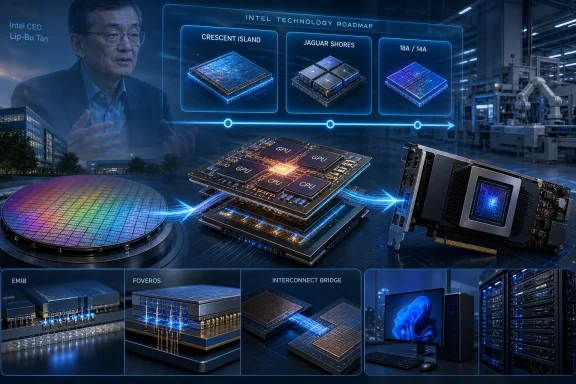
That is why Crescent Island and Jaguar Shores matter. Crescent Island is positioned around inference, where the industry expects a vast amount of AI compute to happen as models are deployed, queried, personalized, and embedded into enterprise workflows. Jaguar Shores is the more ambitious training and high-performance computing piece. Together they imply that Intel wants to stop treating AI acceleration as an adjacent category and start treating it as a core business.
Still, the road is steep. Intel has had ambitious GPU projects before, and ambition did not always translate into market share. Ponte Vecchio was technically interesting but commercially constrained. Gaudi gave Intel an AI accelerator line, but it never changed the industry’s center of gravity. Arc made Intel a discrete GPU player in PCs, but not yet a dominant one.
The hiring push therefore has to be judged by what follows. A single architect, however talented, cannot fix software ecosystems, customer hesitancy, or roadmap inconsistency. But a serious architecture team, backed by a CEO willing to prioritize AI silicon rather than merely mention it, could begin to change Intel’s trajectory.
That is not hypocrisy. It is the foundry business.
A real foundry does not get to be precious about who the customer is. TSMC’s power comes from being indispensable to many competitors at once. If Intel Foundry is to become credible, it must persuade customers that Intel can separate manufacturing partnership from product rivalry. That is culturally difficult for Intel, but unavoidable.
Advanced packaging is one of Intel’s strongest arguments. EMIB and Foveros give Intel a language for chiplets, heterogeneous integration, and complex multi-die systems. In an AI infrastructure world where memory, compute, interconnect, and power delivery all shape performance, packaging is no longer an afterthought. It is a competitive weapon.
But customers will not sign up because Intel has clever packaging acronyms. They will sign up if Intel can offer a reliable combination of process technology, packaging, economics, and delivery. The company’s 18A and future 14A ambitions may be central to that pitch, but the foundry market is unforgiving. One slip can echo for years.
That is where Tan’s customer-focused reputation matters. Intel’s old advantage was scale plus engineering confidence. Intel’s future foundry advantage, if it emerges, will need to be scale plus humility. The company has to listen like a supplier, not lecture like an incumbent.
AMD’s turnaround was not magic. It was architecture, timing, and execution. Zen gave AMD a clean technical foundation. TSMC gave AMD manufacturing leverage. EPYC gave data-center customers a credible alternative. Ryzen gave PC builders performance and value at a moment when Intel was vulnerable.
Intel’s turnaround is more complicated because Intel is trying to fix the factory and the product line at the same time. AMD could lean on TSMC. Intel wants to compete with TSMC. AMD could present itself as the challenger. Intel must be challenger, incumbent, and national strategic asset simultaneously.
That last role is both advantage and burden. Intel matters to U.S. industrial policy in a way AMD does not. Domestic advanced manufacturing, supply-chain resilience, defense-adjacent needs, and the politics of semiconductor sovereignty all make Intel more than a normal public company. But strategic importance does not automatically create competitive products.
The Lisa Su analogy works only if Tan can impose the same kind of product discipline. AMD did not win by asking the market to remember its glory days. It won by shipping parts customers wanted. Intel must do the same, but across more fronts and under brighter political lights.
There is a plausible opening. Not every AI workload needs the most expensive training GPU attached to the most constrained high-bandwidth memory supply. Enterprises will need inference systems that balance performance, cost, memory capacity, power, and deployability. AI PCs, edge servers, private clouds, and vertical-market appliances could all create demand for more varied silicon than today’s Nvidia-centered narrative suggests.
That is where Intel’s breadth could become useful. CPUs remain essential to AI systems. Networking and I/O matter. Packaging matters. Memory choices matter. If Intel can build purpose-specific platforms instead of chasing Nvidia head-on at every point, it may find markets where its integration story resonates.
But “agentic AI” is not a strategy by itself. The phrase describes a software direction, not a guaranteed hardware buying pattern. Many enterprises are still trying to determine which agentic systems are useful, governable, secure, and affordable. Hardware vendors are racing ahead of deployment reality.
For WindowsForum readers, this matters because the AI story will eventually land in the machines and infrastructure they manage. AI PCs are already being marketed aggressively, but the more consequential changes may happen in servers, workstations, developer boxes, and private inference infrastructure. Intel’s success or failure in AI silicon will shape what options enterprises have beyond the Nvidia tax.
A stronger Intel GPU program could matter on the desktop even if the immediate focus is AI infrastructure. Graphics architecture is cumulative. Driver maturity, media engines, display support, AI acceleration blocks, and developer tooling all cross-pollinate between client and data-center products. Intel’s Arc effort has already shown how hard it is to enter GPUs late, but also how useful competition can be when it pushes pricing and feature support.
On CPUs, Intel’s need for top architects is equally consequential. Windows remains deeply tied to x86 compatibility, even as Arm-based Windows PCs improve. If Intel wants to defend its place in laptops, desktops, and servers, it needs cores that are not merely adequate but clearly competitive in performance per watt, security features, platform stability, and AI-adjacent acceleration.
Sysadmins should also watch the foundry angle. If Intel Foundry becomes more credible, it could diversify supply chains for chips that eventually appear in servers, networking gear, storage controllers, and specialized accelerators. If it falters, the industry remains even more concentrated around existing manufacturing leaders.
There is also a firmware and platform-trust dimension. Intel’s comeback cannot be measured only in benchmark charts. Enterprise buyers care about lifecycle support, validation, manageability, security response, and boring predictability. The fastest chip in the world is less attractive if the platform around it makes fleet management painful.
Tan’s quoted remarks suggest he understands that Intel’s decline was emotionally painful because of what the company once represented. That is human. But nostalgia can be corrosive if it becomes a substitute for accountability. Intel does not need to become the old Intel again. It needs to become a company that can win in a market the old Intel did not design.
That means tolerating more outside influence. Foundry customers will demand changes. AI buyers will demand software support and rapid iteration. Cloud providers will demand custom silicon economics. PC OEMs will demand efficiency and platform simplicity. None of those groups care much about Intel’s internal mythology.
The best sign from Tan’s early posture is that he seems to be recruiting around capability rather than simply reorganizing around slogans. Hiring architects is concrete. Rebuilding customer relationships is concrete. Prioritizing workload-specific silicon is concrete. Those moves do not guarantee success, but they are better than pretending that one more corporate vision deck can bend the market back toward Intel.
The risk is that Intel remains too large and conflicted to move at the required speed. A company trying to be a leading CPU vendor, GPU vendor, AI infrastructure supplier, advanced packager, and global foundry has no shortage of strategic narratives. The danger is diffusion. Tan must decide not only what Intel will do, but what it will stop doing.
If Crescent Island samples and lands as a credible inference product, Intel gets a foothold in a market that is still forming. If Jaguar Shores arrives with competitive performance and a usable software stack, Intel gets a stronger claim to serious AI infrastructure. If 18A and subsequent nodes deliver for both internal and external customers, Intel Foundry starts to look less like a strategic hope and more like a business.
If those things slip, the “save Intel” line will become a burden. It will invite comparisons between heroic framing and ordinary execution failure. Intel has already lived through enough grand pronouncements to know that the market’s patience is finite.
Tan’s advantage is that he does not appear to be selling a purely sentimental comeback. His comments point toward architects, purpose-built silicon, customer workloads, foundry capability, packaging, and supply chain. That is the right vocabulary. The next test is whether Intel can make those words show up as products customers buy.
 Intel’s Rescue Story Is Really a Product Story
The Wccftech account of Tan’s remarks lands because it gives Intel’s leadership transition a clean emotional hook. Tan, by his telling, had already proven himself at Cadence Design Systems and was considering the end of his semiconductor career. Most friends told him not to take the Intel job because the odds were bad and reputations are often remembered by their last act.That is a compelling anecdote, but it should not distract from the material problem. Intel did not lose ground because it lacked a heroic executive narrative. It lost ground because its manufacturing roadmap slipped, its data-center GPU strategy failed to keep pace with Nvidia, its CPU dominance eroded under AMD pressure, and its foundry ambitions asked customers to trust a company still repairing its own execution record.
Tan’s “save Intel” moment matters because it signals how he sees the role. He is not merely inheriting Pat Gelsinger’s turnaround plan; he is trying to make it more commercially legible. Gelsinger’s strategy was grand and structurally important: restore process leadership, open Intel Foundry to external customers, and make the United States more competitive in advanced chipmaking. Tan’s challenge is narrower and more brutal: turn that architecture into products, customers, and margins before patience runs out.
That makes the new emphasis on CPU and GPU architects more than a hiring footnote. Intel’s problem has not been that it forgot how to make chips. Its problem has been that too many of its best technologies arrived late, fragmented, or aimed at markets that had already moved. If Tan is hiring top architects for AI workloads, he is acknowledging that process nodes and packaging are not enough. The silicon itself must be compelling.
Pat Gelsinger Built the Runway, but Tan Has to Prove There Is a Plane
It is tempting to cast Tan as a clean break from the Gelsinger era. That would be too simple. Gelsinger’s tenure put Intel Foundry, advanced packaging, and process-roadmap discipline back at the center of Intel’s identity. The company’s current story cannot be understood without that groundwork.But Gelsinger’s plan was expensive, slow, and dependent on a rare sequence of wins. Intel needed to regain manufacturing credibility while still competing against AMD in CPUs, Nvidia in accelerators, TSMC in foundry, and Arm-based designs across everything from phones to servers. That is not a turnaround; it is a multi-front war.
Tan appears to be changing the tone from institutional restoration to customer-driven triage. His Cadence background matters here. Cadence sits close to the design ecosystem, where winning means understanding what chip teams need before they commit billions of dollars and years of engineering effort. That is a different muscle from Intel’s historic “build it and the market will come” posture.
The new Intel cannot just say it has leading nodes, advanced packaging, and a patriotic supply-chain story. It has to convince customers that its roadmap will be predictable enough to build on. Foundry customers do not buy aspiration. They buy yield, design enablement, capacity, support, and trust.
That is why Tan’s remarks about building purpose-built silicon for different workloads are important. They suggest an Intel less obsessed with defending one universal x86 kingdom and more willing to build specialized products around where the market is going. In AI, that shift is overdue.
The GPU Hire Is a Confession in Disguise
Intel’s reported hiring of a top GPU architect is being framed as a sign of renewed ambition. It is that, but it is also a confession. Intel knows it cannot be a serious AI infrastructure company if its accelerator strategy remains a supporting act.The AI market has become the organizing force of the semiconductor industry. Nvidia’s dominance is not just about GPUs in the old gaming or visualization sense. It is about hardware, software, memory, networking, developer mindshare, and a cadence of products that buyers can plan around. AMD has spent years turning a stronger CPU position into a broader data-center platform story. Intel, by contrast, has often looked like it had pieces of an AI strategy rather than the strategy itself.
That is why Crescent Island and Jaguar Shores matter. Crescent Island is positioned around inference, where the industry expects a vast amount of AI compute to happen as models are deployed, queried, personalized, and embedded into enterprise workflows. Jaguar Shores is the more ambitious training and high-performance computing piece. Together they imply that Intel wants to stop treating AI acceleration as an adjacent category and start treating it as a core business.
Still, the road is steep. Intel has had ambitious GPU projects before, and ambition did not always translate into market share. Ponte Vecchio was technically interesting but commercially constrained. Gaudi gave Intel an AI accelerator line, but it never changed the industry’s center of gravity. Arc made Intel a discrete GPU player in PCs, but not yet a dominant one.
The hiring push therefore has to be judged by what follows. A single architect, however talented, cannot fix software ecosystems, customer hesitancy, or roadmap inconsistency. But a serious architecture team, backed by a CEO willing to prioritize AI silicon rather than merely mention it, could begin to change Intel’s trajectory.
Intel Foundry Needs Customers More Than Applause
Tan’s comments about Arm are likely to attract attention because Arm has become a proxy for the industry’s post-x86 future. The notion that Arm might use Intel Foundry in some way is powerful symbolism. Intel, once the company that defined the CPU instruction-set battlefield, now wants to manufacture chips for customers that may compete with its own CPU franchises.That is not hypocrisy. It is the foundry business.
A real foundry does not get to be precious about who the customer is. TSMC’s power comes from being indispensable to many competitors at once. If Intel Foundry is to become credible, it must persuade customers that Intel can separate manufacturing partnership from product rivalry. That is culturally difficult for Intel, but unavoidable.
Advanced packaging is one of Intel’s strongest arguments. EMIB and Foveros give Intel a language for chiplets, heterogeneous integration, and complex multi-die systems. In an AI infrastructure world where memory, compute, interconnect, and power delivery all shape performance, packaging is no longer an afterthought. It is a competitive weapon.
But customers will not sign up because Intel has clever packaging acronyms. They will sign up if Intel can offer a reliable combination of process technology, packaging, economics, and delivery. The company’s 18A and future 14A ambitions may be central to that pitch, but the foundry market is unforgiving. One slip can echo for years.
That is where Tan’s customer-focused reputation matters. Intel’s old advantage was scale plus engineering confidence. Intel’s future foundry advantage, if it emerges, will need to be scale plus humility. The company has to listen like a supplier, not lecture like an incumbent.
The AMD Comparison Cuts Both Ways
Tan’s admiration for Lisa Su is notable because AMD is the turnaround Intel most fears and most wants to emulate. Su took over a weakened AMD and turned it into a formidable competitor through disciplined execution, focused product bets, and a willingness to attack Intel where Intel had grown complacent. The comparison is flattering to Tan, but it is also dangerous.AMD’s turnaround was not magic. It was architecture, timing, and execution. Zen gave AMD a clean technical foundation. TSMC gave AMD manufacturing leverage. EPYC gave data-center customers a credible alternative. Ryzen gave PC builders performance and value at a moment when Intel was vulnerable.
Intel’s turnaround is more complicated because Intel is trying to fix the factory and the product line at the same time. AMD could lean on TSMC. Intel wants to compete with TSMC. AMD could present itself as the challenger. Intel must be challenger, incumbent, and national strategic asset simultaneously.
That last role is both advantage and burden. Intel matters to U.S. industrial policy in a way AMD does not. Domestic advanced manufacturing, supply-chain resilience, defense-adjacent needs, and the politics of semiconductor sovereignty all make Intel more than a normal public company. But strategic importance does not automatically create competitive products.
The Lisa Su analogy works only if Tan can impose the same kind of product discipline. AMD did not win by asking the market to remember its glory days. It won by shipping parts customers wanted. Intel must do the same, but across more fronts and under brighter political lights.
Agentic AI Gives Intel a Door, Not a Victory
Tan’s reference to agentic AI is exactly the sort of phrase that can become empty corporate vapor if handled badly. Every chip company now wants to attach itself to AI agents, inference, reasoning models, and specialized workloads. The question is whether Intel can turn that vocabulary into differentiated hardware.There is a plausible opening. Not every AI workload needs the most expensive training GPU attached to the most constrained high-bandwidth memory supply. Enterprises will need inference systems that balance performance, cost, memory capacity, power, and deployability. AI PCs, edge servers, private clouds, and vertical-market appliances could all create demand for more varied silicon than today’s Nvidia-centered narrative suggests.
That is where Intel’s breadth could become useful. CPUs remain essential to AI systems. Networking and I/O matter. Packaging matters. Memory choices matter. If Intel can build purpose-specific platforms instead of chasing Nvidia head-on at every point, it may find markets where its integration story resonates.
But “agentic AI” is not a strategy by itself. The phrase describes a software direction, not a guaranteed hardware buying pattern. Many enterprises are still trying to determine which agentic systems are useful, governable, secure, and affordable. Hardware vendors are racing ahead of deployment reality.
For WindowsForum readers, this matters because the AI story will eventually land in the machines and infrastructure they manage. AI PCs are already being marketed aggressively, but the more consequential changes may happen in servers, workstations, developer boxes, and private inference infrastructure. Intel’s success or failure in AI silicon will shape what options enterprises have beyond the Nvidia tax.
Windows Users Should Care Because Intel’s Problems Do Not Stay in the Data Center
It is easy to treat Intel’s CEO drama as Wall Street theater. For Windows users and administrators, that would be a mistake. Intel’s strategic choices ripple through client PCs, workstation platforms, driver stacks, firmware updates, enterprise procurement, and the pace at which new Windows capabilities become practical.A stronger Intel GPU program could matter on the desktop even if the immediate focus is AI infrastructure. Graphics architecture is cumulative. Driver maturity, media engines, display support, AI acceleration blocks, and developer tooling all cross-pollinate between client and data-center products. Intel’s Arc effort has already shown how hard it is to enter GPUs late, but also how useful competition can be when it pushes pricing and feature support.
On CPUs, Intel’s need for top architects is equally consequential. Windows remains deeply tied to x86 compatibility, even as Arm-based Windows PCs improve. If Intel wants to defend its place in laptops, desktops, and servers, it needs cores that are not merely adequate but clearly competitive in performance per watt, security features, platform stability, and AI-adjacent acceleration.
Sysadmins should also watch the foundry angle. If Intel Foundry becomes more credible, it could diversify supply chains for chips that eventually appear in servers, networking gear, storage controllers, and specialized accelerators. If it falters, the industry remains even more concentrated around existing manufacturing leaders.
There is also a firmware and platform-trust dimension. Intel’s comeback cannot be measured only in benchmark charts. Enterprise buyers care about lifecycle support, validation, manageability, security response, and boring predictability. The fastest chip in the world is less attractive if the platform around it makes fleet management painful.
The Culture Problem Is the Hardest Node to Shrink
Semiconductor turnarounds are often discussed in terms of process nodes, but Intel’s cultural node may be the more stubborn one. The company spent decades as the default choice. Default choices develop habits: internal complexity, slow decision-making, organizational defensiveness, and a belief that customers will wait.Tan’s quoted remarks suggest he understands that Intel’s decline was emotionally painful because of what the company once represented. That is human. But nostalgia can be corrosive if it becomes a substitute for accountability. Intel does not need to become the old Intel again. It needs to become a company that can win in a market the old Intel did not design.
That means tolerating more outside influence. Foundry customers will demand changes. AI buyers will demand software support and rapid iteration. Cloud providers will demand custom silicon economics. PC OEMs will demand efficiency and platform simplicity. None of those groups care much about Intel’s internal mythology.
The best sign from Tan’s early posture is that he seems to be recruiting around capability rather than simply reorganizing around slogans. Hiring architects is concrete. Rebuilding customer relationships is concrete. Prioritizing workload-specific silicon is concrete. Those moves do not guarantee success, but they are better than pretending that one more corporate vision deck can bend the market back toward Intel.
The risk is that Intel remains too large and conflicted to move at the required speed. A company trying to be a leading CPU vendor, GPU vendor, AI infrastructure supplier, advanced packager, and global foundry has no shortage of strategic narratives. The danger is diffusion. Tan must decide not only what Intel will do, but what it will stop doing.
The “Save Intel” Line Will Age Only as Well as the Roadmap
The rescue story is powerful today because Intel is still in the suspense phase. Tan has the benefit of a fresh mandate, an iconic brand, and a market that wants more alternatives to Nvidia and TSMC. But the semiconductor industry has a way of converting speeches into deadlines.If Crescent Island samples and lands as a credible inference product, Intel gets a foothold in a market that is still forming. If Jaguar Shores arrives with competitive performance and a usable software stack, Intel gets a stronger claim to serious AI infrastructure. If 18A and subsequent nodes deliver for both internal and external customers, Intel Foundry starts to look less like a strategic hope and more like a business.
If those things slip, the “save Intel” line will become a burden. It will invite comparisons between heroic framing and ordinary execution failure. Intel has already lived through enough grand pronouncements to know that the market’s patience is finite.
Tan’s advantage is that he does not appear to be selling a purely sentimental comeback. His comments point toward architects, purpose-built silicon, customer workloads, foundry capability, packaging, and supply chain. That is the right vocabulary. The next test is whether Intel can make those words show up as products customers buy.
The Turnaround Now Has Names, Dates, and Silicon Attached
The most useful way to read Tan’s remarks is not as a victory lap but as a checklist. Intel’s next era is no longer an abstract debate about whether the company should be important. It is a sequence of execution tests that will become visible in silicon, partnerships, and customer adoption.- Intel’s CEO story now has a personal origin, but the company’s recovery will be judged by manufacturing reliability and product competitiveness.
- The hiring of top GPU and CPU architects signals that Intel knows AI infrastructure cannot be won with process technology alone.
- Crescent Island and Jaguar Shores will be early tests of whether Intel can become relevant in AI acceleration beyond legacy data-center CPUs.
- Intel Foundry must prove that it can serve external customers with the discipline of a supplier rather than the habits of an incumbent.
- Windows users and IT administrators should watch this closely because Intel’s platform choices will shape future PCs, workstations, servers, drivers, and enterprise procurement.
- The AMD comparison is useful only if Intel can match AMD’s turnaround discipline: focused bets, timely execution, and products that make customers change plans.
References
- Primary source: Wccftech
Published: Wed, 17 Jun 2026 22:16:00 GMT
Lip-Bu Tan Nearly Walked Away From Semiconductors, But One Plea to 'Save Intel' Pulled Him Back as CEO, Now Hiring Top CPU/GPU Architects
Intel CEO, Lip-Bu Tan was about to retire from the semiconductor industry, but was asked to do one more thing: save Intel. Lip-Bu Tan was on the Intel Candidate List Back in 2021, But Made The Final Decision To Become CEO After Being Convninced By His Wife & Friends Ever since Lip-Bu Tan joined...wccftech.com
- Related coverage: newsroom.intel.com
Intel Appoints Lip-Bu Tan as Chief Executive Officer - Intel Newsroom
Tan to join Intel board of directors.newsroom.intel.com - Related coverage: techcrunch.com
Intel appoints Lip-Bu Tan as its next CEO | TechCrunch
Intel has appointed Lip-Bu Tan, a respected figure in the semiconductor industry, as CEO.techcrunch.com - Related coverage: arstechnica.com
New Intel CEO Lip-Bu Tan will pick up where Pat Gelsinger left off - Ars Technica
Tan will start as CEO on March 18, taking over from interim co-CEOs.arstechnica.com - Related coverage: techradar.com
Intel reveals Lip-Bu Tan as its new CEO | TechRadar
Chip industry veteran Lip-Bu Tan named next Intel CEOwww.techradar.com - Related coverage: investing.com
Intel appoints chip industry veteran Lip-Bu Tan as CEO By Reuters
Intel appoints chip industry veteran Lip-Bu Tan as CEOwww.investing.com
- Related coverage: manufacturingdive.com
Intel taps new CEO | Manufacturing Dive
The struggling semiconductor manufacturer chose longtime technology investor Lip-Bu Tan to help turn around the company’s operations.www.manufacturingdive.com
- Related coverage: forbes.com
Can CEO Lip-Bu Tan Save Intel?
Intel launches New Approach for a New Era and establishes joint venture with TSMCwww.forbes.com - Related coverage: washingtonpost.com
- Related coverage: pcwelt.de
Intel ernennt Tech-Veteranen Lip-Bu Tan zum nächsten CEO - PC-WELT
Der ehemalige Geschäftsführer von Cadence Design Systems, Lip-Bu Tan wird der nächste Intel-CEO. Die ehemaligen Co-CEOs Michelle Johnston Holthaus und David Zinsner bleiben im Unternehmen.www.pcwelt.de - Related coverage: tomshardware.com
Intel details long-awaited Crescent Island AI GPU at Computex, boasts up to 480 GB of LPDDR5X to combat memory shortages — company shares more details of its Xe3P inference accelerator at Computex | Tom's Hardware
Unusual memory choice brings lots of AI data closer to the chip for efficiencywww.tomshardware.com - Related coverage: theinformation.com
Intel Stock Soars On New CEO Pick, Lip-Bu Tan — The Information
Intel named former Cadence Design Systems chief Lip-Bu Tan as its new CEO, sending its stock up 12%. The appointment follows the departure of Pat Gelsinger as CEO in December as it struggled to compete in the market for artificial intelligence chips and its stock price tanked. Tan had stepped...www.theinformation.com - Related coverage: bloomberg.com
- Related coverage: download.intel.com
- Related coverage: pcgamer.com
Intel CEO commits to building new GPUs and has hired the engineer who designed some of AMD's greatest graphics card hits to design them | PC Gamer
But, yup, you guessed it, this is all for AI, not gaming. Probably.www.pcgamer.com - Related coverage: cincodias.elpais.com
Lip-Bu Tan: El hombre que intentará resucitar a Intel, un gigante dormido | Opinión | Cinco Días
Lip-Bu Tan, nuevo CEO de la compañía, que lleva años rezagada en la carrera tecnológica, tiene por delante el reto de recuperar su competitividadcincodias.elpais.com - Related coverage: techxplore.com
