

Intel’s long-promised comeback gained new credibility this week after reports described CEO Lip-Bu Tan drawing unusual industry attention in San Francisco, with the company’s market value sharply higher, its foundry pitch gaining customers, and its AI-era strategy no longer looking purely defensive. The story is not that Intel has suddenly become Nvidia, TSMC, or Apple’s indispensable manufacturing arm. It is that Intel has moved from turnaround theater into the harder, more interesting phase where customers, investors, and Washington are beginning to treat the plan as plausible. That makes Intel newly dangerous — and newly exposed.
For years, Intel’s problem was not simply that it missed a product cycle or slipped a manufacturing node. Its deeper problem was that the industry stopped believing Intel could execute on the one thing Intel was supposed to do better than anyone else: turn semiconductor ambition into high-volume silicon on time.
That loss of belief mattered. Chip companies do not choose foundry partners the way consumers choose laptops. They commit years of engineering work, billions of dollars in future revenue, and their own product road maps to a manufacturing partner that cannot be swapped out at the last minute. Once Intel became the company that missed dates, changed strategies, and explained itself in ever more elaborate process-node charts, the burden of proof shifted against it.
The reported scene around Lip-Bu Tan in San Francisco is therefore more than Silicon Valley celebrity fluff. It is a visible marker of changing expectations. Tan is not being treated like Jensen Huang because Intel has matched Nvidia’s business; he is being treated that way because the market is desperate for a credible second act in advanced chips, and Intel is once again auditioning for that role.
That distinction matters. A stock chart can move faster than a fab. Investor enthusiasm can arrive before yields, margins, and customer ramps prove themselves. Intel has shown signs of life, but the company is still trying to repair trust in an industry that remembers every missed milestone.
That is precisely the cultural reversal Intel has needed. Historically, Intel’s manufacturing strength was tied to vertical integration. The company designed the chips, built the process, tuned the fabs, and shipped the parts under its own brand. That model created one of the great industrial machines in technology, but it also made Intel awkward as a foundry. A foundry must be obsessively accommodating to customers whose designs, tools, risk tolerance, and commercial priorities do not belong to the foundry itself.
TSMC became the world’s most important semiconductor manufacturer by being the opposite of a jealous product company. It did not compete with its customers in CPUs, GPUs, modems, and accelerators. It built a neutral platform where Apple, Nvidia, AMD, Qualcomm, Broadcom, and others could pour in designs without wondering whether the factory had its own product agenda.
Intel cannot become TSMC by saying “foundry” loudly enough. It must persuade customers that its internal product groups will not distort priorities, that its design rules are usable, that its packaging road map is real, and that its manufacturing cadence will be boring in the best possible way. Tan’s task is not merely to raise morale. It is to convince skeptical chip designers that Intel has learned humility.
That is why even preliminary customer commitments matter. A rumored or reported Apple arrangement, Nvidia evaluation, Google involvement, or Tesla-linked manufacturing experiment is not equivalent to full production at scale. But each one is a vote that Intel is worth spending engineering time on again. In semiconductors, that is the first currency of a comeback.
Intel’s opportunity sits inside that pressure. It does not need to displace TSMC overnight to matter. It needs to become credible enough that large customers can use Intel as a second source, a packaging partner, a strategic hedge, or a home for certain classes of products that benefit from U.S.-based manufacturing and closer supply-chain control.
That is a more realistic path than the old triumphalist version of the Intel turnaround story. Intel does not have to win every leading-edge wafer to become relevant again. It can win slices of programs, prove out process technology on internal products, expand advanced packaging relationships, and use government-backed domestic manufacturing priorities to become a strategic supplier even before it becomes the best pure-play foundry on Earth.
The danger is that AI can flatter weak strategies as easily as it rewards strong ones. When demand is hot, customers explore options they might otherwise ignore. When capacity is constrained, even imperfect suppliers get meetings. Intel must prove that this interest survives normal market gravity: slower demand, tighter budgets, product delays, and the cold discipline of yield curves.
That bet remains controversial because it blends national security logic with corporate rescue. Intel struggled because of execution failures, not because Washington failed to appreciate semiconductors. It lost manufacturing leadership, missed mobile, stumbled in GPUs, and watched AMD and Nvidia exploit markets Intel should have anticipated more aggressively. Public support may buy time, but it cannot manufacture competence.
Still, governments do not build strategic redundancy by waiting for perfect companies. They work with the industrial base they have. In the United States, that means Intel remains uniquely important: a company with deep fabrication experience, domestic manufacturing assets, and a history of building at scale, even if that history has recently been overshadowed by delay and drift.
For WindowsForum readers, the government angle is not abstract. If Intel succeeds, the PC ecosystem gets a healthier domestic supplier for CPUs, GPUs, accelerators, and possibly third-party silicon manufacturing. If it fails, the industry’s dependence on a narrower set of overseas manufacturing chokepoints grows more uncomfortable, especially as AI PCs, edge inference, and secure enterprise hardware become more central to Microsoft’s platform strategy.
The Wintel era is no longer the uncontested center of computing, but its installed base remains vast. Enterprises still buy fleets of Windows machines. OEMs still plan road maps around Intel client silicon. Developers still optimize for x86 assumptions, even as Arm gains credibility through Apple Silicon, Qualcomm’s Snapdragon X platform, and Microsoft’s Copilot+ PC push.
Intel’s revival therefore has two PC implications. First, a healthier Intel can compete more effectively in client CPUs, integrated graphics, NPUs, and power efficiency — areas where Windows laptops have been pressured by Apple’s performance-per-watt lead. Second, Intel’s manufacturing progress can make its own PC chips better test vehicles for future foundry credibility.
The company’s client business cannot be dismissed as legacy plumbing. It is where Intel can ship volume, debug process technology, prove platform reliability, and defend its relationship with OEMs. If Panther Lake, Nova Lake, or their successors deliver meaningful gains, they will not merely help laptop buyers. They will signal that Intel’s manufacturing story is moving from slideware into devices people actually use.
That does not make Intel’s GPU ambitions irrelevant. It makes them harder. Intel has tried repeatedly to enter graphics and accelerators, and the market has not rewarded half-measures. In data centers, customers do not buy silicon because it exists; they buy an ecosystem of compilers, libraries, frameworks, management tools, and predictable performance. Nvidia’s moat is not just transistor count. It is habit.
Tan’s reported commitment to continued GPU development is therefore necessary but insufficient. Intel needs architectures that customers can deploy without heroic porting efforts. It needs software that does not feel like a research project. It needs a reason for developers to care beyond “Nvidia is expensive.”
The more intriguing Nvidia angle may be foundry and packaging, not direct GPU competition. If Nvidia uses Intel for some manufacturing or advanced packaging work, even at the margins, it would be a symbolic coup. It would not make Intel the new TSMC, but it would make Intel part of the AI supply chain it once seemed destined to watch from the sidelines.
It would also be a reminder of Intel’s lost position. Apple moved the Mac away from Intel because Apple Silicon delivered the performance-per-watt story Intel could not. The transition was one of the most public defeats in Intel’s modern history: a marquee customer not merely switching suppliers, but demonstrating a better architecture story in front of the same users Intel once owned.
That history makes any renewed Apple-Intel manufacturing relationship deliciously complicated. Apple does not need to forgive Intel’s old CPU road map to use Intel as a foundry partner. It needs Intel to be useful, reliable, and strategically advantageous. That is a very different relationship — and potentially a healthier one for both sides.
For Intel, Apple would be proof that the company can serve a demanding external customer without trying to control the whole stack. For Apple, Intel could become leverage in a supply chain where diversification has strategic value. Neither side has to pretend the old Mac era is returning. The more important possibility is that Intel becomes valuable to Apple after losing Apple’s processors.
Intel’s foundry effort has already carried steep losses, and enthusiasm around customer interest should not obscure that. A foundry turnaround is not measured by applause at a conference. It is measured by wafers shipped, defect density, gross margins, design wins converted into production, and customers returning for the next node.
The company also faces a sequencing problem. Customers want proof before committing their most important products. Intel needs customer commitments to justify capacity, refine processes, and improve economics. That chicken-and-egg problem is why early engagements with major customers are so closely watched: they can unlock credibility, but they can also expose weaknesses.
This is where Tan’s credibility will be tested most severely. Cutting costs can improve the income statement. Selling assets can sharpen focus. Landing exploratory deals can excite investors. But the foundry business will only become a durable pillar if Intel can make external customers believe that its next process node will arrive, work, and scale close enough to plan.
Intel’s best route may be to climb around that mountain rather than sprint straight up it. The company can emphasize U.S. manufacturing, advanced packaging, specific process features, defense and government workloads, custom AI silicon, and second-source strategies. It can win business where resilience matters alongside raw process leadership.
That still requires technical excellence. Strategic diversification is not charity. Customers will not accept a materially worse product simply because it is geographically convenient. The more important point is that “beating TSMC” is the wrong near-term test. Becoming good enough to be designed into serious road maps is the test.
If Intel gets there, the market changes. Not because TSMC collapses, but because the industry gains optionality. Optionality is worth a great deal when the world’s most important chips are concentrated in a small number of fabs, on an island at the center of geopolitical anxiety, serving customers whose demand curves increasingly resemble national infrastructure projects.
Tan’s challenge is to make Intel faster without making it reckless. Semiconductor manufacturing cannot be managed like a social app startup. Fabs require discipline, documentation, quality control, and a painful respect for physics. But discipline is not the same as institutional hesitation.
The strongest signal from Tan’s tenure so far is that he appears willing to reshape leadership, simplify priorities, and bring in outside expertise where Intel’s internal bench no longer has the benefit of the doubt. That can be destabilizing. It can also be necessary. A company trying to serve external foundry customers cannot behave as though every answer must come from the old Intel playbook.
The layoffs and restructuring that have accompanied Intel’s reset are the human cost of this shift. They are also a reminder that turnarounds are rarely clean moral narratives. Investors see efficiency. Employees see uncertainty. Customers see a supplier trying to become leaner while still executing some of the most difficult manufacturing transitions in technology.
Enterprise buyers are not sentimental about Intel. They care about availability, predictable platforms, support windows, and compatibility. If Intel’s revival produces stronger Windows PCs with credible NPUs, better thermals, and fewer platform surprises, IT departments will welcome it. If it produces marketing-heavy AI features and confusing segmentation, buyers will wait.
There is also a security angle. A more resilient domestic semiconductor supply chain may matter for government and regulated industries, but only if it comes with transparent firmware practices, robust update mechanisms, and platform assurance that survives procurement scrutiny. Intel’s historical strength in enterprise platforms gives it a base to build from. Its recent stumbles mean that trust must be re-earned release by release.
The Windows ecosystem benefits when Intel, AMD, Qualcomm, Nvidia, and Microsoft are all forced to compete harder. Intel’s comeback is not valuable because the old monopoly returns. It is valuable if it creates a more competitive hardware market where Windows machines are not defined by compromise.
Now the company must convert. That means turning 18A and 14A progress into products and external commitments. It means proving advanced packaging can become a differentiated business rather than a supporting footnote. It means showing that AI can be a source of revenue and relevance, not just a theme Intel invokes while Nvidia captures the economics.
The old Intel could often count on the PC cycle to paper over strategic errors. The new Intel cannot. Its comeback is being judged simultaneously by investors, hyperscalers, OEMs, governments, and engineers who have alternatives. That is a harsher audience, but also a more useful one. It will not reward nostalgia for very long.
That attention should be interpreted carefully.
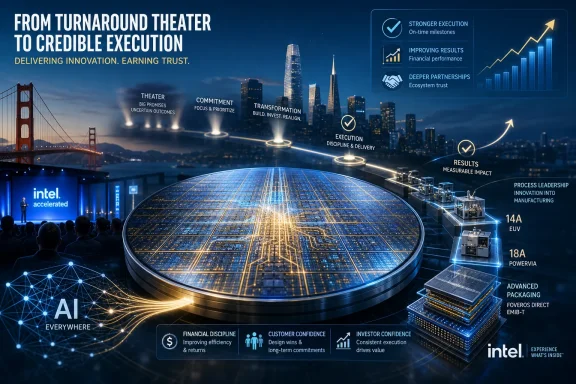 Intel’s Comeback Has Entered the Belief Phase
For years, Intel’s problem was not simply that it missed a product cycle or slipped a manufacturing node. Its deeper problem was that the industry stopped believing Intel could execute on the one thing Intel was supposed to do better than anyone else: turn semiconductor ambition into high-volume silicon on time.That loss of belief mattered. Chip companies do not choose foundry partners the way consumers choose laptops. They commit years of engineering work, billions of dollars in future revenue, and their own product road maps to a manufacturing partner that cannot be swapped out at the last minute. Once Intel became the company that missed dates, changed strategies, and explained itself in ever more elaborate process-node charts, the burden of proof shifted against it.
The reported scene around Lip-Bu Tan in San Francisco is therefore more than Silicon Valley celebrity fluff. It is a visible marker of changing expectations. Tan is not being treated like Jensen Huang because Intel has matched Nvidia’s business; he is being treated that way because the market is desperate for a credible second act in advanced chips, and Intel is once again auditioning for that role.
That distinction matters. A stock chart can move faster than a fab. Investor enthusiasm can arrive before yields, margins, and customer ramps prove themselves. Intel has shown signs of life, but the company is still trying to repair trust in an industry that remembers every missed milestone.
Lip-Bu Tan Is Selling Trust Before He Sells Wafers
Tan’s advantage is that he does not sound like an Intel lifer defending an inherited empire. His background in semiconductor investment, EDA, and customer networks gives him a different kind of authority: less “we invented the x86 world,” more “tell me what your chip actually needs and I will try to build the organization around it.”That is precisely the cultural reversal Intel has needed. Historically, Intel’s manufacturing strength was tied to vertical integration. The company designed the chips, built the process, tuned the fabs, and shipped the parts under its own brand. That model created one of the great industrial machines in technology, but it also made Intel awkward as a foundry. A foundry must be obsessively accommodating to customers whose designs, tools, risk tolerance, and commercial priorities do not belong to the foundry itself.
TSMC became the world’s most important semiconductor manufacturer by being the opposite of a jealous product company. It did not compete with its customers in CPUs, GPUs, modems, and accelerators. It built a neutral platform where Apple, Nvidia, AMD, Qualcomm, Broadcom, and others could pour in designs without wondering whether the factory had its own product agenda.
Intel cannot become TSMC by saying “foundry” loudly enough. It must persuade customers that its internal product groups will not distort priorities, that its design rules are usable, that its packaging road map is real, and that its manufacturing cadence will be boring in the best possible way. Tan’s task is not merely to raise morale. It is to convince skeptical chip designers that Intel has learned humility.
That is why even preliminary customer commitments matter. A rumored or reported Apple arrangement, Nvidia evaluation, Google involvement, or Tesla-linked manufacturing experiment is not equivalent to full production at scale. But each one is a vote that Intel is worth spending engineering time on again. In semiconductors, that is the first currency of a comeback.
The AI Boom Gives Intel a Door It Did Not Create
The artificial intelligence boom has done something Intel could not do alone: it made the world urgently need more advanced manufacturing capacity, more advanced packaging, and more strategic diversity in the chip supply chain. Nvidia’s dominance has turned GPUs into geopolitical infrastructure. TSMC’s dominance has made Taiwan’s fabs a central point of economic and security concern. Hyperscalers now design custom silicon not as an experiment, but as a necessity.Intel’s opportunity sits inside that pressure. It does not need to displace TSMC overnight to matter. It needs to become credible enough that large customers can use Intel as a second source, a packaging partner, a strategic hedge, or a home for certain classes of products that benefit from U.S.-based manufacturing and closer supply-chain control.
That is a more realistic path than the old triumphalist version of the Intel turnaround story. Intel does not have to win every leading-edge wafer to become relevant again. It can win slices of programs, prove out process technology on internal products, expand advanced packaging relationships, and use government-backed domestic manufacturing priorities to become a strategic supplier even before it becomes the best pure-play foundry on Earth.
The danger is that AI can flatter weak strategies as easily as it rewards strong ones. When demand is hot, customers explore options they might otherwise ignore. When capacity is constrained, even imperfect suppliers get meetings. Intel must prove that this interest survives normal market gravity: slower demand, tighter budgets, product delays, and the cold discipline of yield curves.
Washington Bought Insurance, Not a Miracle
The U.S. government’s intervention in Intel was never just about one company’s balance sheet. It was a national industrial policy bet that the country cannot afford to let its most important domestic chip manufacturer collapse into irrelevance at the exact moment advanced semiconductors are becoming the substrate of economic and military power.That bet remains controversial because it blends national security logic with corporate rescue. Intel struggled because of execution failures, not because Washington failed to appreciate semiconductors. It lost manufacturing leadership, missed mobile, stumbled in GPUs, and watched AMD and Nvidia exploit markets Intel should have anticipated more aggressively. Public support may buy time, but it cannot manufacture competence.
Still, governments do not build strategic redundancy by waiting for perfect companies. They work with the industrial base they have. In the United States, that means Intel remains uniquely important: a company with deep fabrication experience, domestic manufacturing assets, and a history of building at scale, even if that history has recently been overshadowed by delay and drift.
For WindowsForum readers, the government angle is not abstract. If Intel succeeds, the PC ecosystem gets a healthier domestic supplier for CPUs, GPUs, accelerators, and possibly third-party silicon manufacturing. If it fails, the industry’s dependence on a narrower set of overseas manufacturing chokepoints grows more uncomfortable, especially as AI PCs, edge inference, and secure enterprise hardware become more central to Microsoft’s platform strategy.
The Windows PC Still Lives in Intel’s Shadow
It has become fashionable to discuss Intel almost entirely through the lens of foundry services and AI data centers. That is understandable, because the highest valuations and most dramatic growth stories now sit in accelerators, hyperscaler silicon, and advanced packaging. But Intel’s condition still matters enormously to the Windows PC.The Wintel era is no longer the uncontested center of computing, but its installed base remains vast. Enterprises still buy fleets of Windows machines. OEMs still plan road maps around Intel client silicon. Developers still optimize for x86 assumptions, even as Arm gains credibility through Apple Silicon, Qualcomm’s Snapdragon X platform, and Microsoft’s Copilot+ PC push.
Intel’s revival therefore has two PC implications. First, a healthier Intel can compete more effectively in client CPUs, integrated graphics, NPUs, and power efficiency — areas where Windows laptops have been pressured by Apple’s performance-per-watt lead. Second, Intel’s manufacturing progress can make its own PC chips better test vehicles for future foundry credibility.
The company’s client business cannot be dismissed as legacy plumbing. It is where Intel can ship volume, debug process technology, prove platform reliability, and defend its relationship with OEMs. If Panther Lake, Nova Lake, or their successors deliver meaningful gains, they will not merely help laptop buyers. They will signal that Intel’s manufacturing story is moving from slideware into devices people actually use.
Nvidia’s Shadow Makes Every Intel Win Look Larger
The comparison between Tan and Jensen Huang is irresistible, but it can mislead. Nvidia is not merely a chip company having a good run. It built a software-and-hardware platform around CUDA, developer lock-in, networking, systems, and an extraordinary ability to turn AI demand into pricing power. Intel is not close to replicating that.That does not make Intel’s GPU ambitions irrelevant. It makes them harder. Intel has tried repeatedly to enter graphics and accelerators, and the market has not rewarded half-measures. In data centers, customers do not buy silicon because it exists; they buy an ecosystem of compilers, libraries, frameworks, management tools, and predictable performance. Nvidia’s moat is not just transistor count. It is habit.
Tan’s reported commitment to continued GPU development is therefore necessary but insufficient. Intel needs architectures that customers can deploy without heroic porting efforts. It needs software that does not feel like a research project. It needs a reason for developers to care beyond “Nvidia is expensive.”
The more intriguing Nvidia angle may be foundry and packaging, not direct GPU competition. If Nvidia uses Intel for some manufacturing or advanced packaging work, even at the margins, it would be a symbolic coup. It would not make Intel the new TSMC, but it would make Intel part of the AI supply chain it once seemed destined to watch from the sidelines.
Apple Would Be a Trust Trophy, Not Just a Revenue Line
Apple is the kind of customer Intel desperately wants and profoundly fears. Apple pushes suppliers hard, demands predictable execution, and designs chips around long product cycles where a manufacturing stumble can ripple through the world’s most valuable consumer hardware franchise. Winning any Apple work would be a badge of foundry seriousness.It would also be a reminder of Intel’s lost position. Apple moved the Mac away from Intel because Apple Silicon delivered the performance-per-watt story Intel could not. The transition was one of the most public defeats in Intel’s modern history: a marquee customer not merely switching suppliers, but demonstrating a better architecture story in front of the same users Intel once owned.
That history makes any renewed Apple-Intel manufacturing relationship deliciously complicated. Apple does not need to forgive Intel’s old CPU road map to use Intel as a foundry partner. It needs Intel to be useful, reliable, and strategically advantageous. That is a very different relationship — and potentially a healthier one for both sides.
For Intel, Apple would be proof that the company can serve a demanding external customer without trying to control the whole stack. For Apple, Intel could become leverage in a supply chain where diversification has strategic value. Neither side has to pretend the old Mac era is returning. The more important possibility is that Intel becomes valuable to Apple after losing Apple’s processors.
The Foundry Business Is Still a Margin Trap Until It Is Not
The harshest version of the Intel bear case has not disappeared. Foundries are brutally capital-intensive. Leading-edge fabs cost staggering sums before they produce profitable volume. Advanced process technologies require relentless yield improvement, customer enablement, and ecosystem maturity. Even successful ramps can look ugly financially before scale arrives.Intel’s foundry effort has already carried steep losses, and enthusiasm around customer interest should not obscure that. A foundry turnaround is not measured by applause at a conference. It is measured by wafers shipped, defect density, gross margins, design wins converted into production, and customers returning for the next node.
The company also faces a sequencing problem. Customers want proof before committing their most important products. Intel needs customer commitments to justify capacity, refine processes, and improve economics. That chicken-and-egg problem is why early engagements with major customers are so closely watched: they can unlock credibility, but they can also expose weaknesses.
This is where Tan’s credibility will be tested most severely. Cutting costs can improve the income statement. Selling assets can sharpen focus. Landing exploratory deals can excite investors. But the foundry business will only become a durable pillar if Intel can make external customers believe that its next process node will arrive, work, and scale close enough to plan.
TSMC Remains the Mountain Intel Must Climb Around
Intel’s comeback narrative often implies a duel with TSMC, but the nearer-term reality is more subtle. TSMC is not standing still, and its customer relationships are deep, technical, and battle-tested. Apple and Nvidia do not merely buy wafers from TSMC; they co-evolve products with a manufacturing partner that has repeatedly delivered.Intel’s best route may be to climb around that mountain rather than sprint straight up it. The company can emphasize U.S. manufacturing, advanced packaging, specific process features, defense and government workloads, custom AI silicon, and second-source strategies. It can win business where resilience matters alongside raw process leadership.
That still requires technical excellence. Strategic diversification is not charity. Customers will not accept a materially worse product simply because it is geographically convenient. The more important point is that “beating TSMC” is the wrong near-term test. Becoming good enough to be designed into serious road maps is the test.
If Intel gets there, the market changes. Not because TSMC collapses, but because the industry gains optionality. Optionality is worth a great deal when the world’s most important chips are concentrated in a small number of fabs, on an island at the center of geopolitical anxiety, serving customers whose demand curves increasingly resemble national infrastructure projects.
The Culture War Inside Intel Is About Speed
Every Intel turnaround story eventually becomes a culture story. The company has long been known for deep technical talent, but also for bureaucracy, internal politics, and a habit of treating process leadership as birthright. Those traits are tolerable when a company is winning. They become poisonous when the market moves faster than the org chart.Tan’s challenge is to make Intel faster without making it reckless. Semiconductor manufacturing cannot be managed like a social app startup. Fabs require discipline, documentation, quality control, and a painful respect for physics. But discipline is not the same as institutional hesitation.
The strongest signal from Tan’s tenure so far is that he appears willing to reshape leadership, simplify priorities, and bring in outside expertise where Intel’s internal bench no longer has the benefit of the doubt. That can be destabilizing. It can also be necessary. A company trying to serve external foundry customers cannot behave as though every answer must come from the old Intel playbook.
The layoffs and restructuring that have accompanied Intel’s reset are the human cost of this shift. They are also a reminder that turnarounds are rarely clean moral narratives. Investors see efficiency. Employees see uncertainty. Customers see a supplier trying to become leaner while still executing some of the most difficult manufacturing transitions in technology.
Enterprise IT Should Watch the Boring Details
For sysadmins and IT buyers, Intel’s stock-market renaissance is less important than the downstream consequences. The questions that matter are practical: Will Intel’s client platforms deliver better battery life? Will drivers be stable? Will vPro, manageability, firmware security, and long-lifecycle support remain dependable? Will AI PC features become useful enough to justify refresh cycles?Enterprise buyers are not sentimental about Intel. They care about availability, predictable platforms, support windows, and compatibility. If Intel’s revival produces stronger Windows PCs with credible NPUs, better thermals, and fewer platform surprises, IT departments will welcome it. If it produces marketing-heavy AI features and confusing segmentation, buyers will wait.
There is also a security angle. A more resilient domestic semiconductor supply chain may matter for government and regulated industries, but only if it comes with transparent firmware practices, robust update mechanisms, and platform assurance that survives procurement scrutiny. Intel’s historical strength in enterprise platforms gives it a base to build from. Its recent stumbles mean that trust must be re-earned release by release.
The Windows ecosystem benefits when Intel, AMD, Qualcomm, Nvidia, and Microsoft are all forced to compete harder. Intel’s comeback is not valuable because the old monopoly returns. It is valuable if it creates a more competitive hardware market where Windows machines are not defined by compromise.
The Comeback Now Depends on Proof, Not Sympathy
Intel has reached the point in the turnaround where sympathy no longer helps. The market has heard the pitch. Washington has shown support. Major customers are reportedly circling. Tan has given Intel a more credible face and a more customer-aware strategy.Now the company must convert. That means turning 18A and 14A progress into products and external commitments. It means proving advanced packaging can become a differentiated business rather than a supporting footnote. It means showing that AI can be a source of revenue and relevance, not just a theme Intel invokes while Nvidia captures the economics.
The old Intel could often count on the PC cycle to paper over strategic errors. The new Intel cannot. Its comeback is being judged simultaneously by investors, hyperscalers, OEMs, governments, and engineers who have alternatives. That is a harsher audience, but also a more useful one. It will not reward nostalgia for very long.
The Signal Inside the San Francisco Spectacle
The selfie scrum around Lip-Bu Tan may look silly, but Silicon Valley spectacle often forms around real shifts before the numbers fully prove them. The attention says that Intel is no longer being treated solely as a cautionary tale. It is being treated as a company whose next move matters.That attention should be interpreted carefully.
- Intel’s market revival reflects renewed confidence, not completed execution.
- Lip-Bu Tan’s customer-first foundry posture is a meaningful break from Intel’s older, more insular manufacturing culture.
- Reported interest from Nvidia, Apple, Google, and other major customers would matter most if it becomes production volume rather than exploratory engagement.
- The AI boom has created a strategic opening for Intel, but it has also raised the standard for software, packaging, and manufacturing execution.
- Windows users and enterprise buyers should judge the comeback by platform quality, efficiency, support, and availability rather than investor excitement.
- The U.S. government’s stake makes Intel strategically important, but public backing cannot substitute for competitive silicon.
References
- Primary source: The New York Times
Published: Fri, 26 Jun 2026 08:54:16 GMT
Intel’s Chip Business Shows Signs of Life After Years of Struggle
It is the centerpiece of President Trump’s drive to make more chips in the United States, but the company still has a long way to go before it can be called a complete turnaround.www.nytimes.com
- Related coverage: tomshardware.com
Intel hires former SK hynix chief Seok-Hee Lee to lead Intel Foundry advanced packaging — company establishing section as 'focused business with dedicated leadership' | Tom's Hardware
Intel carves back-end packaging into a standalone business.www.tomshardware.com - Related coverage: stocktwits.com
Intel CEO Lip-Bu Tan Reportedly Says ‘Multiple Customers’ Eyeing Foundry Tie-Up
Tan said improvement in Intel’s 18A and 14A chip processes has drawn interest from potential customers.stocktwits.com - Related coverage: techcrunch.com
Intel appoints Lip-Bu Tan as its next CEO | TechCrunch
Intel has appointed Lip-Bu Tan, a respected figure in the semiconductor industry, as CEO.techcrunch.com - Related coverage: wccftech.com
Intel CEO Lip-Bu Tan Calls Foundry a "National Treasure" as External Customers Knock on His Door After 18A Yield Turnaround
Intel CEO says its Foundry Business is a National Treasure, & is seeing more customers line up for advanced packaging & process technologies.wccftech.com
- Related coverage: phemex.com
- Related coverage: constellationr.com
Intel to make GPUs; CEO Tan riffs on AI adoption | Constellation Research
Intel CEO Lip-Bu Tan said the chipmaker will make GPUs as well as CPUs and is striving to run two interdependent businesses with its foundry and product units. Tan said the strategy for Intel is to partner and compete with GPU vendors and focus on advanced packaging.www.constellationr.com
- Related coverage: trendforce.com
[News] Intel CEO Lip-Bu Tan Hints at Exciting New Products With NVIDIA as Foundry Collaboration Rumors Grow
At Carnegie Mellon University’s honorary doctorate ceremony, Lip-Bu Tan personally congratulated Jensen Huang on receiving an honorary doctorate in sc...www.trendforce.com - Related coverage: techradar.com
Intel confirms GPU development is heating up with internal builds and top hires aiming to aggressively challenge Nvidia's dominance | TechRadar
Intel’s leadership hires signal serious intent to rebuild internal GPU capabilitywww.techradar.com - Related coverage: pcgamer.com
Intel bigs up its latest 18A chip node as fit for external customers but probably not Nvidia, for now | PC Gamer
Intel CPUs living with Nvidia GPUs.www.pcgamer.com - Related coverage: crn.com
Intel CEO Lip-Bu Tan: ‘This Is A Fundamentally Different Company Today’
As Intel starts to reap the benefits of the AI data center boom, Lip-Bu Tan is crediting the major changes he made to the semiconductor giant in his first year as CEO for the “continued and steady progress” it has seen in that time.www.crn.com - Related coverage: windowscentral.com
Intel to lay off thousands of workers in the United States | Windows Central
Around 5,000 "surplus" employees will be cut from positions at Intel across the United States as it focuses on artificial intelligence.www.windowscentral.com - Related coverage: axios.com
Intel stock soars after Trump teases Apple deal
Intel shares surged Thursday, continuing their meteoric rise after President Trump said on social media that the company had secured a deal to supply chips to Apple.www.axios.com
- Related coverage: download.intel.com
- Related coverage: d1io3yog0oux5.cloudfront.net
Intel CEO Lip-Bu Tan to Headline Intel Foundry Direct Connect
PDF documentd1io3yog0oux5.cloudfront.net
