

SMIC’s N+3 process in Huawei’s Kirin 9030 reportedly uses a 32.5 nm minimum local metal pitch, narrower than the 36 nm minimum metal pitch found in shipping Intel Panther Lake CPUs on Intel 18A, according to SemiAnalysis’ teardown published in June 2026. That is the kind of comparison that travels well on social media and badly in engineering meetings. The number is real, but the story it tells is not that SMIC has leapfrogged Intel. It is that China’s most advanced foundry is buying density with difficulty, while Intel is spending its newest node budget on a different set of trade-offs.
The SemiAnalysis teardown matters because it gives the semiconductor world something better than sanctions-era vibes. It puts cross-sections, metal pitches, cell heights, SRAM estimates, package construction, and performance comparisons behind a chip that has become a proxy for China’s ability to keep advancing without EUV lithography. The result is neither the triumphalist story Beijing would prefer nor the comforting freeze-frame Washington once hoped for. SMIC and Huawei are moving, but they are moving along a more expensive, more constrained, and more integration-heavy path.
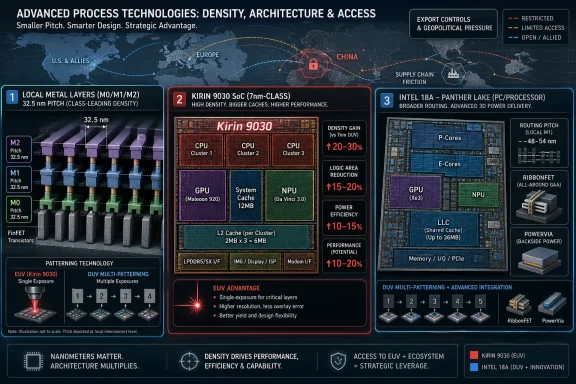
The headline comparison is simple enough: SMIC N+3 shows a 32.5 nm M0 pitch, while Intel’s shipping Panther Lake implementation on 18A is said to use 36 nm. M0 is a very low-level local metal layer, used inside the standard-cell neighborhood rather than as a broad measure of chip-wide interconnect quality. Treating it as a node scoreboard is like judging a city’s transit system by the width of one alley.
Intel 18A is not trying to win every front-side metal-pitch beauty contest. Its big architectural moves are RibbonFET gate-all-around transistors and PowerVia backside power delivery, both of which change how power and signal routing are balanced across the stack. If power routing moves to the backside, the front-side metal system can be optimized differently; a looser pitch in a shipping high-performance library does not mean the node is less advanced in any meaningful full-stack sense.
SMIC’s tighter M0 is impressive for another reason: it appears to be achieved without EUV, through aggressive DUV multi-patterning. That is an engineering achievement, but also a warning label. The tighter the pitch under immersion lithography, the more the fab depends on repeated patterning steps, tighter overlay control, more masks, more process steps, and more opportunities for variation to creep in.
This is why the SemiAnalysis framing is useful. The teardown does not say the 32.5 nm number is fake. It says the number is incomplete. In modern chipmaking, the question is not whether one layer can be pushed smaller; it is whether the whole system of transistors, wires, vias, libraries, SRAM, yield, cost, and voltage-frequency behavior produces competitive silicon at scale.
The new chip is a meaningful step beyond the Kirin 9000s-era comeback. SemiAnalysis describes N+3 as SMIC’s third-generation 7 nm-class process and compares its achieved logic density with TSMC N6, a mature and widely used 7 nm-class node. That is not process leadership, but it is also not stagnation. A sanctioned ecosystem has managed to produce a modern mobile SoC on a domestic advanced logic process with competitive density against an older TSMC EUV-assisted node.
The floorplan tells the story in silicon rather than slogans. The Kirin 9030 keeps a die area close to its predecessor while fitting in an extra middle CPU core, a larger GPU, a larger NPU cluster, and bigger caches. That is exactly what a density improvement should enable: more function in the same physical budget.
But this is where the gap reappears. Huawei can spend the density dividend on more cores and cache, but it cannot erase the power and performance disadvantages of a process stack that sits behind the best from TSMC, Samsung, and Intel. The Kirin 9030 is a better Chinese flagship chip. It is not a peer to the newest Apple, Qualcomm, or MediaTek flagship silicon.
TSMC N6 is not a leading-edge node in 2026, but it is mature, manufacturable, and supported by a deep ecosystem of libraries, design tools, customer experience, and process learning. SMIC N+3 has to reproduce a similar density class under far more constrained equipment access. That means more patterning complexity and likely more sensitivity to yield, variability, and cost.
SemiAnalysis reports a Bohr logic density estimate of about 113.4 million transistors per square millimeter for SMIC N+3, slightly above its estimate for TSMC N6. That is the cleanest version of the good news for SMIC. It says the company is no longer merely attempting 7 nm-class production; it is iterating on it.
The less flattering version is that SMIC is squeezing more out of an older toolchain by accepting complexity that EUV was designed to reduce. EUV’s purpose was never just to make prettier marketing names possible. It was to simplify patterning at small dimensions, reduce some multi-patterning burdens, and improve manufacturing flexibility. Without it, every additional shrink becomes a negotiation with masks, overlay, variability, and cost.
That is real progress. It means Huawei’s silicon design teams are not simply porting old blocks onto a slightly different process. They are tuning cores, adjusting cache allocations, and using the node transition to rebalance the die.
The problem is that performance per watt remains the brutal judge. SemiAnalysis’ comparison places Huawei’s prime core well behind Apple’s efficiency cores in energy behavior and far behind current flagship performance cores in absolute capability. That gap is not just a foundry problem, and it is not just a CPU design problem. It is the compound interest of several missing advantages: denser leading-edge nodes, better voltage-frequency curves, more mature libraries, broader EDA support, and years of microarchitectural refinement.
This is the trap in treating “N6-class density” as if it were a product-level equivalence. A smartphone SoC is not sold as a standard-cell density chart. It must deliver performance within a battery, thermal envelope, modem budget, camera pipeline, memory subsystem, and operating system experience. Huawei can make a chip that is good enough to matter in China’s market and still remain several generations behind the global leaders in efficiency.
That makes the absolute comparison more revealing. The new GPU can reach the territory of older flagship Android chips in some tests, but current flagship parts remain far ahead. The gap is especially punishing because GPU performance in phones is not only about peak frames; it is about sustained performance under heat, memory bandwidth, driver maturity, game optimization, and power efficiency.
For WindowsForum readers, the analogy is familiar from PC graphics. A vendor can make a large generational gain and still be behind if the market leader has moved two generations ahead during the same interval. Huawei’s GPU is a better Huawei GPU, but Apple, Qualcomm, and MediaTek have not been standing still.
The addition of ray tracing is symbolically important, but it should not be overread. Hardware ray tracing in mobile silicon is still bounded by power, memory, and software adoption. Huawei needs the feature for parity and ecosystem signaling, but the teardown’s broader message is that graphics competitiveness remains constrained by both process and architecture.
That is a sensible choice. A smartphone SoC does not need the kind of silicon interposer bandwidth that a high-end AI accelerator demands. Organic packaging keeps cost and board-level mechanical behavior in a practical range, especially when the goal is to ship consumer devices at volume.
The memory story is more geopolitically interesting. SemiAnalysis found Samsung LPDDR5X in one Pro variant and both CXMT and Samsung packages in Pro Max variants. That suggests Huawei is balancing available high-performance memory supply with domestic substitution where possible. CXMT’s presence matters because memory is another front in China’s semiconductor push, even if leading-edge logic gets most of the attention.
The important point is that Huawei is not winning by using one secret trick. It is assembling a stack of adequate-to-strong components under constraint: domestic logic, available advanced DRAM, conventional mobile packaging, and increasingly capable in-house architecture. That is less dramatic than a breakthrough narrative, but more strategically durable.
This is where design-technology co-optimization stops being a buzzword and becomes a manufacturing bill. SMIC is not just shrinking features; it is choosing cell heights, metal ratios, fin depopulation, contact schemes, and routing grids that make density possible without EUV. Each booster helps. Each booster also narrows the margin for error.
Contact over active gate and single diffusion break are good examples. They save area, but they demand tighter modeling and process control. Local layout effects become more important. EDA tools and process design kits must understand the electrical consequences well enough for designers to close timing and power without unpleasant surprises after tape-out.
That matters because SMIC’s customer base at the leading edge is not TSMC’s customer base. TSMC benefits from enormous volume, many customers, a vast ecosystem, and years of library and toolchain maturity. SMIC and Huawei are likely operating in a more vertically coordinated but narrower world. That can move quickly in one direction, but it does not automatically produce the same breadth of design options.
SemiAnalysis found meaningful SRAM shrinkage from Kirin 9020 to Kirin 9030, with cache arrays becoming smaller and total cache capacity increasing. That is a practical win for Huawei. More cache can reduce traffic, improve performance, and compensate for some memory and interconnect limitations.
But the teardown also suggests that part of the apparent improvement is catch-up from relatively large N+2 SRAM cells. In other words, N+3 looks better not only because it is advancing, but because the previous baseline had room to improve. That still counts as progress, but it is not the same as matching the leading edge of SRAM scaling.
The cache layout changes also reinforce a broader theme: Huawei is spending area intelligently. Larger L3 and system-level cache structures help a mobile SoC hide latency and feed CPU, GPU, and NPU blocks. When process efficiency lags, better locality becomes more valuable.
SMIC N+3 exists in the shadow of EUV restrictions. Without EUV, the company is forced into more aggressive DUV multi-patterning. That is slower, more complex, and likely more expensive than the path TSMC used to build its modern process empire. But it is not impossible, particularly when a national industrial policy is willing to absorb inefficiency for strategic autonomy.
Huawei’s response is equally important. If planar transistor scaling is constrained, the company must find gains elsewhere: architecture, cache, packaging, memory locality, and eventually 3D integration. That is why SemiAnalysis’ discussion of Huawei’s τ scaling and LogicFolding roadmap deserves attention even though the Kirin 9030 itself does not use stacked active logic.
The policy lesson is not that sanctions do nothing. It is that sanctions change the optimization function. They make Chinese chips costlier and less competitive globally, but they also incentivize domestic substitution and vertical integration. A less efficient ecosystem can still be strategically powerful if it serves protected or security-sensitive domestic markets.
That is a rational response to being behind in lithography. Modern chips waste enormous energy moving data. If Huawei can shorten critical paths through fine-pitch hybrid bonding or vertically split logic, it can recover some performance and efficiency without matching TSMC or Intel transistor-for-transistor.
But this roadmap is also an admission. Huawei is not saying it can simply reproduce TSMC N2 or Intel 18A under sanctions. It is saying that if the front-end process gap remains, the system must be redesigned around it. That means more packaging complexity, new EDA flows, new thermal problems, new yield challenges, and new test strategies.
The density comparisons will get especially slippery here. A stacked design can claim more transistors per package footprint while each individual die remains less dense than a leading-edge foundry die. That is not cheating, exactly, but it is not the same metric. For customers, the only honest comparison is product-level performance, power, cost, yield, and availability.
Yet the technical read is less damaging. Intel 18A’s significance lies in gate-all-around RibbonFETs and backside power delivery reaching production, not in having the tightest M0 pitch in one shipping library. Panther Lake is a real product embodiment of a new Intel process stack, and its success or failure will be judged by yields, volume, performance, battery life, OEM adoption, and follow-on foundry credibility.
The better criticism of Intel is not that SMIC has beaten it on one pitch. It is that Intel must now prove that its more elegant process architecture translates into reliable high-volume manufacturing and competitive products. A sophisticated node that struggles to supply the market or win external foundry customers will not be rescued by PowerPoint diagrams.
Still, comparing Intel 18A and SMIC N+3 as if they are peers is misleading. Intel is implementing backside power and gate-all-around transistors. SMIC is pushing FinFET-era DUV scaling harder. One is a more advanced architectural transition; the other is an impressive extension of constrained manufacturing. Both are difficult, but they are difficult in different ways.
Intel’s 18A trajectory matters directly to Windows users because Panther Lake-class processors anchor the next phase of x86 AI PCs. If Intel’s process performs well, Windows OEMs get a stronger domestic manufacturing story, better efficiency prospects, and a more credible alternative to TSMC-heavy supply chains. If it stumbles, the Windows ecosystem remains more dependent on external foundry leadership and Arm competitors gain another opening.
SMIC’s progress matters differently. Huawei’s Kirin 9030 is not about appearing in Dell or Lenovo Windows laptops. It is about demonstrating that a restricted Chinese ecosystem can keep improving enough to serve domestic phones, networking, embedded systems, and eventually AI infrastructure. That shifts the strategic balance for multinational vendors, governments, and enterprises that must think about supply-chain exposure.
For sysadmins and IT buyers, the near-term consequence is not that Chinese 7 nm-class chips will replace Intel or AMD in corporate Windows fleets. The consequence is a more fragmented hardware world. Procurement, compliance, firmware trust, update pipelines, and regional availability will increasingly reflect geopolitics as much as benchmark charts.
That distinction matters because strategic debates often flatten into binaries. Either sanctions worked or failed. Either China caught up or did not. Either Intel is back or doomed. Semiconductor reality resists that simplicity because nodes are systems, not labels, and products are compromises, not trophies.
The Kirin 9030 is best understood as a competent, constrained, strategically important chip. It is good enough to show that Huawei and SMIC have built a functioning advanced-node pipeline under pressure. It is not good enough to erase the accumulated advantages of TSMC’s ecosystem, Apple’s CPU design, Qualcomm’s modem and GPU experience, or Intel’s more radical transistor and power-delivery transition.
That makes the chip more important, not less. A country does not need the world’s best semiconductor process to reduce dependence, support domestic platforms, and complicate export-control strategy. It needs a process that keeps improving, enough products to sustain learning, and a roadmap that gives engineers somewhere to go next.
The SemiAnalysis teardown matters because it gives the semiconductor world something better than sanctions-era vibes. It puts cross-sections, metal pitches, cell heights, SRAM estimates, package construction, and performance comparisons behind a chip that has become a proxy for China’s ability to keep advancing without EUV lithography. The result is neither the triumphalist story Beijing would prefer nor the comforting freeze-frame Washington once hoped for. SMIC and Huawei are moving, but they are moving along a more expensive, more constrained, and more integration-heavy path.
 A Smaller Metal Pitch Is Not a Process Victory
The headline comparison is simple enough: SMIC N+3 shows a 32.5 nm M0 pitch, while Intel’s shipping Panther Lake implementation on 18A is said to use 36 nm. M0 is a very low-level local metal layer, used inside the standard-cell neighborhood rather than as a broad measure of chip-wide interconnect quality. Treating it as a node scoreboard is like judging a city’s transit system by the width of one alley.Intel 18A is not trying to win every front-side metal-pitch beauty contest. Its big architectural moves are RibbonFET gate-all-around transistors and PowerVia backside power delivery, both of which change how power and signal routing are balanced across the stack. If power routing moves to the backside, the front-side metal system can be optimized differently; a looser pitch in a shipping high-performance library does not mean the node is less advanced in any meaningful full-stack sense.
SMIC’s tighter M0 is impressive for another reason: it appears to be achieved without EUV, through aggressive DUV multi-patterning. That is an engineering achievement, but also a warning label. The tighter the pitch under immersion lithography, the more the fab depends on repeated patterning steps, tighter overlay control, more masks, more process steps, and more opportunities for variation to creep in.
This is why the SemiAnalysis framing is useful. The teardown does not say the 32.5 nm number is fake. It says the number is incomplete. In modern chipmaking, the question is not whether one layer can be pushed smaller; it is whether the whole system of transistors, wires, vias, libraries, SRAM, yield, cost, and voltage-frequency behavior produces competitive silicon at scale.
The Kirin 9030 Shows China’s Progress More Clearly Than Its Propaganda Does
Huawei’s Kirin 9030 is not a laboratory coupon. It is shipping in a flagship phone family, and that alone makes it strategically important. Huawei was pushed off TSMC’s leading-edge manufacturing after U.S. export controls tightened in 2020, and its return to in-house Kirin silicon with SMIC-made chips has become one of the most closely watched indicators of Chinese semiconductor resilience.The new chip is a meaningful step beyond the Kirin 9000s-era comeback. SemiAnalysis describes N+3 as SMIC’s third-generation 7 nm-class process and compares its achieved logic density with TSMC N6, a mature and widely used 7 nm-class node. That is not process leadership, but it is also not stagnation. A sanctioned ecosystem has managed to produce a modern mobile SoC on a domestic advanced logic process with competitive density against an older TSMC EUV-assisted node.
The floorplan tells the story in silicon rather than slogans. The Kirin 9030 keeps a die area close to its predecessor while fitting in an extra middle CPU core, a larger GPU, a larger NPU cluster, and bigger caches. That is exactly what a density improvement should enable: more function in the same physical budget.
But this is where the gap reappears. Huawei can spend the density dividend on more cores and cache, but it cannot erase the power and performance disadvantages of a process stack that sits behind the best from TSMC, Samsung, and Intel. The Kirin 9030 is a better Chinese flagship chip. It is not a peer to the newest Apple, Qualcomm, or MediaTek flagship silicon.
SMIC Has Reached N6-Class Density the Hard Way
The teardown’s most important technical conclusion is that SMIC N+3 reaches roughly TSMC N6-class logic density through DUV multi-patterning and design-technology co-optimization, not through a clean EUV-enabled shrink. That distinction matters because two chips can arrive at a similar density number with very different economics.TSMC N6 is not a leading-edge node in 2026, but it is mature, manufacturable, and supported by a deep ecosystem of libraries, design tools, customer experience, and process learning. SMIC N+3 has to reproduce a similar density class under far more constrained equipment access. That means more patterning complexity and likely more sensitivity to yield, variability, and cost.
SemiAnalysis reports a Bohr logic density estimate of about 113.4 million transistors per square millimeter for SMIC N+3, slightly above its estimate for TSMC N6. That is the cleanest version of the good news for SMIC. It says the company is no longer merely attempting 7 nm-class production; it is iterating on it.
The less flattering version is that SMIC is squeezing more out of an older toolchain by accepting complexity that EUV was designed to reduce. EUV’s purpose was never just to make prettier marketing names possible. It was to simplify patterning at small dimensions, reduce some multi-patterning burdens, and improve manufacturing flexibility. Without it, every additional shrink becomes a negotiation with masks, overlay, variability, and cost.
The CPU Cores Prove That Density Is Only One Leg of the Stool
Huawei’s CPU story is mixed in the way real engineering stories usually are. The Kirin 9030’s prime core gets a frequency bump and a larger L2 cache while shrinking in area. The middle cores shrink substantially, and the chip uses the savings to add another one. The tiny cores also improve, though less dramatically, and the shared cache structure grows.That is real progress. It means Huawei’s silicon design teams are not simply porting old blocks onto a slightly different process. They are tuning cores, adjusting cache allocations, and using the node transition to rebalance the die.
The problem is that performance per watt remains the brutal judge. SemiAnalysis’ comparison places Huawei’s prime core well behind Apple’s efficiency cores in energy behavior and far behind current flagship performance cores in absolute capability. That gap is not just a foundry problem, and it is not just a CPU design problem. It is the compound interest of several missing advantages: denser leading-edge nodes, better voltage-frequency curves, more mature libraries, broader EDA support, and years of microarchitectural refinement.
This is the trap in treating “N6-class density” as if it were a product-level equivalence. A smartphone SoC is not sold as a standard-cell density chart. It must deliver performance within a battery, thermal envelope, modem budget, camera pipeline, memory subsystem, and operating system experience. Huawei can make a chip that is good enough to matter in China’s market and still remain several generations behind the global leaders in efficiency.
The GPU Gains Are Real, but the Flagship Bar Has Moved
The Kirin 9030’s GPU looks like the strongest part of the upgrade. SemiAnalysis describes a move from four to six GPU compute units, layout changes, hardware ray-tracing support, and major benchmark gains over the previous Maleoon generation. In relative terms, Huawei’s GPU team appears to have delivered.That makes the absolute comparison more revealing. The new GPU can reach the territory of older flagship Android chips in some tests, but current flagship parts remain far ahead. The gap is especially punishing because GPU performance in phones is not only about peak frames; it is about sustained performance under heat, memory bandwidth, driver maturity, game optimization, and power efficiency.
For WindowsForum readers, the analogy is familiar from PC graphics. A vendor can make a large generational gain and still be behind if the market leader has moved two generations ahead during the same interval. Huawei’s GPU is a better Huawei GPU, but Apple, Qualcomm, and MediaTek have not been standing still.
The addition of ray tracing is symbolically important, but it should not be overread. Hardware ray tracing in mobile silicon is still bounded by power, memory, and software adoption. Huawei needs the feature for parity and ecosystem signaling, but the teardown’s broader message is that graphics competitiveness remains constrained by both process and architecture.
Memory and Packaging Show Pragmatism, Not Magic
The Kirin 9030 package is more conventional than the political drama around the chip might suggest. SemiAnalysis describes an integrated package-on-package structure with LPDDR5X memory stacked above the SoC through organic packaging layers. There is no silicon interposer or exotic advanced packaging trick inside this particular mobile chip.That is a sensible choice. A smartphone SoC does not need the kind of silicon interposer bandwidth that a high-end AI accelerator demands. Organic packaging keeps cost and board-level mechanical behavior in a practical range, especially when the goal is to ship consumer devices at volume.
The memory story is more geopolitically interesting. SemiAnalysis found Samsung LPDDR5X in one Pro variant and both CXMT and Samsung packages in Pro Max variants. That suggests Huawei is balancing available high-performance memory supply with domestic substitution where possible. CXMT’s presence matters because memory is another front in China’s semiconductor push, even if leading-edge logic gets most of the attention.
The important point is that Huawei is not winning by using one secret trick. It is assembling a stack of adequate-to-strong components under constraint: domestic logic, available advanced DRAM, conventional mobile packaging, and increasingly capable in-house architecture. That is less dramatic than a breakthrough narrative, but more strategically durable.
The Metal Stack Is Where the Bill Comes Due
The lower metal stack is the teardown’s most revealing section because it shows the price of SMIC’s density. N+3’s 32.5 nm M0 pitch is tight enough that SemiAnalysis associates it with self-aligned quadruple patterning. The M1 and M2 layers are less aggressive but still tuned to recover routing density and cell usability.This is where design-technology co-optimization stops being a buzzword and becomes a manufacturing bill. SMIC is not just shrinking features; it is choosing cell heights, metal ratios, fin depopulation, contact schemes, and routing grids that make density possible without EUV. Each booster helps. Each booster also narrows the margin for error.
Contact over active gate and single diffusion break are good examples. They save area, but they demand tighter modeling and process control. Local layout effects become more important. EDA tools and process design kits must understand the electrical consequences well enough for designers to close timing and power without unpleasant surprises after tape-out.
That matters because SMIC’s customer base at the leading edge is not TSMC’s customer base. TSMC benefits from enormous volume, many customers, a vast ecosystem, and years of library and toolchain maturity. SMIC and Huawei are likely operating in a more vertically coordinated but narrower world. That can move quickly in one direction, but it does not automatically produce the same breadth of design options.
SRAM Scaling Is the Quiet Constraint
Logic density gets the headlines, but SRAM often decides how much of a modern SoC feels fast. Caches consume large die areas, and SRAM scaling has become more stubborn across the industry. TSMC’s recent nodes have shown that logic can continue to benefit from DTCO while SRAM bitcell scaling slows.SemiAnalysis found meaningful SRAM shrinkage from Kirin 9020 to Kirin 9030, with cache arrays becoming smaller and total cache capacity increasing. That is a practical win for Huawei. More cache can reduce traffic, improve performance, and compensate for some memory and interconnect limitations.
But the teardown also suggests that part of the apparent improvement is catch-up from relatively large N+2 SRAM cells. In other words, N+3 looks better not only because it is advancing, but because the previous baseline had room to improve. That still counts as progress, but it is not the same as matching the leading edge of SRAM scaling.
The cache layout changes also reinforce a broader theme: Huawei is spending area intelligently. Larger L3 and system-level cache structures help a mobile SoC hide latency and feed CPU, GPU, and NPU blocks. When process efficiency lags, better locality becomes more valuable.
Export Controls Have Bent the Road, Not Blocked It
The teardown is a useful antidote to two bad takes. The first is that export controls have failed because Huawei is shipping advanced chips. The second is that export controls have succeeded because Huawei is still behind. Reality is more uncomfortable: controls have raised costs, slowed progress, and changed design choices, but they have not prevented progress.SMIC N+3 exists in the shadow of EUV restrictions. Without EUV, the company is forced into more aggressive DUV multi-patterning. That is slower, more complex, and likely more expensive than the path TSMC used to build its modern process empire. But it is not impossible, particularly when a national industrial policy is willing to absorb inefficiency for strategic autonomy.
Huawei’s response is equally important. If planar transistor scaling is constrained, the company must find gains elsewhere: architecture, cache, packaging, memory locality, and eventually 3D integration. That is why SemiAnalysis’ discussion of Huawei’s τ scaling and LogicFolding roadmap deserves attention even though the Kirin 9030 itself does not use stacked active logic.
The policy lesson is not that sanctions do nothing. It is that sanctions change the optimization function. They make Chinese chips costlier and less competitive globally, but they also incentivize domestic substitution and vertical integration. A less efficient ecosystem can still be strategically powerful if it serves protected or security-sensitive domestic markets.
Huawei’s 3D Roadmap Is an Admission Disguised as a Vision
Huawei’s τ scaling concept reframes progress around the time cost of moving and processing data. In plainer language, it is system-technology co-optimization with a Huawei brand stamp. Instead of relying only on smaller transistors, the company wants to shorten wires, reduce buffering, and stack active logic.That is a rational response to being behind in lithography. Modern chips waste enormous energy moving data. If Huawei can shorten critical paths through fine-pitch hybrid bonding or vertically split logic, it can recover some performance and efficiency without matching TSMC or Intel transistor-for-transistor.
But this roadmap is also an admission. Huawei is not saying it can simply reproduce TSMC N2 or Intel 18A under sanctions. It is saying that if the front-end process gap remains, the system must be redesigned around it. That means more packaging complexity, new EDA flows, new thermal problems, new yield challenges, and new test strategies.
The density comparisons will get especially slippery here. A stacked design can claim more transistors per package footprint while each individual die remains less dense than a leading-edge foundry die. That is not cheating, exactly, but it is not the same metric. For customers, the only honest comparison is product-level performance, power, cost, yield, and availability.
Intel’s 18A Looks Less Vulnerable Than the Pitch Meme Suggests
For Intel, the SemiAnalysis comparison is awkward but not catastrophic. The company has spent years promising that 18A would mark its return to process relevance, with Panther Lake as the client proof point. Seeing SMIC advertise, even indirectly, a tighter local metal pitch is not the kind of optics Intel wants.Yet the technical read is less damaging. Intel 18A’s significance lies in gate-all-around RibbonFETs and backside power delivery reaching production, not in having the tightest M0 pitch in one shipping library. Panther Lake is a real product embodiment of a new Intel process stack, and its success or failure will be judged by yields, volume, performance, battery life, OEM adoption, and follow-on foundry credibility.
The better criticism of Intel is not that SMIC has beaten it on one pitch. It is that Intel must now prove that its more elegant process architecture translates into reliable high-volume manufacturing and competitive products. A sophisticated node that struggles to supply the market or win external foundry customers will not be rescued by PowerPoint diagrams.
Still, comparing Intel 18A and SMIC N+3 as if they are peers is misleading. Intel is implementing backside power and gate-all-around transistors. SMIC is pushing FinFET-era DUV scaling harder. One is a more advanced architectural transition; the other is an impressive extension of constrained manufacturing. Both are difficult, but they are difficult in different ways.
The Windows Angle Is About Supply Chains, Not Smartphones
At first glance, a Huawei phone SoC teardown may seem distant from Windows PCs. It is not. The same process technologies, packaging choices, export-control effects, and foundry competition shape the chips that end up in laptops, servers, networking gear, accelerators, and edge devices.Intel’s 18A trajectory matters directly to Windows users because Panther Lake-class processors anchor the next phase of x86 AI PCs. If Intel’s process performs well, Windows OEMs get a stronger domestic manufacturing story, better efficiency prospects, and a more credible alternative to TSMC-heavy supply chains. If it stumbles, the Windows ecosystem remains more dependent on external foundry leadership and Arm competitors gain another opening.
SMIC’s progress matters differently. Huawei’s Kirin 9030 is not about appearing in Dell or Lenovo Windows laptops. It is about demonstrating that a restricted Chinese ecosystem can keep improving enough to serve domestic phones, networking, embedded systems, and eventually AI infrastructure. That shifts the strategic balance for multinational vendors, governments, and enterprises that must think about supply-chain exposure.
For sysadmins and IT buyers, the near-term consequence is not that Chinese 7 nm-class chips will replace Intel or AMD in corporate Windows fleets. The consequence is a more fragmented hardware world. Procurement, compliance, firmware trust, update pipelines, and regional availability will increasingly reflect geopolitics as much as benchmark charts.
The Real Story Is Not a Leapfrog, but a Longer Race
The most durable conclusion from the teardown is that China’s advanced semiconductor effort is neither frozen nor caught up. SMIC N+3 can achieve TSMC N6-class density using DUV and aggressive DTCO. Huawei can design a larger, more capable mobile SoC around it. But the result still trails current flagship silicon in efficiency and performance, and the manufacturing path looks costly.That distinction matters because strategic debates often flatten into binaries. Either sanctions worked or failed. Either China caught up or did not. Either Intel is back or doomed. Semiconductor reality resists that simplicity because nodes are systems, not labels, and products are compromises, not trophies.
The Kirin 9030 is best understood as a competent, constrained, strategically important chip. It is good enough to show that Huawei and SMIC have built a functioning advanced-node pipeline under pressure. It is not good enough to erase the accumulated advantages of TSMC’s ecosystem, Apple’s CPU design, Qualcomm’s modem and GPU experience, or Intel’s more radical transistor and power-delivery transition.
That makes the chip more important, not less. A country does not need the world’s best semiconductor process to reduce dependence, support domestic platforms, and complicate export-control strategy. It needs a process that keeps improving, enough products to sustain learning, and a roadmap that gives engineers somewhere to go next.
The Numbers That Survive the Hype Cycle
The useful takeaway is not that one nanometer-class brand defeated another. It is that the teardown gives us concrete markers for where SMIC, Huawei, and Intel actually stand.- SMIC N+3 reportedly uses a 32.5 nm M0 pitch in the Kirin 9030, which is tighter than the 36 nm M0 pitch reported for shipping Intel Panther Lake CPUs on 18A.
- That metal-pitch comparison does not make N+3 a superior process, because M0 is only one local routing layer and Intel 18A uses a broader architecture built around RibbonFET and PowerVia.
- SMIC appears to have reached roughly TSMC N6-class logic density through aggressive DUV multi-patterning, DTCO, and tighter local design rules rather than EUV-enabled simplification.
- Huawei’s Kirin 9030 gains area efficiency, more cores, larger caches, and a stronger GPU, but it still trails current flagship mobile SoCs in performance and especially power efficiency.
- The next Chinese scaling path is likely to rely more heavily on advanced packaging, stacked logic, and domestic EDA flows because further planar DUV scaling grows increasingly expensive and fragile.
- Export controls have slowed and reshaped China’s semiconductor path, but they have not stopped Huawei and SMIC from shipping progressively more capable advanced silicon.
References
- Primary source: SemiAnalysis
Published: Sun, 14 Jun 2026 19:14:21 GMT
Is SMIC N+3’s Metal Pitch Smaller than Intel 18A’s?
SMIC N+3 Node Deep Dive vs TSMC N6, TechInsights Private Equity Sale, SemiAnalysis Teardown Engineering & Evaluation Lab, HiSilicon Kirin 9030, Process Technology, Pattering, Cell Architecturenewsletter.semianalysis.com - Related coverage: techinsights.com
Huawei Mate 80 Pro Max Teardown Confirms Kirin 9030 Pro on SMIC N+3 | TechInsights
TechInsights’ teardown of the Huawei Mate 80 Pro Max confirms the Kirin 9030 Pro on SMIC’s N+3 process and reveals major upgrades in display, cameras, and connectivity.www.techinsights.com
- Related coverage: tomshardware.com
- Related coverage: allaboutcircuits.com
- Related coverage: pcgamer.com
New report claims Intel is 'struggling' to supply laptop CPUs based on its latest 18A node after speaking to Computex sources | PC Gamer
But it might not be because there's a problem with 18A itself.www.pcgamer.com - Related coverage: wccftech.com
Intel Confirms Nova Lake CPUs For 2026 & "18A" Panther Lake For 2H 2025, 18A HVM Later This Year & 14A With Increased Perf-Per-Watt & Density Scaling
Intel's CEO provided updates on future products including CPUs such as Nova Lake, Panther Lake & the very crucial 18A/14A process nodes.wccftech.com
- Related coverage: windowscentral.com
Everything you need to know about Intel Panther Lake | Windows Central
Intel Panther Lake is right around the corner. Here's everything we know so far about the next-gen computer chips known as Intel Core Ultra (Series 3).www.windowscentral.com - Related coverage: download.intel.com
- Related coverage: laptopmag.com
Big cat sighting: Intel shows off Panther Lake at Computex | Laptop Mag
Intel chose not to host a press conference or keynote at Computex 2025, but the company’s 18A flagship CPU still appeared in small press demo sessions.www.laptopmag.com - Related coverage: intel.com
