

Generative AI has pushed copyright law into a live collision between creators, model builders, and regulators, with Eleonora Rosati arguing in June 2026 that rights holders can still protect their work but face deep uncertainty over how training-data exceptions will be enforced. The fight is no longer theoretical or academic. It is now about money, provenance, disclosure, and whether the AI industry can keep treating the open web as a free provisioning layer for commercial software.
For years, the public argument over AI and copyright had a strangely weightless quality. Developers talked about “learning,” artists talked about theft, and lawyers warned that nobody would know the real answer until courts started producing rulings. That moment has arrived, and the legal debate is hardening around a much less romantic question: where did the training data come from?
Rosati’s interview is useful because it cuts through one of the industry’s favorite metaphors. An AI model is not a person sitting in a library, reading books, forming taste, and later writing under its own influence. The training process requires acts of copying, ingestion, transformation, and storage that copyright law has historically treated as legally meaningful, even when the copy is temporary or buried deep inside a technical system.
That distinction matters to anyone who uses Windows, Microsoft 365, GitHub Copilot, ChatGPT, Claude, or any of the AI assistants now being threaded through workstations and enterprise software. Copyright risk is becoming part of the software supply chain. If a model’s capabilities were built on material obtained without lawful access, then the product sitting in a browser tab or Copilot pane may carry unresolved legal baggage.
The industry’s first defense was scale: everyone scraped, everyone trained, everyone moved fast. The next defense was analogy: machines learn like humans do. Rosati’s point is that neither argument is a legal shield by itself. Copyright does not evaporate because the copying happens at industrial scale, and it does not become harmless just because the end product looks like a statistical model rather than a folder full of PDFs.
In the Anthropic litigation, the central problem was not simply that copyrighted books were used in relation to model training. The explosive issue was the alleged use of pirated copies from shadow libraries. That distinction is why the case became such a warning flare for the AI industry and why the reported $1.5 billion settlement landed with such force.
For model developers, this creates a procurement problem disguised as a copyright problem. It is no longer enough to say that training is transformative, innovative, or socially useful. A company must be able to show how it obtained the underlying material, what rights attached to it, whether any opt-outs were honored, and whether the ingestion process reproduced protected works in ways covered by law or exception.
Rosati’s phrase about illegal sources “poisoning” the training process gets to the heart of the issue. If unlawful acquisition contaminates a training corpus, the risk may not be limited to one dataset or one group of plaintiffs. It can undermine confidence in the entire lineage of a model, especially if the company cannot cleanly separate licensed material, public-domain material, user-generated material, and pirated material.
For enterprise customers, that is not an abstract problem. Procurement teams already ask vendors about data residency, security controls, subcontractors, and indemnity. AI copyright provenance is rapidly joining that checklist. A CIO does not want to discover after deployment that an assistant used across thousands of Windows endpoints was trained in ways that trigger litigation, licensing disputes, or emergency model replacement.
That is why Rosati emphasizes transparency. Rights holders cannot enforce rights they cannot trace. If artists, authors, publishers, developers, broadcasters, and voice actors cannot know whether their work was used, then the legal right exists in theory but fails in practice.
The EU’s regime tries to narrow that gap by requiring documentation, summaries of training content, and copyright compliance policies for general-purpose AI providers. This is not the same as forcing companies to publish every file in a training set, and creators have argued that high-level summaries may still be too vague. But the policy direction is clear: the black box is losing legal privilege.
The European model also leans heavily on text and data mining exceptions, which were not originally drafted with today’s frontier AI models in mind. Rosati’s warning is that these exceptions have conditions. They are not a universal hall pass for every commercial AI training operation, and they may turn on issues such as lawful access, the purpose of the activity, and whether rights holders reserved their rights.
That uncertainty is exactly where litigation will grow. The next generation of European AI copyright cases will not merely ask whether AI is good or bad. They will ask whether a particular dataset was lawfully accessed, whether an exception applied to a particular phase of model training, whether an opt-out was respected, and whether the resulting outputs create separate liability.
That does not mean Microsoft is uniquely exposed or uniquely culpable. It means Microsoft is one of the companies turning generative AI from a website into a platform layer. When AI is a feature inside Word, Teams, Outlook, Windows, Visual Studio Code, GitHub, Edge, and Azure services, the copyright debate stops being a niche concern for artists and becomes part of mainstream computing governance.
Microsoft’s enterprise pitch depends on trust. It asks organizations to place AI in the middle of documents, meetings, source code, email, customer data, and operational workflows. That pitch becomes harder if the surrounding AI ecosystem is still fighting over whether the raw material used to build model capabilities was lawfully acquired.
The practical enterprise question is not whether every Copilot response is infringing. That is too blunt. The sharper question is whether the vendor can document model provenance, contractual protections, opt-out handling, data boundaries, and the separation between customer data and foundation-model training. Those are the issues auditors and legal teams will increasingly expect IT departments to understand.
Microsoft also has a strategic reason to welcome clearer rules. Large incumbents can afford licensing deals, compliance departments, audit processes, and legal settlements. Smaller competitors may struggle. Regulation that looks like a burden can become a moat when the cost of proving clean training data rises.
Voice cloning has made the problem unusually vivid. A singer’s voice, an actor’s cadence, or a narrator’s delivery can now be imitated without copying a particular recording in the old-fashioned sense. That creates a gap between copyright law, which protects works, and identity law, which protects the commercial and personal value of being recognizable as oneself.
This matters because AI does not merely reproduce culture; it can simulate presence. A fake song can sound like a superstar. A fake endorsement can sound like an actor. A fake training video can sound like a real employee. The harm is not only lost royalties but loss of control over association, reputation, and consent.
For Windows users and administrators, this is already a security issue. Voice likeness and synthetic media can be used in fraud, phishing, social engineering, and internal impersonation. The same tools that let a fan generate a novelty song can let an attacker generate a convincing voicemail from a manager approving a wire transfer or a help-desk reset.
That is why the rights conversation and the cybersecurity conversation are converging. A company cannot treat synthetic voice as merely a creative-industry dispute when the same technology can compromise identity verification. The protective moves artists are making today may foreshadow the controls enterprises will need tomorrow.
Rosati does not dismiss text and data mining exceptions. She argues that they need to be read carefully. That is the right posture, because copyright law often survives technological change not by pretending nothing has changed, but by applying old concepts to new mechanisms.
The problem for AI companies is that training is not one simple act. It can involve collection, filtering, deduplication, tokenization, reproduction, storage, embedding, model updating, fine-tuning, evaluation, and deployment. A legal exception that covers one stage may not necessarily cover all of them. A lawful copy used for one purpose may not automatically authorize every downstream use.
This is where the library analogy fails hardest. A reader does not need to make millions of machine-readable copies to form an opinion. A model developer often does. The fact that the final system may not contain a readable copy of a novel or image in ordinary form does not answer the question of whether protected reproductions occurred along the way.
The industry wants one clean rule because one clean rule is cheaper. Courts and regulators are more likely to produce a matrix of distinctions. Lawful access may matter. Commercial purpose may matter. Opt-outs may matter. Memorization may matter in output cases, even if it is not the only issue in training cases. The result will be messy, but that is how software law usually matures.
In ordinary copyright litigation, the plaintiff typically must prove copying. In AI training disputes, that can be brutally difficult. Training datasets may be secret, modified, commingled, deleted, or described only at a high level. A lone illustrator or author cannot easily reverse-engineer the corpus behind a frontier model.
A presumption of use would not automatically mean creators win every case. It would mean developers need evidence. That is the key shift. The company with control over training records would have to produce a credible account of what was used and what was not.
This kind of burden-shifting would be controversial, especially among AI firms and open-source advocates who fear overbroad liability. But it reflects a real enforcement problem. A legal right that cannot be proven is closer to a polite suggestion than a property right.
For enterprise IT, this again sounds familiar. Compliance regimes often shift burdens toward the party with operational control. If a company processes regulated data, it must document controls. If a vendor claims security compliance, it must show audits. AI training may be heading toward the same world: no documentation, no trust.
This tension is especially acute in open source. Publishing code publicly is not the same as surrendering all rights. Licenses matter. Attribution requirements matter. Copyleft obligations matter. If AI systems learn from permissively licensed and restrictively licensed code alike, the legal and ethical boundaries become difficult to trace.
The same goes for technical writing, forum posts, documentation, bug reports, Stack Overflow answers, and community tutorials. Much of the knowledge that makes AI assistants useful came from people solving problems in public. Windows troubleshooting culture itself is built on that shared labor: someone hits a driver bug, documents the workaround, and years later thousands benefit.
Generative AI changes the bargain because it can extract the value of that public labor without necessarily returning traffic, attribution, reputation, or licensing revenue. A forum answer that once brought a reader to a community can become invisible training exhaust. The knowledge persists, but the social and economic loop that produced it weakens.
That does not mean AI should be banned from learning from public technical material. It does mean the tech community should stop pretending that public availability equals unlimited commercial permission. The health of knowledge ecosystems depends on incentives, credit, and consent as much as access.
That is why more cases are likely. Publishers, artists, music labels, photographers, coders, voice actors, and news organizations all face different fact patterns. Some claims focus on training. Others focus on outputs. Some involve pirated datasets. Others involve material scraped from lawful public sources. Some allege market substitution. Others allege misappropriation of likeness.
AI companies may prefer licensing deals where the rights holders are organized and powerful. That is already easier with major publishers, stock image libraries, music catalogs, and news organizations than with millions of individual creators. The risk is a two-tier system in which large rights owners get paid while independent creators are told enforcement is too hard.
This is where regulation may matter more than litigation. Courts decide cases. Regulators shape markets. If transparency obligations are weak, creators will struggle to identify claims. If they are strong, AI companies will face pressure to clean up datasets, honor opt-outs, and negotiate licenses.
The next phase will therefore be less dramatic than the first wave of lawsuits but more important. It will involve templates, compliance policies, dataset summaries, audit trails, contractual indemnities, and licensing infrastructure. That sounds dull. It is also how the internet’s next economic settlement will be written.
That starts with procurement questions. Which models are used? Where are they hosted? What data trains the base model? What customer data is retained? What contractual promises exist around infringement claims? What happens if a model must be withdrawn or replaced because of litigation? These are no longer exotic legal hypotheticals.
Administrators should also distinguish between consumer AI tools and enterprise-managed AI services. A browser extension or free chatbot used by employees may create data leakage and copyright uncertainty. A managed enterprise service may offer stronger controls, but it still requires review. “Powered by AI” should not be a procurement shortcut.
There is also a records-management angle. If AI outputs become part of business documents, legal filings, codebases, marketing material, or customer communications, organizations need policies for review and attribution. The risk is not only that the model was trained on disputed material. It is also that the output may reproduce protected expression, fabricate sources, or create misleading synthetic media.
For sysadmins, the near-term job is practical. Inventory the tools. Control access. Review vendor terms. Educate users. Coordinate with legal and security teams. AI governance should not live solely in the innovation office, because the blast radius lands on endpoints, identities, documents, and logs.
Rosati’s argument points toward a future where documentation becomes a competitive feature. A model with slightly lower benchmark scores but cleaner provenance may be preferable for regulated industries. A vendor with credible indemnity and transparent training summaries may beat a flashier rival that cannot answer basic questions about data lineage.
This will frustrate parts of the AI world that grew up in a culture of scraping first and lawyering later. But it is not unusual in technology history. Databases, encryption, cloud hosting, telemetry, biometric systems, and medical software all became more regulated as they became more important. AI is simply reaching that threshold faster.
The irony is that stronger rules may help the industry mature. Customers do not want endless uncertainty. Creators do not want to be involuntary suppliers. Developers do not want lawsuits hanging over every generated function. Even AI companies need a stable licensing and compliance environment if they want to sell deeply into enterprise and government markets.
The alternative is a permanent gray market in machine intelligence, where nobody knows what was used, nobody knows who is owed, and every new model arrives with a litigation cloud. That may be tolerable for demos. It is not a foundation for critical software infrastructure.
For Windows users and IT professionals, the practical takeaways are concrete:
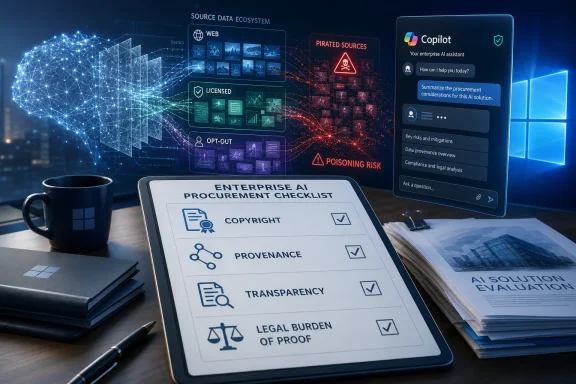 The AI Copyright Fight Has Moved From Philosophy to Procurement
For years, the public argument over AI and copyright had a strangely weightless quality. Developers talked about “learning,” artists talked about theft, and lawyers warned that nobody would know the real answer until courts started producing rulings. That moment has arrived, and the legal debate is hardening around a much less romantic question: where did the training data come from?Rosati’s interview is useful because it cuts through one of the industry’s favorite metaphors. An AI model is not a person sitting in a library, reading books, forming taste, and later writing under its own influence. The training process requires acts of copying, ingestion, transformation, and storage that copyright law has historically treated as legally meaningful, even when the copy is temporary or buried deep inside a technical system.
That distinction matters to anyone who uses Windows, Microsoft 365, GitHub Copilot, ChatGPT, Claude, or any of the AI assistants now being threaded through workstations and enterprise software. Copyright risk is becoming part of the software supply chain. If a model’s capabilities were built on material obtained without lawful access, then the product sitting in a browser tab or Copilot pane may carry unresolved legal baggage.
The industry’s first defense was scale: everyone scraped, everyone trained, everyone moved fast. The next defense was analogy: machines learn like humans do. Rosati’s point is that neither argument is a legal shield by itself. Copyright does not evaporate because the copying happens at industrial scale, and it does not become harmless just because the end product looks like a statistical model rather than a folder full of PDFs.
The Source of the Data Is Becoming the Source of the Liability
The most important development in the U.S. litigation has not been a sweeping declaration that all AI training is unlawful. It has been something narrower and more dangerous for AI companies: courts are beginning to distinguish between lawful access and pirated acquisition. That may sound like a technicality, but it changes the incentives of the entire market.In the Anthropic litigation, the central problem was not simply that copyrighted books were used in relation to model training. The explosive issue was the alleged use of pirated copies from shadow libraries. That distinction is why the case became such a warning flare for the AI industry and why the reported $1.5 billion settlement landed with such force.
For model developers, this creates a procurement problem disguised as a copyright problem. It is no longer enough to say that training is transformative, innovative, or socially useful. A company must be able to show how it obtained the underlying material, what rights attached to it, whether any opt-outs were honored, and whether the ingestion process reproduced protected works in ways covered by law or exception.
Rosati’s phrase about illegal sources “poisoning” the training process gets to the heart of the issue. If unlawful acquisition contaminates a training corpus, the risk may not be limited to one dataset or one group of plaintiffs. It can undermine confidence in the entire lineage of a model, especially if the company cannot cleanly separate licensed material, public-domain material, user-generated material, and pirated material.
For enterprise customers, that is not an abstract problem. Procurement teams already ask vendors about data residency, security controls, subcontractors, and indemnity. AI copyright provenance is rapidly joining that checklist. A CIO does not want to discover after deployment that an assistant used across thousands of Windows endpoints was trained in ways that trigger litigation, licensing disputes, or emergency model replacement.
Europe Is Building a Paper Trail While America Litigates the Boundary
The EU’s approach is not to wait for one definitive court battle to settle the entire question. It is building transparency and compliance obligations into the regulatory structure around general-purpose AI. The AI Act does not solve every copyright issue, but it does force model providers to behave less like magicians and more like accountable suppliers.That is why Rosati emphasizes transparency. Rights holders cannot enforce rights they cannot trace. If artists, authors, publishers, developers, broadcasters, and voice actors cannot know whether their work was used, then the legal right exists in theory but fails in practice.
The EU’s regime tries to narrow that gap by requiring documentation, summaries of training content, and copyright compliance policies for general-purpose AI providers. This is not the same as forcing companies to publish every file in a training set, and creators have argued that high-level summaries may still be too vague. But the policy direction is clear: the black box is losing legal privilege.
The European model also leans heavily on text and data mining exceptions, which were not originally drafted with today’s frontier AI models in mind. Rosati’s warning is that these exceptions have conditions. They are not a universal hall pass for every commercial AI training operation, and they may turn on issues such as lawful access, the purpose of the activity, and whether rights holders reserved their rights.
That uncertainty is exactly where litigation will grow. The next generation of European AI copyright cases will not merely ask whether AI is good or bad. They will ask whether a particular dataset was lawfully accessed, whether an exception applied to a particular phase of model training, whether an opt-out was respected, and whether the resulting outputs create separate liability.
Microsoft Is Not a Bystander in This Argument
For WindowsForum readers, the obvious question is where Microsoft sits in this story. The answer is: everywhere. Microsoft is an investor in OpenAI, a provider of Copilot across Windows and Microsoft 365, a cloud infrastructure giant through Azure, and a software platform vendor whose developer ecosystem increasingly assumes AI assistance as part of the workflow.That does not mean Microsoft is uniquely exposed or uniquely culpable. It means Microsoft is one of the companies turning generative AI from a website into a platform layer. When AI is a feature inside Word, Teams, Outlook, Windows, Visual Studio Code, GitHub, Edge, and Azure services, the copyright debate stops being a niche concern for artists and becomes part of mainstream computing governance.
Microsoft’s enterprise pitch depends on trust. It asks organizations to place AI in the middle of documents, meetings, source code, email, customer data, and operational workflows. That pitch becomes harder if the surrounding AI ecosystem is still fighting over whether the raw material used to build model capabilities was lawfully acquired.
The practical enterprise question is not whether every Copilot response is infringing. That is too blunt. The sharper question is whether the vendor can document model provenance, contractual protections, opt-out handling, data boundaries, and the separation between customer data and foundation-model training. Those are the issues auditors and legal teams will increasingly expect IT departments to understand.
Microsoft also has a strategic reason to welcome clearer rules. Large incumbents can afford licensing deals, compliance departments, audit processes, and legal settlements. Smaller competitors may struggle. Regulation that looks like a burden can become a moat when the cost of proving clean training data rises.
Artists Are Turning Identity Into Infrastructure
Rosati’s comments about Taylor Swift and Matthew McConaughey registering voice-related trademarks point to a second front in the AI war: not just copyrighted works, but personal identity. The legal system has multiple tools for this fight, including trademarks, personality rights, performers’ rights, image rights, unfair competition law, privacy law, and data protection law. None of them maps perfectly onto generative AI, but together they show that creators are no longer waiting passively for legislators.Voice cloning has made the problem unusually vivid. A singer’s voice, an actor’s cadence, or a narrator’s delivery can now be imitated without copying a particular recording in the old-fashioned sense. That creates a gap between copyright law, which protects works, and identity law, which protects the commercial and personal value of being recognizable as oneself.
This matters because AI does not merely reproduce culture; it can simulate presence. A fake song can sound like a superstar. A fake endorsement can sound like an actor. A fake training video can sound like a real employee. The harm is not only lost royalties but loss of control over association, reputation, and consent.
For Windows users and administrators, this is already a security issue. Voice likeness and synthetic media can be used in fraud, phishing, social engineering, and internal impersonation. The same tools that let a fan generate a novelty song can let an attacker generate a convincing voicemail from a manager approving a wire transfer or a help-desk reset.
That is why the rights conversation and the cybersecurity conversation are converging. A company cannot treat synthetic voice as merely a creative-industry dispute when the same technology can compromise identity verification. The protective moves artists are making today may foreshadow the controls enterprises will need tomorrow.
The “Right to Read” Was Always Too Simple
The phrase “the right to read is the right to mine” captured an earlier internet optimism. If a human can lawfully read a page, the argument went, software should be able to analyze it too. That made sense in the age of search indexing, academic analysis, and limited-purpose text mining. It is less convincing when the mining produces a commercial model capable of competing with the people whose work it absorbed.Rosati does not dismiss text and data mining exceptions. She argues that they need to be read carefully. That is the right posture, because copyright law often survives technological change not by pretending nothing has changed, but by applying old concepts to new mechanisms.
The problem for AI companies is that training is not one simple act. It can involve collection, filtering, deduplication, tokenization, reproduction, storage, embedding, model updating, fine-tuning, evaluation, and deployment. A legal exception that covers one stage may not necessarily cover all of them. A lawful copy used for one purpose may not automatically authorize every downstream use.
This is where the library analogy fails hardest. A reader does not need to make millions of machine-readable copies to form an opinion. A model developer often does. The fact that the final system may not contain a readable copy of a novel or image in ordinary form does not answer the question of whether protected reproductions occurred along the way.
The industry wants one clean rule because one clean rule is cheaper. Courts and regulators are more likely to produce a matrix of distinctions. Lawful access may matter. Commercial purpose may matter. Opt-outs may matter. Memorization may matter in output cases, even if it is not the only issue in training cases. The result will be messy, but that is how software law usually matures.
The Coming Fight Is Over Burden of Proof
One of the most consequential ideas Rosati flags is the French proposal to presume use of protected content in certain AI training disputes, shifting the burden to developers to show otherwise. If adopted more broadly, that would be a major change in litigation dynamics. It would attack the asymmetry that currently favors AI companies: creators suspect use, but developers hold the logs.In ordinary copyright litigation, the plaintiff typically must prove copying. In AI training disputes, that can be brutally difficult. Training datasets may be secret, modified, commingled, deleted, or described only at a high level. A lone illustrator or author cannot easily reverse-engineer the corpus behind a frontier model.
A presumption of use would not automatically mean creators win every case. It would mean developers need evidence. That is the key shift. The company with control over training records would have to produce a credible account of what was used and what was not.
This kind of burden-shifting would be controversial, especially among AI firms and open-source advocates who fear overbroad liability. But it reflects a real enforcement problem. A legal right that cannot be proven is closer to a polite suggestion than a property right.
For enterprise IT, this again sounds familiar. Compliance regimes often shift burdens toward the party with operational control. If a company processes regulated data, it must document controls. If a vendor claims security compliance, it must show audits. AI training may be heading toward the same world: no documentation, no trust.
Developers Are Creators Too, and That Complicates the Politics
The copyright debate is often framed as artists versus technologists, but WindowsForum’s audience knows that software developers sit awkwardly on both sides. Developers use AI coding assistants, but their code is also training material. They benefit from generated snippets, but they may worry that open-source repositories were ingested under assumptions the maintainers never accepted.This tension is especially acute in open source. Publishing code publicly is not the same as surrendering all rights. Licenses matter. Attribution requirements matter. Copyleft obligations matter. If AI systems learn from permissively licensed and restrictively licensed code alike, the legal and ethical boundaries become difficult to trace.
The same goes for technical writing, forum posts, documentation, bug reports, Stack Overflow answers, and community tutorials. Much of the knowledge that makes AI assistants useful came from people solving problems in public. Windows troubleshooting culture itself is built on that shared labor: someone hits a driver bug, documents the workaround, and years later thousands benefit.
Generative AI changes the bargain because it can extract the value of that public labor without necessarily returning traffic, attribution, reputation, or licensing revenue. A forum answer that once brought a reader to a community can become invisible training exhaust. The knowledge persists, but the social and economic loop that produced it weakens.
That does not mean AI should be banned from learning from public technical material. It does mean the tech community should stop pretending that public availability equals unlimited commercial permission. The health of knowledge ecosystems depends on incentives, credit, and consent as much as access.
The Settlement Era Will Not Settle the Principle
The Anthropic settlement is often described as a landmark, and financially it is. But settlements do not create the same kind of legal clarity as final appellate rulings. They price risk, avoid trial, and let both sides escape uncertainty. They do not answer every question the market wants answered.That is why more cases are likely. Publishers, artists, music labels, photographers, coders, voice actors, and news organizations all face different fact patterns. Some claims focus on training. Others focus on outputs. Some involve pirated datasets. Others involve material scraped from lawful public sources. Some allege market substitution. Others allege misappropriation of likeness.
AI companies may prefer licensing deals where the rights holders are organized and powerful. That is already easier with major publishers, stock image libraries, music catalogs, and news organizations than with millions of individual creators. The risk is a two-tier system in which large rights owners get paid while independent creators are told enforcement is too hard.
This is where regulation may matter more than litigation. Courts decide cases. Regulators shape markets. If transparency obligations are weak, creators will struggle to identify claims. If they are strong, AI companies will face pressure to clean up datasets, honor opt-outs, and negotiate licenses.
The next phase will therefore be less dramatic than the first wave of lawsuits but more important. It will involve templates, compliance policies, dataset summaries, audit trails, contractual indemnities, and licensing infrastructure. That sounds dull. It is also how the internet’s next economic settlement will be written.
Windows Shops Should Treat AI Provenance Like Any Other Vendor Risk
The lesson for IT departments is not to panic and rip out every AI feature. It is to stop treating AI assistants as magical add-ons outside normal governance. If a tool can read corporate content, generate work product, influence code, summarize meetings, or automate decisions, it belongs inside the same risk framework as cloud storage, endpoint management, identity, and security tooling.That starts with procurement questions. Which models are used? Where are they hosted? What data trains the base model? What customer data is retained? What contractual promises exist around infringement claims? What happens if a model must be withdrawn or replaced because of litigation? These are no longer exotic legal hypotheticals.
Administrators should also distinguish between consumer AI tools and enterprise-managed AI services. A browser extension or free chatbot used by employees may create data leakage and copyright uncertainty. A managed enterprise service may offer stronger controls, but it still requires review. “Powered by AI” should not be a procurement shortcut.
There is also a records-management angle. If AI outputs become part of business documents, legal filings, codebases, marketing material, or customer communications, organizations need policies for review and attribution. The risk is not only that the model was trained on disputed material. It is also that the output may reproduce protected expression, fabricate sources, or create misleading synthetic media.
For sysadmins, the near-term job is practical. Inventory the tools. Control access. Review vendor terms. Educate users. Coordinate with legal and security teams. AI governance should not live solely in the innovation office, because the blast radius lands on endpoints, identities, documents, and logs.
The Real AI Divide Is Between Documented and Undocumented Systems
The debate is often described as a clash between innovation and regulation, but that framing is too lazy. The more meaningful divide is between systems that can account for themselves and systems that cannot. An AI provider that knows what it trained on, how it obtained the data, what rights applied, and how it honors restrictions is in a different category from one that waves toward the internet and says the machine learned.Rosati’s argument points toward a future where documentation becomes a competitive feature. A model with slightly lower benchmark scores but cleaner provenance may be preferable for regulated industries. A vendor with credible indemnity and transparent training summaries may beat a flashier rival that cannot answer basic questions about data lineage.
This will frustrate parts of the AI world that grew up in a culture of scraping first and lawyering later. But it is not unusual in technology history. Databases, encryption, cloud hosting, telemetry, biometric systems, and medical software all became more regulated as they became more important. AI is simply reaching that threshold faster.
The irony is that stronger rules may help the industry mature. Customers do not want endless uncertainty. Creators do not want to be involuntary suppliers. Developers do not want lawsuits hanging over every generated function. Even AI companies need a stable licensing and compliance environment if they want to sell deeply into enterprise and government markets.
The alternative is a permanent gray market in machine intelligence, where nobody knows what was used, nobody knows who is owed, and every new model arrives with a litigation cloud. That may be tolerable for demos. It is not a foundation for critical software infrastructure.
The Copyright Shock Is Now Part of the AI Rollout Plan
The immediate message from Rosati’s analysis is not that AI training is doomed. It is that the era of consequence-free ingestion is ending. Rights holders are organizing, courts are drawing distinctions, regulators are demanding disclosures, and artists are expanding protection from works to identity itself.For Windows users and IT professionals, the practical takeaways are concrete:
- AI vendors will increasingly need to prove that training data was lawfully accessed, not merely argue that training is socially useful.
- The EU’s transparency regime is likely to influence global AI procurement, even for organizations outside Europe.
- Voice, likeness, and synthetic identity protections are becoming security concerns as well as entertainment-industry concerns.
- Enterprise AI deployments should be reviewed for copyright indemnity, data retention, model provenance, and output governance.
- Publicly available code, documentation, forum posts, and creative works should not be treated as rights-free raw material.
- The most trusted AI systems will be the ones that can explain their inputs, not just impress users with their outputs.
References
- Primary source: EL PAÍS English
Published: 2026-06-20T03:50:18.128540
Eleonora Rosati, lawyer: ‘Artists are already thinking about how to protect themselves from AI; Taylor Swift has registered her voice’ | Technology | EL PAÍS English
This expert in intellectual property law believes that new regulations provide safeguards, but also warns that there is a lot of uncertainty about how the exceptions to the laws are being interpretedenglish.elpais.com - Related coverage: elpais.com
- Related coverage: theguardian.com
Taylor Swift files trademarks for voice and image amid concern over AI misuse | Taylor Swift | The Guardian
The singer’s company filed three applications on Friday after Matthew McConaughey launched similar strategywww.theguardian.com
