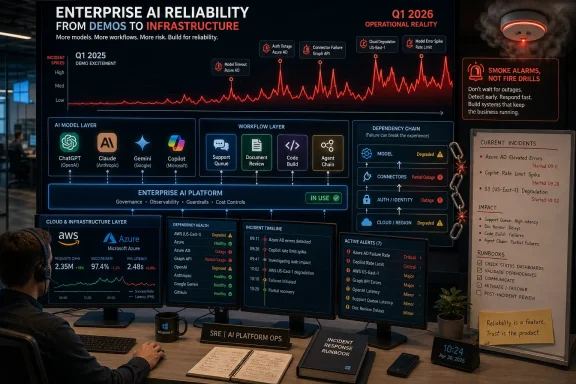
Ookla’s new Downdetector-based analysis says high-signal disruption days across major AI platforms rose from 6 in Q1 2025 to 51 in Q1 2026, using 3.72 million U.S. user reports collected between January 1, 2025, and April 16, 2026. That is not merely an outage statistic; it is a map of how quickly AI has moved from novelty tab to production dependency. The uncomfortable lesson is that AI reliability is now a Windows, cloud, identity, networking, and operations story as much as it is a model story.
The first generation of mass-market AI failures was annoying in the way a broken search engine is annoying. A prompt timed out, a chatbot forgot context, a coding assistant spun for a minute and returned nothing useful. The user sighed, refreshed, and went back to email.
That era is already ending. ChatGPT, Claude, Gemini, and Microsoft Copilot are now woven into writing pipelines, code review, business analysis, help desks, meeting workflows, spreadsheet work, and early forms of agentic automation. When one of those systems stalls, the disruption is no longer confined to a single person asking a single question.
Ookla’s framing matters because it treats these platforms as part of a larger reliability surface. The company defined a high-signal disruption day as one when a service recorded more than ten times its median daily report volume during the study period. That threshold does not prove the precise root cause of every incident, but it does identify the days when enough users experienced enough pain to turn private frustration into public signal.
The sharp rise from 6 such days in Q1 2025 to 51 in Q1 2026 suggests something more consequential than a few bad release windows. It suggests that AI systems are being stressed by the same forces that shaped cloud computing a decade ago: fast adoption, complex dependencies, uneven visibility, and a widening gap between what vendors market as seamless intelligence and what users experience as another fragile layer of infrastructure.
That makes the data imperfect and useful at the same time. A spike in user reports is not the same thing as a forensic incident report. It can reflect publicity, user growth, regional effects, social amplification, or confusion caused by a related cloud outage. But for enterprises, that ambiguity is not a disqualifier. It is the operational reality.
If a user cannot complete work, the failure is real from the user’s perspective. Whether the failure originated in model serving, authentication, DNS, traffic routing, an API gateway, or a third-party connector is important for remediation, but it does not change the business effect. AI services are now judged less like experimental software and more like email, identity, storage, and collaboration platforms.
The study’s choice to look at U.S. Downdetector data from January 1, 2025, through April 16, 2026, also captures a meaningful adoption window. This was the period when AI moved from “try this assistant” into “use this assistant inside the application where your work already happens.” That shift changes the economics of downtime. The more embedded the tool becomes, the less visible the dependency is until it breaks.
The more interesting detail is that the baseline trend reportedly improved. Ookla’s figures show median monthly reports falling from 2,157 in April 2025 to 1,166 in April 2026. In plain English: ChatGPT could produce spectacular outage peaks while also becoming steadier in ordinary use.
That paradox will be familiar to anyone who has managed large-scale infrastructure. Mature platforms often get better at routine reliability while becoming more exposed to rare, high-blast-radius events. The everyday floor improves; the worst days remain ugly.
For WindowsForum readers, the ChatGPT pattern should sound a warning about how to read AI reliability claims. A service can be generally stable, widely adopted, and still capable of breaking workflows at painful moments. Those truths are not contradictory. They are the normal shape of infrastructure under load.
The ChatGPT numbers also reveal why raw report counts need context. A service with hundreds of millions of weekly users will attract more complaints than a niche product even if its relative failure rate is lower. But large platforms do not get a pass because they are large. If anything, scale increases the obligation to communicate clearly, degrade gracefully, and give administrators better ways to route around trouble.
There are several possible readings, and the fairest one is not simply “Claude is unreliable.” Usage growth, model launches, enterprise onboarding, and workflow depth can all intensify the visibility of disruption. A service used occasionally by enthusiasts can wobble without creating much public signal; a service embedded in business processes will generate noise when even narrow components fail.
Still, volatility is volatility. If a platform has many high-signal days, organizations building around it need to treat that pattern as an architectural input. It should influence retry logic, fallback planning, vendor diversification, support expectations, and how aggressively teams automate processes that depend on a single AI provider.
Claude’s position in the data is especially relevant because Anthropic has cultivated a reputation with developers and enterprises that care about long-context work, document-heavy analysis, coding, and safety-oriented deployments. Those use cases are exactly where outages can hurt more than a casual chatbot failure. When a model is part of a legal review workflow, research pipeline, customer support process, or engineering loop, interruption becomes operational debt.
The reported April 15, 2026, peak ahead of an Opus release cycle also points to a recurring AI-era tension. Model releases drive adoption and excitement, but they also create load, routing changes, compatibility questions, and user behavior spikes. In cloud infrastructure, change windows are risk windows. AI vendors are learning the same lesson in public.
Gemini is not just a chatbot. Google has pushed it across Android, Workspace, search-adjacent experiences, developer tools, and cloud services. That strategy makes product sense: put the assistant where the users already are. It also multiplies the number of places where failure can surface.
The largest reported Gemini spike in the study, on February 13, 2026, arrived ahead of a Gemini 3.1 Pro announcement. Whether or not the timing was causal, the pattern is familiar. Feature rollouts, model changes, and demand surges often blur together in user-facing symptoms.
For administrators, Gemini’s rise is a reminder that AI reliability will not always arrive as “Gemini is down.” It may arrive as a document feature that fails, a workspace integration that behaves inconsistently, a mobile assistant that cannot complete a request, or an API that produces intermittent errors. The brand name is singular; the failure modes are not.
Google has vast experience operating global infrastructure, and that matters. But the AI layer adds new kinds of pressure: expensive inference, model routing, context handling, safety systems, content filters, tool calls, and product integrations that cross old service boundaries. Reliability is not inherited automatically from the underlying cloud.
That means Copilot failures may not look like a single AI service outage. They may look like broken sign-in, missing prompts, stalled document summarization, a failing Teams meeting recap, a connector that cannot reach business data, or an assistant that works in one tenant and not another. For users, the distinction between Copilot, Microsoft 365, Azure OpenAI, Graph, Entra ID, and a network edge service is mostly invisible.
Ookla’s observation that Copilot showed strong weekend drop-offs is telling. This is a work tool, and its disruption pattern reflects business usage. Consumer AI tools may generate evening and weekend noise; Copilot’s pain is concentrated when offices are open and workflows are moving.
The report also notes co-spike events alongside OpenAI services. That is unsurprising given Microsoft’s relationship with OpenAI and the way AI capabilities can depend on shared or adjacent layers of infrastructure. But it reinforces a basic point for IT teams: Copilot is not a standalone magic button. It is an orchestration layer sitting on top of identity, data access, model capacity, compliance controls, application surfaces, and cloud routing.
That complexity is precisely why Copilot reliability matters to Windows administrators. The platform is being sold as a productivity accelerator, but any accelerator attached to core work systems becomes part of the support burden. When it fails, the help desk will hear about it before the vendor’s post-incident report arrives.
The AWS incident on October 20, 2025, reportedly generated 315,342 reports and involved a DNS race condition in the DynamoDB system, with impact spreading to EC2 and load balancing. The Azure incident on October 29, 2025, reportedly generated 95,840 reports and involved a Front Door routing failure affecting global traffic routing. Those are not “AI outages” in the narrow sense, but they are very much AI reliability events if AI services depend on the affected layers.
This is where the cloud era’s old abstractions begin to crack. Enterprises like to talk about services, vendors, and platforms as separable categories. Users experience them as one failure: the thing does not work.
AI intensifies the dependency problem because inference workloads are unusually hungry. They require compute capacity, fast networking, storage, model-serving systems, orchestration, identity, logging, policy enforcement, and often retrieval from enterprise data stores. A brittle edge layer can make a healthy model unreachable. A regional capacity issue can make a premium assistant feel random. An authentication failure can masquerade as an AI failure.
The industry has spent years teaching customers to trust managed services so they do not have to care about infrastructure. AI is forcing them to care again. Not because everyone should run their own models, but because every organization now has to understand which business processes depend on whose stack, in which region, through which identity provider, with which fallback.
That means a prompt can fail for reasons that have almost nothing to do with the model’s intelligence. Login loops, file upload errors, broken connectors, rate-limit misfires, workspace permissions, model-specific failures, stale client versions, DNS faults, and edge routing problems can all produce the same user complaint: the AI is down.
Ookla’s report describes this as a multilayer reliability problem spanning product, orchestration, hyperscaler, and edge layers. That framing is useful because it gets beyond the lazy binary of “up” and “down.” AI platforms can be partially alive in ways that are difficult for users and administrators to interpret.
An API can work while the web app fails. A model can respond while file upload is broken. A consumer chatbot can function while enterprise connectors fail. A free tier can be throttled while paid users remain stable, or the reverse can happen if a business service depends on a separate integration path.
For IT pros, this creates a diagnostic problem. The obvious symptom is no longer enough. “Copilot is broken” or “ChatGPT is down” must be translated into a more precise failure report: which tenant, which identity path, which application, which model, which region, which connector, which API endpoint, which user population, and which time window.
In that world, a short disruption is not just a failed chat session. It can interrupt a workflow halfway through. A customer support agent may fail to summarize a case. A coding assistant may fail during a pull request review. A finance workflow may stall while extracting figures from documents. A security automation may fail to classify alerts or draft remediation steps.
The more steps in the chain, the more fragile the chain becomes. Each added tool call, connector, permission check, and model invocation increases the probability that something will fail. Reliability engineering has a name for this problem: compounded dependency risk. AI vendors often package it as seamless automation, but operations teams should hear the gears turning underneath.
This is where AI adoption can quietly outrun AI governance. A business unit may start with harmless summarization, then add document retrieval, then connect the assistant to customer records, then automate draft responses, then let it trigger workflow actions. By the time anyone maps the dependency, the assistant is already part of production work.
The right response is not panic or prohibition. It is design discipline. AI workflows need retry behavior, human checkpoints, durable queues, audit logs, clear failure states, and alternative paths. If an AI assistant is important enough to save hours, it is important enough to fail safely.
That history matters because consumer products train users to tolerate ambiguity. If a chatbot is flaky on a Sunday night, the user refreshes. If an enterprise workflow fails at 10:15 a.m. during a customer escalation, the organization needs accountability, status, remediation, and documentation.
The mismatch is visible in the way AI vendors communicate. Many still describe incidents in broad terms: elevated errors, degraded performance, increased latency, partial outage. Those phrases are common across cloud services, but AI needs more specificity because the failure modes are more varied. Was the issue model availability, tool use, retrieval, file handling, authentication, safety filtering, API latency, capacity management, or regional routing?
Enterprises should push for clearer service-level language. Not every AI feature deserves the same reliability guarantee, but business-critical deployments need something more concrete than a green dashboard and a vague apology after the fact. If a vendor wants AI to be treated as infrastructure, it should accept infrastructure-grade scrutiny.
Microsoft, Google, OpenAI, Anthropic, AWS, and other providers are all trying to move fast in a market where capability gains still dominate the narrative. But IT history is unforgiving. Once a technology becomes essential, reliability becomes a product feature, not an operations footnote.
The support surface gets stranger because AI features often bridge user identity, application permissions, cloud services, local clients, and enterprise data. Traditional troubleshooting boundaries are less useful. Desktop support, Microsoft 365 admins, Azure admins, security teams, network teams, and procurement may all own a piece of the problem without owning the whole thing.
This is also a documentation challenge. Many organizations do not yet have internal runbooks for AI incidents. They have runbooks for email, VPN, endpoint security, identity, storage, and line-of-business applications. AI often sits between those categories, which makes it easy for incidents to bounce between teams.
The smart move is to treat AI services as named dependencies in the enterprise service catalog. If a department depends on Copilot, ChatGPT Enterprise, Claude, Gemini, Azure OpenAI, or an AI feature inside a SaaS platform, that dependency should be visible. It should have an owner, an escalation path, a vendor contact, a data classification policy, and a fallback plan.
That sounds bureaucratic until the first outage lands during quarter close, an incident response event, a product launch, or a customer-support surge. Then it sounds like basic hygiene.
The better reading is comparative texture. ChatGPT shows enormous peaks against an improving baseline. Claude shows intense volatility during a period of apparent growth and heavy usage. Gemini shows a steady climb as Google embeds AI more broadly. Copilot shows an enterprise usage rhythm and complex dependency pattern. AWS and Azure incidents remind everyone that the foundation can move underneath the AI layer.
Those patterns do not answer every question, but they ask the right ones. How much AI downtime can a business tolerate? Which workflows fail open, fail closed, or fail confusingly? Which vendor dependencies are concentrated in one cloud? Which teams know how to distinguish a model outage from an identity outage? Which automation should pause rather than improvise when an upstream service degrades?
The industry’s marketing language is still centered on capability. Bigger context windows, faster models, better reasoning, deeper integration, more agents. Those improvements matter. But the next phase of AI competition will also be fought on reliability, transparency, and operational trust.
Users may forgive a chatbot that occasionally stumbles. Enterprises will be less forgiving when a paid assistant embedded in daily work becomes another unpredictable dependency.
The next year will test whether AI vendors can make reliability as central to their pitch as model benchmarks, and whether enterprises can resist the temptation to automate first and ask dependency questions later. The disruption curve will eventually flatten, but it will not flatten by accident. AI is becoming infrastructure, and infrastructure earns trust not on the demo stage, but on the bad days when everything upstream is noisy and users still expect the work to get done.
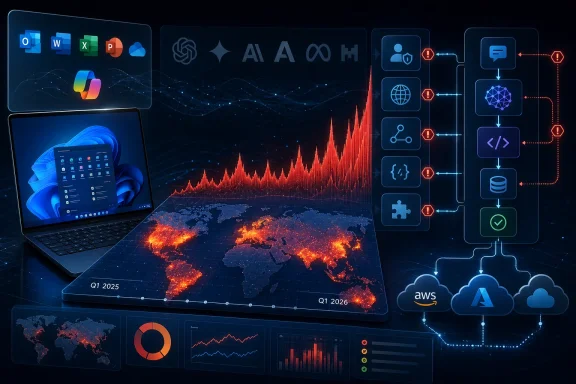 AI Has Crossed From Convenience Into Dependency
The first generation of mass-market AI failures was annoying in the way a broken search engine is annoying. A prompt timed out, a chatbot forgot context, a coding assistant spun for a minute and returned nothing useful. The user sighed, refreshed, and went back to email.That era is already ending. ChatGPT, Claude, Gemini, and Microsoft Copilot are now woven into writing pipelines, code review, business analysis, help desks, meeting workflows, spreadsheet work, and early forms of agentic automation. When one of those systems stalls, the disruption is no longer confined to a single person asking a single question.
Ookla’s framing matters because it treats these platforms as part of a larger reliability surface. The company defined a high-signal disruption day as one when a service recorded more than ten times its median daily report volume during the study period. That threshold does not prove the precise root cause of every incident, but it does identify the days when enough users experienced enough pain to turn private frustration into public signal.
The sharp rise from 6 such days in Q1 2025 to 51 in Q1 2026 suggests something more consequential than a few bad release windows. It suggests that AI systems are being stressed by the same forces that shaped cloud computing a decade ago: fast adoption, complex dependencies, uneven visibility, and a widening gap between what vendors market as seamless intelligence and what users experience as another fragile layer of infrastructure.
Downdetector Is Not a Status Page, and That Is the Point
Vendor status pages have always told only part of the outage story. They are curated, delayed, legally cautious, and often scoped to the vendor’s own definition of service health. Downdetector reports, by contrast, capture the messy public edge of failure: users who cannot log in, generate output, upload files, reach an API, invoke a connector, or tell whether the problem is their network, their tenant, their identity provider, or the platform itself.That makes the data imperfect and useful at the same time. A spike in user reports is not the same thing as a forensic incident report. It can reflect publicity, user growth, regional effects, social amplification, or confusion caused by a related cloud outage. But for enterprises, that ambiguity is not a disqualifier. It is the operational reality.
If a user cannot complete work, the failure is real from the user’s perspective. Whether the failure originated in model serving, authentication, DNS, traffic routing, an API gateway, or a third-party connector is important for remediation, but it does not change the business effect. AI services are now judged less like experimental software and more like email, identity, storage, and collaboration platforms.
The study’s choice to look at U.S. Downdetector data from January 1, 2025, through April 16, 2026, also captures a meaningful adoption window. This was the period when AI moved from “try this assistant” into “use this assistant inside the application where your work already happens.” That shift changes the economics of downtime. The more embedded the tool becomes, the less visible the dependency is until it breaks.
ChatGPT Shows the Paradox of Scale
OpenAI’s ChatGPT recorded the biggest individual spikes in Ookla’s dataset, including tens of thousands of reports on several major disruption days. That is not surprising. ChatGPT remains the most culturally visible AI service, and a large user base turns even a small failure rate into a large absolute number of reports.The more interesting detail is that the baseline trend reportedly improved. Ookla’s figures show median monthly reports falling from 2,157 in April 2025 to 1,166 in April 2026. In plain English: ChatGPT could produce spectacular outage peaks while also becoming steadier in ordinary use.
That paradox will be familiar to anyone who has managed large-scale infrastructure. Mature platforms often get better at routine reliability while becoming more exposed to rare, high-blast-radius events. The everyday floor improves; the worst days remain ugly.
For WindowsForum readers, the ChatGPT pattern should sound a warning about how to read AI reliability claims. A service can be generally stable, widely adopted, and still capable of breaking workflows at painful moments. Those truths are not contradictory. They are the normal shape of infrastructure under load.
The ChatGPT numbers also reveal why raw report counts need context. A service with hundreds of millions of weekly users will attract more complaints than a niche product even if its relative failure rate is lower. But large platforms do not get a pass because they are large. If anything, scale increases the obligation to communicate clearly, degrade gracefully, and give administrators better ways to route around trouble.
Claude’s Volatility Is the Enterprise Warning Light
Anthropic’s Claude appears as the most volatile AI platform in Ookla’s Q1 2026 breakdown, with 39 high-signal disruption days in the quarter. The reported growth is dramatic: 48,589 reports in Q3 2025, 108,694 in Q4 2025, and 314,996 in Q1 2026. March 2026 alone reportedly accounted for 192,773 reports.There are several possible readings, and the fairest one is not simply “Claude is unreliable.” Usage growth, model launches, enterprise onboarding, and workflow depth can all intensify the visibility of disruption. A service used occasionally by enthusiasts can wobble without creating much public signal; a service embedded in business processes will generate noise when even narrow components fail.
Still, volatility is volatility. If a platform has many high-signal days, organizations building around it need to treat that pattern as an architectural input. It should influence retry logic, fallback planning, vendor diversification, support expectations, and how aggressively teams automate processes that depend on a single AI provider.
Claude’s position in the data is especially relevant because Anthropic has cultivated a reputation with developers and enterprises that care about long-context work, document-heavy analysis, coding, and safety-oriented deployments. Those use cases are exactly where outages can hurt more than a casual chatbot failure. When a model is part of a legal review workflow, research pipeline, customer support process, or engineering loop, interruption becomes operational debt.
The reported April 15, 2026, peak ahead of an Opus release cycle also points to a recurring AI-era tension. Model releases drive adoption and excitement, but they also create load, routing changes, compatibility questions, and user behavior spikes. In cloud infrastructure, change windows are risk windows. AI vendors are learning the same lesson in public.
Gemini’s Slow Climb Looks Like a Platform Being Pulled Into Everything
Google Gemini’s reliability profile in the Ookla analysis looks less explosive than Claude’s and less peak-heavy than ChatGPT’s, but it still shows a meaningful rise. The service went from no high-signal disruption days in Q1 2025 to seven in Q1 2026. That is the shape of a platform becoming harder to separate from the rest of a technology ecosystem.Gemini is not just a chatbot. Google has pushed it across Android, Workspace, search-adjacent experiences, developer tools, and cloud services. That strategy makes product sense: put the assistant where the users already are. It also multiplies the number of places where failure can surface.
The largest reported Gemini spike in the study, on February 13, 2026, arrived ahead of a Gemini 3.1 Pro announcement. Whether or not the timing was causal, the pattern is familiar. Feature rollouts, model changes, and demand surges often blur together in user-facing symptoms.
For administrators, Gemini’s rise is a reminder that AI reliability will not always arrive as “Gemini is down.” It may arrive as a document feature that fails, a workspace integration that behaves inconsistently, a mobile assistant that cannot complete a request, or an API that produces intermittent errors. The brand name is singular; the failure modes are not.
Google has vast experience operating global infrastructure, and that matters. But the AI layer adds new kinds of pressure: expensive inference, model routing, context handling, safety systems, content filters, tool calls, and product integrations that cross old service boundaries. Reliability is not inherited automatically from the underlying cloud.
Copilot Makes AI Outages Feel Like Office Outages
Microsoft Copilot’s numbers are smaller in Ookla’s Q1 2026 breakdown, with three high-signal disruption days, but the enterprise implications are larger than the raw count suggests. Copilot sits where many businesses actually live: Microsoft 365, Windows, Teams, Outlook, Word, Excel, PowerPoint, Edge, GitHub, Azure, Entra ID, and the broader Microsoft identity and productivity stack.That means Copilot failures may not look like a single AI service outage. They may look like broken sign-in, missing prompts, stalled document summarization, a failing Teams meeting recap, a connector that cannot reach business data, or an assistant that works in one tenant and not another. For users, the distinction between Copilot, Microsoft 365, Azure OpenAI, Graph, Entra ID, and a network edge service is mostly invisible.
Ookla’s observation that Copilot showed strong weekend drop-offs is telling. This is a work tool, and its disruption pattern reflects business usage. Consumer AI tools may generate evening and weekend noise; Copilot’s pain is concentrated when offices are open and workflows are moving.
The report also notes co-spike events alongside OpenAI services. That is unsurprising given Microsoft’s relationship with OpenAI and the way AI capabilities can depend on shared or adjacent layers of infrastructure. But it reinforces a basic point for IT teams: Copilot is not a standalone magic button. It is an orchestration layer sitting on top of identity, data access, model capacity, compliance controls, application surfaces, and cloud routing.
That complexity is precisely why Copilot reliability matters to Windows administrators. The platform is being sold as a productivity accelerator, but any accelerator attached to core work systems becomes part of the support burden. When it fails, the help desk will hear about it before the vendor’s post-incident report arrives.
The Hyperscaler Layer Is the Outage Nobody Can Ignore
The most sobering part of the Ookla analysis is not limited to the AI vendors themselves. It is the reminder that AI services depend on hyperscaler infrastructure, and hyperscaler failures can cascade through the AI stack even when the model layer is not the root cause.The AWS incident on October 20, 2025, reportedly generated 315,342 reports and involved a DNS race condition in the DynamoDB system, with impact spreading to EC2 and load balancing. The Azure incident on October 29, 2025, reportedly generated 95,840 reports and involved a Front Door routing failure affecting global traffic routing. Those are not “AI outages” in the narrow sense, but they are very much AI reliability events if AI services depend on the affected layers.
This is where the cloud era’s old abstractions begin to crack. Enterprises like to talk about services, vendors, and platforms as separable categories. Users experience them as one failure: the thing does not work.
AI intensifies the dependency problem because inference workloads are unusually hungry. They require compute capacity, fast networking, storage, model-serving systems, orchestration, identity, logging, policy enforcement, and often retrieval from enterprise data stores. A brittle edge layer can make a healthy model unreachable. A regional capacity issue can make a premium assistant feel random. An authentication failure can masquerade as an AI failure.
The industry has spent years teaching customers to trust managed services so they do not have to care about infrastructure. AI is forcing them to care again. Not because everyone should run their own models, but because every organization now has to understand which business processes depend on whose stack, in which region, through which identity provider, with which fallback.
The Failure Surface Has More Layers Than the Status Page Admits
A modern AI request is not a straight line from user to model and back. It is a chain of decisions and dependencies. The user authenticates, the app checks entitlement, the system routes the prompt, the platform chooses a model or model variant, policy filters inspect input, context may be retrieved, tools may be invoked, output may be filtered again, logs may be written, and the answer returns through web, desktop, mobile, or API surfaces.That means a prompt can fail for reasons that have almost nothing to do with the model’s intelligence. Login loops, file upload errors, broken connectors, rate-limit misfires, workspace permissions, model-specific failures, stale client versions, DNS faults, and edge routing problems can all produce the same user complaint: the AI is down.
Ookla’s report describes this as a multilayer reliability problem spanning product, orchestration, hyperscaler, and edge layers. That framing is useful because it gets beyond the lazy binary of “up” and “down.” AI platforms can be partially alive in ways that are difficult for users and administrators to interpret.
An API can work while the web app fails. A model can respond while file upload is broken. A consumer chatbot can function while enterprise connectors fail. A free tier can be throttled while paid users remain stable, or the reverse can happen if a business service depends on a separate integration path.
For IT pros, this creates a diagnostic problem. The obvious symptom is no longer enough. “Copilot is broken” or “ChatGPT is down” must be translated into a more precise failure report: which tenant, which identity path, which application, which model, which region, which connector, which API endpoint, which user population, and which time window.
Agentic Workflows Turn Small Failures Into Broken Processes
The reliability stakes rise sharply when AI stops being a tool a human invokes and becomes a component inside a longer process. The industry calls these agentic workflows, a phrase that often carries more marketing weight than technical precision. But the underlying shift is real: AI systems are beginning to plan, call tools, retrieve data, update records, generate artifacts, and hand work from one system to another.In that world, a short disruption is not just a failed chat session. It can interrupt a workflow halfway through. A customer support agent may fail to summarize a case. A coding assistant may fail during a pull request review. A finance workflow may stall while extracting figures from documents. A security automation may fail to classify alerts or draft remediation steps.
The more steps in the chain, the more fragile the chain becomes. Each added tool call, connector, permission check, and model invocation increases the probability that something will fail. Reliability engineering has a name for this problem: compounded dependency risk. AI vendors often package it as seamless automation, but operations teams should hear the gears turning underneath.
This is where AI adoption can quietly outrun AI governance. A business unit may start with harmless summarization, then add document retrieval, then connect the assistant to customer records, then automate draft responses, then let it trigger workflow actions. By the time anyone maps the dependency, the assistant is already part of production work.
The right response is not panic or prohibition. It is design discipline. AI workflows need retry behavior, human checkpoints, durable queues, audit logs, clear failure states, and alternative paths. If an AI assistant is important enough to save hours, it is important enough to fail safely.
The Consumerization of AI Is Hiding Enterprise Risk
One reason this reliability problem feels slippery is that many AI tools entered organizations through the consumer door. Employees used public chatbots before procurement teams wrote policies. Developers adopted coding assistants before finance teams had vendor-risk templates. Executives saw impressive demos before infrastructure teams had capacity and incident models.That history matters because consumer products train users to tolerate ambiguity. If a chatbot is flaky on a Sunday night, the user refreshes. If an enterprise workflow fails at 10:15 a.m. during a customer escalation, the organization needs accountability, status, remediation, and documentation.
The mismatch is visible in the way AI vendors communicate. Many still describe incidents in broad terms: elevated errors, degraded performance, increased latency, partial outage. Those phrases are common across cloud services, but AI needs more specificity because the failure modes are more varied. Was the issue model availability, tool use, retrieval, file handling, authentication, safety filtering, API latency, capacity management, or regional routing?
Enterprises should push for clearer service-level language. Not every AI feature deserves the same reliability guarantee, but business-critical deployments need something more concrete than a green dashboard and a vague apology after the fact. If a vendor wants AI to be treated as infrastructure, it should accept infrastructure-grade scrutiny.
Microsoft, Google, OpenAI, Anthropic, AWS, and other providers are all trying to move fast in a market where capability gains still dominate the narrative. But IT history is unforgiving. Once a technology becomes essential, reliability becomes a product feature, not an operations footnote.
Windows Admins Will Inherit the Weirdest Edge Cases
For Windows administrators, AI reliability will show up in places that do not look like AI at first. A Teams meeting recap may fail because of a licensing or policy issue. A Copilot prompt in Word may work for one user and fail for another because of tenant configuration. An Edge sidebar feature may behave differently from a Microsoft 365 Copilot experience. A developer may report GitHub Copilot instability while another team complains about Azure OpenAI latency.The support surface gets stranger because AI features often bridge user identity, application permissions, cloud services, local clients, and enterprise data. Traditional troubleshooting boundaries are less useful. Desktop support, Microsoft 365 admins, Azure admins, security teams, network teams, and procurement may all own a piece of the problem without owning the whole thing.
This is also a documentation challenge. Many organizations do not yet have internal runbooks for AI incidents. They have runbooks for email, VPN, endpoint security, identity, storage, and line-of-business applications. AI often sits between those categories, which makes it easy for incidents to bounce between teams.
The smart move is to treat AI services as named dependencies in the enterprise service catalog. If a department depends on Copilot, ChatGPT Enterprise, Claude, Gemini, Azure OpenAI, or an AI feature inside a SaaS platform, that dependency should be visible. It should have an owner, an escalation path, a vendor contact, a data classification policy, and a fallback plan.
That sounds bureaucratic until the first outage lands during quarter close, an incident response event, a product launch, or a customer-support surge. Then it sounds like basic hygiene.
The Numbers Are a Reliability Signal, Not a Final Verdict
It would be easy to turn Ookla’s disruption-day count into a league table of winners and losers. That would be satisfying and probably misleading. Downdetector report volumes reflect user base, user behavior, media attention, geography, and the visibility of failure, not just engineering quality.The better reading is comparative texture. ChatGPT shows enormous peaks against an improving baseline. Claude shows intense volatility during a period of apparent growth and heavy usage. Gemini shows a steady climb as Google embeds AI more broadly. Copilot shows an enterprise usage rhythm and complex dependency pattern. AWS and Azure incidents remind everyone that the foundation can move underneath the AI layer.
Those patterns do not answer every question, but they ask the right ones. How much AI downtime can a business tolerate? Which workflows fail open, fail closed, or fail confusingly? Which vendor dependencies are concentrated in one cloud? Which teams know how to distinguish a model outage from an identity outage? Which automation should pause rather than improvise when an upstream service degrades?
The industry’s marketing language is still centered on capability. Bigger context windows, faster models, better reasoning, deeper integration, more agents. Those improvements matter. But the next phase of AI competition will also be fought on reliability, transparency, and operational trust.
Users may forgive a chatbot that occasionally stumbles. Enterprises will be less forgiving when a paid assistant embedded in daily work becomes another unpredictable dependency.
The Practical Lesson Hidden in the Outage Curve
The central lesson from Ookla’s data is that AI reliability can no longer be delegated entirely to vendors or dismissed as a temporary scaling problem. Organizations adopting AI need to treat it as a real dependency with real failure modes, even when the interface looks deceptively simple.- Organizations should inventory where AI tools are already embedded in business workflows, including unofficial use that predates procurement approval.
- Administrators should distinguish between chatbot availability, API availability, connector health, identity health, and cloud infrastructure health when triaging incidents.
- Teams building agentic workflows should add retries, queues, human approval points, and clear failure states before those workflows become business-critical.
- Enterprises should avoid concentrating critical AI processes on a single provider unless they have accepted the outage and lock-in risks explicitly.
- Vendors should provide more granular incident communication because “degraded performance” is not enough when failures can occur across models, tools, connectors, identity, and edge routing.
- Windows and Microsoft 365 administrators should treat Copilot as part of the productivity stack, not as an optional add-on that can be ignored until a user complains.
The next year will test whether AI vendors can make reliability as central to their pitch as model benchmarks, and whether enterprises can resist the temptation to automate first and ask dependency questions later. The disruption curve will eventually flatten, but it will not flatten by accident. AI is becoming infrastructure, and infrastructure earns trust not on the demo stage, but on the bad days when everything upstream is noisy and users still expect the work to get done.
References
- Primary source: fonearena.com
Published: 2026-06-10T07:54:19.155950
- Related coverage: isdown.app
Is Ookla Down? Check current status and user reports
Check if Ookla is down right now. Live Ookla status, real-time outage detection, and instant alerts when Ookla has issues. Free 14-day trial. isdown.app
- Related coverage: statusgator.com
Ookla Status. Check if Ookla is down or having an outage. | StatusGator
Ookla down? Check the current Ookla status right now, learn about outages, downtime, incidents, and issues.statusgator.com - Related coverage: pulsapi.com
Cloud Outage Report Q1 2026 | PulsAPI Data
PulsAPI analyzed 1,240 incidents across 292 cloud services in Q1 2026. Here's which services had the most outages, the longest MTTR, and the worst SLA compliance.www.pulsapi.com - Related coverage: phonearena.com
T-Mobile had the best U.S. wireless network during the first half of 2025 says new report - PhoneArena
T-Mobile dominates Ookla's Speedtest Connectivity Report for the first half of 2025.www.phonearena.com - Related coverage: islamcketta.com
Microsoft Word - McKetta - Feature Announcement - Downdetector Push - Ookla
PDF documentislamcketta.com