

X, formerly Twitter, suffered a widespread outage on Monday, June 22, 2026, with user reports surging just before 10 a.m. ET and peaking above 26,000 before the service largely recovered around 10:15 a.m. ET. The failure was brief, but it arrived with the familiar modern pattern: timelines went blank, some accounts were logged out, and third-party outage dashboards became the de facto public status page. For Windows users and IT teams, the interesting part is not that a social network hiccuped. It is that the public internet’s unofficial alarm system once again moved faster than the platforms people rely on.
The Monday morning disruption appears to have been short-lived, but it was not subtle. Downdetector registered tens of thousands of complaints starting just before 10 a.m. Eastern, and users described the same symptoms that tend to define large consumer-platform failures: the shell of the app loaded, but the content did not. The navigation was there, the logo was there, and the feed was not.
That distinction matters. A completely unreachable site suggests one kind of incident; a site that renders its interface but fails to populate timelines suggests another. To the user, both feel like “X is down.” To engineers and administrators, the second pattern points toward a partial service failure somewhere behind the front door: APIs, content delivery paths, authentication, database lookups, rate limiting, or some dependency that feeds the timeline rather than the homepage itself.
By about 10:10 a.m. ET, some users reportedly could still reach direct links to individual X accounts while the main timeline remained empty. That is the sort of failure mode that makes outages feel uneven and therefore more confusing. If a profile opens but the feed does not, the user is left wondering whether the problem is account-specific, device-specific, or global.
The outage was reportedly mostly resolved by around 10:15 a.m. ET, which makes it a relatively brief disruption in operational terms. But a fifteen-minute failure at the wrong point in the morning can still be very visible. X is not just a social network for jokes, arguments, and doomscrolling; it is also where newsrooms monitor breaking stories, companies post support updates, public agencies broadcast alerts, and users check whether everything else is broken.
That role is diminished from Twitter’s peak, but it has not disappeared. Even after brand changes, ownership turmoil, policy shifts, API restrictions, and an increasingly fragmented social web, X still acts as a rapid-response layer for internet culture and service monitoring. Users complain there first, companies often acknowledge incidents there first, and journalists still scan it for the first smoke from a technical fire.
That makes outages on X disproportionately visible. A failed shopping app inconveniences its customers. A failed social network that also functions as a public bulletin board interrupts the conversation about the failure itself. When X stumbles, the internet loses one of its loudest outage sirens.
The Monday event also showed how quickly users now triangulate service health across multiple channels. Downdetector, Reddit, competing social networks, direct website checks, mobile apps, and group chats all become part of the informal incident-response mesh. This is not a clean system, but it is often faster than waiting for official communications.
Modern social platforms are not single websites in the old sense. They are bundles of services: authentication, media processing, notification delivery, ranking systems, recommendation engines, ad serving, abuse detection, direct messaging, search, profile rendering, and timeline generation. The app on your phone is only the front end of a larger machine.
That is why partial outages are now the norm. A user may be logged out because an authentication component is failing, while another user may stay logged in but see an empty feed because timeline generation is degraded. A third user may open a direct profile link because profile pages are served differently from the ranked home timeline.
This is also why outage reports can vary dramatically by app, browser, and geography. Mobile clients may cache differently from desktop browsers. Logged-in sessions may behave differently from logged-out requests. Content delivery networks may route traffic differently by region. A platform can be both “up” and effectively unusable, depending on which path a user takes through it.
Downdetector is not a magic window into a company’s infrastructure. It does not know exactly what broke inside X unless X says so. It measures user reports, which means it can detect perception faster than root cause. That is both its limitation and its power.
For users, perception is often the only thing that matters in the moment. If enough people say the app is broken at the same time, the signal becomes useful even before an official incident report exists. For IT pros, that makes Downdetector a good early-warning tool, but not a source of final truth.
The risk is that these dashboards can also create noisy correlation. If users report X, Reddit, Zoom, Microsoft Teams, Fortnite, and other services at similar times, it may indicate a shared infrastructure issue, a regional connectivity problem, a DNS or cloud provider failure, or simply a broad wave of users checking multiple services after noticing one disruption. The dashboard tells us where people are feeling pain. It does not automatically tell us where the fire started.
When multiple unrelated services appear troubled at once, the smart move is not to assume every vendor independently broke at the same minute. The smart move is to ask what they share. That could be a cloud region, a content delivery network, DNS resolution, identity infrastructure, peering routes, or simply the same group of users on the same ISP having trouble reaching the broader internet.
For enterprise IT, this is where consumer outages become operationally relevant. A Teams problem is a work problem. A Zoom problem is a meeting problem. A Reddit or X problem may be a communications and monitoring problem, especially for teams that follow vendor status updates or security researchers through social platforms.
The consumer web and the enterprise web are no longer cleanly separated. The same laptop that runs Outlook, Teams, Intune portals, Azure dashboards, GitHub, Slack, browser-based admin consoles, and X is using the same local network, DNS settings, endpoint security stack, browser profile, VPN tunnel, and identity broker. When users say “the internet is broken,” the help desk has to determine whether that means a SaaS outage, a local proxy issue, a captive portal, a DNS failure, or a bad morning for one overloaded platform.
That is why the reported desktop behavior matters. If the X website loads its interface but fails to populate content, users may try the usual ritual: refresh the page, clear cache, switch browsers, disable extensions, restart the PC, reboot the router. Some of those steps can help with local problems, but they are wasted motion during a platform-side incident.
The more useful diagnostic path is comparative. Does the same account fail on mobile data? Does a direct profile link load when the home feed does not? Are other users on different networks seeing the same thing? Are outage dashboards spiking at the same time? Has the vendor posted anything through a status page or alternate account?
For administrators, the answer is to preserve discipline. Do not start changing DNS, firewall, proxy, or conditional access policies because a consumer service is failing for a few minutes. Establish whether the pattern is local, regional, or global before touching production configuration. The fastest way to turn someone else’s outage into your own outage is to “fix” what was never broken in your environment.
A short outage may never receive a meaningful public postmortem. Companies often reserve detailed incident reports for enterprise customers, regulated services, or failures that trigger contractual obligations. Social platforms tend to treat brief interruptions as weather: inconvenient, observable, and then gone.
But X occupies a strange space. It is privately operated, culturally public, politically charged, and operationally central to many news and support workflows. When it fails, the public impact can exceed the narrow definition of a consumer app outage. That does not mean every fifteen-minute disruption deserves a forensic novel, but a basic acknowledgement would reduce speculation.
The lack of explanation also leaves room for bad theories. Users may blame cyberattacks, censorship, elections, app updates, cloud failures, or their own devices. In the absence of a statement, correlation fills the gap. That is especially dangerous on a platform where speculation is the native format.
The broader internet has normalized intermittent degradation. Services do not simply go down and come back up; they stutter. Feeds stop loading. Login tokens expire unexpectedly. Notifications lag. Media fails while text survives. Desktop breaks while mobile works. A small failure in one internal service can look like a total outage to a user whose workflow depends on that one path.
This is the cloud era’s uncomfortable bargain. Hyperscale platforms can serve enormous audiences with astonishing speed, but they also concentrate complexity behind interfaces that look deceptively simple. When something fails, users see a blank feed. Engineers see a dependency graph.
For WindowsForum readers, the lesson is not to overreact to every consumer outage. It is to build better instincts. The modern Windows desktop is a cockpit for cloud services, and the user’s first report is often imprecise but valuable. “X is down” may mean X is down. It may also be the first hint of a wider network or SaaS problem.
The reported start just before 10 a.m. ET also placed it in a period when U.S. business traffic is fully awake. East Coast workers are online, Central time is ramping, and West Coast users are beginning the day. For a platform like X, that is not a quiet maintenance window. It is prime time for attention.
The reported recovery around 10:15 a.m. ET means many users may have experienced the failure as a short burst of weirdness rather than a prolonged outage. But outage perception is not linear. A service used casually can be unavailable for an hour without much notice; a service used for breaking news can be unavailable for five minutes and become the story.
That is especially true when the failure mode logs people out. Being unable to refresh a feed is one kind of irritation. Being unexpectedly signed out triggers a different response, because users wonder whether their account, credentials, or session security is involved. Even when the cause is mundane, the emotional signal is stronger.
Meanwhile, users have built their own instrumentation. They check Downdetector. They search Reddit. They ask group chats. They test mobile versus Wi-Fi. They open the same service in another browser. They look for liveblogs from tech outlets. They compare notes with coworkers.
This is messy, but it is also rational. The internet has become too critical, too centralized, and too opaque for users to wait politely for official confirmation. If a service is broken, the crowd often knows first.
The problem is that crowd telemetry comes without root cause. It can tell us that people in several places are hurting at once. It cannot reliably distinguish between a platform outage, an ISP issue, a DNS provider failure, a regional cloud incident, or a coincidence amplified by attention. That is where journalism, vendor communication, and IT analysis still matter.
Instead, the right playbook is confirmation, containment, and communication. Confirm whether the problem is widespread. Contain internal noise by telling users what is known and what is not. Communicate that no local action is required unless evidence points to an internal cause.
For managed Windows environments, that means the service desk should have a lightweight outage triage habit. Check multiple networks, multiple devices, and multiple accounts. Compare with public reports. Look at vendor admin centers for enterprise services. Avoid making platform changes until the evidence supports them.
Consumer outages can still matter to enterprise IT because they shape user behavior. A user who cannot access X may open suspicious “status” links, search for unofficial APKs, disable security tools, or assume the company network is blocking the site. Clear internal messaging can prevent a nuisance from becoming a security problem.
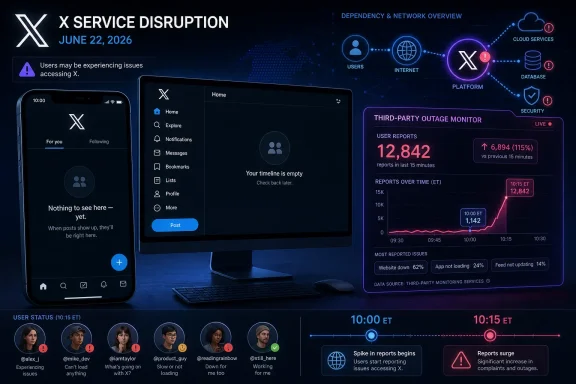 X Went Dark, but the Dashboard Lit Up First
The Monday morning disruption appears to have been short-lived, but it was not subtle. Downdetector registered tens of thousands of complaints starting just before 10 a.m. Eastern, and users described the same symptoms that tend to define large consumer-platform failures: the shell of the app loaded, but the content did not. The navigation was there, the logo was there, and the feed was not.That distinction matters. A completely unreachable site suggests one kind of incident; a site that renders its interface but fails to populate timelines suggests another. To the user, both feel like “X is down.” To engineers and administrators, the second pattern points toward a partial service failure somewhere behind the front door: APIs, content delivery paths, authentication, database lookups, rate limiting, or some dependency that feeds the timeline rather than the homepage itself.
By about 10:10 a.m. ET, some users reportedly could still reach direct links to individual X accounts while the main timeline remained empty. That is the sort of failure mode that makes outages feel uneven and therefore more confusing. If a profile opens but the feed does not, the user is left wondering whether the problem is account-specific, device-specific, or global.
The outage was reportedly mostly resolved by around 10:15 a.m. ET, which makes it a relatively brief disruption in operational terms. But a fifteen-minute failure at the wrong point in the morning can still be very visible. X is not just a social network for jokes, arguments, and doomscrolling; it is also where newsrooms monitor breaking stories, companies post support updates, public agencies broadcast alerts, and users check whether everything else is broken.
The Former Twitter Is Still Part of the Internet’s Nervous System
The irony of an X outage is that X remains one of the first places many people go to confirm outages elsewhere. When the site itself fails, users lose not only a platform but also a diagnostic habit. The question “is it just me?” becomes harder to answer when the place people use to ask that question is also having trouble.That role is diminished from Twitter’s peak, but it has not disappeared. Even after brand changes, ownership turmoil, policy shifts, API restrictions, and an increasingly fragmented social web, X still acts as a rapid-response layer for internet culture and service monitoring. Users complain there first, companies often acknowledge incidents there first, and journalists still scan it for the first smoke from a technical fire.
That makes outages on X disproportionately visible. A failed shopping app inconveniences its customers. A failed social network that also functions as a public bulletin board interrupts the conversation about the failure itself. When X stumbles, the internet loses one of its loudest outage sirens.
The Monday event also showed how quickly users now triangulate service health across multiple channels. Downdetector, Reddit, competing social networks, direct website checks, mobile apps, and group chats all become part of the informal incident-response mesh. This is not a clean system, but it is often faster than waiting for official communications.
A Blank Timeline Is a Different Failure Than a Dead Website
For everyday users, the practical symptom was simple: X did not work. For anyone who has spent time around service reliability, the reported behavior is more revealing. A site that loads its chrome but not its content is telling users that some layers of the system are alive while others are impaired.Modern social platforms are not single websites in the old sense. They are bundles of services: authentication, media processing, notification delivery, ranking systems, recommendation engines, ad serving, abuse detection, direct messaging, search, profile rendering, and timeline generation. The app on your phone is only the front end of a larger machine.
That is why partial outages are now the norm. A user may be logged out because an authentication component is failing, while another user may stay logged in but see an empty feed because timeline generation is degraded. A third user may open a direct profile link because profile pages are served differently from the ranked home timeline.
This is also why outage reports can vary dramatically by app, browser, and geography. Mobile clients may cache differently from desktop browsers. Logged-in sessions may behave differently from logged-out requests. Content delivery networks may route traffic differently by region. A platform can be both “up” and effectively unusable, depending on which path a user takes through it.
Downdetector Has Become the Unofficial Status Page of the Consumer Internet
The Monday outage again put Downdetector in its now-familiar role as the first public scoreboard. According to the reports summarized by multiple outlets, the service saw complaints surge just before 10 a.m. ET, with more than 22,000 and later more than 26,000 user reports tied to X. Roughly half of the complaints reportedly involved the app, while a smaller share cited the desktop website and feed or timeline problems.Downdetector is not a magic window into a company’s infrastructure. It does not know exactly what broke inside X unless X says so. It measures user reports, which means it can detect perception faster than root cause. That is both its limitation and its power.
For users, perception is often the only thing that matters in the moment. If enough people say the app is broken at the same time, the signal becomes useful even before an official incident report exists. For IT pros, that makes Downdetector a good early-warning tool, but not a source of final truth.
The risk is that these dashboards can also create noisy correlation. If users report X, Reddit, Zoom, Microsoft Teams, Fortnite, and other services at similar times, it may indicate a shared infrastructure issue, a regional connectivity problem, a DNS or cloud provider failure, or simply a broad wave of users checking multiple services after noticing one disruption. The dashboard tells us where people are feeling pain. It does not automatically tell us where the fire started.
The Multi-Service Noise Is the Story IT Should Watch
One detail in the Monday reports should catch the eye of administrators: complaints were not limited to X. Downdetector also reportedly showed issues for services including Reddit, Zoom, Microsoft Teams, Fortnite, and others. That does not prove a shared cause, and no explanation had been provided at the time of the initial reporting. But it does put the event into a larger pattern of internet dependency.When multiple unrelated services appear troubled at once, the smart move is not to assume every vendor independently broke at the same minute. The smart move is to ask what they share. That could be a cloud region, a content delivery network, DNS resolution, identity infrastructure, peering routes, or simply the same group of users on the same ISP having trouble reaching the broader internet.
For enterprise IT, this is where consumer outages become operationally relevant. A Teams problem is a work problem. A Zoom problem is a meeting problem. A Reddit or X problem may be a communications and monitoring problem, especially for teams that follow vendor status updates or security researchers through social platforms.
The consumer web and the enterprise web are no longer cleanly separated. The same laptop that runs Outlook, Teams, Intune portals, Azure dashboards, GitHub, Slack, browser-based admin consoles, and X is using the same local network, DNS settings, endpoint security stack, browser profile, VPN tunnel, and identity broker. When users say “the internet is broken,” the help desk has to determine whether that means a SaaS outage, a local proxy issue, a captive portal, a DNS failure, or a bad morning for one overloaded platform.
Windows Users See the Outage Through the Browser First
Windows users are often the first to experience these incidents through a messy stack of browsers, extensions, security products, and corporate controls. An X outage on a personal phone is annoying. An X outage on a managed Windows device may be indistinguishable at first from a browser policy, DNS filter, endpoint agent, or blocked script.That is why the reported desktop behavior matters. If the X website loads its interface but fails to populate content, users may try the usual ritual: refresh the page, clear cache, switch browsers, disable extensions, restart the PC, reboot the router. Some of those steps can help with local problems, but they are wasted motion during a platform-side incident.
The more useful diagnostic path is comparative. Does the same account fail on mobile data? Does a direct profile link load when the home feed does not? Are other users on different networks seeing the same thing? Are outage dashboards spiking at the same time? Has the vendor posted anything through a status page or alternate account?
For administrators, the answer is to preserve discipline. Do not start changing DNS, firewall, proxy, or conditional access policies because a consumer service is failing for a few minutes. Establish whether the pattern is local, regional, or global before touching production configuration. The fastest way to turn someone else’s outage into your own outage is to “fix” what was never broken in your environment.
X’s Silence Leaves Users Reading the Smoke
At the time of the initial reports, no explanation had been provided for the X outage. That absence is not unusual for short consumer-platform disruptions, but it is increasingly unsatisfying. Users have been trained to expect real-time systems, but not real-time accountability.A short outage may never receive a meaningful public postmortem. Companies often reserve detailed incident reports for enterprise customers, regulated services, or failures that trigger contractual obligations. Social platforms tend to treat brief interruptions as weather: inconvenient, observable, and then gone.
But X occupies a strange space. It is privately operated, culturally public, politically charged, and operationally central to many news and support workflows. When it fails, the public impact can exceed the narrow definition of a consumer app outage. That does not mean every fifteen-minute disruption deserves a forensic novel, but a basic acknowledgement would reduce speculation.
The lack of explanation also leaves room for bad theories. Users may blame cyberattacks, censorship, elections, app updates, cloud failures, or their own devices. In the absence of a statement, correlation fills the gap. That is especially dangerous on a platform where speculation is the native format.
The Outage Was Short, but the Pattern Is Long
The June 22 incident was not the only major X disruption reported in 2026. Earlier outages this year drew tens of thousands of user reports, including a January incident that reportedly peaked far higher and a February disruption that also produced large spikes. Not every outage has the same cause, and it would be careless to stitch them into a single technical narrative without evidence. Still, the repetition reinforces a practical point: large social platforms can and do fail visibly, even when their brands imply permanence.The broader internet has normalized intermittent degradation. Services do not simply go down and come back up; they stutter. Feeds stop loading. Login tokens expire unexpectedly. Notifications lag. Media fails while text survives. Desktop breaks while mobile works. A small failure in one internal service can look like a total outage to a user whose workflow depends on that one path.
This is the cloud era’s uncomfortable bargain. Hyperscale platforms can serve enormous audiences with astonishing speed, but they also concentrate complexity behind interfaces that look deceptively simple. When something fails, users see a blank feed. Engineers see a dependency graph.
For WindowsForum readers, the lesson is not to overreact to every consumer outage. It is to build better instincts. The modern Windows desktop is a cockpit for cloud services, and the user’s first report is often imprecise but valuable. “X is down” may mean X is down. It may also be the first hint of a wider network or SaaS problem.
The Calendar Matters More Than the Clock
The timing of the incident made it more visible than its duration alone would suggest. A Monday morning outage hits when office workers are starting the week, newsrooms are scanning the day’s agenda, and IT teams are already sorting through weekend residue. Even a brief disruption can feel larger because it lands during a high-attention window.The reported start just before 10 a.m. ET also placed it in a period when U.S. business traffic is fully awake. East Coast workers are online, Central time is ramping, and West Coast users are beginning the day. For a platform like X, that is not a quiet maintenance window. It is prime time for attention.
The reported recovery around 10:15 a.m. ET means many users may have experienced the failure as a short burst of weirdness rather than a prolonged outage. But outage perception is not linear. A service used casually can be unavailable for an hour without much notice; a service used for breaking news can be unavailable for five minutes and become the story.
That is especially true when the failure mode logs people out. Being unable to refresh a feed is one kind of irritation. Being unexpectedly signed out triggers a different response, because users wonder whether their account, credentials, or session security is involved. Even when the cause is mundane, the emotional signal is stronger.
Outage Culture Has Outgrown Official Status Pages
Official status pages remain important, but they are increasingly only one part of the story. Many companies do not update them quickly for consumer services. Some status pages are scoped narrowly to paid enterprise products. Others lag behind the user-visible failure because the internal monitoring threshold has not yet crossed into a declared incident.Meanwhile, users have built their own instrumentation. They check Downdetector. They search Reddit. They ask group chats. They test mobile versus Wi-Fi. They open the same service in another browser. They look for liveblogs from tech outlets. They compare notes with coworkers.
This is messy, but it is also rational. The internet has become too critical, too centralized, and too opaque for users to wait politely for official confirmation. If a service is broken, the crowd often knows first.
The problem is that crowd telemetry comes without root cause. It can tell us that people in several places are hurting at once. It cannot reliably distinguish between a platform outage, an ISP issue, a DNS provider failure, a regional cloud incident, or a coincidence amplified by attention. That is where journalism, vendor communication, and IT analysis still matter.
The Practical Lesson Is Boring, Which Is Why It Works
The best response to a short outage is rarely dramatic. Users should avoid repeated password resets, unnecessary app reinstalls, or frantic system changes when reports indicate a broader service problem. Administrators should resist the urge to chase every spike unless it intersects with business-critical tools or local infrastructure.Instead, the right playbook is confirmation, containment, and communication. Confirm whether the problem is widespread. Contain internal noise by telling users what is known and what is not. Communicate that no local action is required unless evidence points to an internal cause.
For managed Windows environments, that means the service desk should have a lightweight outage triage habit. Check multiple networks, multiple devices, and multiple accounts. Compare with public reports. Look at vendor admin centers for enterprise services. Avoid making platform changes until the evidence supports them.
Consumer outages can still matter to enterprise IT because they shape user behavior. A user who cannot access X may open suspicious “status” links, search for unofficial APKs, disable security tools, or assume the company network is blocking the site. Clear internal messaging can prevent a nuisance from becoming a security problem.
The June 22 X Failure Leaves a Few Useful Signals
The outage’s brevity should not make it disappear from the operational memory. Short incidents are often the ones that reveal whether users and IT teams have good instincts. Monday’s disruption produced several concrete lessons without requiring a grand theory about what broke inside X.- The X outage began just before 10 a.m. ET on Monday, June 22, 2026, and reports indicated the service was largely back by about 10:15 a.m. ET.
- Downdetector reports climbed into the tens of thousands, with users describing blank timelines, app failures, desktop problems, and some unexpected logouts.
- Direct links to some X accounts reportedly continued working while the main feed failed, suggesting a partial service degradation rather than a simple all-or-nothing website failure.
- Reports of issues with other services at around the same time should be treated as a signal to investigate shared dependencies, not as proof of a single confirmed cause.
- Windows users and administrators should verify whether an outage is local or platform-wide before changing browser, DNS, VPN, firewall, or endpoint security settings.
- X had not provided an explanation in the early reporting, leaving users and IT teams dependent on public outage telemetry and observed behavior.
References
- Primary source: Daytona Beach News-Journal
Published: 2026-06-22T15:42:07.877109
X users report social media site outage. Is Twitter down?
X users reported not being able to get into the site Minday morning. What's the status now?www.news-journalonline.com - Related coverage: tomsguide.com
Spotify was down — what happened during the short outage | Tom's Guide
Users reported issues with the popular music streaming platformwww.tomsguide.com - Related coverage: techradar.com
DoorDash was down for many — here's what happened in the major outage | TechRadar
DoorDash crashed today, but is now back onlinewww.techradar.com - Related coverage: phonearena.com
X is still down from coast-to-coast in the U.S. - PhoneArena
An outage is preventing X users in the U.S. from accessing the app and website.www.phonearena.com - Related coverage: nbcbayarea.com
- Related coverage: outage.report

X (former Twitter) down? Outage map, service status, incidents history
See if X (former Twitter) is down or it's just you. Check current status and outage map. Post yours and see other's reports and complaints
outage.report
- Related coverage: downdetector.jp
Twitter down? Realtime overview of Twitter status, issues and outages - JP
Real-time overview of problems with Twitter. Can't log in or send tweets? We'll tell you what is going on.downdetector.jp - Related coverage: androidcentral.com
X faces major outage as 78K users report disruption this morning | Android Central
People are seeing issues with the app and website, with feeds not refreshing.www.androidcentral.com - Related coverage: datacenterdynamics.com
X suffers outage with site down for thousands globally - DCD
The cause of the outage is not yet clearwww.datacenterdynamics.com - Related coverage: foxbusiness.com
X hit by widespread outage, thousands report issues | Fox Business
Thousands of users reported problems accessing X early Monday, with DownDetector logging more than 41,000 complaints at the peak of the disruption.www.foxbusiness.com
