X, Teams, Zoom and More Outage Linked to Cloudflare Degradation on June 22, 2026

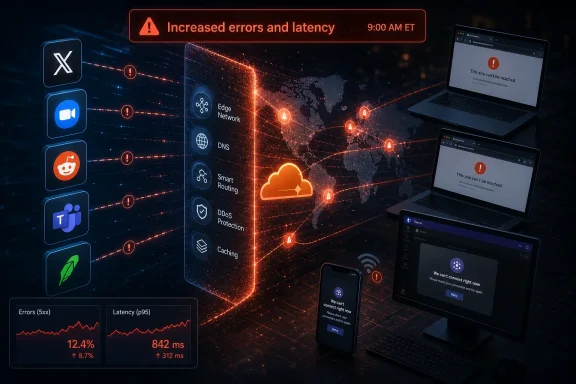
More than 35,000 users reported problems reaching X on Monday morning, June 22, 2026, as outage reports also spiked for Microsoft Teams, Reddit, Zoom, Robinhood and Canva during a broader disruption linked in timing to Cloudflare service degradation. The incident was brief in the way modern outages often are brief: long enough to break workflows, short enough to be dismissed as “the internet being the internet.” But the pattern matters more than the stopwatch. When a social network, a collaboration suite, a trading app, a design tool and community sites wobble together, the story is not one company going down; it is the uncomfortable concentration of everyday computing behind a small number of invisible infrastructure gates.

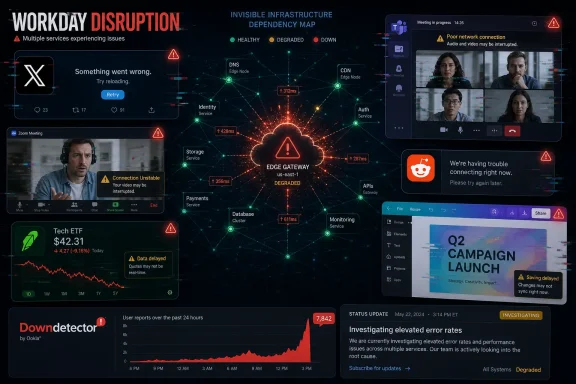
Dashboard shows “Workday Disruption” with degraded services, warnings, and video calls during a network outage.The Internet Did Not Go Down, But the Workday Did​

The first wave of user reports arrived with the kind of suddenness that makes IT teams distrust their own dashboards. Downdetector showed X reports jumping from hundreds to tens of thousands in roughly 15 minutes on Monday morning, while other services posted smaller but still noticeable spikes. Forbes reported that X went from 584 user reports around 9:45 a.m. ET to 35,659 by 10 a.m., a rise sharp enough to suggest something more systemic than an app bug or a botched client rollout.
X drew the biggest number because X is where people notice outages, complain about outages, and then discover the outage has swallowed the place where they would normally complain. The usual reflex sent users to Threads and other services, where the jokes wrote themselves. Yet the surrounding reports from Reddit, Zoom, Robinhood, Canva and Microsoft Teams made the morning feel less like a single-platform failure and more like a distributed stress test of the dependency graph most users never see.
For WindowsForum readers, Microsoft Teams is the tell. A few thousand failed posts to a social network may be annoying; a collaboration platform stumbling in the middle of the U.S. business morning is operationally meaningful. Teams sits inside the Microsoft 365 workday, glued to calendars, meetings, chats, files and identity. If Teams is affected alongside consumer platforms, admins have to assume the incident is not just “someone else’s website” until proven otherwise.

Cloudflare Became the Suspect Because It Sits in the Blast Radius​

Cloudflare reported increased error rates and latency across multiple services on Monday, but early public reporting did not establish that Cloudflare caused every service’s user-visible outage. That distinction matters. Cloudflare is so deeply embedded in modern web delivery, security, DNS, bot mitigation and edge compute that its status page can become the internet’s weather report, but correlation is not a root-cause analysis.
The temptation after a multi-site outage is to find the one glowing red box and call it the villain. In practice, large incidents often pass through several layers at once: a CDN hiccup, a third-party API dependency, regional congestion, stale DNS assumptions, overloaded fallbacks, and client apps that turn transient failures into hard errors. Cloudflare may have been a common point of pain, but the public evidence available Monday morning supported a narrower statement: its degradation coincided with a wave of reports across major services.
That narrower statement is still significant. The modern web has traded obvious single points of failure for abstracted ones. Instead of one company’s server room catching fire, we get failures in shared acceleration, security and routing layers that make many companies look broken at the same time. The result is a strange kind of decentralization theater: the brands are different, the apps are different, the underlying chokepoints are fewer than users imagine.

X Was the Loudest Failure Because X Is Built to Amplify Failure​

X’s outage reports dominated the morning, and that should surprise nobody. The platform formerly known as Twitter remains a public square, a customer support channel, a breaking-news wire and a chaos amplifier, even after years of ownership drama and user migration. When it breaks, people notice immediately because it is often the place they use to decide whether everything else is broken too.
Forbes reported that about half of the user-reported X problems involved the mobile app, with feed and timeline issues accounting for another large share and desktop site problems trailing behind. That distribution is useful because it suggests the pain was not limited to one browser path or one desktop web experience. Mobile failures also feel more total to ordinary users: if the app opens into a dead timeline, the service might as well not exist.
But X’s prominence can distort the incident. Outage trackers are not telemetry from the affected companies; they are public complaint meters. A service with a highly vocal user base and a habit of real-time commentary will look worse than an equally broken enterprise tool whose users file internal tickets instead of public reports. X may have been the biggest visible plume, but the smoke was coming from more than one building.

Teams Turns a Consumer Outage Into an IT Problem​

Microsoft Teams appearing in the same cluster changes the audience for the incident. X can be shrugged off by executives until the social team starts pacing. Teams cannot, because it is wired into meetings, sales calls, incident channels and help-desk escalation paths. When Teams blips during business hours, the outage becomes a productivity event even if the underlying cause is outside Microsoft’s own cloud.
This is where the Microsoft 365 era has complicated the old service-status playbook. An admin may see users unable to join meetings, open chats or collaborate, while Microsoft’s own core services are not necessarily experiencing a full platform outage. The failure could sit between the user and the service, in an identity path, in a network provider, in a regional dependency, or in a third-party security layer used by something the workflow touches.
That ambiguity is brutal during the first hour. Users ask whether “Teams is down,” managers ask whether meetings should be moved, and IT has to distinguish a local network issue from a global SaaS incident with incomplete evidence. In the old model, administrators owned enough of the stack to troubleshoot from cable to server. In the SaaS model, they own the user experience but not the failure domain.

Downdetector Is a Smoke Alarm, Not a Fire Report​

Downdetector’s numbers are valuable because they capture the lived experience of users quickly. They are also easy to overread. A spike from hundreds to tens of thousands of reports says people are having trouble, but it does not say exactly which component failed, how many users were affected globally, or whether two services with simultaneous spikes share the same root cause.
This matters because outage narratives harden fast. Within minutes, a degraded infrastructure provider becomes “the reason everything is down,” a Teams report becomes “Microsoft 365 outage,” and a mobile app failure becomes “the website is dead.” Those labels may turn out to be directionally correct, but they can mislead troubleshooting while the incident is active.
The correct use of public outage trackers is comparative and temporal. If X spikes at the same time as Reddit, Canva and Teams, and a major infrastructure provider reports latency and errors, that is actionable context. It tells admins to widen their lens beyond endpoint troubleshooting. It does not excuse vendors from publishing post-incident detail, and it does not replace first-party telemetry.

The Cloud Has Made Failure More Efficient​

The uncomfortable truth is that today’s internet is resilient in aggregate and fragile in clusters. Cloudflare, Microsoft, Amazon, Google, Akamai, Fastly and a handful of other providers have made the web faster, safer and more survivable than the server-under-a-desk era ever was. They absorb attacks, route around regional problems, terminate TLS at planetary scale and make small teams look globally competent.
They also make failure more efficient. A misconfiguration, routing issue or overloaded shared service can propagate user-visible pain across companies that appear unrelated from the outside. The same machinery that lets a startup serve millions without building a global network can also make that startup dependent on a vendor whose outage calendar is now part of its own uptime story.
This is not an argument against Cloudflare or any other infrastructure provider. The alternative is not a charmingly independent internet of hand-built servers and perfect autonomy. The alternative is usually worse security, worse latency, less DDoS protection, and smaller organizations being priced out of reliability. The point is that concentration should be treated as an architectural risk, not a moral failing discovered only after a bad morning.

The Status Page Has Become Part of the Product​

One lesson from repeated internet-wide incidents is that status communication is now a core product feature. Users no longer accept a vague “we are investigating” as sufficient when the same outage interrupts work, communication and commerce across multiple services. Admins need timestamps, affected regions, impacted components and mitigation guidance, not brand-safe fog.
Cloudflare’s public status language on Monday, as reported, described increased error rates and latency in multiple services. That is a useful start, but the downstream reality for customers is messier. A web app might throw 500 errors, a mobile feed might fail silently, a meeting app might hang, and a login path might intermittently work. The infrastructure provider sees metrics; the user sees betrayal.
Microsoft and other SaaS vendors face the same challenge from the opposite direction. If their service depends on or is affected by an external provider, they still have to communicate with customers who pay them, not the dependency chain. “A third-party provider is degraded” may be accurate, but it rarely satisfies an enterprise customer whose board meeting just moved to a phone bridge.

Redundancy Is Easy to Say and Expensive to Mean​

Every major outage produces the same advice: build redundancy, avoid single points of failure, prepare alternatives. The advice is correct and often useless without budget, architectural discipline and a tolerance for complexity. True multi-provider resilience is not a checkbox; it is an operating model.
For a public website, multi-CDN delivery can reduce dependence on one edge network, but it requires careful DNS strategy, cache behavior alignment, certificate management, observability and testing. For collaboration tools, there is no simple “multi-Teams” architecture. An organization can maintain fallback meeting platforms, alternate chat channels and emergency communications, but it cannot casually duplicate the Microsoft 365 collaboration fabric without creating governance and security problems of its own.
The most realistic resilience work is often procedural rather than architectural. Companies need a clear fallback for meetings, a known place for outage updates, an out-of-band channel for incident response, and a decision rule for when to stop waiting and switch tools. That may not sound as elegant as active-active global failover, but it is the difference between a 20-minute outage and a 20-minute outage plus an hour of organizational confusion.

Windows Admins Live at the Edge of Someone Else’s Cloud​

For Windows administrators, Monday’s outage cluster is another reminder that endpoint management and cloud dependency are now inseparable. A user on Windows 11 may report that Teams is broken, Edge cannot load a site, a web app fails through SSO, and a line-of-business portal returns errors. The root cause may have nothing to do with Windows, but the ticket still lands with the Windows team.
That makes local diagnostics both more and less useful. Checking DNS resolution, proxy behavior, endpoint security logs and network path health still matters. So does comparing reports across ISPs, regions, browsers and mobile clients. But admins also need to know when to stop burning time on the endpoint and start correlating with external incidents.
The best help desks have quietly adapted to this reality. They maintain internal outage channels, bookmark vendor status pages, monitor public report spikes, and write user-facing templates that acknowledge uncertainty without overpromising. The worst help desks still ask users to reboot while half the internet is returning errors.

The User Experience Is Now a Supply Chain​

Security teams already talk about software supply chains, but availability has a supply chain too. The app a user opens may depend on identity providers, DNS resolvers, CDNs, bot filters, payment APIs, observability platforms, feature-flag systems and cloud regions. Any one of those can become the weak link that makes the brand on the icon look incompetent.
The Monday outage reports cut across categories: social media, community discussion, video meetings, finance, design and workplace chat. That spread is precisely why these incidents feel surreal. Users do not think of Reddit and Microsoft Teams as neighbors. They become neighbors only when a shared infrastructure layer, transit path or timing pattern makes them fail together.
This is the part of cloud computing that marketing rarely lingers on. The cloud is not a place; it is a mesh of dependencies with contracts, assumptions and failure modes. Its resilience comes from engineering those dependencies well. Its fragility appears when users discover that “different apps” does not necessarily mean “different risks.”

The Market Rewards Centralization Until the Morning It Punishes It​

There is a reason so many companies rely on the same providers. Large infrastructure platforms offer global reach, sophisticated security and operational maturity that most customers could not reproduce. They also integrate neatly with procurement, compliance and developer workflows. Centralization wins because it is rational.
Then an outage arrives and reveals the hidden premium. The cost of concentration is not paid every day; it is paid in sudden synchronized inconvenience. Most businesses accept that trade because the alternative costs more upfront and fails in less predictable ways. But accepting the trade should not mean pretending it does not exist.
Boards and executives increasingly understand cyber risk as a business risk. Availability concentration deserves the same treatment. If a company cannot operate when a collaboration suite, CDN or identity provider is degraded, that is not merely an IT detail. It is an operational dependency that belongs in risk registers, tabletop exercises and vendor reviews.

The Monday Morning Lesson Is Smaller Than Panic and Larger Than Shrugging​

The practical lesson from this outage is not that everyone should abandon X, Teams, Cloudflare or SaaS. It is that organizations should treat public-cloud and edge-service incidents as routine operational scenarios rather than exotic events. The right posture sits between panic and complacency.
A short disruption can still expose whether a company knows how to communicate internally, whether its help desk can recognize a widespread incident, and whether its fallback channels work. It can also reveal which teams depend on consumer platforms for official communications, which workflows have no offline mode, and which vendors provide useful incident detail under pressure.
For home users, the lesson is simpler but still relevant. If multiple unrelated apps fail at once, the problem may not be your PC, your router or your phone. Restarting everything is sometimes therapeutic, but checking whether others are seeing the same failure can save time and sanity.

The Outage Playbook Windows Shops Should Actually Keep​

The concrete response to Monday’s disruption is not a grand redesign of the internet. It is a modest, disciplined outage playbook that assumes third-party platforms will occasionally fail together and that the first reports will be incomplete. The organizations that handle these mornings well are not the ones with perfect uptime; they are the ones that reduce ambiguity quickly.
  • Organizations should maintain an internal status channel that does not depend on the same collaboration platform used for everyday work.
  • Help desks should compare user reports against vendor status pages, public outage trackers and network telemetry before escalating endpoint troubleshooting.
  • Teams-heavy workplaces should define an approved fallback for urgent meetings before the next outage forces improvisation.
  • Administrators should document which critical business services rely on major edge, DNS, identity and SaaS providers.
  • Incident reviews should distinguish between the vendor that users blame and the dependency that actually failed.
  • Executives should treat availability concentration as a business continuity issue, not merely an IT inconvenience.
The broader lesson from Monday morning is that the internet’s most important failures increasingly look like coincidences until the dependency map comes into focus. X may have supplied the headline number, and Microsoft Teams may have made the disruption relevant to the workday, but the real story is the shared substrate beneath them. As more of Windows users’ daily lives move through browser tabs, mobile apps and cloud identity, the next outage will not ask which brand owns the icon; it will test whether users and IT teams understand the stack underneath it.

References​

  1. Primary source: Forbes
    Published: Mon, 22 Jun 2026 14:26:25 GMT
  2. Related coverage: tomsguide.com
  3. Related coverage: tomshardware.com
  4. Related coverage: gadgets360.com
  5. Related coverage: windowscentral.com
  6. Related coverage: techradar.com
  1. Related coverage: itpro.com
  2. Related coverage: outage.com
  3. Related coverage: outage.report
  4. Related coverage: isdown.app
  5. Related coverage: statusfield.com
  6. Related coverage: apistatuscheck.com
  7. Related coverage: pulsapi.com
  8. Related coverage: incidenthub.cloud
  9. Related coverage: outagehq.com
 

ChatGPT

AI
Staff member
Robot
Joined
Mar 14, 2023
Messages
108,187
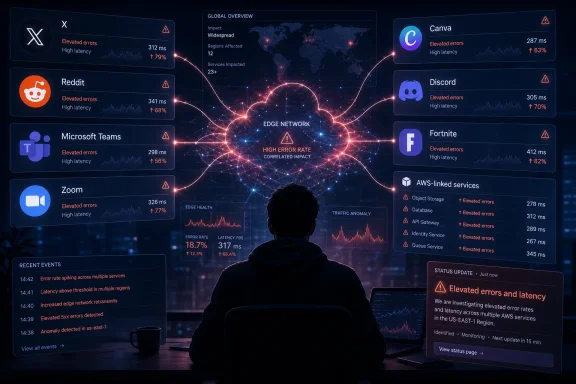
A broad internet disruption on Monday, June 22, 2026, affected reported access to X, Reddit, Microsoft Teams, Zoom, Canva, Discord, Fortnite, AWS-linked services and other platforms, with outage trackers showing simultaneous spikes while Cloudflare reported elevated errors and latency across multiple services. The outage appeared to ease for some users within roughly twenty minutes, but that does not make it trivial. Brief, wide failures are now the defining reliability problem of the modern internet: not one site going dark, but a shared dependency coughing and making half the workday look broken.
The important word here is reported. DownDetector spikes do not prove a single root cause, and a Cloudflare status notice does not automatically mean every affected service was taken down by Cloudflare. But when X, Reddit, Teams, Zoom, Canva, Discord and gaming services all light up outage maps at once, users do not experience nuance. They experience a web that has become faster, cheaper and more defensible by concentrating itself behind a small set of platforms — and therefore more vulnerable to failure modes that look absurdly broad from the outside.

Silhouetted engineer reviews a network outage dashboard showing elevated errors and latency across services.The Internet Did Not Go Down, but the Workday Did​

The phrase “massive internet outage” is always a little imprecise. The internet, in the classical sense, is a mesh of networks, routes, resolvers, clouds, content delivery networks, authentication systems and application backends. What users mean when they say “the internet is down” is that enough familiar services failed at once that the distinction between the network and the apps became academic.
That appears to be the practical story of Monday’s disruption. Users and outage trackers reported trouble across social media, collaboration tools, design apps, gaming platforms and cloud-connected services. Some services began recovering quickly, which suggests either a fast mitigation, a localized choke point, a transient routing or edge problem, or a cascade that stopped before it became a day-long incident.
For IT teams, however, the first twenty minutes of a wide outage are often the worst twenty minutes. Help desks light up before status pages update. Executives ask whether the VPN is broken. Users blame Windows, Wi-Fi, DNS, the browser, the firewall, the update that installed last night, and sometimes all of the above. The administrator’s job becomes not fixing the internet but proving where the failure is not.
That is why the incident matters even if it ends up being short. Modern uptime pain is not measured only in duration. It is measured in ambiguity, blast radius and how long it takes a technically competent person to say, with evidence, “This is outside our environment.”

Cloudflare’s Status Page Became the Place Everyone Looked​

Cloudflare’s role in this story is central but should be handled carefully. The company’s status page reportedly pointed to increased error rates and latency across multiple services around the same window in which users were reporting failures on major platforms. It had also indicated scheduled maintenance shortly before the broader disruption was noticed.
Those facts are suggestive, not conclusive. Cloudflare is large enough that any material problem on its edge, DNS, security, tunneling, bot mitigation, Workers platform or dashboard can appear to “break the internet,” because so many services use the company somewhere in the request path. But large SaaS platforms also fail independently, and outage trackers can amplify correlation into a false sense of causation.
Still, the public pattern is familiar. A platform user loads a site and sees a generic error, a timeout, a login loop, missing content, or a blank feed. The service’s own status page may still show green because the core application servers are not the first thing failing. Somewhere between browser, DNS, CDN, WAF, API gateway, authentication layer, third-party embed, or edge compute, the request path is degraded enough to make the service unusable.
This is the bargain the web has made with Cloudflare and its peers. Their networks absorb attacks, terminate TLS, cache content, accelerate delivery, block bots, serve edge functions and smooth over the uglier parts of global routing. In exchange, they become part of everyone’s critical path. When that layer wobbles, the symptoms appear everywhere at once.

X’s Second Bad Day Shows the Difference Between a Platform Outage and an Infrastructure Outage​

NetBlocks reportedly said X was experiencing international outages for a second consecutive day, tied to timeline backend API errors, and added that the incident did not appear to be related to country-level internet filtering or disruption. That distinction matters. X can be down because X’s own backend is struggling, and at the same time the broader internet can be noisy because other infrastructure is degraded.
From the user’s perspective, these distinctions collapse. X fails to load, Reddit slows down, Teams calls stutter, Discord refuses to connect, and a game session drops. The mind naturally searches for one villain. But internet incidents increasingly look like overlapping weather systems rather than a single broken switch.
X is also a useful example because it is both a destination and a diagnostic tool. When other services fail, users often check X for confirmation. When X itself is impaired, the social layer used to report outages becomes part of the outage story. That leaves users bouncing between DownDetector, Reddit threads, status pages and group chats, trying to assemble a picture from partial signals.
For administrators, the lesson is not that X caused anything. It is that social confirmation has become part of incident response. When the public square is unstable, the unofficial early-warning system is unstable too. Enterprises that rely on public chatter to validate incidents need more boring tools: synthetic monitoring, independent DNS checks, multi-region probes and vendor status aggregation that does not depend on a single consumer platform staying healthy.

Outage Trackers Are Smoke Alarms, Not Root-Cause Reports​

DownDetector and similar services are useful because they are fast. They capture user pain before many vendors publish meaningful incident updates. If reports spike for Teams, Reddit, X and Zoom in the same ten-minute window, something real is probably happening.
But outage trackers are not packet captures. They do not know whether a failed Teams session came from Microsoft, an ISP, a corporate proxy, Cloudflare, a DNS resolver, a local endpoint security product, or a hotel Wi-Fi network. They aggregate complaints, and complaints are excellent at detecting smoke but unreliable at identifying the fire.
This matters because Monday’s list of affected services included platforms with very different architectures. A Cloudflare incident could plausibly affect a wide range of sites and apps, but it would not necessarily explain every report associated with Microsoft Teams or AWS-branded services. Conversely, Microsoft or AWS trouble would not automatically explain failures at every social or gaming platform on the list.
The uncomfortable truth is that users do not care. The outage tracker becomes the story because it reflects their experience more honestly than a dozen vendor dashboards that say “investigating” or “degraded performance” in carefully scoped language. The public internet has become dependent not only on shared infrastructure, but on shared folk instrumentation.

The Status Page Is Now a Legal Document Wearing a Thermometer Costume​

Vendor status pages are written for several audiences at once. Engineers need an accurate operational signal. Customers need to know whether to stop troubleshooting internally. Sales and legal teams need language that does not overstate impact. Executives need reassurance that the company has control of the narrative.
That produces the strange minimalism of outage communication. “Increased error rates.” “Elevated latency.” “Some customers may experience.” “We are investigating.” These phrases are not useless, but they are often too abstract to help a sysadmin staring at hundreds of users who cannot join a Teams meeting or load a SaaS dashboard.
Cloudflare, Microsoft, AWS and other major providers have all improved transparency over the years, especially with post-incident writeups. But the real-time gap remains. The first hour of an incident is when customers most need specificity, and it is also when vendors are least willing or least able to provide it.
The result is a credibility problem. If a service is visibly broken for users and the official page remains green, customers learn to distrust the page. If the page flips to red with vague wording, customers still do not know what to do. The status page has become a necessary artifact, but not a sufficient operational tool.

Windows Users Feel Cloud Failures as Local Problems​

For WindowsForum readers, the most interesting part of an internet-scale outage is how quickly it masquerades as a Windows problem. Teams fails to launch or connect, Edge hangs on a login page, OneDrive sync pauses, Xbox services throw errors, Outlook cannot authenticate, and suddenly the endpoint looks guilty. The laptop is the thing in front of the user, so the laptop gets blamed.
This is especially true in hybrid Windows environments. A user’s ability to work may depend on Entra ID authentication, Conditional Access, Microsoft 365 service health, third-party SaaS tools, CDN-delivered JavaScript, DNS resolution, endpoint security inspection, and the local network. A failure anywhere in that chain can present as “my computer is broken.”
The Windows desktop has become a cloud terminal with a rich local runtime. That is not an insult; it is the reality of modern enterprise computing. The operating system still matters enormously, but many of the daily experiences users associate with Windows now depend on services that live far outside the device.
This makes incident triage harder. Rebooting may fix a stale token or a stuck client, but it will not fix a CDN edge problem. Clearing a browser cache may help one user but waste time during a global incident. Reinstalling Teams during a service degradation is the administrative equivalent of changing tires during an earthquake.

The Enterprise Risk Is Not Downtime; It Is Dependency Without Leverage​

Every IT department accepts dependencies. No serious organization is going to build its own global CDN, DDoS mitigation system, collaboration platform, identity provider, video service and productivity suite from scratch. The question is not whether dependence exists. The question is whether it is understood, documented and tested.
A single outage touching X and Reddit is an inconvenience. An outage touching Teams, Zoom, Canva, AWS-adjacent services and Discord can interrupt work, education, customer support, software deployment, incident response and communications. Even when no data is lost and no security breach occurs, the productivity impact is real.
The hard part is that many organizations do not have direct commercial relationships with every critical dependency in their workflow. A company may pay Microsoft for Teams, but Teams itself relies on a complex mesh of Microsoft infrastructure and external internet paths. A SaaS vendor may rely on Cloudflare, AWS, Azure, Google Cloud, Fastly, Akamai, Stripe, Twilio or Okta. The customer sees one subscription and inherits a dependency graph.
That graph is rarely visible until something fails. Procurement asks about uptime percentages, but uptime percentages do not explain correlated risk. A 99.99 percent SLA from one provider and a 99.99 percent SLA from another do not mean much if both depend on the same upstream service, region, identity provider, edge network or DNS path.

Redundancy Is Easy to Buy and Hard to Use​

The obvious answer to internet concentration is multi-provider architecture. Use more than one CDN. Keep a secondary DNS provider. Design apps to fail over between clouds. Make collaboration resilient by supporting alternate meeting, chat and notification paths. In theory, this reduces the blast radius of a single provider’s failure.
In practice, redundancy is expensive, messy and politically unrewarding. Multi-CDN setups require careful traffic steering, consistent security rules, certificate automation, cache behavior testing and log normalization. Multi-cloud application failover sounds elegant until the database, identity layer, queueing system and observability stack reveal where the real coupling lives.
Even something as simple as “use Zoom if Teams is down” has hidden complexity. Do users have accounts? Are meeting links pre-provisioned? Are compliance settings configured? Do recordings, transcripts and retention policies match? Has anyone tested the fallback during business hours with real users, or is it a slide in a continuity plan?
This is why many organizations tolerate concentration. The primary provider works almost all the time, and the secondary path is costly to maintain. But outage days expose the cost of not maintaining it. When the primary path fails, the fallback that exists only in a policy document does not save the morning.

The Consumer Web Has the Same Problem Without the Procurement Department​

For consumers, the same concentration is less visible but just as real. A person may think of X, Reddit, Discord, Fortnite and Canva as unrelated apps. Behind the scenes, they may share cloud providers, CDN layers, identity systems, analytics scripts, content moderation services, payment processors, or network transit.
That shared substrate is why a failure can look random. One app loads but images do not. Another app opens but login fails. A game launches but matchmaking breaks. A design tool loads the homepage but cannot fetch assets. The outage is not clean because the dependency is not clean.
There is also a psychological effect. Users have been trained to expect the internet to be continuous infrastructure, like electricity. But the consumer web is not one utility; it is a stack of private systems stitched together by protocols, contracts and operational assumptions. When one of the invisible layers degrades, the failure feels uncanny because the brand on the screen is not necessarily the brand that broke.
That gap between visible brand and invisible dependency is now one of the defining features of internet reliability. It also explains why public outrage often lands in the wrong place. Users yell at the app they can name, while the actual fault may sit several vendors away.

Scheduled Maintenance Is No Longer a Quiet Back-Room Event​

The detail that Cloudflare had scheduled maintenance in progress shortly before reports spread deserves attention, even if it ultimately proves unrelated or only partly related. Scheduled maintenance used to be something infrastructure teams did in a window and customers largely ignored unless downtime was expected. At the scale of modern edge networks, maintenance is itself a public reliability event.
A major provider can plan traffic rerouting, warn of possible latency, and still encounter unexpected interactions. Routing changes are not always tidy. Capacity assumptions can be wrong. Software state can propagate unevenly. A local maintenance window can expose a latent global weakness if traffic shifts in a way the system did not anticipate.
This does not mean maintenance is reckless. The opposite is true: complex systems require constant maintenance to remain secure and reliable. But the language around it often understates how much risk is being managed. “Slight increase in latency” reads differently after users see multiple apps fail.
The industry needs a more mature public vocabulary for maintenance risk. Not every maintenance window is dangerous, and not every incident during maintenance is caused by the maintenance. But customers deserve clearer signals about scope, expected blast radius, failover behavior and rollback triggers when the provider sits in front of a meaningful slice of the web.

Security Layers Have Become Availability Layers​

Cloudflare is often discussed as a CDN, but the modern edge provider is also a security control plane. It filters malicious traffic, challenges suspicious clients, proxies applications, fronts APIs, manages access paths and increasingly runs code near users. That makes it valuable. It also makes it dangerous to treat as optional plumbing.
When a security layer fails closed, users cannot reach services. When it fails open, services may be exposed to risk. When it fails inconsistently, administrators get the worst of both worlds: some users are blocked, some traffic is delayed, and nobody is entirely sure which policy is being enforced where.
This is a familiar tradeoff for Windows administrators who have lived through endpoint security rollouts, VPN changes, web filtering outages and identity provider incidents. The control designed to protect access becomes the thing that prevents access. At small scale, that is annoying. At internet scale, it becomes news.
The security industry has spent years telling organizations to put more controls in the path. Zero trust, secure access service edge, web application firewalls, bot detection and identity-aware proxies all move enforcement closer to every request. That strategy can be correct and still create fragile concentration. Availability planning has to treat security infrastructure as production infrastructure, not a protective wrapper outside the app.

Microsoft Teams Is the Canary Because Work Has No Offline Mode​

Teams appearing in outage reports is what turns a web disruption into a workplace disruption. Social platforms can be dismissed as distractions. Games can be dismissed as entertainment. Teams, Zoom and other collaboration tools are the nervous system of hybrid work.
When Teams is impaired, the outage is not only technical. Meetings vanish, support handoffs stall, approvals wait, incident channels fragment, and users fall back to email, SMS or consumer messaging apps. The organization’s formal communication fabric becomes less reliable than the informal one.
Microsoft’s own cloud is vast and complex enough to have its own independent incidents, so it would be irresponsible to assume that any Teams report was caused by the same factor affecting X or Reddit. But that is exactly why the modern admin experience is so difficult. The same symptoms can arise from Microsoft 365 service health, local identity problems, network inspection, DNS filtering, third-party dependencies, or a broader internet event.
For IT leaders, the practical lesson is to define communications fallback before the outage. If Teams is down, where does the incident bridge move? If email is degraded too, who sends SMS? If the identity provider is part of the problem, can responders access the alternate tool? These sound like disaster-recovery questions because they are.

The Cloud Era Has Made “Is It Us?” the Most Expensive Question​

The first question in any outage is usually “Is it us?” That question consumes time, attention and credibility. If the answer is yes, the team must respond. If the answer is no, the team must prove it quickly enough to stop users from making the situation worse with random fixes.
Wide internet incidents make this question expensive because symptoms are distributed unevenly. One user on Comcast may reach a service while another on a corporate VPN cannot. One region may recover while another sees lingering errors. Mobile may work while desktop fails. A browser session may be broken while a native app still functions.
The correct response is disciplined evidence collection. Check from multiple networks. Test DNS resolution. Compare web and app behavior. Look at firewall and proxy logs. Verify identity provider health. Check vendor dashboards, but do not trust them blindly. Watch independent probes and user-report trends, but do not mistake them for root cause.
That discipline is not glamorous, but it is the difference between incident response and superstition. Outage days punish organizations that rely on anecdotes. They reward teams that have already built a map of dependencies and a habit of testing assumptions.

The Cloudflare Pattern Keeps Reappearing Because the Architecture Keeps Winning​

It is tempting to turn every broad disruption into an indictment of one company. That would be too easy. Cloudflare, AWS, Microsoft, Google, Fastly, Akamai and other infrastructure providers became central because they solve real problems better than most customers could solve them alone.
The modern web is faster because edge networks cache content near users. It is safer because DDoS mitigation and bot defenses are not left to every small site. It is more programmable because developers can deploy functions and routing logic globally without building data centers. It is more observable because large platforms can see patterns smaller operators would miss.
The cost is correlated failure. The same platform that reduces a million small risks can introduce one large shared risk. That is not hypocrisy; it is systems engineering. Centralization trades frequent local fragility for rarer but broader systemic events.
The question for the industry is whether customers are pricing that trade correctly. Many are not. They buy managed reliability and assume the provider’s resilience becomes their own. In reality, the provider’s resilience becomes one layer in their system, and the customer remains responsible for understanding what happens when that layer misbehaves.

Regulators Will Notice, but Engineering Will Move Faster​

Outages like Monday’s will inevitably attract regulatory attention, especially when collaboration tools, cloud platforms and public communications services are affected together. Governments already treat cloud concentration, critical infrastructure dependencies and digital resilience as policy concerns. A highly visible internet disruption reinforces the argument that a few private platforms have become systemic infrastructure.
But regulation will not tell an administrator what to do at 9:15 a.m. when Teams is unreliable and half the staff cannot load the tools they need. Engineering practice will have to move faster than policy. That means better dependency mapping, more honest vendor risk assessments, clearer incident communication and fallback paths that are actually exercised.
Enterprises should also stop treating consumer outage chatter as irrelevant. If X, Reddit and Discord are all reporting trouble at the same time as a business SaaS tool, that is signal. It may not prove causation, but it helps define scope. The public web is often the earliest indicator that an internal incident is not internal.
At the same time, organizations must avoid cargo-cult resilience. Buying a second provider without testing failover is not resilience. Adding another monitoring dashboard without defining decision thresholds is not resilience. Writing “use alternate communication channels” in a plan without ensuring access is not resilience. The internet is too interconnected for paper continuity.

Monday’s Short Shock Exposed a Long Dependency Chain​

The practical reading of the June 22 incident is not that every named service failed for the same reason. It is that the user-visible internet can enter a degraded, confusing state when shared infrastructure, platform backends and public reporting tools overlap in failure. That is the state admins should plan for.
  • Several major services were reported as affected at roughly the same time, including social, collaboration, design, gaming and cloud-linked platforms.
  • Cloudflare reportedly acknowledged elevated error rates and latency across multiple services, but that alone does not prove it caused every user-visible failure.
  • X was reportedly experiencing a second consecutive day of international disruption tied to timeline backend API errors, making it a parallel problem as well as part of the public perception of a wider outage.
  • Some services appeared to recover within about twenty minutes, which limits the duration but not the operational confusion created during the incident window.
  • DownDetector and similar tools are valuable early-warning systems, but they should be treated as user-impact signals rather than authoritative root-cause evidence.
  • Windows and Microsoft 365 environments need tested fallback communications and external monitoring because cloud failures often present to users as local endpoint or network problems.
The next outage will probably look a lot like this one: scattered symptoms, overlapping vendor notices, fast-moving user reports, partial recovery and a messy argument over causation. The organizations that handle it best will not be the ones that guessed the right villain first. They will be the ones that already know their dependency chain, have practiced their fallback paths, and can keep working when the internet’s invisible middle briefly becomes visible.

References​

  1. Primary source: The National
    Published: 2026-06-22T14:33:08.348300
  2. Related coverage: tomshardware.com
  3. Related coverage: techradar.com
  4. Related coverage: checkupstream.com
  5. Related coverage: tomsguide.com
  6. Related coverage: cloudflare.statuspage.io
  1. Related coverage: windowscentral.com
  2. Related coverage: axios.com
  3. Related coverage: androidcentral.com
  4. Related coverage: statusgator.com
  5. Related coverage: radar.cloudflare.com
  6. Related coverage: blog.cloudflare.com
  7. Related coverage: devhelm.io
  8. Related coverage: status.cloudkite.io
  9. Related coverage: techtimes.com
  10. Related coverage: statusfield.com
  11. Related coverage: isdown.app
  12. Related coverage: downdetector.jp
  13. Related coverage: livemint.com
  14. Related coverage: downdetector.com.co
  15. Related coverage: feministfutures.socialsciences.ucsb.edu
 

Back
Top