

X, Reddit, Discord, Canva, Zoom, Fortnite, Robinhood and Microsoft Teams suffered overlapping disruptions on Monday, June 22, 2026, beginning around 9:30 a.m. Eastern time, with outage trackers and multiple reports showing failures across social, work, gaming and finance services. The immediate temptation is to treat that as eight separate websites having a bad morning. The more useful reading is harsher: modern online life is only as resilient as the shared infrastructure, habits and fallback channels beneath it. When the timeline, the meeting room and the group chat all fail together, “try again later” is not a plan.
The June 22 disruption appears to have been short-lived for many users, with X beginning to recover before noon Eastern and Reddit following unevenly depending on region. That is the good news. The bad news is that the same narrow window caught consumer social media, workplace collaboration, creator tooling, gaming, investing and chat platforms in one sweep.
Downdetector-style numbers are not a perfect census of failure. They measure user reports, not server telemetry, and they skew toward services whose users know where to complain. But when reports spike across unrelated brands at nearly the same time, the signal is still useful: something larger than one app update or one broken login page may be in play.
That does not mean we can name a single culprit with certainty. Some reports pointed toward shared internet infrastructure, including cloud hosting, content delivery networks and routing layers, but the public record did not immediately supply a clean postmortem from every affected company. In the absence of that, the responsible conclusion is not “Cloudflare did it” or “Microsoft did it” or “AWS did it.” It is that the web’s many doors often lead through surprisingly few corridors.
For ordinary users, the distinction may seem academic. If X will not load and Teams will not connect, the failure feels the same whether the root cause is a CDN, a DNS resolver, an authentication provider or a platform’s own backend. For IT pros, the difference matters because each failure mode demands a different mitigation. For everyone else, the lesson is simpler: redundancy has to exist before the outage.
That habit works until the place people use to report outages is itself down. The June 22 disruption was a reminder that social platforms are excellent sensors but poor foundations. They are fast, messy, emotional and often right before official channels admit anything. They are also vulnerable to the same infrastructure dependencies as the services they are supposed to help diagnose.
This is where many home users and even some small businesses make the same mistake. They assume “the internet” is a single thing and that if one app fails, another will always be there to explain why. The more realistic model is layered: your device, your local network, your ISP, DNS, routing, cloud hosting, identity services, APIs, app frontends and third-party dependencies all have to cooperate.
When enough of those layers are concentrated, failures become theatrical. A handful of major platforms blinking out together creates the feeling of a global event even when the actual technical blast radius is narrower. That feeling matters because people make bad decisions during ambiguous outages: they reset working routers, reinstall apps, change passwords unnecessarily, or flood help desks with duplicate tickets.
A disciplined check takes less than two minutes. Try the same service on a second device. Switch between Wi-Fi and mobile data. Visit a few unrelated sites. If everything fails on Wi-Fi but works on cellular, your local network or ISP is suspect. If only one service fails everywhere, the platform is more likely at fault. If multiple major services fail across different networks, start thinking shared infrastructure.
DNS is a special case because it can make an outage look stranger than it is. A service may be working, but your resolver may not be able to find it. Changing DNS providers is not a magic cure, and enterprise users should not casually bypass corporate DNS controls, but home users can sometimes distinguish a DNS issue by testing a reputable alternate resolver or using a mobile network.
VPNs are similarly useful but often misunderstood. A VPN can route around a regional peering or ISP problem, and it can sometimes bypass a broken path to a service. It will not fix a dead application backend. If a VPN helps, that is a clue about network pathing; if it does not, stop treating it as a talisman.
For IT departments, the status page still matters because it provides the official record. It may identify affected regions, components, mitigations and recovery steps. It may also provide incident IDs that help support teams correlate tickets. But the status page should be one input in a wider incident picture, not the entire dashboard.
A mature outage check combines vendor status pages, independent outage trackers, synthetic monitoring, ISP health, internal telemetry and user reports. Home users do not need all of that machinery, but they can copy the basic logic. Do not rely on a single source of truth during the first fifteen minutes of a widespread failure.
This is especially important for Microsoft Teams and other workplace tools. If Teams is down, the answer is not to move the entire company conversation to a random consumer app on the fly. The answer is to have an agreed fallback path: email if available, SMS for urgent coordination, a secondary meeting provider for critical calls, and a documented place where incident updates live.
For individuals, that means keeping essential contacts somewhere outside a single social platform. If your only way to reach a collaborator is a Reddit DM or an X message, you do not have a contact; you have a dependency. Email addresses, phone numbers and independent websites still matter precisely because they are unfashionable.
For creators and journalists, RSS and newsletters remain underrated resilience tools. They lack the dopamine of a live feed, but they are less dependent on a single platform’s ranking algorithm or login system. If a publication, developer, emergency agency or project maintainer offers an RSS feed, subscribing to it is not nostalgia. It is infrastructure hygiene.
For small businesses, the same principle applies to customers. A restaurant that can only announce a closure on Instagram, a consultant who only schedules through one SaaS platform, or a community group whose entire presence lives inside a social network is one outage away from silence. A lightweight website, mailing list and alternate contact channel are not retro. They are continuity planning.
Task Manager can show whether the machine has network activity at all. The Settings app can confirm Wi-Fi, Ethernet and VPN state. The
The browser is another diagnostic surface. Testing in a private window can rule out a corrupted session or extension conflict. Trying another browser can identify a cached script or site-specific problem. Clearing all cookies should be a last resort, not the first move, because it may sign you out of services you still need during an incident.
Windows users who depend on Teams should also remember that the desktop app, web app and mobile app are not identical paths. Sometimes one fails while another still works. That does not make the service healthy, but it can buy enough time to join a meeting, retrieve a file or send a critical message.
The first step is internal telemetry. Are corporate SaaS apps failing from office networks only, remote users only, or everywhere? Are failures tied to a DNS provider, secure web gateway, identity provider, endpoint agent or VPN concentrator? Are there increased authentication errors, certificate failures, HTTP 5xx responses or packet loss? The goal is not to solve the global outage. It is to identify what the organization can control.
The second step is communications. If the primary collaboration tool is impaired, the fallback channel should already be documented in onboarding material and incident plans. Nobody should be deciding during a Teams outage whether to use Slack, Zoom, email, SMS or a conference bridge. That decision belongs in a calm document written before the bad morning arrives.
The third step is restraint. During third-party outages, well-meaning administrators can create new problems by rotating secrets, changing DNS, disabling security controls or pushing emergency client changes without evidence. Not every outage is a cyberattack. Not every login failure is an identity breach. A measured response preserves the option to act decisively when the evidence improves.
That concentration is not entirely irrational. Centralized services are convenient, powerful and usually reliable enough that most people never think about the scaffolding. X is where people look for live reaction. Reddit is where communities self-diagnose. Teams and Zoom are where the workday happens. Robinhood is where some users monitor money. Discord is where gaming, support and social life blur together. The problem is not that any one of these platforms exists; the problem is that too many people treat them as irreplaceable.
The next major outage may have a completely different cause. It may be a cloud region, a CDN rule, a DNS failure, an authentication cascade, a bad software deployment, a fiber cut, a certificate problem or a security mitigation gone wrong. Users will experience it the same way at first: a blank screen, a failed refresh and a creeping suspicion that the problem is on their end.
The healthier posture is neither paranoia nor fatalism. It is a modest form of digital preparedness: know how to test your connection, know where vendors post status, know how to reach people outside a single app, and know when to stop touching things. If June 22 taught anything, it is that staying online is no longer just about having internet access. It is about having a route around the platforms that taught us to forget we needed one.
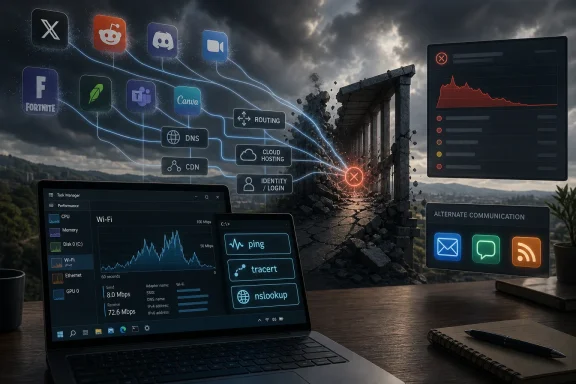 The Outage Was Brief, but the Dependency Was Not
The June 22 disruption appears to have been short-lived for many users, with X beginning to recover before noon Eastern and Reddit following unevenly depending on region. That is the good news. The bad news is that the same narrow window caught consumer social media, workplace collaboration, creator tooling, gaming, investing and chat platforms in one sweep.Downdetector-style numbers are not a perfect census of failure. They measure user reports, not server telemetry, and they skew toward services whose users know where to complain. But when reports spike across unrelated brands at nearly the same time, the signal is still useful: something larger than one app update or one broken login page may be in play.
That does not mean we can name a single culprit with certainty. Some reports pointed toward shared internet infrastructure, including cloud hosting, content delivery networks and routing layers, but the public record did not immediately supply a clean postmortem from every affected company. In the absence of that, the responsible conclusion is not “Cloudflare did it” or “Microsoft did it” or “AWS did it.” It is that the web’s many doors often lead through surprisingly few corridors.
For ordinary users, the distinction may seem academic. If X will not load and Teams will not connect, the failure feels the same whether the root cause is a CDN, a DNS resolver, an authentication provider or a platform’s own backend. For IT pros, the difference matters because each failure mode demands a different mitigation. For everyone else, the lesson is simpler: redundancy has to exist before the outage.
Social Feeds Became the Emergency System by Accident
X and Reddit are not just entertainment platforms anymore. They have become informal incident dashboards for cities, airlines, banks, software vendors, game studios, ISPs and government agencies. When something breaks, many users do not go first to an official status page; they search X, check Reddit, or look for screenshots from someone who got through.That habit works until the place people use to report outages is itself down. The June 22 disruption was a reminder that social platforms are excellent sensors but poor foundations. They are fast, messy, emotional and often right before official channels admit anything. They are also vulnerable to the same infrastructure dependencies as the services they are supposed to help diagnose.
This is where many home users and even some small businesses make the same mistake. They assume “the internet” is a single thing and that if one app fails, another will always be there to explain why. The more realistic model is layered: your device, your local network, your ISP, DNS, routing, cloud hosting, identity services, APIs, app frontends and third-party dependencies all have to cooperate.
When enough of those layers are concentrated, failures become theatrical. A handful of major platforms blinking out together creates the feeling of a global event even when the actual technical blast radius is narrower. That feeling matters because people make bad decisions during ambiguous outages: they reset working routers, reinstall apps, change passwords unnecessarily, or flood help desks with duplicate tickets.
The First Job Is to Prove It Is Not You
The most practical move during any outage is not to refresh harder. It is to determine whether the failure is local, regional or platform-wide. That sounds obvious, but it is the step most users skip because outage behavior is designed to look personal: a blank feed, a failed meeting join, a spinning login prompt, a message that says something went wrong.A disciplined check takes less than two minutes. Try the same service on a second device. Switch between Wi-Fi and mobile data. Visit a few unrelated sites. If everything fails on Wi-Fi but works on cellular, your local network or ISP is suspect. If only one service fails everywhere, the platform is more likely at fault. If multiple major services fail across different networks, start thinking shared infrastructure.
DNS is a special case because it can make an outage look stranger than it is. A service may be working, but your resolver may not be able to find it. Changing DNS providers is not a magic cure, and enterprise users should not casually bypass corporate DNS controls, but home users can sometimes distinguish a DNS issue by testing a reputable alternate resolver or using a mobile network.
VPNs are similarly useful but often misunderstood. A VPN can route around a regional peering or ISP problem, and it can sometimes bypass a broken path to a service. It will not fix a dead application backend. If a VPN helps, that is a clue about network pathing; if it does not, stop treating it as a talisman.
Status Pages Are Necessary, but They Are Not Sufficient
Every serious service should have a public status page. Many do. The problem is that status pages are often slow to reflect what users are already experiencing, especially in the early minutes of an incident. Some depend on the same identity, hosting or monitoring systems affected by the outage. Others are shaped by legal, communications and support workflows that move more slowly than user reports.For IT departments, the status page still matters because it provides the official record. It may identify affected regions, components, mitigations and recovery steps. It may also provide incident IDs that help support teams correlate tickets. But the status page should be one input in a wider incident picture, not the entire dashboard.
A mature outage check combines vendor status pages, independent outage trackers, synthetic monitoring, ISP health, internal telemetry and user reports. Home users do not need all of that machinery, but they can copy the basic logic. Do not rely on a single source of truth during the first fifteen minutes of a widespread failure.
This is especially important for Microsoft Teams and other workplace tools. If Teams is down, the answer is not to move the entire company conversation to a random consumer app on the fly. The answer is to have an agreed fallback path: email if available, SMS for urgent coordination, a secondary meeting provider for critical calls, and a documented place where incident updates live.
The Real Backup Is Boring
The most reliable outage preparation is not glamorous. It is not a new app, a mesh of exotic services or a drawer full of travel routers. It is a boring set of alternate channels that everyone actually knows how to use.For individuals, that means keeping essential contacts somewhere outside a single social platform. If your only way to reach a collaborator is a Reddit DM or an X message, you do not have a contact; you have a dependency. Email addresses, phone numbers and independent websites still matter precisely because they are unfashionable.
For creators and journalists, RSS and newsletters remain underrated resilience tools. They lack the dopamine of a live feed, but they are less dependent on a single platform’s ranking algorithm or login system. If a publication, developer, emergency agency or project maintainer offers an RSS feed, subscribing to it is not nostalgia. It is infrastructure hygiene.
For small businesses, the same principle applies to customers. A restaurant that can only announce a closure on Instagram, a consultant who only schedules through one SaaS platform, or a community group whose entire presence lives inside a social network is one outage away from silence. A lightweight website, mailing list and alternate contact channel are not retro. They are continuity planning.
Windows Users Have Better Tools Than They Use
For WindowsForum readers, the June 22 outage should also prompt a look at the local machine. Windows gives users enough diagnostic tools to avoid superstition, yet most people still jump straight from “app broken” to “internet broken.” The difference matters.Task Manager can show whether the machine has network activity at all. The Settings app can confirm Wi-Fi, Ethernet and VPN state. The
ping, tracert, nslookup and ipconfig commands remain useful for distinguishing local connectivity, DNS resolution and route problems. Windows Terminal is not just for developers; it is a flashlight when the web interface goes dark.The browser is another diagnostic surface. Testing in a private window can rule out a corrupted session or extension conflict. Trying another browser can identify a cached script or site-specific problem. Clearing all cookies should be a last resort, not the first move, because it may sign you out of services you still need during an incident.
Windows users who depend on Teams should also remember that the desktop app, web app and mobile app are not identical paths. Sometimes one fails while another still works. That does not make the service healthy, but it can buy enough time to join a meeting, retrieve a file or send a critical message.
Enterprise IT Should Treat “Everyone Is Down” as a Design Smell
When employees report that Teams, Reddit, X, Zoom and a finance site are all broken, the help desk faces a familiar trap. The symptoms are broad enough to suggest the internet is melting, but the business still needs a triage process. A good runbook separates user impatience from actionable signal.The first step is internal telemetry. Are corporate SaaS apps failing from office networks only, remote users only, or everywhere? Are failures tied to a DNS provider, secure web gateway, identity provider, endpoint agent or VPN concentrator? Are there increased authentication errors, certificate failures, HTTP 5xx responses or packet loss? The goal is not to solve the global outage. It is to identify what the organization can control.
The second step is communications. If the primary collaboration tool is impaired, the fallback channel should already be documented in onboarding material and incident plans. Nobody should be deciding during a Teams outage whether to use Slack, Zoom, email, SMS or a conference bridge. That decision belongs in a calm document written before the bad morning arrives.
The third step is restraint. During third-party outages, well-meaning administrators can create new problems by rotating secrets, changing DNS, disabling security controls or pushing emergency client changes without evidence. Not every outage is a cyberattack. Not every login failure is an identity breach. A measured response preserves the option to act decisively when the evidence improves.
The Six Habits That Keep an Outage From Becoming a Personal Crisis
The June 22 outage did not last long enough to rewrite the internet, but it lasted long enough to expose how many users have no fallback plan. The useful response is not panic-buying redundancy. It is building a small set of habits that make the next outage less confusing and less disruptive.- Confirm whether the failure is local by testing another device, another network and a few unrelated websites before changing settings.
- Check both official status pages and independent outage trackers, because either source can lag or miss important context during the first minutes.
- Keep at least one alternate communication channel ready for work, family and communities that does not depend on the same social platform.
- Subscribe to RSS feeds, email newsletters or direct alerts for sources you genuinely rely on, especially newsrooms, vendors, emergency agencies and project maintainers.
- Use VPNs, alternate DNS and mobile hotspots as diagnostic tools rather than universal fixes, and reverse any temporary changes once the incident ends.
- Avoid repeated refresh loops during confirmed outages, because they waste attention, drain batteries and may add load without improving recovery.
The Internet’s Weak Points Are Now User Habits, Too
It is easy to frame outages as failures by distant infrastructure companies, and sometimes that is exactly what they are. But the user side of the architecture has grown fragile as well. We concentrated attention into a few feeds, work into a few collaboration suites, identity into a few login providers and public incident awareness into the same platforms that can vanish from view.That concentration is not entirely irrational. Centralized services are convenient, powerful and usually reliable enough that most people never think about the scaffolding. X is where people look for live reaction. Reddit is where communities self-diagnose. Teams and Zoom are where the workday happens. Robinhood is where some users monitor money. Discord is where gaming, support and social life blur together. The problem is not that any one of these platforms exists; the problem is that too many people treat them as irreplaceable.
The next major outage may have a completely different cause. It may be a cloud region, a CDN rule, a DNS failure, an authentication cascade, a bad software deployment, a fiber cut, a certificate problem or a security mitigation gone wrong. Users will experience it the same way at first: a blank screen, a failed refresh and a creeping suspicion that the problem is on their end.
The healthier posture is neither paranoia nor fatalism. It is a modest form of digital preparedness: know how to test your connection, know where vendors post status, know how to reach people outside a single app, and know when to stop touching things. If June 22 taught anything, it is that staying online is no longer just about having internet access. It is about having a route around the platforms that taught us to forget we needed one.
References
- Primary source: Rolling Out
Published: 2026-06-22T17:42:08.295520
X and Reddit down: 6 reliable ways to stay online
X, Reddit, Discord, Zoom and more went down Monday morning. Here's what happened and how to stay connected.rollingout.com - Related coverage: techradar.com
The Facebook app is crashing for many — here's what we know about the Android issues | TechRadar
The Facebook app isn't playing ball todaywww.techradar.com - Related coverage: tomsguide.com
Spotify was down — what happened during the short outage | Tom's Guide
Users reported issues with the popular music streaming platformwww.tomsguide.com - Related coverage: phonearena.com
Massive outage affects tens of thousands of X users - PhoneArena
X doesn't mark the spot as the social media site suffers a major outage.www.phonearena.com - Related coverage: geo.tv
X (formerly Twitter), Zoom, Reddit, Teams all go down at once: Reason revealed
X , Zoom, Reddit, and Microsoft Teams suffered a major outage on Monday morning, June 22. The outage left thousands of users unable to access their social media platforms and workplace communication tools. Users began reporting...www.geo.tv - Related coverage: brecorder.com
X recovers after outage affects thousands globally, Downdetector shows - Technology - Business Recorder
The outage begins around 9:00 a.m. ET, peaking at over 25,000 issues being reported in the U.S. before cooling to about 620 reportswww.brecorder.com
- Related coverage: businessupturn.com
Why is X down today, June 22? Here’s what we know so far | Business Upturn
Thousands of users of X, the social media platform formerly known as Twitter, reported problems accessing the service on June...www.businessupturn.com - Related coverage: straitstimes.com
Social media platform X recovers after outage affects thousands globally, Downdetector shows | The Straits Times
In Singapore, there were about 900 reports of issues with the platform on Downdetector at about 10.10pm. Read more at straitstimes.com.www.straitstimes.com
- Related coverage: ground.news
X recovers after outage affects thousands globally, Downdetector shows
Elon Musk's X was largely back up after thousands of users reported issues with the social media platform globally on Monday (Jun 22), according to Downdetector.com.The outage began around 9am ET (9pm Singapore time), peaking at over 25,000 issues being reported in the US before cooling to about...ground.news - Related coverage: windowscentral.com
"We’ve confirmed service health has returned to normal": Microsoft 365 and Outlook are back up and running | Windows Central
If you're just sitting down to your desk, you may not be able to use Outlook or Microsoft 365.www.windowscentral.com - Related coverage: androidcentral.com
X faces major outage as 78K users report disruption this morning | Android Central
People are seeing issues with the app and website, with feeds not refreshing.www.androidcentral.com - Related coverage: pge.com
- Related coverage: glo.texas.gov
- Related coverage: investigacion.udem.edu.mx
Is there a global Microsoft outage today?[[[Microsoft Services Status]]]]
PDF documentinvestigacion.udem.edu.mx
- Related coverage: tmhp.com
- Related coverage: outage.report

Cloudflare down? Outage map, service status, incidents history
See if Cloudflare is down or it's just you. Check current status and outage map. Post yours and see other's reports and complaints
outage.report
- Related coverage: tomshardware.com
Cloudflare's CTO apologizes after error takes huge chunk of the internet offline — 'we failed our customers and the broader internet' | Tom's Hardware
CTO blames bot mitigation bug triggered by routine config change.www.tomshardware.com - Related coverage: blog.cloudflare.com
Cloudflare outage on February 20, 2026
Cloudflare suffered a service outage on February 20, 2026. A subset of customers who use Cloudflare’s Bring Your Own IP (BYOIP) service saw their routes to the Internet withdrawn via Border Gateway Protocol (BGP). blog.cloudflare.com
- Related coverage: itpro.com
Cloudflare outage explained: What happened, who was impacted, and how was it resolved? | IT Pro
The recent Cloudflare outage lasted over six hours and impacted a host of sites including Uber, Wikipedia, and Bet365.www.itpro.com
