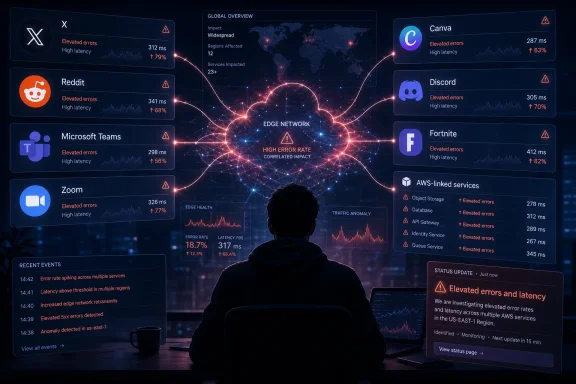
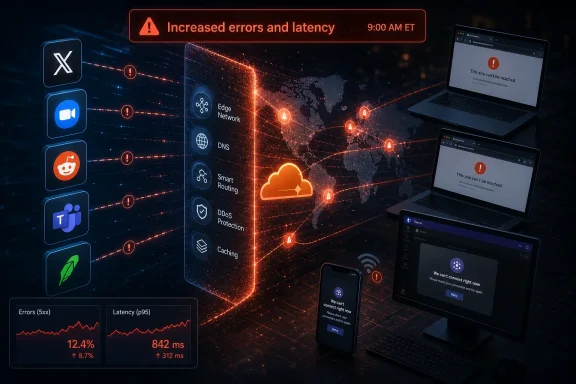
More than 35,000 users reported problems reaching X on Monday morning, June 22, 2026, as outage reports also spiked for Microsoft Teams, Reddit, Zoom, Robinhood and Canva during a broader disruption linked in timing to Cloudflare service degradation. The incident was brief in the way modern outages often are brief: long enough to break workflows, short enough to be dismissed as “the internet being the internet.” But the pattern matters more than the stopwatch. When a social network, a collaboration suite, a trading app, a design tool and community sites wobble together, the story is not one company going down; it is the uncomfortable concentration of everyday computing behind a small number of invisible infrastructure gates.
The first wave of user reports arrived with the kind of suddenness that makes IT teams distrust their own dashboards. Downdetector showed X reports jumping from hundreds to tens of thousands in roughly 15 minutes on Monday morning, while other services posted smaller but still noticeable spikes. Forbes reported that X went from 584 user reports around 9:45 a.m. ET to 35,659 by 10 a.m., a rise sharp enough to suggest something more systemic than an app bug or a botched client rollout.
X drew the biggest number because X is where people notice outages, complain about outages, and then discover the outage has swallowed the place where they would normally complain. The usual reflex sent users to Threads and other services, where the jokes wrote themselves. Yet the surrounding reports from Reddit, Zoom, Robinhood, Canva and Microsoft Teams made the morning feel less like a single-platform failure and more like a distributed stress test of the dependency graph most users never see.
For WindowsForum readers, Microsoft Teams is the tell. A few thousand failed posts to a social network may be annoying; a collaboration platform stumbling in the middle of the U.S. business morning is operationally meaningful. Teams sits inside the Microsoft 365 workday, glued to calendars, meetings, chats, files and identity. If Teams is affected alongside consumer platforms, admins have to assume the incident is not just “someone else’s website” until proven otherwise.
The temptation after a multi-site outage is to find the one glowing red box and call it the villain. In practice, large incidents often pass through several layers at once: a CDN hiccup, a third-party API dependency, regional congestion, stale DNS assumptions, overloaded fallbacks, and client apps that turn transient failures into hard errors. Cloudflare may have been a common point of pain, but the public evidence available Monday morning supported a narrower statement: its degradation coincided with a wave of reports across major services.
That narrower statement is still significant. The modern web has traded obvious single points of failure for abstracted ones. Instead of one company’s server room catching fire, we get failures in shared acceleration, security and routing layers that make many companies look broken at the same time. The result is a strange kind of decentralization theater: the brands are different, the apps are different, the underlying chokepoints are fewer than users imagine.
Forbes reported that about half of the user-reported X problems involved the mobile app, with feed and timeline issues accounting for another large share and desktop site problems trailing behind. That distribution is useful because it suggests the pain was not limited to one browser path or one desktop web experience. Mobile failures also feel more total to ordinary users: if the app opens into a dead timeline, the service might as well not exist.
But X’s prominence can distort the incident. Outage trackers are not telemetry from the affected companies; they are public complaint meters. A service with a highly vocal user base and a habit of real-time commentary will look worse than an equally broken enterprise tool whose users file internal tickets instead of public reports. X may have been the biggest visible plume, but the smoke was coming from more than one building.
This is where the Microsoft 365 era has complicated the old service-status playbook. An admin may see users unable to join meetings, open chats or collaborate, while Microsoft’s own core services are not necessarily experiencing a full platform outage. The failure could sit between the user and the service, in an identity path, in a network provider, in a regional dependency, or in a third-party security layer used by something the workflow touches.
That ambiguity is brutal during the first hour. Users ask whether “Teams is down,” managers ask whether meetings should be moved, and IT has to distinguish a local network issue from a global SaaS incident with incomplete evidence. In the old model, administrators owned enough of the stack to troubleshoot from cable to server. In the SaaS model, they own the user experience but not the failure domain.
This matters because outage narratives harden fast. Within minutes, a degraded infrastructure provider becomes “the reason everything is down,” a Teams report becomes “Microsoft 365 outage,” and a mobile app failure becomes “the website is dead.” Those labels may turn out to be directionally correct, but they can mislead troubleshooting while the incident is active.
The correct use of public outage trackers is comparative and temporal. If X spikes at the same time as Reddit, Canva and Teams, and a major infrastructure provider reports latency and errors, that is actionable context. It tells admins to widen their lens beyond endpoint troubleshooting. It does not excuse vendors from publishing post-incident detail, and it does not replace first-party telemetry.
They also make failure more efficient. A misconfiguration, routing issue or overloaded shared service can propagate user-visible pain across companies that appear unrelated from the outside. The same machinery that lets a startup serve millions without building a global network can also make that startup dependent on a vendor whose outage calendar is now part of its own uptime story.
This is not an argument against Cloudflare or any other infrastructure provider. The alternative is not a charmingly independent internet of hand-built servers and perfect autonomy. The alternative is usually worse security, worse latency, less DDoS protection, and smaller organizations being priced out of reliability. The point is that concentration should be treated as an architectural risk, not a moral failing discovered only after a bad morning.
Cloudflare’s public status language on Monday, as reported, described increased error rates and latency in multiple services. That is a useful start, but the downstream reality for customers is messier. A web app might throw 500 errors, a mobile feed might fail silently, a meeting app might hang, and a login path might intermittently work. The infrastructure provider sees metrics; the user sees betrayal.
Microsoft and other SaaS vendors face the same challenge from the opposite direction. If their service depends on or is affected by an external provider, they still have to communicate with customers who pay them, not the dependency chain. “A third-party provider is degraded” may be accurate, but it rarely satisfies an enterprise customer whose board meeting just moved to a phone bridge.
For a public website, multi-CDN delivery can reduce dependence on one edge network, but it requires careful DNS strategy, cache behavior alignment, certificate management, observability and testing. For collaboration tools, there is no simple “multi-Teams” architecture. An organization can maintain fallback meeting platforms, alternate chat channels and emergency communications, but it cannot casually duplicate the Microsoft 365 collaboration fabric without creating governance and security problems of its own.
The most realistic resilience work is often procedural rather than architectural. Companies need a clear fallback for meetings, a known place for outage updates, an out-of-band channel for incident response, and a decision rule for when to stop waiting and switch tools. That may not sound as elegant as active-active global failover, but it is the difference between a 20-minute outage and a 20-minute outage plus an hour of organizational confusion.
That makes local diagnostics both more and less useful. Checking DNS resolution, proxy behavior, endpoint security logs and network path health still matters. So does comparing reports across ISPs, regions, browsers and mobile clients. But admins also need to know when to stop burning time on the endpoint and start correlating with external incidents.
The best help desks have quietly adapted to this reality. They maintain internal outage channels, bookmark vendor status pages, monitor public report spikes, and write user-facing templates that acknowledge uncertainty without overpromising. The worst help desks still ask users to reboot while half the internet is returning errors.
The Monday outage reports cut across categories: social media, community discussion, video meetings, finance, design and workplace chat. That spread is precisely why these incidents feel surreal. Users do not think of Reddit and Microsoft Teams as neighbors. They become neighbors only when a shared infrastructure layer, transit path or timing pattern makes them fail together.
This is the part of cloud computing that marketing rarely lingers on. The cloud is not a place; it is a mesh of dependencies with contracts, assumptions and failure modes. Its resilience comes from engineering those dependencies well. Its fragility appears when users discover that “different apps” does not necessarily mean “different risks.”
Then an outage arrives and reveals the hidden premium. The cost of concentration is not paid every day; it is paid in sudden synchronized inconvenience. Most businesses accept that trade because the alternative costs more upfront and fails in less predictable ways. But accepting the trade should not mean pretending it does not exist.
Boards and executives increasingly understand cyber risk as a business risk. Availability concentration deserves the same treatment. If a company cannot operate when a collaboration suite, CDN or identity provider is degraded, that is not merely an IT detail. It is an operational dependency that belongs in risk registers, tabletop exercises and vendor reviews.
A short disruption can still expose whether a company knows how to communicate internally, whether its help desk can recognize a widespread incident, and whether its fallback channels work. It can also reveal which teams depend on consumer platforms for official communications, which workflows have no offline mode, and which vendors provide useful incident detail under pressure.
For home users, the lesson is simpler but still relevant. If multiple unrelated apps fail at once, the problem may not be your PC, your router or your phone. Restarting everything is sometimes therapeutic, but checking whether others are seeing the same failure can save time and sanity.
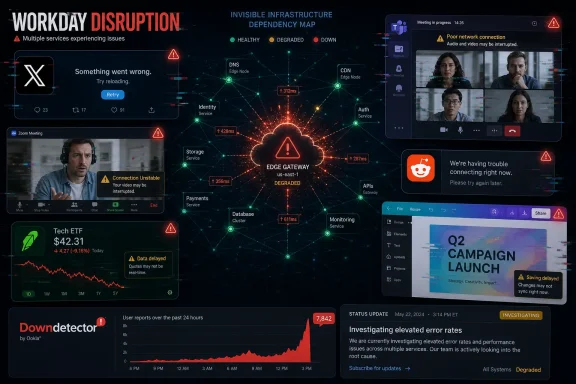 The Internet Did Not Go Down, But the Workday Did
The first wave of user reports arrived with the kind of suddenness that makes IT teams distrust their own dashboards. Downdetector showed X reports jumping from hundreds to tens of thousands in roughly 15 minutes on Monday morning, while other services posted smaller but still noticeable spikes. Forbes reported that X went from 584 user reports around 9:45 a.m. ET to 35,659 by 10 a.m., a rise sharp enough to suggest something more systemic than an app bug or a botched client rollout.X drew the biggest number because X is where people notice outages, complain about outages, and then discover the outage has swallowed the place where they would normally complain. The usual reflex sent users to Threads and other services, where the jokes wrote themselves. Yet the surrounding reports from Reddit, Zoom, Robinhood, Canva and Microsoft Teams made the morning feel less like a single-platform failure and more like a distributed stress test of the dependency graph most users never see.
For WindowsForum readers, Microsoft Teams is the tell. A few thousand failed posts to a social network may be annoying; a collaboration platform stumbling in the middle of the U.S. business morning is operationally meaningful. Teams sits inside the Microsoft 365 workday, glued to calendars, meetings, chats, files and identity. If Teams is affected alongside consumer platforms, admins have to assume the incident is not just “someone else’s website” until proven otherwise.
Cloudflare Became the Suspect Because It Sits in the Blast Radius
Cloudflare reported increased error rates and latency across multiple services on Monday, but early public reporting did not establish that Cloudflare caused every service’s user-visible outage. That distinction matters. Cloudflare is so deeply embedded in modern web delivery, security, DNS, bot mitigation and edge compute that its status page can become the internet’s weather report, but correlation is not a root-cause analysis.The temptation after a multi-site outage is to find the one glowing red box and call it the villain. In practice, large incidents often pass through several layers at once: a CDN hiccup, a third-party API dependency, regional congestion, stale DNS assumptions, overloaded fallbacks, and client apps that turn transient failures into hard errors. Cloudflare may have been a common point of pain, but the public evidence available Monday morning supported a narrower statement: its degradation coincided with a wave of reports across major services.
That narrower statement is still significant. The modern web has traded obvious single points of failure for abstracted ones. Instead of one company’s server room catching fire, we get failures in shared acceleration, security and routing layers that make many companies look broken at the same time. The result is a strange kind of decentralization theater: the brands are different, the apps are different, the underlying chokepoints are fewer than users imagine.
X Was the Loudest Failure Because X Is Built to Amplify Failure
X’s outage reports dominated the morning, and that should surprise nobody. The platform formerly known as Twitter remains a public square, a customer support channel, a breaking-news wire and a chaos amplifier, even after years of ownership drama and user migration. When it breaks, people notice immediately because it is often the place they use to decide whether everything else is broken too.Forbes reported that about half of the user-reported X problems involved the mobile app, with feed and timeline issues accounting for another large share and desktop site problems trailing behind. That distribution is useful because it suggests the pain was not limited to one browser path or one desktop web experience. Mobile failures also feel more total to ordinary users: if the app opens into a dead timeline, the service might as well not exist.
But X’s prominence can distort the incident. Outage trackers are not telemetry from the affected companies; they are public complaint meters. A service with a highly vocal user base and a habit of real-time commentary will look worse than an equally broken enterprise tool whose users file internal tickets instead of public reports. X may have been the biggest visible plume, but the smoke was coming from more than one building.
Teams Turns a Consumer Outage Into an IT Problem
Microsoft Teams appearing in the same cluster changes the audience for the incident. X can be shrugged off by executives until the social team starts pacing. Teams cannot, because it is wired into meetings, sales calls, incident channels and help-desk escalation paths. When Teams blips during business hours, the outage becomes a productivity event even if the underlying cause is outside Microsoft’s own cloud.This is where the Microsoft 365 era has complicated the old service-status playbook. An admin may see users unable to join meetings, open chats or collaborate, while Microsoft’s own core services are not necessarily experiencing a full platform outage. The failure could sit between the user and the service, in an identity path, in a network provider, in a regional dependency, or in a third-party security layer used by something the workflow touches.
That ambiguity is brutal during the first hour. Users ask whether “Teams is down,” managers ask whether meetings should be moved, and IT has to distinguish a local network issue from a global SaaS incident with incomplete evidence. In the old model, administrators owned enough of the stack to troubleshoot from cable to server. In the SaaS model, they own the user experience but not the failure domain.
Downdetector Is a Smoke Alarm, Not a Fire Report
Downdetector’s numbers are valuable because they capture the lived experience of users quickly. They are also easy to overread. A spike from hundreds to tens of thousands of reports says people are having trouble, but it does not say exactly which component failed, how many users were affected globally, or whether two services with simultaneous spikes share the same root cause.This matters because outage narratives harden fast. Within minutes, a degraded infrastructure provider becomes “the reason everything is down,” a Teams report becomes “Microsoft 365 outage,” and a mobile app failure becomes “the website is dead.” Those labels may turn out to be directionally correct, but they can mislead troubleshooting while the incident is active.
The correct use of public outage trackers is comparative and temporal. If X spikes at the same time as Reddit, Canva and Teams, and a major infrastructure provider reports latency and errors, that is actionable context. It tells admins to widen their lens beyond endpoint troubleshooting. It does not excuse vendors from publishing post-incident detail, and it does not replace first-party telemetry.
The Cloud Has Made Failure More Efficient
The uncomfortable truth is that today’s internet is resilient in aggregate and fragile in clusters. Cloudflare, Microsoft, Amazon, Google, Akamai, Fastly and a handful of other providers have made the web faster, safer and more survivable than the server-under-a-desk era ever was. They absorb attacks, route around regional problems, terminate TLS at planetary scale and make small teams look globally competent.They also make failure more efficient. A misconfiguration, routing issue or overloaded shared service can propagate user-visible pain across companies that appear unrelated from the outside. The same machinery that lets a startup serve millions without building a global network can also make that startup dependent on a vendor whose outage calendar is now part of its own uptime story.
This is not an argument against Cloudflare or any other infrastructure provider. The alternative is not a charmingly independent internet of hand-built servers and perfect autonomy. The alternative is usually worse security, worse latency, less DDoS protection, and smaller organizations being priced out of reliability. The point is that concentration should be treated as an architectural risk, not a moral failing discovered only after a bad morning.
The Status Page Has Become Part of the Product
One lesson from repeated internet-wide incidents is that status communication is now a core product feature. Users no longer accept a vague “we are investigating” as sufficient when the same outage interrupts work, communication and commerce across multiple services. Admins need timestamps, affected regions, impacted components and mitigation guidance, not brand-safe fog.Cloudflare’s public status language on Monday, as reported, described increased error rates and latency in multiple services. That is a useful start, but the downstream reality for customers is messier. A web app might throw 500 errors, a mobile feed might fail silently, a meeting app might hang, and a login path might intermittently work. The infrastructure provider sees metrics; the user sees betrayal.
Microsoft and other SaaS vendors face the same challenge from the opposite direction. If their service depends on or is affected by an external provider, they still have to communicate with customers who pay them, not the dependency chain. “A third-party provider is degraded” may be accurate, but it rarely satisfies an enterprise customer whose board meeting just moved to a phone bridge.
Redundancy Is Easy to Say and Expensive to Mean
Every major outage produces the same advice: build redundancy, avoid single points of failure, prepare alternatives. The advice is correct and often useless without budget, architectural discipline and a tolerance for complexity. True multi-provider resilience is not a checkbox; it is an operating model.For a public website, multi-CDN delivery can reduce dependence on one edge network, but it requires careful DNS strategy, cache behavior alignment, certificate management, observability and testing. For collaboration tools, there is no simple “multi-Teams” architecture. An organization can maintain fallback meeting platforms, alternate chat channels and emergency communications, but it cannot casually duplicate the Microsoft 365 collaboration fabric without creating governance and security problems of its own.
The most realistic resilience work is often procedural rather than architectural. Companies need a clear fallback for meetings, a known place for outage updates, an out-of-band channel for incident response, and a decision rule for when to stop waiting and switch tools. That may not sound as elegant as active-active global failover, but it is the difference between a 20-minute outage and a 20-minute outage plus an hour of organizational confusion.
Windows Admins Live at the Edge of Someone Else’s Cloud
For Windows administrators, Monday’s outage cluster is another reminder that endpoint management and cloud dependency are now inseparable. A user on Windows 11 may report that Teams is broken, Edge cannot load a site, a web app fails through SSO, and a line-of-business portal returns errors. The root cause may have nothing to do with Windows, but the ticket still lands with the Windows team.That makes local diagnostics both more and less useful. Checking DNS resolution, proxy behavior, endpoint security logs and network path health still matters. So does comparing reports across ISPs, regions, browsers and mobile clients. But admins also need to know when to stop burning time on the endpoint and start correlating with external incidents.
The best help desks have quietly adapted to this reality. They maintain internal outage channels, bookmark vendor status pages, monitor public report spikes, and write user-facing templates that acknowledge uncertainty without overpromising. The worst help desks still ask users to reboot while half the internet is returning errors.
The User Experience Is Now a Supply Chain
Security teams already talk about software supply chains, but availability has a supply chain too. The app a user opens may depend on identity providers, DNS resolvers, CDNs, bot filters, payment APIs, observability platforms, feature-flag systems and cloud regions. Any one of those can become the weak link that makes the brand on the icon look incompetent.The Monday outage reports cut across categories: social media, community discussion, video meetings, finance, design and workplace chat. That spread is precisely why these incidents feel surreal. Users do not think of Reddit and Microsoft Teams as neighbors. They become neighbors only when a shared infrastructure layer, transit path or timing pattern makes them fail together.
This is the part of cloud computing that marketing rarely lingers on. The cloud is not a place; it is a mesh of dependencies with contracts, assumptions and failure modes. Its resilience comes from engineering those dependencies well. Its fragility appears when users discover that “different apps” does not necessarily mean “different risks.”
The Market Rewards Centralization Until the Morning It Punishes It
There is a reason so many companies rely on the same providers. Large infrastructure platforms offer global reach, sophisticated security and operational maturity that most customers could not reproduce. They also integrate neatly with procurement, compliance and developer workflows. Centralization wins because it is rational.Then an outage arrives and reveals the hidden premium. The cost of concentration is not paid every day; it is paid in sudden synchronized inconvenience. Most businesses accept that trade because the alternative costs more upfront and fails in less predictable ways. But accepting the trade should not mean pretending it does not exist.
Boards and executives increasingly understand cyber risk as a business risk. Availability concentration deserves the same treatment. If a company cannot operate when a collaboration suite, CDN or identity provider is degraded, that is not merely an IT detail. It is an operational dependency that belongs in risk registers, tabletop exercises and vendor reviews.
The Monday Morning Lesson Is Smaller Than Panic and Larger Than Shrugging
The practical lesson from this outage is not that everyone should abandon X, Teams, Cloudflare or SaaS. It is that organizations should treat public-cloud and edge-service incidents as routine operational scenarios rather than exotic events. The right posture sits between panic and complacency.A short disruption can still expose whether a company knows how to communicate internally, whether its help desk can recognize a widespread incident, and whether its fallback channels work. It can also reveal which teams depend on consumer platforms for official communications, which workflows have no offline mode, and which vendors provide useful incident detail under pressure.
For home users, the lesson is simpler but still relevant. If multiple unrelated apps fail at once, the problem may not be your PC, your router or your phone. Restarting everything is sometimes therapeutic, but checking whether others are seeing the same failure can save time and sanity.
The Outage Playbook Windows Shops Should Actually Keep
The concrete response to Monday’s disruption is not a grand redesign of the internet. It is a modest, disciplined outage playbook that assumes third-party platforms will occasionally fail together and that the first reports will be incomplete. The organizations that handle these mornings well are not the ones with perfect uptime; they are the ones that reduce ambiguity quickly.- Organizations should maintain an internal status channel that does not depend on the same collaboration platform used for everyday work.
- Help desks should compare user reports against vendor status pages, public outage trackers and network telemetry before escalating endpoint troubleshooting.
- Teams-heavy workplaces should define an approved fallback for urgent meetings before the next outage forces improvisation.
- Administrators should document which critical business services rely on major edge, DNS, identity and SaaS providers.
- Incident reviews should distinguish between the vendor that users blame and the dependency that actually failed.
- Executives should treat availability concentration as a business continuity issue, not merely an IT inconvenience.
References
- Primary source: Forbes
Published: Mon, 22 Jun 2026 14:26:25 GMT
X—Along With Microsoft Teams, Reddit, Canva—Has Mass Outage
Spikes in outages on X, Microsoft Teams, Square and other websites were reported Monday morning.www.forbes.com - Related coverage: tomsguide.com
Microsoft outage now 'resolved' — latest updates as 365, Outlook and Teams return | Tom's Guide
Everything you need to know about the major Microsoft outagewww.tomsguide.com - Related coverage: tomshardware.com
Cloudflare's CTO apologizes after error takes huge chunk of the internet offline — 'we failed our customers and the broader internet' | Tom's Hardware
CTO blames bot mitigation bug triggered by routine config change.www.tomshardware.com - Related coverage: gadgets360.com
- Related coverage: windowscentral.com
Is Cloudflare down? Here's why Fortnite isn't working | Windows Central
Cloudflare's scheduled downtime aligned with its team "investigating issues" that took out productivity apps and games.www.windowscentral.com - Related coverage: techradar.com
Microsoft 365 and Outlook were down for many – here's what went wrong | TechRadar
Microsoft says the issue is now 'resolved'www.techradar.com
- Related coverage: itpro.com
Cloudflare outage explained: What happened, who was impacted, and how was it resolved? | IT Pro
The recent Cloudflare outage lasted over six hours and impacted a host of sites including Uber, Wikipedia, and Bet365.www.itpro.com - Related coverage: outage.com
Is Canva Down? Real-Time Status & Outage Map
Current status for Canva: Systems are operational. Check real-time outage reports and troubleshooting tips.www.outage.com - Related coverage: outage.report

Canva down? Outage map, service status, incidents history
See if Canva is down or it's just you. Check current status and outage map. Post yours and see other's reports and complaints
outage.report
- Related coverage: isdown.app
Is Canva Down? Check current status and user reports | IsDown
Check if Canva is down right now. Live Canva status, real-time outage detection, and instant alerts when Canva has issues. Free 14-day trial. isdown.app
- Related coverage: statusfield.com
Is Canva Down? Check Live Status & Outage History
Is Canva down right now? Check live Canva status, current incidents, and outage history. Get free instant downtime alerts.statusfield.com - Related coverage: apistatuscheck.com
Is Canva Down? Canva Status & Outage History (2026)
Is Canva down right now? Live status check with real-time monitoring, outage history, and instant alerts. See current Canva incidents and uptime stats.apistatuscheck.com - Related coverage: pulsapi.com
Is Canva Down? – Status & Outage Tracker | PulsAPI
Canva is a leading graphic design and visual communication platform with 150M+ monthly users creating social m… Live Canva status, incidents and 30/90-day uptwww.pulsapi.com - Related coverage: incidenthub.cloud
Is Canva Down Right Now? Live Status and Outage Checker
Is Canva down? Check real-time Canva status, outages, and issues. Track all Canva service disruptions, outage history, and get instant alerts.incidenthub.cloud - Related coverage: outagehq.com
Is Canva Down Right Now? Live login Status | OutageHQ
Is Canva down right now? Check live Canva login, sync, workspace, and integrations status, outage reports, response-time checks, and whether it is down for everyone or just you.outagehq.com