

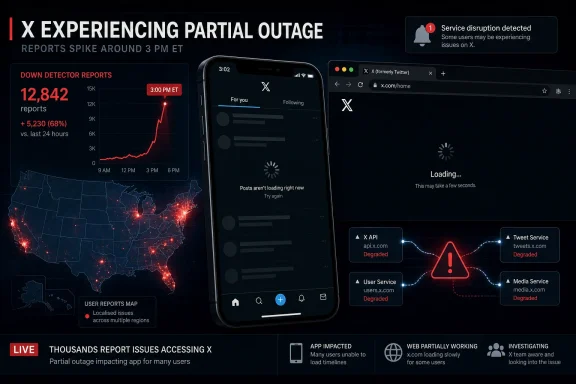
X, formerly Twitter, saw a fresh wave of user-reported problems on Monday afternoon, with Downdetector reports rising shortly before 3 p.m. Eastern and complaints centered mostly on the mobile app, though some users also reported website and timeline failures. The important word is reported: outage trackers are an early-warning system, not a root-cause analysis. But for a platform that functions as a public square, customer-support desk, breaking-news wire, and authentication-adjacent identity layer, even a modest disruption now carries an outsized meaning. X does not merely go down; it reminds everyone how much of the internet still assumes it will be there.
The latest report described nearly 200 problem reports on Downdetector, which is not the sort of number that suggests a global platform has fallen over. It is, however, enough to indicate that a localized or partial failure may have been visible to users, especially when the complaints cluster around one surface: the app.
That distinction matters. A modern social platform can fail in pieces while appearing alive from the outside. The website may load while the app spins. Timelines may show cached posts while new content refuses to appear. Notifications may arrive while replies, direct messages, or posting quietly break behind the glass.
For users, those differences are academic. If the feed does not refresh, if the app throws an error, or if the timeline looks frozen in time, the service is “down” in the only sense that matters. Uptime is no longer a binary state; it is an experience.
The Monday-afternoon timing also fits a familiar pattern. Reports often surface first through outage trackers and user chatter before the company itself says anything, if it says anything at all. That lag creates an information vacuum, and on a platform built to distribute real-time information, the vacuum becomes part of the story.
That is why “Is X down?” is both the right question and the wrong one. The better question is whether the symptoms are consistent across users, platforms, and geographies. If the app fails but the website works, the likely blast radius is different from a full backend outage. If the timeline loads but posting fails, the platform’s read path may be healthier than its write path.
This is where X’s current transparency problem shows. Many major cloud and software vendors maintain status pages that separate degraded performance from full outages and identify affected services. X has not consistently offered the same kind of detailed, public operational posture that enterprise users expect from infrastructure-adjacent platforms.
That absence matters more now than it did in Twitter’s old era. X is not just a social feed; it is a place where public agencies post emergency updates, journalists monitor events, companies handle customer support, creators transact with audiences, and users follow fast-moving crises. A service that wants to be treated like critical communications infrastructure needs a better way to say when the lights are flickering.
That means the mobile app is where failure becomes visible first. App sessions are persistent, cached, and heavily dependent on API calls that may succeed or fail independently. A browser user can refresh, clear cookies, switch networks, or try another tab. An app user gets a spinner and a suspicion.
The app also compresses many subsystems into one emotional experience. Timeline ranking, media loading, direct messages, login state, notifications, posting, ads, and recommendation surfaces can all misbehave in ways that feel like one outage. Users do not care whether the culprit is a timeline service, an API gateway, a bad deployment, or an overloaded edge node.
That is the hidden cost of platform integration. The more X folds into one application — posts, video, subscriptions, livestreaming, AI features, creator monetization, payments ambitions, and identity signals — the less tolerance users have for partial failure. A little degradation can feel like the whole product has gone sideways.
Since Elon Musk’s acquisition of Twitter in 2022 and the later rebrand to X, the platform has been repeatedly reshaped in public. Features have appeared, changed, disappeared, or been renamed at a tempo that keeps the service culturally loud but operationally hard to read. That makes even a minor outage feel like a referendum.
This is not always fair. A few hundred Downdetector reports do not prove systemic neglect, and large distributed systems fail even under conservative management. But perception is part of reliability. When a platform is run with a visible appetite for disruption, users are less likely to assume a glitch is routine.
The result is a credibility tax. Each outage, however brief, is added to a mental ledger that already includes abrupt product changes, API policy shifts, moderation fights, verification confusion, and periodic platform instability. X may restore service quickly, but trust does not reload as easily as a timeline.
That matters because X’s utility has always depended on network concentration. During breaking news, sports, disasters, product launches, elections, software outages, and celebrity chaos, the value is not just that X exists. The value is that everyone else is likely to be looking there too.
A reliability problem therefore has a social dimension. If users begin to doubt that X will be reachable during moments of peak attention, they start building habits elsewhere. They may not delete the app, but they diversify their attention. For a platform whose power comes from being the default place to check right now, that is dangerous.
The shift does not have to be dramatic to matter. A journalist keeps a Bluesky column open. A sysadmin watches vendor status pages instead of searching X. A local government posts to multiple networks. A sports fan opens Threads during a game. These are small acts of redundancy, but redundancy is what users build when they stop trusting a single point of failure.
X does not usually give outsiders enough information to answer that cleanly. That leaves admins and support teams relying on symptoms. If employees cannot access X from managed devices, the cause could be corporate filtering, browser policy, DNS resolution, endpoint security inspection, a mobile app issue, or an actual X-side incident.
The practical response is boring but effective. Test across app and browser. Test on Wi-Fi and cellular. Check whether media, login, posting, and timeline loading fail together or separately. Compare reports across regions before assuming the problem is local. For managed environments, confirm that no security gateway, DNS filter, or app-control policy is blocking a changed endpoint.
The larger lesson is that consumer platforms have become operational dependencies without accepting the norms of operational accountability. IT teams may not run X, but they still field complaints when executives, comms teams, recruiters, journalists, or social-media staff cannot use it. That is shadow infrastructure in its purest form.
The risk is cumulative. Social platforms do not usually lose relevance because of one outage. They lose it when users start assuming instability is normal, when creators cross-post by default, when organizations stop treating the service as the first channel, and when the phrase “check X” becomes “check wherever people are posting.”
That slow erosion is harder to reverse than a server-side incident. Technical teams can roll back a bad deployment. They can restart services, reroute traffic, scale capacity, or patch clients. But confidence is a softer system, and it fails in a less visible way.
This is why Monday’s reports are worth more than a shrug. They are another reminder that X’s ambition to become an everything app runs through the unglamorous work of reliability. Payments, video, AI, creator tools, and real-time news all depend on the same foundation: users opening the app and trusting that it will work.
 The Outage Was Small, but the Signal Was Loud
The latest report described nearly 200 problem reports on Downdetector, which is not the sort of number that suggests a global platform has fallen over. It is, however, enough to indicate that a localized or partial failure may have been visible to users, especially when the complaints cluster around one surface: the app.That distinction matters. A modern social platform can fail in pieces while appearing alive from the outside. The website may load while the app spins. Timelines may show cached posts while new content refuses to appear. Notifications may arrive while replies, direct messages, or posting quietly break behind the glass.
For users, those differences are academic. If the feed does not refresh, if the app throws an error, or if the timeline looks frozen in time, the service is “down” in the only sense that matters. Uptime is no longer a binary state; it is an experience.
The Monday-afternoon timing also fits a familiar pattern. Reports often surface first through outage trackers and user chatter before the company itself says anything, if it says anything at all. That lag creates an information vacuum, and on a platform built to distribute real-time information, the vacuum becomes part of the story.
Downdetector Is a Smoke Alarm, Not a Fire Report
Downdetector is useful because it measures user pain quickly. It is not useful because it proves the precise cause of that pain. A spike can mean a service outage, a carrier routing issue, a bad app build, a regional CDN hiccup, an authentication problem, or simply enough users noticing the same weirdness at the same time.That is why “Is X down?” is both the right question and the wrong one. The better question is whether the symptoms are consistent across users, platforms, and geographies. If the app fails but the website works, the likely blast radius is different from a full backend outage. If the timeline loads but posting fails, the platform’s read path may be healthier than its write path.
This is where X’s current transparency problem shows. Many major cloud and software vendors maintain status pages that separate degraded performance from full outages and identify affected services. X has not consistently offered the same kind of detailed, public operational posture that enterprise users expect from infrastructure-adjacent platforms.
That absence matters more now than it did in Twitter’s old era. X is not just a social feed; it is a place where public agencies post emergency updates, journalists monitor events, companies handle customer support, creators transact with audiences, and users follow fast-moving crises. A service that wants to be treated like critical communications infrastructure needs a better way to say when the lights are flickering.
The App Has Become the Weakest Link Users Notice First
The report that most complaints centered on the app is unsurprising. For most people, X is not a website anymore. It is a notification stream, a home-screen icon, a push-alert machine, and a habit loop wrapped inside a mobile client.That means the mobile app is where failure becomes visible first. App sessions are persistent, cached, and heavily dependent on API calls that may succeed or fail independently. A browser user can refresh, clear cookies, switch networks, or try another tab. An app user gets a spinner and a suspicion.
The app also compresses many subsystems into one emotional experience. Timeline ranking, media loading, direct messages, login state, notifications, posting, ads, and recommendation surfaces can all misbehave in ways that feel like one outage. Users do not care whether the culprit is a timeline service, an API gateway, a bad deployment, or an overloaded edge node.
That is the hidden cost of platform integration. The more X folds into one application — posts, video, subscriptions, livestreaming, AI features, creator monetization, payments ambitions, and identity signals — the less tolerance users have for partial failure. A little degradation can feel like the whole product has gone sideways.
X’s Reliability Story Now Carries Musk-Era Baggage
Every consumer platform has outages. Meta has them. Google has them. Microsoft has them. Apple has them. The difference is that X’s technical incidents are now interpreted through a broader story about ownership, staffing, infrastructure discipline, and product volatility.Since Elon Musk’s acquisition of Twitter in 2022 and the later rebrand to X, the platform has been repeatedly reshaped in public. Features have appeared, changed, disappeared, or been renamed at a tempo that keeps the service culturally loud but operationally hard to read. That makes even a minor outage feel like a referendum.
This is not always fair. A few hundred Downdetector reports do not prove systemic neglect, and large distributed systems fail even under conservative management. But perception is part of reliability. When a platform is run with a visible appetite for disruption, users are less likely to assume a glitch is routine.
The result is a credibility tax. Each outage, however brief, is added to a mental ledger that already includes abrupt product changes, API policy shifts, moderation fights, verification confusion, and periodic platform instability. X may restore service quickly, but trust does not reload as easily as a timeline.
The Former Twitter Still Has a Public-Square Problem
The irony of X outages is that people often go to X to check whether other services are down. When X itself stumbles, users scatter to Downdetector, Reddit, Bluesky, Threads, Mastodon, news sites, group chats, and search engines. The platform becomes the missing witness in its own incident report.That matters because X’s utility has always depended on network concentration. During breaking news, sports, disasters, product launches, elections, software outages, and celebrity chaos, the value is not just that X exists. The value is that everyone else is likely to be looking there too.
A reliability problem therefore has a social dimension. If users begin to doubt that X will be reachable during moments of peak attention, they start building habits elsewhere. They may not delete the app, but they diversify their attention. For a platform whose power comes from being the default place to check right now, that is dangerous.
The shift does not have to be dramatic to matter. A journalist keeps a Bluesky column open. A sysadmin watches vendor status pages instead of searching X. A local government posts to multiple networks. A sports fan opens Threads during a game. These are small acts of redundancy, but redundancy is what users build when they stop trusting a single point of failure.
For IT Pros, “Try Again Later” Is Not an Incident Plan
WindowsForum readers know this pattern from enterprise IT: the first question in any outage is scope. Is it the endpoint? The network? DNS? Authentication? A vendor API? A bad client version? A regional cloud dependency? Consumer users ask “is it down?” Administrators ask “where is the failure domain?”X does not usually give outsiders enough information to answer that cleanly. That leaves admins and support teams relying on symptoms. If employees cannot access X from managed devices, the cause could be corporate filtering, browser policy, DNS resolution, endpoint security inspection, a mobile app issue, or an actual X-side incident.
The practical response is boring but effective. Test across app and browser. Test on Wi-Fi and cellular. Check whether media, login, posting, and timeline loading fail together or separately. Compare reports across regions before assuming the problem is local. For managed environments, confirm that no security gateway, DNS filter, or app-control policy is blocking a changed endpoint.
The larger lesson is that consumer platforms have become operational dependencies without accepting the norms of operational accountability. IT teams may not run X, but they still field complaints when executives, comms teams, recruiters, journalists, or social-media staff cannot use it. That is shadow infrastructure in its purest form.
The Real Risk Is Not One Afternoon of Errors
A brief X disruption is not, by itself, a crisis. Most users will shrug, force-close the app, reopen it, and move on. The platform’s muscle memory is powerful, and its remaining network effects are still formidable.The risk is cumulative. Social platforms do not usually lose relevance because of one outage. They lose it when users start assuming instability is normal, when creators cross-post by default, when organizations stop treating the service as the first channel, and when the phrase “check X” becomes “check wherever people are posting.”
That slow erosion is harder to reverse than a server-side incident. Technical teams can roll back a bad deployment. They can restart services, reroute traffic, scale capacity, or patch clients. But confidence is a softer system, and it fails in a less visible way.
This is why Monday’s reports are worth more than a shrug. They are another reminder that X’s ambition to become an everything app runs through the unglamorous work of reliability. Payments, video, AI, creator tools, and real-time news all depend on the same foundation: users opening the app and trusting that it will work.
The Monday Spike Leaves Users With a Short Checklist
The most useful reading of this incident is practical rather than dramatic. A small Downdetector spike does not prove a major outage, but it does justify checking whether the problem is broader than your phone, your Wi-Fi, or your account.- If X loads in a browser but not in the mobile app, the issue may be app-specific or tied to a mobile API path.
- If neither the app nor the website loads across multiple networks, the problem is more likely to be on X’s side or with a shared network dependency.
- If your timeline shows old posts but will not refresh, the service may be partially degraded rather than fully offline.
- If Downdetector reports are rising quickly, waiting is usually more productive than reinstalling the app or changing account settings.
- If you manage business or public-facing communications, X should be treated as one channel in a redundant stack, not the only place where urgent updates live.
References
- Primary source: aol.com
Published: 2026-06-01T19:50:28.145630
Is X down? Is Twitter down right now? X app down right now? - AOL
According to Downdetector, the former Twitter was having problems Monday afternoon.www.aol.com - Related coverage: phonearena.com
X is still down from coast-to-coast in the U.S. - PhoneArena
An outage is preventing X users in the U.S. from accessing the app and website.www.phonearena.com - Related coverage: macrumors.com
Twitter / X is Down Across iPhone and Web
It's not just you: X is down right now, including on the iPhone and the web. The social media platform, formerly known as Twitter, stopped working in the past few minutes. It is unclear how long the outage will last. We will provide updates as they become available. We will provide updates...www.macrumors.com - Related coverage: aol.co.uk
X down: Twitter not working in major outage - AOL
 www.aol.co.uk
- Related coverage: tech.yahoo.com
Is x down right now? Is twitter down right now? Twitter outage reported
According to Downdetector, the former Twitter was having problems. Most of it was with the timeline.tech.yahoo.com - Related coverage: androidcentral.com
X faces major outage as 78K users report disruption this morning | Android Central
People are seeing issues with the app and website, with feeds not refreshing.www.androidcentral.com
- Related coverage: windowscentral.com
X (Twitter) is down: Millions unable to access timeline and app as X services are knocked offline | Windows Central
A major outage has taken X offline for millions of users, with people reporting they are unable to access the website or the app.www.windowscentral.com - Related coverage: axios.com
Tens of thousands of X users report outages during "massive cyberattack"
Reports of outages spiked several times on Monday.www.axios.com
- Related coverage: techradar.com
X was down again – here's what happened in its latest outage | TechRadar
A bad start to the week for Xwww.techradar.com - Related coverage: as.com
X (Twitter) caído: qué hacer, soluciones y cómo consultar el estado de la red social
X, anteriormente conocida como Twitter, está sufriendo algunos problemas técnicos en España y ni carga ni se puede acceder en la versión de escritorio.as.com
- Related coverage: cadenaser.com
La red social X recupera su actividad tras la segunda caída del día en todo el mundo | Ciencia y tecnología | Cadena SER
La red propiedad de Elon Musk ha recuperado la normalidad sobre las 15:30 horas tras sufrir una hora antes una caída en diversos países, incluidos EEUU, España y Colombia, por causas todavía desconocidas y a lo largo de la tarde ha vuelto a caercadenaser.com - Related coverage: huffingtonpost.es
No hace falta que reinicies el móvil: la red social X (Twitter) sufre una nueva caída mundial
Tal y como ha reportado la web 'Downdetector', la red social que dirige Elon Musk ha registrado un nuevo fallo global.www.huffingtonpost.es
