

The server market has run hotter than most analysts expected in 2025, pushed by an unprecedented build‑out of AI infrastructure — but a parallel surge in memory and storage prices is already reintroducing discipline into buying decisions and could reshape how organizations allocate budgets through 2026. IDC’s latest trackers show the industry ballooning to the mid‑hundreds of billions in annual vendor revenue as hyperscalers race to deploy GPU‑dense racks; meanwhile, suppliers and enterprise buyers face a near‑term reality of constrained DRAM and NAND supply, elevated ASPs, and longer lead times that blunt some of the boom’s shine.
IDC’s public Server Market Insights page reports a dramatic expansion in the worldwide server market during 2025, with full‑year value rising into the hundreds of billions of U.S. dollars and double‑digit — in many periods triple‑digit — quarter‑over‑quarter growth tied directly to accelerated AI server demand. The firm’s published 2024–2026 forecast shows a step function: total server market value increasing from roughly $253 billion in 2024 to about $455 billion in 2025, and jumping again toward $566 billion in 2026. This expansion is not evenly distributed: accelerated, GPU‑embedded systems and non‑x86 platforms (driven largely by hyperscaler custom designs and Arm‑based architectures) are the fastest‑growing segments.
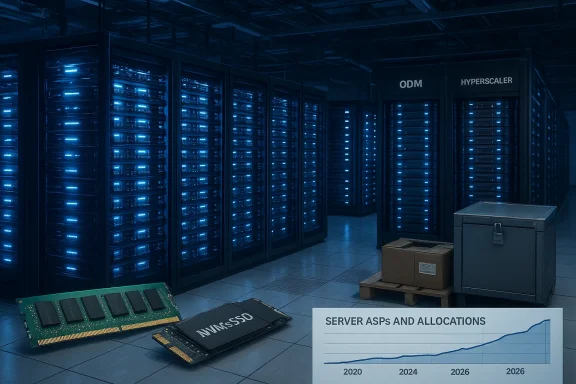
At the same time, multiple industry observers and vendors have warned about memory and flash shortages. Shortages and price hikes for DRAM and enterprise SSDs are creating practical constraints that affect delivery times, configuration choices, and the economics of on‑premises AI deployments for enterprises and cloud providers alike.
Organizations that navigate this period successfully will do so by combining realistic procurement strategies, architectural flexibility, and a willingness to blend cloud consumption with on‑prem investments. Vendors and integrators that offer clarity on lead times, flexible commercial options, and design alternatives will capture the largest share of incremental demand. The boom is real — but so are the pressures that could slow or reshape it. The coming 12–18 months will determine which players emerge as durable winners in a market that has, very quickly, been remade by AI.
Source: IT Pro Memory shortages take the shine off record-breaking server growth
 Background / Overview
IDC’s public Server Market Insights page reports a dramatic expansion in the worldwide server market during 2025, with full‑year value rising into the hundreds of billions of U.S. dollars and double‑digit — in many periods triple‑digit — quarter‑over‑quarter growth tied directly to accelerated AI server demand. The firm’s published 2024–2026 forecast shows a step function: total server market value increasing from roughly $253 billion in 2024 to about $455 billion in 2025, and jumping again toward $566 billion in 2026. This expansion is not evenly distributed: accelerated, GPU‑embedded systems and non‑x86 platforms (driven largely by hyperscaler custom designs and Arm‑based architectures) are the fastest‑growing segments.At the same time, multiple industry observers and vendors have warned about memory and flash shortages. Shortages and price hikes for DRAM and enterprise SSDs are creating practical constraints that affect delivery times, configuration choices, and the economics of on‑premises AI deployments for enterprises and cloud providers alike.
What changed in 2025: AI spending rewrites the server market rules
The hyperscaler effect and accelerated servers
The single biggest structural change is the concentration of demand among hyperscalers and large cloud service providers. Where past server cycles were driven by refreshes and broad enterprise buying, 2025 has been dominated by a relatively small set of large buyers ordering racks upon racks of GPU‑accelerated servers for training and inference clusters.- Hyperscalers are ordering GPU‑dense systems in large volumes, favoring designs with multiple high‑bandwidth GPUs per node.
- Many of these buys are direct or ODM‑direct, bypassing traditional OEM channels in whole‑rack purchases.
- The result: accelerated servers (those with embedded or tightly coupled GPUs/accelerators) now account for a disproportionately large share of server revenue.
Non‑x86 momentum: Arm and custom silicon move into the mainstream
Another notable shift is the rapid expansion of non‑x86 revenues. Arm‑based server designs and other alternative architectures have gained traction where hyperscalers prioritize energy efficiency, custom memory subsystems, or integrated architectures optimized for large language model (LLM) workloads. IDC’s published forecasts show non‑x86 server value rising sharply relative to 2024 levels, reflecting both new product introductions and hyperscaler preference for vertically integrated systems.- Arm designs are attractive to hyperscalers and cloud providers because they enable custom SoC integration and better power per throughput for some AI workloads.
- Vendors that support flexible chassis and custom motherboard designs have benefited as hyperscalers place ODM orders.
x86 remains the largest base — but the growth profile has changed
x86 servers still represent the majority of market value, but their growth is outpaced by accelerated and non‑x86 segments in 2025. Many customers still run x86‑based inference and mixed workloads, and OEMs with broad x86 portfolios continue to capture significant revenue. But the mix is shifting — higher‑value accelerated platforms are changing the composition of total dollars vs. unit counts.Memory and storage: the constraint that threatens to cap growth
What’s happening to DRAM and NAND supply
A critical and recurring theme through the year has been memory allocation and pricing. Manufacturers and market analysts reported constrained allocations of server DRAM and enterprise‑grade NAND as wafer capacity is increasingly diverted to higher‑margin products and AI‑specific memory (such as HBM families) and as fabs prioritize capacity plans that favor advanced nodes and specialty product families.- Buyers report longer lead times and partial order fulfillment for DDR5 server DIMMs.
- Server SSDs and enterprise NAND prices have risen as production is refocused and demand for fast local storage in training and caching increases.
- Some customers are opting to fix prices and secure allocations by contracting early or paying premiums to suppliers, further tightening availability for more price‑sensitive buyers.
Price movement and practical impact
Price increases are not uniform across all memory types, but data from several industry trackers and vendor commentary in late 2025 and early 2026 point to material inflation in DRAM and enterprise SSDs. Procurement teams are seeing elevated quotes for:- High‑capacity DDR5 RDIMMs used in 4+ TB server builds.
- High endurance, NVMe enterprise SSDs used for data staging and model caches.
- HBM and other accelerator‑adjacent memory remain prioritized for AI accelerators, absorbing much of advanced capacity.
- Higher upfront capital costs for the same rack configuration.
- Potential delays in deploying capacity for planned AI projects.
- Trade‑offs between memory size and the number of GPU nodes that can be fielded under a fixed budget.
Strategic responses by buyers and vendors
Buyers and vendors are responding with a range of workarounds and commercial strategies:- Locking in prices and allocations through forward purchase agreements.
- Accepting mixed memory configurations and using software to compensate (e.g., memory tiering, offload to NVMe).
- Increased use of subscription or consumption models to shift capital exposure.
- Prioritizing GPU/accelerator procurement where possible and adapting CPU/memory configs to available supply.
Who won in 2025 — OEMs, ODMs, and the rest of market
OEM leaders and the rise of ODM/direct sales
The 2025 spending surge benefitted multiple OEMs, but the windfall was split between traditional OEMs that successfully adapted their product lines for accelerated workloads and the ODMs that sell directly to hyperscalers.- Established OEMs with strong accelerated server portfolios — and the ability to deliver at scale — captured a substantial share of vendor revenue.
- ODMs and the “rest of market” category (companies supplying hyperscalers directly) grew even faster in percentage terms, reflecting cloud providers’ tendency to buy at rack scale from contract manufacturers.
Regional footprints: where the money moved
Geography mattered a lot in 2025:- The United States accounted for the fastest growth in server revenue, where hyperscaler buildouts and AI projects are most concentrated.
- Canada also saw outsized growth, often tied to North American hyperscaler expansions.
- EMEA and APAC showed healthy double‑digit growth, while China and Latin America trailed at a lower rate. Japan showed pockets of decline in some quarters as hyperscaler buys concentrated elsewhere.
Practical implications for IT pros and procurement teams
For enterprise IT teams considering on‑premises AI
If you’re an IT leader planning on‑prem AI infrastructure in 2026:- Reassess timelines and budgets: expect higher memory and storage costs and longer lead times for target configurations.
- Prioritize architecture decisions: decide whether you need the absolute highest memory per node or whether you can compensate with fast NVMe tiers and software techniques.
- Consider hybrid cloud: where hyperscalers can provide flexible consumption models, offloading some capacity to cloud providers may be more budget‑efficient than competing in the tight hardware market.
For channel partners and system integrators
- Reprice proposals to reflect current component costs and be explicit about lead times.
- Diversify supply lines and include memory alternatives in BOMs where feasible.
- Build consulting offerings around cost‑effective AI deployment patterns that reduce memory footprint without sacrificing model performance.
For CFOs and procurement
- Explore forward purchase agreements for predictable workloads, but weigh the opportunity cost of capital.
- Push vendors for flexible commercial arrangements — leases, consumption models, or staged deliveries that reduce immediate capital outlays.
- Insist on clear SLAs for fulfillment and contingency plans for partial shipments.
Strengths in the current cycle — and why the market’s fundamentals still look solid
- Demand drivers are structural, not cyclical. AI model complexity and the appetite for LLMs and generative AI workloads are creating sustained need for specialized compute.
- Innovation is accelerating: new form factors, integrated GPU/CPU platforms, and Arm‑based and custom silicon options give buyers more choices tailored to specific AI workloads.
- The economics of hyperscale deployments favor continued investment: companies with data advantage are incentivized to keep building infrastructure to protect and monetize their AI efforts.
Risks, fragilities, and second‑order effects to watch
1. Concentration risk: hyperscalers shape the market
When a small group of buyers accounts for a large portion of demand, market dynamics can become volatile. A slowdown or strategic shift by hyperscalers — for example, moving from fresh infrastructure to optimizing existing capacity — could materially depress orders and produce sudden revenue contraction for suppliers that had scaled for sustained orders.2. Component reallocation and supplier incentives
Manufacturers will rationally prioritize the most profitable product lines. If fabs continue prioritizing high‑margin memory types or HBM for accelerators, traditional server DRAM and enterprise NAND could stay constrained, inflating prices further and encouraging substitution or software workarounds.3. Inflation, ASP creep, and buyer pushback
Higher ASPs for servers are manageable for large cloud providers, but many enterprises have fixed budgets. If prices for memory and SSDs stay elevated, companies may delay refreshes or opt for cloud alternatives, reducing the breadth of buyers and concentrating revenue further in hyperscalers.4. Environmental and power constraints
Deploying GPU‑dense racks increases power and cooling requirements. Not all data centers can be upgraded quickly, and the easiest path for many customers may be to colocate with hyperscalers or specialized providers — again concentrating demand and creating potential capacity bottlenecks at sites with the necessary electrical and cooling infrastructure.5. Supply chain opacity and geopolitical risk
As OEMs and ODMs reconfigure supply chains, geopolitical events or export controls affecting advanced nodes, memory, or accelerators could further destabilize supply and prices.Tactical recommendations for organizations evaluating AI infrastructure in 2026
- Be explicit about must‑have vs nice‑to‑have in hardware BOMs. Memory capacity is expensive right now; quantify model performance sensitivity to memory reductions.
- Explore software mitigations: memory tiering, quantization, model pruning, and offload strategies can materially reduce memory requirements for inference and training.
- Treat provisioning as a portfolio decision: combine on‑prem capacity for sensitive workloads with cloud capacity for bursty training needs.
- Negotiate allocation and fulfillment terms with suppliers; consider staged delivery schedules to get partial capacity sooner.
- Revisit total cost of ownership (TCO) models to include higher prices for DRAM and SSDs — don’t assume historical component cost baselines.
What vendors and data‑center operators should be doing now
- Strengthen visibility into wafer‑level allocations for memory and flash and communicate realistic lead times.
- Offer alternative configurations and scaled service options to capture buyers unwilling to pay memory premiums.
- Build or expand consumption and financing programs that smooth customer spend and reduce friction from shortfalls.
- Invest in energy‑efficient rack and cooling technologies to lower operational barriers for GPU‑heavy deployments.
Looking ahead: will price pressure temper the boom?
The short answer: some tempering is likely, but the broader trend of high demand for AI compute is still firmly in place.- Memory and NAND price pressure will likely continue into 2026 while fabs reallocate capacity and increase production for specialized products. That means higher ASPs and potentially fewer units shipped for the same dollars — a dynamic that benefits revenue totals but complicates unit growth and diversity of buyers.
- Hyperscalers will continue to invest aggressively in the near term because the economics of owning training and inference capacity remain favorable; however, the market is becoming more dependent on a handful of large buyers, increasing systemic risk.
- Software innovations that reduce memory footprint or improve model efficiency will gradually reduce pressure on raw hardware demand — but those gains will not immediately eliminate the need for scale. In practice, the market will likely oscillate between periods of rapid capacity additions and pauses as budgets and supply align.
Conclusion
The server market’s 2025 surge — a watershed moment in enterprise infrastructure driven by AI — demonstrates how transformational workloads can rewrite demand patterns almost overnight. For IT pros, procurement teams, and channel partners, the most important takeaway is that value is being re‑priced; hardware dollars now buy different mixes of compute, memory, and storage than they did a year earlier. Memory shortages and sustained price increases are the most immediate constraint and will shape procurement, architecture, and financial choices into 2026.Organizations that navigate this period successfully will do so by combining realistic procurement strategies, architectural flexibility, and a willingness to blend cloud consumption with on‑prem investments. Vendors and integrators that offer clarity on lead times, flexible commercial options, and design alternatives will capture the largest share of incremental demand. The boom is real — but so are the pressures that could slow or reshape it. The coming 12–18 months will determine which players emerge as durable winners in a market that has, very quickly, been remade by AI.
Source: IT Pro Memory shortages take the shine off record-breaking server growth
