

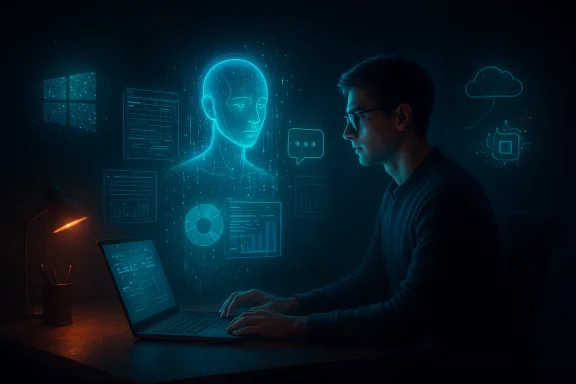
For decades the personal computer and Windows have defined how most of us work, create, and play—but in 2026 the tectonic plates of computing are shifting, and Generative AI and autonomous agents are positioning themselves as the real interface between people and digital outcomes.
The narrative that AI will one day replace the traditional operating system is no longer a provocative thought experiment; it is being argued by analysts, echoed in vendor roadmaps, and reflected in market behavior. Microsoft officially marked a major milestone when it ended mainstream support for Windows 10 on October 14, 2025, a move intended to accelerate migration but also one that exposed how sticky the old OS remained. At the same time, Microsoft doubled down on an “AI-first” vision for Windows: Copilot+ PCs, on-device NPUs, and feature sets that place large and small language models at the center of everyday tasks.
This article takes the TechSpective thesis—that AI will be the last OS most people need—and tests it against market data, vendor strategies, hardware trends, and enterprise realities. It confirms which claims are supported by public evidence, highlights where the argument is strongest, and flags the hard limits and risks that complicate any prediction that Windows will be reduced to legacy status within a short time frame.
As AI agents assume more of the interaction workload, the physical device can change:
At the same time, emerging manufacturing and assembly hubs in Southeast Asia and the Middle East are securing strategic roles in the supply chain. The end-point is a more distributed but politically attentive supply base—one that treats compute as critical national infrastructure.
But the story is not a single linear march to obsolescence for Windows. Instead, it is a complex, multi-vector transition:
Source: TechSpective The Blue Screen of Death for Windows: Why AI is the Last Operating System You’ll Ever Need
 Background
The narrative that AI will one day replace the traditional operating system is no longer a provocative thought experiment; it is being argued by analysts, echoed in vendor roadmaps, and reflected in market behavior. Microsoft officially marked a major milestone when it ended mainstream support for Windows 10 on October 14, 2025, a move intended to accelerate migration but also one that exposed how sticky the old OS remained. At the same time, Microsoft doubled down on an “AI-first” vision for Windows: Copilot+ PCs, on-device NPUs, and feature sets that place large and small language models at the center of everyday tasks.This article takes the TechSpective thesis—that AI will be the last OS most people need—and tests it against market data, vendor strategies, hardware trends, and enterprise realities. It confirms which claims are supported by public evidence, highlights where the argument is strongest, and flags the hard limits and risks that complicate any prediction that Windows will be reduced to legacy status within a short time frame.
The Fragility of the Windows Hegemony
From platform dominance to strategic exposure
For decades, Windows built and defended a durable moat: hardware OEM relationships, backward compatibility, a huge ISV ecosystem, and the sticky value of Microsoft 365. That moat still exists, but its defensive perimeter is under pressure.- Microsoft formally ended support for Windows 10 in October 2025, forcing a choice for millions: upgrade to Windows 11, pay for extended security updates, or run an unsupported OS.
- Adoption of Windows 11 has been uneven. Public trackers and industry surveys show Windows 11 overtook Windows 10 in usage during 2025, but significant percentages of the installed base stayed on Windows 10 up to and beyond EoS. This mismatch between intent and installed reality is crucial: a platform that requires hardware churn to maintain parity can become a growth-limiting bottleneck.
Why TPM 2.0 and hardware rules matter
Windows 11’s hardware baseline—TPM 2.0, Secure Boot, and CPU generation windows—was a deliberate security-first tradeoff. The requirement drove upgrade inertia: millions of machines that could otherwise have migrated were functionally blocked or required firmware updates.- The technical decision to make TPM 2.0 a gating factor strengthened Windows’ security posture, but it created friction at the moment of migration.
- That friction matters because it erodes the psychological and logistical momentum of generational migration; when users resist an upgrade, they start to question whether the OS is an asset or an ordeal.
The Displacement of the Productivity Suite
From tools to outcomes: AI as the interface
One of TechSpective’s central claims is that agentic AI replaces the productivity suite by focusing on outcomes, not tools. The example—prompting AI to analyze budget data and produce a five-slide board summary—captures a realistic workflow shift. Today’s AI tools can:- Parse spreadsheets, databases, and documents.
- Draft narrative summaries, create visualizations, and generate presentation-ready slides.
- Integrate with cloud storage and SaaS endpoints to fetch and reason over the latest data.
What the displacement looks like in practice
- Faster “speed of outcome.” Teams measure productivity by how quickly and reliably they reach an answer, not by how many UI steps they took.
- App-as-service. Traditional desktop apps become back-end services invoked by AI orchestration layers.
- Lower training cost. New hires learn to interact with AI agents (prompts, verification) rather than mastering dozens of application features.
- Not all outcomes are safe to fully automate. Financial reconciliation, compliance reporting, and regulated workflows demand auditable traces and defensible logic.
- The AI is only as good as the data and the orchestration: garbage in, garbage out still applies.
- For creative, exploratory, or developer workflows, the nuance of tool-level control remains valuable. Artists, engineers, and data scientists still rely on local software affordances that agents can’t fully emulate yet.
Beyond the Mouse and Keyboard: A Hardware Revolution
The WIMP legacy meets multimodal AI
Personal computing was born around the WIMP (Windows, Icons, Menus, Pointer) model, optimized for keyboard-and-mouse interaction and a rectangle-based display. AI is inherently multimodal: text, voice, images, gestures, and sensor-driven context all feed into its models.As AI agents assume more of the interaction workload, the physical device can change:
- Devices may shift to natural language-first interactions (voice, glance, gesture).
- Form factors like glasses, earbuds, and “ambient” pucks become credible personal access points.
- On-device NPUs and local models can deliver low-latency experiences that don’t require booting a laptop to get an answer.
The limits of a hardware-only prediction
However, the march to voice-first and glasses-first is neither inevitable nor uniformly desirable.- Environmental constraints (noise, privacy, public etiquette) limit voice-first adoption.
- Display still matters for dense data, creative work, and long-form reading.
- Batteries, heat, and ergonomics remain engineering hurdles for wearable displays that would need to function as general-purpose “PC replacements.”
The New Power Players and Geopolitical Winners
Who stands to gain if the OS becomes invisible
If the OS recedes as an interface, control shifts to whoever owns the intelligence layer, the compute fabric, and the silicon that accelerates models. The most visible beneficiaries are:- NVIDIA and AMD: The economics and performance of modern AI favor specialized accelerators (GPUs, NPUs). These companies control essential silicon and software stacks where high-performance inference and training run.
- AI model providers (OpenAI, Anthropic, and others): If the “user interface” is an LLM or an agentic service, model providers become the de facto platform owners—controlling the personality, capabilities, monetization, and trust relationship.
- Cloud titans (AWS, Google Cloud, Azure): The elastic compute, storage, and data services required to run global, low-latency agents remain concentrated in major cloud providers who can offer scale, regional redundancy, and compliance features.
Geopolitics and “Pax Silica”
The semiconductors and compute infrastructure that underpin AI are geopolitically concentrated. Nations with advanced chip fabrication, packaging, and equipment (the US, Japan, South Korea, the Netherlands—home to key suppliers) are advantaged. This structural reality is accelerating what some analysts call a new alignment of industrial policy around compute sovereignty.At the same time, emerging manufacturing and assembly hubs in Southeast Asia and the Middle East are securing strategic roles in the supply chain. The end-point is a more distributed but politically attentive supply base—one that treats compute as critical national infrastructure.
Fragility and concentration risk
The AI-first future amplifies concentration risk: dominant hardware vendors, hyperscalers, or model owners could capture disproportionate economic and policy influence. Resilience requires:- Multiple hardware architectures and open standards.
- Interoperable agent-to-agent protocols to avoid lock-in.
- National and corporate strategies for data and compute sovereignty.
The Timeline: Hybrid Phase to Post-PC
TechSpective frames the transition in three windows. The broad contours are plausible, but dates and pace are uncertain.- 2025–2027: The Hybrid Phase
- AI features are integrated into OSes as value-adds (Copilot in Windows, on-device models in Copilot+ PCs).
- Users retain keyboards and mice but offload many routine flows to agents.
- Enterprises pilot agentic workflows alongside traditional apps.
- 2027–2030: The Decoupling
- AI-first hardware reaches wider price parity with mid-range laptops.
- Enterprises begin deploying thin clients and cloud agents for standardized workflows.
- The desktop remains for specialized work, but the majority of transactional tasks move to agent layers.
- 2030+: The Post-PC Era
- The OS becomes an invisible substrate. Daily digital life is mediated by persistent, multimodal agents tied to user identity and cloud compute.
- Legacy Windows survives for niche and enterprise scenarios; mainstream consumers live in agentic ecosystems.
Critical Analysis: Strengths and Weaknesses of the AI-OS Thesis
Strengths (where the thesis is strongest)
- User experience simplification: AI agents reduce UI friction and allow people to request outcomes in natural language. That is a foundational change that makes old metaphors (folders, file paths) feel less relevant.
- Composability: Agents orchestrate cloud services, bridging data silos and delivering integrated outputs—something the app-centric model struggles to do seamlessly.
- Hardware acceleration tailwind: The rapid maturity of NPUs and GPU-optimized model runtimes makes real-time, on-device AI plausible, lowering latency and privacy friction.
Weaknesses and risks (where the thesis overreaches or underestimates friction)
- Compatibility and legacy inertia: Enterprises have hundreds of mission-critical apps and processes that are costly and risky to rewrite for agentic paradigms. The cost of migration is non-trivial.
- Trust, auditability, and liability: Autonomous agents that take actions (send emails, change budgets, approve invoices) create thorny governance questions. Regulatory frameworks are not yet mature enough to accept fully automated decision-making in many domains.
- Monoculture risks and vendor lock-in: If a few model providers become the interface layer, competition and innovation could suffer. Openness of agent APIs and portability are unresolved.
- User preference and accessibility: Not all users prefer voice or always-on agents. Accessibility, privacy expectations, and cultural factors will shape adoption paths.
Unverifiable or speculative claims
- Any specific claim that “Windows will be obsolete for the average consumer by 2030” is plausible but not provable today. The trajectory supports a reduced role for Windows as the primary consumer-facing OS, but the timeline and the precise contours of adoption remain speculative.
- References to newly coined geopolitical labels (for example, “Pax Silica”) reflect a useful framing, but the label itself is rhetorical rather than a codified geopolitical reality and should be treated as an interpretive shorthand.
What This Means for Microsoft, OEMs, and Competitors
For Microsoft
- Microsoft has the unique advantage of owning enterprise relationships, Windows, Office, Azure, and partnerships with hardware OEMs. That vertical breadth is a strategic asset.
- The company must manage a delicate balance: push AI experiences that create new value while maintaining backward compatibility and enterprise trust.
- Product moves that feel coercive (aggressive upgrade nudges, opaque data collection) risk reputational damage and regulatory scrutiny.
For OEMs and silicon vendors
- OEMs bet on Copilot+ PCs and NPU-equipped devices to justify premium pricing and new refresh cycles.
- Silicon vendors that provide efficient local inferencing will capture a significant slice of the value chain. But power efficiency and developer ecosystem support will determine winners.
For cloud and model providers
- Cloud providers will reap growth as compute demand explodes, but must incorporate latency strategies, regional compliance, and multi-cloud interoperability.
- Model providers need to focus on safety, fine‑tuning for domain tasks, and mechanisms for explainability to be accepted as trustworthy interfaces.
Practical Advice for IT and Power Users
For IT leaders (concise playbook)
- Inventory and classify: Identify workloads suitable for agentic automation and those that require strict audit trails.
- Pilot cautiously: Deploy agentic workflows in low-risk, high-value pockets (e.g., knowledge work, customer interactions) before wide rollout.
- Governance and logging: Implement auditable orchestration, human-in-the-loop checkpoints, and escalation rules for autonomous actions.
- Invest in identity and data fabric: Agents are only as good as the data they access—secure, governed data is essential.
For consumers and power users
- Evaluate Copilot and agent features based on outcomes, not hype. Try to quantify time saved and productivity improvements.
- Watch for privacy tradeoffs: on-device AI reduces cloud exposure, but many experiences still rely on hybrid models that transmit context.
- Consider alternative OS paths (Chromebooks, Linux, lightweight devices) if Windows upgrades are constrained by hardware or cost.
What Microsoft Could Do to Smooth the Transition
- Prioritize interoperability: Publish agent-to-agent and agent-to-app protocols that enable other model providers and orchestration layers to interoperate with Windows services.
- Offer transition guarantees: Clear migration tooling and long-term compatibility modes reduce enterprise migration risk.
- Expand local AI affordability: Work with silicon partners and OEMs to create entry-level Copilot experiences that don’t require high-end NPUs, broadening the install base.
- Lead on governance: Microsoft should pioneer auditable logs, policy controls, and regulatory engagement for agentic automation—using enterprise customers as a proving ground.
Conclusion
The TechSpective thesis—that AI will become the interface and potentially the last “OS” most people need—is grounded in observable trends: agentic workflows, on-device NPUs, rising cloud compute demand, and the growing centrality of model providers. The move from “software tools” to “digital outcomes” reframes how we think about productivity and interfaces.But the story is not a single linear march to obsolescence for Windows. Instead, it is a complex, multi-vector transition:
- Windows will evolve and likely remain indispensable in many enterprise, creative, and developer scenarios.
- For everyday consumer tasks and routine business workflows, agentic AI can and will replace many traditional app-centric interactions.
- The winners will be entities that combine compute, models, and trusted orchestration—silicon companies, cloud providers, and model owners—unless governance, openness, and competition temper concentration.
Source: TechSpective The Blue Screen of Death for Windows: Why AI is the Last Operating System You’ll Ever Need
