

Interact’s Autumn 2025 release pushes the company from a traditional intranet vendor into the fast‑moving world of agentic AI for employee experience — promising a Microsoft Copilot connector, agentic “Signal” and “Recognition” agents, out‑of‑the‑box HR and IT integrations, and deeper social features designed to surface the workplace signals leaders usually miss. The launch is a clear response to two persistent enterprise problems: employees losing time to context switching between fragmented systems, and leaders missing informal, high‑value signals — praise, emerging concerns, compliance risk — buried in everyday conversations. Interact positions its platform as the single surface to reduce friction, turn chatter into action, and make recognition visible at scale. This article examines what the Autumn 2025 release actually delivers, validates key technical claims where possible, and lays out the operational, security and governance trade‑offs IT and internal communications teams must consider before they flip the switch.
Agentic AI — software that reasons across steps, calls tools, and acts on behalf of users — has moved from research labs into mainstream enterprise tooling this year. Major productivity providers have baked agent primitives and low‑code tools into their stacks so that copilots, “agents”, and connectors can access business data, run multi‑step workflows, and appear inside Teams, SharePoint, and Outlook. These platform moves create both opportunity and operational responsibility: agents can substantially reduce context switching and automate repetitive tasks, but they also require identity, governance, traceability, and careful data handling to avoid leakage or erroneous actions.
Against that backdrop, Interact’s announcement signals two things. First, intranets are trying to reassert themselves as the central hub where knowledge, HR services, recognition, and social signals meet. Second, vendors are adding agentic features to derive signal from noisy social and collaborative channels — not just to answer static FAQs but to surface trends, praise, and potential risks in near real‑time.
Important: several of these claims are vendor statements in a press release and should be validated by customers during procurement (for instance, whether the Copilot connector is available in your tenant configuration, the nitty‑gritty of the SuccessFactors and ServiceNow integrations, and where agent compute and logs run). Treat the release as the vendor’s product snapshot rather than an independent audit.
Why this approach can work
Key benefits Interact claims
However, a few verification steps are necessary:
Concrete governance checklist
Practical next steps
Source: GlobeNewswire Interact's Enterprise Employee Experience Platform Adds Agentic AI to Drive Employee Listening at Scale
 Background / Overview
Agentic AI — software that reasons across steps, calls tools, and acts on behalf of users — has moved from research labs into mainstream enterprise tooling this year. Major productivity providers have baked agent primitives and low‑code tools into their stacks so that copilots, “agents”, and connectors can access business data, run multi‑step workflows, and appear inside Teams, SharePoint, and Outlook. These platform moves create both opportunity and operational responsibility: agents can substantially reduce context switching and automate repetitive tasks, but they also require identity, governance, traceability, and careful data handling to avoid leakage or erroneous actions.Against that backdrop, Interact’s announcement signals two things. First, intranets are trying to reassert themselves as the central hub where knowledge, HR services, recognition, and social signals meet. Second, vendors are adding agentic features to derive signal from noisy social and collaborative channels — not just to answer static FAQs but to surface trends, praise, and potential risks in near real‑time.
What Interact announced (what’s new)
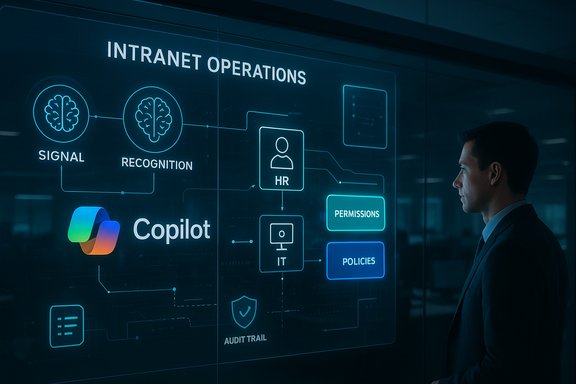
Interact’s Autumn 2025 release bundles several headline features that map to three practical goals: reduce context switching, surface hidden signals, and make recognition timely and trackable. The vendor’s public messaging lists these capabilities:- Microsoft Copilot Connector (permission‑aware intranet content available to Microsoft 365 Copilot).
- Out‑of‑the‑box integrations with SAP SuccessFactors and ServiceNow via Interact’s Marketplace.
- Signal Agent — an always‑on agentic AI that analyzes posts, comments, and forum discussions to detect sentiment shifts, trending topics, and potential risks.
- Recognition Agent — agentic AI that detects recognition signals across internal channels and routes them to the right managers with context.
- Enhanced workplace social tools and marketplace extensions for HR and IT self‑service.
- Early access customers report improved visibility into culture and recognition; Interact cites Love’s Travel Stops as an early access reference.
Important: several of these claims are vendor statements in a press release and should be validated by customers during procurement (for instance, whether the Copilot connector is available in your tenant configuration, the nitty‑gritty of the SuccessFactors and ServiceNow integrations, and where agent compute and logs run). Treat the release as the vendor’s product snapshot rather than an independent audit.
Why the Copilot connector matters — and what to validate
Interact’s pitch is that the new Microsoft Copilot Connector “securely exposes intranet content within Microsoft 365 Copilot, delivering permission‑aware answers without requiring employees to leave their workflow.” If implemented as described, this is a material usability win: employees can get intranet knowledge surfaced inline in Outlook, Teams or the Microsoft 365 Copilot experience, reducing context switches and lowering friction for everyday queries. Microsoft’s agent and Copilot surfaces are explicitly designed for that kind of in‑flow knowledge retrieval, and platform documentation shows mechanisms to honor identity and permission boundaries when indexing content for Copilot use. But there are operational details that determine whether the promise is realized in practice:- Where is the connector hosted? Does it act as an MCP-style server or a managed, vendor-hosted integration? The security model, network topology (VNet/private endpoint), and data residency hinge on this.
- How are permissions enforced at query time? Permission-aware results require both correct indexing and runtime enforcement; confirm that Copilot responses to intranet queries include the same access checks as the intranet itself.
- What data is surfaced to the underlying LLM? Even when answers are permissioned, the model’s context and any logs used for training or telemetry must be bounded by policy.
- Audit trail and observability: does the connector generate traceable logs of queries, tool calls and agent actions that security and compliance teams can review?
- Demand a data flow diagram showing where content is indexed, how Copilot accesses it, and whether a third party hosts connectors.
- Verify identity mapping and permission enforcement — insist on tenant‑scoped validation tests.
- Require logging and audit export formats compatible with your SIEM / eDiscovery tools.
- Confirm model provider, retention policies, and whether queries are used to improve vendor models.
Signal Agent: employee listening at scale — capabilities and caveats
Interact’s Signal Agent is described as an always‑on agentic AI that analyzes internal posts, comments and forum threads to detect sentiment shifts, trending topics, and potential compliance risks — and then routes alerts to the appropriate teams (Internal Comms, HR, IT, Security). This shifts employee listening from periodic surveys to continuous monitoring, which has clear benefits for responsiveness and culture management. It also raises several practical questions.Why this approach can work
- Real‑time surfacing of trends reduces detection time for critical issues — safety complaints, misinformation, policy confusion — enabling faster interventions.
- Automated signal extraction reduces manual moderation load and the “survey fatigue” problem by passively listening to naturally occurring conversations.
- When combined with structured HR/IT integrations, insight → action loops can be closed faster (e.g., a flagged IT outage mention can auto‑open a ServiceNow ticket).
- The model’s grounding approach: does Signal Agent return source citations and confidence scores, or only high‑level summaries? Grounded outputs with citations reduce hallucination risk.
- Scope and sampling: what channels and metadata are included? Public forums, private groups, direct messages — each has different privacy and legal implications.
- False positives and escalation thresholds: how are noisy or ambiguous signals triaged before escalation to HR or Security?
- Retention and anonymization: are transcripts retained raw, and is personal data redacted or pseudonymized when surfaced to broader teams?
- Monitoring employee communications is a privacy minefield. Without clear policy, opt‑outs, and legal review, continuous monitoring can damage trust and create regulatory exposure.
- Over‑reliance on automated sentiment can misinterpret sarcasm, context or topic shifts; human review is essential.
- In regulated industries (healthcare, finance, public sector), listening systems must be scoped to compliance constraints and subject to formal oversight.
Recognition Agent: turning invisible praise into measurable culture
Recognition Agent is purpose‑built to detect praise and recognition signals across internal channels and route them to managers with context. This addresses a perennial people problem: recognition almost always occurs informally (in chat threads, mentions, reply threads) and then evaporates. Making recognition timely and visible helps retention, engagement, and can improve performance reviews when integrated with HR systems.Key benefits Interact claims
- Detects recognition signals across intranet posts and social channels.
- Routes those signals to the right manager with contextual information.
- Prioritizes frontline teams and does so at scale, so managers can act promptly.
- Precision vs. recall: detection models must balance catching most moments of praise without spamming managers with marginal mentions.
- Attribution: recognition often involves teams or cross‑functional contributions—models must surface contributors and context clearly.
- Integration with HRIS and rewards: linking detected recognition to tangible reward workflows (badges, nominations, nominations to SuccessFactors) raises the business value.
- Run Recognition Agent on a pilot community (e.g., a single region or frontline cohort).
- Measure manager adoption, number of recognized cases acted upon, and perceived fairness.
- Tune detection thresholds and notification cadence based on feedback.
The announced HR & IT integrations (SAP SuccessFactors, ServiceNow) — what to expect
Interact says new out‑of‑the‑box integrations with SAP SuccessFactors and ServiceNow bring HR and IT self‑service into the intranet via its Marketplace: PTO balances, task lists, ticket submission, knowledge articles, and similar actions available without leaving the intranet. These integrations are consistent with a broader market trend: vendors are packaging pre‑built connectors to HRIS and ITSM systems to reduce integration lift and make the intranet a portal for transactional work.However, a few verification steps are necessary:
- Confirm supported versions and deployment modes (cloud vs on‑prem). SAP SuccessFactors and ServiceNow installations vary widely across organizations, and “out‑of‑the‑box” can mean different things.
- Check the authorization model (OAuth, SAML, service accounts) and least‑privilege configuration.
- Validate the connector’s reach: read-only vs. read/write; ticket creation, updates, attachments, and commenting are higher‑risk capabilities that require stricter controls.
- Test for latency and scaling under peak load to avoid blocking critical HR or IT operations.
Governance, security and compliance: the real work behind agent rollouts
Agentic features require operational work that many organizations underestimate. The market has responded with platform features — Entra Agent IDs, agent lifecycle controls, observability tooling, Model Context Protocol (MCP) connectors and admin approval flows — but responsibility sits squarely with customers to apply those controls properly.Concrete governance checklist
- Identity & lifecycle: assign agent identities and integrate them into your access review and attestation processes.
- Least privilege and connector hardening: limit agents to the minimum scope and verify connector permissions regularly.
- Observability & audit trails: ensure agent actions, invoked tools, and query logs are exported to your SIEM and that you have end‑to‑end traceability.
- Model and tool provenance: require vendors to disclose model providers and whether customer data is used to train broader models.
- Human oversight & escalation: require human sign‑off for actions that change records or affect employee status; log every automated change for review.
- Privacy & legal review: formalize monitoring scopes, retention windows, and employee notification and consent where required by law or contract.
Verification and independent cross‑checks
Key claims in the Interact release map to broader trends and Microsoft platform capabilities:- Microsoft has invested heavily in Copilot, agent tooling and in‑product agent stores — an ecosystem that enables vendors like Interact to expose intranet content into Copilot and to leverage agent frameworks. Independent coverage of Microsoft’s Copilot and agent strategy corroborates that the technical plumbing exists for permission‑aware connectors and agent publishing.
- The Model Context Protocol (MCP) and related standards are widely discussed as the integration fabric for agents connecting to enterprise data sources; this standard — combined with Copilot Studio and Entra identity features — is the likely reference architecture Interact uses when describing secure Copilot connectors. That landscape is well‑charted in vendor and technical analysis.
- Interact’s statement that it is a Microsoft Cloud AI Partner: this is a partner claim published in the vendor release. Customers should validate partner status and program level through Microsoft’s partner portal and procurement contacts before relying on partner‑specific entitlements.
- Metrics and outcomes implied by the release (for example, uplift in engagement or detection rates) are anecdotal until validated with independent data or customer case studies. Treat early access customer quotes as qualitative signals rather than audited metrics.
Practical rollout plan for IT, HR and Internal Comms
Adopting Interact’s Autumn 2025 features should follow a staged, risk‑aware sequence. The following plan compresses common industry practice into a four‑phase approach.- Pilot and scope (4–8 weeks)
- Select a bounded user group (one business unit or frontline cohort).
- Validate core connector functionality (Copilot indexing, SuccessFactors read scenarios, ServiceNow ticket creation).
- Test Signal and Recognition Agents in read‑only or alert‑only modes with human reviewers.
- Governance and security (parallel)
- Integrate agent identities into identity lifecycle and role‑based access review.
- Configure logging, export audit trails, and map alerts to SIEM.
- Define retention, deletion, and model usage policies; require vendor attestations.
- Operationalize (8–16 weeks)
- Expand integrations to additional HR/IT functions after baseline SLAs are met.
- Empower managers with training and playbooks to act on Recognition Agent prompts.
- Tune Signal Agent thresholds to balance noise and sensitivity.
- Measure and iterate (ongoing)
- Track adoption, recognition response rates, ticket automation outcomes, and false positive rates.
- Conduct quarterly privacy and security audits.
- Incorporate human feedback loops to refine agent behaviour and escalate unresolved issues.
- Validate data residency, contract clauses about model use, and SOC/ISO compliance evidence.
- Ensure Copilot connector enforces permissioning at query time and provides paper trails.
- Start with alert‑only Signal Agent modes until confidence in accuracy is established.
- Train managers and create standard operating procedures to respond to surfaced recognition and risk alerts.
Strengths, limitations and business risk
Strengths- Improved flow‑of‑work: Integrating HR and IT tasks into the intranet and surfacing answers in Copilot reduces context switching and improves employee productivity if implemented correctly.
- Scaled listening and recognition: Automated signal extraction and recognition amplification fix a long‑running cultural blindspot — invisible praise becomes actionable, and emerging concerns can be detected earlier.
- Market alignment: Interact’s moves mirror platform vendor investments in agents and connectors, increasing the likelihood of ecosystem compatibility.
- Privacy and trust: Continuous monitoring of internal communications without transparent policy and opt‑in/opt‑out mechanisms risks eroding employee trust.
- Hallucinations & false positives: Agentic models can be wrong; unchecked automation that updates records or triggers actions can cause operational harm.
- Integration complexity: “Out‑of‑the‑box” often still requires tenant‑level configuration, custom mapping, and security hardening to meet enterprise requirements.
- Vendor claims vs. reality: Press releases convey intent and product snapshots; independent verification through pilots and technical due diligence remains essential.
Bottom line — what organizations should do next
Interact’s Autumn 2025 launch is a timely example of how intranet vendors are moving beyond content publishing into agentic employee experience. The product direction — Copilot connector, Signal and Recognition agents, HR/IT connectors — is the logical next step for intranets that want to remain central to daily work. At the same time, deploying agentic features safely requires the same disciplines enterprises already apply to cloud and SaaS projects: identity control, logging, least‑privilege connectors, human oversight, and legal review.Practical next steps
- Treat the release as an invitation to pilot, not a turnkey production play. Demand technical demos that show tenant‑specific permissioning and end‑to‑end audit trails.
- Require clear vendor commitments on data use, model training, and retention.
- Start with narrow, measurable use cases (e.g., recognition amplification for frontline teams; IT ticket submission) and measure both hard outcomes (ticket resolution time, recognition response rates) and soft outcomes (employee trust, manager satisfaction).
- Integrate governance early: assign agent owners, add agents to access reviews, and connect logs to your SOC.
Source: GlobeNewswire Interact's Enterprise Employee Experience Platform Adds Agentic AI to Drive Employee Listening at Scale
