

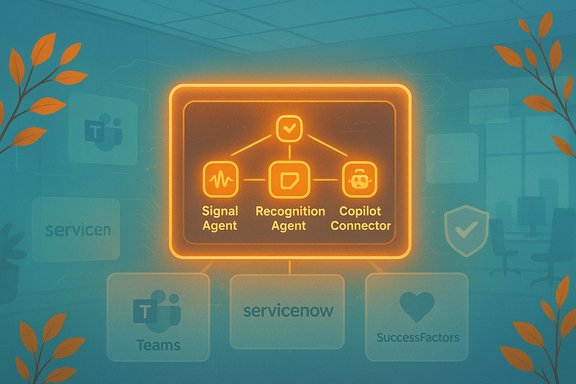
Interact’s Autumn 2025 release vaults the company from intranet vendor to an agentic AI platform for employee experience, bundling a Microsoft 365 Copilot connector, always‑on listening agents (Signal Agent), a Recognition Agent for praise capture, and prebuilt HR/IT integrations designed to reduce context switching and surface hidden workplace signals. The launch promises permission‑aware Copilot answers, in‑intranet HR and IT self‑service via marketplace connectors, and automated detection of sentiment shifts and recognition across internal channels—an ambitious feature set that reflects broader industry momentum toward agent‑driven productivity and in‑flow knowledge.
Enterprise intranets have long claimed to be the single place employees go to find people, policies, and processes. In practice, the day‑to‑day worker switches among email, chat, HRIS, ITSM, and document stores, losing focus with every context switch. Modern intranet vendors want to reclaim that central surface by not just hosting content but by acting as an active, permission‑aware hub that listens, routes, and nudges work forward.
Interact’s Autumn 2025 messaging frames three core outcomes: move work along, know where attention is needed, and make success the norm—each supported by discrete technical investments: a Microsoft Copilot Connector, Signal and Recognition agents, and marketplace connectors for HR and IT systems. The company positions these features as generally available to customers and cites early access feedback from customers such as Love’s Travel Stops.
Source: GlobeNewswire Interact's Enterprise Employee Experience Platform Adds Agentic AI to Drive Employee Listening at Scale
 Background / Overview
Enterprise intranets have long claimed to be the single place employees go to find people, policies, and processes. In practice, the day‑to‑day worker switches among email, chat, HRIS, ITSM, and document stores, losing focus with every context switch. Modern intranet vendors want to reclaim that central surface by not just hosting content but by acting as an active, permission‑aware hub that listens, routes, and nudges work forward.Interact’s Autumn 2025 messaging frames three core outcomes: move work along, know where attention is needed, and make success the norm—each supported by discrete technical investments: a Microsoft Copilot Connector, Signal and Recognition agents, and marketplace connectors for HR and IT systems. The company positions these features as generally available to customers and cites early access feedback from customers such as Love’s Travel Stops.
What Interact announced (feature snapshot)
Microsoft Copilot Connector
- Exposes intranet content to Microsoft 365 Copilot in a permission‑aware manner so employees can get answers inside Teams, Outlook, or Copilot without leaving their workflow. Interact describes the connector as respecting tenant permissions and delivering in‑flow answers.
Signal Agent (agentic listening)
- An always‑on agentic AI that analyzes posts, comments, and forum discussions to detect sentiment shifts, trending themes, and potential risks, then routes alerts to Internal Communications, HR, IT, or Security teams. It’s presented as a continuous employee‑listening capability designed to reduce survey fatigue and accelerate remediation.
Recognition Agent
- An agent that detects recognition signals (praise, achievements) across internal channels and routes those moments to the right managers—especially focused on surfacing frontline recognition that typically disappears in chat threads.
Marketplace connectors for HR and IT
- Out‑of‑the‑box integrations with SAP SuccessFactors and ServiceNow to surface PTO balances, task lists, ticket submission, and knowledge articles inside the intranet, removing common context switches between HR/IT systems and communication surfaces.
Why the timing makes sense: platform context and feasibility
Two platform trends make Interact’s claims technically plausible today:- Microsoft’s Copilot and agent ecosystem has matured. Copilot Studio and the Model Context Protocol (MCP) enable connectors that bring tenant knowledge into Copilot experiences and permit agents to call external tools or APIs in a controlled way. This plumbing explicitly supports permissioned connectors and agent orchestration—exactly the primitives a vendor like Interact needs to deliver a Copilot integration.
- The agentic AI paradigm (agents that plan, call tools, and perform multi‑step actions) is now mainstream in enterprise tooling. Multiple vendors are shipping tenant‑scoped agents and connectors that interoperate with Copilot, ServiceNow, or other enterprise systems. The market now expects agents to be auditable, identity‑tracked, and governed—features Microsoft and others are adding to their platforms.
Technical verification — what can be confirmed independently
Several load‑bearing technical claims in the press release can be cross‑checked against public platform documentation and third‑party vendor moves:- Copilot connectors and MCP: Microsoft’s Copilot Studio documentation and MCP public preview describe how connectors bring external knowledge and actions into agents and tenant Copilot experiences. That public work validates the concept of a permission‑aware connector and agent linking.
- Vendor adoption of Copilot connectors: Other enterprise content and service vendors (Box, ServiceNow, Zendesk, etc. have publicly announced Copilot connectors and agent integrations, confirming the industry trajectory toward device/tenant‑scoped agents and connectors. These announcements support the plausibility of Interact’s engineering direction.
- Interact’s own release: The GlobeNewswire and Interact news pages state the new capabilities and list customers and early access feedback, which corroborates the feature list and availability claim in the vendor channel. These are vendor statements and should be treated as such until independently validated in a customer pilot.
What still requires vendor validation (practical procurement checklist)
Several operational and security details are critical to confirm before deployment. These determine whether the experience will match the headline promise and whether the solution fits corporate governance:- Hosting and architecture
- Is the Copilot Connector hosted by Interact, tenant‑hosted, or mounted behind a tenant VNet/private endpoint?
- Where do agent compute and logs run (vendor cloud, customer Azure subscription, or a managed service)?
- Does the connector implement MCP as per Microsoft guidance, or does it use a bespoke API proxy?
- Permission enforcement
- Are permission checks enforced at query runtime (live) or only at indexing time?
- Can results ever leak content that the requesting user isn’t authorized to see?
- Does the connector honor Microsoft sensitivity labels and Entra identity mappings?
- Model provider and telemetry
- Which LLMs power Signal Agent and Recognition Agent (e.g., Anthropic, OpenAI, Microsoft‑hosted models)?
- Are customer queries, prompts, or outputs logged or used to fine‑tune vendor models?
- What are retention policies for transcripts and processed metadata?
- Observability and audit
- Are full audit trails (query provenance, tool calls, agent actions) exportable to SIEM, eDiscovery and compliance tooling?
- Is there per‑action versioning and the ability to replay agent decisions?
- Data minimization and privacy
- Are personal or sensitive fields redacted or pseudonymized when signals are surfaced to broader teams?
- Is opt‑out supported for certain employee groups or channels?
- Has the solution been legally reviewed in key jurisdictions where the organization operates?
- Accuracy, false positives and escalation
- What are the agent’s precision/recall benchmarks for sentiment detection and recognition extraction?
- How are false positives triaged before an alert reaches HR or Security to avoid noisy escalations?
Operational and ethical risks
Building always‑on listening into the intranet creates measurable benefits—and measurable liabilities.- Trust erosion and employee privacy: Continuous monitoring, even limited to forum posts and public intranet comments, can be perceived as surveillance. Transparency, clear policy, and employee consent channels are essential to avoid trust damage. Without explicit governance, automated monitoring risks chilling effects on candid employee communication.
- False positives and escalation damage: Sentiment detectors and topic classifiers misinterpret nuance, sarcasm, or localized context. Over‑escalation to HR or Security based on noisy signals will distract teams and reduce credibility. Human‑in‑the‑loop review and conservative escalation thresholds are required.
- Compliance and cross‑border data flows: Depending on where agent logs and model compute run, the deployment may trigger data transfer rules, regulatory reporting, or restrictions under laws like GDPR. Contracts and technical controls must cover residency and transfer details.
- Model governance and vendor lock‑in: If the vendor uses proprietary model fine‑tuning on customer data, organizations must understand IP, portability, and whether vendor model updates could alter behavior unpredictably. Insist on contractual controls for model training data and portability of agent definitions.
Enterprise implementation checklist — a pragmatic rollout plan
- Start with a narrow, low‑risk pilot
- Choose one or two channels (public intranet forums, FAQ pages) and a single use case (e.g., IT outage detection or frontline recognition).
- Define KPIs: detection latency, precision/recall for signals, number of valid escalations, manager action rate after recognition alerts.
- Validate connector behavior with tenant tests
- Run tenant‑scoped penetration tests and permissioned queries to confirm runtime permission enforcement and lack of leakage.
- Require full logging and exportability
- Contractually require logs in standard formats and the ability to forward events to SIEM/eDiscovery systems.
- Insist on human review workflows
- Route alerts to a small operations team for triage before wider HR/Security escalation.
- Define retention, redaction and consent policies
- Publish employee‑facing policy and provide opt‑out channels where legally required.
- Measure business outcomes and costs
- Track time saved from reduced context switching, recognition impact on engagement, and Copilot/agent runtime costs.
- Negotiate contract safeguards
- Include data usage limits, model‑training restrictions, exportable agent definitions, and SLAs for false positive reduction and incident response.
How each new capability maps to practical IT and comms outcomes
- Copilot Connector → reduced context switching and faster in‑flow answers.
- Practical gain: fewer clicks and less time lost to searching multiple systems; however, only realized if the connector enforces permissions and returns reliable, grounded results.
- Signal Agent → early detection of employee concerns and emerging operational issues.
- Practical gain: faster incident response and reduced reliance on periodic surveys; risk: noisy signals unless thresholds and human triage are applied.
- Recognition Agent → consistent, timely recognition pushed to managers.
- Practical gain: improved morale and retention signals, particularly for frontline workers who are not always visible in corporate reporting.
- Marketplace HR/IT connectors (SuccessFactors/ServiceNow) → reduced friction for routine HR/IT tasks.
- Practical gain: employees complete tasks without leaving the intranet surface; risk: integration correctness and data consistency must be assured.
Competitive and market context
Interact’s move follows a broad market pattern: vendors that historically focused on content and search are adding agentic layers to convert passive intranet content into active workflows. Microsoft’s Copilot Studio and MCP, and similar integrations from vendors like Box and ServiceNow, have lowered the integration friction for partners that want to surface tenant content into Copilot and run governed agents. This creates vendor opportunity but also raises the bar for governance, identity and observability—areas where enterprises will expect enterprise‑grade controls before rollout.Strengths in Interact’s approach — what to like
- Practical product focus: Interact bundles recognized pain points—context switching, hidden recognition, and slow listening cycles—into a single product narrative that is easy for Internal Comms and HR to evaluate.
- Ecosystem compatibility: Out‑of‑the‑box connectors for SuccessFactors and ServiceNow align with common enterprise stacks, reducing the integration lift for customers.
- Early customer feedback: Love’s Travel Stops and other pilot customers are cited, indicating that the company has already moved beyond lab prototypes for some use cases. Anecdotes don’t replace metrics, but they are meaningful in early enterprise rollouts.
Key caveats and red flags
- Vendor claims vs. verifiable facts: The press release lists features and outcomes but does not publish precision/recall metrics, model provenance, or retention defaults—information that procurement teams will need. Treat the release as promotional until validated in a pilot.
- Governance is the pivot point: The feature is only as safe as the identity, observability, and legal controls applied. Without Entra/Entra Agent ID integration, Purview hooks, and exportable logs, an agentic listening capability becomes a compliance risk.
- Potential for cultural harm: Overreliance on automated listening without clear human‑review procedures can produce poor outcomes—false escalations, employee distrust, and misdirected managerial attention.
Final assessment and recommendation for IT and EX leaders
Interact’s Autumn 2025 release aligns with an inevitable shift: intranets will evolve from static repositories into active surfaces that surface knowledge, execute simple actions, and detect signals automatically. The technical foundation to do this—Microsoft’s Copilot Studio, MCP connectors, and agent identity primitives—exists, and other vendors are following the same route. That makes Interact’s feature set timely and plausible. However, the real test for any organization is governance and verification. Before enabling always‑on listening or broad Copilot access to intranet content, procurement and security teams should insist on:- Tenant‑scoped demonstrations that prove permission enforcement at runtime.
- Exportable, tamper‑evident audit logs and SIEM/eDiscovery integration.
- Clear contractual limits on model‑training usage and data retention.
- Conservative pilot scopes with human‑in‑the‑loop triage and transparent employee policies.
Conclusion
Interact’s Autumn 2025 launch packages an intranet‑style platform with agentic AI that listens, alerts, and routes recognition into manager workflows—an attractive proposition for organizations struggling with fragmented tools and invisible cultural signals. Under the hood, the promise depends on platform interoperability (Copilot/MCP), robust identity and permission controls, and disciplined governance to prevent privacy and compliance failures. The direction is right: intranets that act are more valuable than intranets that only store. The prudent path for IT and EX leaders is a staged, instrumented pilot that proves permission enforcement, auditability, and signal quality before a full rollout—so the organization gains the productivity and cultural upsides without accepting undue legal or reputational risk.Source: GlobeNewswire Interact's Enterprise Employee Experience Platform Adds Agentic AI to Drive Employee Listening at Scale
