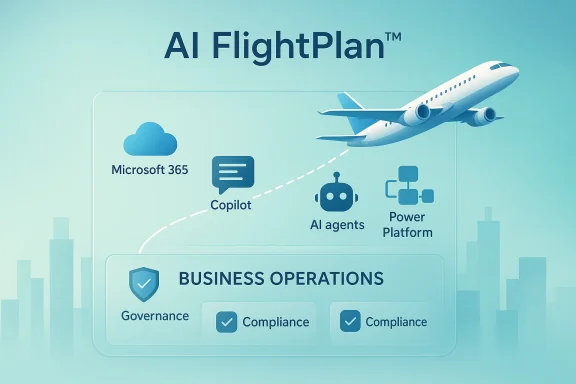
As enterprises rush to adopt Microsoft Copilot, AI agents, and low-code automation, a familiar pattern is reappearing: experimentation is easy, but execution is hard. eSoftware Associates’ new AI FlightPlan™ package is meant to close that gap by turning abstract AI enthusiasm into a concrete roadmap tied to workflows, governance, and business priorities. The launch lands at a moment when Microsoft itself is rapidly expanding Copilot and agent capabilities, making the consulting layer around implementation more valuable—and more crowded—than ever.
The new AI FlightPlan™ offer from eSoftware Associates is less a product than a structured consulting engagement, and that distinction matters. It reflects a broader shift in the AI market: organizations no longer need help understanding that generative AI exists; they need help deciding where it fits, how to govern it, and how to measure whether it is actually delivering value. The company is pitching the service specifically around Microsoft’s ecosystem, including Copilot, Power Platform, SharePoint, and related enterprise workflows.
That positioning makes sense because Microsoft’s AI stack has become more capable at a very rapid pace. In February 2026, Microsoft highlighted new Copilot features including agent-related enhancements, multi-agent collaboration, Outlook access for custom agents, and support for scanned PDFs and image-based documents in SharePoint. In Microsoft’s own framing, these features are intended to help organizations move from simple chat interactions toward deeper workflow automation.
But capability does not automatically translate into adoption success. Many enterprises have discovered that pilot projects are easy to launch and difficult to scale, especially when data quality, permissions, security, and process design are inconsistent. Microsoft has repeatedly emphasized that Copilot deployment works best when organizations align technology with existing workflows and measure the operational gains, not just the novelty value.
That broader context is exactly where a consultancy like eSoftware Associates tries to insert itself. The firm says it specializes in Microsoft 365, SharePoint, Power Platform, and AI-driven business solutions, and its website emphasizes custom applications, migrations, automation, and support for SMB and mid-sized organizations. In other words, it is not selling a standalone AI engine; it is selling implementation judgment in a Microsoft-centric shop.
The timing also reflects a market-wide realization that AI success is increasingly an operating-model problem. Companies that want measurable results need to know which processes should be automated, where human review should remain in place, and how to avoid deploying an agent that is impressive in a demo but brittle in production. That is what makes a “flight plan” metaphor useful: the challenge is not simply takeoff, but navigation, compliance, and landing.
The service seems especially focused on avoiding the common trap of “AI for AI’s sake.” In practice, many firms adopt Copilot or agents because competitors are doing it, then struggle to connect the technology to revenue, cost reduction, or cycle-time improvements. A structured engagement can help separate attractive demonstrations from initiatives that are actually worth funding.
A credible roadmap also helps align technical and business stakeholders. Business leaders want outcomes, while IT teams need clarity about integration, security, and support responsibilities. A good planning engagement gives both sides a common language, which is often more valuable than the AI tool itself.
That matters because it changes what customers need from partners. In the past, a Microsoft consulting firm could be judged largely on migration skill, intranet design, or Power Apps development. In the current cycle, the winning partners are increasingly the ones that can map business processes onto Microsoft’s expanding AI surface area without creating chaos in permissions, compliance, or user adoption.
For consultants, that complexity is an opportunity. The more moving parts Microsoft adds, the more customers need help translating features into business cases. In that sense, AI FlightPlan™ is a bet that the services layer will remain a meaningful part of the AI economy even as the platform layer gets more powerful.
As AI tools become more embedded in workplace systems, governance stops being a compliance side quest and becomes a design requirement. Microsoft’s own agent roadmap, which includes agent visibility, multi-agent collaboration, and admin controls, suggests that the company knows customers will need guardrails as autonomy increases. A planning engagement that surfaces these constraints early may save organizations from expensive rework later.
The value of a planning engagement is that it can expose these flaws before the first production rollout. It is much cheaper to discover a permissions issue on paper than after employees are already using an agent to draft documents from sensitive repositories.
For enterprises, the appeal of AI FlightPlan™ is likely to be the structure. Large companies can afford pilots, but they often struggle with duplication: one team builds a Copilot use case while another builds something similar in a different business unit. A planning engagement can help standardize priorities and reduce the risk of fragmented AI sprawl.
A consulting package that can speak to both markets has a stronger chance of resonating, provided it remains concrete. The danger is that broad AI positioning becomes generic very quickly, especially now that nearly every Microsoft partner claims to do Copilot and automation strategy.
AI FlightPlan™ is therefore best read as a packaging move. By naming and formalizing a planning engagement, eSoftware Associates creates a repeatable entry point for customers who are uncertain where to start. That is smart sales architecture because it turns a vague “Can you help us with AI?” question into a defined, paid process.
That said, the market will quickly judge whether the framework leads to measurable deployments. If the output is simply another slide deck, the brand will fade. If it consistently leads to usable workflows and better governance, it may become a useful sales wedge.
Microsoft’s own internal and public examples support that logic. The company has highlighted AI use cases in customer service, where Copilot helps reduce manual effort, surface information faster, and improve operational visibility. The lesson is not that every company should copy Microsoft’s exact setup, but that AI value tends to appear when the workflow is already well-defined and the information architecture is in decent shape.
That is especially important for mid-market firms where people wear multiple hats and do not have time to absorb poorly designed change. If the AI plan is tied to specific roles, clear workflows, and measurable efficiency gains, adoption becomes much easier to defend internally.
That is why a structured engagement should not just ask, “What AI can we deploy?” but also, “What habits are we trying to change?” If the answer is unclear, the project is probably not ready.
Another concern is expectation management. AI is often sold as a fast path to transformation, but the reality is slower and more dependent on data quality, process discipline, and change management than buyers expect. If the service overpromises speed or underestimates the work required to operationalize agents, customer disappointment could follow.
It will also be worth watching how Microsoft continues to evolve Copilot, especially around agent control, app integration, and cross-workflow orchestration. The more Microsoft pushes toward end-to-end AI-enabled work, the more partners will need structured methods to help organizations adopt it responsibly. In that sense, the success of AI FlightPlan™ will depend partly on whether the market continues moving in the direction Microsoft is clearly encouraging.
Source: The Manila Times ESW Launches AI FlightPlan™ as Companies Struggle to Turn AI Into Real Results
 Background
The new AI FlightPlan™ offer from eSoftware Associates is less a product than a structured consulting engagement, and that distinction matters. It reflects a broader shift in the AI market: organizations no longer need help understanding that generative AI exists; they need help deciding where it fits, how to govern it, and how to measure whether it is actually delivering value. The company is pitching the service specifically around Microsoft’s ecosystem, including Copilot, Power Platform, SharePoint, and related enterprise workflows.That positioning makes sense because Microsoft’s AI stack has become more capable at a very rapid pace. In February 2026, Microsoft highlighted new Copilot features including agent-related enhancements, multi-agent collaboration, Outlook access for custom agents, and support for scanned PDFs and image-based documents in SharePoint. In Microsoft’s own framing, these features are intended to help organizations move from simple chat interactions toward deeper workflow automation.
But capability does not automatically translate into adoption success. Many enterprises have discovered that pilot projects are easy to launch and difficult to scale, especially when data quality, permissions, security, and process design are inconsistent. Microsoft has repeatedly emphasized that Copilot deployment works best when organizations align technology with existing workflows and measure the operational gains, not just the novelty value.
That broader context is exactly where a consultancy like eSoftware Associates tries to insert itself. The firm says it specializes in Microsoft 365, SharePoint, Power Platform, and AI-driven business solutions, and its website emphasizes custom applications, migrations, automation, and support for SMB and mid-sized organizations. In other words, it is not selling a standalone AI engine; it is selling implementation judgment in a Microsoft-centric shop.
The timing also reflects a market-wide realization that AI success is increasingly an operating-model problem. Companies that want measurable results need to know which processes should be automated, where human review should remain in place, and how to avoid deploying an agent that is impressive in a demo but brittle in production. That is what makes a “flight plan” metaphor useful: the challenge is not simply takeoff, but navigation, compliance, and landing.
What AI FlightPlan™ Appears Designed to Solve
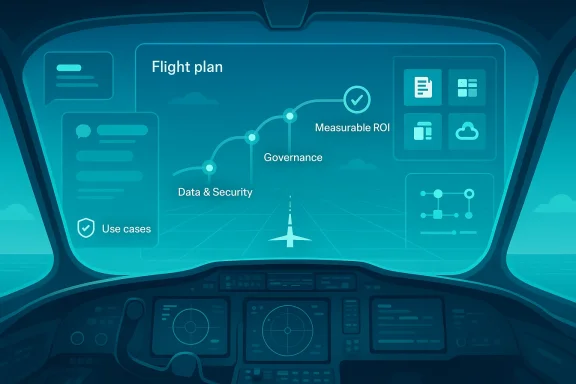
At a high level, AI FlightPlan™ is aimed at the gap between AI curiosity and AI execution. According to the launch, the engagement evaluates an organization’s systems, workflows, and priorities, then identifies high-value use cases, automation opportunities, and the data and governance issues that could block deployment. That is a familiar consulting pattern, but one that remains in demand because most organizations still lack a repeatable method for selecting the right first AI projects.The service seems especially focused on avoiding the common trap of “AI for AI’s sake.” In practice, many firms adopt Copilot or agents because competitors are doing it, then struggle to connect the technology to revenue, cost reduction, or cycle-time improvements. A structured engagement can help separate attractive demonstrations from initiatives that are actually worth funding.
From novelty to operational value
The most useful promise here is prioritization. Rather than trying to automate everything at once, AI FlightPlan™ aims to identify where an organization can get the fastest and safest return—whether that is document handling, customer service workflows, internal knowledge retrieval, or repetitive administrative tasks. That sequencing matters because the first wave of AI projects often determines whether employees trust the technology or dismiss it as a flashy experiment.A credible roadmap also helps align technical and business stakeholders. Business leaders want outcomes, while IT teams need clarity about integration, security, and support responsibilities. A good planning engagement gives both sides a common language, which is often more valuable than the AI tool itself.
- Focuses on high-impact use cases rather than broad experimentation
- Looks for opportunities in automation and AI agents
- Accounts for Microsoft Copilot and Power Platform fit
- Adds attention to data, security, and governance
- Produces a prioritized roadmap with effort estimates
Why Microsoft’s AI Ecosystem Matters Here
This launch is tightly tied to Microsoft’s current strategy. Microsoft has spent the last two years moving Copilot from a productivity assistant into a broader platform for creating and managing AI-enabled workflows. The company’s recent updates emphasize custom agents, agent-to-agent collaboration, and the ability to bring those experiences into places like Outlook and SharePoint.That matters because it changes what customers need from partners. In the past, a Microsoft consulting firm could be judged largely on migration skill, intranet design, or Power Apps development. In the current cycle, the winning partners are increasingly the ones that can map business processes onto Microsoft’s expanding AI surface area without creating chaos in permissions, compliance, or user adoption.
Copilot is becoming a platform, not a feature
Microsoft’s own messaging shows how broad the platform has become. The company is not just adding chat; it is adding agents, context-aware workflows, and integrations that reach across Office apps, Teams, Outlook, and SharePoint. That makes the implementation question much more complex than “Should we turn on Copilot?” because the real question is which workflows should be transformed first, and how much autonomy those agents should receive.For consultants, that complexity is an opportunity. The more moving parts Microsoft adds, the more customers need help translating features into business cases. In that sense, AI FlightPlan™ is a bet that the services layer will remain a meaningful part of the AI economy even as the platform layer gets more powerful.
The Governance Problem Is Now Central
One of the smartest things about eSoftware Associates’ framing is that it treats data, security, and governance as first-class concerns rather than afterthoughts. That is important because many AI efforts fail not due to model quality, but because the underlying data environment is messy, sensitive content is overexposed, or leaders cannot agree on who approves what.As AI tools become more embedded in workplace systems, governance stops being a compliance side quest and becomes a design requirement. Microsoft’s own agent roadmap, which includes agent visibility, multi-agent collaboration, and admin controls, suggests that the company knows customers will need guardrails as autonomy increases. A planning engagement that surfaces these constraints early may save organizations from expensive rework later.
Security and permissions are not optional
In practical terms, the biggest risk is not that AI will be too smart; it is that it will be too loosely connected. If an agent can access the wrong SharePoint site, summarize the wrong customer record, or expose content beyond intended boundaries, the organization has a serious problem. That is why AI adoption in regulated or hybrid environments usually needs a stronger governance layer than a consumer-style trial.The value of a planning engagement is that it can expose these flaws before the first production rollout. It is much cheaper to discover a permissions issue on paper than after employees are already using an agent to draft documents from sensitive repositories.
- Data classification needs to be clear before automation expands
- Permissions must match the principle of least privilege
- Auditability matters when agents take actions on behalf of users
- Human approval may be needed for sensitive workflows
- Retention and eDiscovery obligations must be considered early
Enterprise vs. SMB Impact
eSoftware Associates’ own site suggests it works with SMBs and mid-sized organizations, not only large enterprises. That is significant because smaller organizations often want AI outcomes faster, with fewer internal resources to manage governance, architecture, and change management. They may be more eager to automate, but they also tend to have less tolerance for wasted experimentation.For enterprises, the appeal of AI FlightPlan™ is likely to be the structure. Large companies can afford pilots, but they often struggle with duplication: one team builds a Copilot use case while another builds something similar in a different business unit. A planning engagement can help standardize priorities and reduce the risk of fragmented AI sprawl.
Different customers, different pain points
SMBs are usually asking, “What can we automate first without hiring a giant AI team?” Enterprises are more likely asking, “How do we scale responsibly across dozens of teams?” Those are related questions, but they demand different deployment patterns and different success metrics.A consulting package that can speak to both markets has a stronger chance of resonating, provided it remains concrete. The danger is that broad AI positioning becomes generic very quickly, especially now that nearly every Microsoft partner claims to do Copilot and automation strategy.
Competitive Positioning in the Microsoft Partner Ecosystem
The launch is also a competitive signal. Microsoft’s partner ecosystem is crowded with firms that offer SharePoint consulting, Power Platform development, and Copilot readiness assessments. That means the differentiator is no longer whether a partner understands the stack, but whether it can produce a credible path from discovery to business outcome.AI FlightPlan™ is therefore best read as a packaging move. By naming and formalizing a planning engagement, eSoftware Associates creates a repeatable entry point for customers who are uncertain where to start. That is smart sales architecture because it turns a vague “Can you help us with AI?” question into a defined, paid process.
Why the label matters
Naming matters in consulting, especially when buyers are overwhelmed by jargon. AI readiness, AI assessment, AI roadmap, and now AI FlightPlan™ all promise the same thing at a high level, but a branded framework can feel more tangible to procurement teams and business leaders. It creates the impression of a methodology rather than an ad hoc advisory conversation.That said, the market will quickly judge whether the framework leads to measurable deployments. If the output is simply another slide deck, the brand will fade. If it consistently leads to usable workflows and better governance, it may become a useful sales wedge.
- Branded methodology can reduce buyer uncertainty
- Repeatable packaging improves sales efficiency
- Consulting differentiation now depends on outcomes, not hype
- Microsoft specialization is valuable but widely replicated
- Proof of execution will matter more than naming polish
The Business Case: Where AI Actually Pays Off
The strongest AI projects usually hit one of three targets: they reduce labor on repetitive work, improve the speed of decisions, or increase the quality and consistency of execution. eSoftware Associates’ framing suggests AI FlightPlan™ will look for exactly those kinds of opportunities inside Microsoft-centric environments. That is where the best return on investment usually lives.Microsoft’s own internal and public examples support that logic. The company has highlighted AI use cases in customer service, where Copilot helps reduce manual effort, surface information faster, and improve operational visibility. The lesson is not that every company should copy Microsoft’s exact setup, but that AI value tends to appear when the workflow is already well-defined and the information architecture is in decent shape.
Common ROI patterns
A real AI roadmap will usually focus on a few repeatable categories. These are the kinds of opportunities that can justify pilot funding because they are visible, measurable, and closely tied to everyday work.- Faster document drafting and knowledge retrieval
- More efficient internal support and help desk triage
- Automation of approval and routing workflows
- Better use of structured data in Power Platform apps
- Reduced manual effort in recurring back-office processes
- Improved visibility into activity, status, and exceptions
The Change-Management Challenge
Even when the technology works, employee adoption can still stall. AI often creates anxiety about job displacement, quality control, or simply another tool to learn. A flight-plan model can help here because it frames the rollout as a managed transformation, not a surprise platform switch.That is especially important for mid-market firms where people wear multiple hats and do not have time to absorb poorly designed change. If the AI plan is tied to specific roles, clear workflows, and measurable efficiency gains, adoption becomes much easier to defend internally.
Adoption is a workflow problem
The most successful AI deployments are rarely about the flashiest model. They are about minimizing friction for the worker who has to use the tool every day. If the experience is awkward, or if the answers are inconsistent, employees will revert to email, spreadsheets, and manual workarounds.That is why a structured engagement should not just ask, “What AI can we deploy?” but also, “What habits are we trying to change?” If the answer is unclear, the project is probably not ready.
Strengths and Opportunities
The launch has several clear strengths. It aligns well with Microsoft’s current product direction, it addresses a genuine market pain point, and it gives a consulting firm a clean way to package AI advisory work into something buyers can understand. It also reflects a more mature view of enterprise AI, one that treats planning, governance, and prioritization as essential rather than optional.- Taps into real demand for AI implementation help
- Fits Microsoft’s expanding Copilot and agent roadmap
- Offers a practical bridge between strategy and execution
- Helps customers focus on business outcomes
- Reinforces governance and security from day one
- Can work for both SMBs and larger organizations
- Creates a repeatable entry point for new consulting engagements
Risks and Concerns
The biggest risk is commoditization. There are already many Microsoft partners promising AI strategy, Copilot readiness, and workflow automation, so AI FlightPlan™ must prove it is more than a new name on an old service. If the deliverables are too generic, the offer will struggle to stand out in a crowded market.Another concern is expectation management. AI is often sold as a fast path to transformation, but the reality is slower and more dependent on data quality, process discipline, and change management than buyers expect. If the service overpromises speed or underestimates the work required to operationalize agents, customer disappointment could follow.
- Risk of becoming another generic assessment
- Possible mismatch between hype and implementation reality
- Dependence on Microsoft’s product roadmap
- Governance complexity may slow early wins
- Smaller firms may lack internal resources to follow through
- Competitive pressure from larger consultancies is intense
- Success depends on measurable outcomes, not branding
What to Watch Next
The most important thing to watch is whether this launch becomes a real engagement framework or simply a marketing wrapper. If eSoftware Associates can show repeatable outcomes—faster deployments, better ROI, fewer governance missteps—the concept may resonate beyond its initial audience. If not, it will likely be absorbed into the background noise of the AI consulting market.It will also be worth watching how Microsoft continues to evolve Copilot, especially around agent control, app integration, and cross-workflow orchestration. The more Microsoft pushes toward end-to-end AI-enabled work, the more partners will need structured methods to help organizations adopt it responsibly. In that sense, the success of AI FlightPlan™ will depend partly on whether the market continues moving in the direction Microsoft is clearly encouraging.
Key signals to monitor
- Whether customers report measurable business outcomes
- Whether the service becomes a repeatable package
- How quickly Microsoft rolls out new Copilot agent features
- Whether competitors launch similar AI roadmap offerings
- Whether governance and security become a bigger buying trigger
- Whether the offer expands beyond Microsoft-specific workflows
Source: The Manila Times ESW Launches AI FlightPlan™ as Companies Struggle to Turn AI Into Real Results