

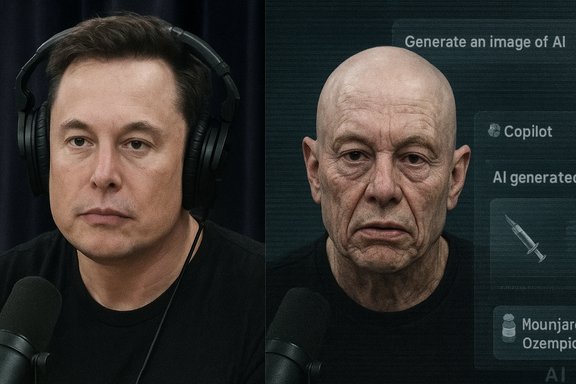
A Daily Mail screenshot of Elon Musk on the Joe Rogan Experience, fed into Microsoft Copilot with the prompt “what would Elon Musk look like without hair transplants or weight‑loss drugs,” produced an exaggerated, grotesque AI‑generated portrait — a small stunt that illuminates much larger questions about generative AI, media practice, health reporting, and the limits of reconstructive imagery.
Elon Musk’s public appearance and physical history have repeatedly become fodder for speculation: a once‑receding hairline that later appears fuller in public photos, and a noticeable weight change that Musk himself has discussed publicly in the context of GLP‑1 class medications such as tirzepatide (marketed as Mounjaro) and semaglutide (marketed in weight‑loss conversations as Ozempic or related products). Those two threads — hair restoration and weight‑loss drug use — were the exact levers the Daily Mail chose to pull when they fed a Rogan screenshot into Copilot and asked the assistant to “remove” those interventions from Musk’s appearance.
The resulting image was less a careful, clinically informed reconstruction than a stylized caricature. That outcome is useful as a case study: it shows how easily consumer‑facing multimodal assistants can be used to create compelling but potentially misleading images of real people, how single‑source media experiments can be framed as definitive, and how health and cosmetic narratives can be amplified by tools that do not apply domain expertise when asked to make medical or surgical inferences.
Important verification notes:
Why that caution matters:
Generative AI is not just a new production tool; it is a new rhetorical device. Publishers must choose whether to treat it as illustration, argument, or evidence — and then document that choice. Failure to do so will continue to produce viral images that look convincingly real while carrying no factual weight.
By exposing what these systems produce when asked to “undo” cosmetic interventions, the episode helps clarify why provenance, reproducibility, and expert context are essential for trustworthy journalism in the era of generative AI.
Source: This is Money https://www.thisismoney.co.uk/tvsho...ithout-hair-transplant-weight-loss-drugs.html
 Background / Overview
Elon Musk’s public appearance and physical history have repeatedly become fodder for speculation: a once‑receding hairline that later appears fuller in public photos, and a noticeable weight change that Musk himself has discussed publicly in the context of GLP‑1 class medications such as tirzepatide (marketed as Mounjaro) and semaglutide (marketed in weight‑loss conversations as Ozempic or related products). Those two threads — hair restoration and weight‑loss drug use — were the exact levers the Daily Mail chose to pull when they fed a Rogan screenshot into Copilot and asked the assistant to “remove” those interventions from Musk’s appearance.The resulting image was less a careful, clinically informed reconstruction than a stylized caricature. That outcome is useful as a case study: it shows how easily consumer‑facing multimodal assistants can be used to create compelling but potentially misleading images of real people, how single‑source media experiments can be framed as definitive, and how health and cosmetic narratives can be amplified by tools that do not apply domain expertise when asked to make medical or surgical inferences.
How the Daily Mail experiment worked — and what we can verify
The published account is straightforward: the Daily Mail captured a still from Musk’s latest Joe Rogan interview, uploaded that image to Microsoft Copilot, and requested an alternate depiction that removed cosmetic interventions and weight‑loss drug effects. Copilot returned an alternate image that the Mail printed alongside the original screenshot as a visual gag. The description of the workflow — upload an image, issue an edit request, receive a generated output — is entirely consistent with how modern multimodal assistants operate in preview and consumer settings. However, the specific session parameters (exact prompt text, Copilot build, any post‑processing or filters) were not preserved in public reporting, which makes technical reproducibility impossible from the published account alone. Treat the Mail’s published result as a media demonstration, not an audited experiment.Important verification notes:
- Musk has publicly acknowledged using a GLP‑1 agent (Mounjaro/tirzepatide) in social posts and public commentary, and the family of GLP‑1 and dual‑agonist drugs is widely discussed in mainstream coverage for weight management and as diabetes therapies. That contextual fact underpins the weight‑loss angle of the Daily Mail prompt. However, the precise medical timeline, dosing, and indications for any individual are private unless disclosed by the person. The public admission supports journalistic coverage but does not authorize speculative medical conclusions from stylized images.
- The hair‑transplant question is plausible and widely discussed among cosmetic surgeons and commentators, but remains unconfirmed by medical records or a direct statement from Musk. Professional surgical analysis of photographic timelines often concludes a transplant is the most likely explanation, but those inferences are inferential, not documentary. Responsible coverage should label hair‑transplant claims as highly likely but unverified.
What the image — and the experiment — reveal about generative AI
Strengths: speed, access, and expressive power
Generative image tools integrated into mainstream assistants now let non‑technical users produce variations on a photo in seconds. That speed and low barrier to entry is valuable for legitimate creative work: concept art, marketing mockups, accessibility features, and rapid prototyping. For journalists and communicators, multimodal assistants can help surface hypothetical visuals to illustrate clearer narratives when marked as synthetic. The Daily Mail experiment demonstrates how accessible these capabilities have become — you do not need a specialist pipeline to ask an assistant to imagine an alternate appearance.Limits and failure modes: caricature, hallucination, and dehumanization
Generative models often over‑exaggerate features when prompted to imagine an alternate reality. A prompt like “what would X look like without hair transplants or weight‑loss drugs?” is simultaneously ill‑posed and loaded with medical, aesthetic, and privacy implications. Models do not have access to patient histories, surgical records, or clinical nuance; they only map statistical correlations from training data into visual outputs. That gap frequently produces caricatured or demeaning results rather than medically plausible reconstructions. The Daily Mail/Copilot portrait is an example: the image is striking and meme‑worthy, but it is not a clinically valid “what if” reconstruction.Safety, policy and legal risk
Image generation of real people — even public figures — touches on impersonation, defamation, privacy, and platform safety. Platforms and vendors are building provenance features (watermarking, labeling, and opt‑outs) and governance controls, but enforcement is inconsistent and product behavior varies across vendors and builds. When a generated image leaves the lab and circulates widely, the absence of provenance metadata and archived session details makes later audit and correction difficult. The Mail’s experiment lacked preserved prompts and model metadata in public reporting, which weakens accountability and reproducibility.Health claims and the problem of reading medical truth from synthetic images
A New York physician quoted in coverage suggested that Musk’s recent Rogan appearance showed signs of “rapid aging” and raised cardiovascular concerns linked to chronic stress. Those medical mechanisms — that prolonged stress and elevated cortisol can contribute to cardiovascular risk and cognitive changes — are grounded in clinical literature and accepted public health explanations. However, drawing a direct causal line from one podcast appearance to a specific medical prognosis is speculative and should be avoided without clinical examination and corroborating data. Stylized AI imagery should never be used as evidence of medical conditions.Why that caution matters:
- Visual signs of stress, sleep deprivation, or aging are noisy and non‑specific: lighting, camera angles, makeup, fatigue, and transient factors change appearance substantially. AI reconstructions amplify that noise.
- GLP‑1 drugs like Mounjaro and Ozempic have known side‑effect profiles and real metabolic effects; their presence in a public figure’s timeline is newsworthy. But using AI imagery to suggest pathological consequences or imminent cardiovascular events crosses from reporting into conjecture.
The hair‑transplant narrative: plausible yet private
Cosmetic clinicians and hair‑restoration clinics frequently analyze public photographs to build timelines that suggest the likelihood of a hair transplant, frequently citing procedures like FUE (follicular unit extraction) vs. FUT (strip harvesting) and graft counts. Those analyses often conclude a surgical intervention is the most plausible explanation for marked hairline restoration over time. But those are professional inferences, not confirmed medical facts. The hair restoration story should be framed as “likely” when relying on photographic timelines, and labelled “unverified” unless the individual confirms it. Journalists should avoid treating clinic‑style analyses as conclusive proof.Ethics, newsroom practice, and editorial guidance
This episode is a useful test case for newsrooms implementing or experimenting with AI image tools. Below are practical editorial policies and technical steps newsrooms should adopt before publishing AI‑altered images of real people.- Label synthetic imagery clearly and persistently: every AI‑generated image should carry a visible, machine‑readable provenance label and a human‑readable caption explaining how it was generated. This prevents accidental re‑circulation as authentic content.
- Archive prompts and model details: retain the original prompt, the model or build identifier, timestamps, and the uploaded original. That archive is essential for future audits and corrections.
- Avoid medical inferences without experts: if an image touches on health, consult clinicians and cite authoritative medical literature rather than relying on synthetic depictions.
- Apply a harm assessment: evaluate whether the image could reasonably lead to defamation, privacy violation, harassment, or political manipulation and weigh those risks against the public interest of publication.
A short editorial checklist for publishing AI‑altered images
- Confirm the news value: does the synthetic image materially inform the reader beyond being a visual gag?
- Obtain an independent expert review if the image suggests medical or surgical claims.
- Preserve and publish model metadata and the original prompt in an audit log.
- Add a clear, visible label stating the image is AI‑generated and describe the transformation.
- Run a legal/harm review for potential defamation or privacy impacts.
Technical and policy takeaways for platform operators
The Daily Mail/Copilot vignette highlights several product and policy gaps platform operators should address:- Provenance by default: generated content should carry an embedded provenance watermark or metadata that survives sharing on common social platforms.
- Reproducibility logging: provide opt‑in (or opt‑out) session logging for content creators that stores prompt, model, and build version for a limited retention period to aid audits and takedowns.
- Sensible defaults for public figures: vendors should consider conservative defaults when asked to produce photorealistic edits of real public figures, including requiring affirmative user consent flows or additional contextual flags before processing.
- Medical safety guardrails: when prompts reference medical conditions or cosmetic surgery, systems should push back and request clarification, include recommended domain disclaimers, or refuse to produce photorealistic medical conjectures.
Reputation risk and the misinformation cascade
A synthetic image that goes viral can seed persistent false beliefs. Once an altered portrait is presented as an evidentiary “reveal” — even as satire — it can be clipped, captioned, and reposted out of context. The original outlet’s labeling and the platform’s provenance failings determine whether the content becomes part of an enduring false narrative. The Mail’s experiment likely intended satire, but the mechanics are the same as any other generative manipulation: reuse the image without context and the truth corrodes. Platforms and publishers share responsibility to minimize that cascade.Legal and regulatory pressures to expect
Regulators in multiple jurisdictions are converging on disclosure requirements for synthetic content and stronger protections around realistic impersonation. The core trends to watch:- Mandatory provenance and watermarking regimes that require platforms to tag synthetic images and videos.
- Privacy and publicity law tests for unauthorized use of a person’s likeness in generated content.
- Consumer protection scrutiny where AI outputs are used in advertising or political persuasion.
Critical analysis — strengths, shortcomings, and concrete risks
Strengths of the Mail/Copilot vignette
- It sparked an important cross‑disciplinary conversation about AI, health, and media ethics in an accessible way. The visceral image invites attention and scrutiny.
- It demonstrated the practical ease with which mainstream assistants can generate photorealistic alternatives, which is a useful public demonstration of capability and risk.
Shortcomings and risks
- Single‑source demonstration: the public record lacks preserved prompts, model builds, and the original session metadata, undermining reproducibility and accountability.
- Medical overreach risk: the experiment implicitly links appearance changes to medical narratives, which is a dangerous jump when using stylized AI imagery as “proof.”
- Caricature and dehumanization: models defaulting to exaggeration risk demeaning or stigmatizing portrayals, especially when applied to personal or protected attributes.
Concrete downstream hazards
- Defamation and harassment cycles when synthetic imagery is repurposed by bad actors.
- Erosion of trust in visual media if provenance and labeling fail to reach mainstream sharing paths.
- Potential for policy misuse, where photorealistic impersonations alter political debate or public perception of leaders.
Practical guidance for readers, editors, and technologists
- Readers: treat unlabelled dramatic AI images of real people as suspect until proven otherwise. Check for clear provenance labels and seek corroborating reporting.
- Editors: adopt a mandatory provenance policy for every AI image and maintain an immutable audit log of prompts and model metadata.
- Technologists: build conservative defaults for public‑figure transformations and mandatory friction when medical or surgical inferences are requested.
Flagged unverifiable claims and cautionary statements
- The exact Copilot build, prompt text, and any post‑processing used by the Daily Mail in the published experiment are not publicly documented; hence, technical reproducibility is not possible from the published report alone. This is a single‑source media demonstration and should be treated accordingly.
- Claims that a single podcast appearance is proof of “rapid aging” or imminent health crisis are speculative. The medical point — that chronic stress increases cardiovascular risk — is well supported, but applying it to one public appearance without clinical evaluation is conjectural.
Broader implications: culture, journalism, and the future of visual trust
The Mail/Copilot event sits at the intersection of three cultural shifts: rapid adoption of generative AI, increased public medicalization of celebrity bodies, and an erosion of intuitive trust in photographic evidence. Together, these trends mean every newsroom, platform, and consumer needs better heuristics to determine when an image is evidence and when it is entertainment.Generative AI is not just a new production tool; it is a new rhetorical device. Publishers must choose whether to treat it as illustration, argument, or evidence — and then document that choice. Failure to do so will continue to produce viral images that look convincingly real while carrying no factual weight.
Conclusion
The Daily Mail’s experiment — feeding an Elon Musk screenshot into Microsoft Copilot and asking for a “what if” image without hair transplants or weight‑loss drugs — is a compact but powerful illustration of both the creative potential and the ethical pitfalls of modern generative AI. The result was a provocative visual, but the deeper lesson is institutional: multimedia assistants are now capable of producing realistic alternatives of living people in a single, everyday workflow. That capability demands stronger provenance, conservative editorial standards, and clear guardrails when medical or identity questions are involved. Newsrooms must archive prompts and metadata, label synthetic content clearly, and resist using stylized AI outputs as evidence for medical or surgical claims. Platforms must bake in provenance defaults and friction for public‑figure manipulations. The public should treat dramatic AI images as intentionally constructed narratives until transparent provenance proves otherwise.By exposing what these systems produce when asked to “undo” cosmetic interventions, the episode helps clarify why provenance, reproducibility, and expert context are essential for trustworthy journalism in the era of generative AI.
Source: This is Money https://www.thisismoney.co.uk/tvsho...ithout-hair-transplant-weight-loss-drugs.html
