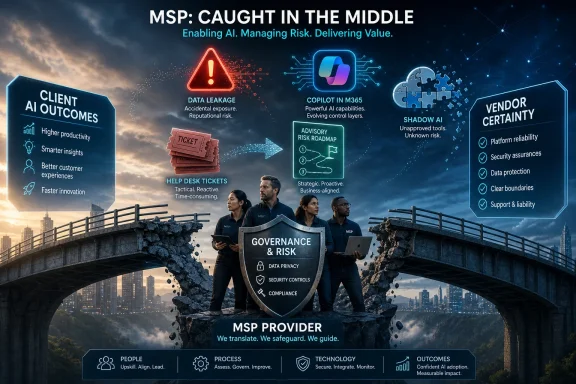
Cynomi released a June 30, 2026 report from Orlando, Florida, and Tel Aviv analyzing MSP conversations about AI from May 2025 through May 2026 across Reddit, search-research patterns, Perplexity Deep Research, and Cynomi’s own customer community. Its useful contribution is not that MSPs are suddenly interested in artificial intelligence; everyone selling technology has been forced into that conversation. The sharper finding is that managed service providers have moved past the demo phase and into the awkward middle, where clients want AI outcomes, vendors sell AI certainty, and providers are left holding the operational risk.
The managed services industry has always had a weakness for packaged urgency. Cloud migration, zero trust, endpoint detection, compliance automation, and vCISO services all arrived with the same promise: move now or be left behind. AI has inherited that script, but it has also broken it, because clients are not waiting for MSPs to productize the offering before experimenting on their own.
That is why Cynomi’s report is more interesting than a normal vendor white paper. The company says it looked at what MSPs were actually discussing in public and semi-private spaces rather than asking them to rank vendor-approved concerns in a survey. That methodology has limits, but it captures something a polished questionnaire often misses: the anxiety in the channel is practical, messy, and already client-facing.
The recurring questions are not abstract. MSPs want to know how to say no to unsafe client requests without losing the account. They want to know whether employees are pasting sensitive data into public AI tools. They want to know where AI actually helps the service desk, whether Microsoft Copilot is worth packaging, and whether automation will compress the value of the MSP itself.
Those are not thought-leadership questions. They are margin, liability, retention, and staffing questions wearing an AI costume.
A client does not need a procurement cycle to paste a contract into a chatbot. A salesperson does not need IT approval to ask an AI assistant to summarize a customer spreadsheet. A manager does not need to understand data residency to upload meeting notes into a summarization tool. By the time the MSP is asked for guidance, the risky behavior may already be normalized.
This is where the “AI will replace MSPs” fear looks misplaced. The more immediate reality is that AI creates a governance vacuum that many SMB clients are poorly equipped to fill. They need someone to define acceptable use, map data flows, evaluate vendor claims, configure controls, train users, and respond when convenience collides with confidentiality.
That work is not the same as patching laptops or resetting passwords. It is advisory, policy-driven, and cross-functional. It also requires MSPs to become more comfortable telling clients that a technically possible request is operationally irresponsible.
AI forces the provider to choose between being a service desk with a logo and being a technology risk partner. The former says, “Sure, we can connect that.” The latter says, “Not until we know what data it touches, who can access it, where prompts are stored, how outputs are reviewed, and what happens if it is wrong.”
That is a harder sale, especially when clients have been trained to see IT as the department of implementation rather than judgment. But it is also the opening MSPs have claimed to want for years. If providers want recurring revenue from advisory services, they must be willing to make advisory decisions that occasionally disappoint the client in the short term.
The winners will not simply block AI tools. A flat prohibition is easy to write and hard to enforce. The better play is to establish sanctioned tools, approved use cases, documented exceptions, and escalation paths for anything involving regulated, confidential, or customer data.
The challenge is that “AI data leakage” is not one problem. It includes consumer chatbot use, browser extensions, meeting transcription apps, CRM plug-ins, productivity suites, developer copilots, and shadow SaaS products that quietly add AI features after a customer has already approved the platform. The attack surface is not a single application; it is a feature layer spreading across the software stack.
Microsoft’s own Copilot ecosystem shows both sides of the issue. In Microsoft 365 commercial environments, Microsoft positions Copilot inside the tenant boundary, respecting existing permissions and saying organizational data is not used to train foundation models. That matters, and it gives MSPs a stronger governance story than a random public chatbot tab.
But “better governed” is not the same as “risk-free.” If permissions are messy, Copilot can surface messy permissions at machine speed. If labels, retention policies, DLP rules, and SharePoint access are poorly managed, AI does not fix the hygiene problem; it makes the consequences easier to discover.
That creates a commercial opportunity for MSPs. Many clients already live in Microsoft 365, and many would rather extend a familiar platform than evaluate a fleet of AI startups. An MSP can build a credible offering around readiness assessments, licensing guidance, data cleanup, user training, prompt governance, and post-deployment monitoring.
It also creates a trap. If an MSP simply resells Copilot as an inevitable upgrade, it inherits every disappointment that follows. Clients may expect magic and get uneven summarization. They may assume Copilot can safely reason across all company data while ignoring the permission sprawl that has accumulated for years. They may ask why they are paying both Microsoft and the MSP if the AI is supposed to make work simpler.
The right Copilot conversation is not “Should we sell it?” It is “What must be true in the client environment before Copilot is safe and useful enough to justify the spend?” That answer often starts with unglamorous work: identity cleanup, conditional access, MFA coverage, sensitivity labels, retention policies, SharePoint governance, endpoint posture, and user education.
For providers under margin pressure, that matters. A tool that saves technicians time on repetitive tickets can improve response consistency and free senior staff for harder work. If implemented carefully, AI can reduce the drag of documentation and make institutional knowledge less dependent on the one engineer who remembers how a client’s environment was built in 2019.
But the service desk is not where the long-term battle for MSP relevance will be decided. If AI makes basic support cheaper and more standardized, clients will eventually treat that work as less differentiated. The provider that only uses AI to do yesterday’s tickets faster may win a short-term margin boost while losing the strategic conversation.
The more durable opportunity is to turn those operational gains into advisory capacity. If AI saves ten hours a week, the question is whether that time becomes profit extraction or client-facing maturity work. Providers that reinvest the efficiency into better security programs, better documentation, better account management, and better compliance outcomes will have a stronger story than providers that merely shrink labor cost.
Those claims may prove meaningful, but they deserve the same scrutiny MSPs should bring to any AI promise. Efficiency metrics depend heavily on baseline process maturity, task selection, user skill, and whether the measured time savings translate into billable capacity or merely less internal friction. A provider with chaotic documentation may see dramatic improvement from structured AI workflows; a mature provider may see less spectacular but still useful gains.
The “agentic” label also needs careful handling. In 2026, almost every AI vendor wants to move from assistant language to coworker language, because the latter sounds like leverage rather than software. But autonomy in security workflows is not merely a productivity feature. It raises questions about approval chains, auditability, exception handling, and accountability when a recommendation is wrong.
That does not make agentic security tools a bad idea. It means MSPs should evaluate them the way they evaluate any system that influences client risk. The more a tool claims to make expert decisions repeatable, the more important it becomes to understand where its authority begins and ends.
Traditional managed services grew around infrastructure complexity. Clients outsourced because networks, endpoints, servers, backups, email systems, and security tools were too complicated to run alone. Much of that complexity still exists, but AI shifts attention toward business process, data classification, user behavior, compliance exposure, and executive decision-making.
That is uncomfortable terrain for providers built around ticket queues. It requires account managers who can discuss risk with leadership, engineers who understand policy implications, and security staff who can translate controls into business language. It also requires pricing models that do not punish the provider for doing preventive work.
The MSPs most at risk are not the smallest ones or the ones without proprietary AI tools. They are the ones that cannot explain their value once routine work becomes less visible. If the client only sees fewer tickets and a higher stack of AI-branded invoices, the relationship weakens.
But that messiness is also useful. Vendor surveys often flatten the market into tidy adoption curves. Community conversations reveal what people are afraid to ask in front of a vendor rep. They capture uncertainty before it becomes an official buying category.
In that sense, Cynomi’s approach fits the AI moment. The MSP channel is not waiting for a single analyst report to define the market. It is crowdsourcing policies, comparing tool failures, swapping client horror stories, and trying to figure out which parts of the hype can be turned into recurring revenue without creating new liability.
The signal is not that every Reddit thread is representative. The signal is that the same five questions keep appearing across different discovery surfaces. When providers independently converge on governance, data leakage, service-desk value, Copilot packaging, and replacement anxiety, the industry has found its real AI agenda.
The vCISO model has been gaining ground for precisely this reason. SMBs and midmarket companies increasingly need security leadership but cannot justify a full-time CISO. AI makes that gap more urgent because it introduces new decisions about acceptable use, vendor review, privacy, training, and incident response.
A provider that can walk into a quarterly business review with an AI risk register, policy draft, tool inventory, user training plan, and control roadmap has a different conversation from one that arrives with a ticket report. The former is harder to replace with automation because it is tied to judgment, prioritization, and trust.
That does not mean every MSP must become a consultancy overnight. It means the line between managed services and managed risk is blurring. Providers that resist that shift may find themselves competing on price for increasingly automated operational work.
An AI governance engagement might start with discovery: which tools are in use, which departments use them, what data is involved, and what contractual commitments apply. It would then move into policy, technical controls, training, and periodic review. For Microsoft-centric clients, it would include Copilot readiness, Purview alignment, identity posture, and permission hygiene.
This is not glamorous work, but it is where real risk reduction happens. The client asking “Can we use AI?” usually needs a better question: “Which AI uses are acceptable for which data, under which controls, with which human review?” The MSP that can answer that earns advisory credibility.
There is also a commercial advantage. Governance work can be packaged into assessments, monthly advisory retainers, compliance support, and security program management. Unlike one-off tool deployment, it creates a continuing reason for the client to engage.
On the operational side, providers should absolutely use AI internally. They should automate documentation, improve ticket triage, accelerate reporting, assist with scripting, and reduce the toil that burns out technicians. Refusing to use AI inside an MSP in 2026 is not prudence; it is self-imposed inefficiency.
On the advisory side, they must be able to explain why not every AI use case should be approved, why Microsoft 365 data hygiene matters before Copilot rollout, why public chatbot use requires policy, and why AI outputs need review in regulated or high-impact workflows. That is the part clients will pay for when the novelty wears off.
The competitive threat, as Cynomi’s CEO puts it, is not AI replacing MSPs. It is AI-enabled MSPs outperforming traditional MSPs. That framing is vendor-friendly, but it is also broadly correct.
The managed services industry has survived every wave of abstraction by moving closer to the client’s real problem. AI will be no different. The providers that thrive will not be the ones that merely bolt a chatbot onto the help desk; they will be the ones that turn automation into capacity, capacity into guidance, and guidance into trust before their clients learn the hard way that unmanaged AI is just shadow IT with better prose.
 The AI Conversation Has Escaped the Vendor Webinar
The managed services industry has always had a weakness for packaged urgency. Cloud migration, zero trust, endpoint detection, compliance automation, and vCISO services all arrived with the same promise: move now or be left behind. AI has inherited that script, but it has also broken it, because clients are not waiting for MSPs to productize the offering before experimenting on their own.That is why Cynomi’s report is more interesting than a normal vendor white paper. The company says it looked at what MSPs were actually discussing in public and semi-private spaces rather than asking them to rank vendor-approved concerns in a survey. That methodology has limits, but it captures something a polished questionnaire often misses: the anxiety in the channel is practical, messy, and already client-facing.
The recurring questions are not abstract. MSPs want to know how to say no to unsafe client requests without losing the account. They want to know whether employees are pasting sensitive data into public AI tools. They want to know where AI actually helps the service desk, whether Microsoft Copilot is worth packaging, and whether automation will compress the value of the MSP itself.
Those are not thought-leadership questions. They are margin, liability, retention, and staffing questions wearing an AI costume.
Clients Are Adopting Faster Than Providers Can Govern
The report’s central tension is familiar to anyone who has supported small and midsize businesses: users do not wait for policy. They discover a tool, try it on real work, and only later does someone ask whether the data should have been there in the first place. Generative AI accelerates that pattern because the barrier to use is almost nonexistent.A client does not need a procurement cycle to paste a contract into a chatbot. A salesperson does not need IT approval to ask an AI assistant to summarize a customer spreadsheet. A manager does not need to understand data residency to upload meeting notes into a summarization tool. By the time the MSP is asked for guidance, the risky behavior may already be normalized.
This is where the “AI will replace MSPs” fear looks misplaced. The more immediate reality is that AI creates a governance vacuum that many SMB clients are poorly equipped to fill. They need someone to define acceptable use, map data flows, evaluate vendor claims, configure controls, train users, and respond when convenience collides with confidentiality.
That work is not the same as patching laptops or resetting passwords. It is advisory, policy-driven, and cross-functional. It also requires MSPs to become more comfortable telling clients that a technically possible request is operationally irresponsible.
Saying No Becomes a Managed Service
One of the most revealing questions in Cynomi’s report is how MSPs can refuse client AI requests without losing the account. That question exposes the cultural problem at the heart of many provider-client relationships. For years, MSPs have been rewarded for responsiveness, not restraint.AI forces the provider to choose between being a service desk with a logo and being a technology risk partner. The former says, “Sure, we can connect that.” The latter says, “Not until we know what data it touches, who can access it, where prompts are stored, how outputs are reviewed, and what happens if it is wrong.”
That is a harder sale, especially when clients have been trained to see IT as the department of implementation rather than judgment. But it is also the opening MSPs have claimed to want for years. If providers want recurring revenue from advisory services, they must be willing to make advisory decisions that occasionally disappoint the client in the short term.
The winners will not simply block AI tools. A flat prohibition is easy to write and hard to enforce. The better play is to establish sanctioned tools, approved use cases, documented exceptions, and escalation paths for anything involving regulated, confidential, or customer data.
Data Leakage Is the First AI Security Problem Most Clients Understand
Security professionals can debate prompt injection, model poisoning, agentic misuse, and autonomous workflow abuse. Most SMB executives understand a simpler risk immediately: an employee may put sensitive company information into the wrong tool. Cynomi’s report rightly treats that concern as one of the dominant MSP discussion threads.The challenge is that “AI data leakage” is not one problem. It includes consumer chatbot use, browser extensions, meeting transcription apps, CRM plug-ins, productivity suites, developer copilots, and shadow SaaS products that quietly add AI features after a customer has already approved the platform. The attack surface is not a single application; it is a feature layer spreading across the software stack.
Microsoft’s own Copilot ecosystem shows both sides of the issue. In Microsoft 365 commercial environments, Microsoft positions Copilot inside the tenant boundary, respecting existing permissions and saying organizational data is not used to train foundation models. That matters, and it gives MSPs a stronger governance story than a random public chatbot tab.
But “better governed” is not the same as “risk-free.” If permissions are messy, Copilot can surface messy permissions at machine speed. If labels, retention policies, DLP rules, and SharePoint access are poorly managed, AI does not fix the hygiene problem; it makes the consequences easier to discover.
Copilot Is Becoming the Channel’s Default AI Argument
The report’s inclusion of Microsoft Copilot is inevitable. For WindowsForum readers, this is the AI question that lands closest to home because Copilot is not an isolated product category. It is being woven through Windows, Edge, Teams, Outlook, Word, Excel, PowerPoint, Microsoft 365 admin experiences, Security Copilot, and the broader Microsoft Graph.That creates a commercial opportunity for MSPs. Many clients already live in Microsoft 365, and many would rather extend a familiar platform than evaluate a fleet of AI startups. An MSP can build a credible offering around readiness assessments, licensing guidance, data cleanup, user training, prompt governance, and post-deployment monitoring.
It also creates a trap. If an MSP simply resells Copilot as an inevitable upgrade, it inherits every disappointment that follows. Clients may expect magic and get uneven summarization. They may assume Copilot can safely reason across all company data while ignoring the permission sprawl that has accumulated for years. They may ask why they are paying both Microsoft and the MSP if the AI is supposed to make work simpler.
The right Copilot conversation is not “Should we sell it?” It is “What must be true in the client environment before Copilot is safe and useful enough to justify the spend?” That answer often starts with unglamorous work: identity cleanup, conditional access, MFA coverage, sensitivity labels, retention policies, SharePoint governance, endpoint posture, and user education.
The Service Desk Use Case Is Real, but It Is Not a Strategy
Cynomi’s report says MSPs are asking where AI delivers value in the service desk, and that is where the immediate efficiency story is strongest. Ticket summarization, suggested replies, knowledge-base drafting, routing, triage, sentiment detection, and post-incident documentation are all plausible uses. They are also relatively easy to measure.For providers under margin pressure, that matters. A tool that saves technicians time on repetitive tickets can improve response consistency and free senior staff for harder work. If implemented carefully, AI can reduce the drag of documentation and make institutional knowledge less dependent on the one engineer who remembers how a client’s environment was built in 2019.
But the service desk is not where the long-term battle for MSP relevance will be decided. If AI makes basic support cheaper and more standardized, clients will eventually treat that work as less differentiated. The provider that only uses AI to do yesterday’s tickets faster may win a short-term margin boost while losing the strategic conversation.
The more durable opportunity is to turn those operational gains into advisory capacity. If AI saves ten hours a week, the question is whether that time becomes profit extraction or client-facing maturity work. Providers that reinvest the efficiency into better security programs, better documentation, better account management, and better compliance outcomes will have a stronger story than providers that merely shrink labor cost.
Vendor Claims Need More Friction Than Channel Marketing Usually Provides
Cynomi naturally frames the moment in terms that favor its own platform. It describes itself as an agentic Security Growth Platform for MSPs, MSSPs, and vCISO firms, powered by “CISO Intelligence” that embeds the decision-making logic of an experienced security leader into workflows. The company also says its upcoming July 16 webinar will show AI coworkers producing up to 4x operational efficiency gains and saving more than 10 hours of manual work per week for early preview participants.Those claims may prove meaningful, but they deserve the same scrutiny MSPs should bring to any AI promise. Efficiency metrics depend heavily on baseline process maturity, task selection, user skill, and whether the measured time savings translate into billable capacity or merely less internal friction. A provider with chaotic documentation may see dramatic improvement from structured AI workflows; a mature provider may see less spectacular but still useful gains.
The “agentic” label also needs careful handling. In 2026, almost every AI vendor wants to move from assistant language to coworker language, because the latter sounds like leverage rather than software. But autonomy in security workflows is not merely a productivity feature. It raises questions about approval chains, auditability, exception handling, and accountability when a recommendation is wrong.
That does not make agentic security tools a bad idea. It means MSPs should evaluate them the way they evaluate any system that influences client risk. The more a tool claims to make expert decisions repeatable, the more important it becomes to understand where its authority begins and ends.
The MSP Job Is Moving Up the Stack, Whether Providers Like It or Not
The strongest conclusion in the report is that AI is not reducing the need for MSPs. It is changing what clients need from them. That distinction is easy to say and hard to operationalize.Traditional managed services grew around infrastructure complexity. Clients outsourced because networks, endpoints, servers, backups, email systems, and security tools were too complicated to run alone. Much of that complexity still exists, but AI shifts attention toward business process, data classification, user behavior, compliance exposure, and executive decision-making.
That is uncomfortable terrain for providers built around ticket queues. It requires account managers who can discuss risk with leadership, engineers who understand policy implications, and security staff who can translate controls into business language. It also requires pricing models that do not punish the provider for doing preventive work.
The MSPs most at risk are not the smallest ones or the ones without proprietary AI tools. They are the ones that cannot explain their value once routine work becomes less visible. If the client only sees fewer tickets and a higher stack of AI-branded invoices, the relationship weakens.
Reddit Is a Messy Mirror, but That Is the Point
Some readers will reasonably ask whether Reddit conversations and AI research patterns are a sound basis for industry analysis. Public forums overrepresent the loud, frustrated, curious, and technically inclined. They do not always map cleanly to the median MSP owner trying to keep renewals moving and technicians staffed.But that messiness is also useful. Vendor surveys often flatten the market into tidy adoption curves. Community conversations reveal what people are afraid to ask in front of a vendor rep. They capture uncertainty before it becomes an official buying category.
In that sense, Cynomi’s approach fits the AI moment. The MSP channel is not waiting for a single analyst report to define the market. It is crowdsourcing policies, comparing tool failures, swapping client horror stories, and trying to figure out which parts of the hype can be turned into recurring revenue without creating new liability.
The signal is not that every Reddit thread is representative. The signal is that the same five questions keep appearing across different discovery surfaces. When providers independently converge on governance, data leakage, service-desk value, Copilot packaging, and replacement anxiety, the industry has found its real AI agenda.
Security Advisory Becomes the New Differentiator
Cynomi’s contributors reportedly point toward a common reality: clients are adopting AI faster than governance frameworks can keep pace. That creates a market for MSPs that can provide guidance around risk, compliance, security, and operational readiness. It also widens the gap between providers that can deliver advisory services and those that can only repeat vendor talking points.The vCISO model has been gaining ground for precisely this reason. SMBs and midmarket companies increasingly need security leadership but cannot justify a full-time CISO. AI makes that gap more urgent because it introduces new decisions about acceptable use, vendor review, privacy, training, and incident response.
A provider that can walk into a quarterly business review with an AI risk register, policy draft, tool inventory, user training plan, and control roadmap has a different conversation from one that arrives with a ticket report. The former is harder to replace with automation because it is tied to judgment, prioritization, and trust.
That does not mean every MSP must become a consultancy overnight. It means the line between managed services and managed risk is blurring. Providers that resist that shift may find themselves competing on price for increasingly automated operational work.
The Channel Should Treat AI as a Governance Product, Not Just a Tool Category
The most practical implication of the report is that MSPs should stop treating AI as a discrete product to be added to the stack. For clients, AI is becoming a horizontal capability across existing tools. That means the MSP offering must be horizontal too.An AI governance engagement might start with discovery: which tools are in use, which departments use them, what data is involved, and what contractual commitments apply. It would then move into policy, technical controls, training, and periodic review. For Microsoft-centric clients, it would include Copilot readiness, Purview alignment, identity posture, and permission hygiene.
This is not glamorous work, but it is where real risk reduction happens. The client asking “Can we use AI?” usually needs a better question: “Which AI uses are acceptable for which data, under which controls, with which human review?” The MSP that can answer that earns advisory credibility.
There is also a commercial advantage. Governance work can be packaged into assessments, monthly advisory retainers, compliance support, and security program management. Unlike one-off tool deployment, it creates a continuing reason for the client to engage.
The Providers That Win Will Be Bilingual
The next-generation MSP needs to be bilingual in a very specific sense. It must speak both the language of operational automation and the language of executive risk. One without the other will not be enough.On the operational side, providers should absolutely use AI internally. They should automate documentation, improve ticket triage, accelerate reporting, assist with scripting, and reduce the toil that burns out technicians. Refusing to use AI inside an MSP in 2026 is not prudence; it is self-imposed inefficiency.
On the advisory side, they must be able to explain why not every AI use case should be approved, why Microsoft 365 data hygiene matters before Copilot rollout, why public chatbot use requires policy, and why AI outputs need review in regulated or high-impact workflows. That is the part clients will pay for when the novelty wears off.
The competitive threat, as Cynomi’s CEO puts it, is not AI replacing MSPs. It is AI-enabled MSPs outperforming traditional MSPs. That framing is vendor-friendly, but it is also broadly correct.
Cynomi’s Report Turns AI Anxiety Into a Channel Roadmap
The most concrete reading of Cynomi’s report is that MSPs do not need to invent their AI strategy from scratch. The community is already telling them where the pain is concentrated.- MSPs need a defensible way to reject unsafe AI requests while still offering clients a path toward approved, governed adoption.
- Sensitive data exposure is the first AI risk most SMB clients will understand, and it should anchor early governance conversations.
- Service-desk AI can deliver real efficiency, but providers should reinvest some of that capacity into higher-value security and advisory work.
- Microsoft Copilot should be treated as a readiness project, not merely a license sale or a default recommendation.
- AI is unlikely to eliminate the need for MSPs, but it will punish providers whose value is limited to repetitive operational tasks.
- The strongest MSP offerings will combine internal automation, client governance, security leadership, and measurable business outcomes.
The managed services industry has survived every wave of abstraction by moving closer to the client’s real problem. AI will be no different. The providers that thrive will not be the ones that merely bolt a chatbot onto the help desk; they will be the ones that turn automation into capacity, capacity into guidance, and guidance into trust before their clients learn the hard way that unmanaged AI is just shadow IT with better prose.
References
- Primary source: The Manila Times
Published: 2026-06-30T13:50:16.656297
Cynomi Releases New Report Revealing the Top AI Questions MSPs Are Asking in 2026 | The Manila Times
New report analyzes Reddit's most-engaged MSP discussions, AI research trends, and community conversations to uncover how service providers are navigating AI adoption, security, and the future of managed services www.manilatimes.net
- Related coverage: globenewswire.com
Cynomi Releases New Report Revealing the Top AI Questions
New report analyzes Reddit's most-engaged MSP discussions, AI research trends, and community conversations to uncover how service providers are navigating...www.globenewswire.com - Related coverage: mizo.tech
AI for MSPs in 2026: What's Real, What's Next, and How to Start
A practical guide to AI for MSPs in 2026 covering what works today, what's overhyped, and a 90-day roadmap to get started.mizo.tech
- Related coverage: cynomi.com
The MSSP's Edge: Scaling Security Services with AI and Automation - Cynomi
Manual security management won't scale in 2026. Learn how top MSSPs use AI and CISO Intelligence to boost margins and streamline delivery.cynomi.com - Related coverage: channelpronetwork.com
CISO Intelligence: An AI-powered vCISO Solution for MSPs
MSPs need to scale security services without heading headcount. Cynomi's CISO Intelligence uses agentic AI to help solve the problem.www.channelpronetwork.com