

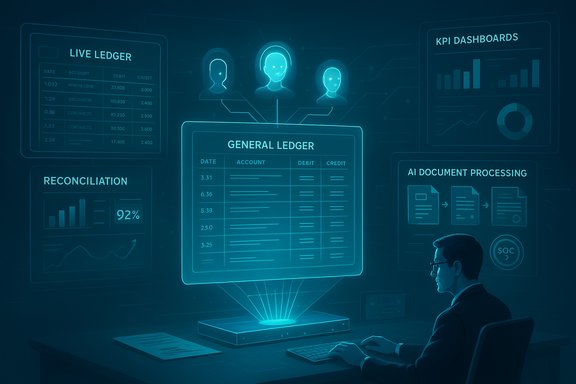
The accounting profession has moved from experimenting with AI to embedding it as core practice infrastructure, and the list of practical, production-ready tools to consider for 2026 reflects that shift: purpose-built copilots for tax and research, ledger overlays and Autonomous General Ledgers (AGLs) that reduce manual bookkeeping, OCR and document‑to‑ledger extractors for invoice and contract capture, and workflow/agent orchestration layers that tie those components together into auditable, controllable pipelines.
Accounting teams in 2024–2025 stopped asking whether AI will matter and started asking how to adopt it safely. Vendors and awards in 2025 made two things clear: domain specialization (tax, audit, bookkeeping) matters, and auditability—logs, versioning, human‑in‑the‑loop controls and provenance—distinguishes adoptable tools from risky experiments. The profession’s current posture is pragmatic: pilot with measurable KPIs, require traceable outputs that map to source documents, and retain human professional responsibility for all deliverables.
Two adoption patterns have emerged:
Every paragraph in your procurement and pilot plans should answer two questions: What measurable pain does this remove? And how will we prove it removed that pain—documented, repeatable, and defensible? When those answers are clear, AI becomes not a risk to manage but a capability to amplify the core professional work accountants do.
Source: Daily Herald https://www.dailyherald.com/2025110...ch-tools-for-accountants-to-consider-in-2026/
 Background
Accounting teams in 2024–2025 stopped asking whether AI will matter and started asking how to adopt it safely. Vendors and awards in 2025 made two things clear: domain specialization (tax, audit, bookkeeping) matters, and auditability—logs, versioning, human‑in‑the‑loop controls and provenance—distinguishes adoptable tools from risky experiments. The profession’s current posture is pragmatic: pilot with measurable KPIs, require traceable outputs that map to source documents, and retain human professional responsibility for all deliverables.Two adoption patterns have emerged:
- Overlay/agent approaches that sit above existing ledgers (no rip‑and‑replace).
- Native, AI‑first ledgers (AGLs) that redesign the general ledger to accommodate continuous agentic workflows.
Overview: the tool categories accountants should evaluate for 2026
The practical stack for firms moving into 2026 can be grouped into clear layers. Each layer contains products that solve specific, measurable pain points in client accounting, tax, and audit workflows.Capture and extraction (document-to-ledger)
- Advanced OCR and contract extraction for invoices, receipts, leases, contracts and K‑1s.
- Role: reduce manual data entry, seed ledgers with structured transactions.
Reconciliation and ledger automation
- Ledger overlays that reconcile bank feeds, categorize transactions, and propose journal entries.
- Role: accelerate month‑end close, reduce exception chasing.
Autonomous General Ledgers (AGLs)
- AI‑native ledgers built around agents that execute bookkeeping workflows with human approvals when needed.
- Role: eliminate many manual bookkeeping tasks and provide always‑current financials.
Audit, attest and research copilots
- Attest platforms with agentic testing and research copilots anchored to authoritative sources for tax and legal research.
- Role: accelerate audit testing and tax research while preserving defensible citations.
Orchestration and connectors
- No‑code workflow builders and agent orchestrators that link OCR, ERPs, tax engines and copilots into monitored pipelines.
- Role: enable production-grade automation with approvals and traceability.
Last‑mile practice automation
- E‑file management, pricing automation, client portals and engagement automation to remove seasonal bottlenecks.
- Role: reduce peak‑season rework and friction in client communications.
Recommended tools and what they deliver in practice
The following selection highlights representative tools in each category, explains the value they claim, and flags verification points every buyer should insist on before rollout.Artifact AI — ledger overlay and reconciliation agent
- What it claims: Artifact positions an overlay that connects to QuickBooks, Xero, NetSuite and other GLs to automate ingestion, reconciliation and posting. Vendor materials advertise up to 99% reconciliation accuracy and 96% posting accuracy, with dramatic productivity gains and measurable ROI in early deployments.
- Why it matters: Firms that do not want to migrate ERPs can still capture agentic automation gains by overlaying intelligence that keeps the core systems intact.
- Buyer checklist: require event‑level audit trails, representative pilot runs (real historical data), written definitions for “accuracy” and exception handling SLAs. Vendor‑stated percentages are directional—validate on your books.
Digits — Autonomous General Ledger (AGL) and embedded agents
- What it delivers: Digits launched an Autonomous General Ledger that embeds accounting agents (bookkeeping, finance and reporting agents) to run workflows and pause for human judgment. The company reports high accuracy benchmarks in internal trials and rapid adoption among early partner firms.
- Why it matters: AGLs change the underlying architecture of accounting systems; they can reduce the integration friction associated with overlay approaches and enable continuous, always‑current financials.
- Buyer checklist: demand whitepapers and trial benchmarks run on your data, assess exportability of audit logs and legal defensibility of automated postings.
AuditFile and Fieldguide — audit automation and attest agents
- AuditFile claims an issued patent covering AI applied to attest engagements and has integrated Azure OpenAI capabilities to help with classification, rollforwards and auto‑generation of statements. The patent (U.S. patent 10,891,294) is real and publicized by the vendor.
- Fieldguide markets audit testing agents that can automate a large share of routine audit testing, claiming up to 70% automation of testing tasks in certain workflows. These are where audit‑grade controls and logs matter most.
- Why it matters: audit automation can materially shorten close and testing cycles—but auditors retain professional responsibility, so every automated step must be verifiable and defensible.
- Buyer checklist: insist on immutable evidence chains (source doc → AI output → reviewer sign‑off), and check local regulator acceptance for digital confirmation processes.
Bloomberg Tax AI Assistant — research with citation fidelity
- What it does: Bloomberg Tax’s AI Assistant is explicitly built to provide chat‑based, citation‑backed answers that pull from Bloomberg’s curated primary and secondary tax resources. It emphasizes jurisdictional filtering and inline citations.
- Why it matters: Tax research is one of the lower‑risk, higher‑value uses of generative AI when it is anchored to authoritative content sets that provide clear source links.
- Buyer checklist: require proof that the assistant surfaces exact citation locations and that users can export evidence to workpapers.
HubSync, Ignition, HubSync’s last‑mile automation — practice operations
- HubSync received a strategic growth investment of more than $100M led by Thoma Bravo to accelerate its tax and accounting automation platform for CPA firms. The platform focuses on engagement automation, e‑file orchestration and last‑mile tasks.
- Why it matters: automating the last mile of tax delivery (e‑file, signatures, jurisdiction checks) often delivers immediate capacity relief during peak season.
- Buyer checklist: validate state/jurisdictional acceptance of e‑file flows and require robust exception handling and rollback pathways.
Fieldcheck: OCR / extraction engines and connectors (Nanonets, Nanonets‑like solutions)
- What they deliver: better structured extraction from scanned invoices, contracts and forms to seed downstream automation.
- Why it matters: automation is only as good as input quality. Strong extraction reduces exceptions and fuels high STP (straight‑through processing) rates.
Verification and evidence: how to treat vendor claims
Vendor benchmarks and ROI stories are useful signals but must be treated as claims until verified. Best practices:- Require representative sample datasets: vendors should run their models on de‑identified or customer‑provided historical files and provide event‑level accuracy metrics.
- Insist on reproducible tests: vendor results should be repeatable under agreed acceptance criteria and with the same model/version pinned during the pilot.
- Audit trails and explainability: every proposed journal entry, reconciliation and test result should include machine‑readable lineage linking to original documents and model inputs.
- Security and compliance artifacts: vendors must provide SOC 2 or ISO 27001 evidence, recent penetration test summaries, and clear data‑usage contracts (especially “no‑train” clauses if required).
Governance, risk and professional responsibility
Adoption risks fall into four practical buckets: hallucination and misattribution, connector and supply‑chain risk, model drift and version risk, and legal/regulatory exposure.- Hallucination: even domain‑tuned models can fabricate plausible but incorrect facts. Treat generative outputs as drafts that require human verification before client delivery.
- Connector risk: agentic systems often orchestrate many APIs and connectors. Use least‑privilege credentials, ephemeral tokens, and connector whitelists. Require vendors to document connector threat models and pen‑test evidence.
- Model drift and updates: insist on model versioning, rollback options, and change notifications in contracts. Avoid “moving target” production models without governance.
- Regulatory exposure: auditors and tax professionals remain fully responsible for signed outputs. Update engagement letters and internal QC checklists to reflect AI assistance and approval gating.
- Human‑in‑the‑loop approvals for material outputs (journal entries, tax positions, signed reports).
- Machine‑readable evidence linking AI outputs to source documents.
- Security attestations (SOC 2 / ISO 27001), contractual no‑train or data‑use clauses where needed.
- Pilot acceptance criteria and the right to audit vendor controls and sample outputs.
A pragmatic 90‑day pilot playbook (step‑by‑step)
- Select 1–2 low‑risk, high‑volume workflows (e.g., invoice capture & AP automation; bank reconciliation).
- Define KPIs: hours saved, exception reduction, STP rate increase, cycle‑time reduction.
- Assemble cross‑functional team: finance SME, IT/security, legal, and process owner.
- Choose minimal stack: one extractor, one copilot/ledger overlay or AGL, one orchestration tool.
- Run pilot on historical or de‑identified live data for 30–90 days with pinned model versions.
- Measure outcomes vs KPIs, collect qualitative feedback, and inspect audit trails for completeness.
- Decide: iterate and re‑pilot; narrow rollout with human gating; or stop.
- Do outputs map to source documents automatically? (Yes → good)
- Are event‑level logs exportable and immutable? (Yes → good)
- Does the vendor provide SOC/ISO documentation and pen‑test summaries? (Yes → good)
- Is there a clear billing model and metering (message meter, capacity packs)? (Yes → ask for cost modeling)
Pricing, billing and cost control
Agentic and copilot platforms use several billing primitives: message meters, capacity packs, seats, or value‑share pricing tied to savings. Some AGLs price per client or per ledger; overlay tools sometimes use percentage‑of‑savings pricing. These models can lead to unpredictable costs if not controlled by capacity packs or caps. Ask vendors for:- Predictable capacity packs or pre‑buy blocks for evaluation.
- A bill‑shock mitigation clause or monthly caps during pilots.
- Cost modelling examples for your client mix and volumes.
Workforce, skills and change management
Automation will change the nature of junior and mid‑level accounting work. Prepare staff for:- New review roles: AI reviewer and escalation owner roles that validate agent outputs.
- Prompt engineering and model‑interpretation training: skillsets that bridge accounting judgement and model behavior.
- Revised KPIs: measure advisory time and client outcomes, not just entries‑per‑hour.
What to watch in 2026 (market and tech trends)
- Role‑based copilots will become more common: vendors will offer finance‑specific Copilots that integrate directly with Excel, ERPs and messaging systems, reducing integration friction.
- More granular governance and billing tools: capacity packs, message meters and tenant controls will proliferate so IT and procurement can manage costs and risk.
- Domain‑trained models for tax and audit: expect more specialized models and agents that emphasize explainability and audit trails—useful, but still requiring human verification. Field deployments will stress test regulatory acceptance and professional liability frameworks.
- Consolidation and investment: growth capital (e.g., HubSync’s >$100M strategic investment) will accelerate platform maturation and last‑mile automation capabilities. Expect more M&A and larger firms packaging agentic features into established suites.
Strengths and risks — final balance
Strengths:- Immediate, measurable productivity gains in AP, reconciliation and routine audit testing.
- New advisory capacity unlocked by removing repetitive data work.
- Mature vendors now provide enterprise controls and audit trails, making adoption practical rather than speculative.
- Vendor ROI and accuracy claims are often vendor‑provided; require independent verification.
- Hallucination and connector risks remain the primary operational hazards.
- Regulatory and professional responsibility do not change because an AI produced the output—firms must retain final accountability.
Practical procurement checklist (quick reference)
- Integration with your primary ERPs and data stores.
- Event‑level traceability from AI output to source documents.
- Data‑handling guarantees: residency, deletion policies, and no‑train clauses.
- Security attestations: SOC 2, ISO 27001, pen‑test summaries.
- Clear, predictable billing models with caps for pilots.
- Local case studies and references you can contact.
Conclusion
2026 is the year accountants move from pilot mode to program mode—building AgentOps, pairing role‑based copilots with ledger overlays or AGLs, and treating AI as production infrastructure backed by governance, audit trails and measurable KPIs. The vendors listed above are representative of the practical choices firms will face: ledger overlays (Artifact), AI‑native ledgers (Digits), audit‑grade platforms (AuditFile, Fieldguide), authoritative research copilots (Bloomberg Tax), and last‑mile practice automation (HubSync). Each brings real operational upside, but none removes the need for human professional judgement, documented verification, and contractual protections. Treat vendor claims as starting points for rigorous pilots, insist on reproducibility and traceability, and redesign roles and pricing to capture the advisory value that automation unlocks.Every paragraph in your procurement and pilot plans should answer two questions: What measurable pain does this remove? And how will we prove it removed that pain—documented, repeatable, and defensible? When those answers are clear, AI becomes not a risk to manage but a capability to amplify the core professional work accountants do.
Source: Daily Herald https://www.dailyherald.com/2025110...ch-tools-for-accountants-to-consider-in-2026/


