
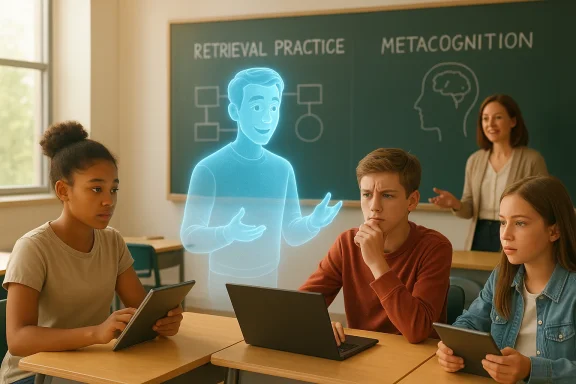
As governments and school districts race to bring generative AI into classrooms, a growing body of evidence suggests the technology’s short-term productivity gains may come at the cost of deeper learning habits: students and teachers increasingly offload mental effort to chatbots, weakening critical thinking, independent problem‑solving, and the routine practice that builds judgment. This tension—between efficiency and cognitive development—now sits at the center of an intensifying debate about the future of schooling.
Background
The conversation is no longer theoretical. Over the past two years, major technology firms and national governments announced large-scale education programs that place chatbots and AI tutoring into everyday schoolwork. Districts in the United States and national ministries abroad are piloting or deploying generative AI tools—Gemini, Copilot, ChatGPT Edu, and other systems—promising to reduce teacher workload, personalize learning, and accelerate student outcomes.At the same time, peer‑reviewed conferences and academic journals have begun publishing empirical evidence that frequent, uncritical use of generative AI correlates with smaller amounts of cognitive effort, reduced verification behavior, and changes in how people enact critical thinking. Those findings raise hard questions for educators about when, where, and how AI should be used in classrooms without handicapping future learning.
What the new research actually shows
The Microsoft / Carnegie Mellon study: scale, scope, and headline claim
A prominent study presented at CHI 2025 surveyed 319 knowledge workers who used generative AI at least weekly and analyzed 936 real-world examples of AI-assisted tasks. The authors—researchers from Microsoft and Carnegie Mellon—found a consistent pattern: higher trust in generative AI correlated with lower self‑reported engagement in higher‑order critical‑thinking steps (analysis, evaluation, problem‑solving) when completing tasks with AI assistance.Key takeaways from the study’s results:
- Participants who reported high confidence in AI were less likely to report exerting cognitive effort when using generative tools.
- When tasks were high‑stakes, users tended to re‑engage critical thinking (verification, cross‑checking sources). But when tasks were low‑risk or routine, users often accepted AI outputs with little scrutiny.
- The pattern suggests a reconfiguration of critical thinking: rather than practicing reasoning routinely, many users shifted to a model of “ask AI, then edit or verify” — a workflow that preserves efficiency but reduces the frequency of practicing core cognitive skills.
Corroborating evidence: cognitive offloading and metacognitive laziness
The CHI study sits within a growing literature about cognitive offloading—the tendency to shift memory, calculation, or reasoning tasks onto external tools. Multiple empirical and review papers from 2024–2025 documented similar mechanisms:- Laboratory experiments and neuroscience measures have found reduced neural engagement and lower retention in groups that relied heavily on generative models for writing or problem solving.
- Broader social‑science surveys connect frequent AI use to declines in self‑directed planning, monitoring, and evaluation—core metacognitive skills educators prize.
- The emergent term “metacognitive laziness” or “cognitive laziness” captures the phenomenon: when users habitually accept AI outputs rather than wrestling with problems themselves, the internal processes that produce deep understanding receive less practice.
Past lessons: technology-in-education failures matter
To evaluate AI’s promise and perils, we must compare it to earlier waves of educational technology that produced optimistic predictions—and, in many cases, disappointing learning outcomes.The most instructive comparison is the One Laptop per Child (OLPC) program and subsequent large deployments of laptops and tablets. Longitudinal, large‑scale evaluations—most notably randomized and quasi‑experimental studies from Peru and other countries—found:
- Substantial gains in digital skills (students learned to use devices and software), but
- Little or no improvement in measured cognitive skills or academic achievement for broad populations, and in some cases small negative effects on grade progression.
The OLPC experience is a cautionary tale: well-meaning technology deployments can consume large public resources while producing modest educational returns if the program neglects human capacity, curricular alignment, and sustained pedagogical integration.
Global rollout: the facts on large AI deployments
AI in education is now more than talk. Governments and districts are moving quickly to adopt and pilot tools at scale. Below are verified, cross‑checked examples that illustrate the breadth of current deployments.- Broward County Public Schools (Florida): Announced a district‑wide collaboration with Microsoft to deploy Microsoft 365 Copilot for educators and staff. The district described this as one of the largest K‑12 adoptions of Copilot globally, with staged student pilots and a formal AI task force to set guardrails. The deployment emphasizes integration with existing Microsoft tenant controls and professional development for staff.
- Miami‑Dade County Public Schools (Florida): Google announced a partnership that made Gemini for Education available to high‑school students and educators; district materials indicate access for roughly 100,000 high‑school students, combined with teacher professional development and workforce pathway programs.
- Kazakhstan: A strategic agreement signed November 6, 2025, between the Republic of Kazakhstan, OpenAI, and Freedom Holding Corp. will provide 165,000 ChatGPT Edu licenses to educators across preschool, secondary, technical, vocational, and higher education—with implementation through local educational platforms. The program is reported as privately financed by Freedom Holding and localized for Kazakh and Russian.
- Thailand: Microsoft partnered with Thai ministries to launch a nationwide education initiative (THAI Academy) that channels a free AI curriculum and over 200 Thai‑language AI courses through a national learning platform. The program targets broad population impact—training hundreds of thousands of learners and reaching large cohorts of students and civil servants; Microsoft’s local announcements and Thai press report specific teacher training cohorts and student reach estimates.
- India: OpenAI announced significant India‑focused education tie‑ups in 2025, launching an OpenAI Learning Accelerator and committing to distribute large numbers of ChatGPT licenses to government schools and technical institutes as part of a nationwide pilot, accompanied by teacher training and research partnerships with Indian universities.
- El Salvador (reported): Multiple media outlets reported an xAI (Elon Musk’s AI company) announcement to deploy its Grok model as a nationwide AI tutor in public schools, targeting more than one million students. These reports require careful scrutiny: coverage is widespread but still relies on company statements and government communications; implementation details—device distribution, offline capacity, data governance—remain thin or preliminary.
Why educators worry: five practical risks
- Routine cognitive atrophy: When AI does the heavy lifting on routine tasks, students and teachers lose repeated practice in evaluation, synthesis, and argumentation—skills built through iterative struggle and feedback.
- Shallow learning and poorer retention: Quick, AI‑generated responses reduce the need for effortful retrieval and elaboration—two processes shown to strengthen long‑term learning.
- Normalization of unverified answers: Easy access to fluent but not always correct AI outputs can condition learners to accept “authoritative‑sounding” mistakes rather than interrogating sources.
- Inequitable access and a two‑tiered future: If human‑centered, teacher‑rich education becomes scarce and concentrated among the privileged, while AI‑heavy approaches reach under-resourced schools, educational inequality could widen. Critics note that many tech executives choose low‑tech or tech‑free schooling for their own children—an uncomfortable signal for policy makers.
- Governance and data risks: Large national deployments must solve complex issues: student privacy, local language support, vendor contracts that protect data from being repurposed, and mechanisms to audit model behavior and bias.
Where AI can help—if we design for learning, not just speed
Despite risks, well‑designed AI can augment human teaching if we shift focus from automation to scaffolding:- Use AI to remove low‑value, repetitive tasks (administration, simple feedback drafts) so teachers can invest that time in high‑impact, interpersonal work: formative assessment conversations, targeted interventions, and socio‑emotional support.
- Build prompted reflection into AI workflows: require learners to explain how they would solve a problem before consulting AI; ask students to critique AI outputs as part of an assignment.
- Design curricula and assessments that reward process, not just product: make reasoning steps visible and graded.
- Train teachers on AI pedagogy: not only on tool mechanics but on cognitive science—how retrieval practice, spaced review, and effortful processing foster mastery.
- Insist on robust governance: contracts that protect student data, explainability measures for AI outputs used in assessment, and independent evaluation of learning outcomes.
A practical governance checklist for districts and ministries
- Establish an AI ethics and pedagogy task force with teachers, cognitive scientists, and community representatives.
- Pilot deployments with rigorous evaluation: measure learning outcomes, not only time savings or user satisfaction.
- Protect student data contractually: require vendors to pledge non‑use of student interactions for model training, maintain data residency rules, and allow audits.
- Invest in teacher professional development that pairs tool usage with concrete classroom reforms.
- Create age and task‑specific guardrails: block AI for summative assessments; allow guided AI for formative practice under teacher supervision.
What policymakers should ask before scaling
- What specific cognitive skills will this tool practice, replace, or diminish?
- How will we measure learning gains (or losses) beyond convenience metrics?
- What training will teachers receive, and how will that training be sustained?
- Who pays for devices, connectivity, and training—and what happens when vendor commitments change?
- How will we preserve equity so that AI complements high‑quality teaching instead of substituting for it?
Conclusion: AI in education must be intentionally conservative and experimentally rigorous
AI’s arrival in classrooms is inevitable; the question is not whether schools will use generative tools, but how they will use them. The evidence so far—empirical studies showing reduced cognitive effort, the long‑term mixed record of earlier tech initiatives like OLPC, and rapid district‑ and national‑scale deployments—tells a simple story: without careful design, monitoring, and a focus on pedagogy, AI risks becoming a short‑term expedient that hollowes out the very skills education aims to build.Policymakers and education leaders must adopt a conservative, experimental approach. That means starting with limited pilots, measuring learning outcomes (not just time saved), protecting student data, and equipping teachers to turn AI from a crutch into a coach. If leaders follow that pathway—integrating cognitive science, teacher development, and governance—AI can be a meaningful accelerator for learning. If they do not, the technology’s promise of personalization and efficiency may come at a steep cost: the gradual erosion of critical thinking that no algorithm can restore once it atrophies.
Source: El.kz AI bots may weaken critical thinking, study warns - el.kz
