

The presence of artificial intelligence in classrooms is no longer a distant prospect; it is actively reshaping how teachers prepare lessons, how administrators run schools, and how students study — sometimes within a single semester. The Daily Observer link provided could not be reached, so this feature synthesizes verifiable, cross-referenced reporting, institutional case studies, and recent surveys to explain how AI is changing our education now, what measurable benefits and risks have already emerged, and what practical steps schools must take to preserve learning quality and equity as adoption accelerates. Note: the original Daily Observer page returned a server error and its exact wording could not be verified; the analysis below draws on multiple independent reports and documented deployments that cover the same trends attributed to that story.
Artificial intelligence — and in particular generative AI and large language models (LLMs) — moved from research labs into mainstream productivity tools in 2023–2024. These systems can generate text, summarize documents, produce draft lesson plans, grade simple assessments, and power conversational assistants. Schools and districts now deploy tools ranging from enterprise copilots (e.g., Microsoft 365 Copilot) to domain-specific tutors and reading-assessment tools integrated into classroom platforms. The result is a rapid reconfiguration of tasks that historically consumed much of educators' time: scheduling, grading, differentiation, and some forms of feedback.
This shift is not uniform. Adoption patterns vary by region, by resource level, and by the vendor agreements that govern how student data are stored and used. That uneven rollout explains why headlines about AI in education range from optimistic case studies to alarmed warnings about academic integrity and equity.
Caveat: Some vendor or institutional claims — such as specific accuracy percentages in predictive models — are context-dependent and require access to the models, datasets, and methodology to independently verify. When such numerical performance claims are cited without accompanying evaluation details, treat them as preliminary.
Source: Daily Observer https://www.observerbd.com/news/560716/
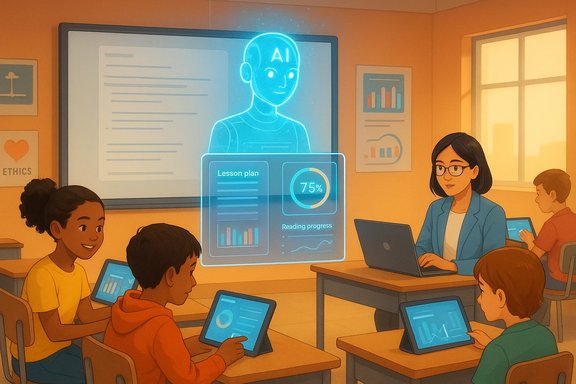 Background / Overview
Artificial intelligence — and in particular generative AI and large language models (LLMs) — moved from research labs into mainstream productivity tools in 2023–2024. These systems can generate text, summarize documents, produce draft lesson plans, grade simple assessments, and power conversational assistants. Schools and districts now deploy tools ranging from enterprise copilots (e.g., Microsoft 365 Copilot) to domain-specific tutors and reading-assessment tools integrated into classroom platforms. The result is a rapid reconfiguration of tasks that historically consumed much of educators' time: scheduling, grading, differentiation, and some forms of feedback.This shift is not uniform. Adoption patterns vary by region, by resource level, and by the vendor agreements that govern how student data are stored and used. That uneven rollout explains why headlines about AI in education range from optimistic case studies to alarmed warnings about academic integrity and equity.
How AI is being used today: concrete examples
Administrative automation and productivity copilots
Many deployments focus first on lowering administrative burden. Tools like Microsoft 365 Copilot are used to draft parent letters, generate lesson-plan templates, synthesize meeting notes, and automate routine reporting. District pilots frequently find material time savings for teachers when AI is used responsibly and with human review. In some trials, teachers reported reclaiming roughly nine hours per week previously lost to paperwork — time that could be redirected to student-facing instruction or planning.Personalized learning and AI tutors
Generative systems are being adapted as on-demand tutors that provide explanations, create practice questions, and scaffold content at different reading levels. Universities and ed‑tech pilots have launched AI assistants to index course materials and offer student-specific feedback, while adaptive study-bots can generate revision plans or flashcards tailored to individual gaps. These personalized supports scale differentiation in large classes where one teacher cannot produce bespoke resources for every learner.Assessment, reading tools, and formative feedback
AI-powered tools that analyze student recordings or written responses produce rapid, data-driven formative feedback. Reading assessment tools embedded in Teams and similar platforms can evaluate pronunciation, reading fluency, and accuracy far faster than manual checks — turning assessment cycles that once took days into hours and enabling teachers to target interventions quickly. Pilots using these tools reported quicker turnaround on assessments and richer granular insight into student performance.Onboarding, chatbot helpdesks, and student services
Universities have launched AI chatbots to help with orientation, registration, and frequently asked questions. These bots reduce friction at scale, guiding new students through common administrative tasks and freeing staff to handle exceptions. When well-constructed and properly maintained, such copilots increase institutional responsiveness and reduce confusion during critical enrollment windows.Language learning, libraries, and enrichment
AI is being used for language practice (grammar checks and interactive exercises), library recommendation systems that match resources to course needs, and creative, project-based learning (for example, using generative image tools in STEAM lessons). These use cases amplify access to differentiated materials and stimulate new learning pathways.What adoption looks like, backed by data
Multiple recent surveys and studies show very high and rapidly rising student use of AI tools for study. Independent studies report adoption figures in the mid‑80s to low‑90s percentage range among college-age learners, with frequent weekly use common across samples. For example, a large 2024–2025 survey landscape shows a majority of students using tools like ChatGPT, Grammarly, and Microsoft Copilot for tasks such as summarization, drafting, and revision. A Harvard undergraduate study found almost 90% of students reported generative AI use in 2024, while sector-wide surveys reported roughly 86% usage rates in late 2024 and similar high numbers into 2025. These independent data points collectively demonstrate that AI has become a default study aid rather than an experimental novelty. At the institutional deployment level, documented case studies show measurable time savings and scaled capabilities:- Brisbane Catholic Education’s rollout to thousands of educators reported average weekly time savings that translated into regained instructional capacity.
- National programs (for example, a Department of Education partnership in the Philippines) combined Copilot deployments with teacher upskilling and rapid-reading assessment rollout that assessed tens of thousands of learners during pilots.
Strengths: what AI delivers well in education
- Time and workload reduction — AI relieves teachers of repetitive documentation and labor‑intensive formative tasks, enabling more time for individualized instruction. Multiple pilots report significant weekly time reclaimed when teachers use copilots for planning and administration.
- Scalable personalization — systems can generate tailored practice, scaffolded explanations, and differentiated worksheets on demand, something previously impossible in large classes.
- Faster assessment cycles — automated reading and formative assessment tools compress turnaround time from days to hours, accelerating remediation and targeted support.
- Improved access and inclusion — translation, simplified explanations, and multimodal material generation can lower barriers for English-language learners and students with special needs when applied thoughtfully.
- On‑ramp to workforce skills — teaching students how to prompt, verify, and ethically use AI prepares them for real workplaces where AI tools are already in daily use. Industry–education partnerships are already developing AI-focused credentials and modules.
Risks and limits: what the evidence warns us about
While the upside is significant, several hard challenges accompany rapid AI adoption.1) Academic integrity and the “invisible shortcut”
High student adoption correlates with increased instances where AI produces work that students submit with little or no critical revision. Surveys show substantial proportions of students using AI to draft essays or answer assessment questions — behaviors that risk hollowing out the very learning assessments aim to measure. The response has not been universal bans; many institutions now “stress-test” assessments, redesign tasks to surface process (draft logs, annotated revisions, in-person defenses), and require disclosure of AI use.2) Hallucinations and factual reliability
Generative models sometimes produce plausible but incorrect information — hallucinations. This is a critical problem in classroom contexts where accuracy matters. Teachers and students must be equipped with fact‑checking skills and workflows that treat AI outputs as provisional drafts, not authoritative sources. Districts that omit verification protocols risk propagating errors at scale.3) Data privacy and vendor governance
Vendor contracts vary widely in whether student inputs are used to train models, whether telemetry is retained, and how long data are stored. Enterprise licensing and specific education‑editions can offer stronger guarantees, but procurement teams must scrutinize deletion rights, audit access, and non‑training clauses. Without rigorous contract terms and tenant isolation, student data may be exposed to downstream risks.4) Inequity and the digital divide
High adoption among students often correlates with access to devices, reliable internet, and AI‑savvy peers. Wealthier students and STEM majors are more likely to exploit AI advantages, potentially widening existing achievement gaps. Effective adoption must include both hardware access and structured AI literacy training for all learners.5) Teacher training gaps and uneven professional development
Many teachers use AI informally but lack formal, deep professional development on prompt design, bias detection, and pedagogical redesign. Districts report inconsistent training rollout: a mix of one‑hour briefings to multiweek courses, with variable depth and outcomes. Pilots with strong teacher training show far better results than ad-hoc deployments.Governance, procurement, and assessment redesign: emerging best practices
Field-proven guidance from districts and universities converges on several practical rules:- Centralize procurement to obtain enterprise/education contracts with explicit data governance and non‑training guarantees. This helps ensure that student inputs are not inadvertently used to train public models.
- Adopt a phased rollout: pilot with teacher-led trials, extend targeted student access (older cohorts first), and redesign assessments before scale. This three-phase approach reduces risks and builds teacher confidence.
- Redesign assessment to emphasize process evidence: staged submissions, oral defenses, annotated revisions, and portfolio work degrade incentives to outsource the task to an AI. This turns assessment into a learning opportunity while keeping standards high.
- Institute prompt-logging and process documentation in learning management systems so educators can see a student’s iterative work and the role AI played in producing a submission.
- Publish transparent AI-use policies for classrooms, describing permitted tools, required disclosures, and acceptable assistance for each course. Students prefer training and clarity to punitive-only approaches.
Case studies: real deployments and what they teach us
Brisbane Catholic Education (Australia) — scale and teacher time savings
BCE rolled out Microsoft 365 Copilot to 12,500 staff after a trial showed participating educators saved an average of about 9.3 hours per week. Those reclaimed hours were framed as opportunities for increased student engagement and better well‑being among educators facing high burnout risks. BCE also paired rollout with ethical guidelines and cybersecurity measures. This case underscores that scale + training + ethics yields measurable returns.Department of Education (Philippines) — assessments and scale
A nationwide DepEd–Microsoft program deployed Copilot and embedded reading-assessment tools (Reading Progress, Reading Coach) in multiple regions. The initiative reported rapid acceleration in assessment turnaround and significant teacher time savings during pilots; thousands of learners were assessed in compressed timeframes. The program demonstrates how national-scale procurement and teacher upskilling can operationalize AI benefits at system level.BINUS University and Tecnológico de Monterrey — personalized AI tutors and administrative automation
Universities are integrating Azure OpenAI Service solutions to automate administrative summaries, forecast enrollment with machine learning models, and deploy AI tutors that index course materials for personalized feedback. Some institutional claims (for example, high prediction accuracy on specific administrative forecasts) are promising but should be treated with caution until independently replicated. These deployments show how AI can reframe staffing priorities in higher education but also illustrate the need for robust validation.Caveat: Some vendor or institutional claims — such as specific accuracy percentages in predictive models — are context-dependent and require access to the models, datasets, and methodology to independently verify. When such numerical performance claims are cited without accompanying evaluation details, treat them as preliminary.
Practical roadmap for school leaders: six steps to responsible adoption
- Pilot with clear learning outcomes: start small with teacher volunteers, measure time savings and learning impact, and collect teacher and student feedback.
- Centralize procurement and require explicit data clauses: insist on non‑training of public models, deletion options, and audit rights.
- Provide high-quality teacher PD: include prompt engineering, verification workflows, bias/bias-mitigation training, and assessment redesign exercises.
- Redesign assessments before scale: move toward process-based evaluation, oral defenses, and staged submissions to preserve learning validity.
- Provide devices and connectivity: ensure equitable access so AI tools don’t widen existing gaps.
- Communicate transparently with students and families: publish AI-use policies, examples of permitted assistance, and remediation steps for misuse.
Guidance for teachers and classroom practice
- Treat AI outputs as draft material: verify facts, check reasoning, and require students to annotate AI contributions.
- Use AI to generate differentiated practice and formative checks, but always follow with teacher-curated feedback to maintain alignment with learning goals.
- Teach AI literacy explicitly: how to prompt effectively, how to spot hallucinations, how to evaluate sources, and the ethics of authorship and attribution.
- Log and archive AI interactions where possible to document process and deter misuse.
- Use AI to augment instruction, not replace critical pedagogical interactions. Students need practice with cognitive effort; over-reliance on AI for initial comprehension tasks can short-circuit deeper learning.
The future classroom: measured optimism
AI’s near-term role in education is about amplification — freeing humans to focus on higher-order teaching while automating repetitive tasks. Over the next five years, expect to see:- Deeper integration of copilots into teacher workflows and LMSs.
- Widespread adoption of process-based assessment designs.
- Growth in AI-literacy curricula and workplace‑oriented credentials.
- Continued vendor evolution around education-focused model variants and stronger contractual privacy guarantees.
Conclusion
AI is changing education in concrete, measurable ways: teachers reclaim time, assessments can be more frequent and actionable, and personalized learning becomes scalable. Those gains come with serious responsibilities — to protect student privacy, preserve academic integrity, and ensure equitable access. The inaccessible Daily Observer link that prompted this piece could not be verified directly, but the trends it likely described are corroborated by multiple independent reports and institutional case studies: high student adoption, meaningful teacher time savings when tools are used thoughtfully, and a policy pivot from bans to managed adoption that redesigns assessment and governance around AI. The essential rule for schools is straightforward: adopt deliberately, govern tightly, and teach students — and teachers — to use AI as a tool for deeper learning rather than a shortcut to grades. By doing so, education systems can harness AI’s productivity and personalization while safeguarding the core mission: developing independent, critical thinkers ready for an AI-augmented world.Source: Daily Observer https://www.observerbd.com/news/560716/
