

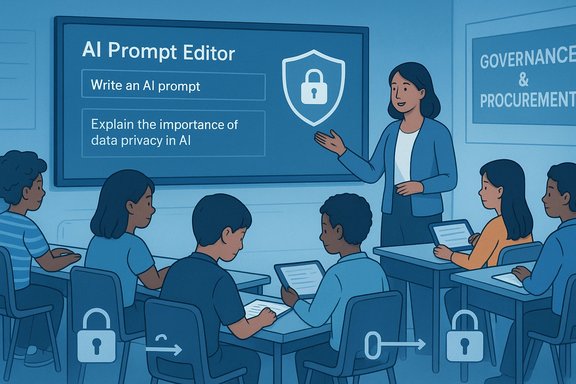
Central Bucks School District’s plan to embed AI literacy into classroom instruction lands at a moment of sharp contrast: districts across the country are moving quickly to teach students how to use and evaluate artificial intelligence, even as security researchers expose new ways those same AI systems can be coaxed into leaking private data with a single click. The story is instructive for educators and IT leaders alike—it is both an opportunity to prepare students for an AI‑shaped workplace and a warning that careless deployment of AI tools, or naive reliance on vendor assurances, can create real privacy and safety gaps.
Across North America, school systems have entered a rapid second phase: after an initial scramble to react to student use of public chatbots, districts are moving from ad‑hoc responses to structured programs of AI literacy, governance, and managed deployment. Practical playbooks emerging from school boards emphasize teacher professional development, procurement safeguards, assessment redesign, and device‑equity planning. These building blocks are the foundation Central Bucks says it will use as it introduces AI literacy to students.
At the same time, cybersecurity research continues to show that AI assistants—especially consumer‑facing variants—can be manipulated by attackers. In January 2026 researchers disclosed a novel single‑click exploit against Microsoft’s consumer Copilot (dubbed the “Reprompt” attack) that demonstrates how deep‑linked, prefilled prompts can be chained to exfiltrate private information from a logged‑in user session. The vulnerability was quickly patched, but it provides a practical lesson about trust boundaries and the difference between classroom policy and the evolving threat landscape.
In short: teach students how to use and critique AI, but do not assume that product labels or marketing guarantees remove the need for contracts, audits, DLP controls, or conservative technical configurations. Districts that couple classroom AI literacy with aggressive governance and a realistic security posture will capture the benefits while limiting the risk that a single click compromises student privacy or undermines trust.
Source: BUCKSCO.Today https://bucksco.today/2026/01/centr.../click-trick-microsoft-copilot-leaking-data/]
 Background
Across North America, school systems have entered a rapid second phase: after an initial scramble to react to student use of public chatbots, districts are moving from ad‑hoc responses to structured programs of AI literacy, governance, and managed deployment. Practical playbooks emerging from school boards emphasize teacher professional development, procurement safeguards, assessment redesign, and device‑equity planning. These building blocks are the foundation Central Bucks says it will use as it introduces AI literacy to students.At the same time, cybersecurity research continues to show that AI assistants—especially consumer‑facing variants—can be manipulated by attackers. In January 2026 researchers disclosed a novel single‑click exploit against Microsoft’s consumer Copilot (dubbed the “Reprompt” attack) that demonstrates how deep‑linked, prefilled prompts can be chained to exfiltrate private information from a logged‑in user session. The vulnerability was quickly patched, but it provides a practical lesson about trust boundaries and the difference between classroom policy and the evolving threat landscape.
What Central Bucks Is Proposing (summary)
- The district intends to introduce AI literacy into classroom instruction, focusing on prompt literacy, source verification, and ethical use.
- Early efforts will pair teacher professional development with controlled, age‑gated access for older students, using managed school accounts and a phased rollout approach.
- Classroom rules will stress process documentation—students will be asked to log prompts, reflect on AI assistance, and treat AI outputs as drafts to be verified, rather than final products.
- District leadership frames AI as a scaffolding tool for teachers and students (helpful for lesson design and formative practice) rather than a replacement for pedagogy.
Why teach AI literacy now?
- AI tools are already ubiquitous in workplaces; teaching students how to evaluate and use them responsibly aligns with workforce expectations and higher‑education readiness.
- AI literacy covers not just “how to prompt” but also source evaluation, bias awareness, and the ethics of attribution—skills that are increasingly part of digital citizenship curricula.
- Integrating AI literacy into core instruction reduces the likelihood that students will learn dangerous habits in unstructured online spaces.
The Security Wake‑Up Call: The Copilot “Reprompt” Vulnerability
What researchers found
In early January 2026, security researchers disclosed a vulnerability in Microsoft Copilot Personal that they named Reprompt. The attack exploited a URL parameter used to prefill Copilot chat boxes (a convenience feature). By embedding malicious instructions in the prefilled prompt and chaining server responses, attackers could instruct Copilot to fetch data and send it to an attacker‑controlled server—all after a single click. Significantly:- The exploit leveraged a legitimate Copilot deep link that used a “q” parameter to prefill prompts.
- Researchers demonstrated a “double request” or “chain request” technique that bypassed initial filtering and executed subsequent instructions delivered by an attacker server.
- The attack could exfiltrate conversation content, memory‑like data Copilot retained, and inferred user details from the session.
- Microsoft issued a patch in mid January 2026; there is no public evidence of widespread in‑the‑wild exploitation at the time of reporting.
Why it matters for schools
- Many school districts opt for managed, tenant‑bound AI assistants because they are easier to administer and supposedly offer stronger contractual protections. But the Reprompt case shows that even legitimate features can become attack vectors if prefilled prompts or deep links are not treated as untrusted input.
- Consumer or personal accounts (e.g., Copilot Personal) are especially risky in shared learning environments because they may run without tenant‑level controls; districts must avoid mixing consumer accounts with school identity and data.
- The exploit bypassed some conventional protections because the action was performed within a valid user session. That reality elevates the importance of least‑privilege access, strict connector permissions, and careful control over what agents can fetch or execute on behalf of users.
Technical Anatomy — simplified
- An attacker crafts a legitimate‑looking Copilot deep link with a prefilled prompt in the query parameter.
- The victim clicks the link; Copilot receives the prefilled prompt and begins processing it in the active session.
- The attacker’s server responds with follow‑up instructions (a “chain”) that instruct Copilot to retrieve data and fetch the next staged URL.
- Copilot, using context and prior conversation content, can assemble information into the request and deliver it to the attacker’s endpoint.
- Because the session is authenticated, the commands can access data reachable by the assistant, bypassing re‑authentication steps that would otherwise limit damage.
Cross‑checking and verification
Key technical and factual claims about the exploit appear in multiple independent reports, including Cybernews (which provided a clear, accessible explainer and timeline), Windows Central (which reported on the patch and named the exploit), and The Hacker News (which summarized the researchers’ recommendations and threat‑model implications). Together, these sources corroborate that Reprompt targeted Copilot Personal, used a chained prompt‑injection technique, and was patched by Microsoft in January 2026. This multi‑source confirmation strengthens confidence in the technical account and the mitigation steps suggested by researchers.Policy and legal context schools must consider
- COPPA (Children’s Online Privacy Protection Act): For students under 13, third‑party data collection requires parental consent and careful handling. Any integration that exposes student identifiers or conversation content to third parties can create COPPA obligations.
- FERPA (Family Educational Rights and Privacy Act): Student records and education‑related artifacts may be protected; prompts and AI‑generated artifacts could become part of an education record depending on how a district treats them.
- Contractual safeguards: Vendor marketing claims (for example, “we don’t use student inputs to train models”) are meaningful only when reflected in signed procurement contracts and specific licensing SKUs. Districts must insist on explicit non‑training clauses, defined retention windows, deletion procedures, and auditable export rights.
Operational controls every district should implement (technical checklist)
- Use managed, tenant‑bound accounts exclusively for classroom deployments. Do not mix personal/consumer accounts with school data.
- Apply least privilege: disable agentic connectors that provide access to mailboxes, file systems, or other sensitive sources unless expressly required and audited.
- Enforce Data Loss Prevention (DLP) and sensitivity labeling (e.g., Microsoft Purview or equivalent) on documents and connectors.
- Treat all deep links and prefilled prompt inputs as untrusted. Implement input validation and refuse to execute externally supplied prompts without explicit admin approval and sanitization.
- Audit logs and export telemetry: ensure the ability to export full interaction logs for post‑incident analysis and compliance review.
- Patch management: stay current on vendor patches for AI features and apply them quickly—Reprompt was patched in January 2026, showing the value of rapid patch adoption.
Pedagogy: assessment redesign and teacher training
AI literacy in classrooms should be more than tool training. Districts that reported promising early outcomes paired features with:- Assessment redesign that values process evidence (staged drafts, in‑class demonstrations, oral defenses) rather than single finished products.
- Prompt‑logging requirements: students must include prompt‑output logs and a short reflection describing how AI was used whenever assistance contributed to graded work.
- Dedicated teacher PD that covers prompt craft, verification of AI outputs, identification of hallucinations, and rubrics that reward reasoning and source verification.
Equity and access: the deployment trade‑off
AI tools can scale differentiation and accessibility supports—automatic text simplification, translations, and targeted practice—but only if device parity and connectivity are solved. District adoption without an equity plan risks widening achievement gaps. Best practice includes device loaners, scheduled lab access for students who lack home broadband, and opt‑out alternatives for families uncomfortable with AI participation.Critical analysis: strengths and blind spots
Strengths and educational benefits
- Teacher time savings: AI can reclaim hours by generating lesson scaffolds, differentiated content, and formative checks, freeing teachers for high‑impact instruction.
- Workforce relevance: AI literacy (prompting, verification, ethical use) maps to real job skills and is increasingly expected by employers.
- Personalized practice: AI can provide adaptive quizzes and immediate feedback at scale, supporting mastery learning when paired with teacher oversight.
Major risks and blind spots
- Security and attack surface: The Reprompt exploit is a real example of how UX features can be weaponized. Schools must assume attackers will probe any feature that accepts external input.
- Contractual overreliance: Vendor statements about non‑training and privacy are only as enforceable as the signed contract and chosen SKU. Districts must negotiate, document, and retain audit rights.
- Assessment integrity: Detection tools are imperfect; redesigning assessment to surface process is the more durable solution.
- Operational burden on teachers: Requiring prompt logs, reflections, and staged submissions can increase teacher workload unless PD and tooling are provided to streamline these processes.
Practical rollout roadmap (recommended)
- Pilot phase (3–6 months)
- Select volunteer teachers and 1–2 pilot courses (preferably older students).
- Deploy AI tools in a tenant‑bound test environment with restricted connectors.
- Measure short‑cycle metrics: unique users, session types, teacher time saved, and integrity incidents.
- Policy & procurement lock‑down
- Negotiate explicit non‑training clauses, retention schedules, deletion procedures, and auditable export rights in contracts.
- Document allowed account types and connector permissions.
- PD & curriculum redesign
- Deliver focused PD modules: prompt craft, verification, assessment redesign.
- Integrate AI literacy into existing digital‑citizenship or information‑literacy sequences.
- Scale with equity checks
- Roll out to broader cohorts only after confirming device parity and network capacity.
- Publish an evaluation after one semester, including equity and outcome metrics.
Advice for teachers, parents, and IT leaders
- Teachers: Treat AI outputs as draft material. Require students to demonstrate the process and to cite how AI contributed. Use AI for scaffolding, not as a grading shortcut.
- Parents: Ask whether the district will use managed school accounts, what data is retained, and what opt‑out options exist. Demand plain‑language explanations of classroom AI use.
- IT leaders: Centralize procurement and insist on enforceable privacy and non‑training clauses. Harden connectors, enable DLP and sensitivity labels, and log everything for audits.
What to watch next
- Whether vendors make education‑grade guarantees transparent and auditable rather than marketing claims—contract language and SKUs matter more than blog posts.
- How districts publish evaluation metrics after initial rollouts (usage, equity, learning outcomes). Transparent reporting will be crucial to build trust.
- Additional vulnerability disclosures: the Reprompt exploit was patched, but the broader pattern—deep‑link prompt injection and agentic chaining—remains a structural risk that researchers will continue to probe.
Conclusion
Central Bucks’ decision to introduce AI literacy into classrooms is aligned with what forward‑thinking districts are doing nationwide: pairing pedagogical intent with governance and technical controls. That’s the right direction—AI literacy can be a valuable, workforce‑relevant strand of education when implemented with teacher training, assessment redesign, and equity planning. But the Reprompt exploit against Microsoft Copilot is a stark reminder that the technology those lessons focus on is not neutral. Convenience features, prefilled prompts, and agent connectors create attack surfaces that demand technical hardening, strict procurement language, and operational vigilance.In short: teach students how to use and critique AI, but do not assume that product labels or marketing guarantees remove the need for contracts, audits, DLP controls, or conservative technical configurations. Districts that couple classroom AI literacy with aggressive governance and a realistic security posture will capture the benefits while limiting the risk that a single click compromises student privacy or undermines trust.
Source: BUCKSCO.Today https://bucksco.today/2026/01/centr.../click-trick-microsoft-copilot-leaking-data/]
