

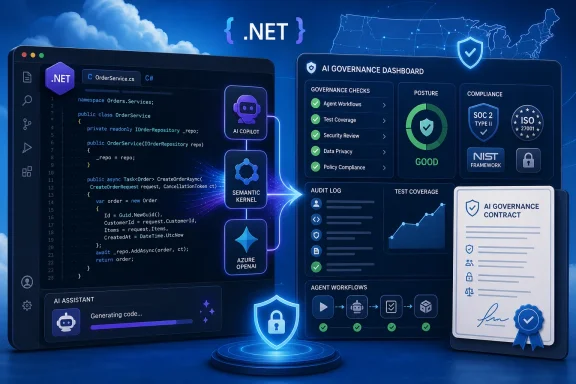
For years, hiring a .NET development company was a familiar procurement exercise. Buyers compared C# experience, Azure credentials, domain references, hourly rates, and delivery maturity. In 2026, that old checklist is still necessary, but no longer sufficient. A vendor can now generate code faster than its contract language, test strategy, and security review process can keep up.
That is the tension running through this market. The best AI .NET partner is not necessarily the one promising the most automation. It is the one that can prove where automation ends, where engineering judgment begins, and who owns the result when an AI tool helped produce half the codebase.
The Vendor List Is Really a Governance Test
Technology.org’s list is conventional on the surface: one mid-sized custom development firm, three global IT services giants, and one AI-oriented talent platform. But the grouping captures the new shape of the .NET services market better than a simple ranking would. AI .NET development is no longer one category; it is several business models competing under the same label.
Belitsoft represents the full-cycle custom development model: architecture, engineering, modernization, testing, deployment, and ongoing support. Wipro, TCS, and Infosys represent enterprise-scale transformation, where Microsoft partnerships, global delivery centers, and massive internal training programs matter as much as individual developer skill. Turing represents a different bet: that companies may want AI-vetted talent and managed teams without buying into a traditional consulting engagement.
That spread matters because “AI .NET development” can mean wildly different things. For one buyer, it may mean embedding Azure OpenAI into an ASP.NET Core application. For another, it may mean using GitHub Copilot to accelerate routine CRUD development. For a third, it may mean modernizing a decade-old .NET Framework monolith into a cloud-native service architecture with agents, observability, and compliance controls.
The danger is that vendors can now market all three as the same thing. In practice, the work falls into three layers: AI inside the application, AI inside the development process, and AI inside the vendor’s delivery model. A mature buyer has to evaluate each layer separately.
This is why the strongest part of the submitted review is not the vendor praise. It is the insistence that structured AI adoption matters more than tool enthusiasm. In 2026, a partner that says its developers “use AI” has said almost nothing. The meaningful questions are whether AI-generated code is reviewed by senior engineers, whether generated tests are trusted or independently validated, whether prompts and agent instructions are versioned, and whether the contract explicitly covers AI-assisted intellectual property.
Microsoft’s Stack Makes .NET an AI Platform Again
The .NET ecosystem has spent much of the last decade rebuilding its credibility after the old Windows-only framework era. Modern .NET runs across Windows, Linux, and macOS; ASP.NET Core is a serious web platform; Blazor has matured into a credible UI option for certain enterprise scenarios; and Azure has made Microsoft-native development attractive again for regulated organizations.
AI has added a new reason for .NET shops to stay in the Microsoft orbit. Azure OpenAI Service, Azure AI Foundry, Semantic Kernel, Microsoft.Extensions.AI, ML.NET, GitHub Copilot, Visual Studio, and Azure DevOps now form something close to an end-to-end AI development environment. That does not make .NET the center of machine learning research, where Python remains dominant. It does make .NET a strong platform for enterprise AI application delivery.
That distinction is important. Most organizations are not training frontier models. They are building document-processing workflows, support copilots, claims triage systems, knowledge-base search, compliance review assistants, forecasting tools, and internal automation. These are integration problems as much as AI problems, and .NET has always been strongest where business logic, identity, databases, APIs, and long-lived systems meet.
The Microsoft stack also gives enterprise buyers a comfort zone. Identity flows through Entra ID. Data sits in SQL Server, Fabric, Cosmos DB, or existing enterprise stores. Deployment can be governed through Azure policies. Logging and telemetry can land in familiar observability tooling. For Windows-heavy organizations, this reduces the cultural tax of AI adoption.
But Microsoft’s advantage cuts both ways. A vendor that is merely “good at .NET” may not be ready for modern AI work. The new baseline includes retrieval-augmented generation, vector search, prompt evaluation, agent orchestration, model routing, token cost controls, privacy boundaries, and red-team testing. Traditional .NET competence remains necessary, but it is no longer the whole job.
The End-of-Support Clock Turns Modernization Into a Budget Line
One of the most practical claims in the review concerns .NET 8 and .NET 9 support. Microsoft’s lifecycle calendar has made November 10, 2026 a date that many IT departments cannot ignore: both .NET 8 LTS and .NET 9 STS are scheduled to reach end of support on that day. That does not mean every application suddenly breaks. It does mean security updates and official support become a problem for organizations that remain stuck.
The timing gives modernization vendors an obvious sales hook. If you are still carrying .NET Framework applications, WebForms, old WCF services, VB6-adjacent workflows, Microsoft Access front ends, or early .NET Core systems, the AI modernization pitch is tempting. Vendors can now claim that agents can analyze legacy code, map business rules, generate target architectures, and produce modern C# or Blazor implementations faster than a traditional migration team.
GAPVelocity AI’s VELO platform, mentioned in the review, is a good example of the direction of travel. Its pitch is not generic code generation. It is a purpose-built modernization pipeline with named agents for analysis, architecture, translation, and quality. Whether any one platform lives up to the marketing is a separate question, but the category itself is real: AI-assisted modernization is becoming one of the most commercially obvious uses of agentic development.
The catch is that modernization has always failed in the hidden corners. Legacy applications encode business exceptions, workflow habits, undocumented data dependencies, and “temporary” decisions that became permanent a decade ago. AI can help excavate that logic, but it can also produce confident-looking translations that miss why the old system behaved the way it did.
That is why the review’s warning about the “70 percent wall” is useful even if the phrase comes from vendor positioning. The first 70 percent of a migration can look miraculous. The last 30 percent is where production behavior, edge cases, security posture, performance, and user trust are won or lost.
Belitsoft Sells the Mid-Market Version of Discipline
Belitsoft’s appearance in the review is notable because it is not a global megaconsultancy. It sits in the market as a custom software development and staff augmentation provider with long-running .NET experience, a European and U.S. footprint, and a pitch built around full-cycle delivery. For startups and mid-market companies, that model may be more relevant than hiring a giant systems integrator.
The company’s strengths, as described, are exactly where the AI .NET market is heading: ASP.NET Core, Blazor, Entity Framework Core, Azure-native architectures, AI agent development, and legacy migration. The review also emphasizes AI-assisted development with senior engineer oversight, automated testing, and security review. That is the right framing. AI speed without a review culture is not acceleration; it is deferred risk.
A firm like Belitsoft also illustrates why vendor size is not the same as suitability. A large enterprise with dozens of workstreams, procurement controls, and global support requirements may prefer TCS, Wipro, or Infosys. A product company trying to ship a focused AI-enabled SaaS platform may care more about direct access to senior engineers and a tighter feedback loop.
The risk with smaller and mid-sized vendors is concentration. If a project depends on a few unusually strong engineers, delivery quality can vary sharply when personnel change. Buyers should press for process evidence: architecture review templates, test coverage standards, secure coding practices, incident response procedures, and clear rules for AI-generated work.
The best version of Belitsoft’s model is not “cheaper enterprise consulting.” It is a more focused engineering partnership where the vendor can move quickly without hiding behind layers of account management. The worst version would be a traditional outsourcing shop with AI language pasted over a familiar delivery model. The difference is visible only when buyers inspect the workflow.
The Indian IT Giants Are Turning Copilot Into Industrial Policy
Wipro, TCS, and Infosys bring a different kind of credibility. Their advantage is not that every individual developer is better. It is that they can turn Microsoft’s AI tooling into an operating model across tens of thousands of people. At that scale, GitHub Copilot licenses, Azure AI practices, internal training programs, and centers of excellence become a form of industrial policy.
Wipro’s three-year Microsoft partnership, its emphasis on Azure, GitHub Copilot, Azure AI Foundry, and its broader AI-native positioning show where large IT services firms are heading. The company is not merely adding AI to project teams; it is trying to recast service delivery as agent-assisted, platform-led, and repeatable. The phrase “services-as-software” may sound like consultant vapor, but it points to a real pressure on the old outsourcing model.
TCS brings the long Microsoft relationship and the conservative enterprise appeal. For large banks, insurers, manufacturers, and public-sector-adjacent organizations, vendor viability is part of the decision. A company may accept slower movement if it believes the partner will still be there through a five-year transformation program, a failed rollout, a regulatory audit, and the next cloud cost review.
Infosys, meanwhile, has been one of the more visible examples of large-scale Copilot adoption. The review’s mention of thousands of developers and millions of lines of Copilot-assisted code captures the point: Infosys is not experimenting at the margins. It is trying to absorb AI coding into mainstream delivery.
The buyer challenge is governance at account level. Global firms can show impressive corporate partnerships and training numbers while project outcomes still depend on the actual team assigned. The question is not whether Wipro, TCS, or Infosys has AI capability somewhere. The question is whether that capability will be present in the room, in the sprint, and in the pull request.
Turing Turns the Labor Market Into the Product
Turing’s inclusion changes the article from a pure vendor ranking into a labor-market story. Turing is not a classic .NET development agency in the same sense as Belitsoft or a systems integrator. It is a talent platform and managed team provider built around remote hiring, AI-vetted candidates, and faster access to specialized skills.
That model fits the moment because AI .NET development is talent-constrained in a specific way. Many companies have C# developers. Fewer have developers who can design reliable RAG systems, build agent workflows, evaluate model output, manage Azure AI costs, understand prompt injection risks, and still write maintainable enterprise code. The gap is not “AI” in the abstract. It is the combination of AI fluency and production software discipline.
A platform like Turing appeals to companies that want control over product direction but lack specific skills. A startup may need one senior .NET developer with Semantic Kernel and Azure OpenAI experience. A scale-up may need a managed pod for six months. An enterprise may need staff augmentation around an internal architecture team.
The tradeoff is accountability. Staff augmentation gives buyers more control, but also more responsibility. If the architecture is weak, the backlog is chaotic, or internal product ownership is absent, adding AI-skilled developers will not fix the operating model. Managed teams reduce some of that burden, but then the buyer must inspect Turing’s delivery process as carefully as it would inspect any agency.
In 2026, the talent cloud pitch is stronger than it was five years ago because remote engineering is normalized and AI tooling has made distributed work easier to coordinate. But it has not repealed the laws of software delivery. Someone still has to own architecture, quality, security, and product judgment.
AI Coding Speed Is Not the Same as Software Throughput
The review repeats a common claim: AI-assisted development can reduce timelines by 20 to 40 percent and sometimes cut overall costs despite higher hourly rates. That may be true in specific contexts, especially for boilerplate-heavy work, test generation, refactoring, documentation, and repetitive integration tasks. It is also one of the most easily abused claims in the current market.
The difference between coding speed and software throughput is the difference between typing and shipping. AI tools can help produce code faster. They do not automatically clarify requirements, resolve stakeholder conflict, improve data quality, simplify architecture, or make a regulated workflow legally compliant. In many enterprise projects, those are the constraints that actually determine delivery time.
There is also a measurement problem. If a vendor says AI reduced development time by 30 percent, compared with what baseline? The same team without AI? A previous project? An estimate? A benchmark from a tool vendor? Without a control group, productivity claims become sales theater.
The better question is narrower: where does the vendor use AI, and how is each use measured? Code completion can be measured through pull request cycle time and defect rates. Test generation can be measured by coverage quality and escaped defects. Documentation assistance can be measured by review time and accuracy. Support automation can be measured by resolution time and escalation rate.
A disciplined AI .NET partner should be comfortable with that granularity. If the only metric is “faster,” the buyer is being asked to fund a belief system.
The Contract Now Has to Understand the Code Generator
AI-assisted development changes the legal and operational assumptions behind outsourcing. In the old model, the customer wanted source code ownership, confidentiality, security controls, and perhaps warranties around open-source licensing. Those still matter. But AI adds several new questions.
If code is generated with a third-party assistant, who warrants that the customer can use it? If prompts include proprietary business logic, where are they stored? If a vendor uses internal AI tools trained on previous client work, how is data separation enforced? If an agent writes tests, is the vendor representing that those tests are sufficient? If generated code creates a vulnerability, is it treated differently from human-written code?
These are not theoretical concerns. They belong in procurement documents, master service agreements, statements of work, and security questionnaires. The buyer should require that all project code live in its own repository, preferably under the buyer’s control or with full transfer rights. It should require documentation of AI tools used in the SDLC. It should require review standards for generated code. It should require explicit treatment of AI-generated deliverables as customer-owned work product.
Security certification matters here, but it is not a magic shield. ISO 27001 can indicate a serious security management system. It does not by itself prove that a vendor understands prompt injection, model output validation, data leakage through embeddings, or the risks of autonomous agents taking actions through internal tools. AI application security is now a distinct discipline layered on top of traditional secure development.
The practical buyer stance is simple: do not ban AI tools reflexively, but do not allow invisible AI use either. The vendor’s AI workflow should be documented, auditable, and contractually boring. In enterprise software, boring is a compliment.
Agentic AI Is the New Demo Trap
The review rightly identifies agentic AI as a major 2026 trend. In the Microsoft ecosystem, agent frameworks, Semantic Kernel, Azure AI Foundry, and related orchestration patterns are making it easier to build systems that can plan, call tools, retrieve information, and execute multi-step workflows. This is where .NET could become especially useful, because enterprise agents need identity, permissions, audit trails, state management, and integration with existing systems.
But agentic AI is also the easiest category to over-sell. A chatbot that calls one API is not the same as an autonomous claims-processing agent. A code assistant that opens pull requests is not the same as a self-healing production system. The more autonomy a vendor promises, the more scrutiny the buyer should apply.
Production-grade agents need boundaries. They need clear tool permissions, human approval gates, rollback paths, logging, cost limits, and abuse testing. They also need failure modes that are acceptable to the business. An agent that summarizes documents incorrectly is a quality problem. An agent that approves refunds, changes records, or triggers workflows incorrectly is an operational risk.
For .NET teams, the architectural challenge is to avoid turning agents into magical sidecars. AI components should be treated like other distributed system components: observable, testable, versioned, and constrained. Prompt changes should be reviewed. Model changes should be evaluated. Tool access should follow least privilege. Outputs should be validated before they hit systems of record.
The winners in AI .NET services will not be the vendors with the flashiest demos. They will be the ones that can explain how the demo behaves on a bad day.
Rates Matter Less Than the Shape of the Team
The cost section of the review gives the familiar geography of software outsourcing: U.S. teams at premium rates, nearshore teams in Eastern Europe and Latin America at lower blended rates, and offshore teams in India, the Philippines, Vietnam, and elsewhere at lower rates still. That geography remains relevant. But AI complicates the old hourly-rate comparison.
A senior AI-capable .NET engineer may cost substantially more than a conventional full-stack developer. If that engineer can design the architecture correctly, avoid a failed integration, set up secure RAG patterns, and establish a repeatable development workflow, the premium may be cheap. Conversely, a low-cost team using AI tools without senior oversight can produce a large amount of code that becomes expensive to fix.
The most important cost unit is no longer the hourly rate. It is the cost of a validated increment of working software. That includes discovery, architecture, implementation, testing, security review, deployment, documentation, and maintainability. AI can reduce parts of that cost, but it can also increase rework if output quality is not controlled.
Team composition matters more than vendor location. A strong five-person team with a solution architect, two senior engineers, one QA automation specialist, and one DevOps-capable engineer may outperform a larger team of cheaper generalists. For AI-heavy projects, buyers may also need a data engineer, an AI application architect, or a security reviewer familiar with model risks.
The hidden cost remains product ownership. Vendors can build faster only when decisions are made quickly. If the customer cannot clarify workflows, provide test data, approve designs, or resolve compliance questions, AI-assisted development becomes a faster way to wait.
The Skills Bar for .NET Developers Has Moved Up
The review’s skills section is one of the clearest signs that the .NET labor market has changed. Employers still need C#, ASP.NET Core, Entity Framework Core, SQL, APIs, cloud deployment, and testing. But they increasingly expect developers to work with AI coding assistants, prompt files, repository-level instructions, RAG patterns, Semantic Kernel, Microsoft.Extensions.AI, Azure OpenAI, vector databases, and agent workflows.
This does not mean every .NET developer must become a machine learning researcher. It means .NET developers are becoming AI application engineers by default. They need to know how to consume models safely, evaluate outputs, structure context, protect data, and integrate AI into business workflows without making the system unmaintainable.
That has consequences for hiring. A resume that says “GitHub Copilot experience” is weak. A stronger candidate can explain how they use AI for refactoring, test generation, code review preparation, documentation, and research while still verifying output. A stronger vendor can show coding standards for AI-assisted work, not just screenshots of tools.
It also has consequences for internal IT teams. Outsourcing AI .NET work does not eliminate the need for internal fluency. Someone inside the customer organization must be able to evaluate architecture choices, challenge vendor claims, and maintain the system after handoff. Otherwise the company simply swaps one dependency for another.
The long-term result is a split in the .NET workforce. Developers who combine enterprise engineering discipline with AI fluency will command a premium. Developers who treat AI as autocomplete may find that the market values their work less, not more.
The Buyer’s Real Shortlist Starts After the Ranking
The useful way to read a vendor roundup is not as a final answer, but as a starting map. Belitsoft, Wipro, TCS, Infosys, and Turing can all be plausible choices, but for different buyers and different risk profiles. The wrong mistake is to treat them as interchangeable “AI .NET companies.”
A startup building an AI-enabled MVP may care about speed, senior attention, flexible scope, and clear IP ownership. A scale-up modernizing a SaaS platform may care about architecture, DevOps, security, and cost predictability. A Fortune 500 company may care about global delivery, compliance, procurement fit, and long-term support. A public-sector-adjacent organization may care most about data residency, auditability, and vendor stability.
The selection process should therefore begin with the shape of the problem, not the logo. Is this a greenfield product, a modernization effort, an AI integration, a staff augmentation need, or a transformation program? Is the main risk technical, regulatory, organizational, or budgetary? Does the buyer need builders, advisers, or operators?
Once those answers are clear, vendor questions become sharper. Ask for examples of AI features shipped into production, not just prototypes. Ask how generated code is reviewed. Ask what happens when a model output is wrong. Ask how the vendor prevents sensitive data from leaking into tools. Ask which parts of the process are accelerated by AI and which remain deliberately human.
A vendor that answers in specifics is worth continuing with. A vendor that answers in adjectives is not.
The Practical Reading of This June 2026 Market
The AI .NET services market is maturing quickly, but not evenly. The concrete lesson from this review is that buyers should separate platform capability, delivery maturity, and AI governance before signing anything.
- Belitsoft is positioned as a focused full-cycle option for buyers that want custom .NET engineering, AI integration, and modernization without the machinery of a global integrator.
- Wipro, TCS, and Infosys offer scale, Microsoft partnership depth, and enterprise transformation capacity, but buyers still need to validate the actual account team and delivery governance.
- Turing is best understood as a talent and managed-team model for organizations that need AI-skilled .NET capacity quickly while retaining more direct control over product direction.
- The November 10, 2026 support deadline for .NET 8 and .NET 9 makes modernization planning urgent for organizations that have not yet standardized on a supported path such as .NET 10 LTS.
- AI productivity claims should be tested against measurable delivery outcomes, defect rates, review practices, and security controls rather than accepted as generic percentage savings.
- Contracts for AI-assisted development should explicitly cover source ownership, tool usage, generated code, data handling, repository control, and security review obligations.
The broader lesson is that AI has made .NET development more valuable and more dangerous at the same time. Microsoft’s ecosystem now gives Windows-centric organizations a credible path to build intelligent applications without abandoning their existing skills, infrastructure, or governance habits. But that path rewards discipline more than enthusiasm. The vendors that matter in the next phase will not be the ones that promise to replace engineers with agents; they will be the ones that use agents to make good engineers more accountable, more productive, and harder to fool.
References
- Top AI .NET Development Companies (June 2026 Review) Technology Org · 2026-06-02T07:30:10.229451