

Ookla’s latest Downdetector analysis says U.S. reports of AI platform problems across ChatGPT, Claude, Gemini, Microsoft Copilot, AWS, and Azure totaled roughly 3.7 million between January 1, 2025, and April 16, 2026. The sharper finding is not that AI services sometimes go down; it is that outage signals multiplied as AI moved from novelty tab to work infrastructure. Reliability is now part of the AI product, not an after-sales concern. For Windows users, developers, and IT departments, that changes how AI should be bought, deployed, and trusted.
The first wave of generative AI outages was easy to laugh off. A chatbot stalled, a student had to write a paragraph unaided, a developer waited a few minutes before asking for a regex. Those interruptions felt like the cost of using a fast-moving toy.
That framing no longer holds. In 2026, AI assistants are embedded in IDEs, ticket queues, office suites, cloud consoles, customer-support workflows, security tools, and the daily muscle memory of knowledge work. When an AI platform becomes unavailable, the failure does not stay inside a browser tab. It moves into the operating rhythm of companies that have quietly redesigned tasks around the assumption that the assistant will be there.
Ookla’s numbers capture that transition with unusual bluntness. The company’s analysis of 471 days of U.S. Downdetector reports found that high-signal disruption days across four major AI apps rose from six in the first quarter of 2025 to 51 in the first quarter of 2026. That is not a rounding error, and it is not merely a function of more people knowing where to complain. It is a sign that AI systems are being stressed by real usage, real dependency, and real infrastructure limits.
The industry spent the past two years arguing about model quality. The next phase will be fought over resilience. The best model in the world is a weak business dependency if it disappears during a release freeze, a sales push, an incident bridge, or a Monday morning code review.
That does not mean Claude is uniquely broken, nor does it erase the product’s reputation among developers and power users. It does, however, make Claude the cleanest example of what happens when adoption outruns operational smoothness. A platform can be excellent in capability and still brittle in practice.
Ookla describes Claude’s early-2025 Downdetector profile as near-zero before reports moved into a sustained baseline from mid-July. That is the shape of a service crossing from early-adopter enthusiasm into heavier, more regular usage. Once users begin treating an AI platform as part of the workday, even partial degradations become visible.
By the first quarter of 2026, Claude generated 314,996 reports in Ookla’s dataset, with March alone coming in at nearly three times February’s level. The key detail is that Ookla did not attribute this to one neat, cinematic outage. Instead, the disruption clustered around demand spikes, model-release windows, platform instability, and rapid scaling of Claude Code and Claude Cowork.
That matters because enterprise reliability failures are rarely single villains. They are usually compound events: a new model, a surge of developer use, a queueing policy, a feature gate, an authentication hiccup, and a capacity boundary all arriving at once. The user sees one thing: “Claude is down.” The operator sees a distributed systems incident wearing a friendly chatbot mask.
But the longer trend in Ookla’s data is more interesting than the biggest spike. ChatGPT’s monthly median daily report volume fell from a peak of 2,157 in April 2025 to 1,166 in April 2026. That improvement reportedly came even as OpenAI claimed more than 900 million weekly active users and rapid growth in Codex usage.
That is what operational maturity looks like: not the absence of incidents, but a declining background rate of pain despite growth. Mature services still have bad days. The distinction is whether the platform’s normal state becomes quieter as the customer base expands.
For enterprise IT, this is the difference between a vendor with growing pains and a vendor building out the muscles needed to carry institutional dependency. It is also a reminder that outage risk should not be judged only by the loudest event. A single large outage can dominate social media for a day, while chronic smaller disruptions quietly erode productivity for months.
ChatGPT’s trajectory suggests that the biggest AI platforms may eventually resemble cloud providers more than consumer apps. They will be judged by status pages, incident writeups, service-level commitments, regional failover, and transparency around degraded modes. “The model is smart” will not be enough when procurement teams begin asking whether the service can survive quarter-end reporting.
Gemini’s reliability story is especially consequential because Google is positioning it across search, Android, Workspace, developer tooling, and cloud services. A Gemini incident is not just a chatbot incident if the assistant is tied into documents, email, code generation, mobile interfaces, and enterprise APIs. The more Google succeeds at embedding Gemini everywhere, the less acceptable “try again later” becomes.
Microsoft Copilot is different. Ookla noted that Copilot’s outage pattern had far fewer reports on weekends, reflecting its enterprise-aligned use. That makes sense: Copilot is not merely an AI destination, it is an extension of Microsoft 365, Windows, Teams, Outlook, Edge, GitHub, and Azure-facing workflows.
That enterprise alignment cuts both ways. On one hand, Microsoft can distribute AI through channels IT departments already understand. On the other hand, Copilot inherits expectations shaped by decades of business software. A consumer chatbot can be flaky and still feel experimental. A paid assistant inside Microsoft 365 is measured against the calendar, the inbox, the spreadsheet, and the meeting transcript.
For WindowsForum readers, Copilot’s pattern is particularly relevant because Microsoft has made AI a layer across the Windows and productivity experience rather than a standalone novelty. The failure mode is therefore more subtle. If Copilot is unavailable, slow, or inconsistent, users may not describe it as an AI outage. They may experience it as Windows Search being less helpful, Office automation failing to appear, Teams summaries lagging, or a GitHub workflow losing its assistant at the wrong time.
The October 2025 incidents are the warning lights. AWS’s DynamoDB DNS event on October 20 generated more than 315,000 U.S. Downdetector reports, while Microsoft’s Azure Front Door incident on October 29 generated nearly 96,000. These were not “AI outages” in the narrow sense, but cloud control-plane failures can make AI platforms appear broken to users and developers all the same.
That distinction is academic during an incident. If a developer cannot reach an AI coding assistant because a dependency’s DNS behavior failed, the assistant is down for that developer. If an enterprise app loses access to an AI API because a front-door service is degraded, the business process is interrupted regardless of which vendor writes the root-cause analysis.
This is the reliability stack AI has inherited. Cloud providers spent the last decade persuading enterprises that regionalized infrastructure, managed databases, and global edge networks were safer than running everything alone. AI vendors are now building on top of that same infrastructure while adding expensive accelerators, fast-changing model deployments, and unpredictable demand curves.
The result is a dependency pyramid. Users blame the AI brand. The AI vendor blames capacity, routing, authentication, a third-party cloud component, or a model rollout. The cloud provider may trace the root cause to a control-plane event. The business affected by the outage cares about none of this unless the architecture was designed with failure in mind.
But that does not make the data useless. In many ways, Downdetector is measuring the thing that matters most to users: the moment a service is perceived as broken. For enterprise reliability, perception is not a cosmetic layer. If enough users cannot complete work, the practical impact exists even before the official root cause is known.
Ookla’s use of a relative threshold — more than 10 times a service’s own median daily report volume — helps avoid a simple popularity contest. ChatGPT’s raw report numbers are naturally large because the service is enormous. A smaller service can have a serious disruption with a smaller absolute number of reports. The high-signal approach tries to capture abnormal pain relative to each platform’s baseline.
That is why Claude’s showing is so notable. The report is not merely saying Claude had fewer or more reports than the biggest competitor. It is saying Claude’s disruption pattern became abnormal against its own median as usage increased. That is exactly the kind of metric IT teams should care about when assessing whether a service is stable enough for daily workflows.
Still, the caveat matters. Downdetector cannot tell an administrator whether the incident was caused by model serving, a web front end, an API gateway, a login provider, abuse mitigation, or capacity throttling. It can tell them that users experienced the service as unreliable. For purchasing and architecture decisions, that is not the whole truth, but it is a truth worth taking seriously.
Early SaaS vendors learned that the browser made deployment easy but uptime unforgiving. Cloud providers learned that elastic infrastructure did not remove failure; it changed its shape. Collaboration platforms learned during the pandemic that sudden demand could transform nice-to-have features into national productivity infrastructure overnight. AI vendors are now learning the same lesson under harsher conditions.
The harshness comes from the workload itself. Generative AI is expensive, stateful in user expectation even when stateless in architecture, latency-sensitive, and heavily shaped by release hype. A new model can drive demand surges. A new coding agent can turn occasional prompts into long-running tool loops. A new enterprise feature can create fresh integration points with identity, file access, permissions, audit logs, and compliance systems.
This is not the same as scaling a static website. AI platforms must balance inference capacity, GPU availability, model routing, safety systems, context windows, tool calls, memory features, file processing, and developer APIs. When a vendor says a service is degraded, that degradation may mean anything from total unavailability to slower responses, failed uploads, broken code execution, disabled tools, or a fallback to a less capable model.
For users, the nuance is often invisible. If the assistant cannot complete the task, it has failed. That is the operational standard AI vendors are now being forced to meet.
That gap is understandable. AI tools spread through organizations from the edges inward. A developer adopts Claude Code, a marketer uses ChatGPT, a manager turns on Copilot summaries, a support team experiments with Gemini, and suddenly work patterns have changed before architecture diagrams catch up. By the time leadership notices, the organization may already have informal AI dependencies.
The danger is not simply that an AI platform might go down. The danger is that nobody knows which processes quietly require it. A developer blocked from an AI coding tool may still write code, but perhaps at a slower pace. A support team using AI drafting may see response times spike. A security analyst relying on AI summarization may miss the speed advantage that justified a new workflow. These are not binary failures, but they are business impacts.
This is where IT needs to resist both panic and boosterism. The answer is not to ban AI tools because they have outages. Every critical technology has outages. The answer is to classify AI dependencies honestly, decide which ones are allowed to affect production workflows, and define what happens when the assistant is unavailable.
That discipline is boring, which is why it matters. The glamour phase of AI was about demos. The operational phase is about runbooks.
That strategy increases the importance of reliability because AI becomes harder to route around. If a user chooses to visit a chatbot site, the dependency is explicit. If AI is woven into the productivity suite, the operating system, and the developer platform, the dependency is ambient. Users may not even know which backend service failed.
Windows administrators should therefore think about AI in tiers. Some AI features are conveniences, such as rewriting text or summarizing a meeting that can be watched later. Some are accelerators, such as code suggestions, help-desk drafting, or document analysis. Some may become operationally significant, such as security triage, compliance review, customer communication, or automated remediation workflows.
Those tiers deserve different expectations. A convenience can fail gracefully. An accelerator needs fallback tooling and user guidance. An operational dependency needs monitoring, vendor commitments, and a tested manual path. Treating all AI features as equally noncritical is as naive as treating all of them as mission-critical.
Copilot’s enterprise usage pattern, including lighter weekend reporting, reinforces this point. AI outages increasingly map to office hours because AI usage increasingly maps to work. The old consumer-app assumption — that downtime is merely annoying — does not fit a tool that becomes part of Monday-through-Friday throughput.
When an AI coding tool becomes unavailable, the immediate effect may look small. Developers can still type. But modern software work is full of context switching, dependency spelunking, test failures, boilerplate, migration work, and unfamiliar code paths. AI tools have become accelerants for precisely those tasks. Losing them can slow a team in ways that are difficult to measure but easy to feel.
The risk becomes sharper with agentic coding tools. A simple autocomplete failure is one thing. A multi-step coding agent that reads files, edits code, runs tests, and iterates introduces a deeper workflow dependency. If that system degrades mid-task, the developer may be left with partial changes, unclear reasoning, or a broken local state.
That does not mean coding agents are too risky to use. It means teams should stop pretending they are only personal productivity toys. If a development organization standardizes around an AI assistant, it should decide how prompts, generated code, context, and task state survive a service interruption. It should also avoid building release processes that assume one external AI vendor will be available at every moment.
This is where old engineering habits apply cleanly. Keep local competence. Maintain documentation. Review generated code. Avoid single points of failure. Have a second path for urgent work. AI changes the interface, but it does not repeal operational common sense.
That will be uncomfortable for AI vendors accustomed to competing through benchmarks, launch videos, and viral demos. Reliability evidence is less glamorous and harder to fake. It requires time, repetition, and a willingness to explain failures.
Cloud providers have spent years developing the ritual language of incidents: degraded performance, elevated error rates, mitigation applied, monitoring continues, root cause identified. AI vendors are adopting the same vocabulary, but the expectations around detail are still uneven. Users often know that something failed without knowing whether their data, workflow, or integrations were affected.
Enterprises will demand more. If an AI assistant is used in regulated work, security operations, software development, or customer communications, vague outage notes will not be enough. IT teams need to know which regions, APIs, models, features, tenants, and data paths were affected. They need timestamps, mitigations, and durable fixes.
The vendors that mature fastest here will gain trust even when they have incidents. The ones that hide behind generic degradation notices will invite customers to build redundancy around them.
That should push organizations toward a more sober deployment model. AI can be transformative without being treated as magic infrastructure. The more valuable it becomes, the more it deserves the same resilience planning applied to email, identity, endpoint management, source control, and cloud hosting.
There is also a user-experience lesson. AI products often present themselves as singular personalities: ChatGPT, Claude, Gemini, Copilot. But behind each name is a stack of services. When the stack fails, the personality disappears. The seamlessness that makes AI appealing also makes its failure modes harder to interpret.
For consumers, the practical response is simple: keep more than one tool in reach, and do not store your only copy of important work inside a live AI session. For businesses, the response is more formal: define acceptable use, map dependencies, monitor vendor health, and avoid placing critical workflows behind an untested AI chokepoint.
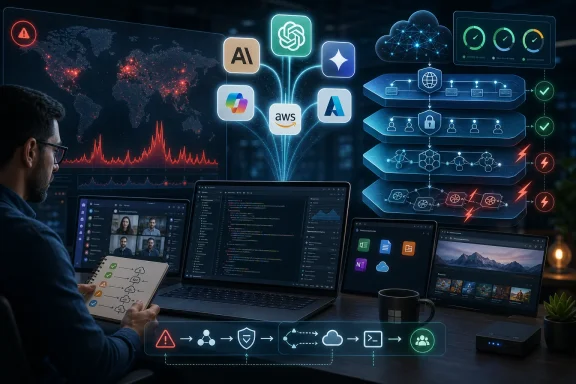 AI’s Uptime Problem Has Become a Work Problem
The first wave of generative AI outages was easy to laugh off. A chatbot stalled, a student had to write a paragraph unaided, a developer waited a few minutes before asking for a regex. Those interruptions felt like the cost of using a fast-moving toy.That framing no longer holds. In 2026, AI assistants are embedded in IDEs, ticket queues, office suites, cloud consoles, customer-support workflows, security tools, and the daily muscle memory of knowledge work. When an AI platform becomes unavailable, the failure does not stay inside a browser tab. It moves into the operating rhythm of companies that have quietly redesigned tasks around the assumption that the assistant will be there.
Ookla’s numbers capture that transition with unusual bluntness. The company’s analysis of 471 days of U.S. Downdetector reports found that high-signal disruption days across four major AI apps rose from six in the first quarter of 2025 to 51 in the first quarter of 2026. That is not a rounding error, and it is not merely a function of more people knowing where to complain. It is a sign that AI systems are being stressed by real usage, real dependency, and real infrastructure limits.
The industry spent the past two years arguing about model quality. The next phase will be fought over resilience. The best model in the world is a weak business dependency if it disappears during a release freeze, a sales push, an incident bridge, or a Monday morning code review.
Claude Became the Case Study in Scale-Up Volatility
The most striking finding in Ookla’s report is the concentration of disruption days around Anthropic’s Claude. Of the 51 high-signal disruption days recorded in the first quarter of 2026 across the major AI apps studied, Claude accounted for 39. Gemini accounted for seven, Microsoft Copilot for three, and ChatGPT for two.That does not mean Claude is uniquely broken, nor does it erase the product’s reputation among developers and power users. It does, however, make Claude the cleanest example of what happens when adoption outruns operational smoothness. A platform can be excellent in capability and still brittle in practice.
Ookla describes Claude’s early-2025 Downdetector profile as near-zero before reports moved into a sustained baseline from mid-July. That is the shape of a service crossing from early-adopter enthusiasm into heavier, more regular usage. Once users begin treating an AI platform as part of the workday, even partial degradations become visible.
By the first quarter of 2026, Claude generated 314,996 reports in Ookla’s dataset, with March alone coming in at nearly three times February’s level. The key detail is that Ookla did not attribute this to one neat, cinematic outage. Instead, the disruption clustered around demand spikes, model-release windows, platform instability, and rapid scaling of Claude Code and Claude Cowork.
That matters because enterprise reliability failures are rarely single villains. They are usually compound events: a new model, a surge of developer use, a queueing policy, a feature gate, an authentication hiccup, and a capacity boundary all arriving at once. The user sees one thing: “Claude is down.” The operator sees a distributed systems incident wearing a friendly chatbot mask.
ChatGPT Shows the Other Side of the Maturity Curve
OpenAI’s ChatGPT still produced the largest single disruption signals in absolute terms in the period Ookla studied. The headline example is about 68,000 reports on December 2, 2025. At ChatGPT’s scale, even a small percentage of affected users can produce an enormous public outage signal.But the longer trend in Ookla’s data is more interesting than the biggest spike. ChatGPT’s monthly median daily report volume fell from a peak of 2,157 in April 2025 to 1,166 in April 2026. That improvement reportedly came even as OpenAI claimed more than 900 million weekly active users and rapid growth in Codex usage.
That is what operational maturity looks like: not the absence of incidents, but a declining background rate of pain despite growth. Mature services still have bad days. The distinction is whether the platform’s normal state becomes quieter as the customer base expands.
For enterprise IT, this is the difference between a vendor with growing pains and a vendor building out the muscles needed to carry institutional dependency. It is also a reminder that outage risk should not be judged only by the loudest event. A single large outage can dominate social media for a day, while chronic smaller disruptions quietly erode productivity for months.
ChatGPT’s trajectory suggests that the biggest AI platforms may eventually resemble cloud providers more than consumer apps. They will be judged by status pages, incident writeups, service-level commitments, regional failover, and transparency around degraded modes. “The model is smart” will not be enough when procurement teams begin asking whether the service can survive quarter-end reporting.
Gemini and Copilot Reveal Two Different Growth Patterns
Google Gemini and Microsoft Copilot showed smaller disruption profiles in Ookla’s analysis, but both are important because they sit inside much larger ecosystems. Gemini’s high-signal disruption days rose from zero in the first quarter of 2025 to seven in the first quarter of 2026, a pattern consistent with rapid user growth. That is the same basic story as Claude, though at a different scale and with a different user mix.Gemini’s reliability story is especially consequential because Google is positioning it across search, Android, Workspace, developer tooling, and cloud services. A Gemini incident is not just a chatbot incident if the assistant is tied into documents, email, code generation, mobile interfaces, and enterprise APIs. The more Google succeeds at embedding Gemini everywhere, the less acceptable “try again later” becomes.
Microsoft Copilot is different. Ookla noted that Copilot’s outage pattern had far fewer reports on weekends, reflecting its enterprise-aligned use. That makes sense: Copilot is not merely an AI destination, it is an extension of Microsoft 365, Windows, Teams, Outlook, Edge, GitHub, and Azure-facing workflows.
That enterprise alignment cuts both ways. On one hand, Microsoft can distribute AI through channels IT departments already understand. On the other hand, Copilot inherits expectations shaped by decades of business software. A consumer chatbot can be flaky and still feel experimental. A paid assistant inside Microsoft 365 is measured against the calendar, the inbox, the spreadsheet, and the meeting transcript.
For WindowsForum readers, Copilot’s pattern is particularly relevant because Microsoft has made AI a layer across the Windows and productivity experience rather than a standalone novelty. The failure mode is therefore more subtle. If Copilot is unavailable, slow, or inconsistent, users may not describe it as an AI outage. They may experience it as Windows Search being less helpful, Office automation failing to appear, Teams summaries lagging, or a GitHub workflow losing its assistant at the wrong time.
The Cloud Layer Is the Part Users Do Not See Until It Breaks
Ookla’s inclusion of AWS and Microsoft Azure is what elevates the report beyond the usual chatbot outage roundup. AI reliability is not just about model serving. It is also about DNS, front doors, identity, storage, databases, traffic routing, GPU fleets, queues, rate limiters, and the policy engines that decide who gets compute when demand exceeds supply.The October 2025 incidents are the warning lights. AWS’s DynamoDB DNS event on October 20 generated more than 315,000 U.S. Downdetector reports, while Microsoft’s Azure Front Door incident on October 29 generated nearly 96,000. These were not “AI outages” in the narrow sense, but cloud control-plane failures can make AI platforms appear broken to users and developers all the same.
That distinction is academic during an incident. If a developer cannot reach an AI coding assistant because a dependency’s DNS behavior failed, the assistant is down for that developer. If an enterprise app loses access to an AI API because a front-door service is degraded, the business process is interrupted regardless of which vendor writes the root-cause analysis.
This is the reliability stack AI has inherited. Cloud providers spent the last decade persuading enterprises that regionalized infrastructure, managed databases, and global edge networks were safer than running everything alone. AI vendors are now building on top of that same infrastructure while adding expensive accelerators, fast-changing model deployments, and unpredictable demand curves.
The result is a dependency pyramid. Users blame the AI brand. The AI vendor blames capacity, routing, authentication, a third-party cloud component, or a model rollout. The cloud provider may trace the root cause to a control-plane event. The business affected by the outage cares about none of this unless the architecture was designed with failure in mind.
Downdetector Is a Smoke Alarm, Not a Court Transcript
It is worth being precise about what Ookla’s data can and cannot prove. Downdetector reports are user-generated signals, not instrumented service telemetry. They reflect visibility, user frustration, regional concentration, and the likelihood that affected users know to report a problem. They can undercount silent failures and overrepresent highly popular services.But that does not make the data useless. In many ways, Downdetector is measuring the thing that matters most to users: the moment a service is perceived as broken. For enterprise reliability, perception is not a cosmetic layer. If enough users cannot complete work, the practical impact exists even before the official root cause is known.
Ookla’s use of a relative threshold — more than 10 times a service’s own median daily report volume — helps avoid a simple popularity contest. ChatGPT’s raw report numbers are naturally large because the service is enormous. A smaller service can have a serious disruption with a smaller absolute number of reports. The high-signal approach tries to capture abnormal pain relative to each platform’s baseline.
That is why Claude’s showing is so notable. The report is not merely saying Claude had fewer or more reports than the biggest competitor. It is saying Claude’s disruption pattern became abnormal against its own median as usage increased. That is exactly the kind of metric IT teams should care about when assessing whether a service is stable enough for daily workflows.
Still, the caveat matters. Downdetector cannot tell an administrator whether the incident was caused by model serving, a web front end, an API gateway, a login provider, abuse mitigation, or capacity throttling. It can tell them that users experienced the service as unreliable. For purchasing and architecture decisions, that is not the whole truth, but it is a truth worth taking seriously.
AI Vendors Are Learning the Old Cloud Lesson the Hard Way
The AI industry likes to describe itself as a break from the past. In reliability engineering, it is living through a rerun. Every major platform generation begins by selling capability and ends up being judged by operations.Early SaaS vendors learned that the browser made deployment easy but uptime unforgiving. Cloud providers learned that elastic infrastructure did not remove failure; it changed its shape. Collaboration platforms learned during the pandemic that sudden demand could transform nice-to-have features into national productivity infrastructure overnight. AI vendors are now learning the same lesson under harsher conditions.
The harshness comes from the workload itself. Generative AI is expensive, stateful in user expectation even when stateless in architecture, latency-sensitive, and heavily shaped by release hype. A new model can drive demand surges. A new coding agent can turn occasional prompts into long-running tool loops. A new enterprise feature can create fresh integration points with identity, file access, permissions, audit logs, and compliance systems.
This is not the same as scaling a static website. AI platforms must balance inference capacity, GPU availability, model routing, safety systems, context windows, tool calls, memory features, file processing, and developer APIs. When a vendor says a service is degraded, that degradation may mean anything from total unavailability to slower responses, failed uploads, broken code execution, disabled tools, or a fallback to a less capable model.
For users, the nuance is often invisible. If the assistant cannot complete the task, it has failed. That is the operational standard AI vendors are now being forced to meet.
Enterprise AI Dependency Is Being Built Faster Than Enterprise AI Governance
The most uncomfortable implication of Ookla’s findings is that organizations are already depending on AI faster than they are governing it. Many companies have pilots, procurement language, acceptable-use rules, and security reviews. Fewer have serious business-continuity plans for AI unavailability.That gap is understandable. AI tools spread through organizations from the edges inward. A developer adopts Claude Code, a marketer uses ChatGPT, a manager turns on Copilot summaries, a support team experiments with Gemini, and suddenly work patterns have changed before architecture diagrams catch up. By the time leadership notices, the organization may already have informal AI dependencies.
The danger is not simply that an AI platform might go down. The danger is that nobody knows which processes quietly require it. A developer blocked from an AI coding tool may still write code, but perhaps at a slower pace. A support team using AI drafting may see response times spike. A security analyst relying on AI summarization may miss the speed advantage that justified a new workflow. These are not binary failures, but they are business impacts.
This is where IT needs to resist both panic and boosterism. The answer is not to ban AI tools because they have outages. Every critical technology has outages. The answer is to classify AI dependencies honestly, decide which ones are allowed to affect production workflows, and define what happens when the assistant is unavailable.
That discipline is boring, which is why it matters. The glamour phase of AI was about demos. The operational phase is about runbooks.
Windows Shops Need to Treat AI Like a Tiered Service
For Microsoft-centric organizations, the Ookla report lands at an awkward moment. Microsoft has been threading Copilot through Windows, Microsoft 365, GitHub, Edge, Security Copilot, Azure, and Dynamics. The company’s strategic message is that AI is not a destination; it is a layer across work.That strategy increases the importance of reliability because AI becomes harder to route around. If a user chooses to visit a chatbot site, the dependency is explicit. If AI is woven into the productivity suite, the operating system, and the developer platform, the dependency is ambient. Users may not even know which backend service failed.
Windows administrators should therefore think about AI in tiers. Some AI features are conveniences, such as rewriting text or summarizing a meeting that can be watched later. Some are accelerators, such as code suggestions, help-desk drafting, or document analysis. Some may become operationally significant, such as security triage, compliance review, customer communication, or automated remediation workflows.
Those tiers deserve different expectations. A convenience can fail gracefully. An accelerator needs fallback tooling and user guidance. An operational dependency needs monitoring, vendor commitments, and a tested manual path. Treating all AI features as equally noncritical is as naive as treating all of them as mission-critical.
Copilot’s enterprise usage pattern, including lighter weekend reporting, reinforces this point. AI outages increasingly map to office hours because AI usage increasingly maps to work. The old consumer-app assumption — that downtime is merely annoying — does not fit a tool that becomes part of Monday-through-Friday throughput.
Developers Are the Canary in the AI Reliability Mine
The report’s references to Claude Code and Codex growth point to one of the most consequential user groups: developers. Coding assistants are not just chatbots with syntax highlighting. They sit inside the production pipeline, shaping how software is written, reviewed, debugged, and shipped.When an AI coding tool becomes unavailable, the immediate effect may look small. Developers can still type. But modern software work is full of context switching, dependency spelunking, test failures, boilerplate, migration work, and unfamiliar code paths. AI tools have become accelerants for precisely those tasks. Losing them can slow a team in ways that are difficult to measure but easy to feel.
The risk becomes sharper with agentic coding tools. A simple autocomplete failure is one thing. A multi-step coding agent that reads files, edits code, runs tests, and iterates introduces a deeper workflow dependency. If that system degrades mid-task, the developer may be left with partial changes, unclear reasoning, or a broken local state.
That does not mean coding agents are too risky to use. It means teams should stop pretending they are only personal productivity toys. If a development organization standardizes around an AI assistant, it should decide how prompts, generated code, context, and task state survive a service interruption. It should also avoid building release processes that assume one external AI vendor will be available at every moment.
This is where old engineering habits apply cleanly. Keep local competence. Maintain documentation. Review generated code. Avoid single points of failure. Have a second path for urgent work. AI changes the interface, but it does not repeal operational common sense.
The Status Page Is Becoming a Procurement Document
One of the quiet shifts in enterprise AI will be the rising importance of public and private reliability signals. Status pages, incident histories, uptime commitments, API error transparency, and post-incident explanations will become part of vendor evaluation. Buyers will ask not only which model scores best, but which service behaves predictably under pressure.That will be uncomfortable for AI vendors accustomed to competing through benchmarks, launch videos, and viral demos. Reliability evidence is less glamorous and harder to fake. It requires time, repetition, and a willingness to explain failures.
Cloud providers have spent years developing the ritual language of incidents: degraded performance, elevated error rates, mitigation applied, monitoring continues, root cause identified. AI vendors are adopting the same vocabulary, but the expectations around detail are still uneven. Users often know that something failed without knowing whether their data, workflow, or integrations were affected.
Enterprises will demand more. If an AI assistant is used in regulated work, security operations, software development, or customer communications, vague outage notes will not be enough. IT teams need to know which regions, APIs, models, features, tenants, and data paths were affected. They need timestamps, mitigations, and durable fixes.
The vendors that mature fastest here will gain trust even when they have incidents. The ones that hide behind generic degradation notices will invite customers to build redundancy around them.
The Real Outage Is the Assumption That AI Is Always There
The clearest lesson from Ookla’s report is not that one AI vendor had a rough quarter or another appears to be improving. It is that the industry’s reliability surface has widened. AI availability now depends on model capacity, product rollouts, developer platforms, cloud control planes, authentication systems, and demand-management policies.That should push organizations toward a more sober deployment model. AI can be transformative without being treated as magic infrastructure. The more valuable it becomes, the more it deserves the same resilience planning applied to email, identity, endpoint management, source control, and cloud hosting.
There is also a user-experience lesson. AI products often present themselves as singular personalities: ChatGPT, Claude, Gemini, Copilot. But behind each name is a stack of services. When the stack fails, the personality disappears. The seamlessness that makes AI appealing also makes its failure modes harder to interpret.
For consumers, the practical response is simple: keep more than one tool in reach, and do not store your only copy of important work inside a live AI session. For businesses, the response is more formal: define acceptable use, map dependencies, monitor vendor health, and avoid placing critical workflows behind an untested AI chokepoint.
The Numbers IT Should Carry Into the Next AI Meeting
Ookla’s dataset should not become a cudgel against AI adoption. It should become a forcing function for better questions. A serious AI rollout plan now needs to discuss failure as plainly as it discusses productivity.- High-signal AI disruption days in Ookla’s U.S. Downdetector analysis rose from six in the first quarter of 2025 to 51 in the first quarter of 2026.
- Claude accounted for 39 of those 51 high-signal disruption days, making it the report’s clearest example of rapid adoption meeting operational strain.
- ChatGPT produced the largest individual report spikes, but its median daily report trend improved between April 2025 and April 2026.
- Gemini and Copilot showed smaller but meaningful outage patterns, with Copilot’s weekday-heavy reports reflecting its enterprise usage profile.
- AWS and Azure incidents in October 2025 showed that cloud control-plane failures can cascade into AI user pain even when the model itself is not the root cause.
- AI continuity planning should now cover fallback tools, manual workflows, vendor monitoring, and clear rules for which AI-assisted tasks are allowed to become business-critical.
References
- Primary source: Mobile World Live
Published: 2026-06-11T09:50:09.271697
Ookla finds AI platform outages surge... - Mobile World Live
AI platform disruptions rose sharply in early 2026 as growing enterprise adoption exposed new risks across the full infrastructure stack.www.mobileworldlive.com
- Related coverage: fonearena.com
- Related coverage: infotechlead.com
AI Service Outages Surge as ChatGPT, Claude and Copilot Face Rising Reliability Challenges in Enterprise Workflows - InfotechLead
Ookla said there is an increase in AI service disruptions as organizations move from chatbot usage to mission-critical agentic AI workflows infotechlead.com
- Related coverage: techradar.com
Claude is down for many — here's what we know about the outage | TechRadar
Anthropic has confirmed the "partial outage"www.techradar.com - Related coverage: letsdatascience.com
Claude, ChatGPT, Grok and Others Experience Outages | Let's Data Science
Anthropic's Claude experienced a significant service outage on Tuesday, June 2, 2026, with users reporting slow responses, login failures, and unavailability, according to The Register and Claude's status page. Reports spiked on Downdetector early in the UTC morning; Anthropic's status page... letsdatascience.com
- Related coverage: tomsguide.com
ChatGPT is back following global outage — here's what happened | Tom's Guide
ChatGPT suffered an unexpected outage on June 10, 2025www.tomsguide.com
