

The PC industry's boldest marketing bet of the last 18 months—the idea that “AI PCs” would ignite a fresh upgrade cycle—has run into a stark reality check: the silicon is arriving faster than the clear, everyday use cases that would make consumers and IT buyers actually pay a premium for it.
When Microsoft and OEM partners introduced the Copilot+ and AI PC narrative, they anchored the story to a concrete-sounding hardware bar: a dedicated Neural Processing Unit (NPU) capable of roughly 40 TOPS (Trillions of Operations Per Second) alongside a modern CPU, 16 GB+ of RAM, and fast SSD storage. That threshold was positioned as the enabler of lower-latency, on‑device inference for features like improved transcription, image editing, Click to Do, and the controversial Recall timeline. Several OEM support pages and Copilot+ documentation reiterate that hardware baseline as a gating factor for the full suite of Copilot+ experiences. Analyst forecasts nevertheless painted a rosy macro picture: research groups projected that AI‑capable PCs would become a major share of shipments—Gartner, for example, reported AI PC shipments of about 77.8 million units in 2025 (roughly 31% of the worldwide market) and forecasted a further jump in 2026. Those numbers helped justify OEMs’ investment in NPU-equipped designs even if near-term consumer demand remained uncertain. Despite those forecasts and the steady rollout of NPU-capable silicon from Qualcomm, Intel, and AMD, OEMs have started to publicly acknowledge a mismatch between technical capability and buyer behaviour. At CES 2026 Dell executives admitted they were dialing back “AI-first” consumer messaging after seeing limited purchasing motivation tied strictly to AI labeling—comments echoed in press briefings and investor communications.
Intel’s early Meteor Lake‑derived NPU implementations, for instance, are commonly reported at around 11 TOPS for the NPU alone (roughly 34 TOPS when GPU + CPU contributions are aggregated in some spec breakdowns). That is materially below the often-cited 40 TOPS Copilot+ threshold, and it left a subset of early devices functionally ineligible for some Copilot+ features at launch. Other platforms, notably Qualcomm’s Snapdragon X Elite and later Snapdragon X Plus variants, were marketed with higher TOPS figures (and were the only widely available Copilot+ devices at first to meet Microsoft’s most demanding guidance). But an uneven mix of NPU capabilities across Intel, AMD and Qualcomm designs created fragmentation in the early product wave and complicated the marketing message.
Many Copilot+ features are genuinely useful in specific scenarios—real‑time captions, low‑latency image edits in built-in apps, and improved video studio effects. But most users can get acceptable versions of these capabilities already through cloud services or existing local CPU/GPU processing. The result: AI features often feel incremental or redundant rather than transformative.
The criticism forced Microsoft to pause, rework, and harden the feature—moving to opt‑in activation, encryption of snapshot storage, tighter controls (Windows Hello gating), and staged rollouts—but the initial backlash damaged trust at a critical moment for the Copilot+ narrative. The episode underscored how quickly privacy missteps can blunt interest in otherwise useful capabilities.
But the path to mainstream adoption is likely to be gradual and uneven. Expect a slow migration driven by:
Source: TechNewsWorld AI PCs' Unmet Promise Dragging Down Adoption
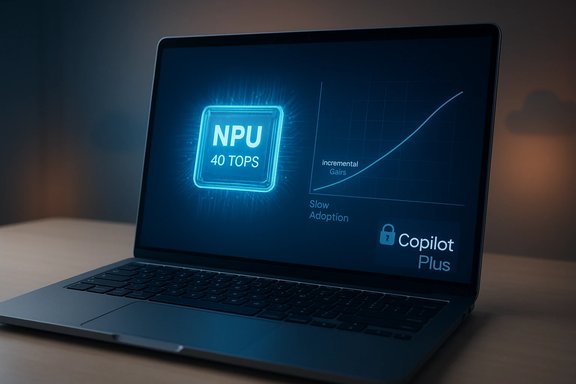 Background: the promise, the spec sheet, and the pivot
When Microsoft and OEM partners introduced the Copilot+ and AI PC narrative, they anchored the story to a concrete-sounding hardware bar: a dedicated Neural Processing Unit (NPU) capable of roughly 40 TOPS (Trillions of Operations Per Second) alongside a modern CPU, 16 GB+ of RAM, and fast SSD storage. That threshold was positioned as the enabler of lower-latency, on‑device inference for features like improved transcription, image editing, Click to Do, and the controversial Recall timeline. Several OEM support pages and Copilot+ documentation reiterate that hardware baseline as a gating factor for the full suite of Copilot+ experiences. Analyst forecasts nevertheless painted a rosy macro picture: research groups projected that AI‑capable PCs would become a major share of shipments—Gartner, for example, reported AI PC shipments of about 77.8 million units in 2025 (roughly 31% of the worldwide market) and forecasted a further jump in 2026. Those numbers helped justify OEMs’ investment in NPU-equipped designs even if near-term consumer demand remained uncertain. Despite those forecasts and the steady rollout of NPU-capable silicon from Qualcomm, Intel, and AMD, OEMs have started to publicly acknowledge a mismatch between technical capability and buyer behaviour. At CES 2026 Dell executives admitted they were dialing back “AI-first” consumer messaging after seeing limited purchasing motivation tied strictly to AI labeling—comments echoed in press briefings and investor communications. What actually ships: NPUs, TOPS, and the real performance story
NPUs are real hardware—but they vary
Modern laptop SoCs from Qualcomm, Intel, and AMD now commonly include some form of NPU or AI acceleration block. But the raw TOPS number is only part of the picture: architecture, memory bandwidth, driver maturity, and thermal headroom determine how that silicon performs in real-world tasks.Intel’s early Meteor Lake‑derived NPU implementations, for instance, are commonly reported at around 11 TOPS for the NPU alone (roughly 34 TOPS when GPU + CPU contributions are aggregated in some spec breakdowns). That is materially below the often-cited 40 TOPS Copilot+ threshold, and it left a subset of early devices functionally ineligible for some Copilot+ features at launch. Other platforms, notably Qualcomm’s Snapdragon X Elite and later Snapdragon X Plus variants, were marketed with higher TOPS figures (and were the only widely available Copilot+ devices at first to meet Microsoft’s most demanding guidance). But an uneven mix of NPU capabilities across Intel, AMD and Qualcomm designs created fragmentation in the early product wave and complicated the marketing message.
TOPS is a useful engineering metric—but it doesn’t sell laptops
From an engineering perspective, TOPS is a shorthand for peak matrix‑multiply throughput—an important capability for certain inference workloads. From a buyer’s view, however, “40 TOPS” is obscure and abstract: shoppers care about battery life, display quality, keyboard feel, price, and reliability long before they factor in an NPU TOPS number. OEMs quietly admit the gap between engineering thresholds and retail purchasing signals.Why sales are soft: no killer app, incremental benefits, and cloud competition
The missing “must-have” feature
The classic sales driver for platform upgrades is a compelling new experience—think faster SSDs enabling instant workflows, or a display improvement you notice. For AI PCs, there hasn’t been an obvious, day‑one feature that forces a refresh.Many Copilot+ features are genuinely useful in specific scenarios—real‑time captions, low‑latency image edits in built-in apps, and improved video studio effects. But most users can get acceptable versions of these capabilities already through cloud services or existing local CPU/GPU processing. The result: AI features often feel incremental or redundant rather than transformative.
Cloud AI reduced the urgency for hardware
Cloud‑hosted LLMs and browser‑based AI tools like ChatGPT, Gemini and others taught users that AI lives in software and follows them across devices. When comparable AI experiences are accessible from a phone or browser, the marginal benefit of buying a new laptop for on‑device inference becomes less persuasive—unless the local experience is clearly faster, more private, or noticeably superior. That dynamic undercuts the hardware-premium argument.Enterprise caution and ROI gating
Enterprises, whose budgets can move markets, remain conservative. IT procurement wants clear ROI, compatibility with an existing application estate, and tight governance. Copilot+ and on‑device agentic features raised unanswered questions about data flows, auditability, and attack surface—especially after high-profile privacy debates over features like Recall. For many buyers, device refresh windows are still governed by imaging, testing, and staged pilots rather than marketing messages.The Recall saga: a case study in trust and timing
Microsoft’s Recall—the on‑device timeline that periodically snapshots the screen to make past activity searchable—became a focal point for concern. Early descriptions of the feature and some implementations raised privacy and security alarms: researchers demonstrated that screenshots and indexed data could contain sensitive material and that initial protections were insufficient.The criticism forced Microsoft to pause, rework, and harden the feature—moving to opt‑in activation, encryption of snapshot storage, tighter controls (Windows Hello gating), and staged rollouts—but the initial backlash damaged trust at a critical moment for the Copilot+ narrative. The episode underscored how quickly privacy missteps can blunt interest in otherwise useful capabilities.
Platform fragmentation and compatibility headaches
ARM vs x86 realities
The early Copilot+ device population skewed toward Arm‑based Qualcomm devices because they met the 40+ TOPS targets at launch. That shift reintroduced the old Windows‑on‑Arm compatibility conversation: while emulation improved, certain drivers, AVs, and anti‑cheat components remained problematic or missing for Arm, which created real friction for mainstream users and gamers. Multiple reports documented application and driver compatibility gaps for Snapdragon‑based Copilot+ PCs at launch, amplifying consumer caution.Driver maturity matters as much as silicon
Silicon without mature drivers and a robust software stack produces disappointing user experiences. Early Snapdragon systems encountered driver and app compatibility issues that required ongoing fixes—another practical reason enterprises and cautious consumers pushed pause on upgrades. Even in cases where NPUs offered excellent efficiency on paper, missing or unstable drivers made features feel brittle.Strengths: why the AI PC effort still matters
- NPUs improve energy‑efficient inference: when software takes advantage of on‑device inference, NPUs can reduce latency and battery impact relative to running everything in the cloud or on a CPU. This advantage is real for several classes of tasks (live captions, local image editing, simple SLMs).
- The industry has upgraded baseline hardware quickly: Copilot+ and AI PC initiatives accelerated OEM and chipmaker roadmaps, producing laptops with more RAM, improved thermal solutions, and silicon tuned for new workloads. Those improvements benefit many non‑AI use cases as well.
- Privacy‑sensitive local processing remains a differentiator: for regulated industries or users who need offline capability, on‑device AI can provide demonstrable privacy advantages—if it’s implemented with clear controls and auditable protections.
Risks and open questions: what OEMs and Microsoft must fix to revive momentum
- Clear, demonstrable day‑one experiences. Consumers need visible wins. Small, repeated productivity advantages (faster video calls, reliable captions, instant local image edits) are more persuasive than abstract metrics. Vendors must craft demo scripts and retail messaging around observable outcomes.
- Cross‑platform developer story and APIs. Fragmented NPU architectures and divergent runtimes make it harder for developers to build apps that reliably exploit on‑device AI across devices. Standardized tooling and runtimes that simplify cross‑vendor development will accelerate meaningful app support.
- Robust privacy and security defaults. Recall’s controversy demonstrated that privacy misconfigurations or unclear defaults inflict long‑lasting reputational damage. Default opt‑in avoidance, strong local encryption, clear retention controls, and transparent consent receipts are basic prerequisites.
- Drive down the cost delta. NPUs and the thermal engineering required to sustain on‑device inference raise BOM costs. OEMs must absorb some of the cost or create compelling price‑value bundles to avoid pushing the category into a premium niche. Market sensitivity to component pricing and memory supply issues will shape adoption.
- Minimize compatibility friction. Particularly for Windows on Arm devices, missing drivers and legacy x86 dependencies remain a purchase barrier. OEMs and platform partners must invest in driver completeness and third‑party integrations that matter to mainstream users (antivirus, productivity suites, popular creative apps, and games).
Practical guidance for buyers and IT leaders
- Treat AI PC features as additive not mandatory. Prioritize treadmill criteria—battery life, display, keyboard, and serviceability—unless your workflows specifically require on‑device inference.
- Pilot with measurable KPIs. For enterprises, set clear metrics (time saved per task, reduced cloud costs, local‑only use cases) before committing to wide deployments.
- Audit privacy posture before adoption. If you plan to enable timeline or continuous‑capture features, require granular data retention policies, encryption at rest, and regular verification of filter effectiveness.
- Verify third‑party app compatibility. Check vendor‑supplied lists and community reports for known gaps (AVs, specialized creative plugins, anti‑cheat systems) especially for Arm‑based Copilot+ devices.
Outlook: normalization, not revolution
AI PCs will not vanish. The category forced a hardware and software modernization that will make future devices more capable, efficient, and flexible. Over time the notion of “AI inside” will become as mundane as “thin and light” once was: NPUs and local inference will be absorbed into the baseline experience as developers build apps that actually take advantage of them.But the path to mainstream adoption is likely to be gradual and uneven. Expect a slow migration driven by:
- Demonstrable, incremental productivity wins that are easy to show on the retail floor;
- Enterprise pilots that translate to measurable ROI;
- Continued maturation of drivers and cross‑platform tooling; and
- Sensible privacy defaults that rebuild trust shaken by early missteps.
Conclusion
The Copilot+ era accelerated a valuable technical upgrade of the PC stack—NPUs, improved thermals, and renewed attention to low‑latency AI. Yet adoption has been tempered by three interlocking realities: a lack of a universally compelling killer app, the convenience and ubiquity of cloud AI, and early execution missteps that raised privacy and compatibility questions. OEMs and Microsoft now face the pragmatic work of translating engineering capability into simple, trustworthy experiences that feel different on day one. Until then, the AI PC story is better described as normalization in progress rather than a mass market revolution.Source: TechNewsWorld AI PCs' Unmet Promise Dragging Down Adoption
