

Microsoft Clarity’s new analysis shows AI assistants and large language models are still a tiny slice of referral traffic but are already producing materially higher conversion rates than traditional channels — a signal that discovery and attribution are shifting beneath publishers’ and advertisers’ feet.
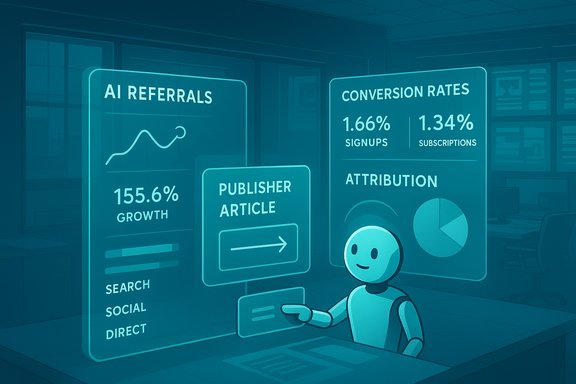
Microsoft Clarity’s November 6, 2025 study analyzed activity across more than 1,200 publisher and news domains and reported a dramatic growth trajectory for AI-driven referral traffic, with referrals from LLM-powered services rising roughly 155.6% over the prior eight months. Despite that growth, Clarity found AI referrals accounted for less than 1% of total traffic during the measurement window, while converting at rates that outpaced search, social and direct channels for both sign-ups and subscriptions.
Those headline numbers — higher conversion rates for AI referrals and fast percentage growth off a small base — have ignited a debate across publishing and ad tech communities. Marketers and advertisers are reporting lower click volumes and changes to click-through dynamics when AI Overviews or assistant responses appear in the discovery path. At the same time, several analytics and measurement vendors have published independent data showing AI-driven sessions often have lower bounce rates, longer dwell time, and higher page depth, even when they remain a very small share of overall visits.
This article untangles what the new Clarity findings mean, where the data is robust, which claims require caution, and how publishers and advertisers should respond to the shifting discovery landscape.
These figures are important because they shift the conversation from pure traffic volume to traffic quality: even a small volume source can matter a lot if it converts at multiples of legacy channels.
Two patience-related realities should temper expectations:
Publishers should accelerate measurement fixes, restructure content for assistant-friendly discovery, and test monetization aligned with the higher conversion propensity of AI referrals. Advertisers must rethink attribution, favor quality-focused KPIs, and invest in experiments that reveal how assistant-driven discovery reshapes the conversion funnel.
Change will be incremental, uneven and sometimes uncomfortable for stakeholders used to legacy search dominance. But the clearest takeaway is strategic: those who build measurement-first, audience-first responses today will be best positioned to capture disproportionate value when assistant-driven discovery becomes a meaningful share of the web.
Source: MediaPost Waiting For Search, LLMs' Obvious Appeal
 Background / Overview
Microsoft Clarity’s November 6, 2025 study analyzed activity across more than 1,200 publisher and news domains and reported a dramatic growth trajectory for AI-driven referral traffic, with referrals from LLM-powered services rising roughly 155.6% over the prior eight months. Despite that growth, Clarity found AI referrals accounted for less than 1% of total traffic during the measurement window, while converting at rates that outpaced search, social and direct channels for both sign-ups and subscriptions.Those headline numbers — higher conversion rates for AI referrals and fast percentage growth off a small base — have ignited a debate across publishing and ad tech communities. Marketers and advertisers are reporting lower click volumes and changes to click-through dynamics when AI Overviews or assistant responses appear in the discovery path. At the same time, several analytics and measurement vendors have published independent data showing AI-driven sessions often have lower bounce rates, longer dwell time, and higher page depth, even when they remain a very small share of overall visits.
This article untangles what the new Clarity findings mean, where the data is robust, which claims require caution, and how publishers and advertisers should respond to the shifting discovery landscape.
What Clarity reported — key figures and claims
Clarity’s public write-up condensed two main findings into clear, headline-ready claims:- AI referrals grew ~155.6% across the studied publisher set over eight months, while Search grew ~24%, Social ~21.5%, and Direct ~14.9% in the same period.
- In one-month conversion snapshots (measured with Clarity’s smart events), visits from LLM referrals converted at significantly higher rates: 1.66% for sign-ups and 1.34% for subscriptions, compared with Search at 0.15% and 0.55%, Direct at 0.13% and 0.41%, and Social at 0.46% and 0.37%, respectively.
These figures are important because they shift the conversation from pure traffic volume to traffic quality: even a small volume source can matter a lot if it converts at multiples of legacy channels.
Cross-checking the broader data picture
Independent industry measurements and vendor reports largely corroborate the pattern Clarity describes: AI referrals still represent a tiny percentage of total sessions for most sites, yet they often show stronger engagement metrics.- Several analytics vendors and agency case studies published in 2025 show AI-referred visits with lower bounce rates, longer session durations, and more page views per session than average visitors. Those indicators are consistent with higher-intent or more task-focused visits.
- Site-aggregated studies from smaller research groups show that average AI referral share is typically measured in fractions of a percent (for example, 0.1–0.3% of sessions on many commercial sites), which aligns with Clarity’s “less than 1%” characterization.
- Independent audits and SEO tools report that a large share of AI influence goes un-attributed in web analytics because users often copy-and-paste URLs from assistant responses or because assistants trigger follow-on searches; this dark AI traffic can inflate direct or search channels while making true AI influence opaque.
Why AI referrals can convert better — four mechanisms
The measured lift in conversion rates for AI-driven referrals is plausibly driven by several interacting mechanisms:- Focused intent and task completion. AI assistants frequently deliver concise answers and then suggest a single source for further reading or a direct link to a publisher’s page. Users are often in a narrower state of intent — completing a task or validating an answer — which leads to higher conversion propensity once they land on the site.
- Selection bias and editorial filtering. Assistants tend to present a shortened set of recommended sources rather than tens of search results. That editorial compression may elevate the likelihood that the clicked result is relevant and therefore more likely to convert.
- Context-rich referrals. Many AI responses include snippets, summaries, or context that prime a site’s value proposition (e.g., “this article has the step-by-step guide you need”), increasing the probability of conversion when the user follows through.
- Desktop and complex-research skew. Early data show AI referrals are more common for desktop sessions and research-heavy paths (product research, subscription sign-ups, long-form reading), which are naturally higher-converting behaviors than casual mobile browsing.
Measurement caveats and attribution pitfalls
While the conversion story is compelling, the data must be interpreted carefully. Measurement limitations that risk over-stating or mischaracterizing AI’s impact include:- Small-sample volatility. When AI referrals represent small absolute counts, a handful of successful conversions can swing percentage metrics dramatically. Studies must report sample sizes and confidence intervals; without them, multiplicative claims (e.g., “17x”) are fragile.
- Attribution leakage. Much generative-AI-driven discovery results in URLs being copied into the browser, or users performing follow-up traditional searches using AI-suggested queries. These behaviors often register as Direct or Organic Search in analytics, masking the true origin.
- Vendor measurement differences. Not all analytics platforms identify AI referrals reliably. Proprietary regex rules, referrer parsing, and differences in how assistant domains are recognized will produce divergent AI share estimates.
- Selection bias in domain sets. Clarity analyzed publisher and news domains. Results for ecommerce, SaaS, and B2B sites may differ materially. Vertical mix matters: publishers with paywalled articles or newsletter funnels may see different conversion patterns than pure-advertising sites.
Implications for publishers
Publishers should treat the rise of AI referrals as both a challenge and an opportunity. The main implications:- Revenue mix and discovery strategy must evolve. Search dominated the web’s second and third decades; AI assistants are emerging as a new discovery layer. Publishers that rely heavily on search-engine traffic must plan for multi-channel discovery where assistants can be the top-of-funnel gateway.
- Monetization models may be affected. If AI assistants satisfy more queries without a click, publishers risk losing impressions and ad revenue for queries that previously drove free clicks. Conversely, the higher-converting clicks AI delivers may be more valuable for subscription and membership revenue models.
- Content structure and metadata matter more. Assistants favor concise, authoritative answers and well-structured content. Investing in clear summaries, structured data, and machine-readable signals (e.g., topic tags, canonical context) increases the chance that an assistant will recommend a publisher’s content.
- Prepare for attribution changes. Publishers must instrument analytics to detect AI referrals (custom channel definitions, regex referral parsing, UTM tagging in syndication) and reconcile the “dark AI” leakage that commonly shows up as Direct.
What advertisers and brands need to know
Advertisers have been particularly vocal about short-term performance impacts as AI Overviews and assistant results alter search result page real estate and click behavior. Key takeaways for marketers:- Clicks may fall even as intent-driven conversions rise. If assistants funnel fewer but higher-intent visitors, CPA-driven campaigns should be re-evaluated for quality rather than just CTR.
- Attribution models must be updated. Multi-touch attribution that ignores AI’s role will misallocate credit. Advertisers should expand measurement to capture assistant-driven referral signals and model potential off-analytics conversions (view-through, assisted conversions).
- Paid search may need strategy adjustment. If AI Overviews reduce organic click volumes for top keywords, paid placements may gain or lose relative value depending on whether assistants include sponsored content or user clicks still flow to paid listings.
- Creative and landing pages should be optimized for context. Assistants often provide a short rationale for a link; matching that context in the landing experience reduces friction and improves downstream conversion.
Technology and policy risks
The shift to AI-mediated discovery introduces several systemic risks that deserve attention:- Concentration and gatekeeping. If a small number of assistant providers serve as primary “front doors,” they could exercise disproportionate influence over visibility and monetization rules for publishers and advertisers.
- Attribution opacity and measurement arms races. Vendors and platforms will compete to claim ownership of attribution pipelines, which could fragment measurement and increase cost for accurate cross-channel reporting.
- Economic displacement for low-value content. Assistant-driven answers that extract short excerpts from many sources may reduce ad impressions on listicle and aggregation formats, concentrating value toward original reporting and subscription content.
- Privacy and consent complexity. Assistants that summarize personalized results or integrate private account data raise new compliance and consent questions for how referrals are generated and tracked.
Practical playbook: What publishers and advertisers should do next
Here is an actionable, prioritized checklist to respond to AI-driven discovery and measurement change:- Audit and tag
- Create custom channel definitions that capture known assistant referrers (e.g., assistant hostnames and domains).
- Add UTM tagging where content is distributed programmatically to minimize “Direct” leakage.
- Harden measurement
- Use server-side event logging as a backup to client-side analytics for critical conversion events.
- Aggregate results over longer windows and focus on cohorts to mitigate small-sample noise.
- Optimize content for assistant surfaces
- Add clear, concise summaries at the top of articles and structured data (FAQ, HowTo, Article schema).
- Maintain canonical versions and avoid accidental duplication that confuses assistant retrieval.
- Rebalance monetization
- Test subscription-first paywalls or metered models on pages likely surfaced by assistants.
- Experiment with contextual offers that match the assistant-provided snippet’s implied intent.
- Negotiate visibility and licensing
- Engage with major assistant providers to understand display policies and explore licensing or referral partnerships where appropriate.
- Monitor and iterate
- Create dashboards for AI referral KPIs (sessions, conversions, revenue per visit) and re-evaluate quarterly.
- Run controlled experiments (holdout pages) to quantify incremental value from assistant-driven traffic.
Skepticism and the patience question for advertisers
Advertisers and performance marketers are right to be skeptical. The industry has seen many waves of promise — social, mobile, AMP, progressive web apps — that changed distribution but did not uniformly benefit every stakeholder. The reality of AI-driven discovery will be incremental and uneven across verticals.Two patience-related realities should temper expectations:
- Change is gradual at scale. Assistants can reshape discovery, but the process of user behavior change across billions of users takes time. Even rapid percentage growth from a small base can take years to materially alter overall traffic patterns.
- Short-term pain can precede long-term optimization gains. Early-stage friction — lower measured CTRs, misattributed conversions, creative mismatch — will be followed by measurement fixes, format evolution, and refined economic models. Advertisers with tolerance for transitional noise can reap first-mover benefits.
Flags and unverifiable claims
Some claims circulating in industry commentary remain difficult to verify with public data:- Exact percentages of total web traffic now driven by AI vary widely by study and by measurement approach. Estimates that claim large absolute shares for AI referrals should be treated with caution unless supported by transparent, large-sample measurement.
- Multiplicative claims like “Copilot converts 17x better” are statistically sensitive to small sample sizes and to the choice of baseline (direct vs. search). These ratios are directionally useful but require confidence intervals to be fully credible.
- The degree to which assistant results cannibalize specific keywords or publisher revenues will be highly site-specific; broad extrapolations are risky without vertical-by-vertical data.
Regulatory and ecosystem considerations
The emergence of assistant-driven discovery invites both commercial and regulatory responses:- Disclosure and transparency. Regulators and publishers will increasingly demand clarity from assistant providers on how content is selected, ranked and altered in summaries. Transparency frameworks for assistant “attribution” will likely be a future area of scrutiny.
- Copyright and licensing. Publishers will press for clear terms when assistants surface their content; licensing deals or revenue-sharing mechanisms may follow, especially for paywalled or premium content.
- Measurement standards. Industry bodies and measurement partners will need to define standard approaches for identifying and reporting AI referrals so that advertisers and publishers can make apples-to-apples comparisons.
Where this goes next — an outlook
Expect an era of experimentation and diversification:- Assistants will iterate on how and when they present links; some may favor more inline answers, others may include more source attributions or “read more” callouts.
- Measurement tools will evolve — regex-based referral identification, llms.txt (or similar machine-readable signals), and deeper server-side instrumentation will become routine to reclaim “dark AI” sessions.
- Economic models will adapt. Publishers that can demonstrate higher per-visit value from assistant referrals will command different distribution terms and monetization strategies than those that cannot.
Conclusion
The Clarity data are an early but credible signal: AI assistants are growing rapidly from a small base and, where properly measured, are sending visitors that behave like higher-intent customers. That matters because it reframes the debate from “who gets the clicks” to “what is the quality and value of the clicks we get.”Publishers should accelerate measurement fixes, restructure content for assistant-friendly discovery, and test monetization aligned with the higher conversion propensity of AI referrals. Advertisers must rethink attribution, favor quality-focused KPIs, and invest in experiments that reveal how assistant-driven discovery reshapes the conversion funnel.
Change will be incremental, uneven and sometimes uncomfortable for stakeholders used to legacy search dominance. But the clearest takeaway is strategic: those who build measurement-first, audience-first responses today will be best positioned to capture disproportionate value when assistant-driven discovery becomes a meaningful share of the web.
Source: MediaPost Waiting For Search, LLMs' Obvious Appeal
