AI Search Engineers, an agency marketing itself as the only AEO Verified firm in the United States, said on June 24, 2026 that professional service firms are running out of time to gain early authority in AI-generated search answers. Its warning is less a neutral market study than a sales thesis, but the underlying pressure is real: search is being rebuilt around answers, not blue links. For law firms, financial advisers, medical practices, and B2B consultants, that means the old SEO race is being joined by a messier contest over which entities machines decide to trust.
Every platform shift produces a gold rush, and every gold rush produces a map seller. AI Search Engineers’ release is very much a map seller’s document: urgent, confident, category-defining, and conveniently aligned with the services the company sells. It argues that businesses which began building “Answer Engine Optimization” authority six months ago now enjoy a compounding advantage over firms starting today.
That claim should be read with care. The company says its data comes from nine professional service engagements and more than 50 AI visibility audits, which is useful as field observation but not broad enough to settle the question scientifically. It is a consultant’s dataset, not a peer-reviewed market benchmark.
Still, dismissing the pitch outright would be a mistake. The web’s discovery layer is changing in ways that make entity clarity, source consistency, and machine-readable reputation more important than they were in the classic SEO era. Google AI Overviews, Microsoft Copilot, ChatGPT, Perplexity, Gemini, and other answer engines increasingly compress research into a synthesized response before a user ever reaches a website.
That shift is especially uncomfortable for businesses that once treated search visibility as a rankings game. Ranking first on a results page is one kind of advantage; being named inside the answer is another. The former is a placement problem. The latter is a trust problem.
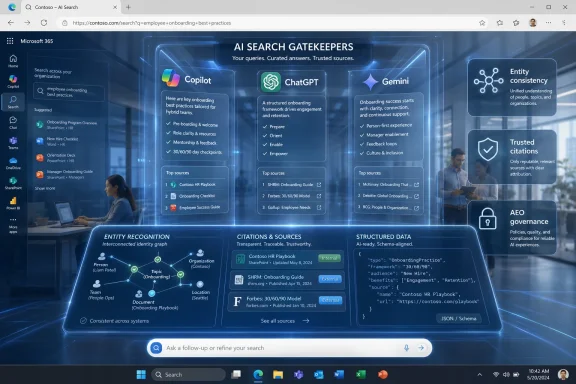
That is why the release leans so heavily on entity recognition. In plain English, an entity is the machine’s idea of a business, person, place, product, or organization. If a law firm’s name, address, practice areas, attorneys, awards, case history, and third-party references are consistent across its website, Google Business Profile, LinkedIn, directories, schema markup, and press coverage, AI systems have less ambiguity to resolve.
For WindowsForum readers, the closest analogy may be endpoint identity management. A device with a clean certificate chain, consistent inventory record, known owner, and predictable telemetry is easier to trust than a machine with stale metadata and conflicting names in three consoles. Search engines are doing a version of that work for public entities on the web.
That does not mean AI systems have a stable, transparent authority score that agencies can simply “engineer” into existence. The major platforms do not publish a universal recipe for inclusion in AI answers, and their retrieval systems vary. But the basic direction is hard to dispute: machines prefer well-structured, corroborated information over messy, contradictory, self-serving claims.
There is a reasonable version of that argument. Search systems have long treated age, consistency, and link/citation history as useful signals. Brand mentions, directory entries, structured data, knowledge graph references, and content trails can all become more valuable when they remain stable over time. A business that has been consistently described by multiple independent sources for months or years is easier for a model or retrieval system to place confidently than one that appears suddenly with a flood of new claims.
But the release moves quickly from plausible mechanism to commercial urgency. It says the first-mover window is “closing,” yet it does not define the window’s size, the markets where it has closed, or the thresholds at which late movers become economically disadvantaged. It identifies three signal layers — entity recognition, trusted source citations, and topical authority — but does not publish enough underlying data to let outsiders compare outcomes across sectors, query types, or platforms.
That matters because AI answer visibility is highly variable. The same business can appear in one system and vanish in another. A query phrased as “best estate planning attorney near me” may behave differently from “who handles probate disputes in Buffalo” or “compare fiduciary financial advisers for retirees.” Locality, intent, personalization, source freshness, regulatory sensitivity, and model behavior all affect the answer.
So the right conclusion is not that the release proves a universal six-month compounding law. The stronger conclusion is that waiting carries an increasingly visible opportunity cost in categories where AI answers are beginning to mediate buyer research.
That commercial value changes the math. If one AI-generated recommendation produces a serious lead, the payoff can dwarf the cost of months of content, schema cleanup, citation building, and reputation work. The agency’s pitch is designed for that psychology: if the buyer value is high, the fear of invisibility becomes easier to monetize.
There is also a trust barrier. AI systems are more cautious around legal, medical, and financial topics because bad recommendations can be harmful. The platforms may not always get this right, but they have every incentive to lean on recognized, corroborated, and conservative sources in high-risk categories. A thin website with aggressive marketing copy is less compelling than a business with a clear identity, credible third-party mentions, professional profiles, consistent structured data, and answer-focused content that addresses real client questions.
This is where “AEO” may be less revolutionary than its branding suggests. Much of it overlaps with disciplined SEO, public relations, local search optimization, content strategy, technical markup, and reputation management. The new part is the target: not simply a search ranking, but selection by an answer system that may summarize the market for the user.
That is a meaningful distinction. The best professional services firms have often been poor at explaining themselves in machine-readable ways. They rely on referrals, relationships, and opaque reputation. AI search punishes opacity.
For years, marketers warned that “zero-click search” would eat the web. AI answers made that warning easier to see. If a user asks for a comparison, recommendation, explanation, or local shortlist and receives a synthesized answer immediately, the old funnel compresses. The user may still click, but the click is now downstream of the answer, not upstream of discovery.
That does not mean websites no longer matter. In fact, they may matter more as source material. But the website’s job changes. It must not only persuade a human visitor; it must also help machines understand the entity, match it to topics, and verify claims against external evidence.
Google’s own AI Overviews missteps in 2024 demonstrated another reality: answer systems can be brittle when source quality is poor, when satire or forum content is misread, or when sparse information leaves the model guessing. That brittleness is precisely why businesses care about becoming the clean, obvious, corroborated source. If machines are going to summarize the market, companies want to make the summary easy.
Still, the broader point stands: structured knowledge layers matter. Search engines and AI systems depend on databases, knowledge graphs, crawled pages, business profiles, public records, and third-party references to resolve ambiguity. If a business is inconsistently named, if its principals are hard to identify, if its service categories shift across platforms, or if its claims exist only on its own website, answer systems have less to work with.
This is where many professional firms are behind. Their websites were built for human credibility and lead capture, not machine interpretation. Attorney bios may be thin. Practice areas may be written as sales copy rather than answerable expertise. Local profiles may disagree about addresses or categories. Press mentions may be scattered. Schema markup may be absent or generic.
AEO vendors are wrapping these old problems in new language, but the work is not imaginary. Entity cleanup, structured data, citation consistency, author credentials, service taxonomy, and independent corroboration are the unglamorous plumbing behind AI visibility. The risk is that vendors sell the plumbing as sorcery.
That roadmap is revealing because it shows AEO as a bundle of familiar disciplines repackaged around AI outputs. Technical SEO handles structured data. Local SEO handles profiles and directories. PR handles citations. Content marketing handles answer-focused pages. Analytics and testing handle visibility checks across platforms.
The novel part is orchestration. In the pre-AI search world, a firm might treat these as separate vendors or quarterly projects. Under the answer-engine model, the work has to converge on one consistent machine-readable identity. The website, business profiles, bios, citations, and explanatory content all need to say the same thing in ways systems can parse.
The weakness is measurement. “Appearing in ChatGPT” or “being recommended by Gemini” is harder to audit than a Google ranking. Prompts vary. Models update. Sessions personalize. Some systems browse live sources, others rely on indexed data, and others mix retrieval with model memory. A screenshot of a favorable answer is not the same as durable market visibility.
For businesses, that means any AEO engagement should be judged by repeatable testing, clear query sets, baseline comparisons, and platform-specific reporting. Without that, the category risks becoming SEO’s old snake oil problem with a shinier label.
Consider a regional healthcare group. Its marketing team wants to appear in AI answers for specialty searches. Its compliance team worries about medical claims. Its IT team controls the CMS, schema plugins, analytics, identity access, and sometimes the data feeds that populate location pages. Its security team worries about impersonation, fake listings, and misinformation. AEO becomes a cross-functional governance problem, not merely a marketing campaign.
The same applies to law firms and financial firms running Windows-heavy environments. Their public authority depends on accurate identity, credentialing, records, and content workflows. If old office addresses remain online, if former partners still appear in structured profiles, if service pages are generated without review, or if AI tools publish unsupported claims, the organization’s machine-readable reputation becomes noisy.
AI search also creates a new attack surface for brand abuse. If answer engines rely on public corroboration, then fake profiles, spam citations, misleading directory entries, and low-quality content can pollute the information environment. Businesses that ignore their public entity data may find that machines have formed an opinion anyway.
That is why the first practical step is not buying an AEO package. It is inventory. What does the public web say the organization is? Where does it say it? Which sources conflict? Which pages are authoritative? Which profiles are stale? Which claims are supportable? Those are IT governance questions as much as marketing questions.
The release says the agency introduced the AEO Differentiation Standard in May 2026. That makes the “only verified” claim less like a mature third-party accreditation and more like a category-building move. There is nothing inherently wrong with a company defining a framework, but buyers should understand who created the standard, who audits it, what evidence is required, and whether competitors can be evaluated under the same process.
This is not a minor detail. The SEO industry has a long history of proprietary badges, partner logos, vague certifications, and performance claims that blur the line between expertise and marketing theater. AI search is young enough that terminology is still fluid. AEO, GEO, AI SEO, LLM optimization, and answer optimization are all competing labels for overlapping work.
A serious agency should welcome scrutiny. It should be able to explain what was measured, which prompts were tested, how often results were checked, what counted as visibility, whether client names can be disclosed, how conflicts were handled, and how results survived platform updates. It should also admit uncertainty where the platforms are opaque.
The buyers most at risk are not sophisticated enterprises with procurement teams. They are profitable regional professional firms that know AI matters, fear being late, and lack the technical staff to challenge a polished pitch. For them, the difference between a good AEO program and expensive vaporware may come down to asking boring questions.
That said, “start now” does not mean “panic buy.” Professional service firms should approach AI visibility the way they approach cybersecurity maturity or compliance readiness. Establish the baseline, prioritize the highest-risk gaps, implement controls, measure progress, and keep improving. The firms that do this calmly will be better positioned than those that sprint after every new acronym.
The most valuable AEO work will likely be the least glamorous. It will involve schema markup that no client ever reads, biography pages that clearly establish credentials, service pages that answer specific questions without hype, consistent directory data, carefully reviewed press activity, and a repeatable process for testing how major AI systems describe the firm.
The firms that struggle will be the ones that treat AI search as a trick. Answer engines are not static directories waiting to be gamed. They are probabilistic systems built on shifting indexes, retrieval pipelines, model updates, and quality controls. A tactic that works in June 2026 may weaken by December.
That volatility does not erase first-mover advantage, but it changes its meaning. The advantage is not merely getting there first. It is building the organizational muscle to keep the public record clean as the machines reading it change.
 The New Search Land Grab Has a Familiar Sales Pitch
Every platform shift produces a gold rush, and every gold rush produces a map seller. AI Search Engineers’ release is very much a map seller’s document: urgent, confident, category-defining, and conveniently aligned with the services the company sells. It argues that businesses which began building “Answer Engine Optimization” authority six months ago now enjoy a compounding advantage over firms starting today.That claim should be read with care. The company says its data comes from nine professional service engagements and more than 50 AI visibility audits, which is useful as field observation but not broad enough to settle the question scientifically. It is a consultant’s dataset, not a peer-reviewed market benchmark.
Still, dismissing the pitch outright would be a mistake. The web’s discovery layer is changing in ways that make entity clarity, source consistency, and machine-readable reputation more important than they were in the classic SEO era. Google AI Overviews, Microsoft Copilot, ChatGPT, Perplexity, Gemini, and other answer engines increasingly compress research into a synthesized response before a user ever reaches a website.
That shift is especially uncomfortable for businesses that once treated search visibility as a rankings game. Ranking first on a results page is one kind of advantage; being named inside the answer is another. The former is a placement problem. The latter is a trust problem.
AI Search Turns Reputation Into Infrastructure
Traditional SEO rewarded relevance, authority, technical hygiene, and links, but it still revolved around pages. A page could rank for a query, lose ground, be refreshed, and climb again. Answer engines are more interested in the identity behind the page: who the business is, what it does, whether outside sources corroborate it, and whether its claims line up across the web.That is why the release leans so heavily on entity recognition. In plain English, an entity is the machine’s idea of a business, person, place, product, or organization. If a law firm’s name, address, practice areas, attorneys, awards, case history, and third-party references are consistent across its website, Google Business Profile, LinkedIn, directories, schema markup, and press coverage, AI systems have less ambiguity to resolve.
For WindowsForum readers, the closest analogy may be endpoint identity management. A device with a clean certificate chain, consistent inventory record, known owner, and predictable telemetry is easier to trust than a machine with stale metadata and conflicting names in three consoles. Search engines are doing a version of that work for public entities on the web.
That does not mean AI systems have a stable, transparent authority score that agencies can simply “engineer” into existence. The major platforms do not publish a universal recipe for inclusion in AI answers, and their retrieval systems vary. But the basic direction is hard to dispute: machines prefer well-structured, corroborated information over messy, contradictory, self-serving claims.
The First-Mover Argument Is Plausible, but Not Proven
AI Search Engineers’ central claim is that the gap between early movers and late movers is not linear. In its telling, a firm that started six months ago is not merely six months ahead; it has accumulated time-weighted trust signals that a late entrant cannot reproduce by publishing a burst of content and press mentions in a single week.There is a reasonable version of that argument. Search systems have long treated age, consistency, and link/citation history as useful signals. Brand mentions, directory entries, structured data, knowledge graph references, and content trails can all become more valuable when they remain stable over time. A business that has been consistently described by multiple independent sources for months or years is easier for a model or retrieval system to place confidently than one that appears suddenly with a flood of new claims.
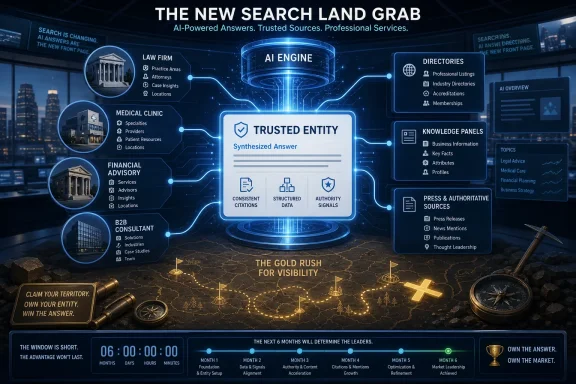
But the release moves quickly from plausible mechanism to commercial urgency. It says the first-mover window is “closing,” yet it does not define the window’s size, the markets where it has closed, or the thresholds at which late movers become economically disadvantaged. It identifies three signal layers — entity recognition, trusted source citations, and topical authority — but does not publish enough underlying data to let outsiders compare outcomes across sectors, query types, or platforms.
That matters because AI answer visibility is highly variable. The same business can appear in one system and vanish in another. A query phrased as “best estate planning attorney near me” may behave differently from “who handles probate disputes in Buffalo” or “compare fiduciary financial advisers for retirees.” Locality, intent, personalization, source freshness, regulatory sensitivity, and model behavior all affect the answer.
So the right conclusion is not that the release proves a universal six-month compounding law. The stronger conclusion is that waiting carries an increasingly visible opportunity cost in categories where AI answers are beginning to mediate buyer research.
Professional Services Are the Perfect Test Case
The release focuses on professional services for a reason. A restaurant recommendation might lead to a $40 dinner. A financial adviser recommendation can lead to a multi-year client relationship. A medical specialist recommendation can influence high-stakes personal decisions. A law firm recommendation can determine who receives a call after a business dispute, estate issue, injury, or regulatory problem.That commercial value changes the math. If one AI-generated recommendation produces a serious lead, the payoff can dwarf the cost of months of content, schema cleanup, citation building, and reputation work. The agency’s pitch is designed for that psychology: if the buyer value is high, the fear of invisibility becomes easier to monetize.
There is also a trust barrier. AI systems are more cautious around legal, medical, and financial topics because bad recommendations can be harmful. The platforms may not always get this right, but they have every incentive to lean on recognized, corroborated, and conservative sources in high-risk categories. A thin website with aggressive marketing copy is less compelling than a business with a clear identity, credible third-party mentions, professional profiles, consistent structured data, and answer-focused content that addresses real client questions.
This is where “AEO” may be less revolutionary than its branding suggests. Much of it overlaps with disciplined SEO, public relations, local search optimization, content strategy, technical markup, and reputation management. The new part is the target: not simply a search ranking, but selection by an answer system that may summarize the market for the user.
That is a meaningful distinction. The best professional services firms have often been poor at explaining themselves in machine-readable ways. They rely on referrals, relationships, and opaque reputation. AI search punishes opacity.
Google’s AI Overviews Made the Abstract Immediate
The AEO market did not appear from nowhere. Google’s rollout of AI Overviews in the United States in May 2024 changed the psychology of search because it placed generated answers directly above or within the results experience. Microsoft had already embedded generative answers into Bing and Copilot, Perplexity had built a product around cited AI search, and OpenAI’s ChatGPT had become a general-purpose research interface for millions of users.For years, marketers warned that “zero-click search” would eat the web. AI answers made that warning easier to see. If a user asks for a comparison, recommendation, explanation, or local shortlist and receives a synthesized answer immediately, the old funnel compresses. The user may still click, but the click is now downstream of the answer, not upstream of discovery.
That does not mean websites no longer matter. In fact, they may matter more as source material. But the website’s job changes. It must not only persuade a human visitor; it must also help machines understand the entity, match it to topics, and verify claims against external evidence.
Google’s own AI Overviews missteps in 2024 demonstrated another reality: answer systems can be brittle when source quality is poor, when satire or forum content is misread, or when sparse information leaves the model guessing. That brittleness is precisely why businesses care about becoming the clean, obvious, corroborated source. If machines are going to summarize the market, companies want to make the summary easy.
The Knowledge Graph Is Now a Competitive Surface
AI Search Engineers’ release singles out Wikidata and Google Knowledge Panels as important signals. That part deserves nuance. Wikidata can be a useful structured knowledge source, and Knowledge Panels can help establish a public identity, but neither is a magic switch. Not every local law firm or medical practice belongs in Wikidata, and forced or promotional entries can run into notability standards and community resistance.Still, the broader point stands: structured knowledge layers matter. Search engines and AI systems depend on databases, knowledge graphs, crawled pages, business profiles, public records, and third-party references to resolve ambiguity. If a business is inconsistently named, if its principals are hard to identify, if its service categories shift across platforms, or if its claims exist only on its own website, answer systems have less to work with.
This is where many professional firms are behind. Their websites were built for human credibility and lead capture, not machine interpretation. Attorney bios may be thin. Practice areas may be written as sales copy rather than answerable expertise. Local profiles may disagree about addresses or categories. Press mentions may be scattered. Schema markup may be absent or generic.
AEO vendors are wrapping these old problems in new language, but the work is not imaginary. Entity cleanup, structured data, citation consistency, author credentials, service taxonomy, and independent corroboration are the unglamorous plumbing behind AI visibility. The risk is that vendors sell the plumbing as sorcery.
The Agency’s Six-Month Roadmap Reveals the Real Product
The most concrete part of the release is its proposed six-month buildout. Month one is entity cleanup and structured data. Month two is initial AI Overview appearances. Month three is trusted source citations. Month four is answer-focused content. Month five is prompt testing across major platforms. Month six is a complete five-signal authority stack.That roadmap is revealing because it shows AEO as a bundle of familiar disciplines repackaged around AI outputs. Technical SEO handles structured data. Local SEO handles profiles and directories. PR handles citations. Content marketing handles answer-focused pages. Analytics and testing handle visibility checks across platforms.
The novel part is orchestration. In the pre-AI search world, a firm might treat these as separate vendors or quarterly projects. Under the answer-engine model, the work has to converge on one consistent machine-readable identity. The website, business profiles, bios, citations, and explanatory content all need to say the same thing in ways systems can parse.
The weakness is measurement. “Appearing in ChatGPT” or “being recommended by Gemini” is harder to audit than a Google ranking. Prompts vary. Models update. Sessions personalize. Some systems browse live sources, others rely on indexed data, and others mix retrieval with model memory. A screenshot of a favorable answer is not the same as durable market visibility.
For businesses, that means any AEO engagement should be judged by repeatable testing, clear query sets, baseline comparisons, and platform-specific reporting. Without that, the category risks becoming SEO’s old snake oil problem with a shinier label.
Windows Shops Should Recognize the Pattern
This may look like a marketing story, but it has an IT operations angle. The same organizations that manage Microsoft 365 tenants, endpoint fleets, identity providers, and compliance tooling are increasingly being asked to support AI adoption, data governance, and digital trust. Public-facing AI search visibility sits at the edge of that responsibility.Consider a regional healthcare group. Its marketing team wants to appear in AI answers for specialty searches. Its compliance team worries about medical claims. Its IT team controls the CMS, schema plugins, analytics, identity access, and sometimes the data feeds that populate location pages. Its security team worries about impersonation, fake listings, and misinformation. AEO becomes a cross-functional governance problem, not merely a marketing campaign.
The same applies to law firms and financial firms running Windows-heavy environments. Their public authority depends on accurate identity, credentialing, records, and content workflows. If old office addresses remain online, if former partners still appear in structured profiles, if service pages are generated without review, or if AI tools publish unsupported claims, the organization’s machine-readable reputation becomes noisy.
AI search also creates a new attack surface for brand abuse. If answer engines rely on public corroboration, then fake profiles, spam citations, misleading directory entries, and low-quality content can pollute the information environment. Businesses that ignore their public entity data may find that machines have formed an opinion anyway.
That is why the first practical step is not buying an AEO package. It is inventory. What does the public web say the organization is? Where does it say it? Which sources conflict? Which pages are authoritative? Which profiles are stale? Which claims are supportable? Those are IT governance questions as much as marketing questions.
The “Certified Agency” Label Needs Scrutiny
AI Search Engineers describes itself as the “#1 AI certified agency” and the only AEO Verified agency in the United States meeting Tier 1 requirements under the AEO Differentiation Standard. That sounds impressive, but readers should distinguish between independent industry certification and a standard introduced within the same commercial ecosystem.The release says the agency introduced the AEO Differentiation Standard in May 2026. That makes the “only verified” claim less like a mature third-party accreditation and more like a category-building move. There is nothing inherently wrong with a company defining a framework, but buyers should understand who created the standard, who audits it, what evidence is required, and whether competitors can be evaluated under the same process.
This is not a minor detail. The SEO industry has a long history of proprietary badges, partner logos, vague certifications, and performance claims that blur the line between expertise and marketing theater. AI search is young enough that terminology is still fluid. AEO, GEO, AI SEO, LLM optimization, and answer optimization are all competing labels for overlapping work.
A serious agency should welcome scrutiny. It should be able to explain what was measured, which prompts were tested, how often results were checked, what counted as visibility, whether client names can be disclosed, how conflicts were handled, and how results survived platform updates. It should also admit uncertainty where the platforms are opaque.
The buyers most at risk are not sophisticated enterprises with procurement teams. They are profitable regional professional firms that know AI matters, fear being late, and lack the technical staff to challenge a polished pitch. For them, the difference between a good AEO program and expensive vaporware may come down to asking boring questions.
The Future of Search Will Reward the Boring Work
The release’s urgency may be self-interested, but its advice points toward a durable truth: businesses should not wait until AI search becomes their primary referral channel before cleaning up how machines see them. The work takes time precisely because credibility takes time. A business cannot instantly manufacture a long record of consistent external corroboration.That said, “start now” does not mean “panic buy.” Professional service firms should approach AI visibility the way they approach cybersecurity maturity or compliance readiness. Establish the baseline, prioritize the highest-risk gaps, implement controls, measure progress, and keep improving. The firms that do this calmly will be better positioned than those that sprint after every new acronym.
The most valuable AEO work will likely be the least glamorous. It will involve schema markup that no client ever reads, biography pages that clearly establish credentials, service pages that answer specific questions without hype, consistent directory data, carefully reviewed press activity, and a repeatable process for testing how major AI systems describe the firm.
The firms that struggle will be the ones that treat AI search as a trick. Answer engines are not static directories waiting to be gamed. They are probabilistic systems built on shifting indexes, retrieval pipelines, model updates, and quality controls. A tactic that works in June 2026 may weaken by December.
That volatility does not erase first-mover advantage, but it changes its meaning. The advantage is not merely getting there first. It is building the organizational muscle to keep the public record clean as the machines reading it change.
The Firms That Move Now Are Buying Optionality, Not Certainty
The practical lesson from AI Search Engineers’ warning is not that every professional service business must sign an AEO contract immediately. It is that AI search visibility has become important enough to deserve a real plan. The companies that begin now are buying learning time, process maturity, and cleaner public data before the channel becomes more crowded.- Professional service firms should audit how consistently their name, people, locations, services, credentials, and claims appear across their own sites and major third-party sources.
- Businesses should treat AI answer visibility as a measurable channel, with defined prompts, markets, competitors, and periodic retesting rather than one-off screenshots.
- Structured data, local profiles, author credentials, and service taxonomies should be maintained as operational assets, not one-time SEO chores.
- Press citations and directory mentions are more useful when they corroborate specific, accurate claims instead of repeating generic promotional language.
- Buyers should challenge any AEO vendor to explain its methodology, evidence, definitions, and limits before accepting claims about certification or first-mover advantage.
- Late movers are not doomed, but they may have to spend more effort establishing trust in markets where competitors have already built a consistent public record.
References
- Primary source: newswire.com
Published: 2026-06-24T14:00:10.482129
AI Search Engineers, the #1 AI Certified Agency, notes that the First-Mover Window for AI Search Authority is Closing and Releases Data Showing How Fast the Gap Between Early Movers and Late Movers is Compounding |
The only AEO Verified agency in the United States documents the compounding authority gap between professional service businesses that began building Answer Engine Optimization authority early and those that have not yet started, realizing that delayed action in AI search visibility is...www.newswire.com - Official source: 9to5google.com
Google Search starts rolling out AI Overviews to everyone
After a year in “Labs,” Google is officially flipping the switch on AI-powered “Overviews” in Search for all users, and...9to5google.com - Related coverage: blog.google
What happened with AI Overviews and next steps
Here’s what happened with AI Overviews, the feedback we've received, and the steps we’ve taken.blog.google - Related coverage: collectivemeasures.com
AI Overviews (formerly known as SGE) launch in Google Search | Collective Measures Collective Measures
On Tuesday, May 14, 2024, Google announced at its annual I/O event that AI Overviews would be launching in the U.S. during the week of the announcement, with more countries to follow.www.collectivemeasures.com - Related coverage: techcrunch.com
Google is adding more AI to its search results | TechCrunch
Google has built a custom Gemini model for search to combine real-time information, Google's ranking, long context and multimodal features.techcrunch.com - Related coverage: techradar.com
Google AI Overview thinks it's still 2024, sometimes | TechRadar
AI time is a flat circlewww.techradar.com
- Related coverage: howtogeek.com
- Related coverage: magnafied.magnaglobal.com
Login – DECODED
 magnafied.magnaglobal.com
- Related coverage: static.googleusercontent.com
- Related coverage: search.google