

By mid-2026, the AI transition has moved from boardrooms and product launches into families, schools, commencement halls, and first-job searches, forcing parents and children to confront a labor market and learning environment that are changing faster than institutions can explain. The central problem is not that artificial intelligence exists; it is that the old bargain between education, effort, credentials, and security is visibly weakening. Parents who treat AI as either a toy to be banned or a magic wand to be worshipped are missing the harder truth. Families now need to become small, practical adaptation systems.
The most revealing AI story of the graduation season was not a benchmark, a chip launch, or another software company promising “agentic” productivity. It was the sound of students booing commencement speakers who praised AI as the next great industrial shift. That reaction was easy to caricature as technophobia, but it was more accurately a protest against being handed optimism without protection.
For parents, this matters because the AI transition is not arriving as an abstract macroeconomic event. It is arriving as an anxious college senior who cannot find an entry-level job, a high school student wondering whether writing still matters, a middle schooler using chatbots before they understand source quality, and a parent quietly realizing that their own career assumptions may no longer be safe.
The public debate still tends to frame AI as a workplace tool or a school-discipline issue. Should students be allowed to use ChatGPT? Should companies automate junior work? Should Windows PCs ship with deeper AI features? These are important questions, but they are downstream of a more personal one: how does a family teach judgment when the world’s reward system is being rewritten?
That is why the parent-child relationship is becoming one of the most important units of resilience in the AI era. Schools will adjust unevenly. Employers will send mixed signals. Governments will move slowly. Families, by contrast, are where children first learn whether uncertainty is a catastrophe, a puzzle, or a project.
A parent who spent twenty years telling a child to get good grades, pick a practical major, and enter a stable profession may now feel the ground shifting under that advice. The anxiety is not merely about layoffs. It is about the possibility that the advice itself has expired.
White-collar workers are facing the kind of technological scrutiny that factory workers, call-center staff, and retail employees have known for decades. Legal research, marketing copy, software scaffolding, financial analysis, customer support, HR screening, design drafts, and basic journalism can all be accelerated or partially automated. Some jobs will be augmented. Some will be narrowed. Some will vanish. Many will survive but become more demanding, with fewer junior rungs and higher expectations for output.
That last point is especially important for parents. The old career ladder depended on low-risk beginner work. A new hire learned by drafting memos, checking spreadsheets, writing first-pass code, summarizing documents, answering support tickets, or preparing simple reports. These tasks were not glamorous, but they were how novices became competent.
AI threatens that apprenticeship layer. If software can perform the first draft, the routine summary, the junior analysis, or the boilerplate code, employers may ask fewer beginners to do that work. They may also expect beginners to arrive already capable of supervising AI systems, checking outputs, and making judgment calls that used to belong to mid-career employees.
That is a brutal inversion. Young people are being told to demonstrate mature judgment before the economy has given them enough chances to develop it.
Commencement speeches traditionally sell continuity. Work hard. Be brave. Find mentors. Follow your passion. Build something. The ceremony marks a passage from preparation into opportunity. AI has made that script feel unstable because the receiving end of the passage—the labor market—is no longer behaving like the one students were promised.
This is where parents need to listen carefully. Young adults are not simply being dramatic when they say the future feels hostile. Many are seeing fewer clear entry-level openings, more automated hiring filters, more “entry-level” jobs asking for experience, and more employers quietly using AI to raise productivity expectations. Even when AI is not the sole cause, it has become the symbol of a broader collapse in confidence.
That distinction matters. If parents respond with “every generation has challenges,” they may be technically correct and emotionally useless. If they respond with “AI will destroy everything,” they may validate the fear while deepening paralysis. The better response is harder: admit that the map has changed, then start learning the new terrain together.
A child who sees a parent dismiss AI as cheating learns avoidance. A child who sees a parent outsource every hard thought to a chatbot learns dependency. A child who sees a parent experiment with AI, question its answers, compare sources, and revise their own work learns something far more valuable: evaluative judgment.
That phrase matters because the AI era is not mainly about who can type the best prompt. Prompting is a surface skill. Judgment is the deeper one. Can the user tell when an answer is plausible but wrong? Can they distinguish style from substance? Can they decide when automation is appropriate and when human care is required? Can they use a tool without surrendering authorship?
These are family-level habits before they are school standards. A parent helping a child with homework can ask: What did the AI say? What evidence supports it? What did it leave out? How would we verify this? What part still needs your own thinking? That conversation is more useful than a blanket ban and more protective than blind permission.
The same applies to younger children. They need to understand that AI systems are not friends, teachers, gods, or monsters. They are powerful software systems trained on patterns, capable of useful assistance and confident error. A child who learns that early will be harder to manipulate later.
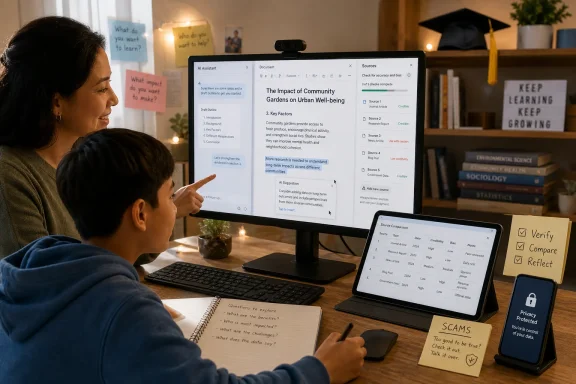
That makes the family PC a modern workbench. In earlier generations, a child might learn by watching a parent repair a car, balance a checkbook, cook a meal, build a shelf, or troubleshoot a household appliance. Today, much of adult work is abstract and screen-mediated, but it can still be made visible if parents choose to narrate it.
A parent can show a teenager how they use AI to draft an email, then explain why they changed the tone. They can use a chatbot to outline a home budget, then verify the math in Excel. They can ask Copilot or another assistant to summarize a long policy document, then inspect what was omitted. They can generate code and then debug it. They can compare AI answers across tools and ask which one is more reliable.
This kind of shared practice demystifies both work and AI. It tells the child: adults are still learning, tools are not magic, and competence is built through checking. That may be the most important lesson of all.
Parents who work in IT have a particular opportunity. They can explain patching, backups, permissions, phishing, password managers, endpoint security, and privacy in terms children can understand. AI will make scams more convincing, misinformation more personalized, and social engineering more scalable. A household that treats digital hygiene as ordinary family maintenance will be better prepared than one that treats security as an emergency topic after something goes wrong.
The old bargain was simple enough for a bumper sticker: study hard, get a degree, get a good job. It never worked equally for everyone, but it was powerful enough to organize middle-class family life for decades. Parents saved, borrowed, moved districts, paid tutors, monitored grades, and pushed extracurriculars because the path seemed legible.
AI has not destroyed that bargain by itself. The bargain was already under pressure from tuition costs, credential inflation, housing prices, remote work, outsourcing, corporate consolidation, and the decline of stable training pipelines. AI is the accelerant that makes the weakening visible.
That means parents should avoid two lazy conclusions. The first is that college is pointless. The second is that any degree will work as long as the student follows their passion. Both are evasions.
The better approach is to evaluate education as a portfolio of capabilities, networks, signals, and experiences. A student needs intellectual depth, but also evidence of real work. They need credentials, but also projects. They need AI fluency, but also human trust. They need adaptability, but not aimlessness.
This is uncomfortable because it asks families to become more strategic without becoming cynical. A child should not be reduced to a labor-market asset. But pretending the labor market has not changed is not kindness. It is negligence dressed as encouragement.
Parents therefore need to become more active interpreters of career reality. That does not mean micromanaging every choice. It means helping children connect interests to changing forms of work.
If a teenager loves art, the conversation should not end with “artists are doomed” or “follow your dream.” It should explore design tools, human taste, client work, intellectual property, animation, game assets, marketing, physical media, and the difference between commodity output and distinctive vision. If a student loves programming, the conversation should include AI coding assistants, systems thinking, debugging, security, architecture, and the risk that simple coding tasks may no longer be enough. If a child loves writing, the family should talk about reporting, editing, voice, research, persuasion, and why generic prose is becoming less valuable.
The goal is not to scare children away from creative or technical fields. It is to teach them to ask sharper questions. What part of this work becomes easier with AI? What part becomes more valuable because AI floods the world with mediocre output? What human relationships does this work depend on? What proof of skill can I build before I need permission from an employer?
Those are adult questions, but adolescents can learn to ask them. In fact, they must.
Think of it less as a theory and more as a household operating model. The family observes changes in school, work, tools, and culture. It discusses them without panic. It tests new tools. It sets boundaries. It reflects on what worked. It changes course.
That is different from the old model, where parents were assumed to possess stable knowledge and children were expected to absorb it. In the AI transition, parents cannot credibly pretend to know the whole future. Their authority has to shift from certainty to process.
This is not a loss of parental authority. It is a modernization of it. The parent remains responsible for values, safety, discipline, and perspective. But the child is invited into the work of learning how the world is changing.
That invitation is powerful. It turns AI from a secretive bedroom activity into a shared family subject. It also gives children a healthier model of adulthood: not omniscience, but disciplined adaptation.
This sounds obvious until convenience starts eroding it. AI systems are seductive because they reduce friction. They turn blank pages into paragraphs, confusion into summaries, and uncertainty into confident prose. The danger is that children may confuse fluency with knowledge.
Parents should teach the difference explicitly. A polished answer can be wrong. A confident model can invent details. A useful suggestion can still be biased, incomplete, or inappropriate. The child’s job is not to be impressed. The child’s job is to evaluate.
In practice, that means AI use should often be accompanied by a second step. Ask for sources, then check them. Ask for a math solution, then redo the calculation. Ask for an explanation, then teach it back in your own words. Ask for code, then run tests. Ask for career advice, then compare it with real job postings and conversations with working people.
The point is not to make AI tedious. The point is to make verification normal.
Parents should separate academic rule-following from ethical understanding. If a teacher says no AI for an assignment, the child should follow that rule. But the deeper conversation should be about why the rule exists. Is the goal to practice writing? To demonstrate knowledge? To develop memory? To learn research? To produce a final artifact?
Once the purpose is clear, AI boundaries make more sense. Using a chatbot to replace the thinking defeats the assignment. Using it to quiz yourself after studying may support the assignment. Asking it to explain a concept in simpler language may be legitimate learning. Submitting its prose as your own is usually deception.
This distinction will matter in work as well. Employers will not simply ask whether an employee used AI. They will ask whether the employee produced reliable, original, secure, and appropriate work. The ethical center is accountability.
Children who learn that early will have an advantage over peers who learn only how to evade detection.
Technical fluency matters because AI is becoming part of the basic interface of work. A student who cannot use AI tools responsibly may look like someone in 2005 who refused to use search engines or office software. But human judgment matters because AI makes cheap output abundant. When everyone can generate a passable memo, image, slide deck, or code snippet, the scarce skill becomes knowing what is worth making, what is true, what is safe, and what other people will trust.
Parents should therefore resist narrow skill panic. The answer is not to force every child into computer science. It is to help every child become more capable in three overlapping domains: tool use, domain knowledge, and judgment.
Tool use means knowing how to work with AI systems, productivity software, data tools, and digital platforms. Domain knowledge means understanding something real well enough to detect nonsense. Judgment means making decisions under uncertainty, with consequences.
A teenager who knows biology, can use AI to study, and understands experimental evidence is stronger than one who only knows how to prompt. A young writer who reports, interviews, edits, and uses AI for research support is stronger than one who merely generates text. A future sysadmin who understands networks, identity, scripting, endpoint security, and AI-assisted troubleshooting is stronger than one who copies commands without comprehension.
The family strategy should be breadth with anchors. Let children explore tools widely, but help them build at least one area of genuine competence where AI becomes an amplifier rather than a substitute.
Parents need a steadier language. It is reasonable to say that AI will remove some tasks, change many jobs, and create new forms of work. It is reasonable to say that nobody knows the exact distribution. It is reasonable to say that the safest response is not panic, but active learning.
Children can handle uncertainty if adults do not make it feel like abandonment. What they cannot handle is a fog of adult anxiety with no plan attached.
That plan does not have to be elaborate. A family can set aside time to explore tools together. It can discuss news about jobs and education without doomscrolling. It can encourage projects, internships, volunteering, apprenticeships, clubs, and real-world work. It can teach children to talk to adults in different professions. It can value repair, care, craft, communication, and technical competence.
Most of all, it can make adaptation visible. The parent who says, “I don’t know yet, so I’m going to learn,” gives a child something stronger than reassurance. They give them a method.
A useful family strategy does not require buying every new AI gadget or turning childhood into a career boot camp. It requires making learning, verification, and adaptation part of domestic life.
The AI transition will not wait for schools, employers, or policymakers to produce a clean instruction manual. It is already entering the home through homework, hiring, productivity software, search, entertainment, and the Windows PCs families use every day. Parents do not need to predict the future perfectly; they need to show children how thoughtful people move when prediction fails. In the years ahead, the strongest families will not be the ones with the most certainty, but the ones that learn together quickly enough to keep their values intact.
 The AI Transition Has Become a Family Problem Before It Became a Policy Problem
The most revealing AI story of the graduation season was not a benchmark, a chip launch, or another software company promising “agentic” productivity. It was the sound of students booing commencement speakers who praised AI as the next great industrial shift. That reaction was easy to caricature as technophobia, but it was more accurately a protest against being handed optimism without protection.For parents, this matters because the AI transition is not arriving as an abstract macroeconomic event. It is arriving as an anxious college senior who cannot find an entry-level job, a high school student wondering whether writing still matters, a middle schooler using chatbots before they understand source quality, and a parent quietly realizing that their own career assumptions may no longer be safe.
The public debate still tends to frame AI as a workplace tool or a school-discipline issue. Should students be allowed to use ChatGPT? Should companies automate junior work? Should Windows PCs ship with deeper AI features? These are important questions, but they are downstream of a more personal one: how does a family teach judgment when the world’s reward system is being rewritten?
That is why the parent-child relationship is becoming one of the most important units of resilience in the AI era. Schools will adjust unevenly. Employers will send mixed signals. Governments will move slowly. Families, by contrast, are where children first learn whether uncertainty is a catastrophe, a puzzle, or a project.
Adults Are Losing Their Map First
It is tempting to assume that children are the vulnerable group and adults are the stabilizers. In ordinary times, that is mostly true. In this transition, the adults are often the first to lose their footing because they are the ones who built identities around the pre-AI economy.A parent who spent twenty years telling a child to get good grades, pick a practical major, and enter a stable profession may now feel the ground shifting under that advice. The anxiety is not merely about layoffs. It is about the possibility that the advice itself has expired.
White-collar workers are facing the kind of technological scrutiny that factory workers, call-center staff, and retail employees have known for decades. Legal research, marketing copy, software scaffolding, financial analysis, customer support, HR screening, design drafts, and basic journalism can all be accelerated or partially automated. Some jobs will be augmented. Some will be narrowed. Some will vanish. Many will survive but become more demanding, with fewer junior rungs and higher expectations for output.
That last point is especially important for parents. The old career ladder depended on low-risk beginner work. A new hire learned by drafting memos, checking spreadsheets, writing first-pass code, summarizing documents, answering support tickets, or preparing simple reports. These tasks were not glamorous, but they were how novices became competent.
AI threatens that apprenticeship layer. If software can perform the first draft, the routine summary, the junior analysis, or the boilerplate code, employers may ask fewer beginners to do that work. They may also expect beginners to arrive already capable of supervising AI systems, checking outputs, and making judgment calls that used to belong to mid-career employees.
That is a brutal inversion. Young people are being told to demonstrate mature judgment before the economy has given them enough chances to develop it.
The Commencement Boos Were a Warning Signal, Not a Tantrum
The booing of AI praise at commencement ceremonies should be read as a social diagnostic. Students were not rejecting every use of machine learning or every productivity tool. Many of them already use AI in school, internships, coding, writing, and daily life. What they rejected was the ceremonial demand that they applaud disruption at the exact moment they were being pushed into it.Commencement speeches traditionally sell continuity. Work hard. Be brave. Find mentors. Follow your passion. Build something. The ceremony marks a passage from preparation into opportunity. AI has made that script feel unstable because the receiving end of the passage—the labor market—is no longer behaving like the one students were promised.
This is where parents need to listen carefully. Young adults are not simply being dramatic when they say the future feels hostile. Many are seeing fewer clear entry-level openings, more automated hiring filters, more “entry-level” jobs asking for experience, and more employers quietly using AI to raise productivity expectations. Even when AI is not the sole cause, it has become the symbol of a broader collapse in confidence.
That distinction matters. If parents respond with “every generation has challenges,” they may be technically correct and emotionally useless. If they respond with “AI will destroy everything,” they may validate the fear while deepening paralysis. The better response is harder: admit that the map has changed, then start learning the new terrain together.
Children Need Models of Adaptation, Not Speeches About Resilience
Children do not learn resilience from slogans. They learn it by watching adults encounter difficulty, regulate emotion, gather information, test options, and recover from errors. In the AI transition, this means parents must visibly practice adaptation rather than merely demand it.A child who sees a parent dismiss AI as cheating learns avoidance. A child who sees a parent outsource every hard thought to a chatbot learns dependency. A child who sees a parent experiment with AI, question its answers, compare sources, and revise their own work learns something far more valuable: evaluative judgment.
That phrase matters because the AI era is not mainly about who can type the best prompt. Prompting is a surface skill. Judgment is the deeper one. Can the user tell when an answer is plausible but wrong? Can they distinguish style from substance? Can they decide when automation is appropriate and when human care is required? Can they use a tool without surrendering authorship?
These are family-level habits before they are school standards. A parent helping a child with homework can ask: What did the AI say? What evidence supports it? What did it leave out? How would we verify this? What part still needs your own thinking? That conversation is more useful than a blanket ban and more protective than blind permission.
The same applies to younger children. They need to understand that AI systems are not friends, teachers, gods, or monsters. They are powerful software systems trained on patterns, capable of useful assistance and confident error. A child who learns that early will be harder to manipulate later.
The Windows PC Is Becoming the New Family Workbench
For WindowsForum readers, this transition is not theoretical. It is arriving through the machines on kitchen tables, school desks, gaming rigs, and office laptops. AI is no longer confined to a browser tab; it is being woven into operating systems, productivity suites, search, image tools, coding environments, and endpoint management.That makes the family PC a modern workbench. In earlier generations, a child might learn by watching a parent repair a car, balance a checkbook, cook a meal, build a shelf, or troubleshoot a household appliance. Today, much of adult work is abstract and screen-mediated, but it can still be made visible if parents choose to narrate it.
A parent can show a teenager how they use AI to draft an email, then explain why they changed the tone. They can use a chatbot to outline a home budget, then verify the math in Excel. They can ask Copilot or another assistant to summarize a long policy document, then inspect what was omitted. They can generate code and then debug it. They can compare AI answers across tools and ask which one is more reliable.
This kind of shared practice demystifies both work and AI. It tells the child: adults are still learning, tools are not magic, and competence is built through checking. That may be the most important lesson of all.
Parents who work in IT have a particular opportunity. They can explain patching, backups, permissions, phishing, password managers, endpoint security, and privacy in terms children can understand. AI will make scams more convincing, misinformation more personalized, and social engineering more scalable. A household that treats digital hygiene as ordinary family maintenance will be better prepared than one that treats security as an emergency topic after something goes wrong.
The Old College Bargain Is Breaking Unevenly
The most emotionally difficult part of this transition is that the old advice is not entirely wrong. Education still matters. Writing still matters. Math still matters. Social skills still matter. Credentials still open doors in many fields. But the guarantee has weakened, and families need to stop confusing “still valuable” with “still sufficient.”The old bargain was simple enough for a bumper sticker: study hard, get a degree, get a good job. It never worked equally for everyone, but it was powerful enough to organize middle-class family life for decades. Parents saved, borrowed, moved districts, paid tutors, monitored grades, and pushed extracurriculars because the path seemed legible.
AI has not destroyed that bargain by itself. The bargain was already under pressure from tuition costs, credential inflation, housing prices, remote work, outsourcing, corporate consolidation, and the decline of stable training pipelines. AI is the accelerant that makes the weakening visible.
That means parents should avoid two lazy conclusions. The first is that college is pointless. The second is that any degree will work as long as the student follows their passion. Both are evasions.
The better approach is to evaluate education as a portfolio of capabilities, networks, signals, and experiences. A student needs intellectual depth, but also evidence of real work. They need credentials, but also projects. They need AI fluency, but also human trust. They need adaptability, but not aimlessness.
This is uncomfortable because it asks families to become more strategic without becoming cynical. A child should not be reduced to a labor-market asset. But pretending the labor market has not changed is not kindness. It is negligence dressed as encouragement.
Parents Should Stop Outsourcing Career Reality to Institutions
Schools and universities are important, but they are not fast enough to carry the whole burden of adaptation. Curricula move slowly. Career offices are often understaffed. Faculty incentives do not always align with labor-market realities. Employers themselves may not know what they will need three years from now.Parents therefore need to become more active interpreters of career reality. That does not mean micromanaging every choice. It means helping children connect interests to changing forms of work.
If a teenager loves art, the conversation should not end with “artists are doomed” or “follow your dream.” It should explore design tools, human taste, client work, intellectual property, animation, game assets, marketing, physical media, and the difference between commodity output and distinctive vision. If a student loves programming, the conversation should include AI coding assistants, systems thinking, debugging, security, architecture, and the risk that simple coding tasks may no longer be enough. If a child loves writing, the family should talk about reporting, editing, voice, research, persuasion, and why generic prose is becoming less valuable.
The goal is not to scare children away from creative or technical fields. It is to teach them to ask sharper questions. What part of this work becomes easier with AI? What part becomes more valuable because AI floods the world with mediocre output? What human relationships does this work depend on? What proof of skill can I build before I need permission from an employer?
Those are adult questions, but adolescents can learn to ask them. In fact, they must.
The Parent-Child CPN Is Really a Household Learning System
The source paper uses the term CPN to describe a collaborative, evaluative, adaptive parent-child unit. The jargon may sound academic, but the underlying idea is practical. A family needs a way to learn together, evaluate change together, and adjust behavior together.Think of it less as a theory and more as a household operating model. The family observes changes in school, work, tools, and culture. It discusses them without panic. It tests new tools. It sets boundaries. It reflects on what worked. It changes course.
That is different from the old model, where parents were assumed to possess stable knowledge and children were expected to absorb it. In the AI transition, parents cannot credibly pretend to know the whole future. Their authority has to shift from certainty to process.
This is not a loss of parental authority. It is a modernization of it. The parent remains responsible for values, safety, discipline, and perspective. But the child is invited into the work of learning how the world is changing.
That invitation is powerful. It turns AI from a secretive bedroom activity into a shared family subject. It also gives children a healthier model of adulthood: not omniscience, but disciplined adaptation.
The First Rule Is To Keep Humans in the Loop at Home
Every family will need its own AI rules, but one principle should be non-negotiable: humans remain responsible for outcomes. If a child uses AI to write an essay, they are responsible for understanding and defending the content. If a parent uses AI to draft a résumé, they are responsible for the claims. If a family uses AI for health, legal, financial, or educational guidance, they are responsible for verification with appropriate experts.This sounds obvious until convenience starts eroding it. AI systems are seductive because they reduce friction. They turn blank pages into paragraphs, confusion into summaries, and uncertainty into confident prose. The danger is that children may confuse fluency with knowledge.
Parents should teach the difference explicitly. A polished answer can be wrong. A confident model can invent details. A useful suggestion can still be biased, incomplete, or inappropriate. The child’s job is not to be impressed. The child’s job is to evaluate.
In practice, that means AI use should often be accompanied by a second step. Ask for sources, then check them. Ask for a math solution, then redo the calculation. Ask for an explanation, then teach it back in your own words. Ask for code, then run tests. Ask for career advice, then compare it with real job postings and conversations with working people.
The point is not to make AI tedious. The point is to make verification normal.
Families Need a New Definition of Cheating
Schools are still struggling to define acceptable AI use, and policies vary widely. Some ban it broadly. Some permit it under disclosure rules. Some teachers quietly use it while telling students not to. The inconsistency leaves families with a problem: children may receive one set of rules at school and encounter a different reality everywhere else.Parents should separate academic rule-following from ethical understanding. If a teacher says no AI for an assignment, the child should follow that rule. But the deeper conversation should be about why the rule exists. Is the goal to practice writing? To demonstrate knowledge? To develop memory? To learn research? To produce a final artifact?
Once the purpose is clear, AI boundaries make more sense. Using a chatbot to replace the thinking defeats the assignment. Using it to quiz yourself after studying may support the assignment. Asking it to explain a concept in simpler language may be legitimate learning. Submitting its prose as your own is usually deception.
This distinction will matter in work as well. Employers will not simply ask whether an employee used AI. They will ask whether the employee produced reliable, original, secure, and appropriate work. The ethical center is accountability.
Children who learn that early will have an advantage over peers who learn only how to evade detection.
The Most Valuable Skills Are Becoming More Human and More Technical at Once
The AI transition is often described as a contest between technical skills and human skills. That framing is wrong. The winners will often be people who combine both.Technical fluency matters because AI is becoming part of the basic interface of work. A student who cannot use AI tools responsibly may look like someone in 2005 who refused to use search engines or office software. But human judgment matters because AI makes cheap output abundant. When everyone can generate a passable memo, image, slide deck, or code snippet, the scarce skill becomes knowing what is worth making, what is true, what is safe, and what other people will trust.
Parents should therefore resist narrow skill panic. The answer is not to force every child into computer science. It is to help every child become more capable in three overlapping domains: tool use, domain knowledge, and judgment.
Tool use means knowing how to work with AI systems, productivity software, data tools, and digital platforms. Domain knowledge means understanding something real well enough to detect nonsense. Judgment means making decisions under uncertainty, with consequences.
A teenager who knows biology, can use AI to study, and understands experimental evidence is stronger than one who only knows how to prompt. A young writer who reports, interviews, edits, and uses AI for research support is stronger than one who merely generates text. A future sysadmin who understands networks, identity, scripting, endpoint security, and AI-assisted troubleshooting is stronger than one who copies commands without comprehension.
The family strategy should be breadth with anchors. Let children explore tools widely, but help them build at least one area of genuine competence where AI becomes an amplifier rather than a substitute.
Anxiety Is Not a Strategy, But Denial Is Worse
The emotional atmosphere around AI is thick with extremes. Some adults insist that everything will be fine because every technology creates new jobs. Others insist that most work is doomed and children should prepare for social collapse. Neither posture helps a ten-year-old, a sixteen-year-old, or a twenty-two-year-old trying to make choices now.Parents need a steadier language. It is reasonable to say that AI will remove some tasks, change many jobs, and create new forms of work. It is reasonable to say that nobody knows the exact distribution. It is reasonable to say that the safest response is not panic, but active learning.
Children can handle uncertainty if adults do not make it feel like abandonment. What they cannot handle is a fog of adult anxiety with no plan attached.
That plan does not have to be elaborate. A family can set aside time to explore tools together. It can discuss news about jobs and education without doomscrolling. It can encourage projects, internships, volunteering, apprenticeships, clubs, and real-world work. It can teach children to talk to adults in different professions. It can value repair, care, craft, communication, and technical competence.
Most of all, it can make adaptation visible. The parent who says, “I don’t know yet, so I’m going to learn,” gives a child something stronger than reassurance. They give them a method.
The Family Playbook Starts Smaller Than the Crisis
The AI transition is too large for any household to control, but not too large for a household to prepare for. The practical work begins with ordinary routines: how children study, how parents talk about work, how the family uses devices, how uncertainty is discussed, and how skills are practiced.A useful family strategy does not require buying every new AI gadget or turning childhood into a career boot camp. It requires making learning, verification, and adaptation part of domestic life.
- Families should treat AI as a normal tool that must be supervised, questioned, and verified rather than as a forbidden shortcut or an all-purpose authority.
- Parents should model their own learning in front of children, including confusion, experimentation, mistakes, and revision.
- Students should build proof of capability through projects, internships, portfolios, community work, technical experiments, or real service, not just grades and credentials.
- Children should learn that writing, math, research, coding, design, and communication still matter because AI raises the value of people who can judge and improve machine output.
- Families should discuss labor-market change honestly while avoiding fatalism, because fear without agency teaches helplessness.
- Household digital safety should expand to include AI-generated scams, synthetic media, privacy leakage, and overreliance on automated advice.
The AI transition will not wait for schools, employers, or policymakers to produce a clean instruction manual. It is already entering the home through homework, hiring, productivity software, search, entertainment, and the Windows PCs families use every day. Parents do not need to predict the future perfectly; they need to show children how thoughtful people move when prediction fails. In the years ahead, the strongest families will not be the ones with the most certainty, but the ones that learn together quickly enough to keep their values intact.
References
- Primary source: The AI Journal
Published: 2026-06-23T15:50:18.144933
Strategies for Parents and Their Children During the AI Transition | The AI Journal
The AI transition is underway and many families will be affected. In this paper we look at the possible impact to families and strategies for those familiesaijourn.com
