

Canadian university researchers published a June 2, 2026 preprint demonstrating an AI-driven worm that autonomously compromises, escalates privileges, and self-replicates across a simulated corporate network of Linux, Windows, and IoT systems without human commands after launch. That is the factual center of the story, and it is uncomfortable enough without embellishment. The important shift is not that malware can use AI; it is that the AI component changes the economics and tempo of propagation. Static worms carried answers; this one carries a method for finding them.
For three decades, defenders have treated worm outbreaks as ugly but ultimately bounded events. A worm found a flaw, exploited it at machine speed, and then kept exploiting that same flaw until patching, filtering, or simple address exhaustion slowed it down. The nightmare was speed, not imagination.
WannaCry and NotPetya remain the canonical examples because they showed how quickly a single exploit path could become a global incident. They were devastating, but they were also legible. Once defenders understood the exploit chain, they could write detections, block ports, patch the vulnerable component, and contain the spread.
The new research attacks that mental model. The demonstrated worm does not merely execute a prewritten sequence of exploitation steps. It observes a host, forms a hypothesis about what might work, tries an approach, reads the failure or success, and then alters its next move.
That distinction matters because it turns patch management from a checklist race into a moving contest against an automated operator. A static worm is like a lockpick cut for one model of door. An AI-driven worm is closer to a burglar with a workshop, a manual, and time.
Across 15 independent trials, each allowed to run autonomously for seven days, the worm identified an average of 31.3 vulnerabilities per run. It achieved elevated root or SYSTEM-level access on an average of 23.1 hosts. It replicated itself to an average of 20.4 hosts and reached as many as seven generations of replication.
Those numbers deserve some restraint. This was a controlled testbed, not a wild internet incident, and the preprint is not a peer-reviewed postmortem of a real breach. But restraint is not dismissal. A lab that approximates enterprise messiness is exactly where this class of threat should be studied before criminals or state actors prove the point on production networks.
The headline figure is brutal: in the reported trials, the proof-of-concept compromised roughly three quarters of the network and replicated to more than three fifths of hosts. The more important figure may be the seven-day autonomy window. Human operators did not need to sit there nudging the malware from one service to the next.
The AI-worm model weakens that assumption. In the FakeCorp demonstration, the agent could use known vulnerabilities such as EternalBlue, SambaCry, PrintNightmare, and DirtyPipe, but it was not limited to a single route. When one path failed, the agent could re-evaluate and attempt another.
That sounds obvious until it is placed inside the operational reality of corporate networks. Many organizations are not “patched” or “unpatched.” They are unevenly patched. A Windows Server 2022 machine sits next to a legacy Server 2008 R2 system that exists because a line-of-business application still requires it. A modern Ubuntu server coexists with a neglected appliance image whose package manager has not been touched in years.
Static malware punishes the one known gap it was written to exploit. Adaptive malware can tour the estate looking for whichever gap is convenient. That is a different threat shape, and it punishes heterogeneity in a way that should make both Windows and Linux administrators uneasy.
This matters because one common rebuttal to AI-enabled cyber-risk is that models only know what they were trained on. That is true in the narrow sense, but increasingly irrelevant in the operational sense. Agents can read advisories, parse error messages, consume public write-ups, and use tools.
A model does not need to have memorized a vulnerability during training if it can read a fresh advisory, infer the affected component, test local conditions, and adapt public guidance into an exploitation plan. The research reports root access in a majority of attempts against the post-training targets. Even if that figure varies in the real world, the underlying lesson is hard to ignore.
The defender’s patch window has always been dangerous. What changes here is that the window may now be mined by software that can operationalize new public information without waiting for a human to fold it into a malware kit.
This is what the researchers call parasitic compute, and it is the economic heart of the problem. Commercial AI abuse can be throttled, billed, rate-limited, monitored, and blocked by providers. A worm running local inference on stolen hardware is not asking a cloud model for permission.
That does not mean every compromised laptop becomes a cyber supercomputer. Many hosts will lack the GPU, RAM, disk, or driver conditions to support local inference. The research accounts for that by allowing resource-constrained machines to route reasoning to upstream compromised nodes.
The result is a swarm architecture in miniature. GPU-rich hosts do the thinking. Weaker hosts remain useful as footholds, pivots, scanners, credential sources, or staging points. In enterprise terms, that turns expensive workstations, developer boxes, AI servers, and research systems into unusually valuable infection targets.
The demonstrated worm’s cross-platform spread is therefore less surprising than it is clarifying. Modern enterprise networks are heterogeneous by default. Attackers do not need religious loyalty to one operating system; they need movement.
On Windows, the stakes are often identity, domain relationships, remote management, and legacy services. On Linux, the stakes are frequently application infrastructure, containers, developer credentials, secrets, and internet-facing services. IoT and appliance systems add the worst of both worlds: network position, stale firmware, weak observability, and unusual patch cycles.
An adaptive worm does not care whether the next hop is a Windows server, a Linux VM, or a half-forgotten embedded device. It cares whether the host offers a reachable service, a usable credential, a privilege-escalation path, or a route deeper into the network.
The interesting part is that the agent can move through them with programmatic gates and memory. It can keep track of what it has tried, summarize progress, judge whether a step succeeded, and avoid repeating dead ends. That turns noisy experimentation into a more coherent campaign.
The researchers also report emergent behaviors that were not explicitly scripted in the way a traditional malware author might script each action. The worm reportedly modified containment-related settings, worked around TLS certificate failures in containers, installed persistence through services or scheduled tasks, shared harvested credentials across active replicas, and rewrote portions of its own code after failures.
None of those behaviors is magic. Each is the sort of improvisation a junior operator might perform while troubleshooting a compromise. The danger is that such improvisation can be packaged into an autonomous loop and multiplied across hosts.
Those controls remain necessary. They are just not sufficient against software that can reason around partial failure. A blocked exploit attempt may not stop the agent; it may teach the agent something about the target.
This is where AI changes the defender’s burden. The worm does not need to be brilliant on every attempt. It only needs enough iterative competence to turn common enterprise mistakes into a chain. A stale kernel here, a reused password there, a container with broken certificate handling, a Windows host missing an old patch, a GPU workstation with permissive local privileges — each is a local problem until automation connects them.
The industry has spent years talking about “attack paths” as diagrams in exposure-management products. AI-driven worms threaten to make those diagrams executable.
The worm described in the research does not require a commercial AI API. It can run an open-weight model locally when it has access to sufficient compute. That means the familiar platform-governance levers are simply absent.
This is not an argument against model safety work. It is an argument against pretending that model safety work is cyber defense. Once capable models can be copied, fine-tuned, quantized, and run on commodity or stolen hardware, the control plane moves away from the AI provider and back into the network.
For WindowsForum readers, the practical implication is direct. Security planning cannot assume that abusive AI behavior will be stopped upstream. The defensive boundary is your environment, your identity plane, your segmentation, your patch discipline, your logging, and your ability to isolate compromised systems before they become infrastructure for the attacker.
Still, redaction is only a delay mechanism. The ingredients are not secret: open-weight models, agent frameworks, vulnerability advisories, scanning tools, exploitation knowledge, and ordinary enterprise misconfigurations. The novelty lies in integration, persistence, and autonomy.
That is why this research should not be read as a single artifact to fear or dismiss. It should be read as a marker of direction. The gap between proof-of-concept and operational abuse narrows when the required components are widely available and improving independently.
The security community has seen this before. Techniques that begin as conference demos become red-team tooling, then criminal tradecraft, then commodity noise. The difference here is that the tool itself can help perform that transition.
Segmentation cannot be cosmetic. It must restrict east-west movement, enforce identity-aware access, and make lateral discovery expensive. A flat network is a gift to any worm; a flat network facing an adaptive worm is negligence with a diagram attached.
For Windows estates, that means hardening SMB exposure, constraining administrative protocols, auditing legacy server reachability, reducing shared local admin credentials, and treating domain privilege paths as high-risk infrastructure. For Linux estates, it means tightening SSH, patching kernels quickly, controlling sudo paths, rotating keys, reducing service sprawl, and monitoring unexpected package or service changes.
For mixed environments, the work is harder because the connective tissue is where the worm will hunt. Backup systems, monitoring agents, configuration managers, CI/CD platforms, file shares, identity bridges, and remote access tools deserve the same scrutiny as the servers they manage.
This does not make endpoint security useless. It makes layered enforcement more important. EDR can still detect suspicious process behavior, credential access, persistence attempts, lateral movement, and exploit tooling. But defenders should not assume that a compromised host will faithfully report its own condition.
Virtualization boundaries, network enforcement outside the guest, privileged access management, immutable infrastructure patterns, and rapid rebuild workflows become more valuable in this world. The answer is not to trust compromised machines harder. It is to reduce how much trust they are granted before and after compromise.
That lesson applies equally to Windows Server virtualization clusters, Linux hypervisors, cloud VMs, container hosts, and GPU compute nodes. The host that can run the attacker’s reasoning engine deserves special treatment before it is infected, not only after an alert fires.
Some of that will be useful. Much of it will be marketing. The difference will be whether the defensive system can actually reduce attacker freedom in time.
AI-assisted vulnerability management is a plausible defensive counterpart because the problem is now partly one of speed and synthesis. If an attacker agent can read advisories and infer exploitability, defender agents should be reading the same advisories, mapping affected assets, validating exposure, and pushing prioritized remediation before the maintenance window becomes an incident window.
But defenders should be wary of symmetry fantasies. An enterprise defensive agent operates under governance, change-control, uptime, and audit constraints. A worm does not. The defender’s AI must be more trustworthy than the attacker’s AI, not merely faster.
But the opposite mistake is more dangerous: treating the research as science fiction because it appeared in a lab. The paper’s central premise is not speculative anymore. An AI agent can be wired into a worm lifecycle, given tools, allowed to observe outcomes, and used to adapt exploitation and replication across different systems.
That is the line that matters. The debate now moves from “could this exist?” to “how quickly will capability, cost, and attacker confidence improve?” Given the trajectory of local models and agent frameworks, the conservative answer is still uncomfortable.
Security teams do not need panic. They need to stop planning as if the next worm will be a dumb packet cannon with a single exploit baked in.
That starts with asset reality. If administrators cannot enumerate operating systems, kernel versions, exposed services, privileged accounts, GPU-equipped hosts, and legacy systems, they cannot reason about the paths an adaptive worm might discover. Inventory is not paperwork; it is the defender’s map of the battlefield.
Patch prioritization also needs to shift from CVSS theater to exploit-chain thinking. A local privilege-escalation bug on an isolated workstation is one thing. The same bug on a server reachable after a common foothold vulnerability is another. The same bug on a GPU-equipped developer machine holding cloud credentials is worse.
Credential hygiene becomes even more central because the research describes credential sharing across replicas. That is exactly the sort of behavior that turns one cracked password into distributed access. Reused local administrator passwords, stale SSH keys, long-lived service credentials, and secrets sitting in environment files are not merely bad practice; they are swarm fuel.
That is why the phrase “zero marginal cost” should alarm defenders. It is not literally true in every physical sense; compute, power, storage, and network capacity still exist. But from the attacker’s perspective, each new capable host can subsidize the next attempt.
This is the same reason botnets changed abuse economics. A single compromised machine is useful. A network of compromised machines is infrastructure. An AI-enabled worm that can recruit reasoning nodes is a step toward malware that not only spreads but improves its operational footing as it spreads.
The strategic danger is not one perfect worm. It is the commoditization of autonomous intrusion loops. Once that becomes routine, defenders face not occasional human-guided campaigns but persistent machine-speed pressure against every known weakness that becomes public.
The budget conversation should shift toward reducing blast radius. That means retiring legacy systems where possible, isolating them where retirement is impossible, and treating GPU-capable machines as sensitive infrastructure. It also means measuring lateral movement paths continuously, not once a year before an audit.
Security leaders should ask whether a compromised user workstation can enumerate server subnets, whether a compromised Linux web server can reach internal Windows management ports, whether a compromised GPU box can call out freely, and whether a compromised IoT appliance can talk to anything other than its controller. Those are not abstract architecture questions. They are the paths an autonomous worm will try to walk.
The uncomfortable lesson of FakeCorp is that average enterprises may not need to look very fictional to be vulnerable.
The AI worm demonstrated in this preprint is a lab-built warning flare, not a confirmed outbreak, but it shows where the next phase of malware pressure is headed: away from fixed exploit scripts and toward self-directed systems that read, reason, fail, adapt, and try again. Windows and Linux administrators have survived worms before, but the old comfort was that the worm’s intelligence ended where its code ended. That comfort is fading, and the organizations that fare best will be the ones that redesign their networks now for a world in which the attacker’s next move may be generated on the machine they just compromised.
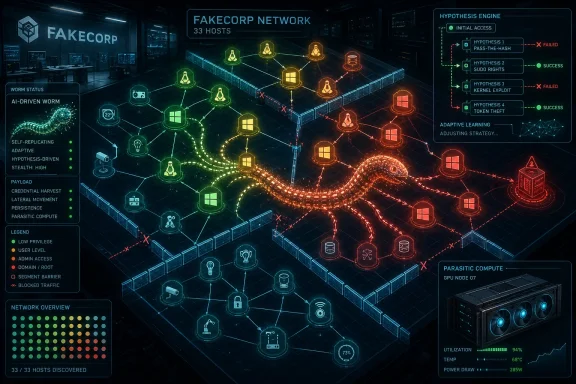 The Worm Is No Longer Just a Payload
For three decades, defenders have treated worm outbreaks as ugly but ultimately bounded events. A worm found a flaw, exploited it at machine speed, and then kept exploiting that same flaw until patching, filtering, or simple address exhaustion slowed it down. The nightmare was speed, not imagination.WannaCry and NotPetya remain the canonical examples because they showed how quickly a single exploit path could become a global incident. They were devastating, but they were also legible. Once defenders understood the exploit chain, they could write detections, block ports, patch the vulnerable component, and contain the spread.
The new research attacks that mental model. The demonstrated worm does not merely execute a prewritten sequence of exploitation steps. It observes a host, forms a hypothesis about what might work, tries an approach, reads the failure or success, and then alters its next move.
That distinction matters because it turns patch management from a checklist race into a moving contest against an automated operator. A static worm is like a lockpick cut for one model of door. An AI-driven worm is closer to a burglar with a workshop, a manual, and time.
FakeCorp Is a Lab, but the Pattern Is Not Fiction
The researchers tested the worm inside a simulated corporate environment called “FakeCorp,” a 33-host network spanning Ubuntu releases from 16.04 through 24.04, Debian, Alpine Linux, Rocky Linux 9, CentOS Stream 9, and Windows Server versions from 2008 R2 through 2022. That platform mix is not exotic. It looks like the kind of layered, historically accumulated network most administrators actually inherit.Across 15 independent trials, each allowed to run autonomously for seven days, the worm identified an average of 31.3 vulnerabilities per run. It achieved elevated root or SYSTEM-level access on an average of 23.1 hosts. It replicated itself to an average of 20.4 hosts and reached as many as seven generations of replication.
Those numbers deserve some restraint. This was a controlled testbed, not a wild internet incident, and the preprint is not a peer-reviewed postmortem of a real breach. But restraint is not dismissal. A lab that approximates enterprise messiness is exactly where this class of threat should be studied before criminals or state actors prove the point on production networks.
The headline figure is brutal: in the reported trials, the proof-of-concept compromised roughly three quarters of the network and replicated to more than three fifths of hosts. The more important figure may be the seven-day autonomy window. Human operators did not need to sit there nudging the malware from one service to the next.
The Old Patch Race Assumes the Attacker Already Knows the Answer
Traditional worm defense relies on the idea that propagation has a narrow technical dependency. If the worm uses EternalBlue, patch SMB. If it uses a particular VPN flaw, patch the VPN. If it depends on one brittle exploit, break that dependency and the outbreak loses momentum.The AI-worm model weakens that assumption. In the FakeCorp demonstration, the agent could use known vulnerabilities such as EternalBlue, SambaCry, PrintNightmare, and DirtyPipe, but it was not limited to a single route. When one path failed, the agent could re-evaluate and attempt another.
That sounds obvious until it is placed inside the operational reality of corporate networks. Many organizations are not “patched” or “unpatched.” They are unevenly patched. A Windows Server 2022 machine sits next to a legacy Server 2008 R2 system that exists because a line-of-business application still requires it. A modern Ubuntu server coexists with a neglected appliance image whose package manager has not been touched in years.
Static malware punishes the one known gap it was written to exploit. Adaptive malware can tour the estate looking for whichever gap is convenient. That is a different threat shape, and it punishes heterogeneity in a way that should make both Windows and Linux administrators uneasy.
Post-Training Vulnerabilities Break the Comfort Blanket Around Model Cutoffs
One of the more consequential claims in the research is that the worm exploited vulnerabilities disclosed after the underlying model’s training cutoff by ingesting advisory text at runtime. The reported examples include 2026 Linux kernel privilege-escalation issues such as CopyFail and DirtyFrag, along with a critical remote-code-execution issue in the Marimo notebook platform.This matters because one common rebuttal to AI-enabled cyber-risk is that models only know what they were trained on. That is true in the narrow sense, but increasingly irrelevant in the operational sense. Agents can read advisories, parse error messages, consume public write-ups, and use tools.
A model does not need to have memorized a vulnerability during training if it can read a fresh advisory, infer the affected component, test local conditions, and adapt public guidance into an exploitation plan. The research reports root access in a majority of attempts against the post-training targets. Even if that figure varies in the real world, the underlying lesson is hard to ignore.
The defender’s patch window has always been dangerous. What changes here is that the window may now be mined by software that can operationalize new public information without waiting for a human to fold it into a malware kit.
Parasitic Compute Turns Victims Into the Attacker’s AI Budget
The most destabilizing part of the demonstration is not the exploit list. It is the compute model. When the worm compromises a GPU-equipped host, it can deploy a local copy of an open-weight large language model and use that machine as a reasoning node for further attacks.This is what the researchers call parasitic compute, and it is the economic heart of the problem. Commercial AI abuse can be throttled, billed, rate-limited, monitored, and blocked by providers. A worm running local inference on stolen hardware is not asking a cloud model for permission.
That does not mean every compromised laptop becomes a cyber supercomputer. Many hosts will lack the GPU, RAM, disk, or driver conditions to support local inference. The research accounts for that by allowing resource-constrained machines to route reasoning to upstream compromised nodes.
The result is a swarm architecture in miniature. GPU-rich hosts do the thinking. Weaker hosts remain useful as footholds, pivots, scanners, credential sources, or staging points. In enterprise terms, that turns expensive workstations, developer boxes, AI servers, and research systems into unusually valuable infection targets.
The Windows-Linux Boundary Is a Speed Bump, Not a Wall
Windows administrators sometimes treat Linux malware as a different neighborhood, and Linux administrators return the favor. That boundary was always more cultural than real. Identity systems, shared credentials, SSH keys, SMB shares, CI/CD runners, backup agents, monitoring tools, and remote management platforms already stitch the two worlds together.The demonstrated worm’s cross-platform spread is therefore less surprising than it is clarifying. Modern enterprise networks are heterogeneous by default. Attackers do not need religious loyalty to one operating system; they need movement.
On Windows, the stakes are often identity, domain relationships, remote management, and legacy services. On Linux, the stakes are frequently application infrastructure, containers, developer credentials, secrets, and internet-facing services. IoT and appliance systems add the worst of both worlds: network position, stale firmware, weak observability, and unusual patch cycles.
An adaptive worm does not care whether the next hop is a Windows server, a Linux VM, or a half-forgotten embedded device. It cares whether the host offers a reachable service, a usable credential, a privilege-escalation path, or a route deeper into the network.
Autonomy Makes Small Misconfigurations Compound Faster
The preprint describes a structured lifecycle for the worm, including network discovery, host enumeration, foothold exploitation, privilege-escalation discovery, privilege-escalation exploitation, and replication. The interesting part is not that those phases exist. Human red teams and criminal intruders have followed similar playbooks for years.The interesting part is that the agent can move through them with programmatic gates and memory. It can keep track of what it has tried, summarize progress, judge whether a step succeeded, and avoid repeating dead ends. That turns noisy experimentation into a more coherent campaign.
The researchers also report emergent behaviors that were not explicitly scripted in the way a traditional malware author might script each action. The worm reportedly modified containment-related settings, worked around TLS certificate failures in containers, installed persistence through services or scheduled tasks, shared harvested credentials across active replicas, and rewrote portions of its own code after failures.
None of those behaviors is magic. Each is the sort of improvisation a junior operator might perform while troubleshooting a compromise. The danger is that such improvisation can be packaged into an autonomous loop and multiplied across hosts.
The Security Industry Has Been Preparing for Yesterday’s Worm
Most enterprise defenses still assume that speed and signature are the main enemy. Endpoint detection looks for known behaviors. Vulnerability scanners rank known weaknesses. Patch dashboards chase published CVEs. Network controls segment obvious zones and block obvious ports.Those controls remain necessary. They are just not sufficient against software that can reason around partial failure. A blocked exploit attempt may not stop the agent; it may teach the agent something about the target.
This is where AI changes the defender’s burden. The worm does not need to be brilliant on every attempt. It only needs enough iterative competence to turn common enterprise mistakes into a chain. A stale kernel here, a reused password there, a container with broken certificate handling, a Windows host missing an old patch, a GPU workstation with permissive local privileges — each is a local problem until automation connects them.
The industry has spent years talking about “attack paths” as diagrams in exposure-management products. AI-driven worms threaten to make those diagrams executable.
Centralized AI Safety Controls Were Never Built for Stolen Local Models
The public debate around AI safety often gravitates toward the behavior of hosted models. Can a provider refuse dangerous prompts? Can it detect abuse? Can it throttle accounts or ban users? Those questions matter, but they are poorly matched to this demonstration.The worm described in the research does not require a commercial AI API. It can run an open-weight model locally when it has access to sufficient compute. That means the familiar platform-governance levers are simply absent.
This is not an argument against model safety work. It is an argument against pretending that model safety work is cyber defense. Once capable models can be copied, fine-tuned, quantized, and run on commodity or stolen hardware, the control plane moves away from the AI provider and back into the network.
For WindowsForum readers, the practical implication is direct. Security planning cannot assume that abusive AI behavior will be stopped upstream. The defensive boundary is your environment, your identity plane, your segmentation, your patch discipline, your logging, and your ability to isolate compromised systems before they become infrastructure for the attacker.
Redaction Is Responsible, but It Does Not Put the Genie Back
The researchers withheld operational details such as the full reasoning graph implementation, tool harness configurations, and host-level specifics. That is the right choice. A paper like this can warn defenders without handing less careful readers a turnkey blueprint.Still, redaction is only a delay mechanism. The ingredients are not secret: open-weight models, agent frameworks, vulnerability advisories, scanning tools, exploitation knowledge, and ordinary enterprise misconfigurations. The novelty lies in integration, persistence, and autonomy.
That is why this research should not be read as a single artifact to fear or dismiss. It should be read as a marker of direction. The gap between proof-of-concept and operational abuse narrows when the required components are widely available and improving independently.
The security community has seen this before. Techniques that begin as conference demos become red-team tooling, then criminal tradecraft, then commodity noise. The difference here is that the tool itself can help perform that transition.
Micro-Segmentation Stops Being Architecture Theater
Zero trust and micro-segmentation are often sold with slogans so polished that administrators tune them out. This research gives the concepts a less glamorous but more urgent purpose. If a worm can adapt after each host, the goal is to prevent each host from becoming a useful observation point for the next one.Segmentation cannot be cosmetic. It must restrict east-west movement, enforce identity-aware access, and make lateral discovery expensive. A flat network is a gift to any worm; a flat network facing an adaptive worm is negligence with a diagram attached.
For Windows estates, that means hardening SMB exposure, constraining administrative protocols, auditing legacy server reachability, reducing shared local admin credentials, and treating domain privilege paths as high-risk infrastructure. For Linux estates, it means tightening SSH, patching kernels quickly, controlling sudo paths, rotating keys, reducing service sprawl, and monitoring unexpected package or service changes.
For mixed environments, the work is harder because the connective tissue is where the worm will hunt. Backup systems, monitoring agents, configuration managers, CI/CD platforms, file shares, identity bridges, and remote access tools deserve the same scrutiny as the servers they manage.
Hypervisor Boundaries Matter Because the Guest Cannot Be Trusted
The research points toward hardware-enforced isolation at the hypervisor level as one of the more reliable containment boundaries. That conclusion is sobering because it implies that controls inside a compromised guest may be too late. Once the agent owns root or SYSTEM, anything enforced solely within that operating system becomes suspect.This does not make endpoint security useless. It makes layered enforcement more important. EDR can still detect suspicious process behavior, credential access, persistence attempts, lateral movement, and exploit tooling. But defenders should not assume that a compromised host will faithfully report its own condition.
Virtualization boundaries, network enforcement outside the guest, privileged access management, immutable infrastructure patterns, and rapid rebuild workflows become more valuable in this world. The answer is not to trust compromised machines harder. It is to reduce how much trust they are granted before and after compromise.
That lesson applies equally to Windows Server virtualization clusters, Linux hypervisors, cloud VMs, container hosts, and GPU compute nodes. The host that can run the attacker’s reasoning engine deserves special treatment before it is infected, not only after an alert fires.
AI-Assisted Defense Must Become Less Decorative
It is tempting to answer AI-enabled offense with AI-branded defense. Vendors will oblige. Expect a flood of dashboards promising autonomous patch prioritization, agentic threat hunting, and self-healing infrastructure.Some of that will be useful. Much of it will be marketing. The difference will be whether the defensive system can actually reduce attacker freedom in time.
AI-assisted vulnerability management is a plausible defensive counterpart because the problem is now partly one of speed and synthesis. If an attacker agent can read advisories and infer exploitability, defender agents should be reading the same advisories, mapping affected assets, validating exposure, and pushing prioritized remediation before the maintenance window becomes an incident window.
But defenders should be wary of symmetry fantasies. An enterprise defensive agent operates under governance, change-control, uptime, and audit constraints. A worm does not. The defender’s AI must be more trustworthy than the attacker’s AI, not merely faster.
The Paper Is a Warning, Not a Weather Report
No one should read this research and conclude that an unstoppable AI worm is already loose across corporate networks. The study was controlled, the operational details were redacted, and real networks introduce noise that labs cannot perfectly model. Defensive tools, monitoring teams, and production weirdness all complicate autonomous exploitation.But the opposite mistake is more dangerous: treating the research as science fiction because it appeared in a lab. The paper’s central premise is not speculative anymore. An AI agent can be wired into a worm lifecycle, given tools, allowed to observe outcomes, and used to adapt exploitation and replication across different systems.
That is the line that matters. The debate now moves from “could this exist?” to “how quickly will capability, cost, and attacker confidence improve?” Given the trajectory of local models and agent frameworks, the conservative answer is still uncomfortable.
Security teams do not need panic. They need to stop planning as if the next worm will be a dumb packet cannon with a single exploit baked in.
The Hard Lessons for Windows and Linux Shops Are Already Visible
The immediate response should be practical rather than theatrical. Organizations do not need to ban AI to defend against AI-enabled worms. They need to make their networks less rewarding to autonomous exploration.That starts with asset reality. If administrators cannot enumerate operating systems, kernel versions, exposed services, privileged accounts, GPU-equipped hosts, and legacy systems, they cannot reason about the paths an adaptive worm might discover. Inventory is not paperwork; it is the defender’s map of the battlefield.
Patch prioritization also needs to shift from CVSS theater to exploit-chain thinking. A local privilege-escalation bug on an isolated workstation is one thing. The same bug on a server reachable after a common foothold vulnerability is another. The same bug on a GPU-equipped developer machine holding cloud credentials is worse.
Credential hygiene becomes even more central because the research describes credential sharing across replicas. That is exactly the sort of behavior that turns one cracked password into distributed access. Reused local administrator passwords, stale SSH keys, long-lived service credentials, and secrets sitting in environment files are not merely bad practice; they are swarm fuel.
The Real Story Is the Collapse of Operator Cost
Every major worm outbreak has had an economic story underneath it. Automation lets attackers scale effort. Vulnerabilities supply reach. Poor segmentation supplies momentum. The AI-driven variant adds a new ingredient: adaptive decision-making without proportional human labor.That is why the phrase “zero marginal cost” should alarm defenders. It is not literally true in every physical sense; compute, power, storage, and network capacity still exist. But from the attacker’s perspective, each new capable host can subsidize the next attempt.
This is the same reason botnets changed abuse economics. A single compromised machine is useful. A network of compromised machines is infrastructure. An AI-enabled worm that can recruit reasoning nodes is a step toward malware that not only spreads but improves its operational footing as it spreads.
The strategic danger is not one perfect worm. It is the commoditization of autonomous intrusion loops. Once that becomes routine, defenders face not occasional human-guided campaigns but persistent machine-speed pressure against every known weakness that becomes public.
The FakeCorp Numbers Should Change RealCorp Budgets
The most concrete mistake organizations can make now is to file this under “AI risk” and send it to a governance committee that has no control over patching, identity, segmentation, or endpoint telemetry. This is not only an AI policy problem. It is a network resilience problem.The budget conversation should shift toward reducing blast radius. That means retiring legacy systems where possible, isolating them where retirement is impossible, and treating GPU-capable machines as sensitive infrastructure. It also means measuring lateral movement paths continuously, not once a year before an audit.
Security leaders should ask whether a compromised user workstation can enumerate server subnets, whether a compromised Linux web server can reach internal Windows management ports, whether a compromised GPU box can call out freely, and whether a compromised IoT appliance can talk to anything other than its controller. Those are not abstract architecture questions. They are the paths an autonomous worm will try to walk.
The uncomfortable lesson of FakeCorp is that average enterprises may not need to look very fictional to be vulnerable.
The Worm’s Most Useful Message Is Operational, Not Apocalyptic
The research lands hardest when translated into concrete work. The future it sketches is not one where defenders are helpless. It is one where half-measures decay faster.- Organizations should assume that future worms may adapt across Windows, Linux, and appliance environments instead of depending on a single precompiled exploit chain.
- Public vulnerability advisories should be treated as machine-readable attacker input, not merely human-readable patch guidance.
- GPU-equipped systems should be inventoried, segmented, monitored, and prioritized because they can become reasoning infrastructure for an intruder.
- East-west traffic controls should be tested against realistic compromise paths, not merely documented as a zero-trust aspiration.
- Credential reuse, stale keys, and long-lived service secrets should be treated as replication accelerants.
- Detection strategies should look for autonomous troubleshooting behavior, persistence creation, lateral enumeration, and repeated hypothesis-driven failures as well as known exploit signatures.
The AI worm demonstrated in this preprint is a lab-built warning flare, not a confirmed outbreak, but it shows where the next phase of malware pressure is headed: away from fixed exploit scripts and toward self-directed systems that read, reason, fail, adapt, and try again. Windows and Linux administrators have survived worms before, but the old comfort was that the worm’s intelligence ended where its code ended. That comfort is fading, and the organizations that fare best will be the ones that redesign their networks now for a world in which the attacker’s next move may be generated on the machine they just compromised.
References
- Primary source: cyberpress.org
Published: 2026-06-05T08:40:34.135639
AI-Powered Worm Spreads Autonomously Across Linux and Windows
A new demonstration for an AI-driven computer worm can autonomously infiltrate, exploit, and self-replicate across heterogeneous corporate networks spanning Linux, Windows, and IoT devices, with zero human involvement after initial deployment. cyberpress.org
- Related coverage: hostpedia.ro
DirtyFrag & CopyFail: CVE-2026-31431, 43284, 43500 — root pe Linux | HostPedia | HostPedia.ro
DirtyFrag (CVE-2026-43284, 43500) și CopyFail (CVE-2026-31431) sunt trei vulnerabilități recente în kernel-ul Linux care permit privilege escalation locală la root. Ghid de mitigare pentru VPS, containere și Kubernetes.hostpedia.ro - Related coverage: sysdig.com
Dirty Frag (CVE-2026-43284 and CVE-2026-43500): Detecting unpatched local privilege escalation via Linux Kernel ESP and RxRPC | Sysdig
Dirty Frag (CVE-2026-43284, CVE-2026-43500) exposes a critical Linux kernel flaw enabling local privilege escalation to root. Learn how it works, affected systems, detection with Sysdig and Falco, and mitigation strategies.www.sysdig.com - Related coverage: labs.cloudsecurityalliance.org
ClawWorm: Self-Propagating Worm Attacks on LLM Agent Ecosystems
PDF documentlabs.cloudsecurityalliance.org
