

Apple’s AirPods, iPhone MagSafe accessories, Apple Pencil, and Microsoft’s Surface Pen can generate magnetic fields strong enough at very close range to trigger “magnet mode” in some implanted pacemakers and defibrillators, according to medical research and safety guidance current as of June 2026. That does not mean earbuds are suddenly contraband for anyone with a cardiac implant. It means the old rule about keeping consumer electronics away from the chest has acquired a new urgency in the era of tiny rare-earth magnets. The most important story here is not panic over AirPods; it is the quiet collision between medical-device assumptions and the magnet-heavy design language of modern gadgets.
The headline version is easy to overstate: AirPods can interfere with pacemakers. The more useful version is narrower and more practical: certain consumer electronics can affect cardiac implantable electronic devices when they are placed very close to the implant site, especially over the chest.
That distinction matters because the hazard is not Bluetooth, music playback, noise cancellation, or Apple branding. It is proximity to magnets. Modern earbuds, cases, phones, watches, styluses, tablet covers, laptop lids, and wireless-charging systems increasingly rely on compact magnets to align parts, hold accessories in place, close cases, dock pens, trigger sensors, and make the physical experience of the device feel effortless.
For most people, those magnets are invisible conveniences. For patients with implanted pacemakers and implantable cardioverter-defibrillators, they can be meaningful because many cardiac devices are intentionally designed to respond to magnetic fields. A magnet placed over an implant can temporarily change how the device behaves.
That behavior is not a design flaw in the traditional sense. It is a medical feature. Clinicians use magnetic response modes during procedures and device management because a predictable magnetic switch can be safer than a device trying to interpret every electrical or magnetic signal around it. The trouble begins when the magnet is not in a hospital, not in a clinician’s hand, and not being applied deliberately.
The consumer-tech industry has spent the last decade putting small magnets everywhere. Medicine has spent decades building implants that respond to magnets in controlled circumstances. Those two trajectories were always going to meet in somebody’s shirt pocket.
Magnet mode changes that behavior. In a pacemaker, magnetic exposure can place the device into an asynchronous pacing mode, meaning it may pace at a fixed rate rather than responding normally to the patient’s intrinsic rhythm. In an implantable cardioverter-defibrillator, magnetic exposure can suspend tachyarrhythmia detection or shock therapy while the magnet is present. The exact response varies by device maker, model, programming, and implant type, which is why blanket internet advice is a poor substitute for a cardiologist or electrophysiology clinic.
The clinical logic is easy to understand. During some procedures, especially those involving equipment that may create electromagnetic interference, doctors may want to prevent inappropriate sensing or therapy. A controlled magnetic response gives clinicians a way to manage that risk. In that context, magnet mode is a safety feature.
But the same feature becomes awkward when the magnetic source is a consumer object that nobody thinks of as a medical actor. A charging case dropped into a breast pocket. A phone resting against the chest while someone naps. A smartwatch clasp pressed against an implant while a patient reclines. A stylus docked magnetically on a tablet and held against the body.
The concern is not that every exposure will cause harm. It is that a temporary change in device behavior can matter precisely because these implants exist for moments when timing matters. A defibrillator that is not detecting a dangerous rhythm while a magnet is present is not performing its most consequential job. A pacemaker forced into an unintended mode may behave differently from how the patient’s clinician intended.
This is why the practical advice sounds almost quaint. Do not carry a phone in a shirt pocket over a pacemaker. Do not tuck an earbud case into the same pocket. Do not let a magnetic watch band, tablet cover, or stylus rest directly over an implant. Do not sleep with a phone or charging case on your chest.
None of that requires abandoning modern electronics. It requires treating the implant site as a protected zone. That is a small behavioral change for many users, but it is not trivial for patients who have built years of habits around carrying devices close to the body.
The six-inch rule also exposes a mismatch between the way engineers test products and the way people actually live with them. A lab can measure field strength at tidy distances and controlled angles. A person can fall asleep on a couch with earbuds in, a charging case under a blanket, and a phone sliding toward the chest. The real world is not a standards document; it is friction, pockets, furniture, and habit.
For WindowsForum readers, the Surface Pen reference is a useful reminder that this is not an Apple-only story. Microsoft’s stylus ecosystem, like Apple’s, uses magnets for storage, alignment, and charging convenience. The problem belongs to an industrial design trend, not a single logo.
That design language is one reason AirPods became a cultural object rather than merely a pair of earbuds. The case closes satisfyingly. The buds seat themselves. The whole system feels simple because magnets quietly enforce order. The user does not need to line up contacts or think about orientation.
The medical-device concern asks users to notice the thing the product was designed to make them ignore. The same goes for phones with magnetic accessory rings, tablets with magnetic keyboard docks, laptop lids, styluses that cling to bezels, and watches with magnetic charging pucks. The convenience is real, but so is the field.
It is also important to resist the temptation to turn this into generational comedy. Yes, the source example of visiting grandparents makes intuitive sense because older adults are more likely to have cardiac implants. But younger patients also live with pacemakers and defibrillators, and plenty of them use the same gadgets, phones, earbuds, tablets, and laptops as everyone else.
The better framing is not “don’t let grandma use AirPods.” It is “make sure anyone with an implant knows which consumer devices should stay away from the implant site.” That is less viral, but far more useful.
This distinction matters because many patients will read a headline and wonder whether wearing earbuds in their ears is dangerous. For most implanted cardiac devices, earbuds worn in the ears are not the main concern because the implant is usually in the upper chest. The charging case in a shirt pocket is a more plausible issue than the bud sitting in the ear canal.
Similarly, a phone in a pants pocket is not the same exposure as a phone resting directly over the implant. A Surface Pen on a desk is not the same as a Surface Pen pressed against the chest. A smartwatch on the wrist is usually far from a chest implant, while a magnetic charging puck placed over the implant is a different story.
That does not make the research alarmist. It makes it specific. The useful lesson is behavioral: the risk concentrates around close placement, prolonged contact, and objects with strong magnets. Avoid those conditions and the risk falls sharply.
This is why the strongest medical advice remains boring. Keep the device away from the implant. Ask your cardiologist how your specific pacemaker or defibrillator responds to magnets. If you feel symptoms such as dizziness, fainting, palpitations, or unexpected weakness after close exposure, move the electronic device away and seek medical advice.
That is not unique to Apple, Microsoft, Samsung, or any other major vendor. It is a structural problem in consumer electronics. The features that sell the product are emotional and immediate. The safety caveats are conditional and buried.
The result is a knowledge gap at the exact point where it matters. A patient may know not to stand next to industrial equipment or walk through certain security systems without caution, yet not realize that a sleek earbud case or stylus can produce a relevant field at close range. A caregiver may remember old warnings about cell phones but not connect them to modern magnetic accessories.
The tech industry also tends to describe magnets as part of a seamless user experience rather than as components with implications. That makes sense in a marketplace where most buyers have no reason to care. But for patients with implants, magnets are not just UX polish. They are environmental inputs to a medical system.
Medical-device makers and regulators have tried to keep up with simplified advice. The six-inch rule is memorable, flexible, and broadly applicable. But the burden still falls heavily on patients and clinicians to translate a general rule into daily behavior across a growing zoo of devices.
For sysadmins and IT departments, this turns a personal medical caution into a workplace device-management issue. A company that hands out laptops, tablets, phones, smart badges, wireless headsets, and wearable devices may also employ people with implanted medical devices. Most organizations will not know who those people are, and they should not need to know in order to make safer device guidance available.
The answer is not to ban modern accessories from the enterprise. It is to make safety documentation visible where device guidance already lives. If an organization distributes magnetic styluses, headset cases, tablets with magnetic keyboard covers, or phones with magnetic charging ecosystems, the onboarding material should include the same basic warning: keep magnet-containing electronics away from implanted medical devices, and consult a physician or device clinic for personalized guidance.
This matters because workplace behavior differs from home behavior. Employees may wear headsets all day, carry devices in badge lanyards or chest pockets, stack phones and earbuds on conference tables, or cradle tablets against the body while walking. IT policy cannot anticipate every posture, but it can prevent ignorance.
There is also a procurement angle. Accessories with magnetic closures or mounts are often bought in bulk because they reduce support friction. They are harder to lose, easier to align, and less likely to break mechanically. That is all rational. But organizations should understand that magnetic convenience is not medically neutral for every user.
The better position is in the middle. The risk is real enough for regulators, clinicians, manufacturers, and researchers to repeat the warning. It is also manageable enough that patients are not being told to abandon phones, earbuds, watches, tablets, or PCs.
That middle position is harder to communicate because it requires context. “AirPods can trigger magnet mode at close range” is accurate but incomplete. “AirPods are safe” is comforting but incomplete. The useful sentence is longer: AirPods and similar devices should generally be kept away from the implant site because their magnets can affect some cardiac devices when very close.
The same precision should apply to symptoms and response. If a patient accidentally places a device near an implant, the first step is usually to move it away. Many cardiac implants are designed to return to normal operation after the magnetic field is removed. But if symptoms occur, or if there is uncertainty about what happened, the patient should contact a clinician or use the monitoring process recommended by their care team.
The technology press can help by avoiding theatrical framing. This is not a story about killer earbuds. It is a story about the unintended consequences of making magnets a default interface component.
This is common in technology. Bright OLED screens are great until photosensitivity enters the conversation. Biometric authentication is convenient until accessibility or injury complicates it. Wireless earbuds are liberating until battery replacement and e-waste come due. Magnetic attachment is elegant until it intersects with implanted medical electronics.
The challenge is not to halt design progress. It is to stop pretending that frictionless design is automatically consequence-free. A magnet that makes a stylus easier to dock is doing work. A magnet that aligns a charging coil is doing work. A magnet that closes a case with a snap is doing work. For most users, that work is benign. For some implants at close range, it is still work.
Manufacturers are already aware of the issue, which is why support pages and manuals contain distance guidance. The question is whether that guidance is visible enough, specific enough, and consistent enough across product categories. A warning that exists only after a user searches for it is not the same as a warning that shapes behavior.
One modest improvement would be clearer labeling in device setup flows and printed quick-start materials for products with strong magnets. Another would be more consistent language across phones, earbuds, watches, tablets, pens, and cases. Consumers should not have to infer that advice written for a phone also applies to a magnetic earbud case.
That rule has survived multiple eras of consumer electronics because the chest pocket is uniquely bad real estate. It places devices close to the implant, often for extended periods, with little awareness from the user. It is also exactly where people put phones, pens, glasses, badges, and earbud cases when they need a free hand.
The rise of wireless earbuds makes the rule more relevant, not less. Earbuds themselves may spend time in the ears, but their cases are pocket objects. They are small, smooth, easy to misplace, and often carried wherever they fit. For someone with a chest implant, “wherever they fit” should not include the pocket directly over the device.
The same goes for phones. The MagSafe era did not invent the advice to keep phones away from pacemakers and defibrillators, but it made the reason more obvious. Phones are no longer just radios and batteries; they are magnetic accessory platforms. Cases, wallets, charging rings, stands, and mounts all extend the magnetic ecosystem.
This is why the warning will probably keep expanding rather than fading. The next generation of devices will not use fewer magnets unless there is a strong reason to do so. Magnets solve too many industrial design problems too elegantly. Patients and clinicians will need to keep treating distance as the simplest protection.
That advice scales well across brands and product categories. It works for AirPods, iPhones, Android phones, smartwatches, magnetic bands, styluses, charging pucks, tablet covers, laptop accessories, and devices that have not yet been announced. Users do not need to memorize every magnet measurement if they maintain a sensible buffer around the implant.
Still, patients should not treat all implants as identical. Pacemakers and defibrillators can respond differently. Newer devices may have different shielding, sensors, and programmed behavior. Leadless pacemakers, traditional chest implants, cardiac resynchronization devices, and ICDs are not interchangeable from a risk-management standpoint.
That is why the cardiologist remains the final authority. A device clinic can explain what a patient’s specific implant does in response to a magnet, whether home monitoring would show relevant events, and what symptoms or exposures should prompt a call. Consumer-tech articles can explain the pattern, but they cannot personalize the medical risk.
For families and caregivers, the useful move is not to confiscate devices. It is to normalize the distance rule. Put charging stations on side tables rather than beds. Avoid placing phones on a sleeping person’s chest. Keep earbud cases, phones, and magnetic accessories out of chest pockets. Make the safe behavior boring.
 The Headphone Warning Is Really a Magnet Warning
The headline version is easy to overstate: AirPods can interfere with pacemakers. The more useful version is narrower and more practical: certain consumer electronics can affect cardiac implantable electronic devices when they are placed very close to the implant site, especially over the chest.That distinction matters because the hazard is not Bluetooth, music playback, noise cancellation, or Apple branding. It is proximity to magnets. Modern earbuds, cases, phones, watches, styluses, tablet covers, laptop lids, and wireless-charging systems increasingly rely on compact magnets to align parts, hold accessories in place, close cases, dock pens, trigger sensors, and make the physical experience of the device feel effortless.
For most people, those magnets are invisible conveniences. For patients with implanted pacemakers and implantable cardioverter-defibrillators, they can be meaningful because many cardiac devices are intentionally designed to respond to magnetic fields. A magnet placed over an implant can temporarily change how the device behaves.
That behavior is not a design flaw in the traditional sense. It is a medical feature. Clinicians use magnetic response modes during procedures and device management because a predictable magnetic switch can be safer than a device trying to interpret every electrical or magnetic signal around it. The trouble begins when the magnet is not in a hospital, not in a clinician’s hand, and not being applied deliberately.
The consumer-tech industry has spent the last decade putting small magnets everywhere. Medicine has spent decades building implants that respond to magnets in controlled circumstances. Those two trajectories were always going to meet in somebody’s shirt pocket.
Magnet Mode Was Built for Medicine, Not for MagSafe Culture
A pacemaker or defibrillator is not a passive lump of titanium under the skin. It is a sensing and therapy system that watches the heart, interprets electrical activity, and responds according to programming set by a clinician. A pacemaker may provide pacing when the heart beats too slowly. An implantable defibrillator may detect dangerous fast rhythms and deliver therapy to correct them.Magnet mode changes that behavior. In a pacemaker, magnetic exposure can place the device into an asynchronous pacing mode, meaning it may pace at a fixed rate rather than responding normally to the patient’s intrinsic rhythm. In an implantable cardioverter-defibrillator, magnetic exposure can suspend tachyarrhythmia detection or shock therapy while the magnet is present. The exact response varies by device maker, model, programming, and implant type, which is why blanket internet advice is a poor substitute for a cardiologist or electrophysiology clinic.
The clinical logic is easy to understand. During some procedures, especially those involving equipment that may create electromagnetic interference, doctors may want to prevent inappropriate sensing or therapy. A controlled magnetic response gives clinicians a way to manage that risk. In that context, magnet mode is a safety feature.
But the same feature becomes awkward when the magnetic source is a consumer object that nobody thinks of as a medical actor. A charging case dropped into a breast pocket. A phone resting against the chest while someone naps. A smartwatch clasp pressed against an implant while a patient reclines. A stylus docked magnetically on a tablet and held against the body.
The concern is not that every exposure will cause harm. It is that a temporary change in device behavior can matter precisely because these implants exist for moments when timing matters. A defibrillator that is not detecting a dangerous rhythm while a magnet is present is not performing its most consequential job. A pacemaker forced into an unintended mode may behave differently from how the patient’s clinician intended.
Six Inches Became the Rule Because Distance Is the Fix
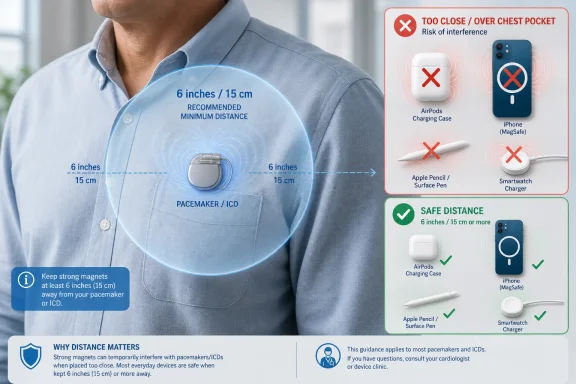
The recurring safety advice from regulators, manufacturers, and clinicians is remarkably simple: keep consumer electronics that contain magnets at least six inches, or about 15 centimeters, away from implanted medical devices. For wireless charging, some device makers recommend even greater separation. The point is not that six inches is a magic force field. It is that magnetic fields fall off quickly with distance, and small changes in placement can turn a meaningful exposure into an irrelevant one.This is why the practical advice sounds almost quaint. Do not carry a phone in a shirt pocket over a pacemaker. Do not tuck an earbud case into the same pocket. Do not let a magnetic watch band, tablet cover, or stylus rest directly over an implant. Do not sleep with a phone or charging case on your chest.
None of that requires abandoning modern electronics. It requires treating the implant site as a protected zone. That is a small behavioral change for many users, but it is not trivial for patients who have built years of habits around carrying devices close to the body.
The six-inch rule also exposes a mismatch between the way engineers test products and the way people actually live with them. A lab can measure field strength at tidy distances and controlled angles. A person can fall asleep on a couch with earbuds in, a charging case under a blanket, and a phone sliding toward the chest. The real world is not a standards document; it is friction, pockets, furniture, and habit.
For WindowsForum readers, the Surface Pen reference is a useful reminder that this is not an Apple-only story. Microsoft’s stylus ecosystem, like Apple’s, uses magnets for storage, alignment, and charging convenience. The problem belongs to an industrial design trend, not a single logo.
AirPods Are Not the Villain, but They Are a Perfect Symbol
AirPods make a convenient villain because they are everywhere, small enough to forget, and often worn or carried near the body. They also embody the design assumptions of the last decade: make the hardware disappear, make charging feel automatic, make accessories snap into place, and hide the mechanical complexity behind a pleasant magnetic click.That design language is one reason AirPods became a cultural object rather than merely a pair of earbuds. The case closes satisfyingly. The buds seat themselves. The whole system feels simple because magnets quietly enforce order. The user does not need to line up contacts or think about orientation.
The medical-device concern asks users to notice the thing the product was designed to make them ignore. The same goes for phones with magnetic accessory rings, tablets with magnetic keyboard docks, laptop lids, styluses that cling to bezels, and watches with magnetic charging pucks. The convenience is real, but so is the field.
It is also important to resist the temptation to turn this into generational comedy. Yes, the source example of visiting grandparents makes intuitive sense because older adults are more likely to have cardiac implants. But younger patients also live with pacemakers and defibrillators, and plenty of them use the same gadgets, phones, earbuds, tablets, and laptops as everyone else.
The better framing is not “don’t let grandma use AirPods.” It is “make sure anyone with an implant knows which consumer devices should stay away from the implant site.” That is less viral, but far more useful.
The Research Is Measuring Contact-Risk, Not Everyday Doom
The studies that triggered much of this public attention generally examine close-range interactions. Researchers place consumer devices near cardiac implants or implant models and observe whether magnet mode is triggered. That is exactly the scenario safety guidance is meant to prevent.This distinction matters because many patients will read a headline and wonder whether wearing earbuds in their ears is dangerous. For most implanted cardiac devices, earbuds worn in the ears are not the main concern because the implant is usually in the upper chest. The charging case in a shirt pocket is a more plausible issue than the bud sitting in the ear canal.
Similarly, a phone in a pants pocket is not the same exposure as a phone resting directly over the implant. A Surface Pen on a desk is not the same as a Surface Pen pressed against the chest. A smartwatch on the wrist is usually far from a chest implant, while a magnetic charging puck placed over the implant is a different story.
That does not make the research alarmist. It makes it specific. The useful lesson is behavioral: the risk concentrates around close placement, prolonged contact, and objects with strong magnets. Avoid those conditions and the risk falls sharply.
This is why the strongest medical advice remains boring. Keep the device away from the implant. Ask your cardiologist how your specific pacemaker or defibrillator responds to magnets. If you feel symptoms such as dizziness, fainting, palpitations, or unexpected weakness after close exposure, move the electronic device away and seek medical advice.
Consumer Electronics Learned to Love Magnets Faster Than Warnings Learned to Travel
One of the striking things about this issue is how much of it hides in plain sight. Product pages advertise magnetic alignment, snap-on accessories, MagSafe-style attachment, detachable keyboard systems, and wireless charging convenience. Those features are treated as premium ergonomics. The medical caveat usually lives elsewhere, in a support document, a regulatory warning, a manual, or a manufacturer safety page that most buyers will never read.That is not unique to Apple, Microsoft, Samsung, or any other major vendor. It is a structural problem in consumer electronics. The features that sell the product are emotional and immediate. The safety caveats are conditional and buried.
The result is a knowledge gap at the exact point where it matters. A patient may know not to stand next to industrial equipment or walk through certain security systems without caution, yet not realize that a sleek earbud case or stylus can produce a relevant field at close range. A caregiver may remember old warnings about cell phones but not connect them to modern magnetic accessories.
The tech industry also tends to describe magnets as part of a seamless user experience rather than as components with implications. That makes sense in a marketplace where most buyers have no reason to care. But for patients with implants, magnets are not just UX polish. They are environmental inputs to a medical system.
Medical-device makers and regulators have tried to keep up with simplified advice. The six-inch rule is memorable, flexible, and broadly applicable. But the burden still falls heavily on patients and clinicians to translate a general rule into daily behavior across a growing zoo of devices.
The Windows Angle Is Bigger Than Surface Pen
Microsoft’s Surface Pen showing up in the research is not a footnote for Windows users. It is a reminder that the modern PC ecosystem has absorbed mobile-device design habits. The Windows world is full of convertibles, detachable keyboards, magnetic covers, pen docks, smart charging connectors, and accessories designed to snap together cleanly.For sysadmins and IT departments, this turns a personal medical caution into a workplace device-management issue. A company that hands out laptops, tablets, phones, smart badges, wireless headsets, and wearable devices may also employ people with implanted medical devices. Most organizations will not know who those people are, and they should not need to know in order to make safer device guidance available.
The answer is not to ban modern accessories from the enterprise. It is to make safety documentation visible where device guidance already lives. If an organization distributes magnetic styluses, headset cases, tablets with magnetic keyboard covers, or phones with magnetic charging ecosystems, the onboarding material should include the same basic warning: keep magnet-containing electronics away from implanted medical devices, and consult a physician or device clinic for personalized guidance.
This matters because workplace behavior differs from home behavior. Employees may wear headsets all day, carry devices in badge lanyards or chest pockets, stack phones and earbuds on conference tables, or cradle tablets against the body while walking. IT policy cannot anticipate every posture, but it can prevent ignorance.
There is also a procurement angle. Accessories with magnetic closures or mounts are often bought in bulk because they reduce support friction. They are harder to lose, easier to align, and less likely to break mechanically. That is all rational. But organizations should understand that magnetic convenience is not medically neutral for every user.
The Pacemaker Internet Needs Less Panic and More Precision
Public discussion of this topic tends to swing between two unhelpful extremes. One side treats any magnet warning as proof that modern gadgets are secretly dangerous. The other side dismisses the concern because the risky scenario requires close placement and because serious adverse events appear uncommon.The better position is in the middle. The risk is real enough for regulators, clinicians, manufacturers, and researchers to repeat the warning. It is also manageable enough that patients are not being told to abandon phones, earbuds, watches, tablets, or PCs.
That middle position is harder to communicate because it requires context. “AirPods can trigger magnet mode at close range” is accurate but incomplete. “AirPods are safe” is comforting but incomplete. The useful sentence is longer: AirPods and similar devices should generally be kept away from the implant site because their magnets can affect some cardiac devices when very close.
The same precision should apply to symptoms and response. If a patient accidentally places a device near an implant, the first step is usually to move it away. Many cardiac implants are designed to return to normal operation after the magnetic field is removed. But if symptoms occur, or if there is uncertainty about what happened, the patient should contact a clinician or use the monitoring process recommended by their care team.
The technology press can help by avoiding theatrical framing. This is not a story about killer earbuds. It is a story about the unintended consequences of making magnets a default interface component.
Design Convenience Has a Medical Externality
The deeper issue is that consumer-device design has externalities that do not show up in ordinary reviews. A reviewer may praise a magnetic case because it feels better, charges better, and loses fewer parts. That is valid. But a feature can be excellent for the median user and still require caution for a medically significant minority.This is common in technology. Bright OLED screens are great until photosensitivity enters the conversation. Biometric authentication is convenient until accessibility or injury complicates it. Wireless earbuds are liberating until battery replacement and e-waste come due. Magnetic attachment is elegant until it intersects with implanted medical electronics.
The challenge is not to halt design progress. It is to stop pretending that frictionless design is automatically consequence-free. A magnet that makes a stylus easier to dock is doing work. A magnet that aligns a charging coil is doing work. A magnet that closes a case with a snap is doing work. For most users, that work is benign. For some implants at close range, it is still work.
Manufacturers are already aware of the issue, which is why support pages and manuals contain distance guidance. The question is whether that guidance is visible enough, specific enough, and consistent enough across product categories. A warning that exists only after a user searches for it is not the same as a warning that shapes behavior.
One modest improvement would be clearer labeling in device setup flows and printed quick-start materials for products with strong magnets. Another would be more consistent language across phones, earbuds, watches, tablets, pens, and cases. Consumers should not have to infer that advice written for a phone also applies to a magnetic earbud case.
The Old Shirt Pocket Rule Keeps Surviving New Technology
There is something almost charmingly analog about the central recommendation. After all the research, the filings, the support pages, the lab measurements, and the magnetic-field discussion, one of the most practical lessons is still: do not put the gadget in the shirt pocket over your implant.That rule has survived multiple eras of consumer electronics because the chest pocket is uniquely bad real estate. It places devices close to the implant, often for extended periods, with little awareness from the user. It is also exactly where people put phones, pens, glasses, badges, and earbud cases when they need a free hand.
The rise of wireless earbuds makes the rule more relevant, not less. Earbuds themselves may spend time in the ears, but their cases are pocket objects. They are small, smooth, easy to misplace, and often carried wherever they fit. For someone with a chest implant, “wherever they fit” should not include the pocket directly over the device.
The same goes for phones. The MagSafe era did not invent the advice to keep phones away from pacemakers and defibrillators, but it made the reason more obvious. Phones are no longer just radios and batteries; they are magnetic accessory platforms. Cases, wallets, charging rings, stands, and mounts all extend the magnetic ecosystem.
This is why the warning will probably keep expanding rather than fading. The next generation of devices will not use fewer magnets unless there is a strong reason to do so. Magnets solve too many industrial design problems too elegantly. Patients and clinicians will need to keep treating distance as the simplest protection.
The Practical Advice Is Smaller Than the Anxiety
For patients with cardiac implants, the best version of this story is empowering rather than frightening. The fix is usually not expensive, technical, or disruptive. It is spatial. Keep magnet-containing electronics away from the implant site.That advice scales well across brands and product categories. It works for AirPods, iPhones, Android phones, smartwatches, magnetic bands, styluses, charging pucks, tablet covers, laptop accessories, and devices that have not yet been announced. Users do not need to memorize every magnet measurement if they maintain a sensible buffer around the implant.
Still, patients should not treat all implants as identical. Pacemakers and defibrillators can respond differently. Newer devices may have different shielding, sensors, and programmed behavior. Leadless pacemakers, traditional chest implants, cardiac resynchronization devices, and ICDs are not interchangeable from a risk-management standpoint.
That is why the cardiologist remains the final authority. A device clinic can explain what a patient’s specific implant does in response to a magnet, whether home monitoring would show relevant events, and what symptoms or exposures should prompt a call. Consumer-tech articles can explain the pattern, but they cannot personalize the medical risk.
For families and caregivers, the useful move is not to confiscate devices. It is to normalize the distance rule. Put charging stations on side tables rather than beds. Avoid placing phones on a sleeping person’s chest. Keep earbud cases, phones, and magnetic accessories out of chest pockets. Make the safe behavior boring.
The AirPods Scare Leaves a Simple Playbook
The most concrete reading of the evidence is that close-range magnetic exposure is the issue, not everyday use at normal distances. Patients should treat modern electronics as manageable objects with placement rules, not as forbidden technology.- Patients with pacemakers, defibrillators, or other implanted cardiac devices should keep AirPods cases, phones, smartwatches, styluses, and magnetic accessories at least six inches away from the implant site.
- The riskiest ordinary habit is carrying a phone, earbud case, magnetic pen, or similar device in a chest pocket directly over the implant.
- Earbuds worn in the ears are not the same exposure as an earbud charging case pressed against the chest.
- Defibrillators and pacemakers can respond differently to magnets, so patients should ask their cardiology team what magnet mode means for their specific device.
- If symptoms such as dizziness, fainting, palpitations, or unexpected weakness occur after close exposure, the electronic device should be moved away and medical advice should be sought.
- Enterprises that issue phones, headsets, tablets, magnetic pens, or wearable devices should include implant-safety guidance in device onboarding rather than leaving employees to find it themselves.
References
- Primary source: Engadget
Published: 2026-06-13T15:52:10.096531
Why Your Cardiologist Might Tell You To Skip AirPods
The magnetic fields emitted by your headphones will need to be used a safe distance away from your CIDs.www.engadget.com - Related coverage: health.clevelandclinic.org
Protecting Your Pacemaker From Smartphones, Power Lines
Smartphones and power lines can interfere with pacemakers and implanted defibrillators. However, while possible, problems are unlikely, experts say.health.clevelandclinic.org - Related coverage: bhf.org.uk
- Related coverage: asiapac.medtronic.com
- Related coverage: medicalxpress.com
