

Alaska Airlines’ decision to bring in an external auditor after a week of cascading IT failures marks a turning point in how airlines—and any large, legacy-dependent operators—must rethink resilience in a hyperscale cloud era. A sudden failure at the carrier’s primary data center triggered a nationwide ground stop and hundreds of cancellations, and days later a separate, widespread outage in a major cloud provider’s global edge service disrupted Alaska’s website and mobile app. The carrier has announced a formal audit of its technology stack and a partnership with a major consultancy to identify weaknesses, harden systems and update forecasts for the quarter. The twin incidents expose technical fault lines that transcend one airline: control‑plane fragility in edge platforms, overconcentration of critical services, brittle change management practices, and the hard costs—in both money and reputation—when IT fails in flight operations.
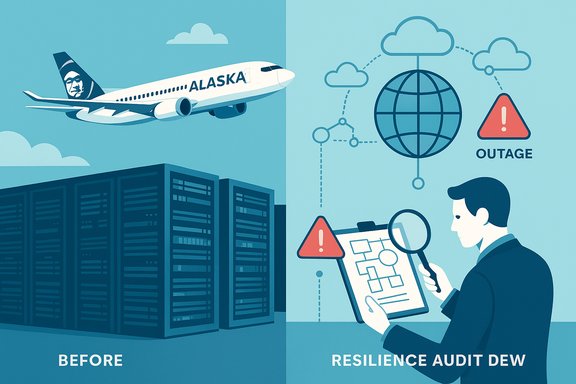
Alaska Airlines experienced two distinct but closely timed technology incidents that together inflicted significant operational damage.
Key technical realities:
At a minimum, the audit should include:
For airlines and other mission‑critical operators, resilience is not a checkbox. It is an engineering discipline that requires repeated exercises, honest third‑party critique, and an appetite to decouple critical control paths from single points of platform failure. The audit will tell whether Alaska’s response is corrective or merely cosmetic. The industry will be watching closely, because the next outage may not come with the same set of warnings—and the cost of complacency has never been higher.
Source: The Economic Times Alaska Airlines to audit IT systems after global outage - The Economic Times
 Background: what happened, in plain terms
Alaska Airlines experienced two distinct but closely timed technology incidents that together inflicted significant operational damage.- In the earlier event, a failure at the airline’s primary data center triggered a systemwide ground stop for Alaska and its regional partner Horizon Air. The ground stop required repositioning aircraft and crews and led to the cancellation of more than 400 flights over the recovery period. The carrier reported that roughly 49,000 passengers had their travel plans disrupted while operations were rebuilt.
- Days later, a global outage at a major cloud provider’s edge and application delivery fabric created 502/504 gateway errors, authentication failures and site‑access problems across many customer environments. That outage affected Alaska’s website and mobile app, leaving travelers unable to check in online and increasing airport congestion and passenger frustration.
- In response to these disruptions, Alaska Air Group said it will commission a top‑to‑bottom audit of its IT systems with external technical experts and a large consultancy to evaluate standards, processes and resilience. The airline also signalled it will reassess its fourth‑quarter outlook after quantifying the financial impact of the disruptions.
Why this matters: the operational and business consequences
The immediate effects are straightforward and painful: grounded flights, canceled schedules, airport chaos and stranded passengers. But the downstream consequences are broader and longer‑lasting.- Operational disruption: Aircraft and crew schedules are tightly choreographed. A multi‑hour system failure not only cancels flights in the short term but creates a cascade of mispositioned assets that takes days to rebalance.
- Customer experience and brand damage: Passengers affected by long delays and cancellations often develop lasting negative perceptions; repeated technical failures accelerate reputational erosion.
- Financial impact: Direct costs—refunds, lodging, rebooking—combine with lost revenue as customers shift to competitors. The company has signalled it will revise guidance after quantifying full losses.
- Regulatory and contractual exposure: A pattern of outages invites scrutiny from regulators, consumer protection agencies and corporate counterparties; it also strengthens the hand of labour and other stakeholders in negotiations.
- Stock and investor pressure: Visible operational failures and the risk of material hits to profitability typically trigger market responses and could pressure management and boards for structural change.
Technical anatomy: how a cloud edge outage turns into a travel nightmare
Two fault classes converged in Alaska’s case: a direct failure in the carrier’s own primary data center, and an external failure in a cloud provider’s global edge/control plane. Both have different mechanics and mitigation strategies.The data-center failure: single-point hardware and runbook gaps
A primary data‑center failure typically stems from a combination of hardware faults (power, storage controllers, network fabric), software errors, or orchestration failures in on‑prem systems. Critical issues:- Many airlines run a hybrid architecture—mixing on‑prem data centers for latency‑sensitive or regulatory workloads with cloud for elasticity.
- A failure in a primary site causes immediate loss of services that depend on on‑prem resources unless an active‑active failover to a redundant site exists and is well‑tested.
- Manual runbooks and human intervention are often required to restore complex stateful systems (e.g., crew databases, flight manifests), and manual processes become a bottleneck when staff are overwhelmed.
The cloud edge outage: control‑plane events create outsized downstream effects
Modern services frequently place a global edge layer in front of apps for performance, TLS termination, web application firewalling and routing. These edge fabrics operate at Layer 7 and are powerful but also concentrated.Key technical realities:
- Edge services perform TLS termination, hostname mapping, global HTTP routing, WAF enforcement and identity token flows. When they fail at the control plane, a wide swath of customer services can suddenly be unreachable—even when origin servers remain healthy.
- Control‑plane misconfigurations or automation errors can propagate rapidly across thousands of Points of Presence, producing mass 502/504 gateway errors and authentication failures.
- DNS caching and client TTLs mean perceived recovery lags—some clients will see restored service sooner than others because of cached DNS and load‑balancer state.
- Blocking configuration changes and rolling back to a last‑known‑good state are standard mitigation steps; they help, but aggressive rollbacks at hyperscale create their own operational challenges.
- Because edge platforms are multi‑tenant and centrally controlled, customers lose fine‑grained control when the provider’s control plane malfunctions.
What the forthcoming audit must examine
An operational audit that merely tallies failed servers is insufficient. A meaningful, actionable review should cover governance, architecture, testing, tooling and third‑party risk.At a minimum, the audit should include:
- Change management and deployment gating
- Review of processes that authorise configuration changes—especially those that propagate globally.
- Evidence of canarying, staged rollouts and automated rollback triggers.
- Disaster recovery and runbook realism
- Validation of runbooks under realistic conditions: identify whether runbooks scale to real incident sizes and if staff can realistically execute them.
- Tests of active‑active failover between data centers and to cloud origins.
- Third‑party dependency mapping
- Inventory of all critical upstream provider services (identity issuance, CDN/edge, DNS, payment processors).
- Contracts, SLAs, and contingency procedures for each third‑party dependency.
- Operational telemetry and incident detection
- Health of monitoring systems: are synthetic checks covering the full user path?
- Availability of automated incident detection and alerting that can trigger failovers before human detection.
- Configuration and infrastructure as code hygiene
- Source control practices for infrastructure definitions, locking and terraform/state protection, drift detection.
- Privilege management for configuration tools and review processes.
- Security‑operations overlap
- Distinguish between cyberattack and infrastructure failure. Assess whether security monitoring produced any alerts and if detection tooling is tuned to identify attacker activity versus configuration faults.
- Communication and customer operations
- Review internal and external communication templates, escalation ladders, and customer remediation policies.
Strengths and mitigations already in place—and why they matter
Not all is broken. Several current practices and decisions are defendable and provide a foundation for resilience, but they need recalibration.- Hybrid architecture: maintaining both on‑prem data centers and cloud presence can be an advantage when implemented with active redundancy and automatic failover. Hybrid enables localized control of critical functions and the cloud’s elasticity for customer‑facing systems.
- Investment in IT: increased capital allocation to IT and recent platform modernization projects show the airline understands the stakes and has been moving resources to reduce future failures.
- Bringing in third‑party expertise: commissioning an external audit by an experienced consultancy is an appropriate, credible step that should accelerate remediation cycles and help prioritize fixes.
- Transparency commitments: public commitments to share updates and implement findings help rebuild customer trust and provide an accountability loop.
The structural risks that persist
Several systemic weaknesses are revealed by the incidents and warrant special emphasis.- Overreliance on a single hyperscaler control plane: concentration risk means an external provider’s operational mistake becomes the airline’s customer outage. Multi‑vendor strategies, multi‑CDN, or independent regional fallbacks reduce blast radius.
- Insufficient control‑plane isolation: when a provider’s global change affects identity issuance and management plane, a tenant’s ability to recover is constrained. Architectures that avoid tight coupling of identity flows through a single global fabric are safer.
- Human factors in change management: inexperienced or rushed rollouts, insufficient peer reviews and inadequate automation testing are the most frequent root causes of large‑scale control‑plane incidents.
- Incomplete or unrealistic DR testing: many organizations "test" failovers in trivial ways; exercises must simulate production load and staff constraints to be meaningful.
- Communication gaps: slow or conflicting public messaging increases customer frustration and legal exposure. Clear internal incident command is as important as technical fixes.
Tactical recommendations: what to fix first (a prioritized checklist)
For an airline that must keep planes moving and passengers sailing on schedule, remediation must balance speed and rigor. Priorities:- Immediate containment and stabilization
- Confirm and harden failover paths between primary and secondary data centers.
- Validate that critical flight‑control and crew‑scheduling systems can operate in a reduced mode (manual interfaces and offline sync) for extended periods.
- Control‑plane risk reduction
- Implement staged configuration rollouts with automated safety gates and immediate automated rollback triggers.
- Reduce global blast radius of future provider changes via regional fronting and multi‑CDN strategies.
- Resilience testing
- Run full‑scale chaos exercises simulating data‑center loss and edge control‑plane failure.
- Measure time to recovery and identify human bottlenecks.
- Third‑party governance
- Reassess contractual SLAs and incident response obligations with cloud and edge partners.
- Mandate transparent postmortems from providers for incidents that impact flight operations.
- Automation and observability
- Expand synthetic monitoring across user journeys (mobile app check‑in, boarding pass issuance, crew manifests).
- Automate failover of DNS and routing where possible to reduce mean time to remediate.
- People and processes
- Strengthen runbooks to be survivable at scale (clear single points of decision, redundant communications).
- Conduct tabletop exercises with cross‑functional teams including ops, IT, customer care and legal.
Architectural patterns that reduce exposure (for IT leaders and architects)
For those designing resilient consumer‑facing systems, the Alaska events are a clarion call to adopt specific patterns:- Use multi‑CDN and multi‑edge architectures so that an issue in one provider doesn’t take the front door offline.
- Maintain active‑active configurations across more than one region or provider where consistency guarantees allow it; avoid brittle active‑passive failovers that require manual intervention.
- Avoid coupling identity issuance and critical operational control planes through a single edge gateway; consider token issuance closer to origin or with fallback identity flows.
- Apply canary and feature‑flag driven rollouts for infrastructure changes—treat the control plane like code and gate changes with observability thresholds.
- Keep minimal, well‑tested manual workflows for operations that must function when automated tooling is offline, and practice those workflows frequently.
What to watch next: metrics and milestones that matter
The audit will be a process, not a single event. Markers that indicate meaningful progress include:- Completion of an external post‑incident root‑cause analysis and publication of a remediation roadmap.
- Shorter mean time to recovery (MTTR) in subsequent incidents and successful execution of large-scale DR exercises.
- Changes to vendor contracts and SLAs that give the airline stronger rights to transparency and faster remediation from cloud providers.
- Visible shifts in telemetry investments—more synthetic checks, end‑to‑end observability and automated incident playbooks.
- Financial disclosures that quantify the impact of the outages and the costs of remediation—not only because investors demand it, but because transparent accounting accelerates prioritization.
Caveats and unresolved questions
Several important details remain unsettled and should be treated cautiously until the audit and provider postmortems are complete:- While the cloud edge incident was publicly attributed to an inadvertent configuration change in the provider’s control plane, a detailed technical root cause analysis has not yet been published by the platform operator; granular causes—human error, automation bug, tooling issue—require confirmation.
- Speculation that adversaries or ransomware groups were involved has circulated in some forums; the airline and the provider have indicated there is no evidence of a cybersecurity attack in the public statements reviewed at this time. Such allegations should be treated as unverified until forensic evidence is released.
- The precise financial impact on the carrier’s quarterly results will not be known until the company completes its internal accounting and updates guidance; initial statements indicate a revision to guidance is likely in early December once assessments are complete.
The broader lesson for enterprises and the cloud era
Airlines sit at the intersection of complex physical operations and digital orchestration. When digital control falters, the physical world is directly affected. The Alaska incidents crystallize a broader lesson for enterprises adopting cloud services: the advantages of hyperscale platforms come with concentrated risk in the control plane, and the responsibility for resilience is shared.- Vendor concentration buys operational simplicity and global reach—but increases systemic risk.
- Active vendor governance, multi‑provider strategies and rigorous testing are insurance policies that now cost less than the financial and reputational fallout of repeated outages.
- External audits and technical forensics are a necessary step, but the real test is whether organizations can convert assessments into prioritized, funded, and measured remediation.
Conclusion
Alaska Airlines’ commitment to an external audit is the right next step, but audits succeed only when followed by governance, investment and a sustained cultural shift toward engineering for failure. The twin incidents—an internal data‑center failure and an external cloud edge outage—are a case study in layered fragility: a single hardware fault migrates through brittle processes to become a national ground stop; a provider configuration error turns into mass customer frustration.For airlines and other mission‑critical operators, resilience is not a checkbox. It is an engineering discipline that requires repeated exercises, honest third‑party critique, and an appetite to decouple critical control paths from single points of platform failure. The audit will tell whether Alaska’s response is corrective or merely cosmetic. The industry will be watching closely, because the next outage may not come with the same set of warnings—and the cost of complacency has never been higher.
Source: The Economic Times Alaska Airlines to audit IT systems after global outage - The Economic Times
