

Alphabet entered the final week of June 2026 with its shares near a widely watched 100-day moving average after a sharp weekly selloff, just as investors weighed Thursday’s U.S. jobs report against a new European Commission push to bring AWS and Microsoft Azure under Digital Markets Act cloud rules. The surface story is a stock testing support. The deeper story is that Google’s parent has suddenly become the cloud challenger with the cleanest regulatory lane in Europe, even while its own AI spending, search dominance, and talent churn keep the investment case anything but simple. For WindowsForum readers, the interesting part is not whether one chart line holds; it is whether Europe’s next cloud fight quietly rewrites the enterprise assumptions beneath Microsoft, Amazon, and Google.
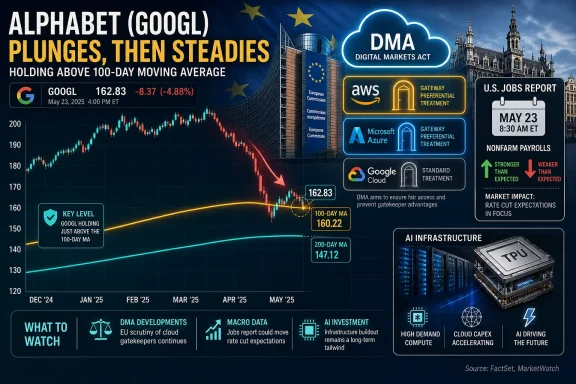
When a stock falls more than seven percent in a week and lands just above its 100-day moving average, financial media inevitably reaches for the language of cliffs and battlegrounds. Alphabet’s reported €296.70 close, with the 100-day line near €291.33, gives traders an unusually tidy setup: hold that zone and the selloff looks like a reset; lose it and the 200-day average near €270 becomes the next obvious marker.
That technical framing matters because there is no obvious Alphabet-specific event scheduled to settle the argument immediately. No earnings release is due this week. No product launch has the force of a quarterly report. No single antitrust deadline is likely to reprice the company by itself before macro data arrives.
So the June U.S. jobs report becomes the proxy battlefield. Because Independence Day shifts the U.S. reporting calendar, the labor-market number arrives on Thursday rather than the usual Friday cadence. For a high-multiple technology name whose AI story depends on enormous capital spending, the jobs report is not just an employment statistic; it is a rates signal.
A strong jobs number would make it harder for bond yields to fall and harder for investors to price in easier monetary policy. That tends to pressure long-duration growth assets, including the AI-heavy megacap complex. A softer reading could do the opposite, giving Alphabet room to stabilize above the 100-day line and letting investors return to the company’s operating story.
The problem with chart-driven moments is that they make support levels look more scientific than they are. Moving averages do not create value, and they do not erase competitive risk. They are coordination devices: useful because many market participants watch them, dangerous because they can turn into self-fulfilling narratives when the underlying business is more complicated.
If the preliminary view becomes a final designation, AWS and Azure would face stricter obligations around fairness, interoperability, and data portability. The details matter because cloud lock-in is rarely one thing. It is contract structure, proprietary APIs, identity management, data-egress costs, architecture choices, managed services, developer habit, certification pipelines, and the sheer terror of moving production workloads without breaking the business.
That is why cloud regulation is harder than regulating a consumer app store button. A company can switch chat apps in an afternoon. A bank cannot casually move a regulated analytics environment, a Kubernetes estate, a data lake, and hundreds of integrated internal tools because a regulator dislikes switching costs. Brussels knows this, which is why the DMA cloud move is both ambitious and politically loaded.
The Commission’s argument is straightforward: AWS and Azure are not merely vendors in a market; they are gateways through which a vast amount of European business activity now passes. If that gateway is too sticky, too vertically integrated, or too difficult to leave, competition suffers even if customers technically have alternatives.
Microsoft and Amazon will not accept that framing quietly. Both companies can argue that the cloud market remains intensely competitive, that customers routinely use more than one provider, and that hyperscale investment is expensive precisely because the services are not static toll booths. They can also argue, with some force, that Europe wants sovereign, resilient, AI-ready infrastructure while simultaneously making it more cumbersome for the largest builders to operate.
But the direction of travel is now clear. Europe is no longer content to police the visible consumer layer of Big Tech. It is moving down into the machinery room.
That does not mean Alphabet is suddenly Brussels’ favorite child. Google remains a familiar target in European competition policy, and its search, advertising technology, Android, and AI-adjacent businesses continue to face scrutiny. But in this specific cloud proceeding, Google has the advantage of being large enough to be credible and small enough to avoid the heaviest new burden.
For enterprise customers, that distinction can matter. Procurement teams do not choose cloud platforms because one regulator issued one preliminary finding. They choose based on workload fit, price, compliance, migration cost, technical depth, vendor relationships, and risk. Yet compliance drag is real. If AWS and Azure face new interoperability or portability obligations first, Google Cloud can position itself as the third hyperscaler with fewer incremental regulatory complications.
That is an odd turn in the cloud wars. For years, Google Cloud’s challenge was that it had the technology but not the same enterprise default status as Microsoft or Amazon. Azure sits naturally inside the Microsoft enterprise account, bundled psychologically if not always contractually with Windows Server, Active Directory history, Entra ID, Microsoft 365, GitHub, Defender, Power Platform, and the Copilot push. AWS owns the original cloud-native imagination and still carries enormous developer credibility.
Google has had to fight harder for the conservative enterprise buyer. It has leaned on data analytics, Kubernetes heritage, AI tooling, custom silicon, and aggressive executive focus. Now Europe may be giving it a new argument: if you are worried about being trapped between the two dominant clouds, the third cloud may be the least encumbered strategic hedge.
That is not the same as saying Google Cloud will suddenly take share in a straight line. Enterprise cloud migrations move slowly, and regulatory advantage can be abstract until procurement officers turn it into contract language. But it does change the conversation around Alphabet’s cloud segment from “distant third” to “strategic beneficiary of a regulatory asymmetry.”
Those are not the numbers of a hobby business. They are the numbers of a segment that has crossed from “expensive strategic option” into “central profit engine.” For years, the bearish view of Google Cloud was that Alphabet was buying relevance in a market already defined by AWS and Azure. That critique loses force as cloud margins expand and backlog balloons.
The backlog figure is especially important. Alphabet has said its cloud backlog nearly doubled quarter over quarter to more than $460 billion, helped by AI infrastructure commitments and TPU-related agreements. Backlog is not revenue in the bank, and it comes with timing, execution, and capacity constraints. Still, the number gives investors a reason to believe cloud growth is not merely a one-quarter burst.
It also reframes Alphabet’s AI spending. Massive capital expenditure looks reckless if the revenue opportunity is vague. It looks more defensible when customers are signing commitments that stretch into future periods. The market is now trying to decide whether Alphabet is building too much infrastructure for an AI boom that may cool, or whether it is one of the few companies with enough demand, silicon capability, and balance-sheet strength to build through the cycle.
The answer may be both. Alphabet can be right about AI demand and still overspend in some years. It can generate extraordinary cloud growth and still disappoint investors if search margins compress, regulatory remedies bite, or depreciation from data centers eats into future profitability. The stock’s weakness reflects that tension more than a simple rejection of the business.
The Windows era trained IT departments to think in terms of platform gravity. Identity, directory services, endpoint management, productivity software, developer tooling, database infrastructure, and security all pulled toward Microsoft. Azure translated that gravity into the cloud era, helped by hybrid features, enterprise agreements, and the reality that many organizations were already living inside Microsoft’s administrative model.
That is precisely why regulators care. Azure is powerful not merely because it runs virtual machines and databases, but because it connects to Microsoft’s broader enterprise stack. For customers, that integration can be a feature. For competitors, it can look like a moat. For regulators, it becomes a question of whether convenience has hardened into structural dependency.
The DMA cloud proceeding could therefore expose a philosophical split between enterprise IT and competition policy. Administrators often want fewer moving parts, better integration, and one throat to choke when something fails. Regulators often want portability, contestability, and the ability for smaller providers to compete without being blocked by ecosystem lock-in. Both instincts are rational, but they pull in different directions.
If Brussels forces Azure toward stronger interoperability and portability obligations, Microsoft customers may eventually gain more leverage. They may also inherit new compliance complexity, altered product behavior, or contract changes that make procurement less predictable. Regulation that sounds pro-customer in principle can still create operational ambiguity in the short term.
Google Cloud will try to exploit that ambiguity. So will Oracle, IBM, OVHcloud, Deutsche Telekom, and every regional or specialized cloud provider that wants Europe to take sovereignty and portability seriously. But the most direct competitive question is whether Microsoft’s deep enterprise integration remains an unqualified advantage if regulators begin treating that integration as evidence of gatekeeper power.
The distinction is scope. In cloud infrastructure, Alphabet may have a cleaner runway than AWS and Azure in Europe for now. In search and advertising, it remains the incumbent. That creates a strange dual identity: challenger in one market, gatekeeper-like force in another.
That dual identity is central to Alphabet’s investment case. The company’s cash machine is still Google Services, especially search and YouTube advertising. Cloud is growing fast, but the capital to fund AI infrastructure comes from the advertising empire. If regulators weaken that empire, or if AI answer engines reduce the value of traditional search ads, the cloud story has to carry more weight.
This is why the stock cannot be analyzed as a clean cloud growth play. Alphabet is a bundle of businesses whose strengths subsidize one another and whose risks bleed across divisions. Search funds AI. AI changes search. Cloud sells AI. AI requires capex. Capex pressures free cash flow. Regulation touches each layer differently.
The market’s job is to price that bundle. At times, investors reward Alphabet for having multiple shots on goal: search, YouTube, Android, Cloud, Waymo, AI models, custom chips, enterprise software, and consumer services. At other times, they punish it for being exposed to every major regulatory and technological fault line in the digital economy.
Still, Alphabet’s AI credibility depends partly on the perception that its best people still want to build inside Google. The company created much of the intellectual foundation for the modern AI boom. Transformers, TPUs, large-scale distributed systems, and deep research infrastructure are part of Google’s institutional identity. When prominent researchers leave, the symbolism can sting more than the operational impact.
The risk is not that one departure breaks Gemini, Search, or Google Cloud. The risk is that the AI labor market starts treating Google as a place where breakthroughs are born but commercial momentum belongs elsewhere. That would be a dangerous narrative for a company trying to prove that it can convert research depth into platform dominance.
Alphabet has pushed back against that perception through product velocity and commercial numbers. AI features are now threaded through Search, Workspace, Android, Cloud, developer tools, and advertising products. Google Cloud says a large majority of its cloud customers use its AI products. The company is not standing still.
But the investor question remains whether Google’s AI advantage is durable or merely historical. Microsoft has OpenAI and a distribution machine. Amazon has AWS and a sprawling model marketplace. Anthropic has momentum with enterprise-friendly positioning. Meta has open-weight influence. Apple has the device base, even if its AI execution has looked uneven. Alphabet has the ingredients, but the market wants proof that the recipe still wins.
Every data center, TPU deployment, power contract, networking buildout, and long-dated customer commitment has an interest-rate shadow. Higher yields raise the opportunity cost of waiting for future cash flows. They also make investors less patient with companies that promise enormous future AI monetization while spending heavily today.
Alphabet is better positioned than most because it produces vast operating income. It does not need to finance its AI ambitions like a speculative startup. But valuation still responds to macro pressure. When yields rise, investors demand more immediate proof. When yields fall, they become more willing to pay for growth several years out.
That is why Thursday’s labor report can matter to a stock sitting near technical support. A hot number could turn the 100-day average into a speed bump. A cooler number could make it a floor. Neither outcome changes Google Cloud’s backlog, but it changes the discount rate applied to that backlog.
This is the awkward truth behind many “should I buy now?” moments. The business case and the entry point are related but not identical. Alphabet can remain fundamentally strong while the stock breaks technical support. It can also bounce from support without resolving the long-term questions around AI returns, regulation, and search disruption.
For a long-term investor, the more important question is whether the reasons for owning Alphabet have deteriorated. On the evidence available, the cloud business has strengthened, the company’s operating margins remain formidable, and the EU’s cloud action may create a relative opening against AWS and Azure. Those are not sell signals.
But neither are they a blank check. The stock’s year-to-date gain, even after the weekly decline, means investors are not buying a forgotten bargain. The market already recognizes Alphabet as an AI winner. The burden is now on the company to show that capital spending converts into durable revenue and margin expansion, not just impressive backlog headlines.
The correct framing is time horizon. If an investor bought Alphabet for a technical swing, the 100-day moving average is a legitimate line in the sand. If an investor owns it for the decade-long cloud and AI transition, one jobs report is not the thesis. The danger is mixing those two approaches: selling a long-term position because a short-term chart wobbled, or buying a short-term dip while pretending not to care if it drops another ten percent.
Alphabet sits in a rare position. Its core business is mature enough to fund enormous bets, yet its growth narrative is still young enough to attract momentum capital. That combination creates violent repricing when macro conditions shift. It also means weakness can be opportunity if the operating story remains intact.
 The Chart Is Loud Because the Calendar Is Empty
When a stock falls more than seven percent in a week and lands just above its 100-day moving average, financial media inevitably reaches for the language of cliffs and battlegrounds. Alphabet’s reported €296.70 close, with the 100-day line near €291.33, gives traders an unusually tidy setup: hold that zone and the selloff looks like a reset; lose it and the 200-day average near €270 becomes the next obvious marker.That technical framing matters because there is no obvious Alphabet-specific event scheduled to settle the argument immediately. No earnings release is due this week. No product launch has the force of a quarterly report. No single antitrust deadline is likely to reprice the company by itself before macro data arrives.
So the June U.S. jobs report becomes the proxy battlefield. Because Independence Day shifts the U.S. reporting calendar, the labor-market number arrives on Thursday rather than the usual Friday cadence. For a high-multiple technology name whose AI story depends on enormous capital spending, the jobs report is not just an employment statistic; it is a rates signal.
A strong jobs number would make it harder for bond yields to fall and harder for investors to price in easier monetary policy. That tends to pressure long-duration growth assets, including the AI-heavy megacap complex. A softer reading could do the opposite, giving Alphabet room to stabilize above the 100-day line and letting investors return to the company’s operating story.
The problem with chart-driven moments is that they make support levels look more scientific than they are. Moving averages do not create value, and they do not erase competitive risk. They are coordination devices: useful because many market participants watch them, dangerous because they can turn into self-fulfilling narratives when the underlying business is more complicated.
Brussels Just Made Cloud Infrastructure a DMA Problem
The more important development is not on Alphabet’s chart but in Brussels. The European Commission has reached the preliminary view that Amazon Web Services and Microsoft Azure should be designated as gatekeepers under the Digital Markets Act for cloud computing services. That is a meaningful escalation: the DMA was already a major force in app stores, messaging, browsers, search, advertising, and operating-system behavior, but applying it to cloud infrastructure moves the fight deeper into the enterprise stack.If the preliminary view becomes a final designation, AWS and Azure would face stricter obligations around fairness, interoperability, and data portability. The details matter because cloud lock-in is rarely one thing. It is contract structure, proprietary APIs, identity management, data-egress costs, architecture choices, managed services, developer habit, certification pipelines, and the sheer terror of moving production workloads without breaking the business.
That is why cloud regulation is harder than regulating a consumer app store button. A company can switch chat apps in an afternoon. A bank cannot casually move a regulated analytics environment, a Kubernetes estate, a data lake, and hundreds of integrated internal tools because a regulator dislikes switching costs. Brussels knows this, which is why the DMA cloud move is both ambitious and politically loaded.
The Commission’s argument is straightforward: AWS and Azure are not merely vendors in a market; they are gateways through which a vast amount of European business activity now passes. If that gateway is too sticky, too vertically integrated, or too difficult to leave, competition suffers even if customers technically have alternatives.
Microsoft and Amazon will not accept that framing quietly. Both companies can argue that the cloud market remains intensely competitive, that customers routinely use more than one provider, and that hyperscale investment is expensive precisely because the services are not static toll booths. They can also argue, with some force, that Europe wants sovereign, resilient, AI-ready infrastructure while simultaneously making it more cumbersome for the largest builders to operate.
But the direction of travel is now clear. Europe is no longer content to police the visible consumer layer of Big Tech. It is moving down into the machinery room.
Google Cloud Gets the Strangest Gift in Enterprise Tech
The striking omission is Google Cloud. The Commission’s preliminary cloud gatekeeper view targets AWS and Azure, the largest and second-largest providers in the European market. Google Cloud, despite being one of the global hyperscale trio and a serious AI infrastructure player, is not in the same regulatory line of fire at this stage.That does not mean Alphabet is suddenly Brussels’ favorite child. Google remains a familiar target in European competition policy, and its search, advertising technology, Android, and AI-adjacent businesses continue to face scrutiny. But in this specific cloud proceeding, Google has the advantage of being large enough to be credible and small enough to avoid the heaviest new burden.
For enterprise customers, that distinction can matter. Procurement teams do not choose cloud platforms because one regulator issued one preliminary finding. They choose based on workload fit, price, compliance, migration cost, technical depth, vendor relationships, and risk. Yet compliance drag is real. If AWS and Azure face new interoperability or portability obligations first, Google Cloud can position itself as the third hyperscaler with fewer incremental regulatory complications.
That is an odd turn in the cloud wars. For years, Google Cloud’s challenge was that it had the technology but not the same enterprise default status as Microsoft or Amazon. Azure sits naturally inside the Microsoft enterprise account, bundled psychologically if not always contractually with Windows Server, Active Directory history, Entra ID, Microsoft 365, GitHub, Defender, Power Platform, and the Copilot push. AWS owns the original cloud-native imagination and still carries enormous developer credibility.
Google has had to fight harder for the conservative enterprise buyer. It has leaned on data analytics, Kubernetes heritage, AI tooling, custom silicon, and aggressive executive focus. Now Europe may be giving it a new argument: if you are worried about being trapped between the two dominant clouds, the third cloud may be the least encumbered strategic hedge.
That is not the same as saying Google Cloud will suddenly take share in a straight line. Enterprise cloud migrations move slowly, and regulatory advantage can be abstract until procurement officers turn it into contract language. But it does change the conversation around Alphabet’s cloud segment from “distant third” to “strategic beneficiary of a regulatory asymmetry.”
The Numbers Explain Why Investors Care More Than They Used To
Alphabet’s first-quarter 2026 numbers make the cloud angle harder to dismiss. The company reported nearly $110 billion in quarterly revenue, operating income just under $40 billion, and an operating margin above 36 percent. Google Cloud revenue reportedly grew 63 percent year over year to about $20 billion, with cloud operating income of roughly $6.6 billion and a margin near 33 percent.Those are not the numbers of a hobby business. They are the numbers of a segment that has crossed from “expensive strategic option” into “central profit engine.” For years, the bearish view of Google Cloud was that Alphabet was buying relevance in a market already defined by AWS and Azure. That critique loses force as cloud margins expand and backlog balloons.
The backlog figure is especially important. Alphabet has said its cloud backlog nearly doubled quarter over quarter to more than $460 billion, helped by AI infrastructure commitments and TPU-related agreements. Backlog is not revenue in the bank, and it comes with timing, execution, and capacity constraints. Still, the number gives investors a reason to believe cloud growth is not merely a one-quarter burst.
It also reframes Alphabet’s AI spending. Massive capital expenditure looks reckless if the revenue opportunity is vague. It looks more defensible when customers are signing commitments that stretch into future periods. The market is now trying to decide whether Alphabet is building too much infrastructure for an AI boom that may cool, or whether it is one of the few companies with enough demand, silicon capability, and balance-sheet strength to build through the cycle.
The answer may be both. Alphabet can be right about AI demand and still overspend in some years. It can generate extraordinary cloud growth and still disappoint investors if search margins compress, regulatory remedies bite, or depreciation from data centers eats into future profitability. The stock’s weakness reflects that tension more than a simple rejection of the business.
Microsoft Is the Unavoidable Character in Alphabet’s Cloud Story
For this publication, the Microsoft angle is not incidental. Azure is not just another cloud competitor. It is the cloud extension of the Windows enterprise universe, and Europe’s decision to scrutinize Azure under the DMA puts Microsoft’s modern platform strategy under a sharper lens.The Windows era trained IT departments to think in terms of platform gravity. Identity, directory services, endpoint management, productivity software, developer tooling, database infrastructure, and security all pulled toward Microsoft. Azure translated that gravity into the cloud era, helped by hybrid features, enterprise agreements, and the reality that many organizations were already living inside Microsoft’s administrative model.
That is precisely why regulators care. Azure is powerful not merely because it runs virtual machines and databases, but because it connects to Microsoft’s broader enterprise stack. For customers, that integration can be a feature. For competitors, it can look like a moat. For regulators, it becomes a question of whether convenience has hardened into structural dependency.
The DMA cloud proceeding could therefore expose a philosophical split between enterprise IT and competition policy. Administrators often want fewer moving parts, better integration, and one throat to choke when something fails. Regulators often want portability, contestability, and the ability for smaller providers to compete without being blocked by ecosystem lock-in. Both instincts are rational, but they pull in different directions.
If Brussels forces Azure toward stronger interoperability and portability obligations, Microsoft customers may eventually gain more leverage. They may also inherit new compliance complexity, altered product behavior, or contract changes that make procurement less predictable. Regulation that sounds pro-customer in principle can still create operational ambiguity in the short term.
Google Cloud will try to exploit that ambiguity. So will Oracle, IBM, OVHcloud, Deutsche Telekom, and every regional or specialized cloud provider that wants Europe to take sovereignty and portability seriously. But the most direct competitive question is whether Microsoft’s deep enterprise integration remains an unqualified advantage if regulators begin treating that integration as evidence of gatekeeper power.
Alphabet’s Regulatory Relief Is Narrow, Not Absolute
Investors should be careful not to overread Google Cloud’s absence from the current DMA cloud target list. Alphabet is not a regulatory bystander. It is one of the world’s most scrutinized companies, and the issues around search distribution, ad-tech dominance, Android behavior, AI answers, and content use are not going away.The distinction is scope. In cloud infrastructure, Alphabet may have a cleaner runway than AWS and Azure in Europe for now. In search and advertising, it remains the incumbent. That creates a strange dual identity: challenger in one market, gatekeeper-like force in another.
That dual identity is central to Alphabet’s investment case. The company’s cash machine is still Google Services, especially search and YouTube advertising. Cloud is growing fast, but the capital to fund AI infrastructure comes from the advertising empire. If regulators weaken that empire, or if AI answer engines reduce the value of traditional search ads, the cloud story has to carry more weight.
This is why the stock cannot be analyzed as a clean cloud growth play. Alphabet is a bundle of businesses whose strengths subsidize one another and whose risks bleed across divisions. Search funds AI. AI changes search. Cloud sells AI. AI requires capex. Capex pressures free cash flow. Regulation touches each layer differently.
The market’s job is to price that bundle. At times, investors reward Alphabet for having multiple shots on goal: search, YouTube, Android, Cloud, Waymo, AI models, custom chips, enterprise software, and consumer services. At other times, they punish it for being exposed to every major regulatory and technological fault line in the digital economy.
The AI Talent Story Is Small Until It Isn’t
Reports of senior AI researchers leaving Google for rivals such as Anthropic have added a more human risk to the model. Talent churn is easy to exaggerate because individual departures make clean headlines. Big AI labs lose people, hire people, acqui-hire teams, reorganize projects, and absorb personality conflicts all the time.Still, Alphabet’s AI credibility depends partly on the perception that its best people still want to build inside Google. The company created much of the intellectual foundation for the modern AI boom. Transformers, TPUs, large-scale distributed systems, and deep research infrastructure are part of Google’s institutional identity. When prominent researchers leave, the symbolism can sting more than the operational impact.
The risk is not that one departure breaks Gemini, Search, or Google Cloud. The risk is that the AI labor market starts treating Google as a place where breakthroughs are born but commercial momentum belongs elsewhere. That would be a dangerous narrative for a company trying to prove that it can convert research depth into platform dominance.
Alphabet has pushed back against that perception through product velocity and commercial numbers. AI features are now threaded through Search, Workspace, Android, Cloud, developer tools, and advertising products. Google Cloud says a large majority of its cloud customers use its AI products. The company is not standing still.
But the investor question remains whether Google’s AI advantage is durable or merely historical. Microsoft has OpenAI and a distribution machine. Amazon has AWS and a sprawling model marketplace. Anthropic has momentum with enterprise-friendly positioning. Meta has open-weight influence. Apple has the device base, even if its AI execution has looked uneven. Alphabet has the ingredients, but the market wants proof that the recipe still wins.
The Jobs Report Matters Because AI Is a Rates Trade Too
It is tempting to treat the upcoming U.S. jobs report as noise next to Alphabet’s strategic issues. That would be a mistake. In the current market, AI infrastructure is as much a capital-cost story as a product story.Every data center, TPU deployment, power contract, networking buildout, and long-dated customer commitment has an interest-rate shadow. Higher yields raise the opportunity cost of waiting for future cash flows. They also make investors less patient with companies that promise enormous future AI monetization while spending heavily today.
Alphabet is better positioned than most because it produces vast operating income. It does not need to finance its AI ambitions like a speculative startup. But valuation still responds to macro pressure. When yields rise, investors demand more immediate proof. When yields fall, they become more willing to pay for growth several years out.
That is why Thursday’s labor report can matter to a stock sitting near technical support. A hot number could turn the 100-day average into a speed bump. A cooler number could make it a floor. Neither outcome changes Google Cloud’s backlog, but it changes the discount rate applied to that backlog.
This is the awkward truth behind many “should I buy now?” moments. The business case and the entry point are related but not identical. Alphabet can remain fundamentally strong while the stock breaks technical support. It can also bounce from support without resolving the long-term questions around AI returns, regulation, and search disruption.
Selling Immediately Is a Trade; Buying Here Is a Thesis
The question in the submitted analysis — sell immediately or buy Alphabet — deserves a more disciplined answer than either panic or cheerleading. For a short-term trader, the €291 area matters because it defines risk. If the stock loses the 100-day moving average decisively, momentum could carry it toward the 200-day line near €270, especially if macro data pushes yields higher.For a long-term investor, the more important question is whether the reasons for owning Alphabet have deteriorated. On the evidence available, the cloud business has strengthened, the company’s operating margins remain formidable, and the EU’s cloud action may create a relative opening against AWS and Azure. Those are not sell signals.
But neither are they a blank check. The stock’s year-to-date gain, even after the weekly decline, means investors are not buying a forgotten bargain. The market already recognizes Alphabet as an AI winner. The burden is now on the company to show that capital spending converts into durable revenue and margin expansion, not just impressive backlog headlines.
The correct framing is time horizon. If an investor bought Alphabet for a technical swing, the 100-day moving average is a legitimate line in the sand. If an investor owns it for the decade-long cloud and AI transition, one jobs report is not the thesis. The danger is mixing those two approaches: selling a long-term position because a short-term chart wobbled, or buying a short-term dip while pretending not to care if it drops another ten percent.
Alphabet sits in a rare position. Its core business is mature enough to fund enormous bets, yet its growth narrative is still young enough to attract momentum capital. That combination creates violent repricing when macro conditions shift. It also means weakness can be opportunity if the operating story remains intact.
Europe’s Cloud Intervention Gives Alphabet a Cleaner Story Than Its Stock Chart Does
The concrete takeaways are less dramatic than the market mood, but more useful. Alphabet’s week ahead is about a collision between technical pressure, macro timing, and a regulatory development that may matter more over years than days.- Alphabet’s reported 100-day moving average near €291 is the immediate trading level to watch, while the 200-day average near €270 becomes more relevant if that support fails.
- Thursday’s U.S. jobs report is likely to influence the stock through bond yields and rate-cut expectations rather than through any direct connection to Alphabet’s operations.
- The European Commission’s preliminary DMA view targets AWS and Azure for cloud gatekeeper designation, leaving Google Cloud outside the current cloud-specific action.
- Google Cloud’s rapid revenue growth, expanding margin, and large backlog make the segment central to Alphabet’s valuation in a way that was not true several years ago.
- Alphabet’s regulatory risk has not disappeared, because search, advertising technology, Android, and AI services remain exposed to antitrust pressure.
- The buy-or-sell decision depends heavily on whether the investor is trading a support level or underwriting a multi-year AI and cloud thesis.
References
- Primary source: ad-hoc-news.de
Published: 2026-06-28T02:30:13.195299
Alphabet Nears Critical Support as Jobs Report and EU Cloud Ruling Collide
Alphabet shares near 100-day moving average after 7% weekly drop; EU targets AWS and Azure under DMA while Google Cloud avoids new rules, but Q1 cloud revenue surged 63%.www.ad-hoc-news.de - Related coverage: itpro.com
AWS says cloud market gatekeeper designation risks ‘deterring European investment and innovation’ as EU regulators plot competition crackdown | IT Pro
Gatekeeper designation under the legislation would force AWS and Microsoft to make concessionswww.itpro.com - Related coverage: digital-strategy.ec.europa.eu
Commission reaches preliminary position that Amazon's and Microsoft's market leading cloud services should be designated under the DMA
The Commission has informed Amazon and Microsoft of its preliminary view that they should be designated as gatekeepers under the Digital Markets Act (DMA), for their cloud computing services, Amazon Web Services (AWS) and Microsoft Azure (Azure) respectively.digital-strategy.ec.europa.eu
- Related coverage: spglobal.com
- Related coverage: germany.representation.ec.europa.eu
DMA: Cloud-Dienste von Amazon und Microsoft könnten als „Gatekeeper“ eingestuft werden
Die EU-Kommission hat Amazon und Microsoft ihre vorläufige Auffassung mitgeteilt, dass ihre Cloud-Computing-Dienste – Amazon Web Services (AWS) bzw. Microsoft Azure (Azure) – im Rahmen des Digital Markets Act (DMA) als „Gatekeeper“ eingestuft werden sollten.germany.representation.ec.europa.eu - Related coverage: thenextweb.com
Brussels moves to put AWS and Azure under its toughest tech rules
The Commission’s preliminary view: Amazon’s and Microsoft’s cloud arms should be DMA gatekeepers, even though neither meets the usual thresholds.thenextweb.com
- Related coverage: laweconcenter.org
ICLE’s Auer: Commission’s Bid to Label AWS and Azure as Gatekeepers Misreads Cloud Competition - International Center for Law & Economics
BRUSSELS (25 June 2026) — The European Commission’s preliminary finding that Amazon Web Services and Microsoft Azure should be designated ‘gatekeepers’ under the Digital Markets . . .laweconcenter.org
- Related coverage: fool.com
Alphabet (GOOGL) Q1 2026 Earnings Call Transcript | The Motley Fool
Alphabet (GOOGL) Q1 2026 Earnings Call Transcriptwww.fool.com - Related coverage: bratby.law
DMA cloud gatekeeper designation: EU vs UK | Bratby Law
DMA cloud gatekeeper designation: the EU Commission's preliminary view that AWS and Azure are gatekeepers, and why the UK CMA took a different path.bratby.law - Related coverage: techtimes.com
EU Set to Brand AWS and Azure as Cloud Gatekeepers, Forcing Egress Fee Overhaul
EU cloud gatekeeper probe targets AWS and Azure under the Digital Markets Act, with preliminary findings expected this week that would mandate data portability, open APIs, and an end to egress feeswww.techtimes.com - Related coverage: androidcentral.com
AI in Google Search is paying off: Alphabet posts strong Q1 2026 growth | Android Central
Alphabet posted $109.9B revenue with continued double-digit growth.www.androidcentral.com - Related coverage: techradar.com
Cloud spending soars as hyperscalers up AI investment - and could reach a landmark high in 2026 | TechRadar
Global cloud market value nears $400 billionwww.techradar.com - Related coverage: savest-financial.com
- Related coverage: s206.q4cdn.com
