

Google’s AI Moat Was Forged Before the AI Boom Had a Name
The easy version of the story says Alphabet got lucky. It had chips before chips became the bottleneck, and now it gets to spend less money than everyone else. That is not quite wrong, but it undersells the more interesting point: Google made a deeply unfashionable infrastructure bet years before generative AI turned compute into the industry’s most coveted resource.
When Google disclosed the first TPU in 2016, the pitch was not “we are building the future of consumer AI.” It was narrower and more utilitarian. Google needed a more efficient way to run machine-learning workloads at enormous internal scale, including services such as Search, Translate, Photos, recommendations, and ads. In other words, TPUs began as an answer to a very Google problem: how to make machine learning cheap enough to disappear into everyday products.
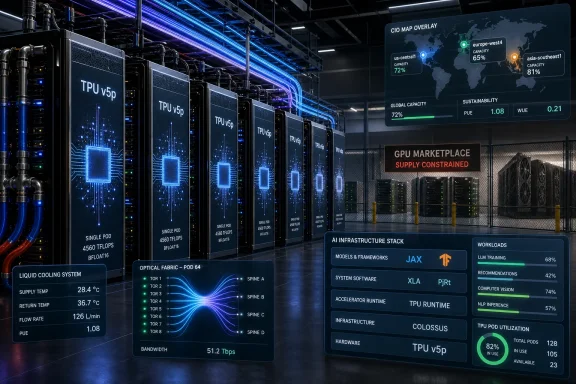
That matters because infrastructure advantages rarely appear overnight. A modern AI accelerator is not just a chip. It is a compiler stack, a networking fabric, a scheduling system, cooling design, data-center power planning, developer tooling, and years of painful production experience. By the time ChatGPT made the public market understand that compute would be the new oil field, Google had already been drilling.
The result is a strange inversion of the AI narrative. Google has spent much of the generative AI era playing defense in public perception, first against OpenAI’s momentum and then against Microsoft’s aggressive product bundling. But beneath the product theater, Alphabet has been sitting on one of the few AI infrastructure assets that cannot simply be purchased from Nvidia with a large enough purchase order.
Nvidia Still Owns the Market, but Google Does Not Need to Beat Nvidia
The temptation is to frame TPUs as a direct Nvidia killer. That is too clean and mostly wrong. Nvidia remains the dominant force in AI acceleration, not only because its GPUs are powerful, but because CUDA, libraries, developer familiarity, and an enormous partner ecosystem have created the closest thing AI hardware has to a default operating environment.
That is why Microsoft, Meta, Amazon, Oracle, xAI, OpenAI’s infrastructure partners, research labs, and countless startups continue to chase Nvidia capacity. The H100 generation became the badge of admission for serious AI training, and Blackwell-era systems have extended Nvidia’s lead in tightly integrated hardware and networking. In the open market, Nvidia still has the gravitational pull.
Google’s advantage is different. Alphabet does not need TPUs to become everyone’s favorite chip. It needs TPUs to be good enough, efficient enough, and available enough for Google’s own enormous workloads and for a meaningful slice of Google Cloud customers. That is a lower bar than dethroning Nvidia, but it is also a more strategically valuable one.
If Google can train and serve Gemini-class models on its own accelerators, the economics change. If Google Cloud can offer customers TPU capacity when comparable GPU clusters are expensive or delayed, the sales conversation changes. If DeepMind engineers and Google Cloud infrastructure teams can co-design models around hardware they understand intimately, the pace of iteration changes.
The power is not that Google has escaped Nvidia entirely. Google still offers Nvidia GPUs in Google Cloud, and many customers will continue to prefer GPU-based environments. The power is optionality. In a market where everyone else is bidding for the same scarce cards, optionality is leverage.
Custom Silicon Turns Capital Spending Into Strategy, Not Just Expense
The AI buildout has made Big Tech capital expenditure numbers look less like normal infrastructure planning and more like wartime logistics. Data centers, power contracts, advanced packaging, high-bandwidth memory, networking gear, and liquid cooling have all become strategic inputs. Investors have begun asking a sensible question: how much of this spending becomes durable advantage, and how much becomes depreciation with a press release attached?
Alphabet’s TPU strategy gives it a better answer than most. When a company buys Nvidia systems at market-clearing prices, it is buying performance, but it is also buying into someone else’s margin stack and roadmap. When Google builds and deploys TPUs at scale, it can shift more of the value capture inward. The savings are not only in chip cost; they show up in system design, workload optimization, fleet utilization, and the ability to plan capacity without waiting for the same allocation queue as everyone else.
That does not mean TPUs are cheap. They are not magic wafers that make data centers inexpensive. Alphabet is still pouring staggering sums into technical infrastructure, and custom accelerators still depend on foundries, advanced packaging, memory supply, networking components, and power availability. A TPU pod does not escape the physics or geopolitics of modern semiconductor manufacturing.
But it does let Alphabet spend differently. The company can tune hardware for workloads it actually runs, rather than accepting a general-purpose accelerator optimized for the broadest possible market. It can decide when a model should be shaped around the hardware and when the hardware should evolve around the model. That feedback loop is the real asset.
This is why the “cost savings” framing is too narrow. A 30 percent or 50 percent improvement in price-performance, where it applies, is significant. But the more durable advantage is organizational: Google owns more of the stack, and therefore owns more of the tradeoffs.
The Stack Is the Product Now
For decades, Microsoft’s platform power came from Windows and Office, then from Azure and enterprise identity. Apple’s came from devices, operating systems, silicon, and services moving as one. Nvidia’s current AI power comes from a full stack of chips, networking, software, libraries, and developer habits. Alphabet’s TPU strategy belongs in that same lineage.
The chip by itself is not the story. Google’s advantage comes from connecting TPUs to JAX, TensorFlow, XLA, Kubernetes, Borg heritage, Google Cloud scheduling, internal model research, and a data-center footprint designed around massive distributed computation. This is why simply announcing a custom AI chip is not the same as having one that matters.
Microsoft has Maia. Amazon has Trainium and Inferentia. Meta has its MTIA family. OpenAI has reportedly explored custom silicon. These efforts are rational, even necessary, because no major AI platform wants to live forever at the mercy of a single external accelerator supplier. But building a chip is the first chapter, not the conclusion.
The hard part is making developers use it without feeling punished. A custom accelerator that requires too much rewriting becomes a science project. A custom accelerator that performs well only on narrow internal workloads becomes an accounting tool, not a platform. A custom accelerator without reliable availability becomes just another SKU that cloud customers cannot trust.
Google has an advantage because its chips have already been through multiple generations of that ugly maturation process. TPU v5p is not a first swing. It is the product of a decade-long march from inference acceleration to large-scale training and cloud availability. That history does not guarantee dominance, but it does mean Google is no longer arguing from a roadmap. It is arguing from deployed infrastructure.
The Cloud Customer Does Not Buy a Chip; It Buys a Deadline
For enterprise buyers, accelerators are not trophies. They are a means to ship a model, run an inference workload, reduce latency, control cloud spend, or satisfy a board mandate that now contains the phrase “AI strategy.” This is where Google Cloud’s TPU pitch becomes more than a benchmark table.
A company training a large model does not care, in the abstract, whether the math happens on an Nvidia GPU or a Google TPU. It cares whether the cluster is available, whether the software stack supports the model, whether performance is predictable, whether the engineers can debug failures, and whether the bill can be defended to finance. Google’s problem has been that the AI developer world still often thinks in Nvidia-first terms. Google’s opportunity is that scarcity can change habits.
If GPU capacity is expensive, reserved months out, or fragmented across regions, a TPU pod becomes easier to consider. If Google can make migration tolerable and keep high-end TPU capacity available, it can win workloads that would once have defaulted to Nvidia by inertia. The pitch is not “learn our exotic chip because we said so.” It is “your job can start sooner, scale cleaner, or cost less here.”
That is a powerful cloud sales motion. Cloud platforms have always sold abstraction, but AI has made the underlying hardware newly visible. Customers are asking which accelerators are available, what interconnects are used, how many chips can be scheduled together, and whether reserved capacity can be guaranteed. The hyperscaler that controls its own accelerator fleet can answer those questions with more confidence.
There is a catch. TPU adoption still asks customers to buy into Google’s ecosystem. The closer a workload is to PyTorch-on-CUDA orthodoxy, the more friction there may be. Google has worked to reduce that friction, but the cultural center of gravity in AI infrastructure remains heavily Nvidia. The best chip is not always the chip developers choose.
Microsoft’s Nvidia Dependence Is the Shadow in This Story
For a WindowsForum audience, the most interesting comparison is Microsoft. Redmond has executed brilliantly on AI distribution: Copilot in Windows, Copilot in Microsoft 365, Azure OpenAI Service, GitHub Copilot, and enterprise integration through identity and compliance. Microsoft has put AI where workers already are.
But infrastructure is the pressure point. Microsoft’s AI ambitions depend heavily on access to massive accelerator fleets, and the company has spent aggressively to secure capacity for both its own services and OpenAI-linked demand. Azure’s position as the enterprise cloud of choice in many organizations gives Microsoft enormous distribution power, yet distribution does not eliminate the cost of inference or the scarcity of training hardware.
This is why Microsoft’s Maia chip matters, even if it is not yet the center of the AI hardware universe. Microsoft understands the problem. A company cannot build every future product around AI and then treat AI silicon as a commodity input controlled by another vendor. The strategic logic that pushed Apple into custom Mac silicon and Amazon into Graviton now applies to AI accelerators.
Still, Microsoft is playing from a different position. Its AI lead in enterprise software rests on products and partnerships, while Google’s infrastructure lead rests on an older internal hardware bet. Microsoft can buy enormous amounts of Nvidia capacity; Alphabet can buy Nvidia capacity and lean on TPUs. That difference may not show up in a Copilot demo, but it matters in margins, capacity planning, and the pace at which AI features can be deployed without blowing up unit economics.
The irony is rich. Microsoft spent years benefiting from the PC industry’s standardized hardware base, with Windows abstracting away the messy diversity underneath. In AI, the hyperscalers are moving in the opposite direction. The winners are trying to make the hardware less interchangeable.
Amazon Saw the Same Movie Earlier
Amazon’s Trainium and Inferentia chips are often treated as supporting characters in the AI chip drama, but AWS saw the economic logic clearly. A cloud provider that rents compute for a living has every incentive to control the silicon economics underneath that rental business. Graviton proved the model for CPUs; Trainium and Inferentia extend it into AI.
The AWS approach differs from Google’s because Amazon’s first identity is cloud infrastructure, not search, ads, or frontier model research. AWS wants to offer customers cheaper or more efficient options across many workloads, while also reducing dependence on external silicon suppliers. Google wants that too, but it also has enormous internal model and product workloads that can absorb TPU capacity directly.
That internal demand is a critical difference. A custom chip program needs scale to survive. If external customers hesitate, Google can still feed TPUs with Search, YouTube, Ads, Gemini, Workspace, Android services, and DeepMind research. AWS has immense cloud demand, but it does not have the same consumer AI product surface. Microsoft has the product surface and the cloud, but its custom accelerator stack is newer.
This is why Alphabet’s position is more defensible than it sometimes appears. The company has both the internal need and the external channel. TPUs can serve Google first, then Google Cloud customers, then a broader ecosystem if the tooling keeps improving. That staged adoption path is much easier than trying to convince the market to embrace a new accelerator before the vendor has proven it at home.
Nvidia’s Real Threat Is Not One Rival Chip, but Many Captive Buyers
Nvidia is not in immediate danger of being pushed aside. If anything, the AI boom has shown how difficult it is to compete with a platform that combines leading hardware, mature software, and a supply chain tuned for scale. Nvidia’s biggest customers may complain about dependence, but they continue to buy.
The long-term risk is subtler. Nvidia’s most important customers are also the companies most capable of funding alternatives. Google, Amazon, Microsoft, Meta, and potentially OpenAI-aligned infrastructure partners are not ordinary buyers. They have the scale, cash, engineering talent, and workload visibility to justify custom silicon, even if those chips never become merchant products.
That means Nvidia can keep winning the open market while losing some of the most strategic internal workloads at its largest customers. The AI accelerator market can grow fast enough for Nvidia revenue to rise even as hyperscalers reduce dependence at the margin. This is not a contradiction; it is what happens when a market expands faster than any single supplier can serve.
For Nvidia, the defense is to keep moving faster than customers can internalize. Blackwell, NVLink, InfiniBand and Ethernet networking, CUDA libraries, inference optimization, and full rack-scale systems are designed to make the Nvidia platform more than a chip order. The harder Nvidia makes it to replicate the whole system, the more attractive it remains even to customers building their own accelerators.
For Google, the counter is specialization. TPUs do not need to be the universal answer. They need to be excellent for the workloads Google cares about most. In AI infrastructure, being narrower can be an advantage if the workload is large enough.
The Developer Ecosystem Is the Friction Google Still Has to Beat
Hardware stories often underestimate software gravity. Developers do not merely choose the fastest chip; they choose the path with the fewest surprises. Nvidia’s greatest achievement is that for many AI teams, CUDA is not a vendor choice but a default assumption.
Google has spent years improving TPU support across major frameworks, and its own research culture has helped popularize JAX in high-end machine learning circles. But the broader AI developer world remains uneven. Some teams are comfortable with TPUs and see major benefits. Others view them as powerful but less convenient, especially when models, kernels, third-party libraries, or debugging workflows assume Nvidia GPUs.
This matters because enterprise AI adoption is already messy. Companies are trying to standardize model governance, data security, deployment pipelines, observability, and cost controls. If a custom accelerator complicates that work, the performance benefit has to be large enough to justify the extra operational burden. Google’s task is not merely to make TPUs fast. It must make them feel boring.
Boring is the highest compliment in enterprise infrastructure. It means capacity appears when promised, workloads behave as expected, tools work, incidents are diagnosable, and the monthly bill does not contain a horror story. If Google Cloud can make TPUs boring, it can turn a hardware advantage into a cloud habit.
This is where Windows and Microsoft shops should pay attention. Many enterprise teams will experience AI not as a model-training science project, but as an application architecture problem: where to run inference, how to manage data, how to integrate identity, and how to control costs. If Google’s TPU economics make certain workloads cheaper or more available, even Microsoft-centered organizations may find themselves evaluating Google Cloud for targeted AI infrastructure.
The AI Arms Race Is Becoming a Supply Chain Race
The public discussion of AI still spends too much time on model personalities and too little on supply chains. The ability to deliver AI at scale depends on electricity, substations, water or liquid cooling systems, high-bandwidth memory, optical networking, advanced packaging, and enough trained technicians to build and operate the facilities. The chip is the glamorous part of a much larger machine.
Custom silicon does not free Alphabet from those constraints. TPUs still require manufacturing partners, memory, packaging, networking, and power. If anything, Alphabet’s capital plans show that the company is exposed to the same infrastructure crunch as its peers. AI demand is forcing all hyperscalers to build at a pace that tests permitting, grid capacity, and global component supply.
But custom silicon gives Google another lever. It can optimize for power efficiency, rack density, network topology, and workload fit across the full system. When power becomes a limiting factor, performance per watt matters as much as peak performance. When data-center space is scarce, cluster design matters. When model serving becomes a permanent cost center rather than a demo expense, inference efficiency becomes existential.
This is where the TPU story may become more important over time, not less. Training gets the headlines because frontier models are expensive and glamorous. Inference gets the bills. If AI features become embedded in search, browsers, office suites, operating systems, phones, security tools, coding assistants, and customer-service workflows, the cost of running models every second of every day will dominate the economics.
Google’s long history of optimizing internal services for machine learning gives it a credible position here. The company did not build TPUs only for spectacular benchmark runs. It built them because small efficiencies become enormous when multiplied across billions of queries, recommendations, translations, and generated responses.
Regulators and Customers Will Notice the Vertical Integration
There is another edge to this story: power concentrated inside vertically integrated AI platforms will invite scrutiny. If the winning companies own the models, the cloud platforms, the chips, the data centers, the developer tools, and the consumer distribution channels, the AI market may become less open than the web era it claims to extend.
Alphabet’s TPU advantage could be framed as healthy competition against Nvidia’s dominance. It could also be framed as another way for a giant platform company to deepen its moat. Both readings can be true. Custom silicon can reduce dependence on one chokepoint while creating another inside a hyperscaler’s walls.
Enterprise customers will have to think carefully about lock-in. A TPU-based workload may deliver strong economics on Google Cloud, but the portability story matters. If a model is tuned too tightly to one accelerator, one framework configuration, or one cloud scheduling system, moving later may be costly. Cloud buyers learned this lesson with proprietary databases, serverless platforms, and data warehouses. AI infrastructure will repeat it at higher speed and higher cost.
The best procurement teams will not simply ask which accelerator is cheapest this quarter. They will ask which parts of the stack are portable, which assumptions are vendor-specific, and what happens if capacity, pricing, or product priorities change. In the AI era, architecture review is vendor risk management.
That does not argue against TPUs. It argues against sleepwalking into them. Google’s custom silicon may be the right answer for many workloads, especially at scale. But the decision should be made with eyes open, not because a benchmark slide promised a tidy percentage improvement.
The Real Winner May Be the Company That Makes AI Economically Ordinary
The first phase of the generative AI boom rewarded spectacle. Bigger models, bigger clusters, bigger demos, bigger valuations. The next phase will reward companies that make AI economically ordinary enough to embed everywhere. That is a different contest.
In that contest, Alphabet’s TPU strategy looks less like a side project and more like a prerequisite. Search margins, cloud margins, Workspace features, Android services, YouTube recommendations, ad systems, and Gemini experiences all depend on whether AI can be served at tolerable cost. If every user interaction requires expensive rented GPU time, the business model strains. If custom silicon lowers the unit cost, the product surface can expand.
This is the point Microsoft, Amazon, Meta, and OpenAI have all recognized in their own ways. The AI arms race is not only about who has the best model at a given moment. Models diffuse. Techniques leak. Talent moves. What persists is infrastructure that lets a company train, deploy, and iterate at lower cost than rivals.
Google’s problem is that infrastructure advantage does not automatically translate into product trust. The company has had uneven AI launches, confusing branding, and the familiar burden of defending a search empire while inventing what comes after it. TPUs give Alphabet a stronger engine. They do not guarantee better driving.
Still, in platform shifts, engines matter. Microsoft’s Windows monopoly was not only about interface; it was about developer gravity and distribution. Apple Silicon was not only about faster Macs; it was about Apple controlling the performance, battery, and roadmap tradeoffs. Google’s TPUs are not only about cheaper AI math; they are about Alphabet refusing to rent the foundation of its next business from someone else.
The TPU Advantage Leaves CIOs With a More Complicated Cloud Map
The practical lesson is not that every organization should move AI workloads to Google Cloud tomorrow. The lesson is that accelerator strategy has become part of cloud strategy. A cloud comparison that ignores silicon is now incomplete.
For IT leaders, this complicates an already crowded landscape. Microsoft may offer the smoothest path for organizations standardized on Entra ID, Microsoft 365, GitHub, Windows, and Azure. AWS may offer the broadest infrastructure menu and a strong custom silicon story of its own. Google may offer the most mature in-house AI accelerator lineage and deep model-infrastructure integration. Nvidia may remain the most portable skill base across clouds. None of these facts cancels the others.
The right answer will often be hybrid in the most annoying sense of the word. Companies may train one model in one cloud, run inference in another, use Microsoft 365 Copilot for office productivity, keep sensitive data on-premises, and rely on Nvidia GPU instances for workloads where ecosystem compatibility matters. AI will not simplify enterprise architecture. It will make the hidden tradeoffs visible.
That is why Alphabet’s TPU edge is significant even for organizations that never directly rent a TPU. It pressures competitors to improve their own silicon, pricing, capacity guarantees, and software layers. It gives Nvidia’s largest customers bargaining leverage. It reminds buyers that “cloud compute” is no longer a generic commodity hiding behind a virtual machine size.
Most of all, it signals that the AI platform winners will be those that can align research, hardware, software, and distribution. Alphabet has not won that race. But it has one of the strongest claims to having built the track.
The Shape of the Advantage Is Now Clear
The most concrete takeaways are less about chip fandom than about control, capacity, and economics. Alphabet’s TPU program should be read as a long-term infrastructure hedge that has matured at precisely the moment AI demand made such hedges valuable.
- Alphabet’s custom TPU fleet gives Google an internal source of AI compute that reduces, but does not eliminate, dependence on Nvidia GPUs.
- TPU v5p and newer generations matter because they turn Google’s decade of machine-learning infrastructure work into a commercial Google Cloud differentiator.
- Nvidia remains the dominant AI accelerator platform because its hardware, software ecosystem, and developer familiarity are still unmatched in the broader market.
- Microsoft, Amazon, Meta, and OpenAI’s reported or announced custom-chip efforts show that hyperscalers increasingly view third-party silicon dependence as a strategic risk.
- Enterprise buyers should evaluate AI infrastructure by capacity, software compatibility, portability, power efficiency, and long-term unit economics rather than by benchmark claims alone.
- Google’s advantage will matter most if it can make TPUs operationally boring for customers while using them internally to keep AI product costs under control.
Alphabet’s custom silicon does not settle the AI arms race, but it explains why the race is no longer just about models, apps, or chatbot market share. The companies that matter most are trying to own the machinery beneath intelligence itself, from chip to cluster to compiler to cloud contract. Google started that work early, sometimes awkwardly and often quietly, and the payoff is now visible: in an era when everyone wants more AI compute than the market can comfortably supply, Alphabet has a private lane on the highway. The next question is whether it can turn that lane into products customers love, margins investors trust, and infrastructure that developers choose even when they are free to go elsewhere.