

Alphabet’s headline rally on December 1 is the clearest market signal so far that the company’s multi‑year pivot into full‑stack artificial intelligence is moving from promise to profit — but the day’s exuberance masks a complex set of technical, commercial, and regulatory trade‑offs that matter for investors and IT leaders alike.
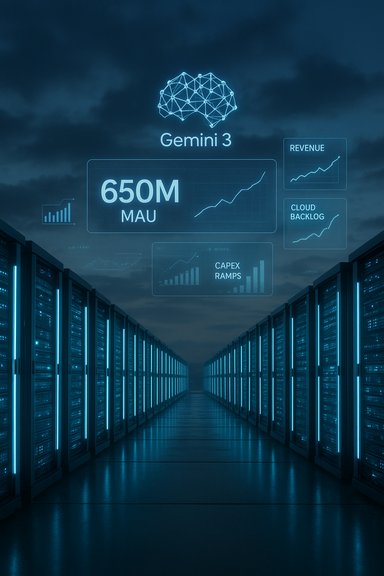
Alphabet’s recent earnings and product disclosures set the stage for the run that spawned headlines calling it “the company’s best day ever.” The core facts are straightforward: Alphabet reported record quarterly revenue of roughly $102.3 billion for Q3 2025 and simultaneously raised capital‑expenditure guidance as it scales AI infrastructure. Google Cloud posted roughly $15.2 billion in the quarter, and management disclosed a materially enlarged cloud backlog cited at about $155 billion — figures that transformed the narrative from “experimental AI” to “commercialized AI.” Two product announcements accelerated investor confidence over the last few weeks. First, the release of the Gemini 3 model and companion consumer app — which Alphabet says now reaches more than 650 million monthly active users — rekindled the argument that Google can pair massive distribution with a first‑class model stack. Second, the company’s Tensor Processing Units (TPUs) and related on‑premises/cloud TPU offerings were reported by multiple outlets as competitive with, and in some cases cheaper than, incumbent GPU solutions — a shift that has immediate implications for hyperscaler economics if third parties adopt TPUs at scale. The market response — a run that pushed Alphabet back toward a roughly $3.9 trillion valuation and placed it among the world’s most valuable firms — is thus as much about forward expectations for AI monetization and infrastructure leverage as it is about one day’s price action.
That said, execution risk is nontrivial. The business case hinges on three linked outcomes: (1) AI features must increase monetizable interactions or support paid subscriptions, (2) Google Cloud must convert backlog into recognized revenue at healthy margins, and (3) capex must be utilized efficiently. If those three pillars hold, Alphabet can sustain a materially higher valuation multiple; if any falter — especially monetization or cloud conversion — the rerating will look premature.
Source: 24/7 Wall St. Alphabet's Best Day Ever
 Background / Overview
Alphabet’s recent earnings and product disclosures set the stage for the run that spawned headlines calling it “the company’s best day ever.” The core facts are straightforward: Alphabet reported record quarterly revenue of roughly $102.3 billion for Q3 2025 and simultaneously raised capital‑expenditure guidance as it scales AI infrastructure. Google Cloud posted roughly $15.2 billion in the quarter, and management disclosed a materially enlarged cloud backlog cited at about $155 billion — figures that transformed the narrative from “experimental AI” to “commercialized AI.” Two product announcements accelerated investor confidence over the last few weeks. First, the release of the Gemini 3 model and companion consumer app — which Alphabet says now reaches more than 650 million monthly active users — rekindled the argument that Google can pair massive distribution with a first‑class model stack. Second, the company’s Tensor Processing Units (TPUs) and related on‑premises/cloud TPU offerings were reported by multiple outlets as competitive with, and in some cases cheaper than, incumbent GPU solutions — a shift that has immediate implications for hyperscaler economics if third parties adopt TPUs at scale. The market response — a run that pushed Alphabet back toward a roughly $3.9 trillion valuation and placed it among the world’s most valuable firms — is thus as much about forward expectations for AI monetization and infrastructure leverage as it is about one day’s price action. What the 24/7 Wall St. piece actually says
The 24/7 Wall St. article paints a bullish — almost celebratory — picture. Its key assertions are:- Gemini 3 has vaulted Alphabet into the lead in model quality and integration versus peers. The piece highlights analyst and insider commentary that Gemini 3 bests competing models on several benchmarks and benefits from deep integration across Search, YouTube, Workspace, and Android.
- Google’s TPU chips are described as a structural advantage that limits Alphabet’s dependence on third‑party silicon (notably NVIDIA) and potentially threatens NVIDIA’s market share if large customers — Meta is repeatedly cited — pivot to TPU buying or rentals. The article references reporting that Meta is in advanced talks to use Google TPUs.
- The company’s valuation surge and market cap milestones are presented as proof that investors are rewarding the AI playbook, not simply the underlying advertising engine.
Verifying the load‑bearing claims: what is solid and what is directional
The most important factual claims can be verified across multiple independent sources. Cross‑checks yield high confidence in several load‑bearing numbers:- Consolidated revenue of roughly $102.3 billion and a 16% year‑over‑year increase for Q3 2025 is reported in company filings and repeated across financial press.
- Google Cloud revenue of about $15.2 billion and management’s reporting of an enlarged cloud backlog (quoted at around $155 billion) are corroborated in the earnings materials and mainstream financial coverage.
- The Gemini app MAU figure (650 million+) and token‑throughput metrics were stated in management commentary and have been widely repeated; they are credible as scale signals but do not by themselves prove profitable monetization per interaction. Treat MAU/token figures as directional scale metrics, not unit‑economic proof.
- CapEx guidance raised into the $91–$93 billion band for 2025 is reflected in investor communications and verified reporting; the figure is central to the evaluation of Alphabet’s margin path and cash‑deployment strategy.
- Assertions that Gemini 3 “outperforms” GPT‑5 on several benchmarks are reported by outlets and by industry insiders, but benchmarking across language models is complex and depends heavily on test design, prompt formats, and evaluation metrics. These claims are plausible and supported by multiple press reports, but they should be treated as competitive positioning until independent third‑party, peer‑reviewed benchmark suites converge on consistent results.
- Cost and performance comparisons between TPUs and NVIDIA GPUs — for example, claims that TPU racks are materially cheaper per rack or per‑inference than equivalent NVIDIA gear — are often phrased as definitive in market copy but are heavily dependent on configuration, workload mix (training vs inference), software stack, and vendor discounts. Reports that Meta is in talks to adopt TPU capacity are credible (Reuters and others), but precise cost deltas are vendor‑sensitive and not fully public. Treat specific “2× cheaper” claims as directional and conditional pending contract-level disclosure.
Why the market reacted: economics behind the “best day”
Short version: the market re‑priced Alphabet because two connected expectations improved simultaneously — product quality and capital efficiency.- Product quality: Gemini 3 and its app placement suggest Alphabet can deliver higher‑value AI experiences inside its existing distribution channels (Search, YouTube, Android, Workspace). If conversational AI produces clearer commercial intent, ad yields and CPMs can rise rather than fall. The 650M+ MAU figure converts novelty into distribution scale.
- Capital efficiency: TPUs and a vertically integrated TPU + model + cloud stack promise more controllable inference costs. If third parties (large customers like Meta) adopt TPU capacity, Alphabet’s incremental revenue from selling TPU capacity or hosting inference would convert capex into contracted revenue — a classic hyperscaler monetization lever. Reuters’ reporting on Meta‑TPU talks is a market catalyst because it validates the commercial market for Google’s chips.
Strengths: what Alphabet brings to the table
- Unmatched distribution. Search, YouTube, Android, Chrome, and Workspace give Alphabet immediate channels to surface AI features to billions. That lowers customer‑acquisition cost for new AI surfaces and shortens monetization cycles.
- Full‑stack control. Owning models (Gemini), accelerators (TPUs), and cloud tooling (Vertex AI) enables performance tuning across the stack and the option to sell integrated solutions rather than commodity compute. This vertical control is a strategic advantage in latency‑sensitive and privacy‑sensitive workloads.
- A growing cloud backlog. Contracted, multi‑year cloud commitments that are visible in backlog/RPO provide revenue visibility that de‑risks capex intensity if the backlog converts predictably.
- Strong balance sheet. Large free cash flows give Alphabet optionality: it can fund capex, buy back stock, and invest in moonshots without immediate solvency pressure.
Vulnerabilities and risks you cannot ignore
- CapEx to utilization risk. Heavy spending on GPU/TPU farms only pays off if utilization is high and a growing share of activity moves to higher‑margin managed AI services. Idle accelerators depress returns quickly. This is the central execution risk.
- Monetization mismatch. If conversational or generative answers compress the number of ad‑bearing impressions (for example, replacing multiple ad‑served search results with a single AI answer), ad inventory and CPMs could weaken — making AI a revenue substitute rather than an augmenter. Monitor revenue‑per‑search and YouTube CPMs closely.
- Competitive pressures. Microsoft, Amazon, Nvidia and specialist “neoclouds” pursue alternative monetization patterns — seat‑based Copilot models, raw compute scale, and cost‑competitive GPU offerings. Open or efficient models could compress pricing for inference and training, pressuring hyperscaler margins.
- Regulatory and antitrust scrutiny. Alphabet’s cross‑product data flows and default distribution raise antitrust and privacy issues in multiple jurisdictions. Remedies that restrict bundling or data sharing would materially change the monetization calculus. Recent antitrust actions and litigation remain live risks.
- Vendor lock‑in and portability concerns for customers. Enterprises buying into full‑stack managed AI offerings must weigh portability, data governance, and exit options. The business risk is not just technical but legal and strategic.
Practical implications for investors and Windows‑centric IT leaders
For investors
- Separate capability from economics. Alphabet has checked the “can build” box; the market’s next test is whether those capabilities translate into reliably higher ARPU or durable cloud margins. Watch the next four quarters for revenue‑per‑search trends, YouTube CPMs, and cloud gross‑margin expansion.
- Treat capex guidance as a forward risk‑reward lever. Higher capex increases upside if utilization follows; it increases downside if workloads shift elsewhere or cloud price competition accelerates. Model sensitivity to capex and cloud utilization explicitly.
- Use event windows. Short‑term trades around product adoption announcements and large cloud contract disclosures can work, but longer‑term allocation should be conditioned on measurable ARPU or Cloud margin inflection points.
For Windows‑centric IT leaders and procurement teams
- Expect richer cross‑vendor AI offerings. Organizations anchored on Windows and Microsoft stacks should evaluate seat‑plus‑consumption pricing (Copilot seat + inference consumption) and compare it to Google’s productized offerings tied to Vertex AI and Gemini. Negotiate visibility into metering and predictable caps on inference pricing.
- Design for portability. Use containerized model deployments, standardized model formats, and multi‑cloud architectures where possible. This reduces vendor lock‑in risk and preserves leverage in contracting.
- Insist on observability. Line items for inference costs, fine‑tuning, data egress, and retrieval costs should be explicit in SOWs. Demand billing demos and stress tests before signing large multi‑year AI contracts.
Deep dive: the TPU question and why it matters
The TPU story is the technical heart of the recent rerating. If Google’s TPUs offer a consistent combination of better raw price/performance and easier integration for large models, the competitive landscape shifts: customers can avoid paying GPU markup to external vendors and hyperscalers that rely on NVIDIA. Reuters’ reporting on Meta’s ongoing talks to buy or rent TPUs is the first third‑party confirmation that this is more than internal marketing. However, the precise economic advantage of TPUs varies dramatically by workload and must be validated on:- training vs inference workloads,
- model architecture and tensor shapes,
- software maturity and operator tooling,
- and amortization curves for TPU racks versus GPU clusters.
What to watch next (milestone signal checklist)
- Quarterly movement in revenue per search and YouTube CPMs — does AI lift ad yields or compress them?
- Google Cloud gross margin and the pace at which backlog converts into recognized revenue. Are large AI deals being booked at sustainable pricing?
- CapEx cadence and accelerator utilization rates — higher spending is only good if it translates to high utilization/contracted revenue.
- Third‑party adoption of TPUs (public contract wins or long‑term commitments from large enterprises). Reuters’ Meta talks are a leading indicator; more deals would be decisive.
- Regulatory developments — any remedies that limit data flows or change default product placements will alter the economics of cross‑product AI monetization.
A balanced verdict
Alphabet has moved rapidly from experimentation to scale: product usage, cloud bookings, and investor re‑rating all point to a material shift. The company’s strengths — distribution, a full‑stack approach, and a commanding balance sheet — make it one of the most formidable AI competitors.That said, execution risk is nontrivial. The business case hinges on three linked outcomes: (1) AI features must increase monetizable interactions or support paid subscriptions, (2) Google Cloud must convert backlog into recognized revenue at healthy margins, and (3) capex must be utilized efficiently. If those three pillars hold, Alphabet can sustain a materially higher valuation multiple; if any falter — especially monetization or cloud conversion — the rerating will look premature.
Final takeaways for WindowsForum readers
- The market’s enthusiasm for Alphabet’s recent advances is understandable and backed by measurable scale gains in revenue, cloud bookings, and user metrics. Those figures are verifiable and show real commercial momentum.
- Technical announcements (Gemini 3, TPUs) materially change the landscape only if adopted broadly and if pricing economics are transparent. Treat vendor benchmarking claims as directional until you can validate them in your own proof‑of‑concepts or through customer references.
- For IT leaders anchored in Windows ecosystems, the prudent path is to negotiate for predictable metering, insist on portability, and design AI procurement around outcomes rather than vendor promises. Multi‑cloud and containerized model deployments remain practical mitigations against vendor lock‑in.
Source: 24/7 Wall St. Alphabet's Best Day Ever
