

AmazoAmazon’s recruitment of Manik Gupta—an executive best known for steering Microsoft Teams’ consumer and growth efforts—signals a sharpened push by the company to make generative AI and agentic assistants central to online shopping; the hire, first reported in a WebProNews dispatch, places a seasoned product leader at the intersection of product discovery, personalization, and AI-driven commerce. n’s move comes as part of a broader reorganization and talent reshuffle across the industry: the company recently consolidated AI leadership under veteran cloud executive Peter DeSantis, following the departure of Rohit Prasad, and has been publicly expanding consumer-facing AI initiatives such as the in-app assistant Rufus. Those shifts reflect a two-front strategy—accelerate product innovation for shoppers while simultaneously strengthening cloud, silicon, and foundational-model capabilities. Amazon’s interest in pairing product-facing leaders with deep engineering resources is driven by the commercial promise of agentic shopping: assistants that can find items, summarize options, set price watches, and even complete purchases on behalf of users. This market is heating up across major platforms; Google, Microsoft, and OpenAI are each racing to stitch discovery, inventory, and delegated checkout into conversational workflows. Amazon’s hiring of Gupta should be read against that competitive backdrop.
Flag: Hiring reports are often clarified later by company announcements or broader reporting; treat early press accounts as directional until Amazon issues formal confirmation.
But the prize is not automatic. Success will require disciplined grounding of model outputs, robust product controls around agentic behaviors, and transparent guardrails for privacy and liability. If Amazon can coordinate front-end product leadership, AWS infrastructure, and silicon economics—while addressing the real operational and ethical risks—Gupta’s hire could mark a turning point: Amazon moves from building AI features to delivering AI that shoppers trust enough to let it act on their behalf.
Ultimately, the next 6–12 months will be decisive. Watch for official confirmations of leadership roles, incremental product experiments (new Rufus features and auto‑buy pilots), and how Amazon ties model selection and inference routing to its hardware roadmap. Those signals will reveal whether this is a headline hire or the start of a substantive shift in how millions of people will shop online.
Source: WebProNews Amazon Hires Ex-Microsoft Exec Manik Gupta to Lead AI Shopping Tools
 Who is Manik Gupta and why this matters
A product leader who blends consumer DNA with enterprise scale
Manik Gupta has a long pedigree in consumer product leadership: earlier tenures include product roles at Google Maps and a high-profile stint as Chief Product Officer at Uber. At Microsoft, he spent several years building the consumer-facing elements of Teams, helping scale the product to hundreds of millions of users while integrating AI features for collaboration and productivity. That blend—consumer sensibility applied to massive, complex systems—is what Amazon appears to be buying. Multiple reports about Gupta’s recent departure from Microsoft reference his contributions to Teams’ growth and to AI-driven product features.- Track record: product leadership at Google Maps, Uber (marketplace scale), and Microsoft Teams (large user bases).
- Skillset Amazon needs: shipping intuitive UX for complex data, orchestrating product + AI roadmaps, and driving cross-functional programs that combine machine learning, infrastructure, and design.
What role will he likely play?
Public reporting places Gupta at the helm of a consumer-facing AI shopping product intended to boost product discovery, personalization, and agentic behaviors—functions that translate directly into higher conversion and retention when done reports his hiring specifically to lead this initiative, major outlets have yet to publish independent confirmation of his Amazon title beyond that initial coverage; that nuance matters. The hire is credible given Gupta’s recent exit from Microsoft and Amazon’s aggressive hiring posture in AI, but the full scope and reporting structure of his role remain to be confirmed by Amazon.Flag: Hiring reports are often clarified later by company announcements or broader reporting; treat early press accounts as directional until Amazon issues formal confirmation.
The product: AI shopping assistant ambitions
From recommendation engines to agentic shopping
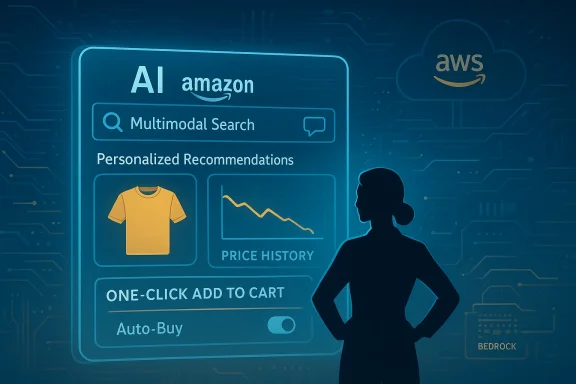
Amazon’s public messaging around Rufus makes clear the product ambition: a generative, agentic shopping assistant embedded into the Amazon Shopping experience that can do more than suggest—it can act. Rufus already offers features like personalized recommendations, price history, price alerts, and opt-in auto-buy for Prime members, and Amazon frames these as powered by a mix of internal models and third‑party LLMs via Bedrock. That technical baseline creates a natural launchpad for Gupta’s mandate: make the assistant feel less like a search tool and more like a trusted shopping companion. Key product capabilities Amazon is explicitly building or piloting:- Persistent account memory and personalization (shopping preferences, household context).
- Price history and price tracking (30‑ and 90‑day trends) and auto-buy for pre-set thresholds.
- Multimodal search (text + visual list ingestion, e.g., handwritten grocery lists).
- Action primitives: add-to-cart, agentic purchase, order tracking, and customer-service automation.
What Manik Gupta could add
Gupta’s proven skill at shipping consumer flows at scale—especially those that require blending product simplicity with complex backend systems—could accelerate Amazon’s transition from feature pilots to mass-usable agentic shopping. Practically, that means:- Tightening UX for multi-step flows (e.g., “build my party list -> add to cart -> set delivery window”).
- Building auditable human-in-the-loop guardrails for agentic actions (confirmations, cancellation windows, detailed receipts).
- Prioritizing trust signals—provenance, confidence, and recency—in outputs so recommendations feel reliable, not speculative.
Infrastructure and partnerships: compute, chips, and models
Amazon’s compute bet and potential OpenAI tie-ins
Amazon is not just building frontend assistants; it is investing in the stack below them. Recent reporting shows Amazon entered talks to invest billions in OpenAI, potentially coupling that capital with commitments to use Amazon’s AI chips (e.g., Trainium) and AWS capacity. If a partnership like this materializes, it would give Amazon both model access and an explicit commercial route for its in-house silicon. That arrangement would materially affect product roadmaps for assistant-led experiences, because model latency, cost, and customization are decisive factors in product viability at scale.Bedrock, Trainium, and the model routing problem
Amazon’s AI stack includes:- Bedrock — a multi-model inference and routing layer that lets customers and internal tools use various foundation models interchangeably.
- Trainium / Graviton — Amazon’s custom silicon efforts to reduce dependence on third‑party accelerators.
- Data and retrieval pipelines — the product graph, inventory feeds, and freshness pipelines that agents rely on to ground responses.
Industry context: talent wars, reorganizations, and the competitive landscape
Reorganizations and leadership shifts at Amazon
Late‑2025 leadership moves—most notably Rohit Prasad’s exit and Peter DeSantis’ broader remit—have centralized the company’s model, chip, and frontier research efforts. That internal consolidation suggests Amazon wants clearer product-to-infrastructure pathways; putting a proven product leader like Gupta into the equation indicates Amazon is serious about turning infrastructure capability into consumer impact. Reuters and other outlets documented the DeSantis/Prasad transition and the organizational aim to unify model development with chip and cloud strategy.The broader talent market
Silicon Valley sees rapid cross‑pollination: executives with product and AI experience are moving between the hyperscalers, challengers, and startups. Amazon’s prior hires from agentic AI startups and its $8B investment in Anthropic reflect a two-pronged approach—buy talent and buy exposure to alternative model architectures. The recruitment of Gupta fits that picture: hire product leaders who can ship while simultaneously strengthening the underlying model and hardware supply chains.Opportunities: what Amazon could win
- Better conversion through contextual discovery. AI that understands intent and context—budget, occasion, household—can prune the funnel and accelerate purchases.
- Higher lifetime value via personalization. Memory and preference modeling foster stickiness and repeat purchases.
- New monetization vectors. Agentic flows open monetizable moments (sponsored suggestions, instant checkout placements, affiliate-like placements within conversational results).
- Console-to-cloud integration. Tight AWS-Amazon store integration (if executed well) could reduce latency, improve personalization, and keep costs competitive versus external LLM providers.
Risks, trade-offs, and ethical considerations
Accuracy, freshness, and hallucinations
Agentic shopping assistants are only useful if they’re correct about price, availability, and product specs. Model hallucinations or stale data can create real consumer harm—wrong orders, chargebacks, or frustrated returns. Amazon faces a particular exposure because of its scale: small error rates can multiply rapidly. Robust grounding with live inventory APIs and explicit provenance in assistant outputs is non‑negotiable. Independent assessments of agentic shopping pilots emphasize that vendor-provided metrics are directional; rigorous A/B tests and third-party audits are needed.Operational risk: payments, refunds, and liability
Agentic buy flows involve delegated payments, pre-authorized charges, and sometimes third‑party merchant routing. The legal and operational frameworks that govern delegated checkouts are still evolving. Amazon must solve settlement, dispute, and fraud workflows for actions taken by an assistant—more complex than a human-initiated checkout because the action path may be distributed across models and services.Workforce and cultural implications
Internal debates at Amazon—mirrored across tech—question how rapidly automation should replace human tasks. Open letters and employee concerns about ethical AI deployment have surfaced; in Amazon’s case, the scale of operations complicates the human-in-the-loop story. A practical approach is to design escalation and transparency into agentic flows so that human review is available where the assistant’s confidence falls below safe thresholds.Privacy, data usage, and regulatory pressure
Personalization requires data. Amazon’s advantage is rich behavioral signals across shopping, Prime Video, Kindle, and more—but that breadth raises privacy and regulatory questions, especially in jurisdictions with strict data protection rules. Explicit consent, clear memory controls, and easy-to-use privacy toggles must be core product features, not afterthoughts. Amazon’s product pages for Rufus emphasize opt‑in controls, but regulators and consumer groups will be watching agentic commerce closely.Execution checklist: what Amazon needs to get right
- Ship conservative, human‑confirmable agentic actions first (e.g., recommended cart builds that require one confirmation click rather than automatic purchases).
- Maintain auditable decision trails for any agentic action—time-stamped logs, model-version metadata, and retrieval sources.
- Invest in near-real-time catalog freshness and reconcile cross-channel pricing (marketplaces, third-party sellers).
- Build clear user controls: memory review, opt-out, and per‑action confirmation thresholds.
- Coordinate product strategy with AWS infrastructure roadmaps (model placements, instance sizing, routing policy for cost/latency trade-offs).
Strategic implications: competition and ecosystem effects
For competitors and merchants
If Amazon delivers a trustworthy, agentic shopping assistant at Amazon scale, it raises the bar for competihifts merchant economics. Merchants may need to make their catalog and inventory APIs cleaner and more accessible to remain visible in assistant-driven flows. The emergence of shared standards—protocols for agentic commerce and delegated checkout—will shape who benefits: platform owners who control the discovery layer or merchants who own fulfillment and returns.For cloud, silicon, and model economics
The rumored talks around a multi‑billion-dollar OpenAI investment tied to chip usage indicate a broader industry pattern: cloud providers seek deeper partnerships with model creators to lock in high-margin compute demand. If Amazon secures similar deals, it could influence model sourcing choices, inference routing, and pricing for large-scale consumer agents. These infrastructure economics will determine whether agentic features are profitable, sustainable, and differentiating over time.What remains unverified
- The exact title, reporting line, and charter for Manik Gupta at Amazon has been reported in WebProNews but lacks broader confirmation from a formal Amazon announcement or corroboration in major outlets at the time of reporting. Treat early press accounts as plausible but incomplete until Amazon confirms.
- Internal financial projections and detailed ROI claims tied to Rufus or other assistant initiatives (such as precise downstream-impact numbers) come from internal documents reported selectively; these are directionally informative but operationally contingent and should be validated with independent metrics or company filings.
Conclusion
Amazon’s reported hiring of Manik Gupta—an executive whose career pairs consumer product instincts with experience building at scale—fits a recognizable pattern: hyperscalers are layering product-focused leaders on top of expanding model and infrastructure investments to turn AI capability into everyday consumer value. The move signals Amazon wants to convert its catalog, logistics, and cloud muscle into a human-friendly shopping intelligence that both discovers and does.But the prize is not automatic. Success will require disciplined grounding of model outputs, robust product controls around agentic behaviors, and transparent guardrails for privacy and liability. If Amazon can coordinate front-end product leadership, AWS infrastructure, and silicon economics—while addressing the real operational and ethical risks—Gupta’s hire could mark a turning point: Amazon moves from building AI features to delivering AI that shoppers trust enough to let it act on their behalf.
Ultimately, the next 6–12 months will be decisive. Watch for official confirmations of leadership roles, incremental product experiments (new Rufus features and auto‑buy pilots), and how Amazon ties model selection and inference routing to its hardware roadmap. Those signals will reveal whether this is a headline hire or the start of a substantive shift in how millions of people will shop online.
Source: WebProNews Amazon Hires Ex-Microsoft Exec Manik Gupta to Lead AI Shopping Tools
