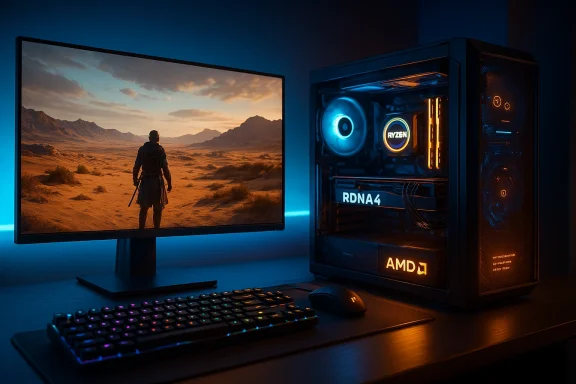
AMD’s latest retail push ties one of 2026’s most-anticipated open-world action/adventure releases to a hardware purchase: buy select AMD processors, Radeon GPUs, or qualifying Ryzen-equipped laptops from participating retailers between February 10 and April 25, 2026, and you’ll receive a redeemable code for Crimson Desert on PC — redeemable through AMD’s rewards flow until May 23, 2026.
Pearl Abyss’s Crimson Desert is launching as a visually ambitious single-player open-world action/adventure title, and AMD has tied the game’s PC release to a targeted hardware promotion that centers on its high-end Ryzen 9000 X3D CPUs and its new Radeon RX 9070 family. The bundle is a straightforward “buy eligible product, receive a coupon code” offer; major OEM and channel partners (MSI, Newegg, GIGABYTE and others) are participating in region-specific campaigns to distribute coupon codes at point of sale or via order confirmation.
This kind of manufacturer-backed game bundle isn’t new, but the scope and timing matter: Crimson Desert’s March 19, 2026 launch window means the promotion serves as both a launch incentive and a short-term boost for AMD hardware sales in the spring buying cycle. The campaign period and redemption deadline are explicit and tight — purchases must be made during the campaign window (Feb 10–Apr 25) and redeemed by May 23, 2026 — which places the emphasis on buying through participating channels and acting quickly to claim the code.
Why that matters to buyers of qualifying hardware:
Technically, the tie-in is sensible: Pearl Abyss’s intent to expose FSR Redstone features in Crimson Desert positions the title as a showcase for AMD’s machine-learning-driven GPU enhancements, and that helps AMD make the case for RDNA4 hardware beyond raw raster performance. However, the real user benefit will hinge on implementation quality and driver stability at launch — not on the press release. Early adopter caution is advised: expect staged feature rollouts, driver updates, and potential tuning after day one.
If you plan to buy into the promotion: verify retailer participation, keep documentation, budget for SSD-headroom, and remember that the free game is an add-on to what should primarily be a hardware-driven purchase decision. The code deadlines (purchase by April 25, redemption by May 23, 2026) mean there’s little time to hesitate if you want the bundled game.
In short: Crimson Desert is being used as a timely incentive for AMD’s high-end 2026 hardware, and the campaign is well scoped and tightly timed. For enthusiasts looking to pair bleeding-edge AMD features (X3D CPUs, RDNA4/GPU‑ML-powered FSR Redstone) with a new open-world release, the bundle is an efficient value add — but it’s not a substitute for shopping smart, confirming eligibility, and preparing your PC for a large SSD-based install and the early-driver dance that follows any major graphics feature rollout.
Source: Wccftech Crimson Desert AMD Game Bundle Announced - Get the Open World Game for Free by Purchasing AMD Hardware from Eligible Retailers
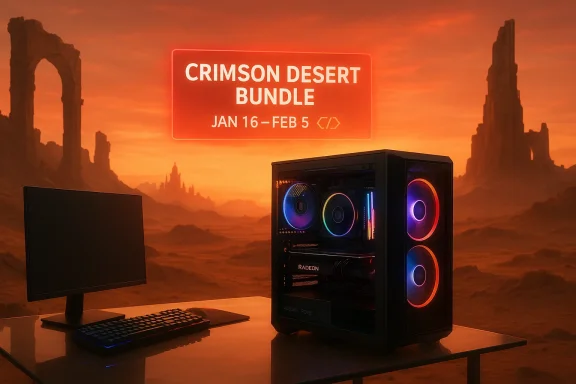 Background / Overview
Pearl Abyss’s Crimson Desert is launching as a visually ambitious single-player open-world action/adventure title, and AMD has tied the game’s PC release to a targeted hardware promotion that centers on its high-end Ryzen 9000 X3D CPUs and its new Radeon RX 9070 family. The bundle is a straightforward “buy eligible product, receive a coupon code” offer; major OEM and channel partners (MSI, Newegg, GIGABYTE and others) are participating in region-specific campaigns to distribute coupon codes at point of sale or via order confirmation. This kind of manufacturer-backed game bundle isn’t new, but the scope and timing matter: Crimson Desert’s March 19, 2026 launch window means the promotion serves as both a launch incentive and a short-term boost for AMD hardware sales in the spring buying cycle. The campaign period and redemption deadline are explicit and tight — purchases must be made during the campaign window (Feb 10–Apr 25) and redeemed by May 23, 2026 — which places the emphasis on buying through participating channels and acting quickly to claim the code.
What the bundle includes: qualifying hardware and OEM partners
Eligible desktop CPUs and GPUs (headline list)
AMD’s marketing and partner pages list the specific desktop SKUs that qualify for the Crimson Desert bundle. The key desktop qualifiers called out by OEM partners and retailers include:- AMD Ryzen™ 9 9950X3D
- AMD Ryzen™ 9 9900X3D
- AMD Ryzen™ 7 9850X3D
- AMD Ryzen™ 7 9800X3D
- AMD Radeon™ RX 9070 XT
- AMD Radeon™ RX 9070
Qualified laptops and Ryzen AI platforms
AMD and partners have also extended the promotion to select laptops that include Ryzen processors — a broad list of current gaming notebooks from major brands (Acer Nitro, ASUS TUF/ROG Strix, GIGABYTE AERO, HP OMEN, Lenovo Legion, MSI Raider, Razer Blade, etc.) are included, with qualifying models and Ryzen AI/9000/8000/7000 HX/X3D families enumerated in partner pages. This means both discrete-desktop buyers and gamers shopping for laptops can find eligible SKUs across multiple brands. Retailers and OEM pages emphasize that only select SKUs in each laptop family qualify; buyers should confirm the exact model and the promotional sticker or listing before purchase.Regional and retailer caveats
Participation varies by region and by retail channel. The campaign is global across most major markets (APJ, EMEA, India, LATAM, North America, Taiwan/HK) but explicitly excludes certain countries from the campaign in partner material. Partner sites and the AMD Rewards redemption flow are the definitive sources for which stores and SKUs are participating in each market; marketplace and third-party (non-participating) sellers are commonly excluded. The PR and OEM copy repeatedly instruct buyers to confirm eligibility at purchase and to verify whether the retailer will issue an AMD coupon code with the sale.How the redemption works — practical steps and things to watch for
- Buy an eligible product from a participating retailer during Feb 10 – Apr 25, 2026.
- Receive an AMD coupon code from the retailer (code distribution method depends on the seller: printed on the packing slip, emailed after purchase, provided at checkout, or available via retailer portal).
- Visit the AMD Rewards / AMD token redemption flow, sign in or create an AMD account, and register the coupon code to obtain the game activation key.
- Redeem the activation key on the store platform your edition uses (the partner materials and the AMD redemption flow will show whether the code maps to Steam, another PC storefront, or an AMD-specific distribution). Codes must be redeemed no later than May 23, 2026.
- Timing is strict. Campaign purchases outside the window generally do not qualify, though some partners will allow purchases made before the campaign to be included if the transaction’s invoice date falls inside the window — check the specific partner’s terms.
- Marketplace purchases (e.g., private sellers) are risky. Promotional copy from AMD partners explicitly warns that marketplace listings and non-participating third-party sellers may not distribute codes; if the bundle isn’t advertised at checkout or in the product listing, the purchase probably won’t qualify.
- Stock and allocation. Many cards and X3D CPUs are in tight supply at launch windows; availability on eligible SKUs can be limited and retailers may run out of the promotional stock or run separate “bundle while supplies last” terms. Confirm code issuance method at point of purchase.
The technical tie-in: FSR “Redstone” and what Pearl Abyss is promising
AMD’s promotional alignment with Pearl Abyss is not just marketing — Crimson Desert is being positioned as one of the first titles to expose the full suite of AMD’s recently rebranded FSR “Redstone” features in a meaningful way. According to developer/PR remarks reported in the trade press, Pearl Abyss intends to integrate multiple Redstone features including ML-based upscaling, frame generation, and the newer “ray regeneration” and radiance-caching features where appropriate. That makes Crimson Desert an important test case for AMD’s RDNA4-powered FSR Redstone stack.Why that matters to buyers of qualifying hardware:
- FSR Redstone is AMD’s machine-learning-driven graphics suite (it consolidates previous FSR versions into a platform that includes upscaler, frame generation, ray regeneration, and radiance caching). Early deployments are limited to RDNA4 GPUs for the ML-powered features, so the RX 9070 series cards are a natural focus. The tech can materially change perceived performance and ray-tracing fidelity when implemented well.
- Crimson Desert supporting Frame Generation and Ray Regeneration means that buyers with compatible Radeon RX 9000-series hardware could get a substantially smoother or higher-fidelity experience via AMD’s driver/SDK stack than older cards can provide — but only if the features are well-implemented and the developer’s implementation targets the performance/visual trade-offs correctly. Early reporting suggests Pearl Abyss intends to support competing solutions (for example, NVIDIA alternatives) where appropriate, so the experience might be multi-vendor friendly.
Verifying the PC system requirements — where reporting diverges
The Crimson Desert PC requirements have been published by Pearl Abyss and picked up by multiple outlets, but there is notable variance in the reported install size and which processors are named in “recommended” columns. Multiple outlets report the game’s minimum and recommended hardware as relatively accessible compared with the most extreme late‑2025 titles, with headlines similar to:- Minimum: OS: Windows 10 64-bit; CPU: Ryzen 5 2600X / i5-8500; Memory: 16 GB; GPU: GTX 1060 / RX 6500 XT; Storage: ≈100 GB (SSD recommended).
- Recommended: CPU/GPU pairings vary across reports (some outlets list Ryzen 7 7700X / i7-13700K with RTX 4070 SUPER / RX 7800 XT, others list Ryzen 5 5600 / i5-11600K paired with RTX 2080 / RX 6700 XT). The one stable number across sources is 16 GB of system RAM and the explicit recommendation to install on an SSD.
- Storage size: various outlets have listed the game’s install at 100 GB, 110 GB, or (in some dealer promo copy) as large as 135 GB. The larger 135 GB figure appears in some retailer-facing promotional copy and may include patch or unpacking overhead; Pearl Abyss’s published guidance has been cited as ~100 GB in developer-published materials. Because install sizes often expand with day-one patches and language packs, planning for extra headroom (an additional 20–40 GB) is prudent. Where Wccftech or other retail materials list “135 GB,” treat that as a practical upper-bound estimate rather than an immutable day‑one number — and double-check the developer support documentation or the Steam/retailer store page at time of install.
- Recommended CPU/GPU pairs: Some reports list high-end modern hardware (Ryzen 7 7700X / RTX 4070 SUPER) as recommended for higher-fidelity play, while others provide mid-range recommended pairings (Ryzen 5 5600 / RTX 2080). This variance likely stems from different editorial interpretations of “recommended” (comfort target at 60 FPS vs. high-fidelity presets). Until Pearl Abyss publishes an explicit multi-tier table (Minimum/Recommended/Ultra) that ties settings and framerates to the hardware examples, expect editorial variation.
Value analysis — is the bundle a good deal?
- Game price vs. hardware premium. Crimson Desert’s standard retail price sits in the typical $60–70 bracket for new PC AAA releases. The qualifying AMD parts (X3D Ryzen 9/7 and RX 9070-series) occupy a high-cost segment. For many buyers, the free game is a minor addition relative to the price of the qualifying hardware. That said, for buyers already planning a high-end CPU or GPU purchase, the bundle adds incremental value — particularly for gamers who wanted Crimson Desert anyway.
- Timing and bundled SKU availability. If you were already in-market for a Ryzen 9000 X3D CPU or an RX 9070 card, the bundle is “free money” — the game’s retail value is essentially a small rebate. However, if you’re buying hardware primarily to get the game (especially in the laptop space), you can often find cheaper configurations that still deliver a great Crimson Desert experience; verify that a lesser SKU is not eligible before paying a premium solely for the bundle.
- Second‑hand/code resale risk. The redemption code model means codes can be separated from hardware and resold independently; codes redeemed or resold outside official channels can be revoked by AMD or the publisher if fraud is suspected. Buying from non-participating channels with claims of “code included” is riskier than buying directly from an authorized retail partner or an OEM store.
- If the CPU/GPU/laptop is on your upgrade list and the price is reasonable, factor the free game into the value equation as an added bonus.
- If the hardware is a significant stretch and your only goal is access to Crimson Desert, look for sales, less expensive SKUs, or wait for standalone discounts — the incremental cost per game with top-tier hardware is usually several hundred dollars.
Retail and consumer pitfalls to watch for
- Retailer participation differences: Not every store listing for an eligible SKU will include the coupon code. The bundle’s promotional literature repeatedly emphasizes that buyers must confirm participation at purchase. If the product page or checkout does not display the promotional mention, the sale may not produce a code. Always get confirmation in writing or a promotional sticker on the order.
- Timing of code delivery: Different retailers deliver codes at different times (immediately at checkout, via order confirmation email, or after the order ships). If you don’t receive a code, the first point of contact is the retailer; if the retailer claims they issued one but you can’t find it, you’ll need to escalate to AMD Rewards with proof of purchase. Keep invoices and confirmation emails.
- Limited stock and bundle “while supplies last.” Popular GPUs and X3D CPUs have limited inventory during launch windows and promotions. If the bundle is advertised as limited, retailers may run out of promo-eligible units even if they still have the SKU in stock. Ask the seller whether the unit you are buying is an eligible promotional item before completing purchase.
- Regional restrictions and exclusions. Some territories and countries are excluded from the campaign; check your region’s campaign page carefully to be certain you’ll receive a coupon code.
What this means for hardware buyers and PC builders
- For enthusiasts upgrading to X3D CPUs or RDNA4 GPUs: The bundle is a practical bump in value and a marketing signal that Pearl Abyss is targeting AMD’s high-end hardware for the best visual experience (including Redstone features). If you want to experience FSR Redstone’s ray regeneration or frame generation in Crimson Desert, buying RDNA4 hardware (RX 9000 family) or AMD’s selected X3D CPUs aligns you with the developer’s tested target.
- For mainstream buyers: If your aim is a good 1080p/60 experience, you can likely get by with a mid-range GPU and an SSD; the added value of the high-end bundle diminishes if you don’t intend to use the extra GPU horsepower or X3D CPU performance. Verify whether a mid-tier SKU is eligible for any other offers before spending up for the Crimson Desert bundle alone.
- For laptop shoppers: The inclusion of select Ryzen-equipped laptops makes the promotion a legitimate perk for mobile buyers, but the model selection is narrow: only specific configurations qualify. Confirm the exact model and SKU before expecting a code.
Recommendations — how to buy wisely
- Confirm eligibility at purchase. Demand written confirmation (product page text, checkout banner, or e-receipt) that the unit is part of the Crimson Desert bundle. If the retailer’s product page doesn’t show the promo, ask customer support before you buy.
- Keep proof of purchase and watch for the code delivery window. Save invoices and emails; if the retailer is the distribution point for the coupon code, you’ll need the transaction record to escalate an issue.
- Budget for storage and an SSD install. Even conservative published requirements suggest ~100 GB of free space and an SSD recommended for best performance; leave an extra 20–40 GB of headroom for patches and unpacking overhead. If you’re bottlenecked on storage, upgrade to an NVMe SSD now rather than later.
- Plan for driver updates and Redstone feature toggles. If you buy RDNA4 hardware to use FSR Redstone features, expect AMD driver and game patches in the weeks after launch. Keep your system drivers current and check the game’s graphics settings after Day‑One patches land.
Final take — marketing, technology, and what to expect at launch
The Crimson Desert AMD Game Bundle is a classic hardware-marketing play: it bundles a high-profile new release with premium hardware to nudge purchase decisions during a short, focused campaign window. For gamers who were already targeting flagship Ryzen X3D CPUs or the new Radeon RX 9070 family, the free copy of Crimson Desert is welcome extra value. For buyers chasing a standalone game deal, it’s generally more cost-effective to shop the market for game discounts or wait for broader bundles unless you need the hardware itself.Technically, the tie-in is sensible: Pearl Abyss’s intent to expose FSR Redstone features in Crimson Desert positions the title as a showcase for AMD’s machine-learning-driven GPU enhancements, and that helps AMD make the case for RDNA4 hardware beyond raw raster performance. However, the real user benefit will hinge on implementation quality and driver stability at launch — not on the press release. Early adopter caution is advised: expect staged feature rollouts, driver updates, and potential tuning after day one.
If you plan to buy into the promotion: verify retailer participation, keep documentation, budget for SSD-headroom, and remember that the free game is an add-on to what should primarily be a hardware-driven purchase decision. The code deadlines (purchase by April 25, redemption by May 23, 2026) mean there’s little time to hesitate if you want the bundled game.
In short: Crimson Desert is being used as a timely incentive for AMD’s high-end 2026 hardware, and the campaign is well scoped and tightly timed. For enthusiasts looking to pair bleeding-edge AMD features (X3D CPUs, RDNA4/GPU‑ML-powered FSR Redstone) with a new open-world release, the bundle is an efficient value add — but it’s not a substitute for shopping smart, confirming eligibility, and preparing your PC for a large SSD-based install and the early-driver dance that follows any major graphics feature rollout.
Source: Wccftech Crimson Desert AMD Game Bundle Announced - Get the Open World Game for Free by Purchasing AMD Hardware from Eligible Retailers