

AMD and Intel have published a new ACE specification through the x86 Ecosystem Advisory Group in June 2026, defining shared x86 AI Compute Extensions for matrix multiplication, reduced-precision formats, and future CPU-side machine-learning acceleration. The move is less about replacing GPUs than about admitting that general-purpose CPUs can no longer treat AI math as somebody else’s problem. ACE is x86’s attempt to make matrix engines, tile state, and FP8/FP6/FP4-era formats part of the common platform rather than vendor-specific plumbing. If it works, the next phase of Windows and Linux AI PCs may depend less on whose accelerator sits beside the CPU and more on what the CPU itself can promise consistently.
For most of the last decade, the industry’s default answer to AI performance has been simple: use a GPU, an NPU, or a cloud accelerator. CPUs remained essential for orchestration, preprocessing, security boundaries, memory management, and fallback execution, but they were not where the glamour math happened. Neural networks turned matrix multiplication into the industry’s most valuable primitive, and the CPU was increasingly treated as the thing feeding data to something more specialized.
That division of labor made sense when AI workloads were either server-scale training jobs or carefully packaged inference workloads running on discrete accelerators. It makes less sense as AI moves into every layer of the client stack. Windows features, local copilots, on-device search, creative tools, security models, developer environments, and background classification pipelines all want some amount of machine-learning compute close to the operating system.
The awkward part is that the PC is not a datacenter rack. A consumer laptop or business desktop may have a GPU, an NPU, both, or neither. Even when the hardware exists, software support varies by vendor, driver, OS version, model format, memory topology, and framework. A CPU path that is merely “good enough” becomes strategically important because it is the path that almost always exists.
ACE is AMD and Intel’s answer to that pressure. It says the x86 CPU should not just dispatch AI work; it should gain a standardized matrix-compute vocabulary of its own.
But the first year of the group has produced a more concrete agenda than a normal standards press release. The named pillars — FRED, AVX10, ChkTag, and ACE — map directly onto the places where x86 needed modernization: event delivery, vector portability, memory safety, and matrix acceleration. That is not a random collection of acronyms. It is a checklist of the architecture’s most visible gaps.
ACE is the most symbolically important of the set because it addresses the AI-era question head-on. Intel already had AMX in server CPUs, but Intel-only features do not solve the cross-vendor software problem. AMD has its own accelerator strategy across GPUs, EPYC, Ryzen AI, and NPUs, but that does not give framework authors a single x86 matrix target. The lesson of x86’s past is that fragmentation can be just as damaging as absence.
The promise of ACE is not that AMD and Intel suddenly agree on microarchitecture. They will still compete on tile throughput, cache hierarchy, power behavior, scheduling, and which products expose which features first. The more meaningful shift is that they are trying to agree on the contract software sees.
That contract matters. Developers do not want to maintain an Intel AI path, an AMD AI path, a GPU path, an NPU path, a cloud path, and three fallbacks unless the prize is enormous. The entire point of a common ISA extension is to make the CPU backend boring enough to be useful.
Traditional SIMD extensions such as AVX and AVX-512 can perform matrix operations, but they do so through vector instructions that are not shaped around matrix tiles as first-class objects. That works, and highly optimized libraries can wring impressive performance out of vector units. But it is not the same as giving the CPU an explicit matrix engine with tile registers, state management, and instructions designed around the dataflow of multiplication and accumulation.
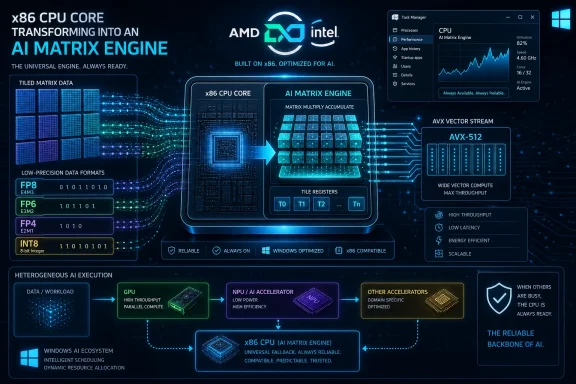
ACE introduces that missing architectural vocabulary. The specification describes new ACE register state, including tile and block-scale registers, operations that consume AVX register input and operate on ACE tile state, data movement between ACE and AVX registers, and system-management mechanisms to make the feature manageable by operating systems and hypervisors. In plain English: ACE is not just “more AVX.” It is an attempt to bolt a matrix-compute subsystem onto x86 in a way that remains tightly connected to the existing vector world.
That tight connection to AVX is important. AI workloads are not pure matrix multiplication from beginning to end. They involve format conversion, normalization, activation functions, memory rearrangement, quantization, dequantization, and scalar control logic. A matrix engine that cannot cooperate cleanly with vector code risks becoming a high-throughput island surrounded by software overhead.
ACE tries to avoid that by treating matrix acceleration and AVX data processing as complementary rather than separate kingdoms. The tile engine does the dense multiply work; AVX remains useful for the messy surrounding operations. If that balance holds in real silicon, CPU-side inference could become less of a fallback and more of a viable tier in heterogeneous AI execution.
That alphabet soup tells a larger story. AI performance is no longer just about doing floating-point math faster; it is about doing less precise math accurately enough, at much higher density, with less bandwidth and lower energy. Modern inference increasingly depends on quantized models where weights and activations can be represented in 8-bit, 6-bit, or even 4-bit forms. The payoff is simple: more model data fits in cache and memory bandwidth goes further.
The industry has already moved in this direction on GPUs. FP8 support became a headline feature in modern accelerator platforms, and newer designs have pushed further into block-scaled and microscaling formats. These formats are not merely smaller numbers; they often rely on shared scaling metadata to preserve useful dynamic range while keeping per-value storage tiny.
That is where ACE’s block-scale registers and OCP-style microscaling support become interesting. They suggest AMD and Intel are not merely adding a basic matrix multiply instruction and calling it AI-ready. They are aligning the CPU ISA with the formats that machine-learning frameworks and model compression pipelines are actually using.
For Windows users, the implications are subtle but real. A future laptop CPU with ACE support could run smaller local models more efficiently when the NPU is busy, unavailable, underpowered, unsupported by a given framework, or intentionally bypassed for security or compatibility reasons. For servers, ACE could improve CPU inference density for workloads where sending everything to a GPU is too expensive, too latent, or operationally awkward.
This is not magic. Low precision still requires careful calibration, runtime support, and model-aware implementation. But making these formats visible in a common x86 extension gives compilers and libraries a target that looks less like a hack and more like a platform.
Arm-based platforms often pitch themselves around efficiency, integration, and purpose-built acceleration. Apple’s client machines combine CPU, GPU, Neural Engine, unified memory, and OS-level frameworks into a tightly managed stack. Qualcomm’s Windows push leans on NPU performance and battery life. Cloud vendors with Arm or custom silicon can design around specific workloads without waiting for the PC ecosystem to agree.
x86’s traditional strength is different. It wins on compatibility, software depth, vendor competition, and decades of optimization. But those advantages can become liabilities when the workload changes quickly. If every vendor exposes AI acceleration differently, software moves toward abstraction layers, vendor runtimes, or accelerator-specific paths. The CPU ISA becomes less central.
ACE is a bid to keep x86 central by giving AI software a reason to care about the CPU instruction set again. It does not have to beat a high-end GPU to matter. It has to be common, predictable, virtualizable, debuggable, and good enough to justify library support.
That is why AMD and Intel cooperating here is more important than either company’s individual feature set. Intel-only AMX helped Intel servers, but it did not automatically define the future of x86. An AMD-and-Intel-backed ACE has a better chance of becoming something frameworks can assume will spread across the market over time.
The enemy is not Arm alone. The enemy is irrelevance at the layer where developers make portable decisions.
The path from ACE specification to visible performance goes through several bottlenecks. Silicon has to implement it. Firmware has to expose it correctly. Operating systems have to save, restore, schedule, and virtualize the new state. Compilers, debuggers, profilers, math libraries, and machine-learning runtimes have to learn how to target it. Application developers then have to ship code that calls into those libraries or frameworks.
Windows has navigated this pattern before with SSE, AVX, AVX2, AVX-512, virtualization extensions, security features, and platform-management capabilities. The feature may be architecturally elegant and still sit unused if software does not detect it safely or if the performance gain is too inconsistent. In the AI era, that problem is compounded by the presence of NPUs and GPUs that may already be the preferred execution target.
Microsoft’s role will be decisive. Windows increasingly presents AI capability through higher-level APIs and runtime decisions rather than asking every app to hand-pick instructions. If ACE becomes another backend available to ONNX Runtime, DirectML-adjacent paths, PyTorch builds, TensorFlow builds, or vendor libraries, users may benefit without ever seeing the acronym. If ACE remains a niche instruction path used only by specialized libraries, its impact will be narrower.
There is also a security and context-switching angle. Tile state is state, and state has to be managed. Operating systems and hypervisors need clear rules for enabling, saving, restoring, and isolating architectural extensions. The more powerful CPU-side AI engines become, the more important it is that they behave like first-class citizens in multitasking and virtualized environments.
The glamour of ACE is matrix throughput. The practical success of ACE will depend on boring OS details.
AVX10 is the cleanup attempt for a vector-extension history that became too fragmented. AVX-512’s uneven client support, frequency behavior, and vendor split left developers wary of assuming too much. A more portable AVX10 roadmap gives x86 a cleaner vector story, which ACE can then extend into matrix acceleration.
FRED, or Flexible Return and Event Delivery, addresses the machinery of interrupts and transitions. That may sound distant from AI, but modern systems spend enormous time moving among privilege levels, threads, guests, kernels, and services. Cleaner event delivery is part of reducing platform overhead in a world where performance is not just about peak instructions per cycle.
ChkTag is the security pillar. Memory tagging is one of the areas where Arm has had a clear architectural story, and x86 needed a response to the continuing reality of memory-safety bugs. If x86 wants to remain the default for client and server computing, it cannot treat memory safety as merely a compiler or language problem.
Together, these features show a wider strategic correction. AMD and Intel are trying to make x86 look less like a legacy ISA accreting vendor extensions and more like a governed platform with shared priorities. That is a profound change in tone for two companies whose historic rivalry often produced incompatible or unevenly adopted features.
The catch is that a roadmap is not a product. The industry has seen ambitious ISA plans before. What matters now is whether these extensions arrive across enough CPUs, with enough consistency, soon enough for developers to care.
The modern AI PC is not one accelerator. It is a scheduling problem. Some workloads fit an NPU because they are steady, efficient, and supported by the vendor’s stack. Some fit the GPU because they need throughput and memory bandwidth. Some fit the CPU because they are small, branchy, latency-sensitive, security-sensitive, or entangled with ordinary application logic.
ACE strengthens that third category. It gives the CPU more ability to handle matrix-heavy work without punting everything to another device. That can matter for fallback paths, model fragments, preprocessing, postprocessing, or cases where moving data to an accelerator costs more than doing the work locally.
It may also matter for privacy and enterprise policy. Organizations deploying local AI tools will care where model execution occurs, which drivers are involved, whether the path is supported under virtualization, and how the workload behaves under endpoint security controls. A standardized CPU path can be easier to reason about than a maze of device-specific runtimes.
None of this means CPUs will dominate high-end AI. They will not. GPUs and dedicated accelerators are built for scale and will continue to own training and large inference. But in client systems and many server niches, there is enormous value in raising the floor.
ACE is about that floor. It is x86 saying the baseline machine should not be helpless when the workload includes neural-network math.
The most successful CPU extensions disappear into libraries. Few users know which exact vector path their video encoder, browser, compression tool, database, or game engine is using. They just notice that one CPU generation is faster than another, or that a software update suddenly performs better on hardware that already existed.
ACE will need the same treatment. If NumPy, SciPy, BLAS implementations, oneDNN-style libraries, PyTorch, TensorFlow, ONNX Runtime, and compiler toolchains can target ACE cleanly, the feature becomes part of the invisible performance substrate. If developers have to write bespoke ACE code by hand, adoption will be slower and narrower.
The specification’s mention of software enablement is therefore not boilerplate. AI acceleration is a stack problem. Hardware that supports FP4 matrix operations is useful only if model tooling can quantize appropriately, runtime kernels can dispatch correctly, and profilers can show developers what happened.
This is where AMD and Intel’s cooperation has to extend beyond ISA documents. The two companies need aligned discovery mechanisms, consistent compiler support, testable behavior, and enough public documentation for open-source maintainers to implement support without living inside vendor NDA programs. Linux and Windows ecosystems both depend on that kind of transparency.
The x86 world has one major advantage here: its software base is enormous. If ACE becomes a reliable target, the performance gains can propagate through countless applications indirectly. But that advantage turns into inertia if the feature arrives unevenly or too late.
The first question is lifecycle. Which CPU generations will support ACE, and in which product tiers? If the feature is confined to premium laptops or high-end server SKUs for several years, enterprise software vendors will be cautious about depending on it. If it spreads quickly across mainstream Ryzen, Core, Xeon, and EPYC families, it becomes more interesting.
The second question is virtualization. AI workloads increasingly run in containers, virtual machines, remote desktops, and managed endpoint environments. New architectural state has to be exposed safely through hypervisors, and administrators need policy controls for when it is enabled. A feature that works beautifully on bare metal but disappears in VMs will have a smaller enterprise footprint.
The third question is observability. IT teams need to know when applications are using CPU AI paths, how much power they consume, whether they affect thermals, and how they interact with battery policies. If local AI features quietly hammer matrix units in the background, laptop fleet behavior could change in ways help desks will notice before executives do.
The fourth question is patching. New CPU features intersect with microcode, firmware, operating systems, and runtimes. The more complex the acceleration path, the more likely it is that early deployments will involve errata, feature flags, and version dependencies. Enterprises will not rush to enable a shiny AI path unless the management story is credible.
That skepticism is healthy. ACE’s success should be measured not only by benchmark slides but by whether it survives contact with managed Windows environments.
Those numbers will matter, but they will not tell the whole story. The most important question is not whether a future CPU can post a dramatic speedup over scalar or conventional vector code. Of course it can, if the workload is shaped correctly. The important question is whether ACE gives developers a stable enough target to include in default builds and whether operating systems can schedule it without drama.
A modest but consistent speedup available across millions of machines can matter more than an enormous speedup confined to one product line. This is especially true for Windows software, where developers often target the broad install base rather than the most advanced hardware. The PC ecosystem rewards features that become assumptions.
That is where AVX-512 offers a cautionary tale. Technically impressive extensions can struggle when support is uneven, client availability changes, or developers cannot count on the feature being present. ACE’s cross-vendor origin is an attempt to avoid that fate before it starts.
Still, cross-vendor does not automatically mean universal. AMD and Intel may implement different subsets, ship on different schedules, or vary performance dramatically. The spec’s flexibility may help silicon designers, but too much variability could make software authors conservative.
The cleanest outcome would be simple: detect ACE, run a well-maintained library path, and get predictable acceleration. Anything more complicated will slow adoption.
Local transcription, image tagging, semantic search, code completion, document classification, spam detection, accessibility features, and security analysis often do not need datacenter-scale acceleration. They need predictable latency, acceptable power draw, and enough performance to avoid making the user wait. Many of these workloads also benefit from quantization, which aligns neatly with ACE’s low-precision emphasis.
This matters for Windows because the OS is becoming a host for many AI-adjacent tasks rather than one big AI application. Some features will run on NPUs. Some will run in the cloud. Some will use GPUs. But a common CPU path gives Microsoft, OEMs, and app developers another tool for systems that lack ideal accelerator support.
There is also a developer-machine angle. Many programmers experiment locally before deploying elsewhere. If ordinary x86 CPUs become better at running reduced-precision matrix kernels, local testing and lightweight inference become smoother. That does not replace cloud GPUs, but it reduces friction.
The irony is that ACE may be most valuable when users never know it is there. The best case is not a sticker on a laptop palm rest. It is a feature that makes AI workloads feel less special and more like ordinary software.
ACE points toward a more mature phase. Instead of asking whether a PC has a particular accelerator block, the ecosystem can begin asking what baseline AI primitives the platform exposes. Matrix multiply, reduced precision, memory safety, event delivery, and vector portability are not marketing categories. They are the raw materials from which reliable software platforms are built.
That does not make ACE glamorous. In fact, the whole point of a good ISA extension is that it should become dull. Nobody wants to think about tile registers while using a photo editor or running a local assistant. They want the system to be fast, quiet, compatible, and secure.
The danger is that the industry keeps overselling AI hardware before the software foundation is ready. ACE is not a reason to delay buying a PC today, nor is it proof that future CPUs will make discrete accelerators irrelevant. It is a sign that AMD and Intel understand the baseline is moving.
For Windows users, that baseline matters because it determines what developers can assume. The more consistent the assumption, the more likely useful features ship broadly rather than only on carefully blessed hardware.
 x86’s AI Problem Is No Longer Theoretical
For most of the last decade, the industry’s default answer to AI performance has been simple: use a GPU, an NPU, or a cloud accelerator. CPUs remained essential for orchestration, preprocessing, security boundaries, memory management, and fallback execution, but they were not where the glamour math happened. Neural networks turned matrix multiplication into the industry’s most valuable primitive, and the CPU was increasingly treated as the thing feeding data to something more specialized.That division of labor made sense when AI workloads were either server-scale training jobs or carefully packaged inference workloads running on discrete accelerators. It makes less sense as AI moves into every layer of the client stack. Windows features, local copilots, on-device search, creative tools, security models, developer environments, and background classification pipelines all want some amount of machine-learning compute close to the operating system.
The awkward part is that the PC is not a datacenter rack. A consumer laptop or business desktop may have a GPU, an NPU, both, or neither. Even when the hardware exists, software support varies by vendor, driver, OS version, model format, memory topology, and framework. A CPU path that is merely “good enough” becomes strategically important because it is the path that almost always exists.
ACE is AMD and Intel’s answer to that pressure. It says the x86 CPU should not just dispatch AI work; it should gain a standardized matrix-compute vocabulary of its own.
The Advisory Group Is Becoming More Than Diplomatic Theater
When AMD and Intel announced the x86 Ecosystem Advisory Group in October 2024, it was easy to read the move as defensive branding. Arm was ascendant in mobile and server conversations. Apple had already demonstrated what tight hardware-software integration could do for client computing. Qualcomm was pushing Windows on Arm harder. Cloud providers were building or buying custom silicon. The two historic x86 rivals had every incentive to tell developers that x86 still had a future.But the first year of the group has produced a more concrete agenda than a normal standards press release. The named pillars — FRED, AVX10, ChkTag, and ACE — map directly onto the places where x86 needed modernization: event delivery, vector portability, memory safety, and matrix acceleration. That is not a random collection of acronyms. It is a checklist of the architecture’s most visible gaps.
ACE is the most symbolically important of the set because it addresses the AI-era question head-on. Intel already had AMX in server CPUs, but Intel-only features do not solve the cross-vendor software problem. AMD has its own accelerator strategy across GPUs, EPYC, Ryzen AI, and NPUs, but that does not give framework authors a single x86 matrix target. The lesson of x86’s past is that fragmentation can be just as damaging as absence.
The promise of ACE is not that AMD and Intel suddenly agree on microarchitecture. They will still compete on tile throughput, cache hierarchy, power behavior, scheduling, and which products expose which features first. The more meaningful shift is that they are trying to agree on the contract software sees.
That contract matters. Developers do not want to maintain an Intel AI path, an AMD AI path, a GPU path, an NPU path, a cloud path, and three fallbacks unless the prize is enormous. The entire point of a common ISA extension is to make the CPU backend boring enough to be useful.
ACE Puts Matrix Math Where Software Can Count on It
The technical center of ACE is matrix multiplication, the operation at the heart of neural networks and large language models. Matrix multiply is not just one workload among many in AI; it is the workload around which modern accelerators have been architected. NVIDIA’s Tensor Cores, Apple’s Neural Engine, Intel’s AMX, AMD’s GPU matrix instructions, and many NPUs all exist because dense linear algebra dominates inference and training performance.Traditional SIMD extensions such as AVX and AVX-512 can perform matrix operations, but they do so through vector instructions that are not shaped around matrix tiles as first-class objects. That works, and highly optimized libraries can wring impressive performance out of vector units. But it is not the same as giving the CPU an explicit matrix engine with tile registers, state management, and instructions designed around the dataflow of multiplication and accumulation.
ACE introduces that missing architectural vocabulary. The specification describes new ACE register state, including tile and block-scale registers, operations that consume AVX register input and operate on ACE tile state, data movement between ACE and AVX registers, and system-management mechanisms to make the feature manageable by operating systems and hypervisors. In plain English: ACE is not just “more AVX.” It is an attempt to bolt a matrix-compute subsystem onto x86 in a way that remains tightly connected to the existing vector world.
That tight connection to AVX is important. AI workloads are not pure matrix multiplication from beginning to end. They involve format conversion, normalization, activation functions, memory rearrangement, quantization, dequantization, and scalar control logic. A matrix engine that cannot cooperate cleanly with vector code risks becoming a high-throughput island surrounded by software overhead.
ACE tries to avoid that by treating matrix acceleration and AVX data processing as complementary rather than separate kingdoms. The tile engine does the dense multiply work; AVX remains useful for the messy surrounding operations. If that balance holds in real silicon, CPU-side inference could become less of a fallback and more of a viable tier in heterogeneous AI execution.
Low Precision Is the Real AI Native Language
The most revealing part of ACE is not simply that it accelerates matrices. It is that the specification embraces the low-precision formats that now define practical AI compute. The document’s format list includes familiar types such as INT8, INT32, FP32, BF16, and FP16, but the strategic turn is in FP8, MX FP8, MX FP6, MX FP4, and MX INT8-style formats.That alphabet soup tells a larger story. AI performance is no longer just about doing floating-point math faster; it is about doing less precise math accurately enough, at much higher density, with less bandwidth and lower energy. Modern inference increasingly depends on quantized models where weights and activations can be represented in 8-bit, 6-bit, or even 4-bit forms. The payoff is simple: more model data fits in cache and memory bandwidth goes further.
The industry has already moved in this direction on GPUs. FP8 support became a headline feature in modern accelerator platforms, and newer designs have pushed further into block-scaled and microscaling formats. These formats are not merely smaller numbers; they often rely on shared scaling metadata to preserve useful dynamic range while keeping per-value storage tiny.
That is where ACE’s block-scale registers and OCP-style microscaling support become interesting. They suggest AMD and Intel are not merely adding a basic matrix multiply instruction and calling it AI-ready. They are aligning the CPU ISA with the formats that machine-learning frameworks and model compression pipelines are actually using.
For Windows users, the implications are subtle but real. A future laptop CPU with ACE support could run smaller local models more efficiently when the NPU is busy, unavailable, underpowered, unsupported by a given framework, or intentionally bypassed for security or compatibility reasons. For servers, ACE could improve CPU inference density for workloads where sending everything to a GPU is too expensive, too latent, or operationally awkward.
This is not magic. Low precision still requires careful calibration, runtime support, and model-aware implementation. But making these formats visible in a common x86 extension gives compilers and libraries a target that looks less like a hack and more like a platform.
This Is Also an Arm Story, Even When Nobody Says Arm
The Wccftech framing calls ACE a way for AMD and Intel to “arm x86 against the AI gap,” and that wording captures the market subtext. This is not only a technical exercise. It is x86 responding to a world in which competitors have been able to sell architectural coherence as much as raw performance.Arm-based platforms often pitch themselves around efficiency, integration, and purpose-built acceleration. Apple’s client machines combine CPU, GPU, Neural Engine, unified memory, and OS-level frameworks into a tightly managed stack. Qualcomm’s Windows push leans on NPU performance and battery life. Cloud vendors with Arm or custom silicon can design around specific workloads without waiting for the PC ecosystem to agree.
x86’s traditional strength is different. It wins on compatibility, software depth, vendor competition, and decades of optimization. But those advantages can become liabilities when the workload changes quickly. If every vendor exposes AI acceleration differently, software moves toward abstraction layers, vendor runtimes, or accelerator-specific paths. The CPU ISA becomes less central.
ACE is a bid to keep x86 central by giving AI software a reason to care about the CPU instruction set again. It does not have to beat a high-end GPU to matter. It has to be common, predictable, virtualizable, debuggable, and good enough to justify library support.
That is why AMD and Intel cooperating here is more important than either company’s individual feature set. Intel-only AMX helped Intel servers, but it did not automatically define the future of x86. An AMD-and-Intel-backed ACE has a better chance of becoming something frameworks can assume will spread across the market over time.
The enemy is not Arm alone. The enemy is irrelevance at the layer where developers make portable decisions.
Windows Will Need More Than a New Instruction Set
For WindowsForum readers, the natural question is what this means for the PC in front of them. The honest answer is: probably nothing immediately, and potentially a lot later. Instruction-set extensions usually arrive years before they become broadly useful to normal users.The path from ACE specification to visible performance goes through several bottlenecks. Silicon has to implement it. Firmware has to expose it correctly. Operating systems have to save, restore, schedule, and virtualize the new state. Compilers, debuggers, profilers, math libraries, and machine-learning runtimes have to learn how to target it. Application developers then have to ship code that calls into those libraries or frameworks.
Windows has navigated this pattern before with SSE, AVX, AVX2, AVX-512, virtualization extensions, security features, and platform-management capabilities. The feature may be architecturally elegant and still sit unused if software does not detect it safely or if the performance gain is too inconsistent. In the AI era, that problem is compounded by the presence of NPUs and GPUs that may already be the preferred execution target.
Microsoft’s role will be decisive. Windows increasingly presents AI capability through higher-level APIs and runtime decisions rather than asking every app to hand-pick instructions. If ACE becomes another backend available to ONNX Runtime, DirectML-adjacent paths, PyTorch builds, TensorFlow builds, or vendor libraries, users may benefit without ever seeing the acronym. If ACE remains a niche instruction path used only by specialized libraries, its impact will be narrower.
There is also a security and context-switching angle. Tile state is state, and state has to be managed. Operating systems and hypervisors need clear rules for enabling, saving, restoring, and isolating architectural extensions. The more powerful CPU-side AI engines become, the more important it is that they behave like first-class citizens in multitasking and virtualized environments.
The glamour of ACE is matrix throughput. The practical success of ACE will depend on boring OS details.
AVX10, FRED, ChkTag, and ACE Are One Modernization Campaign
ACE should not be viewed in isolation. The x86 Ecosystem Advisory Group’s other pillars help explain why AMD and Intel are grouping these changes together.AVX10 is the cleanup attempt for a vector-extension history that became too fragmented. AVX-512’s uneven client support, frequency behavior, and vendor split left developers wary of assuming too much. A more portable AVX10 roadmap gives x86 a cleaner vector story, which ACE can then extend into matrix acceleration.
FRED, or Flexible Return and Event Delivery, addresses the machinery of interrupts and transitions. That may sound distant from AI, but modern systems spend enormous time moving among privilege levels, threads, guests, kernels, and services. Cleaner event delivery is part of reducing platform overhead in a world where performance is not just about peak instructions per cycle.
ChkTag is the security pillar. Memory tagging is one of the areas where Arm has had a clear architectural story, and x86 needed a response to the continuing reality of memory-safety bugs. If x86 wants to remain the default for client and server computing, it cannot treat memory safety as merely a compiler or language problem.
Together, these features show a wider strategic correction. AMD and Intel are trying to make x86 look less like a legacy ISA accreting vendor extensions and more like a governed platform with shared priorities. That is a profound change in tone for two companies whose historic rivalry often produced incompatible or unevenly adopted features.
The catch is that a roadmap is not a product. The industry has seen ambitious ISA plans before. What matters now is whether these extensions arrive across enough CPUs, with enough consistency, soon enough for developers to care.
The CPU Is Becoming an AI Safety Net, Not an AI Island
There is a temptation to frame ACE as AMD and Intel trying to turn the CPU into an NPU. That is the wrong way to read it. ACE is better understood as making the CPU a credible AI participant inside a heterogeneous system.The modern AI PC is not one accelerator. It is a scheduling problem. Some workloads fit an NPU because they are steady, efficient, and supported by the vendor’s stack. Some fit the GPU because they need throughput and memory bandwidth. Some fit the CPU because they are small, branchy, latency-sensitive, security-sensitive, or entangled with ordinary application logic.
ACE strengthens that third category. It gives the CPU more ability to handle matrix-heavy work without punting everything to another device. That can matter for fallback paths, model fragments, preprocessing, postprocessing, or cases where moving data to an accelerator costs more than doing the work locally.
It may also matter for privacy and enterprise policy. Organizations deploying local AI tools will care where model execution occurs, which drivers are involved, whether the path is supported under virtualization, and how the workload behaves under endpoint security controls. A standardized CPU path can be easier to reason about than a maze of device-specific runtimes.
None of this means CPUs will dominate high-end AI. They will not. GPUs and dedicated accelerators are built for scale and will continue to own training and large inference. But in client systems and many server niches, there is enormous value in raising the floor.
ACE is about that floor. It is x86 saying the baseline machine should not be helpless when the workload includes neural-network math.
Developers Will Decide Whether ACE Becomes Real
Instruction sets do not become important because architects publish PDFs. They become important when developers stop thinking about them.The most successful CPU extensions disappear into libraries. Few users know which exact vector path their video encoder, browser, compression tool, database, or game engine is using. They just notice that one CPU generation is faster than another, or that a software update suddenly performs better on hardware that already existed.
ACE will need the same treatment. If NumPy, SciPy, BLAS implementations, oneDNN-style libraries, PyTorch, TensorFlow, ONNX Runtime, and compiler toolchains can target ACE cleanly, the feature becomes part of the invisible performance substrate. If developers have to write bespoke ACE code by hand, adoption will be slower and narrower.
The specification’s mention of software enablement is therefore not boilerplate. AI acceleration is a stack problem. Hardware that supports FP4 matrix operations is useful only if model tooling can quantize appropriately, runtime kernels can dispatch correctly, and profilers can show developers what happened.
This is where AMD and Intel’s cooperation has to extend beyond ISA documents. The two companies need aligned discovery mechanisms, consistent compiler support, testable behavior, and enough public documentation for open-source maintainers to implement support without living inside vendor NDA programs. Linux and Windows ecosystems both depend on that kind of transparency.
The x86 world has one major advantage here: its software base is enormous. If ACE becomes a reliable target, the performance gains can propagate through countless applications indirectly. But that advantage turns into inertia if the feature arrives unevenly or too late.
Enterprise IT Will Ask the Unfashionable Questions
Sysadmins and IT decision-makers are not paid to admire instruction sets. They are paid to keep fleets stable, supportable, secure, and cost-effective. For them, ACE raises a different set of questions than it does for chip architects.The first question is lifecycle. Which CPU generations will support ACE, and in which product tiers? If the feature is confined to premium laptops or high-end server SKUs for several years, enterprise software vendors will be cautious about depending on it. If it spreads quickly across mainstream Ryzen, Core, Xeon, and EPYC families, it becomes more interesting.
The second question is virtualization. AI workloads increasingly run in containers, virtual machines, remote desktops, and managed endpoint environments. New architectural state has to be exposed safely through hypervisors, and administrators need policy controls for when it is enabled. A feature that works beautifully on bare metal but disappears in VMs will have a smaller enterprise footprint.
The third question is observability. IT teams need to know when applications are using CPU AI paths, how much power they consume, whether they affect thermals, and how they interact with battery policies. If local AI features quietly hammer matrix units in the background, laptop fleet behavior could change in ways help desks will notice before executives do.
The fourth question is patching. New CPU features intersect with microcode, firmware, operating systems, and runtimes. The more complex the acceleration path, the more likely it is that early deployments will involve errata, feature flags, and version dependencies. Enterprises will not rush to enable a shiny AI path unless the management story is credible.
That skepticism is healthy. ACE’s success should be measured not only by benchmark slides but by whether it survives contact with managed Windows environments.
The Benchmark Slides Will Be Less Important Than the Compatibility Story
There will be numbers. There are always numbers. Vendors will eventually show ACE acceleration ratios, matrix throughput comparisons, energy-per-token claims, and carefully selected AI demos that make the feature look indispensable.Those numbers will matter, but they will not tell the whole story. The most important question is not whether a future CPU can post a dramatic speedup over scalar or conventional vector code. Of course it can, if the workload is shaped correctly. The important question is whether ACE gives developers a stable enough target to include in default builds and whether operating systems can schedule it without drama.
A modest but consistent speedup available across millions of machines can matter more than an enormous speedup confined to one product line. This is especially true for Windows software, where developers often target the broad install base rather than the most advanced hardware. The PC ecosystem rewards features that become assumptions.
That is where AVX-512 offers a cautionary tale. Technically impressive extensions can struggle when support is uneven, client availability changes, or developers cannot count on the feature being present. ACE’s cross-vendor origin is an attempt to avoid that fate before it starts.
Still, cross-vendor does not automatically mean universal. AMD and Intel may implement different subsets, ship on different schedules, or vary performance dramatically. The spec’s flexibility may help silicon designers, but too much variability could make software authors conservative.
The cleanest outcome would be simple: detect ACE, run a well-maintained library path, and get predictable acceleration. Anything more complicated will slow adoption.
The Small Models Are Where ACE Could Bite First
The most immediate opportunity for CPU matrix extensions is not running giant frontier models on a laptop CPU. That fantasy keeps reappearing because it is easy to imagine and hard to deliver. The more realistic target is the fast-growing universe of smaller models and model components that sit close to applications.Local transcription, image tagging, semantic search, code completion, document classification, spam detection, accessibility features, and security analysis often do not need datacenter-scale acceleration. They need predictable latency, acceptable power draw, and enough performance to avoid making the user wait. Many of these workloads also benefit from quantization, which aligns neatly with ACE’s low-precision emphasis.
This matters for Windows because the OS is becoming a host for many AI-adjacent tasks rather than one big AI application. Some features will run on NPUs. Some will run in the cloud. Some will use GPUs. But a common CPU path gives Microsoft, OEMs, and app developers another tool for systems that lack ideal accelerator support.
There is also a developer-machine angle. Many programmers experiment locally before deploying elsewhere. If ordinary x86 CPUs become better at running reduced-precision matrix kernels, local testing and lightweight inference become smoother. That does not replace cloud GPUs, but it reduces friction.
The irony is that ACE may be most valuable when users never know it is there. The best case is not a sticker on a laptop palm rest. It is a feature that makes AI workloads feel less special and more like ordinary software.
The AI PC Needs a Baseline More Than Another Badge
The PC industry has spent the last few years inventing AI badges. TOPS numbers, NPU requirements, Copilot branding, model demos, and accelerator claims have become part of the sales language. Some of that is useful. Much of it is confusing.ACE points toward a more mature phase. Instead of asking whether a PC has a particular accelerator block, the ecosystem can begin asking what baseline AI primitives the platform exposes. Matrix multiply, reduced precision, memory safety, event delivery, and vector portability are not marketing categories. They are the raw materials from which reliable software platforms are built.
That does not make ACE glamorous. In fact, the whole point of a good ISA extension is that it should become dull. Nobody wants to think about tile registers while using a photo editor or running a local assistant. They want the system to be fast, quiet, compatible, and secure.
The danger is that the industry keeps overselling AI hardware before the software foundation is ready. ACE is not a reason to delay buying a PC today, nor is it proof that future CPUs will make discrete accelerators irrelevant. It is a sign that AMD and Intel understand the baseline is moving.
For Windows users, that baseline matters because it determines what developers can assume. The more consistent the assumption, the more likely useful features ship broadly rather than only on carefully blessed hardware.
The ACE Bet Comes Down to Five Practical Tests
ACE is an important architectural signal, but its importance will depend on execution rather than acronym density. The next few years will show whether AMD and Intel can turn a shared specification into a shared platform that software trusts.- ACE gives x86 a common matrix-compute target instead of leaving CPU-side AI acceleration to vendor-specific implementations.
- The inclusion of FP8, microscaled FP6, FP4, and related low-precision formats shows that AMD and Intel are designing for modern inference economics, not just traditional floating-point throughput.
- Windows will benefit only if Microsoft, compiler vendors, libraries, and machine-learning runtimes make ACE a normal backend rather than a specialist feature.
- Enterprise adoption will depend on virtualization, fleet visibility, power behavior, firmware maturity, and predictable product availability across mainstream CPU lines.
- ACE will not replace GPUs or NPUs, but it can make the CPU a stronger fallback and coordination point for local AI workloads.
- The feature’s real success will be measured by whether developers can rely on it across both AMD and Intel systems without writing two different stories.
References
- Primary source: Wccftech
Published: Fri, 19 Jun 2026 12:05:00 GMT
AMD and Intel arm x86 against the AI gap with ACE, baking matrix-multiply engines & low-precision formats straight into future CPUs
ACE, the upcoming set of x86 Extensions defined by both AMD & Intel, has seen the latest spec release, focusing on AI acceleration.wccftech.com
- Related coverage: phoronix.com
AMD & Intel Mark x86 Ecosystem Advisory Group's Anniversary: FRED, ACE, AVX10, ChkTag - Phoronix
It's been one year already since Intel and AMD formed the x86 Ecosystem Advisory Group in cooperation with other industry stakeholderswww.phoronix.com
- Related coverage: tomshardware.com
AMD and Intel celebrate first anniversary of x86 alliance — new security features coming to x86 CPUs | Tom's Hardware
The x86 Ecosystem Advisory Group turns one year old.www.tomshardware.com - Related coverage: download.intel.com
- Related coverage: revistacloud.com
AMD e Intel celebran el primer año del x86 Ecosystem Advisory Group con cuatro hitos de estandarización: FRED, AVX10, ChkTag y ACE - Revista Cloud
AMD e Intel han cumplido el primer año del x86 Ecosystem Advisory Group (EAG), la iniciativa conjunta creada en octubre de 2024 para reforzar el futuro del cómputo x86 con decisión colaborativa, funciones estandarizadas e innovación amigable para desarrolladores. El mensaje de ambos: más...revistacloud.com - Related coverage: etude.lu
AMD and Intel Co-Author x86 ACE Matrix Instructions, Claiming a 16× AI-Performance Leap — Étude
The x86 Ecosystem Advisory Group's first major output unifies matrix-math instructions across AMD and Intel CPUs — a quiet but consequential détente between two long-time rivals in the face of Arm and AI accelerators.etude.lu
- Related coverage: omgpu.com
Intel et AMD renforcent l'écosystème x86 avec des fonctionnalités standardisées : AVX10, FRED, ChkTag, ACE
Intel et AMD célèbrent le premier anniversaire du groupe consultatif de l’écosystème x86 tout en renforçant cette initiative avec de nouvelleswww.omgpu.com - Related coverage: xenospectrum.com
IntelとAMD、x86向けにAVX10、ChkTag等の新技術投入を予告 | XenoSpectrum
IntelとAMDが共同で設立した「x86 Ecosystem Advisory Group (EAG)」が設立1周年を迎え、両社はx86アーキテクチャの未来を方向付ける4つの重要な技術仕様の標準化を発表した。発表された […]xenospectrum.com - Related coverage: en.gamegpu.com
Intel and AMD Strengthen Collaboration: Unified AVX10, FRED, ChkTag, and ACE Standards
Intel and AMD celebrated the first anniversary of the x86 Ecosystem Advisory Group (EAG), a joint initiative formed in October 2024.en.gamegpu.com
- Related coverage: kad8.com
Intel and AMD Mark One Year of the x86 Ecosystem Advisory Group · KAD
Intel and AMD celebrate one year of the x86 Ecosystem Advisory Group, advancing open standards, compatibility, and next-gen CPU technologies.www.kad8.com - Related coverage: pausehardware.com
Intel Et AMD Modernisent Le X86 Avec FRED, AVX10 Et ChkTag
En 2025, Intel et AMD détaillent FRED, AVX10/AMX et ChkTag : plus de perfs vectorielles/matrices et une sécurité mémoire renforcée pour le x86.pausehardware.com - Related coverage: techspot.com
AMD and Intel are working together to standardize the future of x86 processors | TechSpot
AMD and Intel recently marked the first anniversary of the x86 Ecosystem Advisory Group (EAG), a trade organization launched in October 2024. The goal of the EAG...www.techspot.com - Related coverage: elchapuzasinformatico.com
AMD e Intel lanzan los estándares: FRED, AVX10, ChkTag y ACE
Intel y AMD han presentado de manera conjunta sus sets para CPU x86 denominados como FRED, AVX10, ChkTag y ACE, ¿qué hacen exactamente? elchapuzasinformatico.com
- Related coverage: pcgamer.com
AMD and Intel teaming up to stick it to Arm has led to 'significant progress' improving x86 after just a year | PC Gamer
What's bigger, two or one? One. One army, a real army, with one purpose.www.pcgamer.com
