

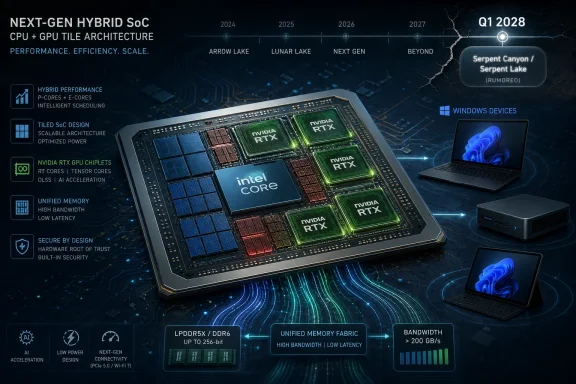
Intel’s first x86 processors with integrated NVIDIA RTX graphics are reportedly listed on an internal roadmap for the first quarter of 2028, with Igor’s Lab, VideoCardz, and Wccftech tying the leak to a platform name circulating as “Serpent Canyon” or “Serpent Lake.” The leak is not a product announcement, and Intel has not confirmed the codename, launch window, or silicon design. But it matters because Intel and NVIDIA already confirmed the underlying partnership in September 2025: Intel will build x86 SoCs for PCs that integrate NVIDIA RTX GPU chiplets. The roadmap rumor turns that abstract alliance into something PC buyers, OEMs, and Windows enthusiasts can finally argue about.
The first thing to separate is the solid floor from the fog. NVIDIA and Intel formally announced in September 2025 that they would collaborate on multiple generations of data-center and PC products, with NVIDIA also planning a $5 billion investment in Intel common stock. For personal computing, the companies said Intel would build x86 system-on-chips that integrate NVIDIA RTX GPU chiplets.
That confirmed sentence is the real news engine behind the latest leak. The 2028 timing, the Serpent name, and the exact packaging arrangement are all unconfirmed, attributed by VideoCardz to leaker Erdi Özüağ and then amplified by sites including Wccftech, TechSpot, TechRadar, and Igor’s Lab. In other words, the roadmap rumor is not floating in empty air, but it is still a rumor.
The naming is already messy in the way leaked roadmaps often are. Igor’s Lab’s English headline uses “Serpent Canyon,” while other coverage describes “Serpent Lake,” and Intel has previously used Serpent Canyon for its NUC 12 Enthusiast platform. That does not disprove the leak, but it should make readers cautious about treating the codename as settled fact.
The more durable point is that Intel and NVIDIA are no longer merely vendors that meet inside a gaming laptop chassis. They are now publicly committed to building a more fused PC platform. That is a much bigger shift than whether the first public SKU lands at CES 2028 or slips into the back half of that year.
That is what makes the NVIDIA tie-up strategically sharp and a little humiliating. Intel spent years trying to convince the market that it could be a serious graphics company, then turned around and agreed to put the strongest rival GPU brand directly inside future Intel client SoCs. This is not a surrender of all graphics ambition, but it is an admission that Intel’s own GPU brand does not carry the same gravitational pull.
For NVIDIA, the attraction is obvious. The company already dominates discrete PC graphics, but integrated and semi-integrated platforms are where the volume lives. If NVIDIA can push RTX graphics, ray tracing, DLSS-style features, and AI acceleration deeper into mainstream Windows machines without requiring a separate GPU board or traditional laptop dGPU arrangement, it gains reach without waiting for every OEM to design a full gaming notebook.
That makes the project less like a conventional CPU-GPU bundle and more like a bid to define a new middle tier. The target is not necessarily the desktop enthusiast with a 450-watt graphics card. It is the creator laptop, compact workstation, mini PC, premium ultraportable, handheld-adjacent machine, and small-form-factor Windows box that needs far more than a normal iGPU but cannot tolerate the cost, board space, cooling, or battery penalties of a classic discrete GPU.
The comparison is useful, but only up to a point. Kaby Lake-G was a fascinating one-off that arrived before today’s chiplet era had fully hardened into the industry’s default vocabulary. A future Intel-NVIDIA x86 RTX SoC would arrive in a market already conditioned to think in tiles, chiplets, advanced packaging, shared interconnects, and heterogeneous compute.
The software context is also different. In the Kaby Lake-G era, the idea was mostly better graphics in a compact package. In 2028, the pitch will be graphics, AI, upscaling, ray tracing, media engines, creator acceleration, and possibly enterprise-friendly local inference, all wrapped in the halo of the NVIDIA software ecosystem.
That does not mean CUDA suddenly becomes a simple integrated-client feature, or that every RTX software advantage transfers neatly into a tiled SoC. NVIDIA’s strongest developer lock-in has historically lived around its discrete GPU stack and data-center platforms. But the RTX label now carries enough meaning in gaming and creative workflows that even a constrained implementation would be more marketable than most integrated graphics branding.
The danger is that history repeats in a more expensive package. If Serpent-whatever ships in a few premium designs, suffers from driver ambiguity, and then vanishes, it will be remembered as Kaby Lake-G with better branding. If it becomes a repeatable platform across multiple generations, it could be one of the most important Windows PC architecture shifts of the decade.
Those questions matter because integrated graphics are usually starved less by ambition than by memory reality. A GPU that looks strong on a block diagram can collapse under gaming, rendering, or AI workloads if it is fed like an ordinary iGPU. NVIDIA’s brand does not repeal physics.
AMD’s recent high-end APUs have already shown the appeal of a bigger integrated graphics block paired with serious memory bandwidth. Apple’s M-series chips have taught the broader market to expect CPU, GPU, media, and neural acceleration to behave as one coherent platform rather than a set of parts connected by habit. Intel and NVIDIA cannot just print RTX on a tile and declare victory; they need the platform to feel integrated under real workloads.
That is where the confirmed NVIDIA-Intel language about GPU chiplets becomes interesting. A chiplet is not automatically better than a monolithic GPU, and advanced packaging is not magic. But it does create room for Intel to combine x86 CPU leadership, NVIDIA GPU IP, and a packaging strategy that could scale across different power classes.
The best version of this product would sit above ordinary integrated graphics and below traditional discrete GPUs. It would give OEMs a simpler board design, users better battery behavior, and Windows a cleaner performance tier for local AI, creative apps, and mainstream gaming. The worst version would be a thermally constrained branding exercise that costs too much and performs too inconsistently to matter.
That matters because the PC is becoming more heterogeneous, not less. Microsoft, AMD, Intel, Qualcomm, NVIDIA, and Apple are all pushing the idea that the next useful computer is not just a faster CPU, but a coordinated set of accelerators. Windows now has to span x86, Arm, NPUs, GPUs, local AI runtimes, and legacy applications that refuse to die.
NVIDIA already owns the most coveted accelerator brand in that mix. What it lacks in the client PC space is a way to make that brand present in machines that are too thin, cheap, or power-sensitive for a conventional RTX dGPU. An Intel-built x86 RTX SoC could give NVIDIA access to designs where it currently appears only indirectly, if at all.
The company also gets a hedge. Data-center AI is still NVIDIA’s empire, but empires like optionality. A deep Intel relationship gives NVIDIA another architectural lane, another packaging partner, and another route into enterprise and consumer systems where x86 compatibility remains non-negotiable.
Intel, meanwhile, gets something it badly needs: borrowed momentum. A future Core-class platform with NVIDIA RTX graphics would be easier to sell than another internal promise that Arc will eventually change buyer perception. That does not solve Intel’s process, packaging, or execution problems, but it gives OEMs a story they can put on a box.
But “complementary” can mean many things. Arc could remain central to Intel’s integrated graphics, media blocks, entry-level graphics, and some discrete efforts. NVIDIA RTX chiplets could occupy premium client SoCs or custom segments where branding and software ecosystem matter most. Intel could also use the partnership to reduce the pressure on Arc in markets where it has struggled to match NVIDIA’s pull.
The problem is not whether Intel can maintain multiple GPU strategies on a slide. The problem is whether developers, OEMs, and buyers will understand why one Intel PC has Intel graphics, another has Intel Arc, another has NVIDIA RTX inside the package, and another still has a separate NVIDIA GPU. Platform segmentation becomes dangerous when it starts to look like confusion.
Drivers are the other long-term test. One reason enthusiasts remain skeptical of hybrid graphics experiments is that hardware often outlives enthusiasm. A tightly integrated Intel-NVIDIA SoC would need years of coordinated Windows driver updates, game optimizations, creator-app support, firmware care, and OEM validation. If the platform lands in 2028, customers will expect support well into the 2030s.
That is where NVIDIA’s participation is both reassuring and risky. NVIDIA is excellent at maintaining game-facing driver relevance, but it is also ruthless about product segmentation. Intel is experienced at PC platform validation, but has stumbled in discrete GPU software. The combined platform will need the best habits of both companies, not the bureaucratic averages.
But OEMs also live in the practical world. They will care about thermals, yields, cost, platform availability, memory configuration, firmware schedules, driver coordination, and whether the chip can be used across enough models to justify design investment. A beautiful part that ships late or in low volume is not a platform; it is a boutique SKU.
The most plausible early homes would be premium notebooks and compact PCs. Gaming laptops already have a mature CPU-dGPU model, so an integrated RTX SoC would need to win on thinness, acoustics, battery behavior, or price. Mini PCs and creator laptops, by contrast, may be more forgiving if the product delivers a meaningful jump over ordinary integrated graphics.
Handhelds are tempting to mention, but they are not automatic winners. The handheld PC market is brutally power-sensitive, and NVIDIA’s traditional strengths do not always map cleanly to 15-watt scenarios. If Intel and NVIDIA can scale the design down efficiently, the category becomes interesting; if not, AMD-style APUs may remain the more natural fit.
Enterprise devices could be the sleeper market. A corporate workstation-class laptop with better local AI, accelerated video, and credible graphics in a simpler package might appeal to IT buyers who do not want fleets of gaming-style dGPU machines. But enterprises will demand predictable lifecycle support, stable drivers, and clean deployment tools before they care about a codename.
If the leak reflects a real internal roadmap, major decisions would already need to be in motion. The companies would need to define the product tier, power envelopes, memory approach, interconnect, manufacturing responsibilities, validation strategy, and software ownership. OEMs would need enough confidence to plan designs long before public launch.
That is why the official September 2025 announcement matters so much. Intel and NVIDIA did not merely say they might cooperate someday. They described multiple generations of custom data-center and PC products, and specifically identified Intel-built x86 SoCs with NVIDIA RTX GPU chiplets. The roadmap leak slots into that public framework rather than inventing it.
The risk is that roadmaps are not contracts. Silicon slips. Packaging plans change. Market priorities shift. A 2028 part could become a late-2028 part, a limited OEM launch, a different codename, or a platform that appears first in a narrow segment rather than a broad consumer rollout.
Still, the timing lines up with where the PC market is heading. By 2028, local AI expectations will be more mature, Windows on Arm will have had more time to pressure x86 incumbents, and buyers will be more accustomed to judging laptops by accelerator performance as well as CPU benchmarks. Intel and NVIDIA are not building for the PC market of 2024; they are trying to shape the one that comes after the AI PC hype cycle either hardens into usefulness or burns off.
The Windows ecosystem is already juggling a lot. Copilot+ PCs pushed NPUs into the marketing foreground. Qualcomm’s Snapdragon X chips forced Microsoft to take Arm PCs more seriously. AMD and Intel continue to ship x86 platforms with increasingly capable NPUs. NVIDIA, meanwhile, wants developers to keep seeing the GPU as the primary accelerator for serious local AI and creative workloads.
An Intel-NVIDIA SoC complicates that landscape in a useful way. It says the future Windows PC may not be defined by a single NPU number or a clean CPU-versus-GPU split. It may instead be a system in which the GPU tile, NPU, CPU, media engines, and memory fabric all matter, with software deciding where work belongs.
That could be good for users if Windows and developers abstract the complexity away. It could be bad if buyers are left decoding whether a given AI feature runs on Intel’s NPU, NVIDIA’s RTX tile, a cloud service, or not at all. The industry loves new badges; users want their software to run faster without becoming platform archaeologists.
For sysadmins, the concern is not theoretical. Mixed accelerator fleets are harder to validate, image, monitor, patch, and support. If Intel-NVIDIA machines become common in business environments, IT departments will need clean driver channels, predictable Windows Update behavior, and clarity about which workloads use which silicon.
The real question is whether the PC’s old component boundaries are finally dissolving. For decades, enthusiasts thought in discrete boxes: CPU, GPU, memory, motherboard, storage. Laptops blurred that picture, but the mental model remained. A chiplet-based x86 RTX SoC would push the mainstream Windows PC further toward the Apple-style idea of a designed compute package, without abandoning x86 compatibility.
That is why AMD should pay attention. AMD has spent years benefiting from its ability to combine credible CPU and GPU IP under one roof. Its APUs, especially at the higher end, are the natural comparison point for any Intel-NVIDIA hybrid. If Intel can attach NVIDIA’s graphics and software cachet to x86 CPUs in a compact package, AMD’s integrated advantage faces a new kind of pressure.
Apple should pay attention for a different reason. The Mac’s M-series pitch has been integration: performance per watt, unified memory, strong media engines, and a platform that feels cohesive. An Intel-NVIDIA x86 RTX SoC would not copy Apple directly, but it would be the Windows ecosystem’s most direct answer to the idea that integration is the product.
The open question is whether two companies can integrate as cleanly as one. Apple’s advantage is not just silicon; it is control. Intel and NVIDIA must coordinate across corporate boundaries, product priorities, software stacks, and OEM needs. That is harder, but it also gives the Windows world something Apple cannot offer: a broad hardware ecosystem with multiple vendors competing around a shared platform idea.
For Windows enthusiasts, the appeal is obvious. A laptop or mini PC with Intel CPU compatibility and meaningful RTX-class graphics in one package could be exactly the machine many users have wanted: smaller than a gaming rig, stronger than an iGPU box, and more flexible than a locked-down platform. But “could” is doing a lot of work.
For Intel, the product would be a chance to regain excitement in client computing without asking buyers to wait for Arc to become a household name. For NVIDIA, it would extend RTX into PC categories where discrete GPUs are cumbersome. For Microsoft and OEMs, it would create another hardware tier to support, market, and explain.
The market does not need another halo oddity. It needs a repeatable platform that ships in volume, behaves predictably, and has enough performance to justify the complexity. That is the bar Serpent Canyon, Serpent Lake, or whatever the final name becomes will have to clear.
 The Leak Is Less Important Than the Partnership It Points Toward
The first thing to separate is the solid floor from the fog. NVIDIA and Intel formally announced in September 2025 that they would collaborate on multiple generations of data-center and PC products, with NVIDIA also planning a $5 billion investment in Intel common stock. For personal computing, the companies said Intel would build x86 system-on-chips that integrate NVIDIA RTX GPU chiplets.That confirmed sentence is the real news engine behind the latest leak. The 2028 timing, the Serpent name, and the exact packaging arrangement are all unconfirmed, attributed by VideoCardz to leaker Erdi Özüağ and then amplified by sites including Wccftech, TechSpot, TechRadar, and Igor’s Lab. In other words, the roadmap rumor is not floating in empty air, but it is still a rumor.
The naming is already messy in the way leaked roadmaps often are. Igor’s Lab’s English headline uses “Serpent Canyon,” while other coverage describes “Serpent Lake,” and Intel has previously used Serpent Canyon for its NUC 12 Enthusiast platform. That does not disprove the leak, but it should make readers cautious about treating the codename as settled fact.
The more durable point is that Intel and NVIDIA are no longer merely vendors that meet inside a gaming laptop chassis. They are now publicly committed to building a more fused PC platform. That is a much bigger shift than whether the first public SKU lands at CES 2028 or slips into the back half of that year.
Intel Is Borrowing the One GPU Brand PC Buyers Still Understand
Intel’s graphics problem has never been only technical. Arc has improved, Intel’s integrated graphics have become far more credible than the UHD era, and modern Core Ultra parts have made iGPU performance a serious part of the pitch. But in the consumer market, the three letters that still move laptops, desktops, and creator boxes are RTX.That is what makes the NVIDIA tie-up strategically sharp and a little humiliating. Intel spent years trying to convince the market that it could be a serious graphics company, then turned around and agreed to put the strongest rival GPU brand directly inside future Intel client SoCs. This is not a surrender of all graphics ambition, but it is an admission that Intel’s own GPU brand does not carry the same gravitational pull.
For NVIDIA, the attraction is obvious. The company already dominates discrete PC graphics, but integrated and semi-integrated platforms are where the volume lives. If NVIDIA can push RTX graphics, ray tracing, DLSS-style features, and AI acceleration deeper into mainstream Windows machines without requiring a separate GPU board or traditional laptop dGPU arrangement, it gains reach without waiting for every OEM to design a full gaming notebook.
That makes the project less like a conventional CPU-GPU bundle and more like a bid to define a new middle tier. The target is not necessarily the desktop enthusiast with a 450-watt graphics card. It is the creator laptop, compact workstation, mini PC, premium ultraportable, handheld-adjacent machine, and small-form-factor Windows box that needs far more than a normal iGPU but cannot tolerate the cost, board space, cooling, or battery penalties of a classic discrete GPU.
Kaby Lake-G Is the Ghost in the Package
Anyone who has followed Intel long enough will remember that the company has tried strange CPU-GPU marriages before. Kaby Lake-G paired Intel CPU cores with AMD Radeon Vega graphics and HBM2 in a single package. It was clever, fast for its class, and short-lived enough to become a cautionary tale.The comparison is useful, but only up to a point. Kaby Lake-G was a fascinating one-off that arrived before today’s chiplet era had fully hardened into the industry’s default vocabulary. A future Intel-NVIDIA x86 RTX SoC would arrive in a market already conditioned to think in tiles, chiplets, advanced packaging, shared interconnects, and heterogeneous compute.
The software context is also different. In the Kaby Lake-G era, the idea was mostly better graphics in a compact package. In 2028, the pitch will be graphics, AI, upscaling, ray tracing, media engines, creator acceleration, and possibly enterprise-friendly local inference, all wrapped in the halo of the NVIDIA software ecosystem.
That does not mean CUDA suddenly becomes a simple integrated-client feature, or that every RTX software advantage transfers neatly into a tiled SoC. NVIDIA’s strongest developer lock-in has historically lived around its discrete GPU stack and data-center platforms. But the RTX label now carries enough meaning in gaming and creative workflows that even a constrained implementation would be more marketable than most integrated graphics branding.
The danger is that history repeats in a more expensive package. If Serpent-whatever ships in a few premium designs, suffers from driver ambiguity, and then vanishes, it will be remembered as Kaby Lake-G with better branding. If it becomes a repeatable platform across multiple generations, it could be one of the most important Windows PC architecture shifts of the decade.
The Real Battlefield Is Memory Bandwidth, Not Stickers
The most important specifications are the ones we do not have. How large is the NVIDIA GPU tile? What memory does it access? Is the design built around shared system memory, a dedicated pool, advanced cache, or some hybrid? How much bandwidth can the RTX component actually see under sustained load?Those questions matter because integrated graphics are usually starved less by ambition than by memory reality. A GPU that looks strong on a block diagram can collapse under gaming, rendering, or AI workloads if it is fed like an ordinary iGPU. NVIDIA’s brand does not repeal physics.
AMD’s recent high-end APUs have already shown the appeal of a bigger integrated graphics block paired with serious memory bandwidth. Apple’s M-series chips have taught the broader market to expect CPU, GPU, media, and neural acceleration to behave as one coherent platform rather than a set of parts connected by habit. Intel and NVIDIA cannot just print RTX on a tile and declare victory; they need the platform to feel integrated under real workloads.
That is where the confirmed NVIDIA-Intel language about GPU chiplets becomes interesting. A chiplet is not automatically better than a monolithic GPU, and advanced packaging is not magic. But it does create room for Intel to combine x86 CPU leadership, NVIDIA GPU IP, and a packaging strategy that could scale across different power classes.
The best version of this product would sit above ordinary integrated graphics and below traditional discrete GPUs. It would give OEMs a simpler board design, users better battery behavior, and Windows a cleaner performance tier for local AI, creative apps, and mainstream gaming. The worst version would be a thermally constrained branding exercise that costs too much and performs too inconsistently to matter.
NVIDIA Gets a New Door Into the PC Without Buying an x86 License
For NVIDIA, the Intel deal is a way to walk through a door that has always been awkwardly closed. NVIDIA does not control the x86 CPU platform, and despite periodic speculation, it cannot simply decide to become an x86 client CPU vendor on its own terms. Intel gives NVIDIA a direct route into x86 PCs without NVIDIA needing to own the instruction set.That matters because the PC is becoming more heterogeneous, not less. Microsoft, AMD, Intel, Qualcomm, NVIDIA, and Apple are all pushing the idea that the next useful computer is not just a faster CPU, but a coordinated set of accelerators. Windows now has to span x86, Arm, NPUs, GPUs, local AI runtimes, and legacy applications that refuse to die.
NVIDIA already owns the most coveted accelerator brand in that mix. What it lacks in the client PC space is a way to make that brand present in machines that are too thin, cheap, or power-sensitive for a conventional RTX dGPU. An Intel-built x86 RTX SoC could give NVIDIA access to designs where it currently appears only indirectly, if at all.
The company also gets a hedge. Data-center AI is still NVIDIA’s empire, but empires like optionality. A deep Intel relationship gives NVIDIA another architectural lane, another packaging partner, and another route into enterprise and consumer systems where x86 compatibility remains non-negotiable.
Intel, meanwhile, gets something it badly needs: borrowed momentum. A future Core-class platform with NVIDIA RTX graphics would be easier to sell than another internal promise that Arc will eventually change buyer perception. That does not solve Intel’s process, packaging, or execution problems, but it gives OEMs a story they can put on a box.
Arc Is Not Dead, but Its Job Description Gets Harder
The uncomfortable question is what this does to Intel Arc. After the 2025 partnership announcement, Tom’s Hardware reported that Intel said it remained committed to its GPU product offerings and framed the NVIDIA collaboration as complementary. That is the kind of statement a company has to make, and it may even be true.But “complementary” can mean many things. Arc could remain central to Intel’s integrated graphics, media blocks, entry-level graphics, and some discrete efforts. NVIDIA RTX chiplets could occupy premium client SoCs or custom segments where branding and software ecosystem matter most. Intel could also use the partnership to reduce the pressure on Arc in markets where it has struggled to match NVIDIA’s pull.
The problem is not whether Intel can maintain multiple GPU strategies on a slide. The problem is whether developers, OEMs, and buyers will understand why one Intel PC has Intel graphics, another has Intel Arc, another has NVIDIA RTX inside the package, and another still has a separate NVIDIA GPU. Platform segmentation becomes dangerous when it starts to look like confusion.
Drivers are the other long-term test. One reason enthusiasts remain skeptical of hybrid graphics experiments is that hardware often outlives enthusiasm. A tightly integrated Intel-NVIDIA SoC would need years of coordinated Windows driver updates, game optimizations, creator-app support, firmware care, and OEM validation. If the platform lands in 2028, customers will expect support well into the 2030s.
That is where NVIDIA’s participation is both reassuring and risky. NVIDIA is excellent at maintaining game-facing driver relevance, but it is also ruthless about product segmentation. Intel is experienced at PC platform validation, but has stumbled in discrete GPU software. The combined platform will need the best habits of both companies, not the bureaucratic averages.
Windows OEMs Will Love the Story and Fear the Complexity
For Dell, HP, Lenovo, ASUS, MSI, Acer, and the rest of the Windows hardware ecosystem, an Intel x86 RTX SoC could be a dream part. It promises a recognizable CPU vendor, the strongest graphics brand, and a simpler physical design than a traditional CPU-plus-dGPU motherboard. It also offers a premium upsell that is easier to explain than TOPS, NPU blocks, or memory fabric diagrams.But OEMs also live in the practical world. They will care about thermals, yields, cost, platform availability, memory configuration, firmware schedules, driver coordination, and whether the chip can be used across enough models to justify design investment. A beautiful part that ships late or in low volume is not a platform; it is a boutique SKU.
The most plausible early homes would be premium notebooks and compact PCs. Gaming laptops already have a mature CPU-dGPU model, so an integrated RTX SoC would need to win on thinness, acoustics, battery behavior, or price. Mini PCs and creator laptops, by contrast, may be more forgiving if the product delivers a meaningful jump over ordinary integrated graphics.
Handhelds are tempting to mention, but they are not automatic winners. The handheld PC market is brutally power-sensitive, and NVIDIA’s traditional strengths do not always map cleanly to 15-watt scenarios. If Intel and NVIDIA can scale the design down efficiently, the category becomes interesting; if not, AMD-style APUs may remain the more natural fit.
Enterprise devices could be the sleeper market. A corporate workstation-class laptop with better local AI, accelerated video, and credible graphics in a simpler package might appeal to IT buyers who do not want fleets of gaming-style dGPU machines. But enterprises will demand predictable lifecycle support, stable drivers, and clean deployment tools before they care about a codename.
The 2028 Date Is Both Far Away and Alarmingly Soon
A first-quarter 2028 target sounds distant to consumers, especially in a PC market trained to expect annual refreshes. But for a complex tiled SoC involving Intel CPU technology, NVIDIA GPU IP, packaging, firmware, drivers, OEM designs, and Microsoft ecosystem work, 2028 is not leisurely. It is tomorrow in silicon-planning terms.If the leak reflects a real internal roadmap, major decisions would already need to be in motion. The companies would need to define the product tier, power envelopes, memory approach, interconnect, manufacturing responsibilities, validation strategy, and software ownership. OEMs would need enough confidence to plan designs long before public launch.
That is why the official September 2025 announcement matters so much. Intel and NVIDIA did not merely say they might cooperate someday. They described multiple generations of custom data-center and PC products, and specifically identified Intel-built x86 SoCs with NVIDIA RTX GPU chiplets. The roadmap leak slots into that public framework rather than inventing it.
The risk is that roadmaps are not contracts. Silicon slips. Packaging plans change. Market priorities shift. A 2028 part could become a late-2028 part, a limited OEM launch, a different codename, or a platform that appears first in a narrow segment rather than a broad consumer rollout.
Still, the timing lines up with where the PC market is heading. By 2028, local AI expectations will be more mature, Windows on Arm will have had more time to pressure x86 incumbents, and buyers will be more accustomed to judging laptops by accelerator performance as well as CPU benchmarks. Intel and NVIDIA are not building for the PC market of 2024; they are trying to shape the one that comes after the AI PC hype cycle either hardens into usefulness or burns off.
Microsoft Is the Quiet Third Player in the Room
Any x86 RTX SoC will ultimately live or die inside Windows. That makes Microsoft the quiet but unavoidable third player in this story. Hardware vendors can design elegant accelerators, but users experience them through drivers, APIs, app support, power management, update reliability, and whether Windows knows how to schedule work across CPU, GPU, and NPU resources.The Windows ecosystem is already juggling a lot. Copilot+ PCs pushed NPUs into the marketing foreground. Qualcomm’s Snapdragon X chips forced Microsoft to take Arm PCs more seriously. AMD and Intel continue to ship x86 platforms with increasingly capable NPUs. NVIDIA, meanwhile, wants developers to keep seeing the GPU as the primary accelerator for serious local AI and creative workloads.
An Intel-NVIDIA SoC complicates that landscape in a useful way. It says the future Windows PC may not be defined by a single NPU number or a clean CPU-versus-GPU split. It may instead be a system in which the GPU tile, NPU, CPU, media engines, and memory fabric all matter, with software deciding where work belongs.
That could be good for users if Windows and developers abstract the complexity away. It could be bad if buyers are left decoding whether a given AI feature runs on Intel’s NPU, NVIDIA’s RTX tile, a cloud service, or not at all. The industry loves new badges; users want their software to run faster without becoming platform archaeologists.
For sysadmins, the concern is not theoretical. Mixed accelerator fleets are harder to validate, image, monitor, patch, and support. If Intel-NVIDIA machines become common in business environments, IT departments will need clean driver channels, predictable Windows Update behavior, and clarity about which workloads use which silicon.
The Serpent Name Matters Less Than the Shape of the Next PC
The codename has attracted attention because codenames are easy to remember and fun to argue about. But “Serpent Canyon” may be a recycled Intel NUC reference, a mistranslation, a platform label, or simply an early roadmap artifact. Treating it as the most important part of the story mistakes the label for the architecture.The real question is whether the PC’s old component boundaries are finally dissolving. For decades, enthusiasts thought in discrete boxes: CPU, GPU, memory, motherboard, storage. Laptops blurred that picture, but the mental model remained. A chiplet-based x86 RTX SoC would push the mainstream Windows PC further toward the Apple-style idea of a designed compute package, without abandoning x86 compatibility.
That is why AMD should pay attention. AMD has spent years benefiting from its ability to combine credible CPU and GPU IP under one roof. Its APUs, especially at the higher end, are the natural comparison point for any Intel-NVIDIA hybrid. If Intel can attach NVIDIA’s graphics and software cachet to x86 CPUs in a compact package, AMD’s integrated advantage faces a new kind of pressure.
Apple should pay attention for a different reason. The Mac’s M-series pitch has been integration: performance per watt, unified memory, strong media engines, and a platform that feels cohesive. An Intel-NVIDIA x86 RTX SoC would not copy Apple directly, but it would be the Windows ecosystem’s most direct answer to the idea that integration is the product.
The open question is whether two companies can integrate as cleanly as one. Apple’s advantage is not just silicon; it is control. Intel and NVIDIA must coordinate across corporate boundaries, product priorities, software stacks, and OEM needs. That is harder, but it also gives the Windows world something Apple cannot offer: a broad hardware ecosystem with multiple vendors competing around a shared platform idea.
The Practical Stakes Are Already Visible
The safest way to read the leak is neither to dismiss it nor to crown it. The confirmed Intel-NVIDIA partnership makes an x86 RTX SoC real enough to matter, while the specific 2028 roadmap details remain unverified. That distinction is not pedantry; it is the difference between understanding the direction of travel and pretending we already have a launch deck.For Windows enthusiasts, the appeal is obvious. A laptop or mini PC with Intel CPU compatibility and meaningful RTX-class graphics in one package could be exactly the machine many users have wanted: smaller than a gaming rig, stronger than an iGPU box, and more flexible than a locked-down platform. But “could” is doing a lot of work.
For Intel, the product would be a chance to regain excitement in client computing without asking buyers to wait for Arc to become a household name. For NVIDIA, it would extend RTX into PC categories where discrete GPUs are cumbersome. For Microsoft and OEMs, it would create another hardware tier to support, market, and explain.
The market does not need another halo oddity. It needs a repeatable platform that ships in volume, behaves predictably, and has enough performance to justify the complexity. That is the bar Serpent Canyon, Serpent Lake, or whatever the final name becomes will have to clear.
The Roadmap Leak Leaves Five Hard Tests Behind
The most useful way to think about the 2028 rumor is as a checklist of execution risks. The idea is plausible because Intel and NVIDIA have already confirmed the partnership; the outcome is uncertain because every important implementation detail remains open.- Intel and NVIDIA have officially confirmed x86 PC SoCs with integrated NVIDIA RTX GPU chiplets, but they have not confirmed the Serpent codename, the first-quarter 2028 window, or the exact silicon design.
- The strongest version of the product would create a new Windows performance tier between ordinary integrated graphics and traditional discrete GPUs.
- Memory bandwidth, thermals, driver support, and OEM adoption will matter more than whether the spec sheet says RTX.
- Intel will have to explain how NVIDIA-powered client SoCs coexist with Arc graphics without making its GPU roadmap look fragmented.
- NVIDIA gains a deeper route into x86 PCs, but the company still needs Intel, Microsoft, and OEMs to make the experience feel native rather than bolted on.
- Buyers should treat the leak as directionally important but not as a reason to delay purchases today.
References
- Primary source: igor´sLAB
Published: 2026-07-05T04:50:10.434680
Loading…
www.igorslab.de - Related coverage: investor.nvidia.com
Loading…
investor.nvidia.com - Related coverage: tomshardware.com
- Related coverage: newsroom.intel.com
Loading…
newsroom.intel.com - Related coverage: techspot.com
Intel and Nvidia team up on Intel x86 RTX SoCs for future gaming PCs | TechSpot
Intel says the x86 RTX SoCs will power PCs that demand integration of world-class CPUs and GPUs, i.e., the gaming market. There's no word yet on price,...www.techspot.com - Related coverage: techcrunch.com
Nvidia buys $5B stake in Intel, planning AI chip collaboration | TechCrunch
Nvidia has agreed to invest $5 billion in Intel as part of a broader deal to together develop "multiple generations" of data center and PC products. Nvidia will buy Intel stock.techcrunch.com
- Related coverage: windowscentral.com
NVIDIA and Intel announce partnership building x86 CPUs fused with RTX GPUs | Windows Central
NVIDIA is partnering up with Intel to product new chips that fuse x86 Intel CPUs with RTX GPUs in an attempt to compete with AMD APUs, along with helping Intel stay afloat in its fight with TSMC.www.windowscentral.com - Related coverage: techradar.com
Intel wins $5 billion Nvidia investment to develop custom x86 CPUs and launch RTX SoCs for PCs | TechRadar
Nvidia remains committed to its Arm-based processors alongside the new Intel partnershipwww.techradar.com - Related coverage: portaltela.com
Serpent Lake: CPUs Intel com gráficos RTX da NVIDIA chegam em 2028 (rumor)
Intel planeja lançar seus primeiros processadores com gráficos RTX integrados da NVIDIA no primeiro trimestre de 2028, sob o codinome Serpent Lake. A possíve...www.portaltela.com - Related coverage: phoronix.com
NVIDIA To Make $5B Investment Into Intel - x86 RTX SoCs & More To Come - Phoronix
NVIDIA is making a $5 billion investment into Intel and the two companies will work together on custom data center and client CPUs.www.phoronix.com
- Related coverage: pcmrace.com
Loading…
www.pcmrace.com - Related coverage: tweaktown.com
Loading…
www.tweaktown.com - Related coverage: pcgamer.com
'We're going to build revolutionary products' says Nvidia CEO Jensen Huang about his newly-announced collaboration with Intel: 'Nothing of its kind has ever been built before' | PC Gamer
Impressive claims, but whether Nvidia will eventually use Intel's Foundry in future remains a question mark for now.www.pcgamer.com - Related coverage: axios.com
Nvidia to invest $5 billion in Intel and co-develop chips
It's an unexpected lifeline to an old rival.www.axios.com
- Related coverage: download.intel.com
Loading…
download.intel.com - Related coverage: nvidianews.nvidia.com
- Related coverage: news.synopsys.com
Loading…
news.synopsys.com - Related coverage: nvidia.com
Loading…
www.nvidia.com - Related coverage: investor.cisco.com
Loading…
investor.cisco.com
