

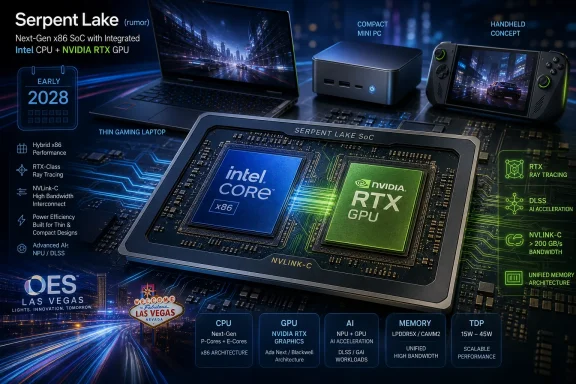
Intel and NVIDIA’s rumored “Serpent Lake” processor is reportedly an early-2028 client x86 SoC that would pair Intel CPU technology with an NVIDIA RTX graphics chiplet, but neither the codename, launch window, CES 2028 reveal, architecture, memory system, nor target devices have been officially confirmed. The reason this rumor has legs is that the underlying partnership is not fiction. Intel and NVIDIA really did announce a multi-generation collaboration to build x86 RTX SoCs for PCs, and that alone is enough to make every handheld, laptop, and mini-PC roadmap feel temporarily provisional. The leak is not proof of a product, but it is a useful glimpse at the kind of product the PC industry now has to assume is coming.
The usual silicon leak lives or dies on whether the audience believes the premise. In this case, the premise is unusually solid: Intel and NVIDIA have publicly said they will co-develop PC system-on-chips that combine Intel x86 CPUs with NVIDIA RTX GPU chiplets. That is not a forum fantasy, a supply-chain whisper, or a misread driver string.
What remains unconfirmed is nearly everything that turns a strategic announcement into a product buyers can evaluate. “Serpent Lake” is reportedly the codename. The first quarter of 2028 is reportedly the target. CES 2028 is reportedly a plausible unveiling moment. Those are not trivial details, but they are downstream of the bigger change: Intel is preparing to sell PC processors whose most important graphics block may come from NVIDIA rather than Intel.
That is why this story should not be filed away as just another roadmap rumor. If Intel and NVIDIA ship even a moderately successful x86 RTX SoC, they will redraw a line that has defined the PC market for years. AMD’s advantage in high-performance integrated graphics has always depended on owning both the CPU and GPU pieces. Intel’s answer, if this partnership works, is not to out-AMD AMD. It is to bring in the GPU company whose software stack already dominates much of the gaming, creator, AI, and workstation conversation.
The rumored 2028 timing also matters because it places the first serious client product far enough out to be believable. A chiplet-based CPU-GPU package involving two companies, two roadmaps, and two driver cultures is not something that appears twelve months after a press release. Early 2028 is close enough to excite device makers and far enough away to remind everyone that roadmaps are promises made to spreadsheets before they are promises made to customers.
An NVIDIA chiplet gives Intel a shortcut around the slowest part of that climb. Instead of asking laptop vendors and gamers to believe Arc will eventually stand shoulder to shoulder with GeForce, Intel could offer a premium mobile SoC with RTX inside the package. That does not make Intel’s graphics work irrelevant, but it changes the story. Arc can remain important for mainstream integrated graphics and media engines while NVIDIA becomes the halo option for systems where GPU capability sells the machine.
NVIDIA’s motivation is subtler. The company already owns the high-end discrete GPU market and has built an enormous data-center business around accelerators, networking, and software. But the PC client market is moving toward tighter integration in several categories, especially thin gaming notebooks, handheld PCs, mini systems, and workstations that want more GPU than a typical iGPU but less board complexity than a full discrete design. If more of that market becomes SoC-shaped, NVIDIA cannot rely forever on the old assumption that every performance PC has room for a separate GeForce chip.
An x86 RTX SoC gives NVIDIA a way into integrated PCs without becoming a general-purpose x86 CPU vendor. It lets Intel handle the CPU, platform, OEM relationships, and Windows PC plumbing, while NVIDIA contributes the GPU tile and the software gravity around it. That is not merely a component deal. It is a way to keep RTX central as the physical shape of PCs changes.
The five-billion-dollar equity investment made the alliance look dramatic, but the product strategy is the more important part. Intel gets credibility in premium integrated graphics. NVIDIA gets an x86 client foothold that does not require it to build a Windows laptop CPU business from scratch. Both companies get a new answer to AMD’s strongest integrated platforms.
The current reporting points to a first-quarter 2028 target, with CES 2028 naturally suggested as a possible reveal stage. That makes calendar sense. CES remains the PC industry’s preferred theater for laptop silicon, platform branding, OEM design wins, and “available later this year” messaging. If Intel and NVIDIA wanted to introduce the first x86 RTX SoC to consumers, Las Vegas in January would be the obvious place to do it.
But obvious is not the same as confirmed. Earlier rumors reportedly placed the relevant Intel-NVIDIA client silicon later, in late 2028 or even early 2029. That discrepancy could mean the schedule has moved up. It could mean different sources are describing different products. It could mean engineering samples, platform launches, OEM availability, and retail systems are being compressed into one overly tidy date.
The more useful reading is that the project appears to be on a 2028-ish track, not that buyers should circle a quarter on the calendar. Silicon schedules this far out are especially elastic. Tape-out, validation, packaging, firmware, driver integration, OEM qualification, operating system support, and thermal design all have veto power over a launch date. Add two companies with historically separate graphics software stacks and the risk curve gets steeper.
That is why the leak should be treated as directional rather than contractual. The PC industry now has a rough target for when the Intel-NVIDIA alliance could matter in client hardware. It does not yet have a product definition.
This is the only practical way such a partnership makes sense. Intel can manufacture or source CPU and platform tiles according to its own roadmap. NVIDIA can design a GPU tile using the process, IP, and design methods that suit its graphics architecture. The two companies can then meet at the package boundary rather than attempting to create a fully merged die that would be politically, technically, and economically harder to manage.
But chiplets are not magic Lego bricks. The package still has to move data fast enough that the GPU does not behave like a constrained afterthought. The memory system has to be coherent enough, or at least well-managed enough, for the operating system and applications to treat the platform as a seamless PC rather than a science project. Power delivery has to account for CPU boost behavior, GPU bursts, idle states, media playback, sleep transitions, and thermal emergencies.
This is where the absence of real specifications becomes important. We do not know whether Serpent Lake, if that is indeed the product, uses a unified memory architecture. We do not know whether the GPU tile gets special cache, a dedicated memory path, or shared LPDDR. We do not know the package interconnect, the bandwidth target, the latency profile, the TDP range, or how closely the graphics tile will resemble a conventional NVIDIA client GPU.
Intel and NVIDIA have emphasized NVLink in the broader partnership, especially as a way to connect their architectures in data-center and accelerated-computing products. That does not automatically tell us how a client SoC will be wired. A laptop or handheld package has different cost, power, and board constraints than an AI server. The brand name of the interconnect is less important than whether the final system behaves like an integrated platform.
This is the part of the story that should make Windows users excited and cautious at the same time. A CPU and GPU in one package can reduce board complexity, improve physical efficiency, and enable machines that would be awkward with a discrete GPU. It can also produce disappointing devices if the GPU is starved for bandwidth, the cooling solution is optimistic, or the drivers spend the first year learning how to cooperate.
That advantage is not just about silicon blocks. AMD can coordinate CPU cores, GPU architecture, memory controllers, power management, firmware, and drivers inside one corporate roadmap. When AMD gets the balance right, it can deliver systems that feel unusually coherent: enough CPU, enough GPU, shared memory, manageable power draw, and one vendor responsible for most of the platform behavior. That is exactly the territory Intel and NVIDIA want to contest.
The rumored Serpent Lake concept attacks AMD from a different angle. Intel brings x86 client scale and OEM reach. NVIDIA brings the graphics ecosystem that many buyers already associate with premium gaming and professional acceleration. In a high-end notebook or compact gaming PC, “Intel CPU plus RTX graphics in one package” is a marketing sentence that practically writes itself.
Handhelds are the most seductive version of the rumor, but also the one that deserves the most skepticism. A handheld PC is a power-management product before it is a performance product. Peak GPU throughput matters, but battery life, idle behavior, frame pacing at low wattage, memory bandwidth, thermals, fan noise, suspend reliability, driver overhead, and display pipeline efficiency matter more than a spec-sheet win.
That does not mean Serpent Lake would be a poor handheld candidate. It means the handheld narrative is premature. The same SoC could make more immediate sense in premium 14- and 16-inch gaming notebooks, compact creator systems, mobile workstations, and high-end mini PCs where a 40W to 100W platform envelope is easier to justify than a handheld’s brutal constraints.
There is another competitor hiding in the background: the discrete GPU itself. If an Intel-NVIDIA SoC delivers enough RTX performance inside the CPU package, some low-end and midrange discrete mobile GPUs become harder to justify. That would not destroy the GeForce laptop market. It would, however, shift the boundary between integrated and discrete graphics upward, which is exactly where the PC industry has been heading for years.
Intel still needs its own graphics IP. Mainstream CPUs need integrated graphics for display output, media encode and decode, light gaming, AI features, and power-efficient everyday use. Corporate desktops, budget laptops, education machines, and thin-and-light systems do not need an NVIDIA chiplet in every package. Intel cannot outsource the visual foundation of its entire client lineup without surrendering too much control over cost and platform design.
Arc also gives Intel leverage. A company that has no internal GPU option negotiates differently from one that can credibly ship its own tile. Even if NVIDIA owns the premium tier, Intel benefits from maintaining a graphics roadmap that covers the rest of the market and preserves some technical independence.
The challenge is perception. If the most desirable Intel client chips use NVIDIA RTX graphics, Intel will have to explain why Arc remains compelling elsewhere. That can be done, but only with disciplined segmentation. Arc becomes the efficient, integrated, broadly deployed graphics layer. RTX becomes the premium, gaming-and-creator-focused chiplet option. The danger is that consumers hear a simpler message: Intel uses NVIDIA when graphics really matter.
This is not fatal, but it is delicate. Intel has spent years trying to persuade developers, reviewers, and buyers that Arc should be taken seriously. A successful x86 RTX SoC would validate Intel’s platform strategy while potentially undercutting Intel’s graphics branding. That is the kind of trade a company makes when it needs to win systems now rather than win every argument internally.
For Windows users, the practical question is less ideological. If an Intel laptop with RTX-in-package performs well, has stable drivers, supports the expected NVIDIA features, and does not melt through battery life, most buyers will not care whether the GPU tile wounded Arc’s pride. Platform politics matter inside Santa Clara. Frame rates, thermals, and driver reliability matter outside it.
AMD has strong hardware and improving software, but NVIDIA’s ecosystem remains a gravitational force. Game studios test against GeForce hardware. Creator tools often expose NVIDIA acceleration first or best. AI hobbyists, researchers, and developers still encounter CUDA as the default path more often than rival stacks. Laptop buyers may not understand every layer of this, but they understand the sticker.
For Windows, that software gravity creates both opportunity and risk. An x86 RTX SoC could give compact PCs access to features previously associated with discrete NVIDIA GPUs. That could make small systems more capable for local AI tools, video workflows, ray-traced games, and upscaling technologies. It could also introduce new complexity if the platform has to reconcile Intel and NVIDIA driver models at a lower level than a traditional CPU-plus-discrete-GPU laptop.
The good version looks boring in the best way. Windows sees a stable platform. NVIDIA’s drivers update cleanly. Intel’s chipset, power, and firmware components do their jobs quietly. Hybrid graphics behavior is predictable. Sleep works. External displays behave. Game launchers, creator apps, and AI tools identify the GPU correctly and use it without hacks.
The bad version is familiar to anyone who has lived through early hybrid graphics laptops. Features arrive unevenly. OEM firmware matters too much. Battery life depends on whether the dGPU-like tile truly powers down. Driver updates become a dance between Intel, NVIDIA, Microsoft, and laptop vendors. Enthusiasts will tolerate some of that for performance. Enterprise IT will not.
That is why the first product’s software maturity may matter more than benchmark leadership. Intel and NVIDIA do not simply need to build a fast package. They need to build a platform that feels less like two companies shaking hands across a substrate and more like one coherent PC.
If the design uses shared LPDDR memory, it could save space and power while making the platform attractive for thin notebooks and handheld-style devices. But shared memory also means the CPU and GPU compete for bandwidth, and a large RTX-class graphics tile would need careful scheduling, caching, and memory-controller design to avoid bottlenecks. High-capacity, high-bandwidth memory configurations would help, but they would also raise cost.
If the design gives the GPU tile a more discrete-like memory arrangement, performance could improve, but the platform becomes less elegant. Board complexity rises. Power use may rise. Package and routing challenges increase. The system starts to look less like a clean APU competitor and more like a tightly packaged CPU-plus-GPU module.
This trade-off is especially important for handhelds. A handheld gaming PC cannot simply throw more watts at a bandwidth problem. It needs efficiency across the whole curve: 7W, 15W, 25W, charging, unplugged, docked, idle, and suspended. A chip that looks excellent in a gaming notebook might be far less impressive in a device the size of a Steam Deck or ROG Ally.
For laptops, the envelope is more forgiving, but the memory question still shapes product identity. A premium thin gaming notebook with an integrated RTX chiplet could be compelling if it delivers discrete-class features with lower motherboard complexity. A mobile workstation could be compelling if CUDA-capable performance appears in thinner designs. A mini PC could be compelling if it offers real RTX acceleration without a separate graphics card.
The point is not that one memory approach is obviously correct. The point is that no serious conclusion about Serpent Lake can be drawn until this part of the design is known. Architecture rumors are entertaining. Memory bandwidth is destiny.
Windows already handles a wide range of CPU and GPU combinations, but integrated high-performance chiplets raise expectations. Users will expect NVIDIA’s control panels, overlays, AI tools, upscaling features, and creator acceleration to behave normally. They will also expect Intel platform features, firmware updates, Windows Update delivery, power plans, sleep states, and device security to behave normally. The more integrated the hardware becomes, the less patience users have for “that’s the other vendor’s driver” explanations.
This matters for administrators as much as gamers. A fleet of premium mobile workstations built around Intel-NVIDIA SoCs would need predictable driver packaging, enterprise deployment tools, firmware servicing, vulnerability handling, and lifecycle support. If the platform is aimed only at consumer gaming machines, the stakes are narrower. If it expands into business notebooks and creator workstations, manageability becomes part of the product.
Microsoft also has its own strategic concern: Windows on Arm has been improving, and Qualcomm’s PC ambitions have pushed the industry to rethink battery life and integrated platform design. An Intel-NVIDIA x86 SoC would be a very different answer to the same pressure. It would keep the broad Windows x86 software base intact while trying to deliver the kind of package integration that made Arm-based systems attractive in the first place.
That makes Serpent Lake, or whatever it is ultimately called, part of a larger fight over the next Windows PC. Is the future a lower-power Arm laptop with acceptable compatibility? Is it an AMD APU with strong integrated graphics? Is it an Intel x86 platform with NVIDIA acceleration in the package? Microsoft can support all of them, but the winner shapes where developers optimize first.
If Serpent Lake arrives in early 2028, the launch systems will tell us what Intel and NVIDIA think they have built. A wave of premium gaming notebooks would suggest confidence in performance and thermals. A small number of halo concept machines would suggest the technology is real but not yet broadly economical. A handheld design win would generate the loudest headlines, but it would also invite the harshest scrutiny because handheld users notice every watt.
OEM behavior will also reveal cost. Chiplet packaging is not free. NVIDIA IP is not free. Premium memory is not free. If the platform appears only in expensive machines, it may be less an AMD APU killer than a new high-margin category above mainstream integrated graphics. That could still be successful, but it would narrow the revolution.
There is also the question of product overlap. NVIDIA will still want to sell discrete laptop GPUs. Intel will still want to sell a range of Core platforms. OEMs will still want simple good-better-best segmentation. If an x86 RTX SoC is too weak, it becomes a curiosity. If it is too strong, it cannibalizes nearby products. The sweet spot is difficult: enough RTX to matter, not so much that the rest of the portfolio becomes incoherent.
The first generation may therefore be conservative. It may prioritize a few premium designs, stable drivers, and clear marketing over maximum architectural ambition. That would disappoint enthusiasts looking for a handheld miracle chip, but it would be the rational way to launch a new class of PC silicon.
That does not mean anyone should delay a purchase for a rumored 2028 processor. It does mean that the boundaries between CPU vendor, GPU vendor, and platform vendor are becoming less tidy. The old PC model treated the CPU and GPU as separately chosen performance pillars. The new model increasingly treats them as ingredients in a packaged system experience.
Here is the practical shape of the story as it stands:
 The Rumor Matters Because the Deal Is Real
The usual silicon leak lives or dies on whether the audience believes the premise. In this case, the premise is unusually solid: Intel and NVIDIA have publicly said they will co-develop PC system-on-chips that combine Intel x86 CPUs with NVIDIA RTX GPU chiplets. That is not a forum fantasy, a supply-chain whisper, or a misread driver string.What remains unconfirmed is nearly everything that turns a strategic announcement into a product buyers can evaluate. “Serpent Lake” is reportedly the codename. The first quarter of 2028 is reportedly the target. CES 2028 is reportedly a plausible unveiling moment. Those are not trivial details, but they are downstream of the bigger change: Intel is preparing to sell PC processors whose most important graphics block may come from NVIDIA rather than Intel.
That is why this story should not be filed away as just another roadmap rumor. If Intel and NVIDIA ship even a moderately successful x86 RTX SoC, they will redraw a line that has defined the PC market for years. AMD’s advantage in high-performance integrated graphics has always depended on owning both the CPU and GPU pieces. Intel’s answer, if this partnership works, is not to out-AMD AMD. It is to bring in the GPU company whose software stack already dominates much of the gaming, creator, AI, and workstation conversation.
The rumored 2028 timing also matters because it places the first serious client product far enough out to be believable. A chiplet-based CPU-GPU package involving two companies, two roadmaps, and two driver cultures is not something that appears twelve months after a press release. Early 2028 is close enough to excite device makers and far enough away to remind everyone that roadmaps are promises made to spreadsheets before they are promises made to customers.
Intel Is Buying Time, NVIDIA Is Buying an x86 Beachhead
Intel’s side of the bargain is easy to understand. The company has spent years trying to rebuild its manufacturing credibility, defend its client CPU share, and turn Arc graphics into something more than a symbol of ambition. It has made real progress in integrated graphics, but it has not displaced NVIDIA in the places where graphics ecosystems compound: game optimizations, creator apps, CUDA workflows, RTX branding, ray tracing, upscaling, and developer mindshare.An NVIDIA chiplet gives Intel a shortcut around the slowest part of that climb. Instead of asking laptop vendors and gamers to believe Arc will eventually stand shoulder to shoulder with GeForce, Intel could offer a premium mobile SoC with RTX inside the package. That does not make Intel’s graphics work irrelevant, but it changes the story. Arc can remain important for mainstream integrated graphics and media engines while NVIDIA becomes the halo option for systems where GPU capability sells the machine.
NVIDIA’s motivation is subtler. The company already owns the high-end discrete GPU market and has built an enormous data-center business around accelerators, networking, and software. But the PC client market is moving toward tighter integration in several categories, especially thin gaming notebooks, handheld PCs, mini systems, and workstations that want more GPU than a typical iGPU but less board complexity than a full discrete design. If more of that market becomes SoC-shaped, NVIDIA cannot rely forever on the old assumption that every performance PC has room for a separate GeForce chip.
An x86 RTX SoC gives NVIDIA a way into integrated PCs without becoming a general-purpose x86 CPU vendor. It lets Intel handle the CPU, platform, OEM relationships, and Windows PC plumbing, while NVIDIA contributes the GPU tile and the software gravity around it. That is not merely a component deal. It is a way to keep RTX central as the physical shape of PCs changes.
The five-billion-dollar equity investment made the alliance look dramatic, but the product strategy is the more important part. Intel gets credibility in premium integrated graphics. NVIDIA gets an x86 client foothold that does not require it to build a Windows laptop CPU business from scratch. Both companies get a new answer to AMD’s strongest integrated platforms.
“Serpent Lake” Is a Codename for Uncertainty as Much as Silicon
The reported codename has already done what codenames do: it gives an unannounced product a personality before the product has specifications. “Serpent Lake” sounds like a real Intel platform because it fits the company’s naming culture, and that makes it tempting to treat the leak as more concrete than it is. But a codename is not a launch plan.The current reporting points to a first-quarter 2028 target, with CES 2028 naturally suggested as a possible reveal stage. That makes calendar sense. CES remains the PC industry’s preferred theater for laptop silicon, platform branding, OEM design wins, and “available later this year” messaging. If Intel and NVIDIA wanted to introduce the first x86 RTX SoC to consumers, Las Vegas in January would be the obvious place to do it.
But obvious is not the same as confirmed. Earlier rumors reportedly placed the relevant Intel-NVIDIA client silicon later, in late 2028 or even early 2029. That discrepancy could mean the schedule has moved up. It could mean different sources are describing different products. It could mean engineering samples, platform launches, OEM availability, and retail systems are being compressed into one overly tidy date.
The more useful reading is that the project appears to be on a 2028-ish track, not that buyers should circle a quarter on the calendar. Silicon schedules this far out are especially elastic. Tape-out, validation, packaging, firmware, driver integration, OEM qualification, operating system support, and thermal design all have veto power over a launch date. Add two companies with historically separate graphics software stacks and the risk curve gets steeper.
That is why the leak should be treated as directional rather than contractual. The PC industry now has a rough target for when the Intel-NVIDIA alliance could matter in client hardware. It does not yet have a product definition.
Chiplets Make the Marriage Possible, but Not Easy
The key technical phrase in the official partnership is RTX GPU chiplet. That wording matters. Intel and NVIDIA are not promising a traditional monolithic APU where CPU cores and GPU units are etched into one shared slab of silicon. They are describing a modular package, with Intel building the x86 SoC around one or more chiplets and NVIDIA supplying the graphics technology as a separate tile.This is the only practical way such a partnership makes sense. Intel can manufacture or source CPU and platform tiles according to its own roadmap. NVIDIA can design a GPU tile using the process, IP, and design methods that suit its graphics architecture. The two companies can then meet at the package boundary rather than attempting to create a fully merged die that would be politically, technically, and economically harder to manage.
But chiplets are not magic Lego bricks. The package still has to move data fast enough that the GPU does not behave like a constrained afterthought. The memory system has to be coherent enough, or at least well-managed enough, for the operating system and applications to treat the platform as a seamless PC rather than a science project. Power delivery has to account for CPU boost behavior, GPU bursts, idle states, media playback, sleep transitions, and thermal emergencies.
This is where the absence of real specifications becomes important. We do not know whether Serpent Lake, if that is indeed the product, uses a unified memory architecture. We do not know whether the GPU tile gets special cache, a dedicated memory path, or shared LPDDR. We do not know the package interconnect, the bandwidth target, the latency profile, the TDP range, or how closely the graphics tile will resemble a conventional NVIDIA client GPU.
Intel and NVIDIA have emphasized NVLink in the broader partnership, especially as a way to connect their architectures in data-center and accelerated-computing products. That does not automatically tell us how a client SoC will be wired. A laptop or handheld package has different cost, power, and board constraints than an AI server. The brand name of the interconnect is less important than whether the final system behaves like an integrated platform.
This is the part of the story that should make Windows users excited and cautious at the same time. A CPU and GPU in one package can reduce board complexity, improve physical efficiency, and enable machines that would be awkward with a discrete GPU. It can also produce disappointing devices if the GPU is starved for bandwidth, the cooling solution is optimistic, or the drivers spend the first year learning how to cooperate.
AMD Is the Obvious Target, but Not the Only One
The competitive target is AMD, even if neither Intel nor NVIDIA needs to say it loudly. AMD has spent years turning its CPU-GPU integration into a practical advantage. Its APUs power handheld gaming PCs, compact systems, and increasingly ambitious mobile platforms where integrated graphics are no longer synonymous with “good enough for the desktop.”That advantage is not just about silicon blocks. AMD can coordinate CPU cores, GPU architecture, memory controllers, power management, firmware, and drivers inside one corporate roadmap. When AMD gets the balance right, it can deliver systems that feel unusually coherent: enough CPU, enough GPU, shared memory, manageable power draw, and one vendor responsible for most of the platform behavior. That is exactly the territory Intel and NVIDIA want to contest.
The rumored Serpent Lake concept attacks AMD from a different angle. Intel brings x86 client scale and OEM reach. NVIDIA brings the graphics ecosystem that many buyers already associate with premium gaming and professional acceleration. In a high-end notebook or compact gaming PC, “Intel CPU plus RTX graphics in one package” is a marketing sentence that practically writes itself.
Handhelds are the most seductive version of the rumor, but also the one that deserves the most skepticism. A handheld PC is a power-management product before it is a performance product. Peak GPU throughput matters, but battery life, idle behavior, frame pacing at low wattage, memory bandwidth, thermals, fan noise, suspend reliability, driver overhead, and display pipeline efficiency matter more than a spec-sheet win.
That does not mean Serpent Lake would be a poor handheld candidate. It means the handheld narrative is premature. The same SoC could make more immediate sense in premium 14- and 16-inch gaming notebooks, compact creator systems, mobile workstations, and high-end mini PCs where a 40W to 100W platform envelope is easier to justify than a handheld’s brutal constraints.
There is another competitor hiding in the background: the discrete GPU itself. If an Intel-NVIDIA SoC delivers enough RTX performance inside the CPU package, some low-end and midrange discrete mobile GPUs become harder to justify. That would not destroy the GeForce laptop market. It would, however, shift the boundary between integrated and discrete graphics upward, which is exactly where the PC industry has been heading for years.
Arc Does Not Disappear, but Its Job Description Changes
The partnership raises an uncomfortable question for Intel: what happens to Arc? The simplistic answer is that Intel gives up on high-end graphics and lets NVIDIA handle the exciting part. The more plausible answer is messier and more strategically useful.Intel still needs its own graphics IP. Mainstream CPUs need integrated graphics for display output, media encode and decode, light gaming, AI features, and power-efficient everyday use. Corporate desktops, budget laptops, education machines, and thin-and-light systems do not need an NVIDIA chiplet in every package. Intel cannot outsource the visual foundation of its entire client lineup without surrendering too much control over cost and platform design.
Arc also gives Intel leverage. A company that has no internal GPU option negotiates differently from one that can credibly ship its own tile. Even if NVIDIA owns the premium tier, Intel benefits from maintaining a graphics roadmap that covers the rest of the market and preserves some technical independence.
The challenge is perception. If the most desirable Intel client chips use NVIDIA RTX graphics, Intel will have to explain why Arc remains compelling elsewhere. That can be done, but only with disciplined segmentation. Arc becomes the efficient, integrated, broadly deployed graphics layer. RTX becomes the premium, gaming-and-creator-focused chiplet option. The danger is that consumers hear a simpler message: Intel uses NVIDIA when graphics really matter.
This is not fatal, but it is delicate. Intel has spent years trying to persuade developers, reviewers, and buyers that Arc should be taken seriously. A successful x86 RTX SoC would validate Intel’s platform strategy while potentially undercutting Intel’s graphics branding. That is the kind of trade a company makes when it needs to win systems now rather than win every argument internally.
For Windows users, the practical question is less ideological. If an Intel laptop with RTX-in-package performs well, has stable drivers, supports the expected NVIDIA features, and does not melt through battery life, most buyers will not care whether the GPU tile wounded Arc’s pride. Platform politics matter inside Santa Clara. Frame rates, thermals, and driver reliability matter outside it.
NVIDIA’s Software Stack Is the Real Chiplet
The physical GPU tile is only half the value NVIDIA brings. The more important tile is software: drivers, game profiles, DLSS, RTX features, CUDA, OptiX, creator application support, AI acceleration frameworks, and a long history of developer engagement. That is why the partnership could matter even if the first product is not an earth-shattering performance monster.AMD has strong hardware and improving software, but NVIDIA’s ecosystem remains a gravitational force. Game studios test against GeForce hardware. Creator tools often expose NVIDIA acceleration first or best. AI hobbyists, researchers, and developers still encounter CUDA as the default path more often than rival stacks. Laptop buyers may not understand every layer of this, but they understand the sticker.
For Windows, that software gravity creates both opportunity and risk. An x86 RTX SoC could give compact PCs access to features previously associated with discrete NVIDIA GPUs. That could make small systems more capable for local AI tools, video workflows, ray-traced games, and upscaling technologies. It could also introduce new complexity if the platform has to reconcile Intel and NVIDIA driver models at a lower level than a traditional CPU-plus-discrete-GPU laptop.
The good version looks boring in the best way. Windows sees a stable platform. NVIDIA’s drivers update cleanly. Intel’s chipset, power, and firmware components do their jobs quietly. Hybrid graphics behavior is predictable. Sleep works. External displays behave. Game launchers, creator apps, and AI tools identify the GPU correctly and use it without hacks.
The bad version is familiar to anyone who has lived through early hybrid graphics laptops. Features arrive unevenly. OEM firmware matters too much. Battery life depends on whether the dGPU-like tile truly powers down. Driver updates become a dance between Intel, NVIDIA, Microsoft, and laptop vendors. Enthusiasts will tolerate some of that for performance. Enterprise IT will not.
That is why the first product’s software maturity may matter more than benchmark leadership. Intel and NVIDIA do not simply need to build a fast package. They need to build a platform that feels less like two companies shaking hands across a substrate and more like one coherent PC.
The Memory System Will Decide Whether the Hype Survives Contact
The missing detail that should bother performance-minded readers most is memory. Integrated graphics live and die by memory bandwidth and memory behavior. A powerful GPU tile attached to insufficient bandwidth is a sports car on a gravel driveway.If the design uses shared LPDDR memory, it could save space and power while making the platform attractive for thin notebooks and handheld-style devices. But shared memory also means the CPU and GPU compete for bandwidth, and a large RTX-class graphics tile would need careful scheduling, caching, and memory-controller design to avoid bottlenecks. High-capacity, high-bandwidth memory configurations would help, but they would also raise cost.
If the design gives the GPU tile a more discrete-like memory arrangement, performance could improve, but the platform becomes less elegant. Board complexity rises. Power use may rise. Package and routing challenges increase. The system starts to look less like a clean APU competitor and more like a tightly packaged CPU-plus-GPU module.
This trade-off is especially important for handhelds. A handheld gaming PC cannot simply throw more watts at a bandwidth problem. It needs efficiency across the whole curve: 7W, 15W, 25W, charging, unplugged, docked, idle, and suspended. A chip that looks excellent in a gaming notebook might be far less impressive in a device the size of a Steam Deck or ROG Ally.
For laptops, the envelope is more forgiving, but the memory question still shapes product identity. A premium thin gaming notebook with an integrated RTX chiplet could be compelling if it delivers discrete-class features with lower motherboard complexity. A mobile workstation could be compelling if CUDA-capable performance appears in thinner designs. A mini PC could be compelling if it offers real RTX acceleration without a separate graphics card.
The point is not that one memory approach is obviously correct. The point is that no serious conclusion about Serpent Lake can be drawn until this part of the design is known. Architecture rumors are entertaining. Memory bandwidth is destiny.
The 2028 Calendar Gives Microsoft a Stake in the Outcome
A 2028 client platform is not just an Intel and NVIDIA event. It lands in the middle of Microsoft’s continuing attempt to make Windows feel modern across AI PCs, gaming handhelds, hybrid devices, and increasingly heterogeneous hardware. That gives Redmond a quiet but important role.Windows already handles a wide range of CPU and GPU combinations, but integrated high-performance chiplets raise expectations. Users will expect NVIDIA’s control panels, overlays, AI tools, upscaling features, and creator acceleration to behave normally. They will also expect Intel platform features, firmware updates, Windows Update delivery, power plans, sleep states, and device security to behave normally. The more integrated the hardware becomes, the less patience users have for “that’s the other vendor’s driver” explanations.
This matters for administrators as much as gamers. A fleet of premium mobile workstations built around Intel-NVIDIA SoCs would need predictable driver packaging, enterprise deployment tools, firmware servicing, vulnerability handling, and lifecycle support. If the platform is aimed only at consumer gaming machines, the stakes are narrower. If it expands into business notebooks and creator workstations, manageability becomes part of the product.
Microsoft also has its own strategic concern: Windows on Arm has been improving, and Qualcomm’s PC ambitions have pushed the industry to rethink battery life and integrated platform design. An Intel-NVIDIA x86 SoC would be a very different answer to the same pressure. It would keep the broad Windows x86 software base intact while trying to deliver the kind of package integration that made Arm-based systems attractive in the first place.
That makes Serpent Lake, or whatever it is ultimately called, part of a larger fight over the next Windows PC. Is the future a lower-power Arm laptop with acceptable compatibility? Is it an AMD APU with strong integrated graphics? Is it an Intel x86 platform with NVIDIA acceleration in the package? Microsoft can support all of them, but the winner shapes where developers optimize first.
The First Generation Will Be Judged Less by Specs Than by Devices
The danger in following chip leaks is that the chip becomes the whole story. In the PC market, the device is the story. A great SoC can be ruined by a thin chassis, a noisy fan curve, conservative firmware, slow memory, a bad display, or a price that pushes buyers toward a more conventional gaming laptop.If Serpent Lake arrives in early 2028, the launch systems will tell us what Intel and NVIDIA think they have built. A wave of premium gaming notebooks would suggest confidence in performance and thermals. A small number of halo concept machines would suggest the technology is real but not yet broadly economical. A handheld design win would generate the loudest headlines, but it would also invite the harshest scrutiny because handheld users notice every watt.
OEM behavior will also reveal cost. Chiplet packaging is not free. NVIDIA IP is not free. Premium memory is not free. If the platform appears only in expensive machines, it may be less an AMD APU killer than a new high-margin category above mainstream integrated graphics. That could still be successful, but it would narrow the revolution.
There is also the question of product overlap. NVIDIA will still want to sell discrete laptop GPUs. Intel will still want to sell a range of Core platforms. OEMs will still want simple good-better-best segmentation. If an x86 RTX SoC is too weak, it becomes a curiosity. If it is too strong, it cannibalizes nearby products. The sweet spot is difficult: enough RTX to matter, not so much that the rest of the portfolio becomes incoherent.
The first generation may therefore be conservative. It may prioritize a few premium designs, stable drivers, and clear marketing over maximum architectural ambition. That would disappoint enthusiasts looking for a handheld miracle chip, but it would be the rational way to launch a new class of PC silicon.
The Leak Is a Warning Shot, Not a Product Launch
The most concrete lesson from the Serpent Lake report is that the PC industry should now plan around Intel and NVIDIA as a combined client-platform threat. The leak may be wrong in its details and still right in its implications. AMD, OEMs, Microsoft, game developers, and IT buyers all have roughly two years to decide what an x86 RTX SoC would change for them.That does not mean anyone should delay a purchase for a rumored 2028 processor. It does mean that the boundaries between CPU vendor, GPU vendor, and platform vendor are becoming less tidy. The old PC model treated the CPU and GPU as separately chosen performance pillars. The new model increasingly treats them as ingredients in a packaged system experience.
Here is the practical shape of the story as it stands:
- Intel and NVIDIA have officially confirmed a multi-generation plan for PC x86 SoCs that integrate NVIDIA RTX GPU chiplets.
- The Serpent Lake name, first-quarter 2028 timing, and CES 2028 reveal window remain leaks or speculation rather than confirmed product details.
- The biggest competitive pressure falls on AMD’s high-performance APUs, especially in notebooks, compact PCs, and possible handheld gaming systems.
- The decisive unknowns are memory architecture, power behavior, package interconnect, driver integration, manufacturing process, and OEM device design.
- Intel Arc is unlikely to vanish, but a successful RTX chiplet tier would force Intel to define Arc more clearly as a mainstream and efficiency-focused graphics platform.
- Buyers should treat this as a roadmap signal, not as a reason to freeze current PC plans.
References
- Primary source: igor´sLAB
Published: 2026-06-23T04:20:41.472016
Intel-NVIDIA SoC 'Serpent Lake' Expected in Early 2028
Intel's first x86 processor with an integrated NVIDIA RTX chiplet is rumored for early 2028, with CES 2028 as a potential unveiling date.www.igorslab.de - Related coverage: techradar.com
Intel CPU with integrated Nvidia RTX GPU rumored to arrive early in 2028 — and I can't wait to see this power up gaming laptops and handhelds | TechRadar
Powerful Intel Serpent Lake chips could debut at CES 2028www.techradar.com - Related coverage: pcgamer.com
Intel's first chip with Nvidia graphics is coming in early 2028 according to the latest leak and it could mark a new era for handheld PC gaming | PC Gamer
Nvidia's second-gen RTX Spark is also due in 2028 and AMD has new chips coming, too.www.pcgamer.com - Related coverage: tomshardware.com
- Related coverage: techspot.com
Intel and Nvidia team up on Intel x86 RTX SoCs for future gaming PCs | TechSpot
Intel says the x86 RTX SoCs will power PCs that demand integration of world-class CPUs and GPUs, i.e., the gaming market. There's no word yet on price,...www.techspot.com - Related coverage: techcrunch.com
Nvidia buys $5B stake in Intel, planning AI chip collaboration | TechCrunch
Nvidia has agreed to invest $5 billion in Intel as part of a broader deal to together develop "multiple generations" of data center and PC products. Nvidia will buy Intel stock.techcrunch.com
- Related coverage: arstechnica.com
Nvidia, Intel to co-develop “multiple generations” of chips as part of $5 billion deal - Ars Technica
Intel once considered buying Nvidia outright, but its fortunes have shifted.arstechnica.com - Related coverage: windowscentral.com
NVIDIA and Intel announce partnership building x86 CPUs fused with RTX GPUs | Windows Central
NVIDIA is partnering up with Intel to product new chips that fuse x86 Intel CPUs with RTX GPUs in an attempt to compete with AMD APUs, along with helping Intel stay afloat in its fight with TSMC.www.windowscentral.com - Related coverage: phoronix.com
NVIDIA To Make $5B Investment Into Intel - x86 RTX SoCs & More To Come - Phoronix
NVIDIA is making a $5 billion investment into Intel and the two companies will work together on custom data center and client CPUs.www.phoronix.com
- Related coverage: cloudnews.tech
NVIDIA and Intel Form a Strategic Partnership to Co-develop x86 CPUs and SoCs with RTX and Native NVLink Integration: $5 Billion Investment and Multi-Generational Roadmap | Cloud News
Santa Clara, September 18, 2025. NVIDIA (NASDAQ: NVDA) and Intel Corporation (NASDAQ: INTC) announced a multi-year collaboration to develop multiplecloudnews.tech - Related coverage: forbes.com
Nvidia Will Invest $5 Billion In Rival Chipmaker Intel, Following $10 Billion Deal With U.S. Government
Nvidia’s investment in its struggling rival comes less than a month after the U.S. government took a 10% stake in Intel.www.forbes.com - Related coverage: portaltela.com
Serpent Lake: CPUs Intel com gráficos RTX da NVIDIA chegam em 2028 (rumor)
Intel planeja lançar seus primeiros processadores com gráficos RTX integrados da NVIDIA no primeiro trimestre de 2028, sob o codinome Serpent Lake. A possíve...www.portaltela.com - Related coverage: investing.com
Intel closes 23% higher after Nvidia takes $5B stake By Investing.com
Intel closes 23% higher after Nvidia takes $5B stakewww.investing.com - Related coverage: tomsguide.com
Nvidia and Intel’s partnership shakes up the tech industry: New 'x86 RTX' chips, $5 billion investment and more | Tom's Guide
When enemies become friendswww.tomsguide.com - Related coverage: nvidianews.nvidia.com
